The Clinical Drainage Supplies Market is analyzed across its key product, application and end-use segments, with the study covering market dynamics, regional trends and demand outlook, forecast 2026 to 2036.
By Fact.MR Healthcare DeskFact-checked under the Fact.MR editorial processUpdated
11 min read
Clinical Drainage Supplies Market Forecast and Outlook By Fact.MR
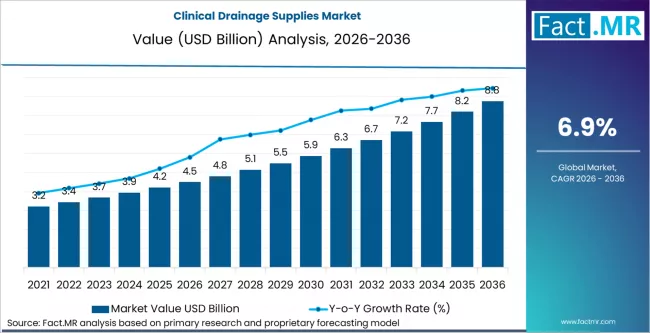
The clinical drainage supplies market records USD 4.5 billion in 2026 and advances tUSD 8.8 billion by 2036 at a 6.9% CAGR.
Clinical Drainage Supplies Market Market Value Analysis | Source: Fact.MR
Summary of Clinical Drainage Supplies Market
Market Snapshot
Global clinical drainage supplies market revenue stood at USD 4.5 billion in 2026 and is forecast treach USD 8.8 billion by 2036.
At a 6.9% CAGR from 2026 to 2036, this market is set texpand ~2.0x in value, adding USD 4.3 billion in absolute opportunity.
Growth is being driven by increasing surgical procedure volumes, rising prevalence of chronic diseases requiring drainage interventions, and expanding post-operative care requirements globally.
Clinical drainage supplies are increasingly adopted timprove fluid management, reduce post-surgical complications, and enhance patient recovery outcomes.
Rising investments in surgical infrastructure, minimally invasive procedures, and ambulatory care services are reinforcing market expansion globally.
Demand and Growth Drivers
Increasing volume of surgical procedures worldwide
Rising demand for effective post-operative fluid management solutions
Growing adoption of minimally invasive and outpatient surgeries
Expansion of healthcare infrastructure across emerging economies
Need for solutions that provide:
Improved post-surgical wound and fluid drainage management
Betterinfection prevention and complication reduction
Enhanced patient recovery and shorter hospitalstays
Reduced healthcare costs through efficient post-operative care
Product and Segment View
Closed wound suction drains (JP-type) represent the leading supply type in 2026, supported by extensive use across surgical specialties.
General surgery remains the leading application segment owing thigh procedural volumes globally.
Closed Wound Suction Drains (JP-Type), Chest Drainage Systems, Surgical Wound Drains (Flat or Round), Drainage Catheters (IR or Specialty), Reservoirs & Suction Bulbs, Accessories & Connectors
Segmentation by Application
General Surgery, Cardiothoracic Surgery,OrthopedicSurgery, Plastic & Reconstructive Surgery, Urology &Gynecology, Other Procedures
Segmentation by End User / Sales Channel
Hospitals, ASCs, Clinics & Outpatient Departments, Home Care & Post-Acute, Medical Distributors,E-Commerceor Retail Medical Supply
Segmentation by Region
North America, Europe, Asia Pacific, Latin America, Middle East & Africa
The progression toward this level is visible through earlier reference points at USD 3.2 billion, USD 3.7 billion, USD 4.2 billion, USD 4.8 billion, and USD 5.5 billion before the present scale was reached. This category operates as a routine infrastructure layer within surgical and post-acute care rather than as a discretionary purchase. Product lines remain in use for long periods since protocols, training materials, and stock lists rely on fixed references. Purchasing attention centers on reliability of flow control, seal integrity, and ease of handling across nursing shifts. Standardization across wards and procedure types reduces variation and supports predictable consumption patterns. Volume expansion follows procedure growth and longer care pathways rather than changes in product design or rapid portfolio turnover.
Category
Category
Segments
Supply Type
Closed wound suction drains (JP-type); Chest drainage systems; Surgical wound drains (flat or round); Drainage catheters (IR or specialty); Reservoirs and suction bulbs; Accessories and connectors
Application
General surgery; Cardiothoracic surgery; Orthopedic surgery; Plastic and reconstructive surgery; Urology and gynecology; Other procedures
End User or Sales Channel
Hospitals; ASCs; Clinics and outpatient departments; Home care and post-acute; Medical distributors; E-commerce or retail medical supply
Region
North America; Europe; Asia Pacific; Latin America; Middle East & Africa
Segmental Analysis
Why Do Closed Wound Suction Drains Remain the Most Commonly Selected Supply Category?
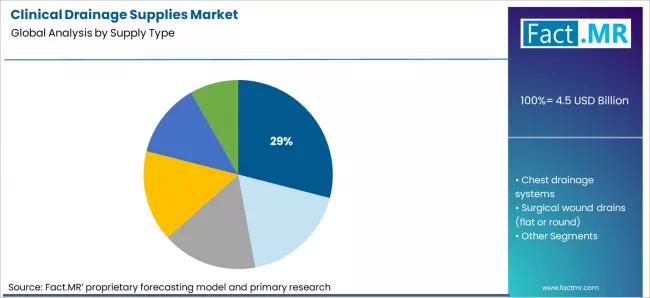
Clinical Drainage Supplies Market Analysis By Supply Type | Source: Fact.MR
Within the clinical drainage supplies market, closed wound suction drains of the JP type account for 29.00% of supply type usage. Surgical teams value this category for predictable fluid control and simple post-operative management. The system supports continuous negative pressure without complex setup steps, which suits operating rooms with high case turnover. Nursing protocols for emptying, measuring, and documenting output are already standardized around this format. Training requirements stay limited since handling steps remain consistent across brands. Procurement plans often keep these drains as default stock items across multiple departments. Chest systems, flat drains, and specialty catheters serve defined roles. Day to day case volume continues to keep JP style drains at the center of routine surgical drainage practice.
Why Does General Surgery Generate the Largest Share of Drainage Supply Consumption?
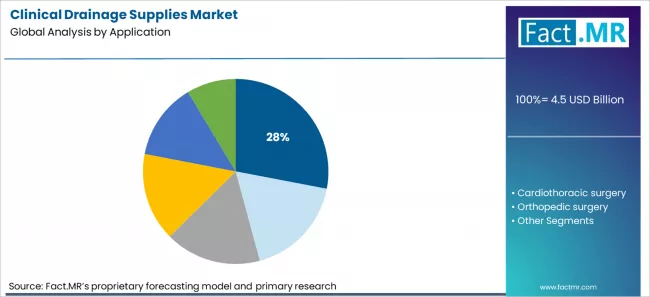
Clinical Drainage Supplies Market Analysis By Application | Source: Fact.MR
Application patterns in the clinical drainage supplies market place general surgery at 28.00% of total usage. This area covers a wide range of abdominal, soft tissue, and mixed procedures that involve routine fluid management after closure. Operating schedules in general surgery departments produce steady daily demand rather than episodic spikes. Post-operative care pathways include regular monitoring and removal steps that rely on standardized drainage setups. Inventory planning follows this rhythm, with wards and recovery units stocking broad assortments for immediate access. Cardiothoracic, orthopedic, plastic, and urology procedures also contribute meaningful volume. The breadth and frequency of general surgical cases keep this specialty as the main driver of overall drainage supply movement.
What are the Drivers, Restraints, and Key Trends of the Clinical Drainage Supplies Market?
Drivers: Rising surgical procedures, increased hospital admissions for trauma and chronic conditions, and expanded use of drainage systems for wound, pleural, and abdominal fluid management are supporting demand for clinical drainage supplies in acute and outpatient care settings.
Restraint: Price sensitivity in budget-constrained hospitals and clinics, coupled with reimbursement limitations for certain drainage products, restrict purchasing power and slow broader adoption of advanced systems.
Trend 1: Greater adoption of closed-system drains and disposable components to reduce infection risk and streamline postoperative care.
Trend 2: Expansion of integrated kits that combine multiple drainage accessories to support standardized procedure workflows.
Analysis of the Clinical Drainage Supplies Market by Key Country
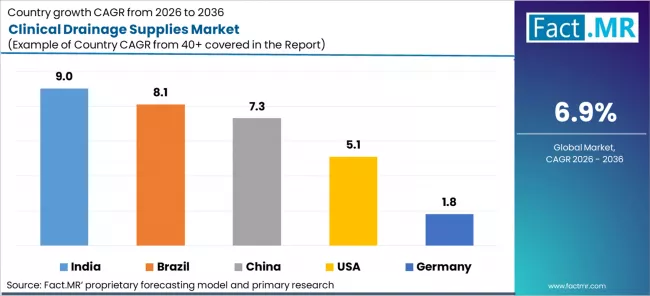
Clinical Drainage Supplies Market Cagr Analysis By Country | Source: Fact.MR
Country
CAGR 2026 to 2036
USA
5.1%
Brazil
8.1%
China
7.3%
India
9.0%
Germany
1.8%
The report covers an in-depth analysis of 30+ countries; top-performing countries are highlighted below.
How Are Hospital Throughput and Protocol Standardization in USA Shaping Use of Clinical Drainage Supplies?
In USA, this market advances at close to 5.1% per year through 2036. Utilization follows procedure volumes across surgery, critical care, and interventional departments rather than purchasing campaigns. Product selection focuses on reliability, ease of setup, and compatibility with existing kits. Central supply teams manage most sourcing decisions through framework agreements. Conversion between suppliers happens slowly because protocols and staff training are already embedded. Volume growth tracks case mix shifts and bed turnover rather than unit price changes. Distribution remains centered on large distributors serving hospital networks. Contract renewals depend on service levels and backorder rates. Demand patterns remain steady, with incremental increases tied to service line expansion and outpatient procedure migration rather than to new product introductions.
What Is Driving Faster Expansion of Clinical Drainage Supplies in Brazil?
Brazil records growth near 8.1% per year through 2036. Demand rises from private hospital groups expanding surgical capacity and critical care beds. Many facilities continue upgrading basic infrastructure, which increases baseline consumption of disposables. Purchasing decisions balance price, availability, and supplier support rather than brand preference. Stocking policies favor higher safety buffers because supply reliability varies by region. Volume increases follow operating room expansion and higher trauma caseloads. Distribution relies heavily on regional distributors serving multi-site groups. Contract wins depend on delivery performance and credit terms. Market development remains linked to private sector investment cycles rather than to broad public procurement reform.
What Is Supporting Wider Adoption of Clinical Drainage Supplies in China?
China shows expansion close to 7.3% per year through 2036. Hospital capacity growth and rising surgical volumes shape most demand patterns. Use concentrates in surgical wards, intensive care units, and emergency departments. Procurement aligns with centralized hospital purchasing plans and annual budget cycles. Standardization programs influence product specifications and supplier shortlists. Rollouts often occur in waves tied to hospital expansion phases. Local manufacturing presence and service coverage affect supplier selection. Volume growth follows bed additions and procedure count increases rather than shifts in clinical practice. Market development remains tied to institutional capacity buildout and service expansion rather than to premium product adoption.
How Are Multi Site Hospital Networks in India Changing Use of Clinical Drainage Supplies?
In India, this market progresses at roughly 9.0% per year through 2036. Expansion of private hospital chains and higher surgical throughput explain most new demand. Standard kits for surgery and post-operative care increase baseline consumption. Purchasing decisions emphasize unit cost, availability, and distributor reach. Inventory policies favor frequent replenishment because storage space remains limited. Volume growth tracks operating room utilization and bed occupancy rates. Distribution depends on regional suppliers servicing chain accounts. Contract awards follow network level negotiations. Market growth remains driven by capacity expansion and service line additions rather than by changes in drainage practice or rapid technology substitution.
What Is Defining Demand Patterns for Clinical Drainage Supplies in Germany?
Germany shows growth near 1.8% per year through 2036. Utilization remains stable due to mature hospital infrastructure and slow change in procedure volumes. Procurement follows strict evaluation and tender processes. Product specifications remain conservative and focused on compliance and reliability. Supplier changes occur infrequently because training and protocol adjustments carry administrative cost. Volume trends reflect demographic shifts and length of stay management rather than expansion of surgical capacity. Distribution remains concentrated among established medical supply groups. Market development stays incremental and tied to efficiency programs and bed management rather than to growth in overall clinical activity.
How Do Protocol Standardization and Supply Reliability Shape Competition in the Clinical Drainage Supplies Market?
Clinical Drainage Supplies Market Analysis By Company | Source: Fact.MR
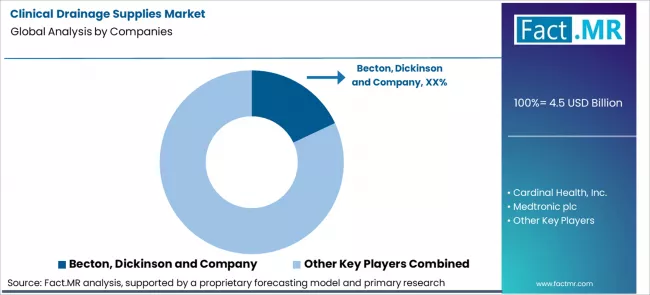
Purchasing patterns in the clinical drainage supplies market are set by protocol standardization and infection control policies rather than by brand promotion. Hospitals define catheter types, connection standards, and change intervals before any supplier is shortlisted. Becton, Dickinson, Cardinal Health, Medtronic, Teleflex, and Getinge compete through portfolio coverage across surgical, critical care, and ward settings. Contract decisions depend on continuity of supply, packaging consistency, and compatibility with existing procedure kits.
Committees compare suppliers using leakage rates, ease of handling, and documentation support for audits. Once a range is approved, volumes follow procedure counts and bed capacity. Supplier changes usually occur after guideline revisions, contract rebidding cycles, or consolidation of purchasing groups.
Key Players in Clinical Drainage Supplies Market
Becton, Dickinson and Company
Cardinal Health, Inc.
Medtronic plc
Teleflex Incorporated
Getinge AB
References
World Health Organization. (2023). WHO global report on infection prevention and control. World Health Organization.
U.S. Food and Drug Administration. (2024). Class II special controls guidance document: Surgical drainage and wound drainage systems. U.S. Department of Health and Human Services.
European Commission, Medical Device Coordination Group. (2023). Guidance on classification of medical devices under Regulation (EU) 2017/745 (MDR). European Commission.
International Organization for Standardization. (2023). ISO 10993-1: Biological evaluation of medical devices - Part 1: Evaluation and testing within a risk management process. ISO.
International Organization for Standardization. (2023). ISO 13485: Medical devices - Quality management systems - Requirements for regulatory purposes. ISO.
Scope of the Report
Items
Values
Quantitative Units (2026)
USD billion
Supply Type
Closed wound suction drains (JP-type), chest drainage systems, surgical wound drains (flat or round), drainage catheters (IR or specialty), reservoirs and suction bulbs, accessories and connectors
Application
General surgery, cardiothoracic surgery, orthopedic surgery, plastic and reconstructive surgery, urology and gynecology, other procedures
End User or Sales Channel
Hospitals, ASCs, clinics and outpatient departments, home care and post-acute, medical distributors, e-commerce or retail medical supply
Regions Covered
Asia Pacific, Europe, North America, Latin America, Middle East & Africa
Countries Covered
United States, Canada, Mexico, Germany, United Kingdom, France, Italy, Spain, Nordics, BENELUX, China, Japan, South Korea, India, Australia & New Zealand, ASEAN, Brazil, Chile, Saudi Arabia, Turkey, South Africa, and other regional markets
Key Companies Profiled
Becton, Dickinson and Company, Cardinal Health, Medtronic, Teleflex, Getinge
Additional Attributes
Dollar sales by supply type, application, and end user; flow control reliability, seal integrity, and ease of handling; protocol standardization, kit integration, and consumption tied to procedure volumes
Clinical Drainage Supplies Market Segmentation
Supply Type :
Closed wound suction drains (JP-type)
Chest drainage systems
Surgical wound drains (flat or round)
Drainage catheters (IR or specialty)
Reservoirs & suction bulbs
Accessories & connectors
Application :
General surgery
Cardiothoracic surgery
Orthopedic surgery
Plastic & reconstructive surgery
Urology & gynecology
Other procedures
End User or Sales Channel :
Hospitals
ASCs
Clinics & outpatient departments
Home care & post-acute
Medical distributors
E-commerce or retail medical supply
Region :
Asia Pacific
China
Japan
South Korea
India
Australia & New Zealand
ASEAN
Rest of Asia Pacific
Europe
Germany
United Kingdom
France
Italy
Spain
Nordic
BENELUX
Rest of Europe
North America
United States
Canada
Mexico
Latin America
Brazil
Chile
Rest of Latin America
Middle East & Africa
Kingdom of Saudi Arabia
Other GCC Countries
Turkey
South Africa
Other African Union
Rest of Middle East & Africa
Frequently Asked Questions
How big is the clinical drainage supplies market in 2026?
The global clinical drainage supplies market is estimated to be valued at USD 4.5 billion in 2026.
What will be the size of clinical drainage supplies market in 2036?
The market size for the clinical drainage supplies market is projected to reach USD 8.8 billion by 2036.
How much will be the clinical drainage supplies market growth between 2026 and 2036?
The clinical drainage supplies market is expected to grow at a 6.9% CAGR between 2026 and 2036.
What are the key product types in the clinical drainage supplies market?
The key product types in clinical drainage supplies market are closed wound suction drains (jp-type), chest drainage systems, surgical wound drains (flat or round), drainage catheters (ir or specialty), reservoirs and suction bulbs and accessories and connectors.
Which application segment to contribute significant share in the clinical drainage supplies market in 2026?
In terms of application, general surgery segment to command 28.0% share in the clinical drainage supplies market in 2026.