- Market Value (2025): USD 841.0 Mn
- Estimated Value (2026): USD 931.0 Mn
- Forecast Value (2036): USD 2572.9 Mn
- CAGR (2026-2036): 10.7%
What is the Compact Collaborative Grippers Market forecast to be worth by 2036?
USD 931.0 million in 2026 to USD 2,572.9 million by 2036 at a 10.7% CAGR.
- The Compact Collaborative Grippers Market reached USD 841.0 million in 2025.
- Demand is set to increase from USD 931.0 million in 2026 to USD 2,572.9 million by 2036.
- The market is forecast to record 10.7% CAGR from 2026 to 2036 as makers expand cobot handling.
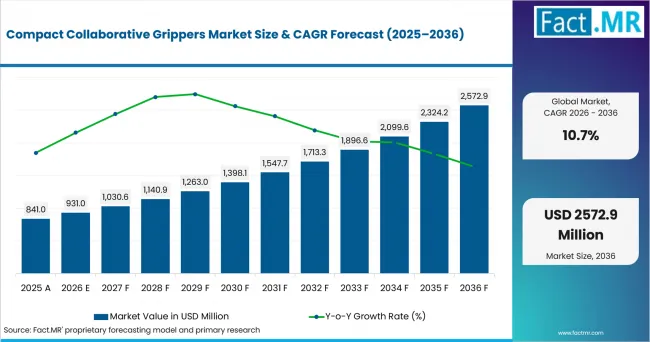
Compact Collaborative Grippers Market Value Analysis | Source: Fact.MR
What are the defining numbers behind Compact Collaborative Grippers Market growth?
An absolute opportunity of USD 1,641.9 million is expected between 2026 and 2036.
- Demand Drivers in the Market
- Factory teams need low-mass grippers that preserve cobot payload while providing enough force and stroke for part changes. Compact tools keep wrist hardware small. A lighter wrist leaves more of the arm load for the part. That helps one cobot serve more jobs with the same arm.
- Robot teams need plug-and-play links for short work runs and mixed robot brands. Standard mechanical mounts and robot-specific software reduce setup work when a gripper moves between similar cobot cells. A ready mount lets teams swap tools with less design work. The same mount can also ease spares and staff training.
- Production planners need gripping that can change with the workpiece. Electric parallel, vacuum and adaptive designs give robot teams several ways to match part shape while keeping the wrist package compact. Part shape often decides which grip type works best. A broad tool range helps one cell take on more jobs.
- Key Segments Analyzed
- By Grip Principle: Parallel electric is expected to hold 39.0% share in 2026 because settable force and stroke fit compact cobot cells that handle varied parts.
- By Payload: <1 kg is projected to account for 30.0% share in 2026 as electronics, small parts and light machine-tending parts reward low tool mass.
- By Cobot Task: Machine tending is anticipated to capture 36.0% share in 2026. Repeat load and unload work suits grip checks and quick setup.
- By Integration: Plug-and-play flange is estimated to represent 33.0% share in 2026 since pre-engineered mounting reduces setup work at the robot wrist.
- Analyst Opinion at Fact.MR
- Shambhu Nath Jha, Principal Consultant at Fact.MR, states, “Compact cobot grippers are bought as part of a task package. The market is set to favor products that shorten setup while preserving payload and grip feedback. Suppliers should pair compact hardware with robot-specific software and clear task limits.”
- Strategic Implications
- Gripper makers should publish payload, force and stroke limits so design teams can screen tools before cell design. Clear limits help teams rule out a poor fit at the start. That saves design time before the robot is set on the line.
- Cobot teams should standardize flanges and software across repeat tasks to reduce design time. In May 2025, SCHUNK described the EZU centric gripper as a plug-and-play solution with a large number of interfaces for flexible loading and unloading of cylindrical workpieces. A shared flange can also make tool swaps easier across cells. The same software map helps staff learn each cell faster.
- Machine builders should pair grip checks with a clear reset step. A missed part can then trigger a safe retry during an unattended tending cycle. A safe retry keeps one missed grip from halting a full shift. Grip checks also help teams trace faults after a stop.
- End users should check the full wrist package before the cell is set. Cables and adapters use part of the payload that remains for the workpiece. Low tool mass gives the arm more load for the part. That trade-off is vital on small cobots with tight load limits.
The United Kingdom is forecast at 11.2% CAGR through 2036, followed by Japan at 10.9%. The USA is estimated at 10.6%, Germany at 10.3%, and France at 10.0%, reflecting different robot use and factory needs.
How does the Compact Collaborative Grippers Market break down by segment?
Parallel electric leads Grip Principle at 39.0% share in 2026; machine tending leads Cobot Task at 36.0% share.
Which Grip Principle dominates?
Parallel electric is set to hold 39.0% share in 2026.
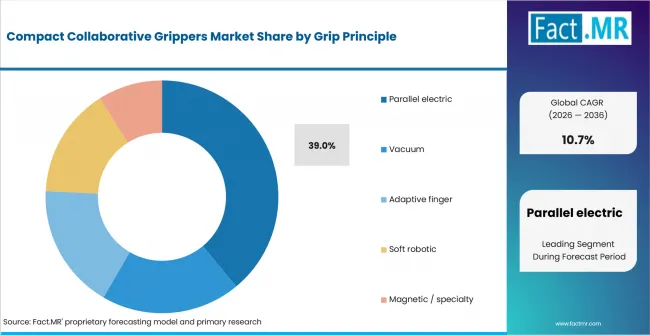
Compact Collaborative Grippers Market Analysis By Grip Principle | Source: Fact.MR
Parallel electric grippers let staff adjust force, speed and jaw position from the controller. Robotiq offers adjustable 2F-85 and 2F-140 adaptive grippers, while OnRobot positions its 2FG7 as a parallel gripper for collaborative and light-industrial robots. This range lets a plant choose the grip method around the part instead of forcing one tool across every task. It also helps a cobot move from one short run to the next with less change at the wrist. Plant teams can save grip sets for each part and call them back. That makes short runs easier when the part mix changes often.
What leads the Payload segment?
<1 kg is projected to account for 30.0% share in 2026.
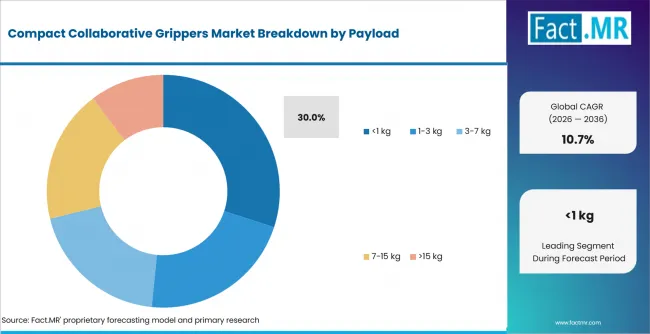
Compact Collaborative Grippers Market Analysis By Payload | Source: Fact.MR
The <1 kg class fits small parts where wrist mass reduces usable cobot payload. SCHUNK lists the Co-act EGP-C as a collaborative gripper for small-component handling, with a recommended workpiece weight of 0.7 kg for current Size 40 configurations. Heavier classes remain useful for metal parts and larger packages. A light tool gives the robot more room for the part itself, which matters when reach and safe motion are fixed by the cell layout. Small tool mass also helps keep motion smooth near the machine.
How does Cobot Task shape demand?
Machine tending is anticipated to lead with 36.0% share in 2026.
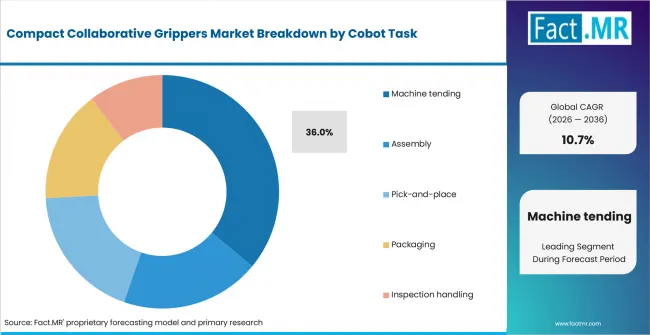
Compact Collaborative Grippers Market Analysis By Cobot Task | Source: Fact.MR
Machine tending needs repeat loading, transfer and release across the same work cycle. Standard adapters let one cobot move between similar machines. At the same time, grip detection helps the cell confirm a completed grasp before motion continues. In February 2025, Robotiq stated that its Adaptive Grippers integrate with Universal Robots, FANUC, Doosan, Omron, and Techman cobots. That fit helps machine-tending cells built around mixed robot fleets. A repeat grip check can help keep each load cycle on track. That is useful when one cobot tends more than one machine.
What supports Plug-and-play flange within Integration?
Plug-and-play flange is estimated to represent 33.0% share in 2026.
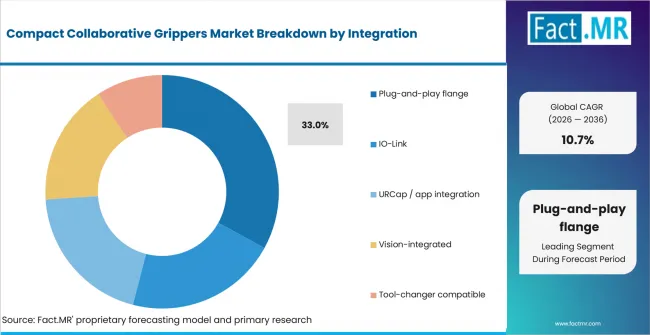
Compact Collaborative Grippers Market Analysis By Integration | Source: Fact.MR
Plug-and-play flanges reduce mechanical design work and give robot teams a standard mount. SMC offers cobot grippers in plug-and-play setups for several robot brands. Apps, vision and tool-changer fit further shorten task changes. A common mount also gives the plant a clear base for spare tools, training and service when the same cobot family is used across several work cells. A common flange also makes spare tool plans much simpler. Teams can move a known tool set from one cell to another.
What is accelerating Compact Collaborative Grippers Market adoption, and what is holding it back?
Flexible cobot deployment drives it; integration effort and application limits restrain it.
Drivers Impact Analysis
| DRIVER | (~) % IMPACT ON CAGR | GEOGRAPHIC RELEVANCE | IMPACT TIMELINE |
|---|---|---|---|
| Growth in collaborative handling and machine tending | +1.6% | North America, Europe, East Asia | Short term (<= 2 years) |
| Need to preserve cobot payload with compact EOAT | +1.3% | Global | Medium term (2-4 years) |
| Plug-and-play robot and software integration | +1.0% | North America, Europe | Medium term (2-4 years) |
| High-mix production and shorter changeovers | +0.8% | Global | Long term (>= 4 years) |
Opportunity Impact Analysis
| OPPORTUNITY | (~) % IMPACT ON CAGR | GEOGRAPHIC RELEVANCE | IMPACT TIMELINE |
|---|---|---|---|
| Compact electric grippers for SME cobot cells | +1.1% | North America, Europe | Medium term (2-4 years) |
| Vision-guided mixed-part handling | +0.9% | Europe, East Asia | Long term (>= 4 years) |
| Tool-changer-ready gripper ecosystems | +0.7% | Global | Medium term (2-4 years) |
Restraints Impact Analysis
| RESTRAINT | (~) % IMPACT ON CAGR | GEOGRAPHIC RELEVANCE | IMPACT TIMELINE |
|---|---|---|---|
| Application-specific safety validation | -0.7% | Global | Short term (<= 2 years) |
| Payload and gripping-force trade-offs | -0.5% | Global | Medium term (2-4 years) |
| Integration work across mixed robot brands | -0.4% | Europe, North America | Medium term (2-4 years) |
Which countries are scaling the Compact Collaborative Grippers Market through 2036?
- The country spread is 1.2 points, from 11.2% in the United Kingdom to 10.0% in France.
- The United Kingdom remains 0.3 point above Japan as public programs help robot use.
- Japan remains 0.3 point above the USA, backed by domestic robot production.
- The USA remains 0.3 point above Germany as productivity goals help flexible cobot use.
- Germany remains 0.3 point above France as machinery demand helps redeployable cobot cells.
Similar CAGRs can still lead to different entry needs. Cobot use and machine building vary by country. Coverage spans North America, Latin America, Europe, East Asia, South Asia & Pacific, and Middle East & Africa.
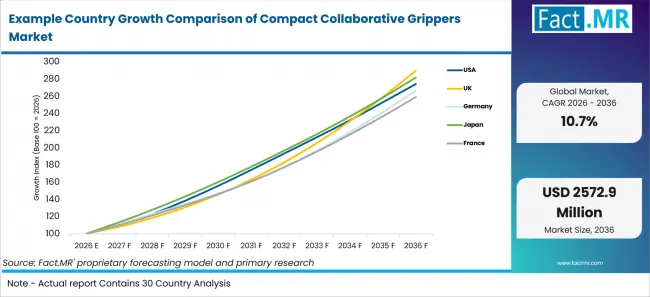
Example Country Growth Comparison Of Compact Collaborative Grippers Market | Source: Fact.MR
| Country | CAGR (2026-2036) |
|---|---|
| United Kingdom | 11.2% |
| Japan | 10.9% |
| United States | 10.6% |
| Germany | 10.3% |
| France | 10.0% |
What supports USA adoption?
10.6% CAGR, backed by factory automation and machine-tending demand.
U.S. makers continue to use cobot tooling where repeat loading can be separated from higher-skill staff work. In May 2026, the Federal Reserve reported that capacity utilization for U.S. manufacturing industries classified under NAICS 31–33 stood at 74.7% in December 2025. That operating base keeps attention on robot projects that improve cell use while preserving the core production line. Compact grippers fit this pattern because they preserve wrist space and let robot teams match force, stroke, and fingers to machine-tending parts. Their small footprint also suits retrofit cells around CNC machines where access, guarding, and staff movement leave little room for larger tooling.
What supports the United Kingdom’s growth?
11.2% CAGR, led by automation help and flexible manufacturing.
The United Kingdom is widening access to factory automation through programs aimed at smaller makers. In July 2026, the UK Department for Business and Trade stated that £116 million was available through the Made Smarter Programme to help SMEs adopt advanced technologies including robotics and automation. That help favors compact cobot cells where setup cost and setup time are closely watched. Grippers with ready-made flanges and simple software setup can shorten the path from a manual handling task to a repeat robot cycle. That feature is especially useful for smaller factories that want to automate one station first and reuse the same setup approach across linked tasks later. A simple tool swap helps small plants test one task first.
What is supporting Germany’s adoption?
10.3% CAGR, driven by machinery investment and flexible production systems.
Germany’s machinery base creates regular demand for handling tools that can be integrated into existing machinery. In February 2026, Destatis reported that real new orders in German manufacturing increased 7.8% month on month in December 2025, after seasonal and calendar adjustment. Higher order activity strengthens the case for flexible tending and assembly capacity when factories balance several product variants. Compact electric grippers fit that environment through settable force and stroke. At the same time, iO-Link and robot-specific links simplify data exchange inside existing control systems. German machine builders can therefore treat the gripper as a module that teams can set up within a repeatable cell design instead of designing a new wrist package for every task.
How does Japan perform?
10.9% CAGR, led by domestic robot production and high-density factory automation.
Japan combines a mature robot maker base with continued investment in automated handling. In June 2026, the Japan Robot Association reported that robot production value reached JPY 945.3 billion in calendar year 2025. That scale helps a broad local ecosystem for end effectors, adapters and setup services. Compact grippers benefit because electronics, machine tools and automotive subassembly often require controlled handling in limited wrist space where a lighter tool preserves usable cobot payload. Local setup experience also helps precise finger design and repeatable grip settings when parts change across short work runs.
What is supporting France’s adoption?
10.0% CAGR, shaped by industrial robotics programs and flexible automation projects.
France is directing public help toward industrial robotics and linked tools that can broaden the robot supplier base. In June 2026, the French government announced 31 new France 2030 projects under its “Robots and Intelligent Machines of Excellence” initiative, covering industrial robotics, drones, additive manufacturing, and associated technologies. The program covers industrial robotics and enabling hardware or software. That setting helps gripper demand where makers introduce cobot handling in focused steps, mainly for inspection, assembly and machine-tending tasks that benefit from compact tools and quick setup.
Who leads the Compact Collaborative Grippers Market?
SCHUNK, Robotiq, OnRobot, Zimmer Group, SMC and Festo sell compact electric, air, vacuum and cobot grippers.
SCHUNK addresses collaborative and flexible robot gripping through products including the Co-act EGP-C and EGU. The Co-act EGP-C is designed for collaborative small-component handling, while the EGU provides adjustable electric gripping with multiple communication interfaces. SCHUNK also supplies robot-specific adapters, connection cables and software plug-ins to simplify integration with leading robot platforms.
Robotiq offers 2F-85 and 2F-140 adaptive grippers with programmable stroke, speed and gripping force. OnRobot supplies electric parallel grippers and electric vacuum grippers for a broad range of collaborative and industrial robot platforms. These portfolios provide functions such as adjustable gripping parameters, grip detection and software-assisted integration.
Zimmer Group supplies HRC grippers and its MATCH end-of-arm ecosystem, which combines standardized robot interfaces, communication modules, grippers and robot-specific software. SMC offers pneumatic air grippers, magnetic grippers and vacuum grippers configured for collaborative robots from several manufacturers.
In May 2026, Festo introduced the HPPH two-finger pneumatic parallel gripper for collaborative applications. The HPPH integrates its pneumatic control valve, position sensors and electrical interface directly into the gripper body, reducing external components and simplifying installation and commissioning.
Which companies are the key providers?
Key firms cover SCHUNK; Robotiq; OnRobot; Zimmer Group; SMC; and Festo.
- SCHUNK
- Robotiq
- OnRobot
- Zimmer Group
- SMC
- Festo
Bibliography
- U.S. Bureau of Labor Statistics. (2026, March 24). Productivity and costs: Fourth quarter and annual averages 2025, revised.
- SCHUNK. (2025, May). German Innovation Award 2025: Smart automation with the EZU centric gripper.
- Jobin, J.-P. (2025, February 20). New effortless integration of Robotiq adaptive grippers with top cobot brands. Robotiq.
- Board of Governors of the Federal Reserve System. (2026, May 15). Industrial production and capacity utilization—G.17: Table 7. Capacity utilization: Manufacturing, mining, and utilities.
- Department for Business and Trade. (2026, July 15). Advanced manufacturing.
- Federal Statistical Office (Destatis). (2026, February 5). New orders in manufacturing in December 2025: +7.8% on the previous month.
- Ministère de l’Économie, des Finances et de la Souveraineté industrielle, énergétique et numérique. (2026, June 18). France 2030 : 31 nouveaux projets pour accélérer l’émergence d’une filière française d’excellence en robotique et en drones souverains.
- Festo NAM. (2026, May 26). Festo introduces two-finger pneumatic gripper for cobot applications.
This Report Answers
- The report explains where compact collaborative grippers are used across grip principle and payload class. It also covers cobot task and integration method, together with regional deployment.
- Segment analysis identifies the leading subsegments and explains why users prioritize parallel electric grippers, lightweight payload classes, machine-tending applications, and plug-and-play flange integration.
- Country analysis examines the United States, United Kingdom, Germany, Japan, and France. It also considers factory automation, robot production, machinery activity, and public programs supporting collaborative-robot adoption.
- Competitive analysis reviews SCHUNK, Robotiq, OnRobot, Zimmer Group, SMC, and Festo across electric, pneumatic, vacuum, adaptive, magnetic, and collaborative gripping approaches. It also considers robot-specific adapters, software links, and cobot-ready integration.
- Application analysis assesses how tool mass, gripping force, stroke, part shape, grip detection, and setup time influence gripper selection. It also considers flange compatibility, IO-Link, robot apps, tool changers, and fit with machine tending, assembly, packaging, and inspection tasks.
What does the Compact Collaborative Grippers Market cover?
The Compact Collaborative Grippers Market covers compact gripping tools designed for collaborative robot arms and lightweight automation cells. The scope includes electric parallel grippers, vacuum tools, adaptive finger systems, soft robotic grippers and magnetic or specialty designs when they are configured for compact collaborative handling.
The scope covers machine tending, assembly, pick-and-place, packaging and inspection work. It covers flanges, IO-Link, robot apps and tool changers. The gripper package is the core product in this study. The focus stays on the tool that holds the part and confirms the grip.
What is included in the scope?
The scope includes single grippers and cobot-ready kits. A kit can pair the tool with a flange, control link or robot app. Electric, air, vacuum, magnetic and soft grip designs are included when they fit cobot use.
Factory, machine shop, assembly and packaging uses are included. Fingers and adapters are covered when they ship as part of the gripper setup. The robot arm stays outside the product scope.
What is excluded from the scope?
The market covers grippers sold as end tools for cobot handling. Robot arms and heavy-cell grip packs stay outside the scope. Process tools and fixed jigs are outside the scope unless they are sold as robot grip tools.
Vision, safety, force and tool-change systems stay outside the scope when sold on their own. Their links can still affect gripper choice and setup in a cobot cell.
How Was the Analysis Built?
The analysis draws on 120+ sources, 35+ company portfolios, 25+ countries, and more than 20 industry interviews.
- Primary Research: Primary research includes discussions with manufacturers, service providers, technology developers, distributors, end users, and subject-matter experts. These conversations examine purchasing priorities, product adoption, operational challenges, approval requirements, competitive positioning, and the factors that influence wider market acceptance.
- Desk Research: Desk research covers government statistics, regulatory publications, company filings, trade data, technical studies, industry associations, standards, public policy, and other authoritative sources. Every source used in the analysis is documented in the bibliography.
- Market Sizing and Forecasting: Market estimates combine historical performance, demand indicators, pricing and volume trends, segment shares, company participation, country-level growth, adoption patterns, investment activity, and barriers to market expansion.
- Data Validation and Update Cycle: Findings are validated by comparing primary interviews with public data, company activity, regulatory changes, trade patterns, and industry developments. Regular updates review new product launches, capacity changes, partnerships, approvals, and shifts in commercial adoption.
What is the report’s scope and coverage?
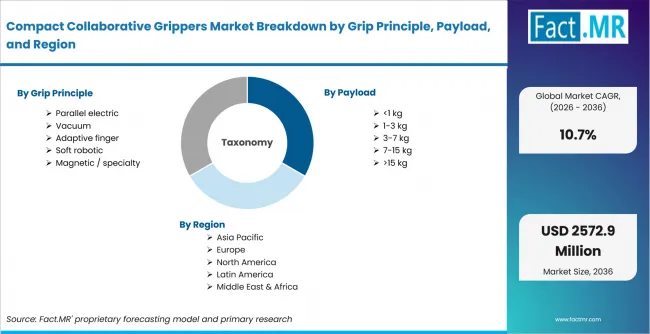
Compact Collaborative Grippers Market Breakdown By Grip Principle, Payload, And Region | Source: Fact.MR
| Attribute | Details |
|---|---|
| Quantitative Units | USD million in 2026 to USD million by 2036 at a CAGR |
| Market Definition | Compact end-of-arm gripping devices designed for collaborative robot applications where tool mass, safe interaction, programmable gripping and fast integration are central selection factors. |
| Grip Principle | Parallel electric; Vacuum; Adaptive finger; Soft robotic; Magnetic / specialty |
| Payload | <1 kg; 1-3 kg; 3-7 kg; 7-15 kg; >15 kg |
| Cobot Task | Machine tending; Assembly; Pick-and-place; Packaging; Inspection handling |
| Integration | Plug-and-play flange; IO-Link; URCap / app integration; Vision-integrated; Tool-changer compatible |
| Regions Covered | North America; Latin America; Western Europe; Eastern Europe; East Asia; South Asia & Pacific; Middle East & Africa |
| Countries Covered | United States; United Kingdom; Germany; Japan; France |
| Key Companies Profiled | SCHUNK; Robotiq; OnRobot; Zimmer Group; SMC; Festo |
| Forecast Period | 2026 to 2036 |
| Approach | Hybrid top-down and bottom-up approach using cobot deployment, end-effector application fit, manufacturing activity, country automation conditions and provider portfolio review. |
How is the market segmented?
-
By Grip Principle
- Parallel electric
- Vacuum
- Adaptive finger
- Soft robotic
- Magnetic / specialty
-
By Payload
- <1 kg
- 1-3 kg
- 3-7 kg
- 7-15 kg
- >15 kg
-
By Cobot Task
- Machine tending
- Assembly
- Pick-and-place
- Packaging
- Inspection handling
-
By Integration
- Plug-and-play flange
- IO-Link
- URCap / app integration
- Vision-integrated
- Tool-changer compatible
-
By Region
- North America
- Latin America
- Western Europe
- Eastern Europe
- East Asia
- South Asia & Pacific
- Middle East & Africa