- Market Value (2025): USD 4.6 Bn
- Estimated Value (2026): USD 4.9 Bn
- Forecast Value (2036): USD 9.4 Bn
- CAGR (2026-2036): 6.6%
What is the Consumer-Friendly Peel Films Market forecast to be worth by 2036?
USD 4.9 billion in 2026 to USD 9.4 billion by 2036 at a 6.6% CAGR.
- The Consumer-Friendly Peel Films Market crossed a valuation of USD 4.6 billion in 2025.
- Demand is forecast to increase from USD 4.9 billion in 2026 to USD 9.4 billion by 2036.
- The market is forecast to record a 6.6% CAGR from 2026 to 2036 as packers specify controlled peel behavior.
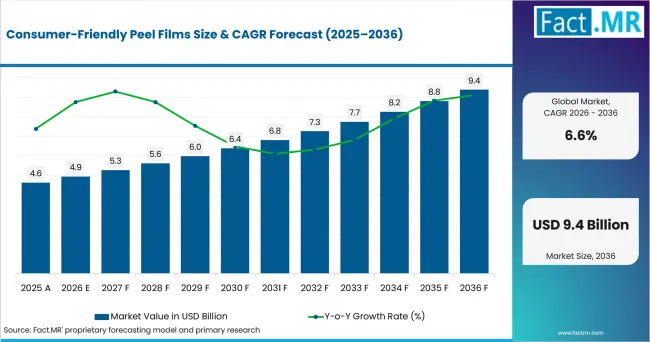
Consumer Friendly Peel Films Value Analysis | Source: Fact.MR
What are the defining numbers behind Consumer-Friendly Peel Films Market growth?
USD 4.4 billion absolute opportunity by 2036, led by PET; dairy cups; clean peel; and peelable sealant formats.
- Demand Drivers in the Market
- Dairy plants need plastic lids that peel away from rigid cups without leaving a mess. The seal stays tight until opened. A steady pull prevents torn foil and sticky spills in yogurt and chilled desserts.
- Prepared-food packers need lids that peel the same way after cold storage. In June 2026, the USDA Economic Research Service reported that inflation-adjusted U.S. food-at-home spending reached USD 1.10 trillion in 2025.
- Meat and cheese packages require tough, peelable webs. The top film lifts in one smooth motion. Some containers also need a stronger barrier against air, or a resealable flap for multi-serve items.
- Companies want fewer layers in their packaging without losing convenience. This matches wider eco-friendly goals. Suppliers aim to prove that leaner films can still hold a reliable seal. The peel remains consistent, even after long storage.
- Key Segments Analyzed
- By Seal Mechanism: Peelable sealant is forecast to hold 29.0% share in 2026. It sets the release at the seal layer.
- By Base Film: PET is forecast to hold 36.0% share in 2026. Its stable form suits many types of lid film.
- By Opening Performance: Clean peel is forecast to hold 31.0% share in 2026. Packers want lids that lift without shreds or residue.
- By Application: Dairy cups are forecast to hold 37.0% share in 2026. Single-serve cups need a steady and easy peel.
- Analyst Opinion at Fact.MR
- Shambhu Nath Jha, Principal Consultant at Fact.MR, states: “Peel force is easy to test and easy for users to notice. The market is forecast to favor films that keep the same peel after filling and storage. Suppliers need the right seal layer and tray tests to keep opening smooth and seals firm.”
- Strategic Implications
- Film converters must evaluate peel strength on the exact containers clients use. This applies to both standard and resealable webs. Assessments should verify the sealing temperature window and check how the peel performs after routine storage.
- Food producers need to verify opening ease after shipping and refrigeration. Seal strength often shifts over time. Therefore, quality checks must account for temperature fluctuations and shelf life before packages reach consumers.
- Pack designers should cut extra film layers where barrier needs allow it. In January 2026, the German Environment Agency and ZSVR reported that about 5.5 million tonnes of packaging waste collected by Germany’s dual systems were recycled in 2024.
China is forecast at 8.3% CAGR through 2036 as packaged-food retail expands. France is projected at 7.1% as dairy and recycling needs shape film choice. The USA and Japan are each anticipated at 5.9%. Germany is estimated to record a 5.7% CAGR.
How does the Consumer-Friendly Peel Films Market break down by segment?
PET leads Base Film at 36.0%; dairy cups lead Application at 37.0%.
Which Seal Mechanism dominates?
Peelable sealant is forecast to hold 29.0% share in 2026.
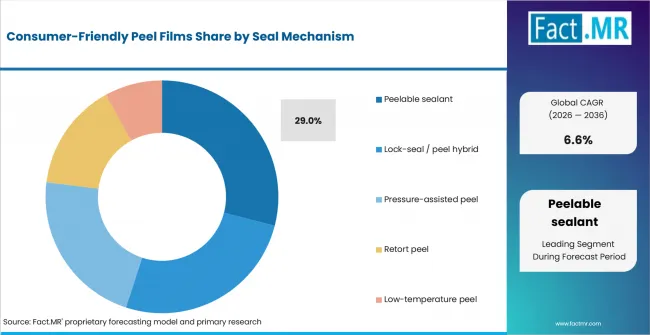
Consumer Friendly Peel Films Analysis By Seal Mechanism | Source: Fact.MR
Peelable sealants set the release force at the seal layer. Lock-seal hybrids suit packs that need a firmer first seal. Pressure-assisted formats help where edge bonds are stronger. Retort and low-temperature options serve narrow process ranges. Similar designs appear in resealable films for chilled and multi-use packs.
What leads the Base Film segment?
PET is forecast to account for 36.0% share in 2026.
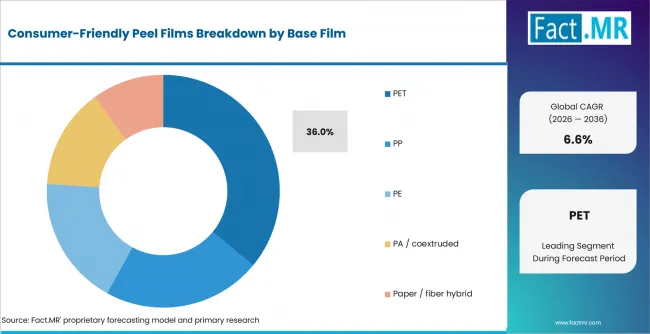
Consumer Friendly Peel Films Analysis By Base Film | Source: Fact.MR
PET keeps its shape and works well as a carrier for print and peel coats. PP and PE can match common tray resins. PA and coextruded webs add more barrier strength when needed. Fiber hybrids add a paper face while the seal layer controls the peel. These options form part of the wider plastic film value chain.
How does Opening Performance shape demand?
Clean peel is forecast to lead with 31.0% share in 2026.
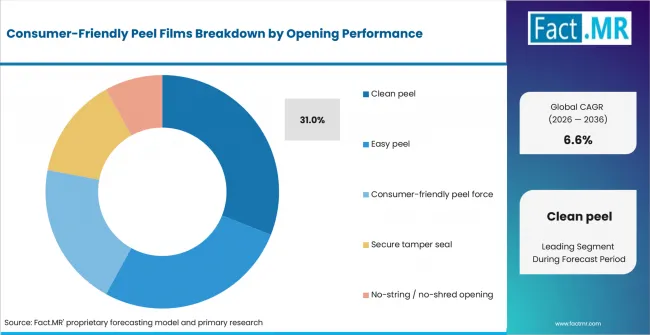
Consumer Friendly Peel Films Analysis By Opening Performance | Source: Fact.MR
Clean peel leaves a clear rim after opening and cuts torn film pieces. Easy-peel formats need less pull force at first opening. Controlled-force films aim for the same peel from pack to pack. Tamper seals stay firm during handling before first opening. No-string and no-shred films keep the seal rim clear after removal.
What supports Dairy Cups within Application?
Dairy cups are forecast to represent 37.0% share in 2026.
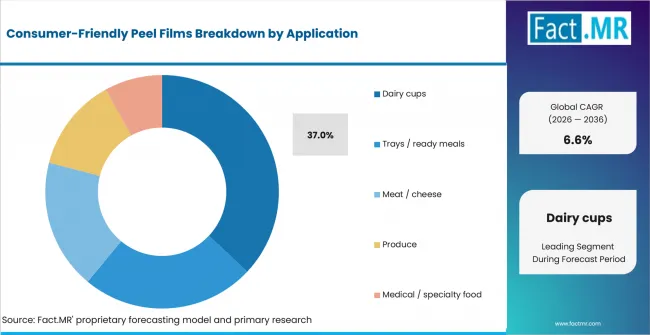
Consumer Friendly Peel Films Analysis By Application | Source: Fact.MR
Dairy cups are forecast to lead because users open yogurt and dessert packs from rigid cups. In June 2026, Agreste reported French fresh cheese output rose 3.9% year on year in April 2026. That output supports repeat use of lids that seal well and peel cleanly. Related film choices connect with PCR dairy bottle and lid applications
What is accelerating Consumer-Friendly Peel Films Market adoption, and what is holding it back?
Convenient opening and chilled-food packs support demand; seal-window control and recycling constraints limit design freedom.
Drivers Impact Analysis
| DRIVER | (~) % IMPACT ON CAGR | GEOGRAPHIC RELEVANCE | IMPACT TIMELINE |
|---|---|---|---|
| Consumer-friendly opening requirements | +1.5% | Global | Short term (<= 2 years) |
| Chilled dairy and prepared-food packaging | +1.2% | North America, Europe, East Asia | Short term (<= 2 years) |
| Peel-and-reseal formats | +0.9% | Europe, North America | Medium term (2-4 years) |
| Material simplification and recyclability | +0.8% | Europe, Japan, USA | Medium term (2-4 years) |
| Line-speed compatible sealants | +0.6% | Global | Long term (>= 4 years) |
Opportunity Impact Analysis
| OPPORTUNITY | (~) % IMPACT ON CAGR | GEOGRAPHIC RELEVANCE | IMPACT TIMELINE |
|---|---|---|---|
| Mono-PP peel and reseal structures | +1.0% | Europe, North America | Medium term (2-4 years) |
| Easy-open dairy lidding | +0.9% | Global | Short term (<= 2 years) |
| Retort and temperature-tolerant peel | +0.7% | East Asia, Europe | Long term (>= 4 years) |
| Fiber-hybrid lidding with functional seal layers | +0.5% | Europe, USA | Medium term (2-4 years) |
Restraints Impact Analysis
| RESTRAINT | (~) % IMPACT ON CAGR | GEOGRAPHIC RELEVANCE | IMPACT TIMELINE |
|---|---|---|---|
| Narrow seal and peel processing window | -0.7% | Global | Short term (<= 2 years) |
| Barrier versus recyclability trade-offs | -0.6% | Europe, North America, Japan | Medium term (2-4 years) |
| Substrate-to-substrate variability | -0.5% | Global | Short term (<= 2 years) |
| Food-contact compliance and validation load | -0.4% | USA, Europe, East Asia | Long term (>= 4 years) |
Which countries are scaling Consumer-Friendly Peel Films Market through 2036?
- The country range spans 2.6 percentage points. China stands at 8.3% and Germany at 5.7% through 2036.
- China remains above the other profiled countries through 2036. Packaged-food retail is forecast to widen use of sealed cups and trays.
- France follows at a 7.1% CAGR through 2036. Dairy output and pack recovery needs are forecast to shape film choice.
- The USA and Japan each record 5.9%. Large food-pack volumes and easy opening are forecast to support peel formats.
- Germany closes the range at a 5.7% CAGR through 2036. Ready-meal output and pack recycling needs are forecast to shape lid choices.
Similar growth rates can still lead to different film choices. Food types and tray resins vary by country. Coverage spans North America and Latin America in the report. Western Europe and Eastern Europe are covered in the same review. East Asia; South Asia & Pacific; and Middle East & Africa are included.
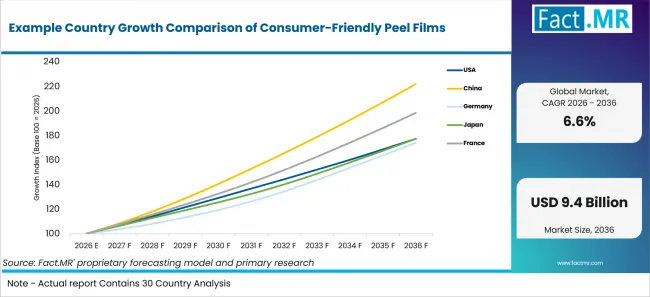
Example Country Growth Comparison Of Consumer Friendly Peel Films | Source: Fact.MR
| Country | CAGR (2026-2036) |
|---|---|
| China | 8.3% |
| France | 7.1% |
| United States | 5.9% |
| Japan | 5.9% |
| Germany | 5.7% |
How is China scaling demand?
8.3% CAGR, backed by packaged-food retail and convenience-focused lidding.
China’s packaged-food retail base is forecast to widen use of sealed cups and trays. In February 2026, China’s National Bureau of Statistics reported that retail sales of grain, oil and food by enterprises above the designated size increased by 9.3% in 2025. Film makers are expected to keep peel force steady on PET and PP packs used on high-volume food lines.
What supports France adoption?
7.1% CAGR, backed by dairy packaging and recycling-oriented film choices.
France’s dairy and chilled-food uses are forecast to keep clean opening in focus. In October 2025, Eurostat reported that France recycled 25.7% of the plastic packaging waste generated in 2023. Pack teams are expected to balance peel control with film choices that fit recovery routes and food-contact rules.
What supports USA adoption?
5.9% CAGR, backed by high-volume dairy packaging and consumer convenience.
The USA is forecast to keep a broad use base in dairy cups and chilled food packs. In April 2026 USDA National Agricultural Statistics Service reported U.S. cheese output of 14.8 billion pounds in 2025. That scale supports repeat lid use where firm seals and easy opening are needed on long runs.
How does Japan perform?
5.9% CAGR, shaped by convenience needs and packaging collection planning.
Japan’s small chilled-food packs are forecast to support clean and controlled peeling. In March 2026, Japan’s Ministry of the Environment reported that 82.4% of municipalities planned separate collection of plastic containers and packaging for fiscal 2026. Film makers are expected to pair easy opening with choices that fit local collection systems.
What is supporting Germany’s adoption?
5.7% CAGR, backed by ready-meal output and packaging recycling needs.
Germany’s ready-meal sector is forecast to support tray lids that stay firm in shipping and peel cleanly at use. In January 2026 Destatis reported output of 1.7 million tonnes of ready meals in 2024. Film makers are expected to test peelable PET and PP on real line settings and recycling-led pack designs.
Who leads the Consumer-Friendly Peel Films Market?
Amcor serves the cheese-packaging market through AmPrima® films and Easy Pack formats for hard cheese. Klöckner Pentaplast offers kp® ReClose, a multilayer PET rigid film for form-fill-seal and thermoforming applications such as sliced cheese, with peel-and-reseal functionality and compatibility with standard lock-seal PE top lidding films. These solutions address convenience, sealing performance, and product protection through different flexible and thermoformed packaging formats.
Constantia Flexibles supplies peelable dairy lidding solutions, including EasyPeelCover for dairy applications, while Winpak offers easy-peel films for dairy and protein packaging, including thermoformed packs, cups, tubs, and trays. In December 2025, Amcor reported that packaging developed with Laïta for Paysan Breton Emmental cheese blocks, using AmPrima® PP film in the Easy Pack format, had received a Zero Impact Packaging Trophies award.
Competitive differentiation is expected to depend on sealing integrity, opening and reclosure performance, film compatibility, processing efficiency, and the requirements of the selected packaging format.
Which companies are the key providers?
Companies profiled include Amcor; Klöckner Pentaplast; Constantia Flexibles; Coveris; and Winpak.
- Amcor
- Klöckner Pentaplast
- Constantia Flexibles
- Coveris
- Winpak
Bibliography
- Touati-Houari, N. (2026, June 12). Lait. Avril 2026 : la collecte de lait toujours en hausse sur un an. Agreste.
- Amcor. (2025, December 11). Amcor and Laïta win the Zero Impact Packaging Trophies award.
- Eurostat. (2025, October 22). Plastic packaging waste in the EU: 35.3 kg per person.
- Statistisches Bundesamt (Destatis). (2026, January 14). Produktion von Fertiggerichten binnen fünf Jahren mengenmäßig um 25,6 % gestiegen [Production of ready meals increased by 25.6% in volume within five years].
- German Environment Agency, & Central Agency Packaging Register. (2026, January 27). Facts against myths: Packaging waste recycling in Germany is working.
- National Bureau of Statistics of China. (2026, February 28). Statistical communiqué of the People’s Republic of China on the 2025 national economic and social development.
- Zeballos, E., & Sinclair, W. (2026, June 11). Total U.S. food spending reached $2.51 trillion in 2025. U.S. Department of Agriculture, Economic Research Service.
- U.S. Department of Agriculture, National Agricultural Statistics Service. (2026, April 24). Dairy products 2025 summary.
This Report Answers
- The report explains where consumer-friendly peel films are used across seal mechanism and base film. It also covers opening performance and application across the defined packaging formats.
- Segment analysis identifies the leading subsegments and explains the operational reasons packers prioritize peelable sealants, PET films, clean-peel performance, and dairy-cup applications.
- Country analysis examines the United States, China, Germany, Japan, and France. It also considers the food-packaging, recycling, convenience, and collection factors shaping peel-film demand across these markets.
- Competitive analysis reviews Amcor, Klöckner Pentaplast, Constantia Flexibles, Coveris, and Winpak. It covers easy-open, peel-and-reseal, dairy-lidding, thermoforming, and related flexible-film approaches used by these providers.
- Application analysis assesses how peel force, seal integrity, barrier needs, substrate compatibility, and processing conditions influence film selection. It also considers opening consistency, reseal performance, refrigeration, storage, and line-fit requirements.
What does the Consumer-Friendly Peel Films Market cover?
The market covers peelable lid and web films for cups; trays; and similar packs. Users remove a sealed top film before eating or serving. The scope includes food-contact films built for a set peel force and a firm seal. Opening control created by the film or seal layer remains in scope.
The material scope covers PET; PP; PE; and PA-based films. It includes coextruded webs and some fiber hybrids when they change seal or peel results. Barrier films stay in scope only when they alter the peel layer.
What is included in the scope?
Included products are reel-fed or die-cut lids and peelable top webs. Peel-and-reseal films are covered when the first opening uses a set peel layer. Seal-coated and coextruded films are included when they are sold for a defined opening result.
The analysis includes food-contact use in dairy and ready meals. Meat and cheese packs are included when peelable lidstock forms part of the main pack. Produce is covered when the seal layer creates the opening function.
What is excluded from the scope?
The scope excludes rigid trays or cups sold alone. Plain wraps; pressure-sensitive labels; and rigid mechanical closures are excluded when a peel film is absent from the pack.
General barrier film falls outside the scope unless it is sold for controlled peel in the listed uses. Rigid trays and cups are treated as base parts only when their resin changes seal or opening results.
How Was the Analysis Built?
The analysis draws on 120+ sources, 35+ company portfolios, 25+ countries, and more than 20 industry interviews.
- Primary Research: Primary research includes discussions with manufacturers, service providers, technology developers, distributors, end users, and subject-matter experts. These conversations examine purchasing priorities, product adoption, operational challenges, approval requirements, competitive positioning, and the factors that influence wider market acceptance.
- Desk Research: Desk research covers government statistics, regulatory publications, company filings, trade data, technical studies, industry associations, standards, public policy, and other authoritative sources. Every source used in the analysis is documented in the bibliography.
- Market Sizing and Forecasting: Market estimates combine historical performance, demand indicators, pricing and volume trends, segment shares, company participation, country-level growth, adoption patterns, investment activity, and barriers to market expansion.
- Data Validation and Update Cycle: Findings are validated by comparing primary interviews with public data, company activity, regulatory changes, trade patterns, and industry developments. Regular updates review new product launches, capacity changes, partnerships, approvals, and shifts in commercial adoption.
What is the report’s scope and coverage?
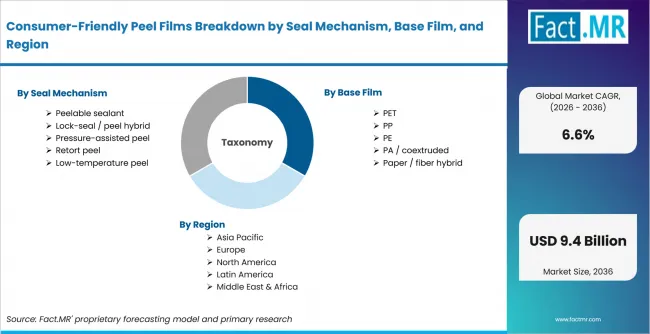
Consumer Friendly Peel Films Breakdown By Seal Mechanism, Base Film, And Region | Source: Fact.MR
| Attribute | Details |
|---|---|
| Quantitative Units | USD billion in 2026 to USD billion by 2036 at a CAGR |
| Market Definition | Flexible lidding and web films engineered to provide controlled peel opening from sealed food or specialty packs while maintaining required seal integrity before opening. |
| Seal Mechanism | Peelable sealant; Lock-seal / peel hybrid; Pressure-assisted peel; Retort peel; Low-temperature peel |
| Base Film | PET; PP; PE; PA / coextruded; Paper / fiber hybrid |
| Opening Performance | Clean peel; Easy peel; Consumer-friendly peel force; Secure tamper seal; No-string / no-shred opening |
| Application | Dairy cups; Trays / ready meals; Meat / cheese; Produce; Medical / specialty food |
| Regions Covered | North America; Latin America; Western Europe; Eastern Europe; East Asia; South Asia & Pacific; Middle East & Africa |
| Countries Covered | United States; China; Germany; Japan; France |
| Key Companies Profiled | Amcor; Klöckner Pentaplast; Constantia Flexibles; Coveris; Winpak |
| Forecast Period | 2026 to 2036 |
| Approach | Hybrid bottom-up and top-down assessment using food-packaging applications, film structures, seal mechanisms, country demand indicators, and verified provider portfolios. |
How is the market segmented?
-
By Seal Mechanism
- Peelable sealant
- Lock-seal / peel hybrid
- Pressure-assisted peel
- Retort peel
- Low-temperature peel
-
By Base Film
- PET
- PP
- PE
- PA / coextruded
- Paper / fiber hybrid
-
By Opening Performance
- Clean peel
- Easy peel
- Consumer-friendly peel force
- Secure tamper seal
- No-string / no-shred opening
-
By Application
- Dairy cups
- Trays / ready meals
- Meat / cheese
- Produce
- Medical / specialty food
-
By Region
- North America
- Latin America
- Western Europe
- Eastern Europe
- East Asia
- South Asia & Pacific
- Middle East & Africa