- Market Value (2025): USD 587.2 Mn
- Estimated Value (2026): USD 680.0 Mn
- Forecast Value (2036): USD 2948.5 Mn
- CAGR (2026-2036): 15.8%
What is the Dispersible Coffee Pouches Market forecast to be worth by 2036?
USD 680.0 million in 2026 to USD 2948.5 million by 2036, at a 15.8% CAGR.
- The market is valued at USD 587.2 million in 2025.
- Demand is projected to increase from USD 680.0 million in 2026 to USD 2948.5 million by 2036.
- The market is forecast to record a 15.8% CAGR from 2026 to 2036 as coffee brands test single-serve formats that combine portioning convenience with controlled dissolution and food-contact performance.
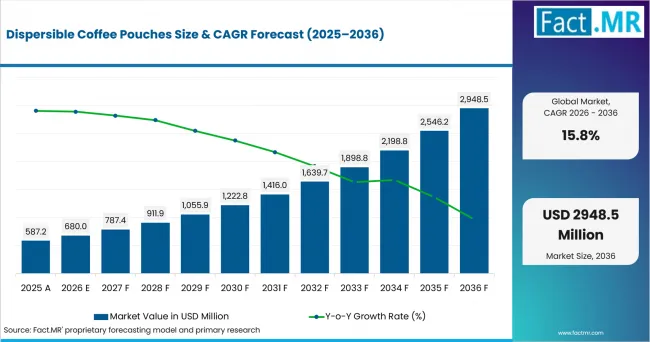
Dispersible Coffee Pouches Value Analysis | Source: Fact.MR
What are the defining numbers behind Dispersible Coffee Pouches Market growth?
The market is projected to create an absolute dollar opportunity of USD 2,268.5 million between 2026 and 2036.
- Demand Drivers in the Market
- Single-serve coffee formats create demand for portion-controlled packs that can simplify preparation while reducing the need to remove a conventional sachet before use.
- Food-contact requirements keep film chemistry and migration behavior within the qualification process when the pouch dissolves or disperses in the same vessel as the beverage.
- Pressure on small-format flexible packaging is increasing interest in alternatives to conventional film structures, particularly where collection and recycling routes remain weak.
- Material developers are testing substitutes for incumbent water-soluble polymers as brands look for better evidence around dissolution behavior and end-of-life claims.
- Key Segments Analyzed
- By Pouch Material: Water-soluble film accounts for 33.0% share in 2026, making it the leading material category.
- By Coffee Format: Instant coffee holds 37.0% share in 2026, supported by its direct compatibility with rapid-dissolve portion packs.
- By Dissolution: Hot-water rapid dissolve represents 44.0% share in 2026, reflecting the preparation conditions of mainstream instant coffee.
- By Pack Size: 5-15 g accounts for 36.0% share in 2026, aligning with single-cup portioning and compact sachet formats.
- Analyst Opinion at Fact.MR
- Shambhu Nath Jha, Senior Consultant, Fact.MR, notes that dispersible coffee pouches will be judged on what remains after the convenience claim is removed. Brands still need evidence on food-contact safety, dissolution under real preparation conditions and the fate of the pouch material once it enters the beverage or wastewater stream.
- He adds that the strongest commercial route is likely to come from tightly defined use cases such as instant coffee portions, where hot-water preparation provides a predictable operating condition. Material suppliers that can document performance without presenting water solubility as equivalent to recycling or compostability will have a more credible proposition.
- Strategic Implications
- Pouch developers should test dissolution using the actual coffee formulation and serving conditions because temperature, solids and additives can change dispersal behavior.
- Coffee brands should keep water-soluble, dispersible and compostable claims separate unless each claim is supported by the appropriate evidence.
- Food-contact qualification should cover the complete pouch formulation, including any inks, coatings or additives that enter the beverage-contact environment.
- Suppliers serving Europe need to assess dispersible pouch formats against PPWR requirements without assuming that dissolution provides a recycling route.
How does the Dispersible Coffee Pouches Market break down by segment?
The Dispersible Coffee Pouches Market is segmented by Pouch Material into Water-soluble film, Cellulose dispersible film, Starch-based film, Seaweed / alginate film and Other bio-dispersible film; by Coffee Format into Instant coffee, Coffee + creamer blends, Functional coffee, Cold-brew concentrate sachets and Specialty single-serve; by Dissolution into Hot-water rapid dissolve, Hot-water controlled dissolve, Cold-water dispersible, Compostable after use and Other; and by Pack Size into <5 g, 5-15 g, 16-30 g, 31-50 g and >50 g.
Which Pouch Material Dominates the Dispersible Coffee Pouches Market?
Water-soluble film holds 33.0% share in 2026.
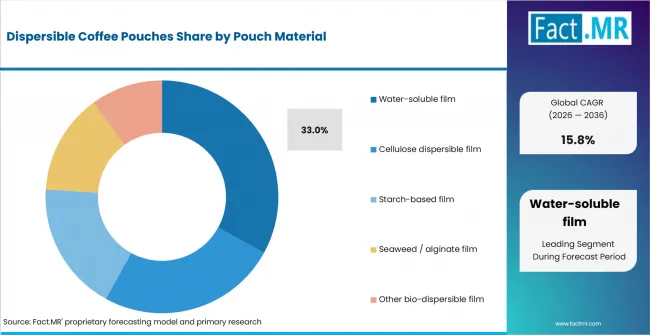
Dispersible Coffee Pouches Analysis By Pouch Material | Source: Fact.MR
Water-soluble film leads the pouch material segment due to its compatibility with single-serve formats that are designed to dissolve or disperse during beverage preparation. Its ability to eliminate the need for conventional pouch disposal supports adoption in applications where convenience and controlled portioning are important. Material performance, however, remains dependent on moisture resistance during storage and reliable dissolution at the point of use.
Which Coffee Format Dominates the Dispersible Coffee Pouches Market?
Instant coffee accounts for 37.0% share in 2026.
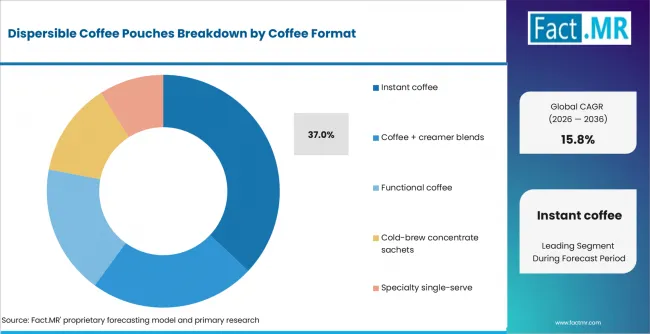
Dispersible Coffee Pouches Analysis By Coffee Format | Source: Fact.MR
Instant coffee leads the coffee format segment because its preparation already relies on rapid dissolution in water. Dispersible pouches therefore fit naturally into the established preparation process while offering pre-measured portions for individual servings. Formats containing larger particles or higher levels of oils and other ingredients can require more complex pouch and dissolution performance.
Which Dissolution Route Dominates the Dispersible Coffee Pouches Market?
Hot-water rapid dissolve holds 44.0% share in 2026.
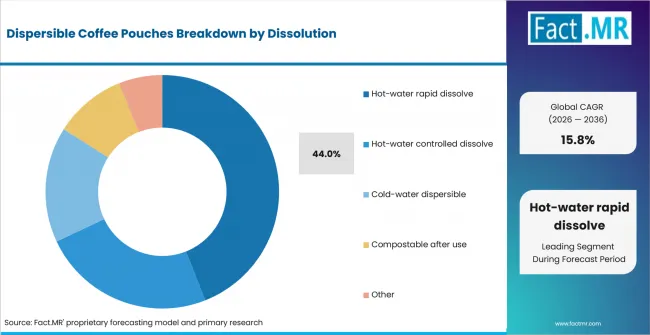
Dispersible Coffee Pouches Analysis By Dissolution | Source: Fact.MR
Hot-water rapid dissolve leads the dissolution segment as elevated water temperatures support faster pouch softening and dispersion during coffee preparation. The format is particularly suited to instant coffee applications where consumers expect quick preparation with limited residue. Consistent dissolution across typical serving temperatures remains an important performance requirement for pouch manufacturers.
Which Pack Size Leads Demand for Dispersible Coffee Pouches?
5–15 g accounts for 36.0% share in 2026.
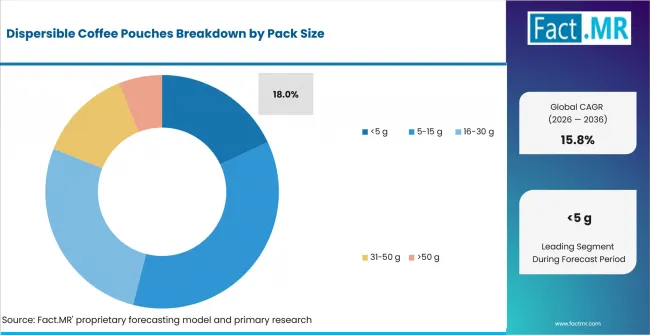
Dispersible Coffee Pouches Analysis By Pack Size | Source: Fact.MR
The 5–15 g pack size leads demand because it aligns closely with single-cup coffee portions and supports controlled serving quantities. The format also limits the amount of pouch material required per serving while providing sufficient capacity for coffee formulations that may include small quantities of additional ingredients. This makes the range suitable for individually portioned dispersible coffee applications.
What is accelerating Dispersible Coffee Pouches Market adoption, and what is holding it back?
Single-serve convenience, pressure on small flexible packs and food-contact innovation support adoption; unresolved end-of-life claims and material qualification can slow scale-up.
Drivers Impact Analysis
| DRIVER | (~) % IMPACT ON CAGR | GEOGRAPHIC RELEVANCE | IMPACT TIMELINE |
|---|---|---|---|
| Single-serve preparation convenience | +1.8% | Japan, USA, Europe | Short term (<= 2 years) |
| Pressure on hard-to-recycle small packs | +1.4% | UK, Germany, France | Medium term (2-4 years) |
| Food-contact material innovation | +1.0% | USA, EU | Medium term (2-4 years) |
| Alternative bio-dispersible material development | +0.7% | Europe, Global | Long term (>= 4 years) |
- Single-serve convenience: Portion packs can simplify dosing and preparation, especially where the pouch itself is designed to disperse during use.
- Small-pack recovery pressure: Conventional flexible sachets are difficult to collect and sort in many systems, increasing interest in alternative packaging routes for low-weight formats.
- Food-contact innovation: FDA and EFSA oversight keeps material safety central when the package is in direct contact with the beverage preparation process.
- Alternative material development: Publicly funded work on replacements for incumbent water-soluble polymers shows that the material platform is still evolving rather than settled.
Opportunity Impact Analysis
| OPPORTUNITY | (~) % IMPACT ON CAGR | GEOGRAPHIC RELEVANCE | IMPACT TIMELINE |
|---|---|---|---|
| Rapid-dissolve instant-coffee portions | +1.2% | Japan, USA, Global | Short term (<= 2 years) |
| Cellulose and starch-based alternatives | +0.9% | Europe, Global | Medium term (2-4 years) |
| Functional coffee single-serve formats | +0.6% | USA, Europe | Medium term (2-4 years) |
| Cold-water dispersible systems | +0.4% | Global | Long term (>= 4 years) |
- Rapid-dissolve portions: Instant coffee offers the clearest match between preparation behavior and dispersible packaging, making it a practical starting point for wider adoption.
- Alternative materials: Cellulose, starch and other bio-dispersible films can address concerns around incumbent water-soluble polymers if they meet food-contact and dissolution requirements.
- Functional coffee: Single-serve blends create room for differentiated products, although added ingredients can change film-contact and dispersal conditions.
- Cold-water systems: Reliable dispersion at lower temperatures would expand use beyond hot instant coffee, but it requires tighter control over material behavior.
Restraints Impact Analysis
| RESTRAINT | (~) % IMPACT ON CAGR | GEOGRAPHIC RELEVANCE | IMPACT TIMELINE |
|---|---|---|---|
| Unclear end-of-life positioning | -1.0% | UK, Germany, France | Short term (<= 2 years) |
| Food-contact qualification burden | -0.8% | USA, EU | Medium term (2-4 years) |
| Taste, residue and dissolution consistency | -0.6% | Global | Short term (<= 2 years) |
| Material cost and scale-up constraints | -0.4% | Global | Medium term (2-4 years) |
- End-of-life positioning: A pouch that dissolves during use does not automatically qualify as recyclable or compostable. Claims need to reflect the actual fate of the material.
- Food-contact qualification: The pouch formulation enters the beverage-contact environment, increasing the importance of migration and intended-use assessment.
- Dissolution consistency: Incomplete dispersal, residue or sensory interaction can undermine the convenience advantage if performance varies with water temperature or coffee formulation.
- Material cost and scale-up: New bio-dispersible films need commercial-volume production and converting compatibility before they can compete broadly with established flexible-packaging materials.
Which countries are scaling Dispersible Coffee Pouches Market through 2036?
- Japan: 15.3% CAGR, with single-serve coffee familiarity and food-industry standards shaping adoption.
- USA: 15.9% CAGR, with food-contact substance requirements central to material qualification.
- Germany: 15.6% CAGR, with packaging cost responsibility and recycling scrutiny influencing small-format pack choices.
- France: 16.3% CAGR, with food-contact safety and waste-sorting considerations setting the compliance boundary.
- UK: 16.6% CAGR, with weak flexible-film recovery creating pressure to examine alternative routes for small packaging formats.
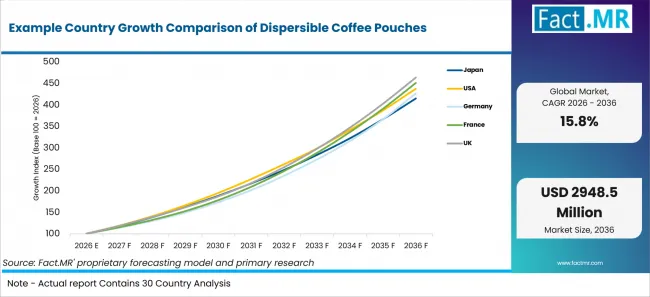
Example Country Growth Comparison Of Dispersible Coffee Pouches | Source: Fact.MR
| Country | CAGR |
|---|---|
| Japan | 15.3% |
| USA | 15.9% |
| Germany | 15.6% |
| France | 16.3% |
| UK | 16.6% |
What supports Japan adoption?
15.3% CAGR through 2036, shaped by single-serve coffee use and food-industry standards.
Japan is forecast to expand at 15.3% CAGR from 2026 to 2036. MAFF's food-industry and standards role provides the national framework around food safety and product quality, while the country's established single-serve coffee culture gives portioned formats a practical route to adoption.
What supports USA growth?
15.9% CAGR through 2036, shaped by food-contact material qualification.
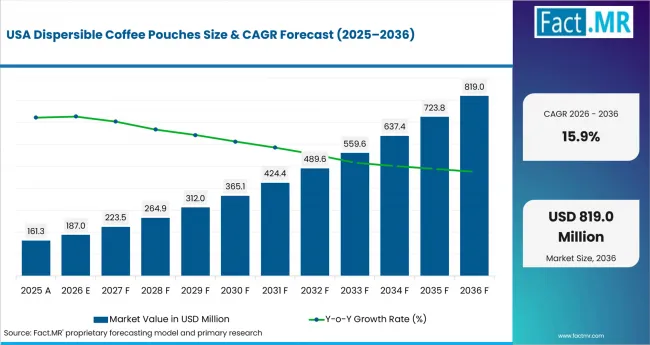
Dispersible Coffee Pouches Country Value Analysis | Source: Fact.MR
The USA market is forecast to expand at 15.9% CAGR from 2026 to 2036. FDA food-contact controls matter directly because pouch film can enter the beverage environment during preparation. Material selection therefore depends on intended-use evidence rather than on dissolution performance alone.
How is Germany scaling demand?
15.6% CAGR through 2036, shaped by packaging responsibility and material scrutiny.
Germany is forecast to expand at 15.6% CAGR from 2026 to 2036. UBA's waste and producer-responsibility framework keeps collection costs and material claims under scrutiny. Dispersible pouches need to be positioned as a distinct route rather than presented as part of conventional film recycling without evidence.
What supports France growth?
16.3% CAGR through 2036, shaped by food-contact safety and waste-system considerations.
France is forecast to expand at 16.3% CAGR from 2026 to 2036. ANSES provides the national food-contact and environmental-health context, making both consumer exposure and downstream waste handling relevant when new pouch materials are introduced.
What supports the UK outlook?
16.6% CAGR through 2036, shaped by pressure on flexible-packaging recovery.
The UK is forecast to expand at 16.6% CAGR from 2026 to 2036. WRAP's flexible-plastic work shows the continuing gap between film use and recycling. Dispersible coffee pouches sit outside that conventional recovery route, so their value proposition depends on a clearly defined material fate rather than a generic recyclability claim.
Who leads the Dispersible Coffee Pouches Market?
Kuraray, Aicello and Aquapak Polymers are among the companies active in water-soluble or dispersible film technologies relevant to coffee pouch applications. Competition is shaped by dissolution control, food-contact suitability, film converting performance and the strength of evidence behind environmental claims.
Futamura Chemical, Notpla and TIPA also participate across cellulose, seaweed-derived and compostability-oriented packaging materials that can influence the development of dispersible pouch formats. Supplier selection will depend on how well a material performs in the intended beverage application and how clearly its post-use pathway can be explained.
Which companies are the key providers?
Key companies include Kuraray, Aicello, Aquapak Polymers, Futamura Chemical, Notpla and TIPA.
- Kuraray
- Aicello
- Aquapak Polymers
- Futamura Chemical
- Notpla
- TIPA
Bibliography
- Japan Ministry of Agriculture, Forestry and Fisheries. Food Industry Policy and Japan Agricultural Standards.
- U.S. Food and Drug Administration. Food Ingredients & Packaging.
- Umweltbundesamt. Waste | Resources.
- ANSES. Food, Environmental and Occupational Health Publications.
- WRAP. Flexible Plastic Kerbside Collection Trial.
- European Commission, Directorate-General for Environment. Packaging Waste.
- European Food Safety Authority. Food Contact Materials.
- CORDIS. PlantSea Project.
- Fraunhofer Institute for Process Engineering and Packaging IVV. Packaging and Recycling Research.
- DIN. Circular Economy Standardization.
This Report Answers
- The report explains demand for dispersible coffee pouches across Pouch Material, Coffee Format, Dissolution and Pack Size.
- Segment analysis identifies the leading category within each market segment and explains the use-case logic behind adoption.
- Country analysis examines Japan, the USA, Germany, France and the UK and the national mechanisms affecting material qualification or packaging recovery.
- Competitive analysis reviews leading material suppliers without disclosing company market shares.
- Regulatory analysis covers food-contact requirements, packaging recovery pressure and the distinction between dissolution, compostability and recycling.
- The forecast covers 2026 to 2036 across the defined segment and country markets.
What does the Dispersible Coffee Pouches Market cover?
The Dispersible Coffee Pouches Market covers portion packs for coffee products made from films designed to dissolve, disperse or otherwise break down during or after beverage preparation.
The market includes pouch materials used with instant coffee, coffee and creamer blends, functional coffee, cold-brew concentrate sachets and specialty single-serve products. The defining boundary is the use of a dispersible or dissolution-oriented pouch rather than a conventional sachet that must be removed before consumption.
What is included in the scope?
The scope includes water-soluble, cellulose-based, starch-based, seaweed or alginate, and other bio-dispersible pouch films used for coffee portioning.
It covers hot-water and cold-water dissolution routes, formats described as compostable after use, and pack sizes from below 5 g to above 50 g. Food-contact performance is included where the pouch material enters the beverage or preparation vessel.
What is excluded from the scope?
The scope excludes conventional coffee sachets that remain intact during preparation, rigid coffee capsules, loose coffee packaging and non-coffee applications.
Standalone soluble-film resin is excluded when it is not converted into a coffee pouch application. Claims around recycling or compostability are outside the market definition unless they apply to the finished pouch format under the relevant conditions.
How Was the Analysis Built?
The analysis covers market size, segment structure, country growth, food-contact requirements, packaging recovery conditions and material-development trends relevant to dispersible coffee pouches.
- Primary Research: Research inputs consider pouch qualification, dissolution behavior, coffee-format compatibility, purchasing requirements and adoption barriers across relevant industry participants.
- Desk Research: Public evidence includes food-industry policy, food-contact regulation, waste and packaging policy, flexible-film recovery studies, EU packaging rules, public material research and standardization.
- Market Sizing and Forecasting: The assessment covers market value, segment structure, country growth and the operating factors influencing adoption from 2026 to 2036.
- Data Validation and Update Cycle: Findings are reviewed against regulatory developments, public research, country-level market conditions and company participation where relevant to competitive analysis.
What is the report’s scope and coverage?
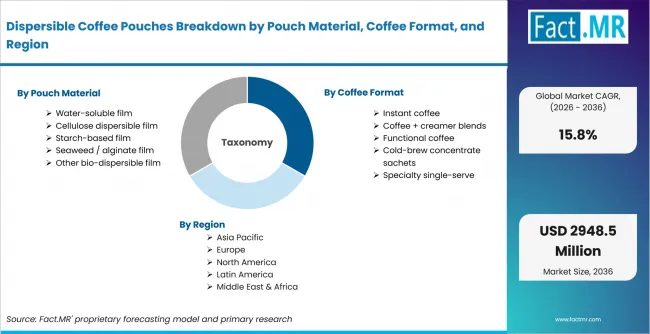
Dispersible Coffee Pouches Breakdown By Pouch Material, Coffee Format, And Region | Source: Fact.MR
| Attribute | Details |
|---|---|
| Quantitative Units | USD million |
| Market Definition | Coffee portion packs made from films designed to dissolve, disperse or otherwise break down during or after beverage preparation. |
| Pouch Material | Water-soluble film; Cellulose dispersible film; Starch-based film; Seaweed / alginate film; Other bio-dispersible film |
| Coffee Format | Instant coffee; Coffee + creamer blends; Functional coffee; Cold-brew concentrate sachets; Specialty single-serve |
| Dissolution | Hot-water rapid dissolve; Hot-water controlled dissolve; Cold-water dispersible; Compostable after use; Other |
| Pack Size | <5 g; 5-15 g; 16-30 g; 31-50 g; >50 g |
| Regions Covered | North America; Latin America; Western Europe; Eastern Europe; East Asia; South Asia & Pacific; Middle East & Africa |
| Countries Covered | Japan; USA; Germany; France; UK |
| Key Companies Profiled | Kuraray; Aicello; Aquapak Polymers; Futamura Chemical; Notpla; TIPA |
| Forecast Period | 2026 to 2036 |
| Approach | Market sizing, segment analysis and country growth assessment, with coverage of food-contact regulation, packaging recovery and dispersible-material development. |
How is the market segmented?
-
By Pouch Material
- Water-soluble film
- Cellulose dispersible film
- Starch-based film
- Seaweed / alginate film
- Other bio-dispersible film
-
By Coffee Format
- Instant coffee
- Coffee + creamer blends
- Functional coffee
- Cold-brew concentrate sachets
- Specialty single-serve
-
By Dissolution
- Hot-water rapid dissolve
- Hot-water controlled dissolve
- Cold-water dispersible
- Compostable after use
- Other
-
By Pack Size
- <5 g
- 5-15 g
- 16-30 g
- 31-50 g
- >50 g
-
By Region
- North America
- Latin America
- Western Europe
- Eastern Europe
- East Asia
- South Asia & Pacific
- Middle East & Africa