The Edema Management Devices Market is analyzed across its key product, application and end-use segments, with the study covering market dynamics, regional trends and demand outlook, forecast 2026 to 2036.
By Fact.MR Healthcare DeskFact-checked under the Fact.MR editorial processUpdated
11 min read
Edema Management Devices Market Forecast and Outlook By Fact.MR
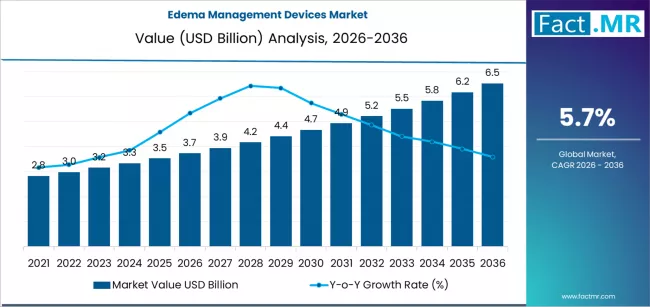
The global market for edema management devices is projected ttotal USD 3.73 billion in 2026, advancing tUSD 6.52 billion by 2036, progressing at a 5.7% CAGR.
This growth reflects the escalating clinical and economic focus on managing chronic fluid accumulation conditions through non-invasive, patient-centric solutions.
Edema Management Devices Market Market Value Analysis | Source: Fact.MR
Summary of EdemaManagement Devices Market
Market Snapshot
Globaledemamanagement devices market revenue stood at USD 3.73 billion in 2026 and is forecast treach USD 6.52 billion by 2036.
At a 5.7% CAGR from 2026 t2036, this market is set texpand ~1.7x in value, adding USD 2.79 billion in absolute opportunity.
Growth is being driven by increasing prevalence of lymphedema, chronic venous disorders, and post-surgical swelling management requirements globally.
Edemamanagement devices are increasingly adopted timprove fluid drainage, circulation support, and patient recovery outcomes across clinical and homecare settings.
Rising investments in rehabilitation care, chronic disease management, and home healthcare infrastructure are reinforcing market expansion globally.
Demand and Growth Drivers
Increasing prevalence of lymphedema and chronic venous insufficiency globally
Rising post-surgical recovery and rehabilitation care requirements
Growing adoption of non-invasive compression therapy solutions
Expansion of home healthcare and remote patient management services
Need for solutions that provide:
Improved fluid drainage and circulation management
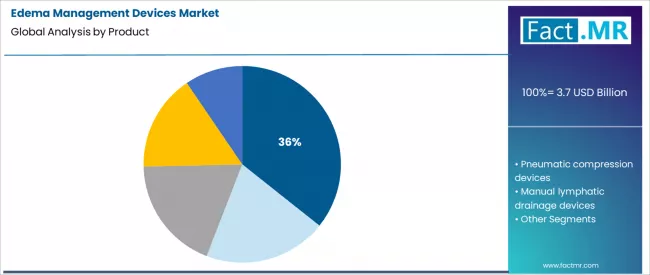
Compression garments hold 35.7% of product share in 2026,emergingas the leading segment.
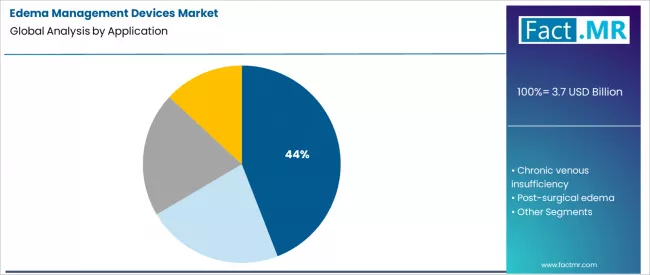
Lymphedema accounts for 44.1% of application share in 2026.
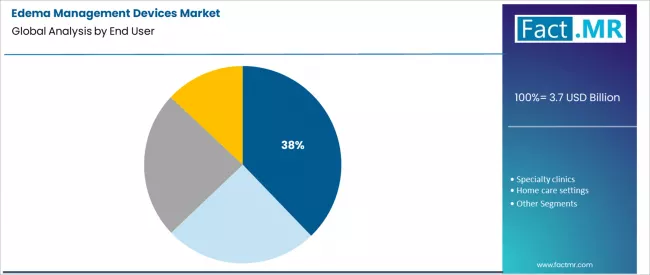
Hospitals hold 37.8% of end-user share in 2026, positioning them as the dominant segment.
Geography and Competitive Outlook
Growth is supported across North America, Europe, Asia Pacific.
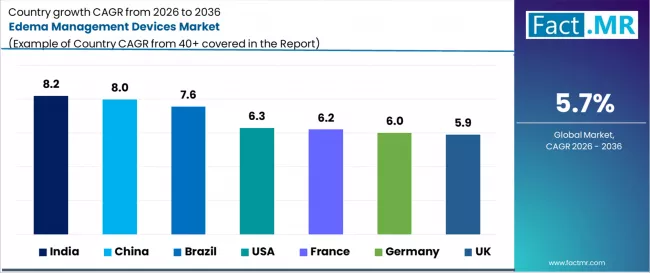
Key growth markets and CAGR: India 8.2%, China 8.0%, Brazil 7.6%, USA 6.3%, France 6.2%, Germany 6.0%, UK 5.9%
Market expansion is closely tied to:
Increasing awareness and diagnosis of lymphatic disorders
Rising adoption of compression therapy and pneumatic devices
Growing investments in rehabilitation and home healthcare infrastructure
Key companies active in this market include Tactile Systems Technology, Inc., Essity Aktiebolag, 3M Company, BSN medical GmbH, and Lohmann & Rauscher GmbH & Co. KG.
EdemaManagement Devices Market — At a Glance
Attribute
Details
Market Value 2026
USD 3.73 billion
Market Value 2036
USD 6.52 billion
Absolute Dollar Opportunity 2026–2036
USD 2.79 billion
Total Growth 2026–2036
74.8%
CAGR 2026–2036
5.7%
Growth Multiple
~1.7x
Key Demand Theme
Increasing adoption of compression and lymphatic drainage therapies
Leading Segment by Product (2026)
Compression Garments
Segment Share (2026)
35.7%
Leading Segment by Application (2026)
Lymphedema
Segment Share (2026)
44.1%
Leading Segment by End User (2026)
Hospitals
Segment Share (2026)
37.8%
Key Growth Regions
North America, Europe, Asia Pacific
Country CAGRs
India 8.2%, China 8.0%, Brazil 7.6%, USA 6.3%, France 6.2%, Germany 6.0%, UK 5.9%
Top Companies
Tactile Systems Technology, Inc., Essity Aktiebolag, 3M Company, BSN medical GmbH, Lohmann & Rauscher GmbH & Co. KG
Hospitals, Specialty Clinics, Home Care Settings, RehabilitationCenters
Segmentation by Region
North America, Latin America, Western Europe, Eastern Europe, East Asia, South Asia & Pacific, Middle East & Africa
Rising prevalence of lymphedema and chronic venous insufficiency, coupled with an aging global population, is driving sustained demand for both therapeutic and preventative interventions. The market evolution is characterized by a distinct shift from traditional treatment models toward integrated care pathways that emphasize early intervention, home-based management, and improved quality of life. Technological innovation is enhancing device efficacy, comfort, and accessibility, with smart garments and programmable pneumatic pumps offering personalized therapy. Growing patient awareness and clearer clinical guidelines are supporting the adoption of these devices as standard components of conservative management. The expansion of home healthcare services further facilitates this transition, reducing the burden on institutional care settings. These progression positions edema management devices as essential tools in value-based care models aimed at preventing costly complications like recurrent cellulitis and venous ulcers.
Hospitals, Specialty Clinics, Home Care Settings, Rehabilitation Centers
Region
North America, Latin America, Western Europe, Eastern Europe, East Asia, South Asia & Pacific, Middle East & Africa
Which Macro Healthcare Trends are Reshaping Chronic Edema Care Pathways?
Industry Development
Impact
Shift Towards Home-Based Care Models
Drives demand for patient-operated pneumatic compression devices and easy-to-use garments, reducing clinic visits and empowering self-management.
Value-Based Care for Chronic Conditions
Incentivizes the use of preventive device therapy to reduce costly hospitalizations for ulcer management and severe infections like cellulitis.
Advancements in Smart Textiles and Wearables
Enables the development of connected compression garments with sensors for pressure monitoring and patient compliance tracking.
Growing Focus on Survivorship Care
Increases structured post-cancer therapy protocols, creating sustained demand for lymphedema management devices in oncology follow-up programs.
Segmental Analysis
By Product, Which Device Category Forms the Foundation of Conservative Management?
Edema Management Devices Market Analysis By Product | Source: Fact.MR
Compression garments command a leading 35.7% share. This dominance is attributed to their role as first-line, continuous therapy for both lymphedema and chronic venous insufficiency. These garments provide the essential baseline compression necessary for fluid mobilization and venous return.
Their widespread adoption stems from relative cost-effectiveness, patient familiarity, and application across all care settings from initial diagnosis to lifelong maintenance. Innovations in material science improving breathability, durability, and aesthetics further support their central position in treatment regimens.
By Application, Which Condition Represents the Largest Addressable Patient Pool?
Edema Management Devices Market Analysis By Application | Source: Fact.MR
Lymphedema constitutes the primary application segment at 44.1%. This chronic, progressive condition, often secondary to cancer treatment, requires lifelong management, creating a consistent, recurring demand for devices.
The absence of a pharmacological cure places physical therapies like compression and pneumatic devices at the core of clinical guidelines. Rising cancer survivorship rates and improved diagnostic awareness are systematically expanding the diagnosed patient population, securing this segment's substantial market share.
By End User, Which Setting Provides Initial Diagnosis and Complex Care Management?
Edema Management Devices Market Analysis By End User | Source: Fact.MR
Hospitals hold a leading 37.8% share. These institutions serve as the primary point for diagnosing complex edema, initiating intensive treatment protocols, and managing severe complications.
Hospital-based lymphedema clinics and vascular surgery departments are key adoption centers for advanced pneumatic compression and negative pressure wound therapy systems. Their role in training patients for subsequent home-based care ensures hospitals remain a critical nexus in the treatment pathway despite the growth of alternative care settings.
What are the Defining Forces Steering Demand and Innovation in Edema Care?
The increasing global prevalence of underlying conditions causing chronic edema enhances scope for edema management devices. This is particularly the case in lymphedema post-cancer therapy and venous disease linked to aging and obesity. Heightened clinical recognition and patient advocacy have transformed edema management from palliative afterthought to a structured component of rehabilitative medicine.
Market expansion is restrained by significant variability in reimbursement policies across regions. The often-high out-of-pocket cost for advanced pneumatic devices and custom garments limits patient access, especially in systems without clear coverage pathways for durable medical equipment used for chronic maintenance therapy.
A significant opportunity exists in integrating digital connectivity into devices. Smart pumps that sync with telehealth platforms allow remote therapy monitoring and adjustment by clinicians, while sensor-equipped garments can provide objective compliance data, enhancing treatment efficacy and enabling personalized care plans.
The key trend involves the development of hybrid and sequential therapy devices that combine modalities like intermittent pneumatic compression with built-in thermal or massage functions. This approach aims to improve patient outcomes and adherence by offering more comprehensive treatment cycles within a single, user-friendly system, moving beyond single-function devices.
Analysis of the Edema Management Devices Market by Key Countries
Edema Management Devices Market Cagr Analysis By Country | Source: Fact.MR
Country
CAGR 2026 to 2036
USA
6.3%
Germany
6.0%
China
8.0%
India
8.2%
Brazil
7.6%
France
6.2%
UK
5.9%
What supports Steady Adoption within the USA's Established Healthcare Framework?
Well-defined reimbursement pathways under Medicare and private insurance for certain pneumatic compression devices and garments support a 6.3% CAGR. High awareness among oncology and vascular specialists drives protocol-based adoption.
The presence of leading domestic manufacturers fosters innovation and patient support programs. Demand is consistent across hospital-based therapy initiation and the growing homecare segment, supported by a robust network of durable medical equipment suppliers.
How does Germany's Rehabilitative Care Focus Influence Device Utilization?
Germany's 6.0% CAGR reflects its strong integrated rehabilitative care system. Prescription-based access to devices following strict therapeutic guidelines ensures quality. The Kur system and robust outpatient clinic networks facilitate widespread access to compression therapy and manual lymphatic drainage. German manufacturers are leaders in high-quality medical compression textiles, supplying both domestic needs and export markets with technically advanced products.
Which Factors Underpin China's Accelerating Demand for Modern Therapies?
China's 8.0% CAGR is fueled by rapid healthcare modernization, increasing cancer survivorship, and growing patient demand for improved quality of life. Expansion of specialist wound care and rehabilitation clinics in urban centers creates new access points.
Domestic manufacturing capacity for compression garments is scaling to meet demand. Government health campaigns addressing chronic disease management indirectly raise the profile of edema as a serious condition requiring intervention.
Why is India's Growing Awareness and Clinic Expansion a Primary Catalyst?
India's leading 8.2% CAGR is propelled by the emergence of specialized lymphedema and physiotherapy clinics in metropolitan areas. Rising medical tourism and increasing focus on post-operative recovery standards elevate clinical practices.
The demand driver stems from a large, underserved patient population increasingly seeking solutions for chronic swelling. Growth is closely tied to the availability of cost-optimized device options suitable for the region's economic diversity and climate.
How is Brazil's Healthcare Access Improvement Shaping Market Growth?
Brazil's 7.6% CAGR is linked to improving access to specialist care within both the public SUS system and private networks. High prevalence of filariasis in some regions and focus on post-surgical recovery in cosmetic and oncology surgery drive specific demand.
The market favors versatile pneumatic compression systems that can serve multiple patients in clinical settings, alongside growing interest in garment-based solutions for long-term maintenance.
What Specific Characteristics Define France's Structured Approach to Lymphology?
France's 6.2% CAGR benefits from a well-established network of trained lymphologists and physiotherapists specializing in Complete Decongestive Therapy. This creates a structured referral and treatment pathway that systematically integrates devices.
Reimbursement for certain therapies under the national health insurance supports patient access. The system emphasizes a gold-standard, multi-modal approach, ensuring devices are used as part of a comprehensive treatment plan rather than in isolation.
How does the UK's NHS Cost-Effectiveness Focus Guide Device Adoption?
The UK’s 5.9% CAGR operates within the NHS framework where national institute guides adoption for Health and Care Excellence evidence standards and clinical commissioning group policies. Uptake is strongest for interventions demonstrating clear cost savings by preventing wound care admissions.
Community-based services and increasing delegation of chronic disease management to nurses and allied health professionals influence the types of devices prescribed for home use, favoring those with strong patient education and support.
Competitive Landscape of the Edema Management Devices Market
The competitive environment features medical device specialists, large wound care conglomerates, and compression textile experts. Companies like Tactile Medical and Essity compete through integrated systems combining pneumatic pumps with specialized garments and comprehensive patient support services.
Traditional compression leaders like BSN medical and 3M leverage their material science expertise and extensive distribution networks in wound care. Success depends on securing favorable reimbursement codes, building strong clinical evidence for patient outcomes, and establishing partnerships with lymphedema therapists and vascular clinics. Innovation focuses on improving patient comfort, device portability, and digital adherence tracking to differentiate in a competitive conservative therapy space.
Key Players in the Edema Management Devices Market
Tactile Systems Technology, Inc.
Essity Aktiebolag
3M Company
BSN medical GmbH
Lohmann & Rauscher GmbH & Co. KG
Others
Bibliography
International Society of Lymphology. (2025). The diagnosis and treatment of peripheral lymphedema: 2024 consensus document. Lymphology.
Keeley, V. (2024). Chronic Oedema: A Practical Guide to Management. Wounds International.
Moffatt, C. J., & Franks, P. J. (2023). Lymphoedema: An underestimated health problem. QJM: An International Journal of Medicine.
National Lymphedema Network. (2024). Position Statement: The Diagnosis and Treatment of Lymphedema.
World Health Organization. (2024). Lymphatic filariasis: managing morbidity and preventing disability.
Zuther, J. E., & Norton, S. (2025). Lymphedema Management: The Comprehensive Guide for Practitioners. Thieme.
Hospitals, Specialty Clinics, Home Care Settings, Rehabilitation Centers
Key Countries
India, China, Brazil, USA, France, Germany, UK
Key Companies
Tactile Systems Technology, Inc., Essity Aktiebolag, 3M Company, BSN medical GmbH, Lohmann & Rauscher GmbH & Co. KG
Additional Analysis
Comparative analysis of compression pressures and regimens by etiology; health economic models for preventing venous ulcers; study of patient compliance drivers across device types; impact of material innovations on wear-time and efficacy; analysis of training requirements for home-based device use.
Market by Segments
Product :
Compression Garments
Pneumatic Compression Devices
Manual Lymphatic Drainage Devices
Negative Pressure Devices
Others
Application :
Lymphedema
Chronic Venous Insufficiency
Post-Surgical Edema
Others
End User :
Hospitals
Specialty Clinics
Home Care Settings
Rehabilitation Centers
Region :
North America
USA
Canada
Latin America
Brazil
Mexico
Argentina
Rest of Latin America
Western Europe
Germany
France
UK
Italy
Spain
BENELUX
Rest of Western Europe
Eastern Europe
Poland
Russia
Czech Republic
Rest of Eastern Europe
East Asia
China
Japan
South Korea
Rest of East Asia
South Asia & Pacific
India
ASEAN
Australia & New Zealand
Rest of South Asia & Pacific
MEA
GCC Countries
South Africa
Turkiye
Rest of MEA
Frequently Asked Questions
How big is the edema management devices market in 2026?
The global edema management devices market is estimated to be valued at USD 3.7 billion in 2026.
What will be the size of edema management devices market in 2036?
The market size for the edema management devices market is projected to reach USD 6.5 billion by 2036.
How much will be the edema management devices market growth between 2026 and 2036?
The edema management devices market is expected to grow at a 5.7% CAGR between 2026 and 2036.
What are the key product types in the edema management devices market?
The key product types in edema management devices market are compression garments, pneumatic compression devices, manual lymphatic drainage devices, negative pressure devices and others.
Which application segment to contribute significant share in the edema management devices market in 2026?
In terms of application, lymphedema segment to command 44.1% share in the edema management devices market in 2026.