- Market Value (2025): USD 824.1 Mn
- Estimated Value (2026): USD 890.0 Mn
- Forecast Value (2036): USD 1921.4 Mn
- CAGR (2026-2036): 8.0%
What is the Electrically Insulating Epoxies Market forecast to be worth by 2036?
USD 1921.4 million by 2036 at 8.0% CAGR.
- The Electrically Insulating Epoxies Market reached USD 824.1 million in 2025.
- Demand is projected to increase from USD 890.0 million in 2026 to USD 1921.4 million by 2036.
- The market is forecast to record a 8.0% CAGR from 2026 to 2036.
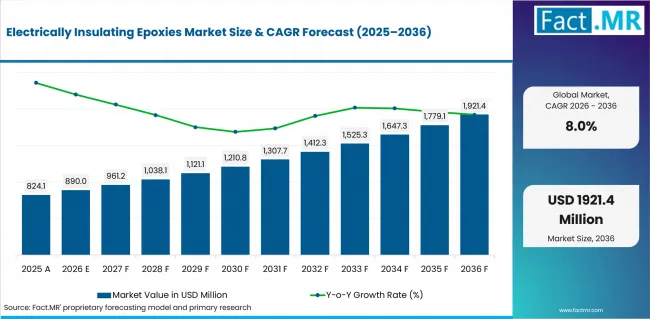
Electrically Insulating Epoxies Market Value Analysis | Source: Fact.MR
What are the defining numbers behind Electrically Insulating Epoxies Market growth?
An absolute opportunity of USD 1,030.0 million is expected between 2026 and 2036.
- Demand Drivers in the Market
- Transformer and coil potting protects windings, conductors and embedded electrical parts from moisture, vibration and electrical stress. Filling internal voids with cured resin also helps stabilize components that would otherwise move under mechanical or thermal loading.
- Standard dielectric formulations serve a broad installed base of transformers, motors and electrical equipment where insulation performance matters more than specialized thermal or vacuum properties. This keeps processing requirements simpler while supporting routine protection against arcing and environmental exposure.
- Silica-filled epoxy systems help control cure shrinkage and thermal expansion around embedded conductors. Lower dimensional movement reduces stress at the interface between resin, copper windings and surrounding components as equipment heats and cools during operation.
- Grid expansion and electrification are increasing requirements for transformers and related power-conversion equipment. The IEA reports that grid investment needs to rise as electricity demand and renewable deployment increase, while the U.S. Department of Energy expects distribution-transformer demand to grow and is supporting programmes addressing transformer supply constraints. Higher equipment production directly expands the volume of insulating and potting materials required during manufacturing.
- Manufacturers use vacuum potting and controlled cure schedules to limit trapped air around windings and electrical connections. Voids can reduce dielectric consistency and create localized electrical stress, so material viscosity, vacuum conditions and cure behaviour must be qualified as one production process rather than treated as independent specifications.
- Key Segments Analyzed
- Transformer/coil potting accounts for 36.0% of Application in 2026 because cured epoxy surrounds windings and conductors with a dielectric barrier while adding mechanical support against vibration and movement.
- Standard dielectric holds 39.0% of Dielectric Class in 2026 as a broad range of transformers, motors and control equipment can meet insulation requirements without the added processing demands of highly specialized formulations.
- Silica-filled represents 31.0% of Filler in 2026 because silica reduces cure shrinkage and limits differences in thermal expansion between the resin and embedded conductors.
- Electrical equipment captures 40.0% of End User in 2026 because transformers, motors and control assemblies consume insulating epoxy during manufacture to protect windings and electrical connections.
- Analyst Opinion at Fact.MR
- Shambhu Nath Jha, Senior Consultant at Fact.MR, states, "Electrically insulating epoxy demand will increasingly depend on how consistently suppliers can combine dielectric protection with void control and dimensional stability around energized components. Grid expansion increases transformer requirements, while electrification adds motors and power-electronic assemblies. Suppliers that qualify resin viscosity, vacuum conditions and cure behaviour against the customer's actual winding geometry are better positioned for repeat production."
- Strategic Implications
- Suppliers should document viscosity and cure conditions alongside dielectric strength because successful transformer potting depends on resin penetration around the actual winding geometry.
- Customer trials should reproduce winding density, conductor materials and vacuum conditions so that void formation and cure shrinkage can be assessed before production approval.
- Technical support should extend across China, the USA, Germany, Japan and South Korea as grid investment and electrical-equipment manufacturing create geographically distributed demand.
- Silica-filled systems should be positioned around dimensional stability and lower cure stress rather than filler content alone.
- Commercial positioning should distinguish standard insulating grades from high-temperature or specialized formulations according to the voltage and operating-temperature requirements of the finished equipment.
How does the Electrically Insulating Epoxies Market break down by segment?
The market is segmented by Application, Dielectric Class, Filler and End User.
Why does Transformer/coil potting lead Application?
Transformer/coil potting is projected to account for a 36.5% share in 2026.
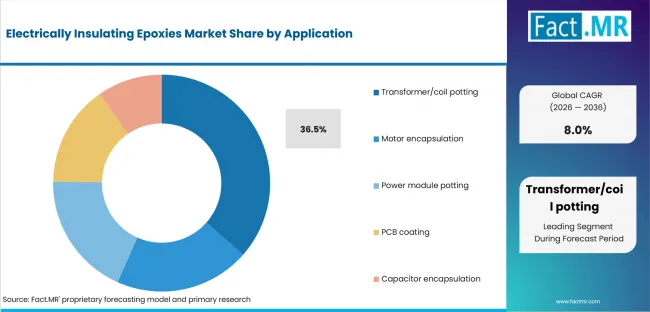
Electrically Insulating Epoxies Market Analysis By Application | Source: Fact.MR
Potting fills the spaces around windings and electrical connections with a cured dielectric material, providing insulation while mechanically stabilizing conductors against vibration and handling. The application therefore uses epoxy as part of the electrical design rather than as a secondary surface coating.
Complete resin penetration is important because trapped air can create local variations in dielectric performance. Manufacturers consequently qualify viscosity, vacuum conditions and cure schedules together to improve filling around tightly wound conductors.
Why does Standard dielectric lead Dielectric Class?
Standard dielectric is projected to account for a 38.7% share in 2026.
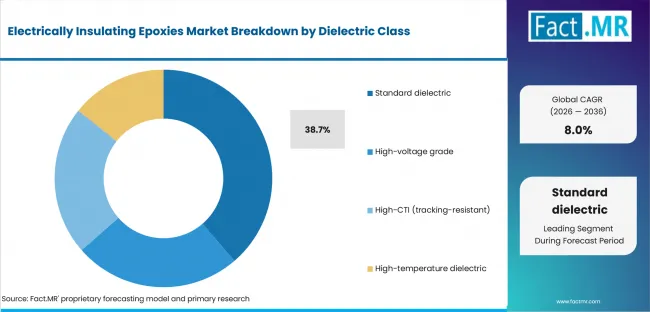
Electrically Insulating Epoxies Market Analysis By Dielectric Class | Source: Fact.MR
Standard dielectric grades address a broad range of transformers, motors and industrial electrical assemblies that require reliable insulation without the additional cost or processing constraints of highly specialized materials.
Their established performance allows manufacturers to qualify the resin against defined operating voltage and temperature requirements. More demanding applications can move to high-temperature or other specialist grades, but the installed base of conventional electrical equipment supports wider use of standard systems.
Why does Silica-filled lead Filler?
Silica-filled is projected to account for a 31.2% share in 2026.
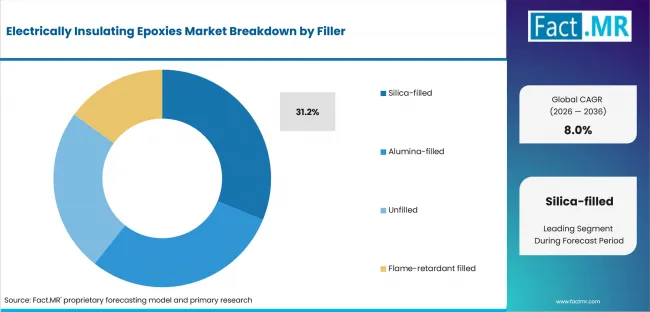
Electrically Insulating Epoxies Market Analysis By Filler | Source: Fact.MR
Silica modifies the dimensional behaviour of cured epoxy by reducing shrinkage and lowering thermal expansion relative to an unfilled resin. This is useful around copper windings and embedded electrical components that experience repeated temperature changes during operation.
Lower movement in the cured mass can reduce mechanical stress at interfaces between conductors and insulation. Suppliers can also adjust filler loading to balance dimensional stability against the viscosity required for effective potting.
Why does Electrical equipment lead End User?
Electrical equipment is projected to account for a 39.6% share in 2026.
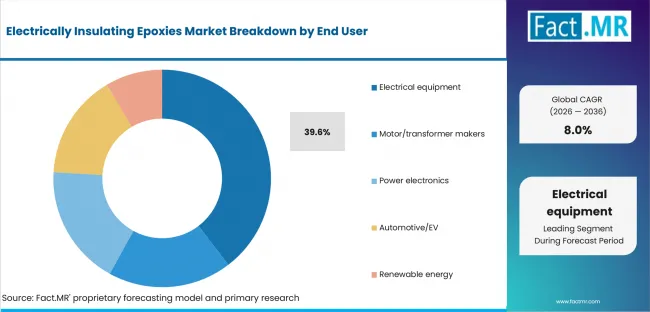
Electrically Insulating Epoxies Market Analysis By End User | Source: Fact.MR
Transformers, electric motors and control assemblies use insulating materials directly around windings or energized components. This creates repeated epoxy consumption during equipment manufacture rather than demand limited to occasional maintenance.
Grid modernization strengthens this application base. The U.S. Department of Energy identifies distribution transformers as fundamental grid components and reports continuing supply constraints as utilities respond to electrification and renewable-energy growth.
What is accelerating Electrically Insulating Epoxies Market adoption, and what is holding it back?
Drivers Impact Analysis
| Factor | (~) % Impact on CAGR | Geographic Relevance | Impact Timeline |
|---|---|---|---|
| Rising transformer and coil-potting requirements | +2.2% | China, USA, Germany, Japan and South Korea | Short term (<= 2 years) |
| Broad use of standard dielectric epoxy in electrical equipment | +1.8% | Global | Medium term (2-4 years) |
| Grid expansion and electrification investment | +1.3% | China, USA, Germany, Japan, South Korea and Europe | Long term (>= 4 years) |
Opportunity Impact Analysis
| Factor | (~) % Impact on CAGR | Geographic Relevance | Impact Timeline |
|---|---|---|---|
| Lower-stress insulation around densely wound conductors | +1.1% | China, Germany, Japan, USA and South Korea | Short term (<= 2 years) |
| High-temperature dielectric epoxy for power electronics and advanced electrical equipment | +0.9% | Germany, Japan, USA, China and South Korea | Medium term (2-4 years) |
| Automated vacuum potting for repeatable void control | +0.6% | Japan, Germany, China, USA and South Korea | Long term (>= 4 years) |
Restraints Impact Analysis
| Factor | (~) % Impact on CAGR | Geographic Relevance | Impact Timeline |
|---|---|---|---|
| Exotherm and cure shrinkage in large resin volumes | -1.0% | Global | Short term (<= 2 years) |
| Trapped voids around windings and embedded conductors | -0.8% | Global | Medium term (2-4 years) |
| Cost and time required for electrical qualification | -0.6% | Global | Long term (>= 4 years) |
These restraints should be treated as global process issues. Exotherm, shrinkage and void formation arise from the resin formulation and potting process rather than from conditions specific to one country.
Which countries are scaling the Electrically Insulating Epoxies Market through 2036?
- Germany: Germany's electrical-equipment, machinery and automotive industries create demand for dielectric epoxies across transformers, electric drives and industrial control systems. Continued investment in electrified equipment increases the importance of insulation systems that can withstand temperature cycling while maintaining dimensional stability.
- Japan: Japan combines transformer manufacturing with automotive electrification and precision electrical equipment. METI has also established updated energy-efficiency standards for transformers, keeping transformer design and manufacturing performance under continuing technical scrutiny.
- USA: U.S. grid investment is increasing demand for distribution and power transformers. The Department of Energy attributes long-term transformer demand to electrification, renewable-energy deployment and replacement of aging grid infrastructure, creating a direct demand path for insulating materials used during transformer manufacture.
- South Korea: South Korea's electronics, battery and automotive industries create applications for electrically insulating epoxy in motors, converters and related electrical assemblies. Continued investment in high-tech manufacturing increases requirements for materials that combine dielectric protection with controlled thermal and mechanical properties.
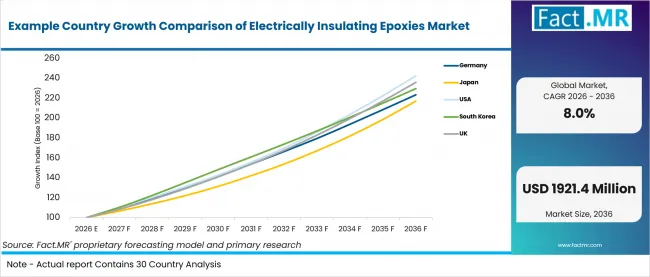
Example Country Growth Comparison Of Electrically Insulating Epoxies Market | Source: Fact.MR
Country CAGR (2026-2036)
| Country | CAGR (2026-2036) |
|---|---|
| Germany | 8.5% |
| Japan | 8.4% |
| USA | 8.9% |
| South Korea | 8.7% |
What is driving Germany's growth through 2036?
Germany is forecast to expand at an 8.5% CAGR from 2026 to 2036.
Germany's demand is tied to its electrical-equipment and industrial manufacturing base, where motors and power-control assemblies require reliable dielectric insulation. Electrification of transport and industrial systems adds more high-voltage components that must remain mechanically stable across repeated heating and cooling.
This creates opportunities for silica-filled and high-temperature epoxies where the insulation material must control thermal expansion around conductors while maintaining electrical properties. Local application support is important because winding geometry and cure conditions influence void formation during potting.
What is driving Japan's growth through 2036?
Japan is forecast to expand at an 8.4% CAGR from 2026 to 2036.
Japan has an established transformer and electrical-equipment industry alongside automotive electrification. METI has adopted updated energy-efficiency standards for transformers used in buildings and factories, reinforcing continued investment in transformer performance and production technology.
For insulating epoxy suppliers, the opportunity comes from equipment manufacturers that require repeatable dielectric and dimensional performance. Vacuum potting and controlled cure schedules can help maintain consistency around complex windings, supporting closer process development between resin suppliers and manufacturers.
What is driving the USA's growth through 2036?
The USA is forecast to expand at an 8.9% CAGR from 2026 to 2036.
The U.S. Department of Energy identifies increasing electricity demand, electrification and renewable-energy growth as drivers of distribution-transformer requirements. Aging infrastructure and utility investment in grid resilience add further replacement demand.
DOE also describes distribution transformers as fundamental components of the grid and is working with industry to shorten production times amid continuing supply constraints. Higher transformer output translates directly into greater consumption of dielectric potting and insulation materials during manufacturing.
What is driving South Korea's growth through 2036?
South Korea is forecast to expand at an 8.7% CAGR from 2026 to 2036.
South Korea's electronics and automotive manufacturing base creates demand for insulating materials in power conversion, electric drives and control assemblies. Expansion of battery and electrified-vehicle production adds further high-voltage components that require dielectric protection around conductors and electronic modules.
Domestic high-tech manufacturing also supports qualification of specialized formulations. Suppliers that can adjust filler loading and viscosity while maintaining predictable cure behaviour can work more closely with electrical-equipment manufacturers on production-specific potting requirements.
Who leads the Electrically Insulating Epoxies Market?
Henkel is positioned as a leading supplier through formulation breadth and technical support. Huntsman and Elantas (Altana) compete through application-specific materials for electronics or industrial equipment.
Competition is determined by cured performance and process consistency. Buyers assess viscosity and cure profile together with thermal, dielectric or mechanical requirements.
Qualification history and lot control create switching costs, so suppliers with stable formulations and local process support retain stronger positions.
Which companies are the key providers?
Key companies include Henkel; Huntsman; Elantas (Altana); Von Roll; Master Bond; and Epic Resins.
- Henkel
- Huntsman
- Elantas (Altana)
- Von Roll
- Master Bond
- Epic Resins
Bibliography
- U.S. Department of Energy. (2025). Materials Innovation for Distribution Transformers and Grid Equipment. U.S. Government.
- International Electrotechnical Commission. (2025). Electrical Insulation Systems and Dielectric Testing Standards. IEC.
- National Renewable Energy Laboratory. (2025). Thermal Management for Electric Drive Systems. U.S. Department of Energy.
- U.S. Department of Commerce. (2025). Advanced Manufacturing Programmes. U.S. Government.
- IPC. (2024). Electronics Assembly Process Control and Materials Standards. IPC.
- Ministry of Industry and Information Technology, China. (2026). Development of the Electronic Information Manufacturing Industry in 2025. Government of China.
- Federal Ministry for Economic Affairs and Climate Action, Germany. (2025). Industrial and Automotive Transformation Programmes. Government of Germany.
- Ministry of Economy, Trade and Industry, Japan. (2025). Strategy for Semiconductor and Digital Industry Revitalization. Government of Japan.
- U.S. Department of Commerce. (2025). CHIPS for America Advanced Packaging Manufacturing Program. U.S. Government.
- Ministry of Trade, Industry and Energy, Republic of Korea. (2025). High-Tech Strategic Industry and Materials Development Measures. Government of the Republic of Korea.
- ELANTAS. (2026). Electrical Insulating Resins for Transformers and Coils. ALTANA.
- Von Roll. (2026). Electrical Insulation Resin Systems. Von Roll.
This Report Answers
- The report examines demand across Application, Dielectric Class, Filler, End User.
- Segment analysis explains the operating reason behind each leading category.
- Country analysis evaluates the listed markets and adoption conditions through 2036.
- Competitive analysis reviews the listed companies and clarifies ownership or research roles where relevant.
- The analysis considers qualification, process control and application fit that influence purchasing decisions.
What does the Electrically Insulating Epoxies Market cover?
Electrically insulating epoxy compounds for potting, encapsulation and coating of transformers, motors, power modules and electronic assemblies requiring dielectric protection.
The assessment follows the stated segmentation by Application, Dielectric Class, Filler, End User. Revenue is counted only where the stated product or equipment is sold for the listed applications.
What is included in the scope?
The scope includes Transformer/coil potting, Motor encapsulation, Power module potting, PCB coating, Capacitor encapsulation.
It also covers Standard dielectric, High-voltage grade, High-CTI (tracking-resistant), High-temperature dielectric.
Demand is assessed across Filler: Silica-filled, Alumina-filled, Unfilled, Flame-retardant filled; End User: Electrical equipment, Motor/transformer makers, Power electronics, Automotive/EV, Renewable energy.
What is excluded from the scope?
Materials that do not meet the defined viscosity, electrical, thermal, vacuum or chemistry requirement are excluded.
Standalone mixers, dispensers and curing equipment are excluded from material revenue.
General construction resins are outside the market unless sold into the listed application.
How Was the Analysis Built?
The analysis combines product scope, segment demand, country outlook and supplier coverage.
- Primary Research: Interviews focus on formulators, distributors, equipment suppliers and end users responsible for bonding, potting or thermal management.
- Desk Research: The review covers technical standards, government manufacturing programmes and company product literature.
- Market Sizing and Forecasting: Estimates combine application volume, material use per part, formulation mix, pack size and realized pricing.
- Data Validation and Update Cycle: Findings are checked against public evidence and supplier portfolios. Updates review formulation changes, ownership changes and manufacturing shifts.
What is the report's scope and coverage?
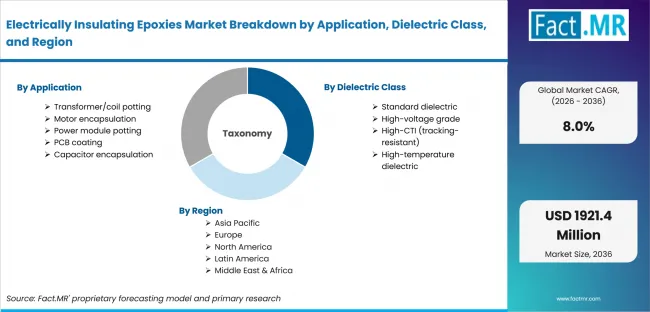
Electrically Insulating Epoxies Market Breakdown By Application, Dielectric Class, And Region | Source: Fact.MR
| Attribute | Details |
|---|---|
| Quantitative Units | USD 890.0 million in 2026 to USD 1,920.0 million by 2036 at a 8.0% CAGR |
| Market Definition | Electrically insulating epoxy compounds for potting, encapsulation and coating of transformers, motors, power modules and electronic assemblies requiring dielectric protection. |
| Segments Covered | Application; Dielectric Class; Filler; End User |
| Regions Covered | North America; Latin America; Europe; East Asia; South Asia and Oceania; Middle East and Africa |
| Countries Covered | Germany; Japan; USA; South Korea |
| Key Companies Profiled | Henkel; Huntsman; Elantas (Altana); Von Roll; Master Bond; Epic Resins |
| Forecast Period | 2026 to 2036 |
| Base Year | 2025 |
| Market Value, 2026 | USD 890.0 million |
| Market Value, 2036 | USD 1,920.0 million |
| CAGR, 2026-2036 | 8.0% |
| Absolute Opportunity | USD 1,030.0 million |
| Approach | Combines application volume, material use per part, formulation mix, pack size and realized pricing. |
How is the market segmented?
-
By Application
- Transformer/coil potting
- Motor encapsulation
- Power module potting
- PCB coating
- Capacitor encapsulation
-
By Dielectric Class
- Standard dielectric
- High-voltage grade
- High-CTI (tracking-resistant)
- High-temperature dielectric
-
By Filler
- Silica-filled
- Alumina-filled
- Unfilled
- Flame-retardant filled
-
By End User
- Electrical equipment
- Motor/transformer makers
- Power electronics
- Automotive/EV
- Renewable energy
-
By Region
- North America
- Latin America
- Western Europe
- Eastern Europe
- East Asia
- South Asia and Pacific
- Middle East & Africa