- Market Value (2025): USD 1.6 Bn
- Estimated Value (2026): USD 1.9 Bn
- Forecast Value (2036): USD 9.4 Bn
- CAGR (2026-2036): 17.2%
What is the High-Thrust Electric Propulsion Market forecast to be worth by 2036?
USD 1.9 billion in 2026 to USD 9.4 billion by 2036 at a 17.2% CAGR.
- The market is valued at USD 1.6 billion in 2025.
- Demand is projected to increase from USD 1.9 billion in 2026 to USD 9.4 billion by 2036.
- The market is forecast to record a 17.2% CAGR from 2026 to 2036.
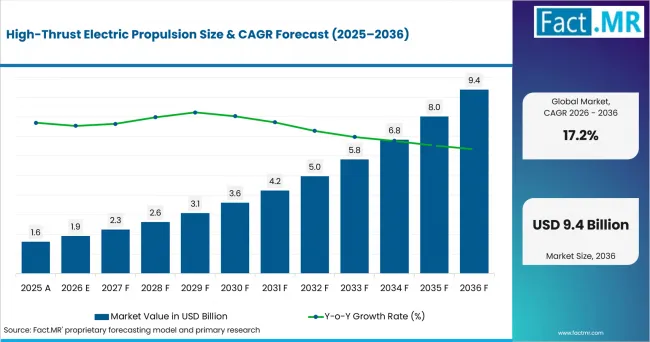
High Thrust Electric Propulsion Value Analysis | Source: Fact.MR
What are the defining numbers behind High-Thrust Electric Propulsion Market growth?
An absolute opportunity of USD 7.5 billion is expected between 2026 and 2036.
- Demand Drivers in the Market
- Qualification is moving higher-power Hall propulsion closer to mission deployment. NASA reported in 2025 that the 12-kW Advanced Electric Propulsion System had progressed through production and qualification activity for Gateway's Power and Propulsion Element, with component and environmental testing used to demonstrate design robustness.
- Power scaling is widening the mission envelope for electric propulsion. NASA TechPort reports that the XR-100 program demonstrated a nested Hall propulsion string at high power and showed that Hall technology can be scaled toward the 100-kW class, supporting future cislunar and transport requirements.
- Deep-space and transfer missions keep electric propulsion relevant beyond conventional satellite station keeping. JAXA describes electric propulsion as a key technology for complex satellite operations and as a final-stage propulsion option for deep-space transportation, while ESA continues electric-propulsion laboratory testing for long-duration missions.
- National space programs are increasing spacecraft development and integration activity. ASI reported continued IRIDE deployment in 2026, with additional Eaglet II satellites placed in orbit as part of a six-constellation program coordinated with ESA. A larger mission pipeline raises the need for propulsion engineering and qualified spacecraft subsystems.
- Qualification discipline is becoming more formal across European space procurement. ECSS created an Industrialization, production and maintenance branch in 2025 and continues to maintain engineering and product-assurance standards used in European space projects. This raises the value of propulsion systems that arrive with complete qualification evidence and production controls.
- Key Segments Analyzed
- By Thruster Type: High-power Hall thruster accounts for 41.0% share in 2026. Hall architecture has the strongest position because it combines a mature electric-propulsion lineage with an active path toward higher-power clustered and nested systems.
- By Power: 21-50 kW accounts for 31.0% share in 2026. This range provides a meaningful increase in transfer capability while remaining below the electrical and thermal integration burden associated with 100-kW-class systems.
- By Propellant: Xenon accounts for 39.0% share in 2026. Existing Hall and ion qualification programs use xenon, and test infrastructure has been built around its feed and vacuum-handling requirements.
- By Mission: Large LEO orbit raising accounts for 29.0% share in 2026. Electric propulsion can reduce propellant mass for sustained orbit transfer, while higher-power systems shorten transfer time compared with lower-power electric propulsion.
- Analyst Opinion at Fact.MR
- Shambhu Nath Jha, Sr. Consultant, Fact.MR says, “The commercial inflection point is the shift from proving a thruster in isolation to qualifying a complete propulsion string that includes power processing, propellant flow, thermal control, and long-duration operation. Hall systems have the clearest near-term route because flight-oriented qualification programs are already active, while ion and plasma architectures remain important where mission efficiency or specialized operating conditions justify a different design trade-off. The 21-50 kW power class is positioned as a practical bridge between established mid-power systems and 100-kW-class propulsion. Procurement decisions will depend on spacecraft power availability and mission duration, with propellant strategy becoming more important as xenon cost and availability encourage research into krypton and iodine alternatives.”
- Strategic Implications
- Propulsion suppliers should prioritize qualification of the full propulsion string rather than treating the thruster as a stand-alone product. Power processing, feed systems, thermal behavior, and lifetime verification are part of spacecraft acceptance.
- Spacecraft integrators should freeze the power and thermal architecture early. Moving from tens of kilowatts toward 100-kW-class propulsion changes solar-array sizing, electrical distribution, heat rejection, and vacuum-test requirements.
- Propellant planning should include supply resilience. Xenon remains the leading propellant, but ONERA's 2025 ECRA work on iodine and European work on alternative propellants show why qualification pathways for non-xenon options matter.
- Mission planners should select propulsion against transfer time and available spacecraft power. The value of high-thrust electric propulsion is strongest where a mission needs electric-propulsion efficiency without accepting the transfer duration of a lower-power system.
How does the High-Thrust Electric Propulsion Market break down by segment?
The market is segmented by Thruster Type, Power, Propellant, Mission, and Region. The leading 2026 categories are High-power Hall thruster in Thruster Type, 21-50 kW in Power, Xenon in Propellant, and Large LEO orbit raising in Mission.
Why does High-power Hall thruster lead Thruster Type?
High-power Hall thruster holds 41.0% of Thruster Type in 2026.
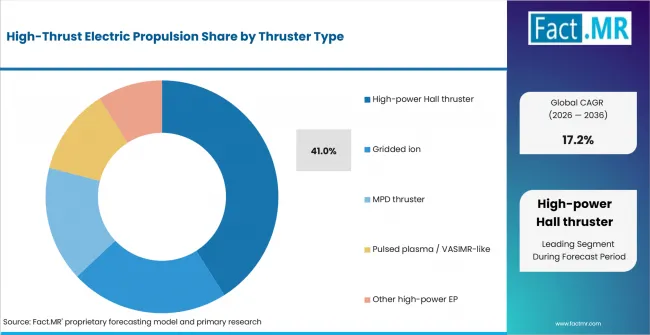
High Thrust Electric Propulsion Analysis By Thruster Type | Source: Fact.MR
Its position is supported by a development path that extends proven Hall-effect principles into higher-power propulsion strings. NASA's 2025 AEPS qualification work shows how a 12-kW Hall thruster is being moved through environmental and life-related verification for an operational spacecraft program.
The upper end of Hall propulsion is also being tested as an integrated system. NASA TechPort records the XR-100 program as a high-power electric propulsion effort based on a nested Hall thruster architecture. This gives Hall systems a clearer scale-up pathway than architectures that have less flight-oriented qualification activity at comparable system power.
Why does 21-50 kW lead Power?
The 21-50 kW range holds 31.0% of Power in 2026.
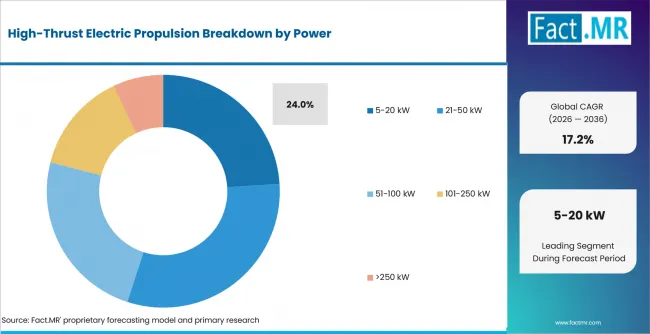
High Thrust Electric Propulsion Analysis By Power | Source: Fact.MR
It sits above established single-thruster mid-power systems and below the power-system demands of 100-kW-class propulsion, making it suitable for clustered architectures and spacecraft that need faster orbit transfer without redesigning the platform around very-high-power loads.
NASA's work from 12-kW AEPS hardware toward 100-kW-class Hall systems illustrates the engineering continuum. The commercial opportunity in 21-50 kW comes from occupying the middle of that continuum, where additional thrust can be obtained while qualification, thermal rejection, and electrical distribution remain more manageable than at the highest power bands.
Why does Xenon lead Propellant?
Xenon holds 39.0% of Propellant in 2026.
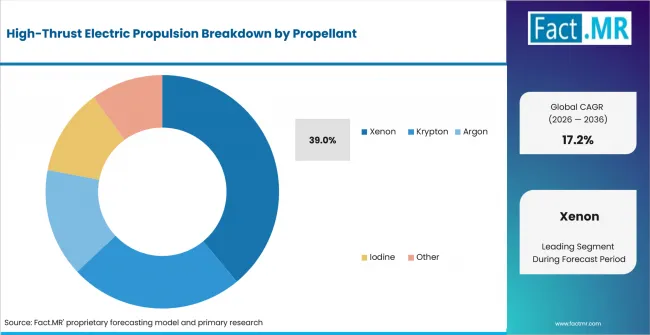
High Thrust Electric Propulsion Analysis By Propellant | Source: Fact.MR
Hall and gridded-ion programs have accumulated extensive operating experience with xenon, and current NASA and ESA test programs continue to use it in electric-propulsion hardware. That qualification heritage lowers integration risk for programs that place reliability ahead of propellant cost.
The same dependence creates an opening for alternatives. ONERA reported in May 2025 that its ECRA electric thruster, already operated on xenon, was being adapted for iodine. ONERA also notes iodine's storage and cost advantages while highlighting the additional plasma-chemistry and materials challenges that must be managed before broader adoption.
Why does Large LEO orbit raising lead Mission?
Large LEO orbit raising accounts for 29.0% of Mission in 2026.
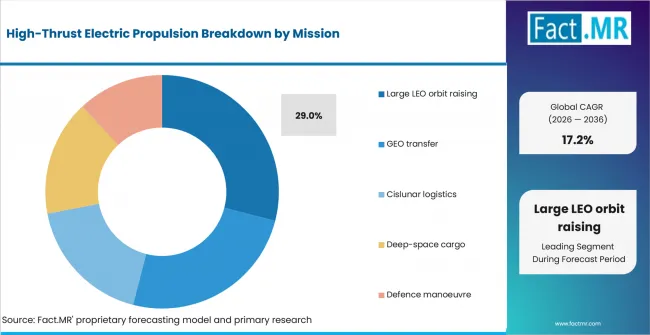
High Thrust Electric Propulsion Analysis By Mission | Source: Fact.MR
Orbit raising is a natural use case for electric propulsion because the spacecraft can trade longer firing duration for lower propellant consumption. Raising power improves this trade by increasing thrust and reducing transfer time relative to lower-power electric propulsion.
The mission logic is reinforced by active satellite deployment programs and by public agencies continuing to invest in electric-propulsion qualification. Higher-power systems are especially relevant for spacecraft with larger mass or tighter transfer schedules, where a low-power electric system can impose an operational delay even if propellant efficiency is attractive.
What is accelerating High-Thrust Electric Propulsion Market adoption, and what is holding it back?
Adoption is being accelerated by qualification of higher-power Hall systems, wider use of electric propulsion for orbit transfer, and mission planning beyond Earth orbit. NASA's Gateway propulsion work links high-power solar electric propulsion with cislunar operations, while JAXA identifies electric propulsion as a key technology for deep-space transportation.
The main constraints are integration and qualification. Electric propulsion at higher power requires larger electrical supply and heat-rejection capacity, and long-duration thruster operation must be demonstrated in vacuum facilities. Propellant availability also matters. Xenon has strong qualification heritage, but its cost and supply limitations are encouraging work on krypton and iodine, which introduces new feed-system and materials questions.
Drivers Impact Analysis
| Driver | Market effect | Geographic relevance | Impact timeline |
|---|---|---|---|
| Qualification of higher-power Hall propulsion strings | High positive | USA and Europe | Near to mid term |
| Growth in orbit-transfer and maneuvering requirements | High positive | Global spacecraft programs | Near to long term |
| Cislunar and deep-space transportation planning | Moderate positive | USA, Japan and Europe | Mid to long term |
Opportunity Impact Analysis
| Opportunity | Market effect | Geographic relevance | Impact timeline |
|---|---|---|---|
| Scaling from mid-power systems into the 21-50 kW class | High positive | USA and Europe | Near to mid term |
| Alternative propellants such as krypton and iodine | Moderate positive | France, Germany and Europe | Mid term |
| Integrated propulsion for cislunar logistics and deep-space cargo | High positive | USA, Japan and Europe | Mid to long term |
Restraints Impact Analysis
| Restraint | Market effect | Geographic relevance | Impact timeline |
|---|---|---|---|
| Long qualification and life-test requirements | High negative | Global | Near to mid term |
| Spacecraft power and thermal integration burden | High negative | Global | Near to long term |
| Xenon availability and alternative-propellant qualification | Moderate negative | Global | Mid term |
Which countries are scaling the High-Thrust Electric Propulsion Market through 2036?
- USA: The market is forecast to expand at a 16.4% CAGR from 2026 to 2036. NASA's Hall-thruster qualification work and Glenn Research Center test capability support a domestic path from development hardware to integrated high-power propulsion systems.
- France: The market is forecast to expand at an 18.2% CAGR from 2026 to 2036. ONERA maintains electric-propulsion research and vacuum-test capability, including current work on ECRA and iodine propellant chemistry.
- Italy: The market is forecast to expand at an 18.7% CAGR from 2026 to 2036. ASI's continuing satellite programs add mission cadence and spacecraft integration activity that can support demand for more capable propulsion systems.
- Germany: The market is forecast to expand at a 16.1% CAGR from 2026 to 2036. DLR research covers radio-frequency ion propulsion and multistage plasma engines, with continued work on electric-propulsion system integration and qualification.
- Japan: The market is forecast to expand at a 16.8% CAGR from 2026 to 2036. JAXA's electric-propulsion research spans ion engines, pulsed-plasma thrusters and MPD technology, with deep-space transportation identified as a core application.
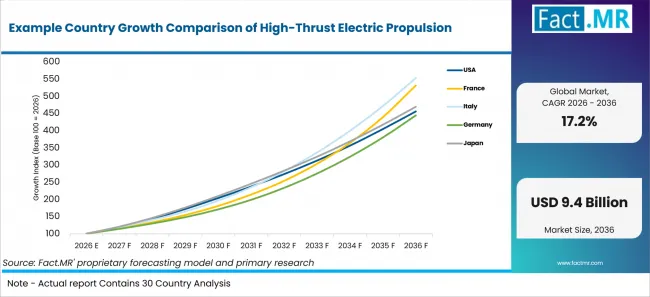
Example Country Growth Comparison Of High Thrust Electric Propulsion | Source: Fact.MR
Country CAGR (2026-2036)
| Country | CAGR |
|---|---|
| USA | 16.4% |
| France | 18.2% |
| Italy | 18.7% |
| Germany | 16.1% |
| Japan | 16.8% |
What is driving USA's growth through 2036?
The USA is forecast to expand at a 16.4% CAGR from 2026 to 2036.
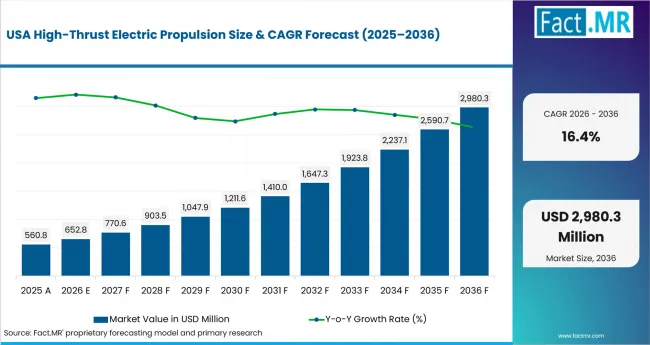
High Thrust Electric Propulsion Country Value Analysis | Source: Fact.MR
NASA is advancing Hall propulsion at two relevant scales. Its 12-kW AEPS program is in qualification for Gateway's Power and Propulsion Element, while the XR-100 program demonstrated a nested Hall propulsion string intended to test the viability of 100-kW-class electric propulsion.
This combination of flight-oriented qualification and high-power ground testing reduces the distance between laboratory performance and spacecraft integration. NASA Glenn also provides the vacuum and electrical infrastructure required to test electric propulsion at high power, which supports domestic development across thrusters and integrated propulsion hardware.
What is driving France's growth through 2036?
France is forecast to expand at an 18.2% CAGR from 2026 to 2036.
ONERA's electric-propulsion work provides a national research base for plasma behavior and propellant alternatives. In May 2025, ONERA reported that its ECRA thruster was being adapted from xenon to iodine and that the ERIS vacuum facility supports electric-propulsion testing.
The immediate ECRA program operates below the high-power classes covered by this market, but the underlying capability is relevant to scale-up because propellant chemistry, plasma diagnostics and vacuum testing remain central to higher-power systems. France therefore has a research mechanism that can support future qualification and propulsion-system engineering as mission power increases.
What is driving Italy's growth through 2036?
Italy is forecast to expand at an 18.7% CAGR from 2026 to 2036.
ASI reported in March 2026 that the IRIDE program had added eight Eaglet II satellites, bringing that constellation to 16 satellites in orbit, with further deployment planned during 2026. The program is coordinated by ESA with ASI support and forms part of a wider six-constellation initiative.
A sustained national satellite pipeline strengthens spacecraft integration and operations capability. For high-thrust electric propulsion, the commercial relevance is the expansion of missions that can eventually require larger orbit-change budgets, heavier platforms, or more demanding maneuver profiles, creating room for higher-power propulsion as those mission requirements develop.
What is driving Germany's growth through 2036?
Germany is forecast to expand at a 16.1% CAGR from 2026 to 2036.
DLR identifies radio-frequency ion propulsion and highly efficient multistage plasma engines as focal areas for German research. DLR's 2025 DEEP work also addresses the integration of electric propulsion with compact energy supply, highlighting the system-level link between thruster operation and spacecraft power architecture.
Germany's opportunity is therefore tied to research depth and qualification capability rather than to a single mission program. Work on propulsion physics, power integration and spacecraft demonstration can support suppliers that need to validate new electric-propulsion configurations before wider mission adoption.
What is driving Japan's growth through 2036?
Japan is forecast to expand at a 16.8% CAGR from 2026 to 2036.
JAXA states that electric propulsion is a key technology for complex satellite operations and for deep-space transportation when used as a final-stage propulsion system. Its research portfolio includes pulsed-plasma thrusters, DC arc jets, MPD technology and microwave-discharge ion engines.
JAXA's experience with ion propulsion on Hayabusa missions gives Japan a deep-space technology base that can inform future higher-power systems. Current spacecraft programs such as HTV-X also maintain an active platform-development environment for power, operations and in-space technology demonstration, all of which are relevant when propulsion systems become more electrically demanding.
Who Leads the High-Thrust Electric Propulsion Market?
Competition in the high-thrust electric propulsion market includes established spacecraft propulsion suppliers and specialist developers focused on Hall-effect, ion and plasma-based propulsion systems. Market leadership varies by propulsion architecture, spacecraft class and mission requirement, which makes a single supplier ranking less meaningful across the full market.
Competitive strength is shaped by flight heritage, demonstrated operating life, power-processing integration and the ability to support spacecraft qualification. Suppliers with proven high-power systems, reliable in-orbit performance and close integration with satellite platforms are likely to hold stronger positions as demand expands across large spacecraft, orbital-transfer vehicles and other high-energy missions.
Which companies are the key providers?
Key Companies includes Safran; Aerojet Rocketdyne / L3Harris; Busek; Thales Alenia Space; SITAEL; Ad Astra Rocket Company
- Safran
- Aerojet Rocketdyne / L3Harris
- Busek
- Thales Alenia Space
- SITAEL
- Ad Astra Rocket Company
Bibliography
- National Aeronautics and Space Administration. (2025, May 5). 12-kW Advanced Electric Propulsion System Hall Current Thruster Qualification and Production Status. NASA Technical Reports Server.
- National Aeronautics and Space Administration. (2025, December 18). High Power Electric Propulsion (HPEP). NASA TechPort.
- Office national d'etudes et de recherches aerospatiales. (2025, May). Propulsion electrique: la technologie ECRA. ONERA.
- Italian Space Agency. (2026, March 30). IRIDE continues its development: eight more Eaglet II satellites in orbit. ASI.
- German Aerospace Center. (2025, September 25). DEEP - Decentralized Energy supplied Electric Propulsion - a new propulsion system developed for small satellites. DLR Electronic Library.
- German Aerospace Center. Electric propulsion systems. German Space Agency at DLR.
- Japan Aerospace Exploration Agency. Research on Space Technologies: Electric Propulsion. JAXA.
- Japan Aerospace Exploration Agency. (2026, February 19). Target Dates and Times for the Departure of HTV-X1 from the ISS. JAXA.
- European Space Agency. (2025, April 3). Firing up Henon's engine. ESA.
- European Cooperation for Space Standardization. (2025, March 20). I-Branch is born! ECSS.
- European Cooperation for Space Standardization. (2025, November 21). ECSS-S-ST-00C Rev.2: Description, implementation and general requirements. ECSS.
This Report Answers
- How large is the High-Thrust Electric Propulsion Market in 2025 and 2026, and what is the 2036 forecast?
- Which Thruster Type, Power, Propellant and Mission categories lead the market in 2026?
- What technical and qualification factors are accelerating adoption of higher-power electric propulsion?
- How do market growth mechanisms differ across the USA, France, Italy, Germany and Japan?
- Which companies participate in the High-Thrust Electric Propulsion Market?
- What technologies, missions and adjacent systems are included or excluded from the market scope?
What does the High-Thrust Electric Propulsion Market cover?
The High-Thrust Electric Propulsion Market covers electric-propulsion thrusters and integrated propulsion-system hardware used where spacecraft require more transfer or maneuver capability than low-power station-keeping systems can provide. The market includes high-power Hall thrusters, gridded ion systems, magnetoplasmadynamic thrusters, pulsed-plasma and VASIMR-like systems, and other high-power electric-propulsion architectures within the stated taxonomy.
Commercial coverage extends across propulsion power from 5-20 kW through systems above 250 kW. Propellant coverage includes xenon, krypton, argon, iodine and other in-scope propellants. Mission demand includes large LEO orbit raising, GEO transfer, cislunar logistics, deep-space cargo and defence manoeuvre applications.
What is included in the scope?
The scope includes thruster hardware and propulsion-system components that are sold as part of an electric-propulsion capability for the defined power classes and missions. Integrated power-processing and propellant-flow elements are included when they form part of the propulsion system supplied for spacecraft use.
The market includes systems at development, qualification and commercial deployment stages where they fit the defined technology and mission boundary. ECSS defines a spacecraft propulsion system as the set of components used to provide thrust, including thrusters, propellant-related hardware and electrical components, which supports the system-level boundary used here.
What is excluded from the scope?
Chemical propulsion systems are excluded when they are sold as stand-alone chemical thrusters or engines. Low-power electric propulsion used only for small-satellite station keeping is outside the market when it does not fit the stated high-thrust electric-propulsion power and mission classes.
Standalone solar arrays, spacecraft buses, launch vehicles, ground vacuum facilities and generic power electronics are excluded unless they are supplied as an inseparable part of an in-scope electric-propulsion system. Research services without commercial propulsion hardware are also outside the market boundary.
How Was the Analysis Built?
The analysis is based on a structured research methodology combining primary research, desk research, data validation and market forecasting.
- Primary Research: Interviews and discussions with manufacturers, suppliers, distributors, technology providers, industry experts and other participants across the value chain are used to understand demand conditions, technology adoption, competitive developments and market outlook.
- Desk Research: Publicly available information from company reports, investor presentations, government agencies, industry associations, regulatory bodies and other credible institutional sources is reviewed to establish the market structure and assess industry developments.
- Data Validation: Findings from primary and desk research are cross-checked across multiple sources to verify market estimates, segment shares, regional patterns and growth assumptions.
- Market Forecasting: Historical trends, current demand indicators, technology developments and expected changes in end-use industries are assessed to develop the market outlook across the defined forecast period.
What is the report's scope and coverage?
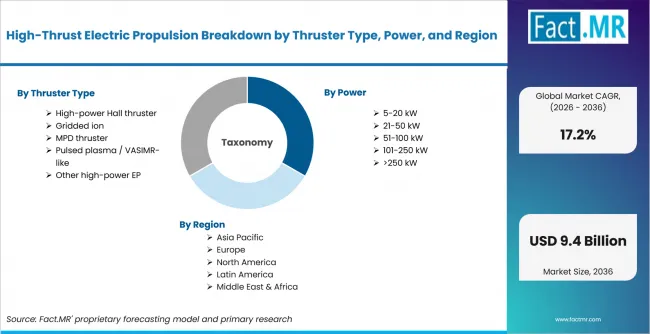
High Thrust Electric Propulsion Breakdown By Thruster Type, Power, And Region | Source: Fact.MR
| Attribute | Details |
|---|---|
| Quantitative units | USD billion |
| Market definition | Higher-power electric propulsion thrusters and integrated propulsion systems used for spacecraft orbit raising, transfer, cislunar logistics, deep-space cargo and defence manoeuvre applications. |
| Thruster Type | High-power Hall thruster; Gridded ion; MPD thruster; Pulsed plasma / VASIMR-like; Other high-power EP |
| Power | 5-20 kW; 21-50 kW; 51-100 kW; 101-250 kW; >250 kW |
| Propellant | Xenon; Krypton; Argon; Iodine; Other |
| Mission | Large LEO orbit raising; GEO transfer; Cislunar logistics; Deep-space cargo; Defence manoeuvre |
| Regions covered | North America; Latin America; Western Europe; Eastern Europe; East Asia; South Asia & Pacific; Middle East & Africa |
| Countries analyzed | USA; France; Italy; Germany; Japan |
| Key companies | Safran; Aerojet Rocketdyne / L3Harris; Busek; Thales Alenia Space; SITAEL; Ad Astra Rocket Company |
| Forecast period | 2026 to 2036 |
| Evidence framework | National space agencies, public research organizations, ESA and ECSS standards |
How is the market segmented?
-
By Thruster Type
- High-power Hall thruster
- Gridded ion
- MPD thruster
- Pulsed plasma / VASIMR-like
- Other high-power EP
-
By Power
- 5-20 kW
- 21-50 kW
- 51-100 kW
- 101-250 kW
- >250 kW
-
By Propellant
- Xenon
- Krypton
- Argon
- Iodine
- Other
-
By Mission
- Large LEO orbit raising
- GEO transfer
- Cislunar logistics
- Deep-space cargo
- Defence manoeuvre
-
By Region
- North America
- Latin America
- Western Europe
- Eastern Europe
- East Asia
- South Asia & Pacific
- Middle East & Africa