The Inflammatory Bowel Disease Biologics Market is analyzed across its key product, application and end-use segments, with the study covering market dynamics, regional trends and demand outlook, forecast 2026 to 2036.
By Fact.MR Healthcare DeskFact-checked under the Fact.MR editorial processUpdated
10 min read
Inflammatory Bowel Disease Biologics Market Forecast and Outlook 2026 to 2036
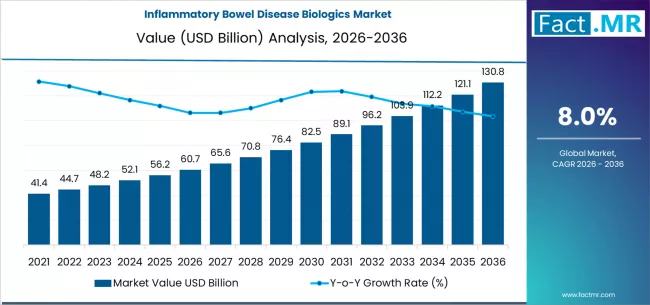
The global inflammatory bowel disease biologics market is projected to grow to USD 60.73 billion in 2026, and to USD 130.81 billion by 2036 at a CAGR of 8.0%. This robust expansion is sustained by the chronic, progressive nature of IBD, necessitating long-term treatment, and the ongoing shift towards biologic therapy as a standard of care for moderate-to-severe disease.
Summary of Inflammatory Bowel Disease Biologics Market
Market Snapshot
Global inflammatory bowel disease biologics market revenue stood at USD 60.73 billion in 2026 and is forecast to reach USD 130.81 billion by 2036.
Ata8.0% CAGR from 2026 to 2036, this market is set to expand ~2.2x in value, adding USD 70.08 billion in absolute opportunity.
Growth is being driven by the chronic, progressive nature of IBD requiring long-term treatment and the increasing shift toward biologic therapies as standard care.
Biologics areemergingas core therapeutic solutions for moderate-to-severe IBD, enabling sustained remission and improved disease management outcomes.
Demand and Growth Drivers
Rising prevalence of Crohn’s disease and ulcerative colitis is accelerating demand for biologic therapies.
Increasing adoption of biologics as frontline therapy for moderate-to-severe IBD is driving market expansion.
Continuous entry of novel biologic agents with differentiated mechanisms of action is enhancing treatment options.
Need for therapies that provide:
Sustained clinical and endoscopic remission
Reduced relapse rates
Targeted immune response modulation
Long-term disease control
Advancements in biologic drug development and biosimilars are improving accessibility and treatment outcomes.
Product and Segment View
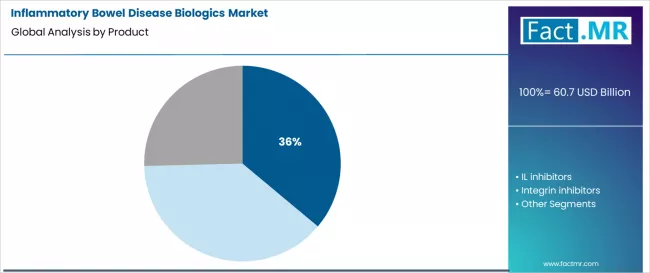
Anti-TNF Agents hold 36.1% of product type share in 2026,emergingas the leading segment.
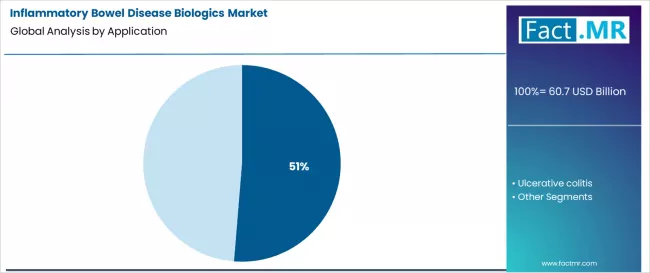
Crohn’s Disease accounts for 51.3% of application share in 2026, positioning it as the dominant segment.
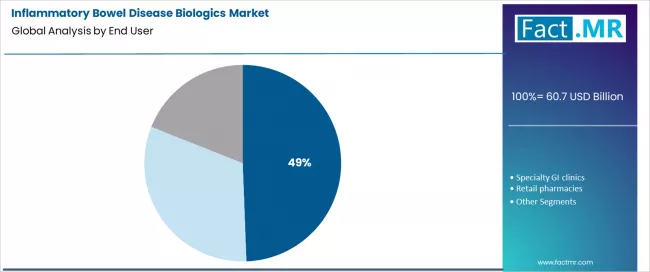
Hospital Pharmaciesrepresent49.4% of end-user share in 2026, reflecting primary distribution channels.
Key product categories include:
Anti-TNF agents
Interleukin inhibitors
Integrin receptor antagonists
Biosimilars and emerging biologics
Geography and Competitive Outlook
Growth is supported globally, driven by increasing biologic therapy adoption and healthcare advancements.
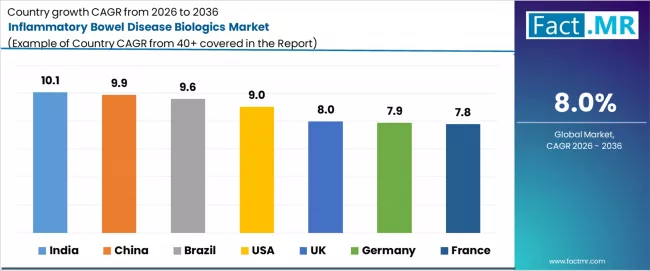
Key growth markets and CAGR: India 10.1%, China 9.9%, Brazil 9.6%, USA 9.0%, UK 8.0%, Germany 7.9%, France 7.8%.
Market expansion is closely tied to:
Rising disease prevalence
Expansion of biologic therapy adoption
Continuous innovation in immunology-based treatments
Key companies active in this marketinclude:AbbVie Inc., Johnson & Johnson, Takeda Pharmaceutical Company Limited, Pfizer Inc., Bristol-Myers Squibb Company
Inflammatory Bowel Disease Biologics Market — At a Glance
Attribute
Details
Market Value 2026
USD 60.73 billion
Market Value 2036
USD 130.81 billion
Absolute Dollar Opportunity 2026-2036
USD 70.08 billion
Total Growth 2026-2036
115.4%
CAGR 2026-2036
8.0%
Growth Multiple
~2.2x
Key Demand Theme
Increasing adoption of biologic therapies for long-term management of IBD
Leading Segment by Product Type (2026)
Anti-TNF Agents
Segment Share (2026)
36.1%
Leading Segment by Application (2026)
Crohn’s Disease
Segment Share (2026)
51.3%
Leading Segment by End User (2026)
Hospital Pharmacies
Segment Share (2026)
49.4%
Key Growth Regions
Asia-Pacific, North America, Europe
Country CAGRs
India 10.1%, China 9.9%, Brazil 9.6%, USA 9.0%, UK 8.0%, Germany 7.9%, France 7.8%
Top Companies
AbbVie Inc., Johnson & Johnson, Takeda Pharmaceutical Company Limited, Pfizer Inc., Bristol-Myers Squibb Company
North America, Latin America, Europe, Asia Pacific, MEA
The evolution of the inflammatory bowel disease biologics market is marked by an increasingly crowded and competitive landscape, where therapeutic success is defined by achieving and maintaining deep remission, including endoscopic healing. Growth is propelled by the continuous entry of novel agents with distinct mechanisms of action, offering solutions for patients who fail or lose response to existing therapies. A key trend is the strategic movement towards more convenient subcutaneous formulations and extended dosing intervals, which enhance patient adherence and quality of life. Additionally, the market is witnessing a significant evolution in treatment paradigms, with a growing emphasis on using clinical and biomarker data to personalize therapy sequences and optimize outcomes. The competitive intensity is driving research into next-generation biologics and small molecules that target novel inflammatory pathways, aiming for improved safety profiles and greater efficacy in difficult-to-treat patient populations.
Category
Category
Segments
Product
Anti-TNF Agents, IL Inhibitors, Integrin Inhibitors
Application
Crohn’s Disease, Ulcerative Colitis
End User
Hospital Pharmacies, Specialty GI Clinics, Retail Pharmacies
Region
North America, Latin America, Western Europe, Eastern Europe, East Asia, South Asia & Pacific, Middle East & Africa
Segmental Analysis
By Product, Which Segment Maintains Leadership Through Extensive Real-World Experience?
Anti-TNF agents command a leading 36.1% share, underpinned by their longstanding position as the first major biologic class in IBD. Their dominance is supported by over two decades of clinical use, well-understood safety and efficacy profiles, and the availability of biosimilars which have expanded access. Despite competition from newer mechanisms, they remain a foundational treatment option, often serving as the first biologic for newly diagnosed patients with severe disease.
By Application, Which Complex Condition Drives Significant Utilization of Advanced Therapies?
Crohn’s disease constitutes the primary application segment at 51.3%. The transmural and often complicated nature of CD, including fistulizing and structuring phenotypes, creates a high need for potent biologic therapies to induce and maintain remission. The chronic, progressive course of the disease ensures a sustained and growing patient pool requiring advanced treatment, solidifying its position as the largest application for IBD biologics.
By End User, Which Channel is Critical for Administering and Managing Infusion Therapies?
Inflammatory Bowel Disease Biologics Market Analysis By End User | Source: Fact.MR
Hospital pharmacies form the dominant end-user segment at 49.4%. This reflects the fact that a significant portion of biologic therapies, particularly intravenous formulations and complex induction regimens, are administered in hospital infusion centers or affiliated clinics. These settings provide the necessary infrastructure for safe administration, monitoring for acute reactions, and managing patients with severe disease activity.
What are the Principal Drivers, Constraints, and Evolving Dynamics of this Market?
The principal driver is the rising global prevalence and diagnosis of IBD, coupled with treatment guidelines that advocate for earlier and more aggressive use of biologics to prevent disease complications and disability.
A major constraint is the development of immunogenicity and secondary loss of response to biologic therapies, which can lead to treatment cycling and increased healthcare costs. A significant opportunity lies in the expansion into emerging markets where diagnosis rates are rapidly increasing, and biologic penetration is currently low but growing.
The dominant trend is the intensifying focus on treat-to-target and precision medicine approaches, utilizing biomarker monitoring and therapeutic drug monitoring to optimize dosing, reduce immunogenicity, and personalize treatment sequences for improved long-term outcomes.
Analysis of the Inflammatory Bowel Disease Biologics Market by Key Countries
Inflammatory Bowel Disease Biologics Market Cagr Analysis By Country | Source: Fact.MR
Country
CAGR 2026 to 2036
India
10.1%
China
9.9%
Brazil
9.6%
USA
9.0%
UK
8.0%
Germany
7.9%
France
7.8%
Is the USA's Market Characterized by Rapid Novel Agent Uptake and Competitive Biosimilar Penetration?
The USA’s 9.0% CAGR is driven by high treatment rates, favorable reimbursement for specialty drugs, and rapid adoption of newly approved agents within a competitive payer landscape. Growth is shaped by the significant penetration of anti-TNF biosimilars, which are reducing costs for older therapies, while novel IL and integrin inhibitors capture premium pricing. The market is highly dynamic, with choice influenced by payer formularies and specialist preference in hospital-based practices.
Can Brazil's Public Health System Integrate High-Cost Biologics for a Growing IBD Population?
Brazil’s 9.6% CAGR is challenged by the need to fund lifelong, expensive biologic therapies within its public Unified Health System (SUS). Access is often secured through judicial rulings or restrictive public protocols. Growth is consequently uneven, with broader availability of older anti-TNF agents, while newer classes are predominantly accessible only in the private healthcare sector, creating a significant access disparity.
Does China's Market Growth Reflect Westernization, Improved Diagnosis, and Domestic Innovation?
China’s 9.9% CAGR is fueled by rapidly rising IBD incidence linked to dietary and environmental changes, alongside major improvements in endoscopic diagnostic capabilities. The market is expanding as more biologics are included in the National Reimbursement Drug List (NRDL). Domestic biopharma companies are actively developing biosimilars and novel biologics, which will increase competition and potentially improve access over the forecast period.
Will India's Market Emergence be Led by a Burgeoning Patient Pool and Evolving Specialist Infrastructure?
A large, young, and increasingly diagnosed patient population propels India’s leading 10.1% CAGR. Growth is currently constrained by high out-of-pocket costs but is being unlocked by the expanding network of private specialty gastroenterology clinics in urban centers and the gradual introduction of biosimilars, which are making foundational biologic therapy more financially accessible.
Is Germany's Guideline-Driven System Optimizing Biologic Sequencing and Cost Management?
Germany’s 7.9% CAGR operates within a structured framework defined by specialist society guidelines. Adoption of new therapies is methodical, based on robust clinical data and health technology assessments. The market emphasizes the optimal sequential use of biologics and incorporates biosimilars as a key cost-containment tool within the statutory health insurance system, leading to steady, value-focused growth.
Does France's Emphasis on Hospital-Led Care and Real-World Evidence Moderate Adoption Speed?
A hospital-centric model for initiating complex biologic therapies characterizes France’s 7.8% CAGR. New agents are often subject to rigorous evaluation of real-world effectiveness post-launch.
Growth is consistent but can be initially slower as specialists gather experience and data, with broad reimbursement contingent on demonstrating added therapeutic value to the Haute Autorité de Santé.
Is the UK's NICE Appraisal Process the Definitive Gatekeeper for Biologic Market Access?
The UK’s 8.0% CAGR is fundamentally governed by the cost-effectiveness appraisals of the National Institute for Health and Care Excellence (NICE). Access to new, high-cost biologics is carefully managed, typically requiring patients to fail conventional therapy and often older biologics first. Market growth follows a highly regulated, step-wise pathway within the NHS budget, prioritizing therapies with the strongest cost-per-QALY evidence.
Competitive Landscape of the Inflammatory Bowel Disease Biologics Market
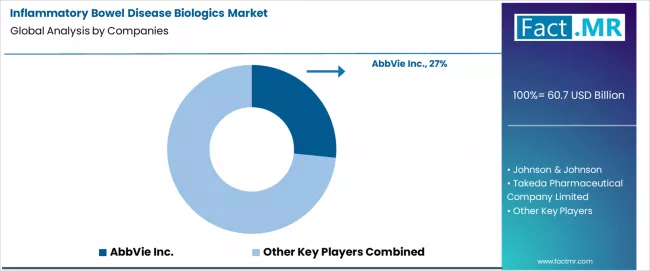
Inflammatory Bowel Disease Biologics Market Analysis By Company | Source: Fact.MR
The competitive landscape is intensely rivalrous, featuring several multinational pharmaceutical giants with competing and overlapping portfolios. Companies compete on the strength of clinical data from head-to-head trials, the convenience of administration, dosing frequency, and long-term safety profiles. A key battleground is securing favorable positions in national and international treatment guidelines as first- or second-line therapy.
Given the chronic nature of IBD, competitive success is heavily reliant on building comprehensive patient support programs that improve adherence and outcomes. Strategic focus includes life-cycle management of blockbuster drugs through new formulations or indications, and aggressive development of next-generation therapies targeting novel pathways like JAK inhibition or IL-23 inhibition. The rapid growth of the biosimilar segment for anti-TNFs has added a layer of price competition, forcing originator companies to defend their brands with superior service and data.
Key Players in the Inflammatory Bowel Disease Biologics Market
AbbVie Inc.
Johnson & Johnson
Takeda Pharmaceutical Company Limited
Pfizer Inc.
Bristol-Myers Squibb Company
Others
Bibliography
European Crohn’s and Colitis Organisation (ECCO). (2025). Consensus Guidelines on the Use of Biologics and Small Molecules in IBD.
International Organization for the Study of Inflammatory Bowel Disease (IOIBD). (2024). Selecting Therapeutic Targets in Inflammatory Bowel Disease (STRIDE-III).
The American Gastroenterological Association (AGA). (2025). Clinical Guideline on the Pharmacological Management of Crohn’s Disease and Ulcerative Colitis.
The Lancet Gastroenterology & Hepatology. (2024). Series on the Future of IBD Management.
Scope of Report
Items
Metrics
Quantitative Units
USD Billion
Product
Anti-TNF Agents, IL Inhibitors, Integrin Inhibitors
Application
Crohn’s Disease, Ulcerative Colitis
End User
Hospital Pharmacies, Specialty GI Clinics, Retail Pharmacies
Key Countries
India, China, Brazil, USA, Germany, France, UK
Key Companies
AbbVie, Johnson & Johnson, Takeda, Pfizer, Bristol-Myers Squibb, Others
Additional Analysis
Impact of biosimilars on market value and access patterns; therapeutic drug monitoring adoption and its effect on treatment persistence; pharmacoeconomic models comparing different biologic sequences; analysis of pipeline agents targeting novel mechanisms (e.g., JAK, S1P).
Market by Segments
Product :
Anti-TNF Agents
IL Inhibitors
Integrin Inhibitors
Application :
Crohn’s Disease
Ulcerative Colitis
End User :
Hospital Pharmacies
Specialty GI Clinics
Retail Pharmacies
Region :
North America
USA
Canada
Latin America
Brazil
Mexico
Argentina
Rest of Latin America
Western Europe
Germany
France
UK
Italy
Spain
BENELUX
Rest of Western Europe
Eastern Europe
Russia
Poland
Czech Republic
Rest of Eastern Europe
East Asia
China
Japan
South Korea
Rest of East Asia
South Asia & Pacific
India
ASEAN
Australia
Rest of South Asia & Pacific
MEA
GCC Countries
South Africa
Turkiye
Rest of MEA
Frequently Asked Questions
How big is the inflammatory bowel disease biologics market in 2026?
The global inflammatory bowel disease biologics market is estimated to be valued at USD 60.7 billion in 2026.
What will be the size of inflammatory bowel disease biologics market in 2036?
The market size for the inflammatory bowel disease biologics market is projected to reach USD 130.8 billion by 2036.
How much will be the inflammatory bowel disease biologics market growth between 2026 and 2036?
The inflammatory bowel disease biologics market is expected to grow at a 8.0% CAGR between 2026 and 2036.
What are the key product types in the inflammatory bowel disease biologics market?
The key product types in inflammatory bowel disease biologics market are anti-tnf agents, il inhibitors and integrin inhibitors.
Which application segment to contribute significant share in the inflammatory bowel disease biologics market in 2026?
In terms of application, crohn’s disease segment to command 51.3% share in the inflammatory bowel disease biologics market in 2026.