- Market Value (2025): USD 194.3 Bn
- Estimated Value (2026): USD 208.3 Bn
- Forecast Value (2036): USD 417.5 Bn
- CAGR (2026-2036): 7.2%
What is the Insulated Wires and Cables Market forecast to be worth by 2036?
USD 208.3 billion in 2026 and USD 417.5 billion by 2036, representing a 7.2% CAGR.
- The insulated wires and cables market reached USD 194.3 billion in 2025.
- Demand is projected to increase from USD 208.3 billion in 2026 to USD 417.5 billion by 2036.
- The market is forecast to record 7.2% CAGR from 2026 to 2036 as utilities and contractors specify safer cable runs. Telecom operators and industrial teams add separate demand.
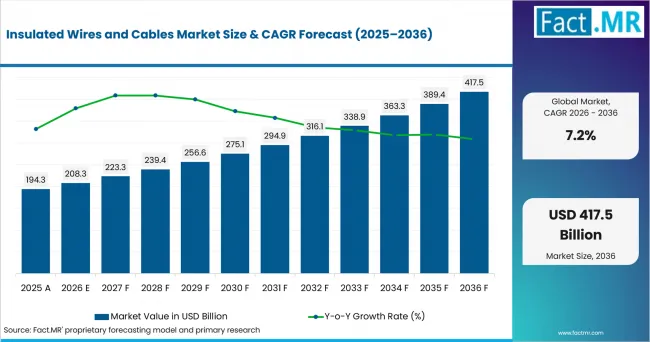
Insulated Wires And Cables Market Value Analysis | Source: Fact.MR
What are the defining numbers behind Insulated Wires and Cables Market growth?
USD 209.2 billion between 2026 and 2036, led by Low Voltage Insulated Cables, Power Transmission & Distribution, Utilities and XLPE Insulation Technology.
- Demand Drivers in the Market
- Utility procurement teams need reliable cable supply as distribution upgrades move from planning to field installation. The U.S. Energy Information Administration reported in March 2026 that U.S. electricity generation reached 4.43 thousand TWh in 2025, up 2.8% from 2024.
- Electrical contractors require insulation systems that meet fire, voltage, and installation rules. The U.S. Census Bureau reported in August 2026 that U.S. construction spending was USD 2,166.5 billion at a seasonally adjusted annual rate in June 2026. This level of construction activity provides demand context for building-wire planning.
- Industrial engineering teams select shielded cable formats when automation and factory equipment need signal protection.
- Cable producers are expected to prioritize polymer consistency, conductor availability, and test documentation.
- Key Segments Analyzed
- By Product: Low Voltage Insulated Cables are expected to hold 42.6% share in 2026 because they serve building, utility, and equipment wiring.
- By Application: Power Transmission & Distribution is projected to account for 74.8% share in 2026 due to grid reinforcement work.
- By End Use: Utilities are anticipated to capture 39.4% share in 2026 owing to replacement and network expansion cycles.
- By Technology: XLPE Insulation Technology is estimated to represent 67.3% share in 2026 as heat tolerance supports underground installations.
- By Formulation: Thermoplastic Insulation Systems are forecast to hold 58.9% share in 2026 since installers value processing flexibility.
- By Distribution Channel: Direct Industrial Sales are projected to lead with 46.3% share in 2026 because large users buy against specifications.
- Analyst Opinion at Fact.MR
- Shambhu Nath Jha, Senior Consultant at Fact.MR, states, “Cable demand is tied to practical electrification work in substations and building feeders. Factory automation and telecom upgrades add separate insulation needs. Buyers are expected to favor suppliers that combine conductor availability with verified insulation performance. Better commercial positioning comes from product breadth, delivery control, and documented safety performance across voltage classes.”
- Strategic Implications
- Cable manufacturers should protect conductor and insulation sourcing before tender volumes tighten availability. Priority inputs include copper and aluminum conductors. PVC, XLPE, and thermoplastics need separate purchase planning. NKT said the agreement, valued at EUR 6 billion, secures a stable supply of European-produced copper for its power-cable manufacturing through 2036.
- Utility engineering teams should align cable specifications with thermal rating, bend radius, and installation environment.
- Distributors should hold fast-moving low-voltage and specialty cable inventories near project clusters.
- Investors should separate broad cable exposure from verified utility and building positions. Data and industrial wiring positions require separate review.
Germany is expected to record 8.3% CAGR through 2036. Brazil is projected to advance at 7.6% CAGR as transmission tenders support cable orders. The USA is anticipated to post 6.8% CAGR as line rebuilding expands procurement. The UK is estimated to reach 6.1% CAGR. Japan is forecast to record 5.4% CAGR as offshore wind plans require transmission reinforcement.
How does the Insulated Wires and Cables Market break down by segment?
Low Voltage Insulated Cables lead at 42.6%; Power Transmission & Distribution leads at 74.8%.
Which product dominates?
Low Voltage Insulated Cables hold 42.6% share in 2026.
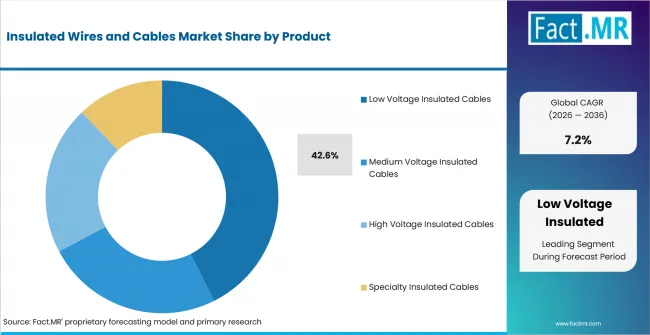
Insulated Wires And Cables Market Analysis By Product | Source: Fact.MR
Low Voltage Insulated Cables are expected to lead Product with 42.6% share in 2026 because they serve homes, plants, and local distribution assets. PVC cables remain useful where cost guides installation. XLPE and higher-voltage cables carry more value when utility approvals release projects. Belden launched its 10GXM13 Category 6A cable in May 2025. Belden stated that the 0.230-inch (5.84 mm) cable delivers 100-meter lengths that meet full TIA compliance.
What leads the Application segment?
Power Transmission & Distribution holds 74.8% share in 2026.
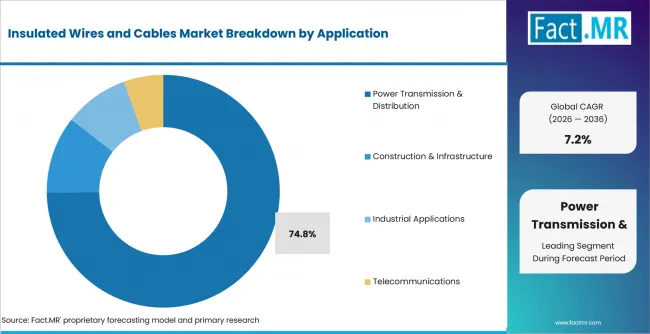
Insulated Wires And Cables Market Analysis By Application | Source: Fact.MR
Power Transmission & Distribution is projected to account for 74.8% share in 2026 due to grid replacement and substations. Underground links and feeder upgrades add further cable volume. Construction wiring supports recurring demand. Industrial and telecom work favors cables that resist heat, abrasion, and signal interference. In July 2025, Prysmian won a Terna framework agreement with potential value of EUR 382.5 million, including at least 50 km of high-voltage cable supply each year.
How does End Use shape demand?
Utilities lead with 39.4% share in 2026.
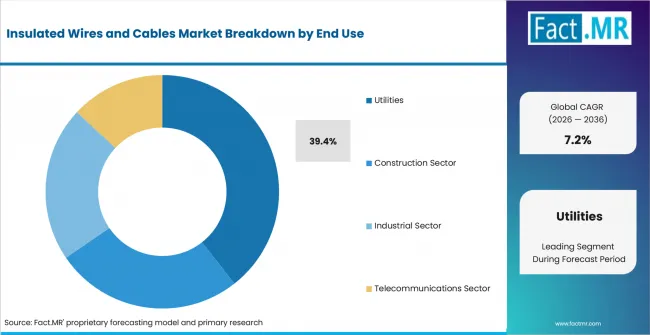
Insulated Wires And Cables Market Analysis By End Use | Source: Fact.MR
Utilities are anticipated to capture 39.4% share in 2026 as grid owners replace aging lines and connect new generation. Construction users stay price-sensitive. Industrial and telecom users pay for specialty designs when downtime or signal loss raises failure cost.
What supports XLPE within Technology?
XLPE Insulation Technology holds 67.3% share in 2026.
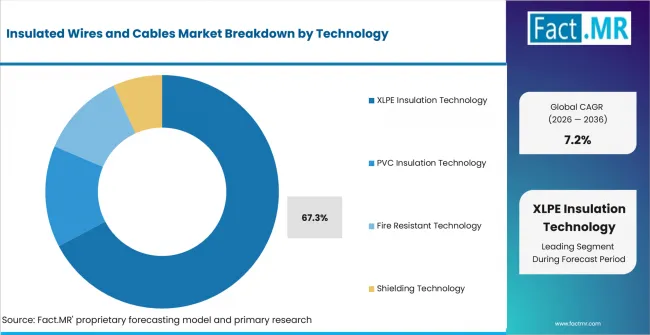
Insulated Wires And Cables Market Analysis By Technology | Source: Fact.MR
XLPE Insulation Technology is estimated to represent 67.3% share in 2026 since cross-linked polyethylene supports heat and voltage stress. PVC remains common in low-voltage work. Fire-resistant technologies serve public buildings and tunnels. Shielding technologies serve instrumentation and data lines.
What leads Formulation demand?
Thermoplastic Insulation Systems hold 58.9% share in 2026.
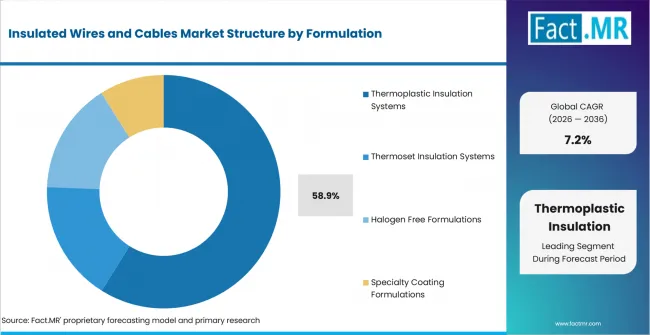
Insulated Wires And Cables Market Analysis By Formulation | Source: Fact.MR
Thermoplastic Insulation Systems are forecast to lead with 58.9% share in 2026 as producers use them across low-voltage and construction applications. Thermoset and XLPE formulations serve higher load conditions. Rubber, halogen-free, and low-smoke systems answer harsher duty cycles.
How does Distribution Channel affect supplier selection?
Direct Industrial Sales lead with 46.3% share in 2026.
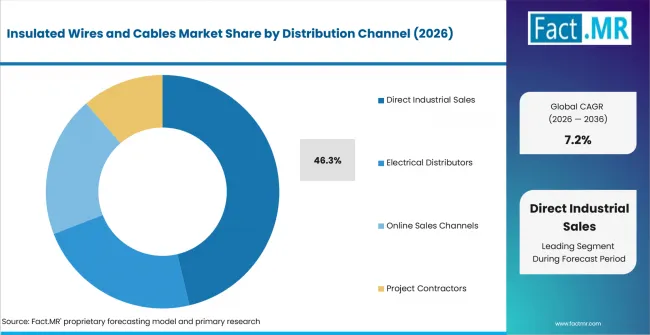
Insulated Wires And Cables Market Analysis By Distribution Channel | Source: Fact.MR
Direct Industrial Sales are projected to hold 46.3% share in 2026 because utilities, OEMs, and large contractors require certificates and shipment control. Electrical distributors support smaller regional orders. Online channels serve standard products where specification risk is lower.
What is accelerating Insulated Wires and Cables Market adoption, and what is holding it back?
Grid expansion drives it; material and approval pressure restrain it.
Drivers Impact Analysis
| DRIVER | (~) % IMPACT ON CAGR | GEOGRAPHIC RELEVANCE | IMPACT TIMELINE |
|---|---|---|---|
| Grid reinforcement and electrification | +2.0% | Germany, USA, UK, Brazil | Short term (<= 2 years) |
| Low-voltage replacement | +1.5% | Global building and utility base | Short term (<= 2 years) |
| XLPE and fire-safe insulation | +1.2% | Europe, Japan, urban projects | Medium term (2-4 years) |
| Data and industrial wiring | +0.9% | USA, UK, Germany | Medium term (2-4 years) |
| Supplier qualification | +0.6% | Utility and OEM channels | Long term (>= 4 years) |
Source: Fact.MR analysis. Updated Aug 13, 2026
- Grid reinforcement and electrification: Network owners are expected to buy more cable as connection queues pressure existing lines. In its February 2026 Electricity 2026 report, the IEA stated that more than 2,500 GW of renewable, large-load and storage projects were stalled in grid queues worldwide.
- Low-voltage replacement: Homes, commercial sites, and local distribution networks keep low-voltage cable demand broad. Replacement work favors easy-pull products with clear certification.
- XLPE and fire-safe insulation: Underground and dense-building applications place more weight on heat, smoke, and flame behavior. Tested formulations help suppliers pass tender review.
- Data and industrial wiring: Factories, data rooms, and communication networks require signal protection. Shielded instrumentation and structured copper runs remain part of the cable mix.
- Supplier qualification: Large industrial and utility users buy against standards and test reports. Direct industrial sales are therefore expected to remain useful for complex orders.
Opportunity Impact Analysis
| OPPORTUNITY | (~) % IMPACT ON CAGR | GEOGRAPHIC RELEVANCE | IMPACT TIMELINE |
|---|---|---|---|
| Underground distribution upgrades | +0.9% | USA, Germany, UK, Japan | Medium term (2-4 years) |
| Fire-safe formulations | +0.7% | Europe and urban projects | Medium term (2-4 years) |
| Data center and automation cabling | +0.6% | USA, UK, Germany | Short term (<= 2 years) |
| Regional distributor stocking | +0.4% | Brazil and contractor-led markets | Long term (>= 4 years) |
Source: Fact.MR analysis. Updated Aug 13, 2026
- Underground distribution upgrades: Utilities are expected to use insulated cables where reliability or land constraints make overhead lines difficult. Medium-voltage experience supports urban grid work.
- Fire-safe formulations: Public infrastructure and dense buildings need tested smoke and flame behavior. Halogen-free and low-smoke formulations are used where project specifications place greater emphasis on fire-safety performance.
- Data center and automation cabling: Enterprise facilities need cable paths that support power delivery and signal quality. Cable vendors with industrial connectivity portfolios are expected to benefit when projects standardize product families.
- Regional distributor stocking: Contractors in large geographies need cable drums near project sites. Local stock reduces downtime when weather or schedules shift.
Restraints Impact Analysis
| RESTRAINT | (~) % IMPACT ON CAGR | GEOGRAPHIC RELEVANCE | IMPACT TIMELINE |
|---|---|---|---|
| Copper and polymer cost exposure | -1.0% | Global cable manufacturing | Short term (<= 2 years) |
| Grid approval delays | -0.8% | Germany, USA, UK, Brazil | Medium term (2-4 years) |
| Non-compliant products | -0.5% | Price-sensitive channels | Medium term (2-4 years) |
| Installation labor constraints | -0.4% | Urban utility work | Long term (>= 4 years) |
Source: Fact.MR analysis. Updated Aug 13, 2026
- Copper and polymer cost exposure: Cable producers remain exposed to conductor metals and insulation resins. Input volatility can compress margins between quotation and delivery. Procurement teams are expected to use indexed contracts or shorter pricing windows.
- Grid approval delays: Cable orders often follow right-of-way and utility approval steps. Long approval windows can shift demand even when grid need is clear.
- Non-compliant products: Low-voltage channels face price pressure from weak documentation. Contractors risk rework when insulation or conductor size fails inspection.
- Installation labor constraints: Skilled pulling and jointing work can limit cable deployment. Testing and termination capacity also affect project schedules. Training and easier installation designs reduce on-site friction.
Which countries are scaling Insulated Wires and Cables Market fastest?
- The country comparison spans 2.9 percentage points and forms three practical growth bands across the forecast period.
- Germany remains 0.7 percentage point above Brazil through grid approvals and renewable connections.
- Brazil remains 0.8 percentage point above the USA as transmission auctions support cable tenders.
- The USA remains 0.7 percentage point above the UK through line rebuilding and utility procurement.
- The UK remains 0.7 percentage point above Japan as grid investment supports cabling work.
- Japan closes the displayed range through reliability needs and offshore wind planning.
Comparable CAGRs create different entry conditions because cable demand follows local grid approvals and construction cycles. Utility procurement rules add another country-level difference. Full report coverage includes North America; Latin America; Europe; East Asia; South Asia and Pacific; Middle East and Africa.
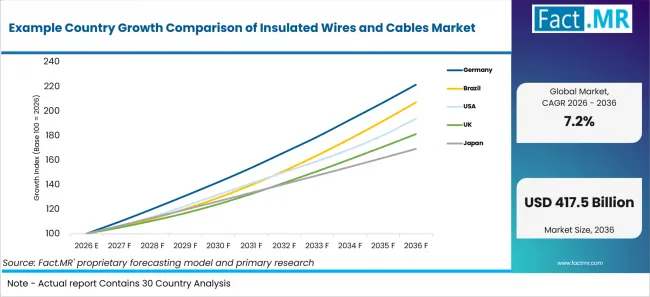
Example Country Growth Comparison Of Insulated Wires And Cables Market | Source: Fact.MR
| Country | CAGR (2026-2036) |
|---|---|
| Germany | 8.3% |
| Brazil | 7.6% |
| USA | 6.8% |
| UK | 6.1% |
| Japan | 5.4% |
Source: Fact.MR analysis. Updated Aug 13, 2026
What supports Germany adoption?
8.3% CAGR, supported by grid approvals and renewable power connections.
Germany’s cable demand is tied to grid approval work that turns long-planned corridors into procurement orders. In January 2026, the Bundesnetzagentur said it approved around 2,000 km of electricity lines in 2025. The increase was about 45.0% from 2024. The country is expected to favor XLPE and higher-voltage insulated cables where transmission reinforcement and renewable evacuation require documented thermal performance. Long approval routes and conductor-cost exposure are expected to keep suppliers focused on tender timing and material planning.
How is Brazil scaling demand?
7.6% CAGR, supported by transmission tenders and national electricity consumption.
Brazil’s demand is shaped by large transmission tenders and a distributor base that needs cable delivery across long corridors. In February 2026, ANEEL said contracts tied to Transmission Auction 4/2025 covered 1,081 km of lines. The same contracts added 2,000 MVA of transformation capacity. The country is projected to keep buying medium-voltage and high-voltage insulated cable for grid expansion and substation work. Regional distributors are expected to remain useful where long routes make nearby cable drums valuable. Licensing steps and tariff pressure are expected to slow some orders where projects are not yet ready for construction.
What supports USA growth?
6.8% CAGR, supported by electricity demand and line rebuilding.
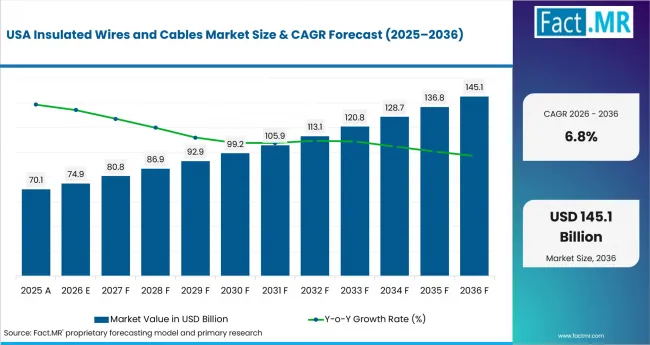
Insulated Wires And Cables Market Country Value Analysis | Source: Fact.MR
Utility procurement in the USA is shifting toward rebuilds that raise capacity without always opening new corridors. In October 2025, the U.S. Department of Energy closed a USD 1.6 billion loan guarantee to reconductor and rebuild around 5,000 miles of transmission lines. The country is anticipated to keep using direct industrial sales where utilities require shipment control and test documentation. OEM cable demand is expected to add separate volume as equipment makers source repeatable insulated wire assemblies. Permitting and skilled installation labor are expected to constrain some underground and high-voltage cable deployments.
How is the UK developing demand?
6.1% CAGR, supported by network investment and cabling reform.
Grid planning in the UK is moving toward faster consents and more distribution buildout. The market is estimated to support low-voltage and medium-voltage cable orders as networks connect clean power and industrial loads. Higher-voltage cable demand is expected to follow transmission reinforcement. Contractors are expected to value cable makers that can support specification checks before site work starts. Network charges and land access negotiations are expected to shape project timing.
How does Japan perform?
5.4% CAGR, supported by grid reliability and offshore wind planning.
Japan’s cable demand reflects grid reliability needs and careful engineering review across dense urban and coastal assets. In April 2026, METI reported that renewable energy, including hydroelectric power, accounted for 23.1% of Japan’s FY2024 power generation mix. The country is forecast to use insulated cables in utility upgrades and offshore wind links. Factory and transport work is expected to add separate specialty demand. Mature construction demand and long approval cycles are expected to keep growth below the other profiled countries.
Who leads the Insulated Wires and Cables Market?
Belden and Amphenol remain relevant on industrial and connectivity cable applications. Prysmian, Nexans, Southwire and NKT anchor the power cable supplier group.
Verified suppliers compete through portfolio depth and utility relationships. Distribution reach and product documentation shape tender outcomes. Belden and Amphenol support industrial cable, signal cable, and connectivity applications. Prysmian, Nexans, Southwire and NKT strengthen the power cable side across voltage classes and grid-related programs. Cable makers with higher-voltage references compete differently from low-voltage distributors. The profile therefore separates power, industrial, and connectivity roles.
Which companies are the key providers?
Key companies include Belden Inc., Amphenol Corporation, Prysmian S.p.A., Nexans S.A., Southwire Company, LLC, and NKT A/S.
- Belden Inc.
- Amphenol Corporation
- Prysmian S.p.A.
- Nexans S.A.
- Southwire Company, LLC
- NKT A/S
Bibliography
- Agência Nacional de Energia Elétrica. (2026, February 23). Assinados novos contratos de empreendimentos de transmissão.
- Bundesnetzagentur. (2026, January 2). Energiewende nimmt entscheidende Hürde – 2025 zeigt deutliche Fortschritte beim Stromnetzausbau.
- International Energy Agency. (2026, February 6). Grids. In Electricity 2026.
- Ministry of Economy, Trade and Industry. (2026, April 14). FY2024 Energy Supply and Demand Report (Revised Report).
- Nexans. (2025, June 2). Nexans further enhances its portfolio in electrification with the acquisition of Cables RCT in Spain.
- NKT A/S. (2025, January 28). Investments in additional capacity in the medium-voltage power cable business completed at two out of three sites.
- Southwire Company, LLC. (2025, September 12). Southwire celebrates ribbon cutting at new industrial plant in Bremen, Ind.
- U.S. Department of Energy. (2025, October 16). Energy Department closes loan guarantee to strengthen U.S. grid reliability.
- Department for Energy Security and Net Zero. (2026, April 27). Electricity network infrastructure: Consents, land access and rights – Government response.
- Amphenol Corporation. (2026, January 12). Amphenol completes acquisition of CCS business from CommScope.
This Report Addresses
- The report provides strategic intelligence on Product and Application choices that shape utility and construction cable programs. Industrial and telecom cable programs are reviewed separately.
- Segment analysis covers Low Voltage Insulated Cables and Power Transmission & Distribution as the 2026 share leaders.
- Country outlook evaluates Germany and Brazil alongside the USA. The UK and Japan complete the 2026 to 2036 comparison.
- Competitive analysis profiles Belden and Amphenol alongside Prysmian and Nexans. Southwire and NKT complete the provider set.
- Technology assessment covers XLPE and PVC. Fire Resistant Technology and Shielding Technology complete the technology view.
What does the Insulated Wires and Cables Market cover?
The market covers insulated wire categories used for voltage delivery and building wiring. Equipment links, telecom runs, and industrial control paths are included where insulation performance affects service life. Cable systems are included where insulation protects conductors from heat and moisture. Abrasion and electrical stress protection remain part of the wire and cable coverage.
Coverage extends to high voltage cable systems and submarine power cable applications. The adjacent copper wire value chain remains relevant because conductor supply is central to cable manufacturing.
What is included in the scope?
The scope includes low-voltage building cable and medium-voltage distribution cable. High-voltage transmission cable and specialty insulated cable are also included. Applications include structured cabling and cable connector systems. Electrical conduit paths are covered where installation design affects cable selection.
What is excluded from the scope?
Uninsulated conductors and bare overhead wire remain outside the scope. Fiber-only service revenue and postal services are excluded. Audio devices, newswire services, and unrelated power supplies are also excluded. Polyolefin compound demand is included only when used as insulation or cable-compound input.
How Was the Analysis Built?
The analysis draws on 120+ sources, 35+ company portfolios, 25+ countries, and more than 20 industry interviews.
- Primary Research: Primary research includes discussions with manufacturers, service providers, technology developers, distributors, end users, procurement teams, and subject-matter experts. These conversations examine purchasing priorities, product adoption, operational challenges, approval requirements, competitive positioning, and the factors that influence wider market acceptance.
- Desk Research: Desk research covers government statistics, regulatory publications, company filings, trade data, technical studies, industry associations, standards, public policy, and other authoritative sources. Every source used in the analysis is documented in the bibliography.
- Market Sizing and Forecasting: Market estimates combine historical performance, demand indicators, pricing and volume trends, segment shares, company participation, country-level growth, adoption patterns, investment activity, and barriers to market expansion.
- Data Validation and Update Cycle: Findings are validated by comparing primary interviews with public data, company activity, regulatory changes, trade patterns, and industry developments. Regular updates review new product launches, capacity changes, partnerships, approvals, procurement trends, and shifts in commercial adoption.
Segmentation
What is the report’s scope and coverage?
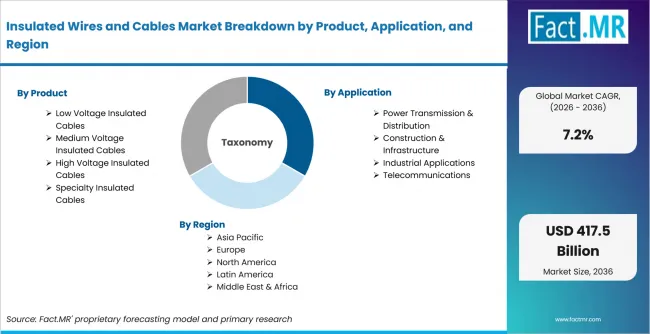
Insulated Wires And Cables Market Breakdown By Product, Application, And Region | Source: Fact.MR
| Attribute | Details |
|---|---|
| Quantitative Units | USD billion |
| Market Definition | Insulated electrical and signal conductors used across power transmission, distribution, construction wiring, industrial wiring, telecommunications, and equipment assemblies. |
| Product | Low Voltage Insulated Cables; Medium Voltage Insulated Cables; High Voltage Insulated Cables; Specialty Insulated Cables |
| Application | Power Transmission & Distribution; Construction & Infrastructure; Industrial Applications; Telecommunications |
| End Use | Utilities; Construction Sector; Industrial Sector; Telecommunications Sector |
| Technology | XLPE Insulation Technology; PVC Insulation Technology; Fire Resistant Technology; Shielding Technology |
| Formulation | Thermoplastic Insulation Systems; Thermoset Insulation Systems; Halogen Free Formulations; Low Smoke Systems; Specialty Coating Formulations |
| Distribution Channel | Direct Industrial Sales; Electrical Distributors; Online Sales Channels; Project Contractors |
| Regions Covered | North America; Latin America; Europe; East Asia; South Asia and Pacific; Middle East and Africa |
| Countries Covered | Germany; Brazil; USA; UK; Japan |
| Key Companies Profiled | Belden Inc.; Amphenol Corporation; Prysmian S.p.A.; Nexans S.A.; Southwire Company, LLC; NKT A/S |
| Forecast Period | 2026 to 2036 |
| Approach | Hybrid top-down and bottom-up approach using grid activity, construction wiring demand, industrial automation, telecom cabling, country CAGRs, segment shares, and official evidence. |
Source: Fact.MR analysis. Updated Aug 13, 2026
How is the market segmented?
-
By Product
- Low Voltage Insulated Cables
- PVC Insulated Cables
- XLPE Insulated Cables
- Medium Voltage Insulated Cables
- Underground Power Cables
- Aerial Bundled Cables
- High Voltage Insulated Cables
- Transmission Cables
- Extra High Voltage Cables
- Specialty Insulated Cables
- Fire Resistant Cables
- Shielded Instrumentation Cables
- Low Voltage Insulated Cables
-
By Application
- Power Transmission & Distribution
- Grid Infrastructure Applications
- Utility Distribution Networks
- Construction & Infrastructure
- Residential Construction Wiring
- Commercial Construction Wiring
- Industrial Applications
- Manufacturing Plant Wiring
- Process Industry Wiring
- Telecommunications
- Data Transmission Networks
- Communication Infrastructure
- Power Transmission & Distribution
-
By End Use
- Utilities
- Electric Power Utilities
- Water & Energy Utilities
- Construction Sector
- Residential Developers
- Commercial Developers
- Industrial Sector
- Heavy Industries
- Light Industries
- Telecommunications Sector
- Network Operators
- Infrastructure Providers
- Utilities
-
By Technology
- XLPE Insulation Technology
- Cross Linked Polymer Systems
- Advanced Extrusion Systems
- PVC Insulation Technology
- Flexible Polymer Systems
- Cost Optimized Insulation Systems
- Fire Resistant Technology
- Flame Retardant Systems
- Safety Insulation Systems
- Shielding Technology
- EMI Shielding Systems
- Signal Protection Systems
- XLPE Insulation Technology
-
By Formulation
- Thermoplastic Insulation Systems
- PVC Based Formulations
- Polyethylene Based Formulations
- Thermoset Insulation Systems
- XLPE Formulations
- Rubber Based Compounds
- Halogen Free Formulations
- Low Smoke Systems
- Green Cable Systems
- Specialty Coating Formulations
- Fire Retardant Mixes
- Chemical Resistant Formulations
- Thermoplastic Insulation Systems
-
By Distribution Channel
- Direct Industrial Sales
- OEM Supply Contracts
- Enterprise Procurement
- Electrical Distributors
- Regional Cable Distributors
- Specialized Cable Distributors
- Online Sales Channels
- B2B E-commerce Platforms
- Manufacturer Online Stores
- Project Contractors
- EPC Contractors
- System Integrators
- Direct Industrial Sales
-
By Region
- North America
- Latin America
- Western Europe
- Eastern Europe
- East Asia
- South Asia and Pacific
- Middle East & Africa
Frequently Asked Questions
How big is the insulated wires and cables market in 2026?
What is the CAGR of the insulated wires and cables market from 2026 to 2036?
Which product leads the insulated wires and cables market?
Which application leads the insulated wires and cables market?
Who are the leading companies in the insulated wires and cables market?
Who worked on this report


Preview the report firsthand - request a free sample
Free SampleGet the brochure for pricing and purchase details
Download PDF