The Low-Chloride Concrete Safe Deicing Products Market is analyzed across its key product, application and end-use segments, with regional trends and demand outlook, forecast 2026 to 2036.
By Fact.MR Chemical & Materials DeskFact-checked under the Fact.MR editorial processUpdated
10 min read
Low-Chloride Concrete Safe Deicing Products Market Forecast and Outlook 2026 to 2036
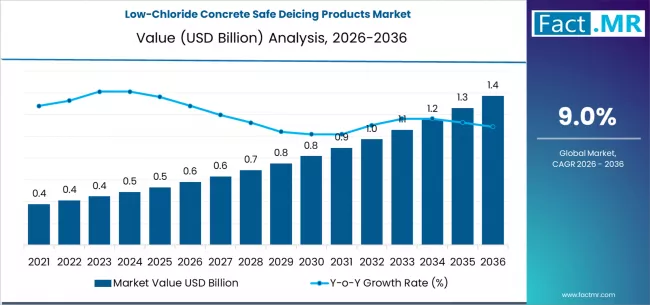
The low-chloride concrete safe deicing products market, with an estimated value of USD 0.58 billion in 2026, is forecast to reach USD 1.37 billion by 2036, advancing at a CAGR of 9.0% over the decade. The market is expanding as infrastructure longevity becomes a critical economic and safety imperative. These specialized chemicals provide effective ice control while actively preserving the structural integrity of concrete assets, from bridges to airport runways.
Summary of Low-Chloride Concrete SafeDeicingProducts Market
Market Snapshot
Global low-chloride concrete safedeicingproducts market is valued at USD 0.58 billion in 2026 and is projected to reach USD 1.37 billion by 2036.
The market is expected to grow at aCAGRof 9.0% during 2026–2036.
Growth is driven by increasing focus on infrastructure longevity and safety, as traditional chloride-baseddeicersaccelerate corrosion in reinforced concrete structures.
Low-chloridedeicingproducts are gaining adoption as concrete-safe alternatives, helping reduce lifecycle maintenance costs and improve durability of transport infrastructure.
Demand and Growth Drivers
Rising concern over chloride-induced corrosion in bridges, roads, and parking structures is driving demand for saferdeicingsolutions.
Increasing emphasis on extending infrastructure service life and reducing repair costs is supporting adoption across public infrastructure projects.
Environmental and regulatory pressure is encouraging the shift toward low-corrosion, low-impactdeicingformulations.
Growing awareness among municipalities and infrastructure operatorsregardinglong-term structural damage is accelerating transition away from chloride-based salts.
Product and Segment View
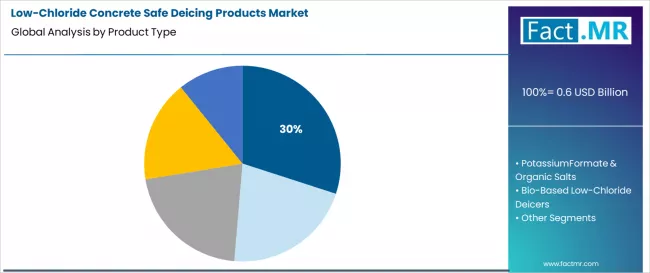
Acetate-baseddeicershold 30.0% share in 2026,emergingas the leading product type due to reduced corrosive impact and balanced performance.
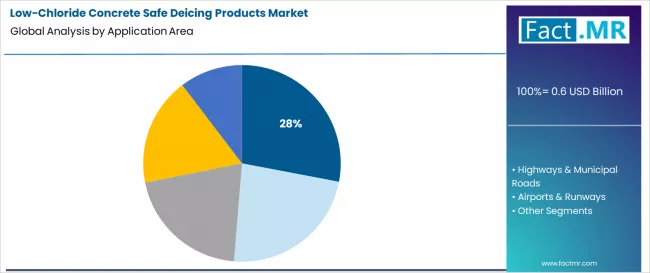
Bridges and parking structures account for 28.0% of application share in 2026, positioning this as the dominant segment due to high vulnerability of reinforced concrete.
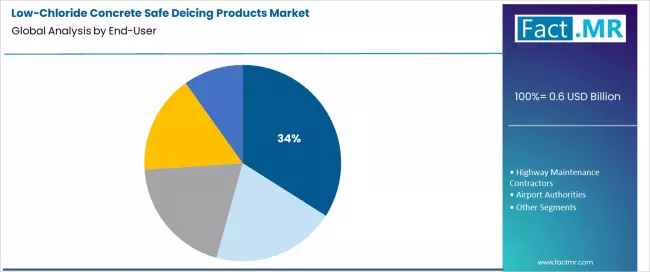
Government and municipal authoritiesrepresent34.0% of end-user share in 2026, reflecting their responsibility formaintainingpublic infrastructure.
Product categories include:
Acetate-baseddeicers
Potassiumformateand organic salts
Bio-based low-chloridedeicers
Calcium magnesium acetate (CMA)
Others
Geography and Competitive Outlook
Market growth is driven globally by infrastructure maintenance requirements and winter road safety needs, particularly in cold-climate regions.
Adoption is increasing as public agencies and contractors prioritize durability, sustainability, and corrosion mitigation.
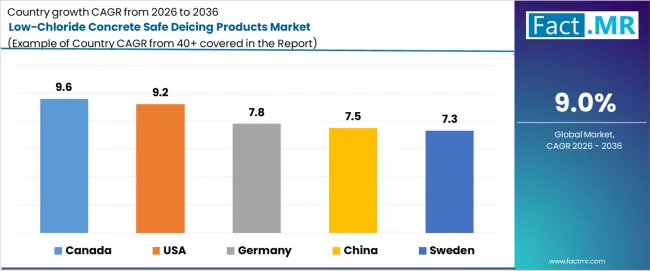
Key country growth rates include:
Canada (9.6%)
China (7.5%)
Sweden(7.3%)
Germany (7.8%)
USA (9.20%)
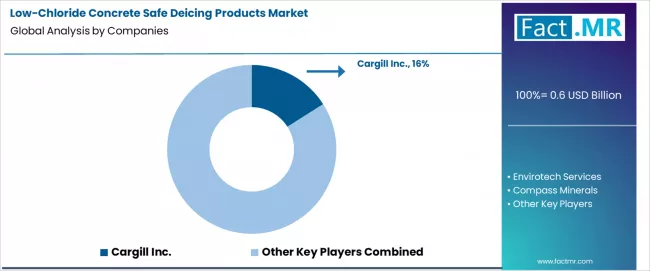
Key companiesoperatingin this market include Cargill Inc.,EnvirotechServices, Compass Minerals, K-Tech Specialty Coatings, and Dow Inc.
Low Chloride Concrete SafeDeicingProducts Market - At a Glance
Attribute
Details
Market Value 2026
USD 0.58 billion
Market Value 2036
USD 1.37 billion
Absolute Dollar Opportunity 2026–2036
USD 0.79 billion
Total Growth 2026–2036
136.2%
CAGR2026–2036
9.0%
Growth Multiple
~2.4x
Key Demand Theme
Increasing adoption of low-corrosion, infrastructure-safedeicingsolutions
North America, Europe, Asia Pacific, Latin America,MEA
Acetate-based deicers represent the foremost product category, securing a 30% market share due to their balanced performance and reduced corrosive profile. Their application is most critical on bridges and parking structures, which constitute the leading application area with a 28% share, reflecting the acute vulnerability of reinforced concrete in these settings to chloride-induced spalling and rebar corrosion. Government and municipal authorities are the primary end-users, driving 34% of demand, as they bear the long-term fiscal responsibility for maintaining public infrastructure against winter damage. Growth is driven by the escalating cost of infrastructure repair and replacement. Traditional chloride-based salts, while inexpensive upfront, accelerate the deterioration cycle of concrete, leading to massive rehabilitation costs. Low-chloride alternatives, such as acetates, formats, and bio-based blends, mitigate this damage, offering a lifecycle cost benefit that is recognized in public procurement and asset management strategies. The market’s progression is marked by innovation in formulations that maintain ice-melting efficacy at lower temperatures without compromising their concrete-safe guarantee.
Government & Municipal Authorities, Highway Maintenance Contractors, Airport Authorities, Commercial Property Owners, Industrial Facility Operators
Region
North America, Latin America, Western Europe, Eastern Europe, East Asia, South Asia & Pacific, MEA
Segmental Analysis
By Product Type, Which Chemistry is Preferred for Concrete Protecti
Low Chloride Concrete Safe Deicing Products Market Analysis By Product Type | Source: Fact.MR
Acetate-based deicers lead this segment with a 30% share. Their dominance is rooted in a proven ability to effectively lower the freezing point of water while presenting a negligible risk of chloride-induced corrosion to steel reinforcement embedded within concrete.
Potassium acetate and calcium magnesium acetate are particularly valued in pre-wetting and anti-icing strategies for critical infrastructure. They offer a reliable alternative where the preservation of the asset outweighs the marginal cost savings of conventional rock salt.
By Application Area, Where is the Need Most Acute?
Low Chloride Concrete Safe Deicing Products Market Analysis By Application Area | Source: Fact.MR
Bridges and parking structures are the foremost application area, holding a 28% share. These structures are exceptionally vulnerable. Bridges experience splash and spray concentrated with deicing chemicals, while parking garages are enclosed environments where runoff is managed internally.
Both settings feature exposed rebar and concrete joints where chloride penetration can initiate rapid deterioration. The high cost and disruptive nature of repairing or replacing these structures make the adoption of protective deicers a strategic investment in asset management.
By End-User, Who Prioritizes Lifecycle Cost Over Initial Expense?
Low Chloride Concrete Safe Deicing Products Market Analysis By End User | Source: Fact.MR
Government and municipal authorities constitute the leading end-user segment at 34%. Their procurement decisions are increasingly guided by lifecycle cost analysis and infrastructure asset management plans.
While low-chloride products command a higher price per ton, these entities evaluate the avoided costs associated with delayed concrete degradation, including extended service life, reduced emergency repairs, and lower long-term capital expenditures on bridge decks and roadways. This shift represents a move from viewing deicing as an annual expense to framing it as a preservation activity.
What are the Drivers, Restraints, and Key Trends of the Market?
The principal driver is the global crisis of aging infrastructure and the staggering cost of concrete repair. Transportation departments and private asset owners are proactively seeking ways to decouple winter safety operations from accelerated decay.
Strengthening environmental regulations limiting chloride runoff into waterways, which also protects concrete in aquatic environments, provide a complementary regulatory push. The rise of performance-based specifications in construction and maintenance contracts further incentivizes solutions that demonstrably extend asset lifespan.
A central market restraint remains the significant price premium of concrete-safe products compared to sodium chloride. This cost barrier is most pronounced for large-scale roadways where budgets are deeply constrained.
Some alternative deicers, particularly acetates, can exhibit a higher BOD in water, creating a different environmental trade-off that requires careful management. There is also a need for education and training among maintenance crews to optimize application rates and timing for these often more concentrated products.
Notable trends include the development of hybrid inhibitor technologies that blend low-chloride salts with organic corrosion inhibitors specifically formulated for concrete protection. The market is seeing increased integration with smart infrastructure monitoring, where sensors embedded in bridges help calibrate deicer application to precise need, maximizing product efficiency.
Another trend is the creation of specialized formulations for new concrete, which is particularly susceptible to damage in its first few winters, requiring gentle yet effective deicing solutions.
Analysis of the Low-Chloride Concrete Safe Deicing Products Market by Key Countries
Low Chloride Concrete Safe Deicing Products Market Cagr Analysis By Country | Source: Fact.MR
Country
CAGR (2026-2036)
Canada
9.60%
USA
9.20%
Germany
7.80%
China
7.50%
Sweden
7.30%
How Does Canada's Infrastructure Strategy Foster Adoption?
Canada's leading CAGR of 9.60% is driven by its extreme winter climate and a strategic federal focus on infrastructure resilience. Investments in major bridge projects and transit systems are accompanied by mandates to use materials and practices that ensure long-term durability.
Provincial transportation ministries, facing the relentless cycle of freeze-thaw and salt exposure, are early adopters of concrete-safe deicers to protect high-value investments and reduce lifecycle maintenance costs on essential corridors.
What Drives Demand in the USA's Cost-Conscious but Liability-Aware Market?
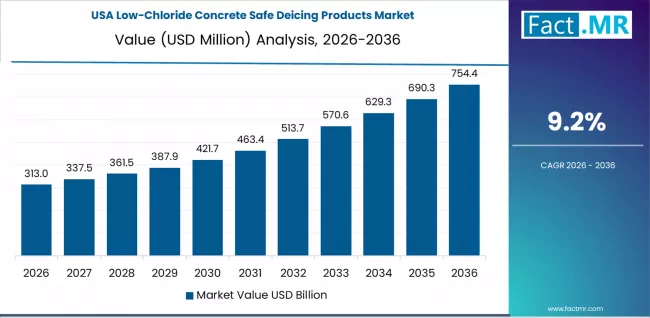
Low Chloride Concrete Safe Deicing Products Market Country Value Analysis | Source: Fact.MR
The USA's 9.20% growth is fueled by a combination of massive infrastructure spending bills and escalating liability concerns. State DOTs are mandated to steward assets effectively, making the case for premium deicers on critical bridges increasingly persuasive.
Property managers of large parking structures and commercial developments use these products to mitigate slip-and-fall liability and avoid costly concrete restoration projects, viewing them as a form of insurance.
Why is Germany a Center for Engineered Material Solutions?
Germany's 7.80% CAGR reflects its engineering-centric approach to infrastructure. The country’s autobahn network and numerous bridges are assets of national economic importance.
German standards prioritize material preservation, and there is a deep understanding of chloride’s corrosive mechanics. This environment favors precisely engineered liquid acetate and formate blends applied via automated systems, ensuring optimal coverage and minimal waste on sensitive concrete surfaces.
How is China's Rapid Infrastructure Build-Out Influencing the Market?
China's 7.50% growth is linked to its focus on building durable, long-lasting infrastructure. In northern provinces, protecting new bridges, high-speed rail infrastructure, and airport runways from early-stage deterioration is a priority.
As the country addresses maintenance challenges on its vast constructed network, specifications are evolving to include concrete-safe deicing protocols, particularly for flagship projects where longevity is a key performance indicator.
What is the Basis of Sweden's Environmental and Technical Leadership?
Sweden's 7.30% growth is built upon its legacy of environmental regulation and technical innovation. Swedish agencies have long researched the impact of deicers on both ecosystems and infrastructure. Their procurement policies for roads and bridges explicitly favor products with validated low-corrosivity to concrete and metals. This creates a sophisticated demand for high-performance, environmentally classified products, driving continuous improvement in formulation efficacy and environmental profile.
Competitive Landscape of the Low-Chloride Concrete Safe Deicing Products Market
Low Chloride Concrete Safe Deicing Products Market Analysis By Company | Source: Fact.MR
Companies with expertise in both chemical formulation and infrastructure materials science define the competitive landscape. Competition centers on providing robust technical validation, including independent laboratory data on corrosion inhibition and field case studies demonstrating extended concrete service life.
Success hinges on building partnerships with engineering firms, transportation departments, and large property owners, positioning the deicer not as a commodity but as an integral component of a long-term asset preservation strategy. Supply chain reliability for key organic raw materials is also a critical competitive factor.
Key Players in the Low-Chloride Concrete Safe Deicing Products Market
Mechanisms of chloride-induced concrete spalling and rebar corrosion; standardized testing protocols for deicer corrosion potential (e.g., SHRP H-205.2); lifecycle cost analysis models for infrastructure asset management; impact of deicer chemistry on sealers and concrete coatings; review of green building standards (LEED, BREEAM) related to winter maintenance.
Market by Segments
Product Type :
Acetate-Based Deicers
Potassium Formate & Organic Salts
Bio-Based Low-Chloride Deicers
Calcium Magnesium Acetate (CMA)
Other Concrete-Safe Low-Chloride Products
Application Area :
Bridges & Parking Structures
Highways & Municipal Roads
Airports & Runways
Commercial & Residential Pavements
Industrial & Logistics Facilities
End-User :
Government & Municipal Authorities
Highway Maintenance Contractors
Airport Authorities
Commercial Property Owners
Industrial Facility Operators
Region :
North America
USA
Canada
Latin America
Brazil
Mexico
Argentina
Rest of Latin America
Western Europe
Germany
UK
France
Spain
Italy
BENELUX
Rest of Western Europe
Eastern Europe
Russia
Poland
Czech Republic
Rest of Eastern Europe
East Asia
China
Japan
South Korea
Rest of East Asia
South Asia & Pacific
India
ASEAN
Australia
Rest of South Asia & Pacific
MEA
Saudi Arabia
UAE
Turkiye
Rest of MEA
Frequently Asked Questions
How big is the low-chloride concrete safe deicing products market in 2026?
The global low-chloride concrete safe deicing products market is estimated to be valued at USD 0.6 billion in 2026.
What will be the size of low-chloride concrete safe deicing products market in 2036?
The market size for the low-chloride concrete safe deicing products market is projected to reach USD 1.4 billion by 2036.
How much will be the low-chloride concrete safe deicing products market growth between 2026 and 2036?
The low-chloride concrete safe deicing products market is expected to grow at a 9.0% CAGR between 2026 and 2036.
What are the key product types in the low-chloride concrete safe deicing products market?
The key product types in low-chloride concrete safe deicing products market are acetate-based deicers, potassiumformate & organic salts, bio-based low-chloride deicers, calcium magnesium acetate (cma) and other concrete-safe low-chloride products.
Which application area segment to contribute significant share in the low-chloride concrete safe deicing products market in 2026?
In terms of application area, bridges & parking structures segment to command 28.0% share in the low-chloride concrete safe deicing products market in 2026.