- Market Value (2025): USD 195.0 Mn
- Estimated Value (2026): USD 224.0 Mn
- Forecast Value (2036): USD 720.0 Mn
- CAGR (2026-2036): 12.4%
What is the Membrane Deammoniation System Market forecast to be worth by 2036?
USD 720.0 million by 2036 at 12.4% CAGR.
- The Membrane Deammoniation System Market reached USD 199.3 million in 2025.
- Demand is projected to increase from USD 224.0 million in 2026 to USD 721.0 million by 2036.
- The market is forecast to record a 12.4% CAGR from 2026 to 2036.
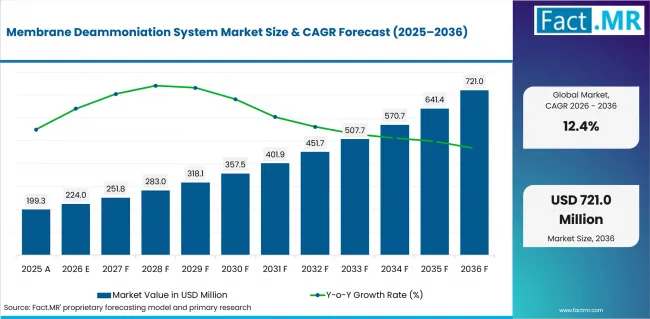
Membrane Deammoniation System Market Value Analysis | Source: Fact.MR
What are the defining numbers behind Membrane Deammoniation System Market growth?
An absolute opportunity of USD 496.0 million is expected between 2026 and 2036.
- Demand Drivers in the Market
- Municipal and industrial wastewater operators face nitrogen-control requirements, increasing interest in technologies that remove ammonia before it reaches the main biological treatment stage.
- Hollow-fiber hydrophobic contactors provide a large gas-liquid interface in a compact module while keeping wastewater and acid absorbent physically separated.
- Vacuum membrane stripping increases the ammonia-transfer driving force for concentrated centrate, digestate and industrial sidestreams.
- Municipal plants generate ammonia-rich digestion return liquors that can be treated separately, reducing nitrogen load on the main aeration basin.
- Acid absorption converts recovered ammonia into ammonium sulfate, giving operators a usable fertilizer salt rather than transferring nitrogen into another waste stream.
- Key Segments Analyzed
- Hollow-fiber hydrophobic accounts for 38.0% of Membrane Type in 2026 because thousands of fibers provide high transfer area in a compact housing while hydrophobic pores keep the liquid phases separated.
- Vacuum membrane stripping holds 35.0% of Process Configuration in 2026 because reduced pressure increases ammonia transfer from concentrated wastewater sidestreams.
- Municipal wastewater represents 38.0% of Application in 2026 because digestion centrate and return liquors can carry concentrated ammonia loads suited to side-stream treatment.
- Ammonium sulfate captures 41.0% of Recovery Product in 2026 because sulfuric-acid absorption converts recovered ammonia into a stable fertilizer salt with an established use pathway.
- Analyst Opinion at Fact.MR
- Shambhu Nath Jha, Principal Consultant at Fact.MR, states, "Buyer decisions in the Membrane Deammoniation System Market will centre on ammonia recovery as a usable product while reducing downstream biological treatment load. Buyers will compare the 2026 segment leaders with qualification evidence and the operating cost of the full process. Suppliers that support application trials and preserve formulation or equipment consistency can move more quickly into repeat production."
- Strategic Implications
- Suppliers should document the process conditions that allow Hollow-fiber hydrophobic to deliver repeatable performance.
- Customer trials should use the intended substrate, fluid path or process stream before commercial qualification.
- Regional technical support is important in China and Germany because adoption depends on local production or infrastructure conditions.
- Commercial positioning should distinguish qualified application performance from general material or equipment capability.
- The 3M (Membrana) label is historical. Liqui-Cel moved through Solventum and became part of Thermo Fisher Scientific after the 2025 transaction.
How does the Membrane Deammoniation System Market break down by segment?
The market is segmented by Membrane Type, Process Configuration, Application and Recovery Product.
Why does Hollow-fiber hydrophobic lead Membrane Type?
Hollow-fiber hydrophobic is projected to account for a 37.6% share in 2026.
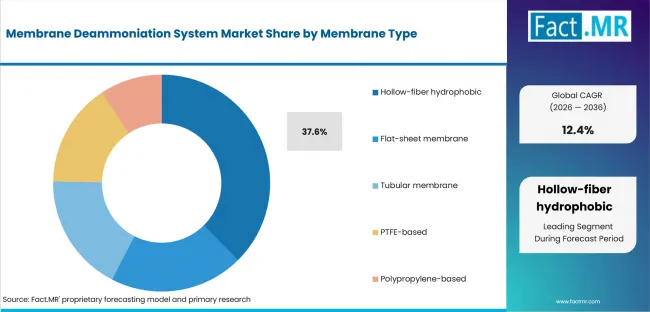
Membrane Deammoniation System Market Analysis By Membrane Type | Source: Fact.MR
Hollow-fiber modules pack a large membrane area into a small vessel, increasing the gas-liquid interface available for ammonia transfer without a large footprint.
Hydrophobic pores allow gaseous ammonia to pass while preventing bulk liquid mixing, making wetting resistance central to sustained performance.
Why does Vacuum membrane stripping lead Process Configuration?
Vacuum membrane stripping is projected to account for a 35.2% share in 2026.
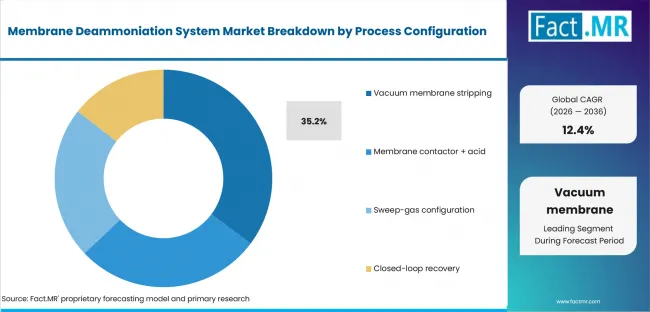
Membrane Deammoniation System Market Analysis By Process Configuration | Source: Fact.MR
Vacuum lowers ammonia partial pressure on the receiving side and increases the transfer driving force across the membrane.
The configuration is most attractive for ammonia-rich centrate, digestate and selected industrial streams where pH adjustment and vacuum energy can be justified.
Why does Municipal wastewater lead Application?
Municipal wastewater is projected to account for a 38.3% share in 2026.
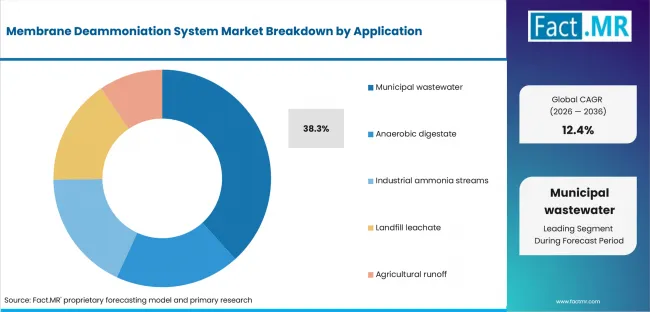
Membrane Deammoniation System Market Analysis By Application | Source: Fact.MR
Municipal plants often return ammonia-rich centrate from sludge dewatering to the headworks, adding nitrogen load to the biological process.
Treating this sidestream separately can reduce aeration demand and free biological capacity while creating a nutrient-recovery route.
Why does Ammonium sulfate lead Recovery Product?
Ammonium sulfate is projected to account for a 40.6% share in 2026.
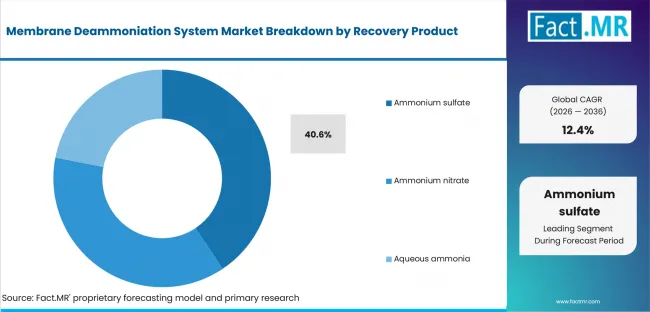
Membrane Deammoniation System Market Analysis By Recovery Product | Source: Fact.MR
Ammonia transferred through the membrane can be captured in sulfuric acid to form ammonium sulfate, a stable salt with established fertilizer use.
This provides a clearer product outlet than dilute aqueous ammonia, although recovered-product quality still depends on feed contaminants and process control.
What is accelerating Membrane Deammoniation System Market adoption, and what is holding it back?
Drivers Impact Analysis
| Factor | (~) % Impact on CAGR | Geographic Relevance | Impact Timeline |
|---|---|---|---|
| Ammonia transfer through Hollow-fiber hydrophobic | +3.3% | China | Short term (<= 2 years) |
| Higher removal with Vacuum membrane stripping | +2.7% | Germany | Medium term (2-4 years) |
| Nitrogen control in Municipal wastewater | +2.0% | Netherlands | Long term (>= 4 years) |
Opportunity Impact Analysis
| Factor | (~) % Impact on CAGR | Geographic Relevance | Impact Timeline |
|---|---|---|---|
| Ammonium sulfate recovery | +1.7% | China | Short term (<= 2 years) |
| Digestion sidestream treatment | +1.4% | Germany | Medium term (2-4 years) |
| Industrial modular systems | +1.0% | Netherlands | Long term (>= 4 years) |
Restraints Impact Analysis
| Factor | (~) % Impact on CAGR | Geographic Relevance | Impact Timeline |
|---|---|---|---|
| Fouling and wetting | -1.6% | China | Short term (<= 2 years) |
| pH and acid burden | -1.2% | Germany | Medium term (2-4 years) |
| Product-quality validation | -0.9% | Netherlands | Long term (>= 4 years) |
Which countries are scaling the Membrane Deammoniation System Market through 2036?
- Germany: Germany combines water-quality controls with membrane engineering and detailed pilot practice.
- Netherlands: The Netherlands has a water-technology and circular-resource ecosystem.
- USA: The USA has diverse municipal and industrial water streams with DOE and EPA research support.
- Saudi Arabia: Saudi Arabia has extensive desalination and water-reuse requirements.
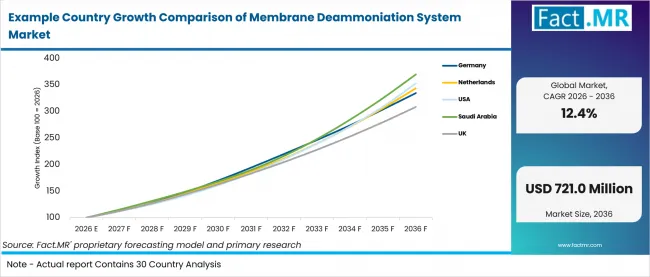
Example Country Growth Comparison Of Membrane Deammoniation System Market | Source: Fact.MR
Country CAGR (2026-2036)
| Country | CAGR (2026-2036) |
|---|---|
| Germany | 12.9% |
| Netherlands | 13.1% |
| USA | 13.3% |
| Saudi Arabia | 14.0% |
What is driving Germany's growth through 2036?
Germany is forecast to expand at a 12.9% CAGR from 2026 to 2036.
Germany combines stringent water-quality controls with membrane engineering and utility pilot practice, supporting technologies that can reduce energy use or recover resources.
Utilities can justify membrane deammoniation where sidestream treatment reduces aeration demand and recovered ammonium sulfate has a credible outlet.
What is driving Netherlands's growth through 2036?
The Netherlands is forecast to expand at a 13.1% CAGR from 2026 to 2036.
The Netherlands has a strong water-technology and circular-resource ecosystem, making recovery and brine-management technologies a close fit with utility and industrial programmes.
Ammonia recovery complements circular-resource programmes by converting dissolved nitrogen into a concentrated product.
What is driving the USA's growth through 2036?
The USA is forecast to expand at a 13.3% CAGR from 2026 to 2036.
The USA has diverse municipal and industrial water streams, while federal research programmes provide pilot evidence for advanced desalination and nutrient-control technologies.
Membrane contactors are relevant where operators can compare reduced biological load against pH, acid and maintenance costs using site-specific pilot data.
What is driving Saudi Arabia's growth through 2036?
Saudi Arabia is forecast to expand at a 14.0% CAGR from 2026 to 2036.
Saudi Arabia's desalination and water-reuse system creates a direct incentive to increase water recovery and reduce difficult concentrate streams.
Water-reuse projects create demand for compact nitrogen-control systems where ammonia recovery can reduce downstream treatment load.
Who leads the Membrane Deammoniation System Market?
The company list includes 3M (Membrana), Fibracast and EnviroChemie. Competition spans membrane modules, complete wastewater systems and nutrient-recovery integration.
Selection depends on ammonia-transfer efficiency, resistance to wetting and control of pH, cleaning and recovered-product quality.
Reference plants matter because wastewater composition changes by site.
The 3M (Membrana) label is historical. Liqui-Cel moved through Solventum and became part of Thermo Fisher Scientific after the 2025 transaction.
The PermeOx entry is retained, but public information indicates adjacent treatment chemistry and its product-level membrane fit should be reviewed.
Which companies are the key providers?
Key companies profiled include 3M (Membrana); Fibracast; EnviroChemie; Nijhuis Saur Industries; Prayon; and PermeOx (Evonik).
- 3M (Membrana)
- Fibracast
- EnviroChemie
- Nijhuis Saur Industries
- Prayon
- PermeOx (Evonik)
Bibliography
- U.S. Environmental Protection Agency. (2010). Nutrient Control Design Manual. U.S. Government.
- U.S. Environmental Protection Agency. (2023). Emerging Wastewater Treatment Technologies: Nutrient Recovery and Ammonia Removal. U.S. Government.
- European Commission. (2025). Urban Wastewater Treatment and Nutrient Recovery Policy. European Union.
- International Water Association. (2025). Resource Recovery from Wastewater. IWA.
- Thermo Fisher Scientific. (2026). Liqui-Cel Membrane Contactors for Ammonia Removal and Recovery. Thermo Fisher Scientific.
- Ministry of Industry and Information Technology, China. (2026). Development of the Electronic Information Manufacturing Industry in 2025. Government of China.
- Federal Ministry for Economic Affairs and Climate Action, Germany. (2025). Industrial and Automotive Transformation Programmes. Government of Germany.
- Government of the Netherlands. (2025). Water Technology and Circular Economy Programme. Government of the Netherlands.
- U.S. Department of Commerce. (2025). CHIPS for America Advanced Packaging Manufacturing Program. U.S. Government.
- Saudi Water Authority. (2025). Desalination and Water Innovation Programmes. Government of Saudi Arabia.
- Thermo Fisher Scientific. (2025). Thermo Fisher Completes Acquisition of Solventum Purification and Filtration Business. Thermo Fisher Scientific.
- Nijhuis Saur Industries. (2026). Nutrient Recovery and Ammonia Treatment Systems. Nijhuis Saur Industries.
This Report Answers
- The report examines demand across Membrane Type, Process Configuration, Application, Recovery Product.
- Segment analysis explains the operating reason behind each leading category.
- Country analysis evaluates the listed markets and adoption conditions through 2036.
- Competitive analysis reviews the listed companies and clarifies ownership or research roles where relevant.
- The analysis considers qualification, process control and application fit that influence purchasing decisions.
What does the Membrane Deammoniation System Market cover?
Membrane contactor systems for ammonia removal and recovery from wastewater, digestate and industrial streams using gas-permeable membranes and acid absorption.
The assessment follows the stated segmentation by Membrane Type, Process Configuration, Application, Recovery Product. Revenue is counted only where the stated product or equipment is sold for the listed applications.
What is included in the scope?
The scope includes Hollow-fiber hydrophobic, Flat-sheet membrane, Tubular membrane, PTFE-based, Polypropylene-based.
It also covers Membrane contactor + acid, Vacuum membrane stripping, Sweep-gas configuration, Closed-loop recovery.
Demand is assessed across Application: Municipal wastewater, Anaerobic digestate, Industrial ammonia streams, Landfill leachate, Agricultural runoff; Recovery Product: Ammonium sulfate, Ammonium nitrate, Aqueous ammonia.
What is excluded from the scope?
Standalone membrane polymers or laboratory coupons sold without a module or contactor function are excluded.
Conventional biological treatment, reverse osmosis or packed absorption is excluded unless inseparable from the in-scope system.
Engineering services are counted only when embedded in contactor deployment.
How Was the Analysis Built?
The analysis combines product scope, segment demand, country outlook and supplier coverage.
- Primary Research: Interviews focus on membrane developers, system integrators, utilities, industrial operators and engineering companies.
- Desk Research: The review covers government water or carbon-capture programmes, project disclosures and module information.
- Market Sizing and Forecasting: Estimates combine installed and planned module capacity, system value, application mix, project scale and country deployment.
- Data Validation and Update Cycle: Findings are checked against public evidence and supplier portfolios. Updates review ownership changes, demonstration results and infrastructure policy.
What is the report's scope and coverage?
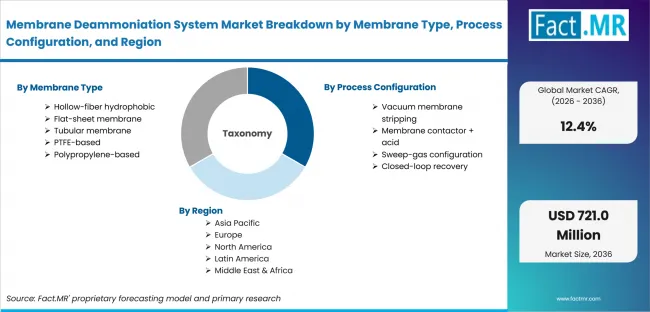
Membrane Deammoniation System Market Breakdown By Membrane Type, Process Configuration, And Region | Source: Fact.MR
| Attribute | Details |
|---|---|
| Quantitative Units | USD 224.0 million in 2026 to USD 720.0 million by 2036 at a 12.4% CAGR |
| Market Definition | Membrane contactor systems for ammonia removal and recovery from wastewater, digestate and industrial streams using gas-permeable membranes and acid absorption. |
| Segments Covered | Membrane Type; Process Configuration; Application; Recovery Product |
| Regions Covered | North America; Latin America; Europe; East Asia; South Asia and Oceania; Middle East and Africa |
| Countries Covered | China; Germany; Netherlands; USA; Saudi Arabia |
| Key Companies Profiled | 3M (Membrana); Fibracast; EnviroChemie; Nijhuis Saur Industries; Prayon; PermeOx (Evonik) |
| Forecast Period | 2026 to 2036 |
| Base Year | 2025 |
| Market Value, 2026 | USD 224.0 million |
| Market Value, 2036 | USD 720.0 million |
| CAGR, 2026-2036 | 12.4% |
| Absolute Opportunity | USD 496.0 million |
| Approach | Combines installed and planned module capacity, system value, application mix, project scale and country deployment. |
How is the market segmented?
-
By Membrane Type
- Hollow-fiber hydrophobic
- Flat-sheet membrane
- Tubular membrane
- PTFE-based
- Polypropylene-based
-
By Process Configuration
- Membrane contactor + acid
- Vacuum membrane stripping
- Sweep-gas configuration
- Closed-loop recovery
-
By Application
- Municipal wastewater
- Anaerobic digestate
- Industrial ammonia streams
- Landfill leachate
- Agricultural runoff
-
By Recovery Product
- Ammonium sulfate
- Ammonium nitrate
- Aqueous ammonia
-
By Region
- North America
- Latin America
- Western Europe
- Eastern Europe
- East Asia
- South Asia and Pacific
- Middle East & Africa