- Market Value (2025): USD 145.0 Mn
- Estimated Value (2026): USD 168.0 Mn
- Forecast Value (2036): USD 620.0 Mn
- CAGR (2026-2036): 13.9%
What is the Membrane Distillation Contactors Market forecast to be worth by 2036?
USD 620.0 million by 2036 at 13.9% CAGR.
- The Membrane Distillation Contactors Market reached USD 147.0 million in 2025.
- Demand is projected to increase from USD 168.0 million in 2026 to USD 617.0 million by 2036.
- The market is forecast to record a 13.9% CAGR from 2026 to 2036.
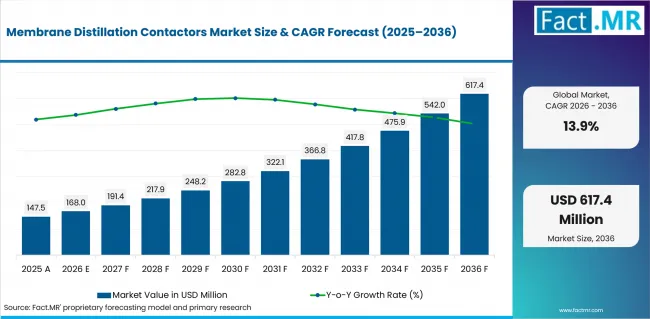
Membrane Distillation Contactors Market Value Analysis | Source: Fact.MR
What are the defining numbers behind Membrane Distillation Contactors Market growth?
An absolute opportunity of USD 452.0 million is expected between 2026 and 2036.
- Demand Drivers in the Market
- Membrane distillation transfers water vapour through a hydrophobic membrane while rejecting non-volatile salts, allowing treatment of brines that become difficult for pressure-driven membranes at very high salinity.
- Direct-contact membrane distillation uses a simple hot-feed and cold-permeate arrangement, supporting modular systems with fewer auxiliary loops.
- Hollow-fiber modules provide high membrane area in compact housings, allowing developers to scale capacity by adding modules.
- Low-grade waste heat and solar thermal energy can supply the temperature difference that drives membrane distillation, creating value from heat that would otherwise be unused.
- Brine-minimization and zero-liquid-discharge projects need additional water recovery before crystallization or disposal, making membrane distillation relevant after reverse osmosis.
- Key Segments Analyzed
- Direct-contact MD accounts for 38.0% of Configuration in 2026 because hot feed and cold permeate contact opposite membrane surfaces directly, keeping the thermal arrangement comparatively simple.
- Hollow-fiber holds 33.0% of Module Geometry in 2026 because high membrane area can be packed into a compact vessel for modular scale-out.
- Desalination represents 37.0% of Application in 2026 because hydrophobic membranes transfer water vapour while retaining dissolved salts, including at salinities that challenge conventional pressure-driven treatment.
- Analyst Opinion at Fact.MR
- Shambhu Nath Jha, Principal Consultant at Fact.MR, states, "Buyer decisions in the Membrane Distillation Contactors Market will centre on use of low-grade heat or solar thermal energy to concentrate high-salinity water. Buyers will compare the 2026 segment leaders with qualification evidence and the operating cost of the full process. Suppliers that support application trials and preserve formulation or equipment consistency can move more quickly into repeat production."
- Strategic Implications
- Suppliers should document the process conditions that allow Direct-contact MD to deliver repeatable performance.
- Customer trials should use the intended substrate, fluid path or process stream before commercial qualification.
- Regional technical support is important in Germany and China because adoption depends on local production or infrastructure conditions.
- Commercial positioning should distinguish qualified application performance from general material or equipment capability.
- Memsys is currently represented through EvCon GmbH.
How does the Membrane Distillation Contactors Market break down by segment?
The market is segmented by Configuration, Module Geometry and Application.
Why does Direct-contact MD lead Configuration?
Direct-contact MD is projected to account for a 37.6% share in 2026.
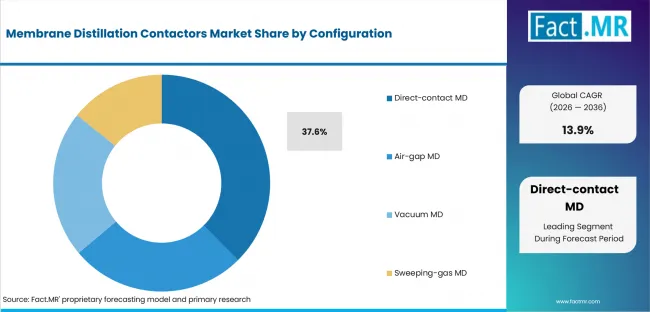
Membrane Distillation Contactors Market Analysis By Configuration | Source: Fact.MR
Direct-contact MD places hot feed and cold permeate directly against opposite sides of the hydrophobic membrane, reducing system complexity relative to configurations with air gaps or vacuum hardware.
The simplicity supports modular pilots and smaller commercial installations, although conductive heat loss remains an efficiency constraint.
Why does Hollow-fiber lead Module Geometry?
Hollow-fiber is projected to account for a 33.4% share in 2026.
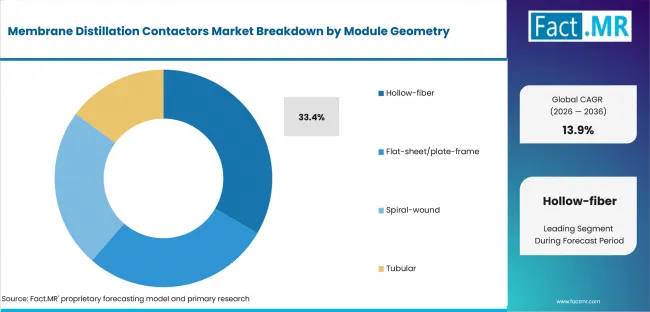
Membrane Distillation Contactors Market Analysis By Module Geometry | Source: Fact.MR
Hollow-fiber modules provide a high membrane-area-to-volume ratio, allowing substantial evaporation surface within a compact housing.
The geometry supports scale-out, but long-term performance depends on controlling pressure drop, fouling, scaling and membrane wetting.
Why does Desalination lead Application?
Desalination is projected to account for a 36.6% share in 2026.
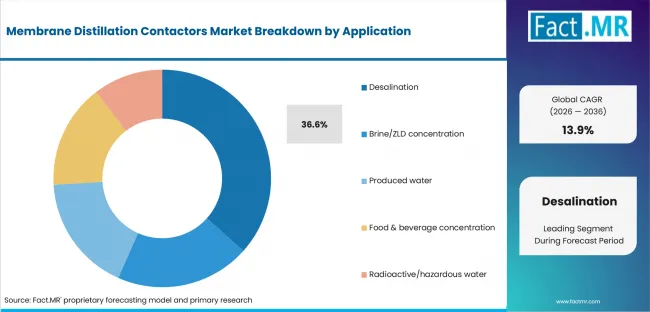
Membrane Distillation Contactors Market Analysis By Application | Source: Fact.MR
Membrane distillation suits high-salinity water because the membrane transports vapour rather than dissolved salts, so osmotic pressure has less direct effect on separation.
The economics improve where low-grade heat or solar thermal energy is available, particularly for brine concentration after reverse osmosis.
What is accelerating Membrane Distillation Contactors Market adoption, and what is holding it back?
Drivers Impact Analysis
| Factor | (~) % Impact on CAGR | Geographic Relevance | Impact Timeline |
|---|---|---|---|
| Modular operation with Direct-contact MD | +3.8% | Germany | Short term (<= 2 years) |
| Compact area using Hollow-fiber | +3.1% | China | Medium term (2-4 years) |
| High-salinity treatment in Desalination | +2.2% | USA | Long term (>= 4 years) |
Opportunity Impact Analysis
| Factor | (~) % Impact on CAGR | Geographic Relevance | Impact Timeline |
|---|---|---|---|
| Use of low-grade heat | +2.0% | Germany | Short term (<= 2 years) |
| Brine concentration | +1.5% | China | Medium term (2-4 years) |
| Solar-thermal desalination | +1.1% | USA | Long term (>= 4 years) |
Restraints Impact Analysis
| Factor | (~) % Impact on CAGR | Geographic Relevance | Impact Timeline |
|---|---|---|---|
| Wetting and scaling | -1.8% | Germany | Short term (<= 2 years) |
| Conductive heat loss | -1.4% | China | Medium term (2-4 years) |
| Limited long-duration references | -1.0% | USA | Long term (>= 4 years) |
Which countries are scaling the Membrane Distillation Contactors Market through 2036?
- Germany: Germany combines water-quality controls with membrane engineering and detailed pilot practice.
- China: China is investing in industrial wastewater treatment and water reuse.
- USA: The USA has diverse municipal and industrial water streams with DOE and EPA research support.
- Netherlands: The Netherlands has a water-technology and circular-resource ecosystem.
- Saudi Arabia: Saudi Arabia has extensive desalination and water-reuse requirements.
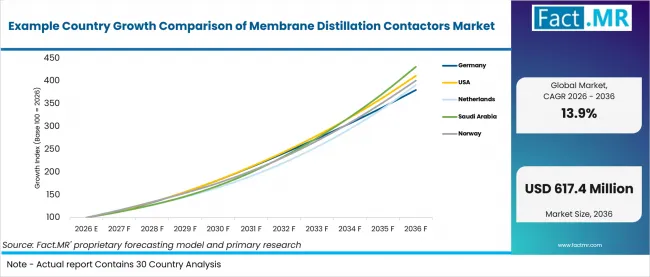
Example Country Growth Comparison Of Membrane Distillation Contactors Market | Source: Fact.MR
Country CAGR (2026-2036)
| Country | CAGR (2026-2036) |
|---|---|
| Germany | 14.4% |
| USA | 15.0% |
| Netherlands | 14.6% |
| Saudi Arabia | 15.8% |
What is driving Germany's growth through 2036?
Germany is forecast to expand at a 14.4% CAGR from 2026 to 2036.
Germany combines stringent water-quality controls with membrane engineering and utility pilot practice, supporting technologies that can reduce energy use or recover resources.
Industrial users can adopt membrane distillation where recovered water and lower disposal volumes offset thermal and cleaning requirements.
What is driving the USA's growth through 2036?
The USA is forecast to expand at a 15.0% CAGR from 2026 to 2036.
The USA has diverse municipal and industrial water streams, while federal research programmes provide pilot evidence for advanced desalination and nutrient-control technologies.
High-salinity brines and reverse-osmosis concentrate create applications where membrane distillation can use available waste or solar heat.
What is driving Netherlands's growth through 2036?
The Netherlands is forecast to expand at a 14.6% CAGR from 2026 to 2036.
The Netherlands has a strong water-technology and circular-resource ecosystem, making recovery and brine-management technologies a close fit with utility and industrial programmes.
Brine-management projects can use membrane distillation as an additional concentration step before crystallization or disposal.
What is driving Saudi Arabia's growth through 2036?
Saudi Arabia is forecast to expand at a 15.8% CAGR from 2026 to 2036.
Saudi Arabia's desalination and water-reuse system creates a direct incentive to increase water recovery and reduce difficult concentrate streams.
Solar resources and large brine volumes make thermal membrane processes relevant where reverse osmosis approaches practical salinity limits.
Who leads the Membrane Distillation Contactors Market?
Aquastill and Memsys are positioned through membrane-distillation modules and system development. Scarab Development and the other listed participants contribute demonstration, licensing or specialist desalination capability.
Competition depends on flux stability, heat recovery and cleaning under concentrated brine.
Company comparison should separate deployable module supply from research and technology-transfer roles.
Memsys is currently represented through EvCon GmbH.
Fraunhofer ISE is a research and licensing participant, not a conventional equipment vendor.
Which companies are the key providers?
Key companies profiled include Aquastill; Memsys; Scarab Development; Fraunhofer ISE (licensees); Xzero; and SolarSpring.
- Aquastill
- Memsys
- Scarab Development
- Fraunhofer ISE (licensees)
- Xzero
- SolarSpring
Bibliography
- U.S. Department of Energy. (2025). Solar Desalination and Membrane Distillation Research. U.S. Government.
- U.S. Department of Energy. (2025). Desalination Basics and High-Salinity Water Treatment. U.S. Government.
- U.S. Department of Energy. (2024). Membrane Distillation Using Low-Grade Waste Heat. U.S. Government.
- Fraunhofer Institute for Solar Energy Systems. (2025). Membrane Distillation Research and Demonstration. Fraunhofer-Gesellschaft.
- International Desalination Association. (2025). Desalination and Brine Management Technical Resources. IDA.
- Federal Ministry for Economic Affairs and Climate Action, Germany. (2025). Industrial and Automotive Transformation Programmes. Government of Germany.
- Ministry of Industry and Information Technology, China. (2026). Development of the Electronic Information Manufacturing Industry in 2025. Government of China.
- U.S. Department of Commerce. (2025). CHIPS for America Advanced Packaging Manufacturing Program. U.S. Government.
- Government of the Netherlands. (2025). Water Technology and Circular Economy Programme. Government of the Netherlands.
- Saudi Water Authority. (2025). Desalination and Water Innovation Programmes. Government of Saudi Arabia.
- Aquastill. (2026). Membrane Distillation Modules and Desalination Systems. Aquastill.
- EvCon GmbH. (2026). Memsys Membrane Distillation Technology. EvCon.
This Report Answers
- The report examines demand across Configuration, Module Geometry, Application.
- Segment analysis explains the operating reason behind each leading category.
- Country analysis evaluates the listed markets and adoption conditions through 2036.
- Competitive analysis reviews the listed companies and clarifies ownership or research roles where relevant.
- The analysis considers qualification, process control and application fit that influence purchasing decisions.
What is the report's scope and coverage?
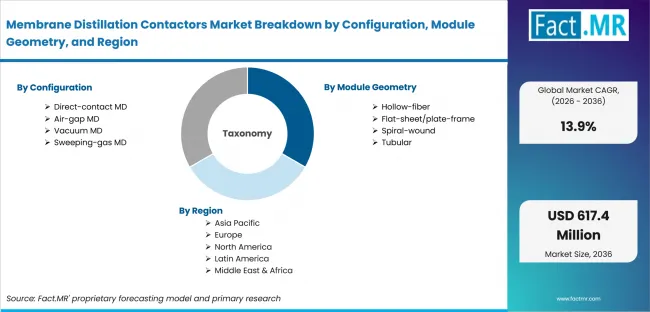
Membrane Distillation Contactors Market Breakdown By Configuration, Module Geometry, And Region | Source: Fact.MR
| Attribute | Details |
|---|---|
| Quantitative Units | USD 168.0 million in 2026 to USD 620.0 million by 2036 at a 13.9% CAGR |
| Market Definition | Membrane distillation contactor modules using hydrophobic membranes and thermal gradients for desalination, brine concentration and water recovery from challenging streams. |
| Segments Covered | Configuration; Module Geometry; Application |
| Regions Covered | North America; Latin America; Europe; East Asia; South Asia and Oceania; Middle East and Africa |
| Countries Covered | Germany; China; USA; Netherlands; Saudi Arabia |
| Key Companies Profiled | Aquastill; Memsys; Scarab Development; Fraunhofer ISE (licensees); Xzero; SolarSpring |
| Forecast Period | 2026 to 2036 |
| Base Year | 2025 |
| Market Value, 2026 | USD 168.0 million |
| Market Value, 2036 | USD 620.0 million |
| CAGR, 2026-2036 | 13.9% |
| Absolute Opportunity | USD 452.0 million |
| Approach | Combines installed and planned module capacity, system value, application mix, project scale and country deployment. |
How is the market segmented?
-
By Configuration
- Direct-contact MD
- Air-gap MD
- Vacuum MD
- Sweeping-gas MD
-
By Module Geometry
- Hollow-fiber
- Flat-sheet/plate-frame
- Spiral-wound
- Tubular
-
By Application
- Desalination
- Brine/ZLD concentration
- Produced water
- Food & beverage concentration
- Radioactive/hazardous water
-
By Region
- North America
- Latin America
- Western Europe
- Eastern Europe
- East Asia
- South Asia and Pacific
- Middle East & Africa