- Base Value(2025): 3.2 Bn
- Estimated Value(2026): 3.4 Bn
- Forecast Value (2036): 7.7 Bn
- CAGR (2026 - 2036): 8.4%
Menopause-Targeted Functional Food and Beverage Market Forecast By Fact.MR
The menopause-targeted functional food and beverage market reached USD 3.2 billion in 2025. Fact MR estimates the market will expand to USD 3.4 billion in 2026 and attain USD 7.7 billion by 2036. The market is forecast to register a CAGR of 8.4% across the assessment period.
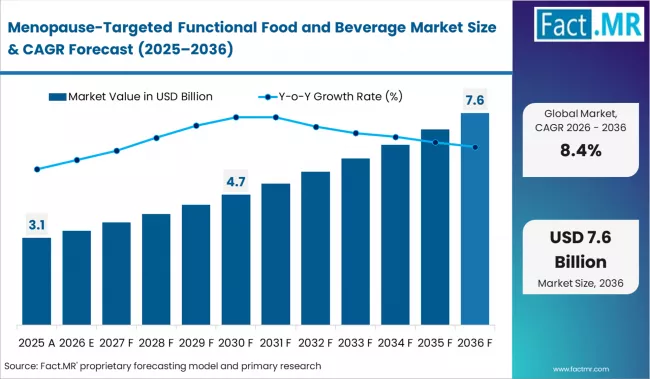
Menopause Targeted Functional Food And Beverage Market Market Value Analysis | Source: Fact.MR
Summary of the Menopause-Targeted Functional Food and Beverage Market
- Market Definition
- The market includes food and beverage products formulated to support nutritional requirements associated with menopause related physiological changes. These products incorporate functional ingredients such as phytoestrogens, vitamins, minerals, probiotics, omega fatty acids, and botanical extracts designed to support bone health, metabolic balance, cardiovascular function, and hormonal stability. Product formats include functional beverages, fortified cereals, dairy alternatives, snack bars, and ready meals designed for women in midlife stages.
- Demand Drivers
- Increasing awareness of life stage specific nutrition addressing hormonal balance and metabolic health requirements
- Rising demand for functional foods formulated with phytoestrogens, vitamins, minerals, and botanical compounds
- Expansion of fortified beverages and functional snacks supporting convenient nutrient intake formats
- Growing availability of condition specific nutrition products across organized retail and online distribution channels
- Key Segments Analyzed
- Product Type: Functional beverages lead with approximately 26% share supported by convenient nutrient delivery format
- Distribution Channel: Supermarkets and hypermarkets account for nearly 39% share due to structured retail accessibility
- Functional Benefit: Hormonal balance, bone health, and metabolic support demonstrate stable demand across targeted nutrition products
- Geography: Asia Pacific shows relatively higher growth supported by increasing awareness of women health nutrition
- Analyst Opinion at Fact MR
- Shambhu Nath Jha, Principal Consultant, Fact MR, opines, "In this updated edition of the Menopause-Targeted Functional Food and Beverage Market report, industry participants will observe sustained demand linked to condition specific nutrition formulated for midlife health requirements. Functional beverages, fortified foods, and botanical nutrition products support dietary intake patterns aligned with hormonal balance and metabolic health management. Companies that strengthen formulation validation, ingredient transparency, and retail distribution access are expected to maintain competitive positioning through 2036."
- Strategic Implications/Executive Takeaways
- Expand formulation capabilities incorporating phytoestrogens, botanical extracts, and micronutrient blends aligned with menopause nutrition requirements
- Strengthen retail distribution across supermarkets, specialty health stores, pharmacies, and online platforms
- Improve clinical substantiation and labeling transparency supporting condition specific nutrition positioning
- Monitor substitution risk from dietary supplements positioned for women health and general wellness applications
- Methodology
- Primary interviews conducted with functional food manufacturers, ingredient suppliers, healthcare nutrition specialists, and product developers
- Desk research based on nutrition science publications, regulatory guidelines, company reports, and trade statistics
- Market sizing derived using a hybrid approach combining bottom up production analysis with top down consumption assessment
- Data validation performed through cross verification with functional food industry datasets and internal peer review aligned with Fact MR standards
Menopause-Targeted Functional Food and Beverage Market
| Metric | Details |
|---|---|
| Industry Size (2026E) | USD 3.4 billion |
| Industry Value (2036F) | USD 7.7 billion |
| CAGR (2026 to 2036) | 8.4% |
An increase of USD 4.3 billion indicates moderate to transformational expansion, reflecting emerging lifecycle-specific nutrition positioning and broader acceptance of functional formulations targeting hormonal balance and metabolic health. Growth remains supported by rising consumer awareness of symptom-specific dietary management and product premiumization, while moderated by regulatory scrutiny over health claims, formulation cost pressures linked to specialty ingredients, and substitution risk from dietary supplements and general wellness products.
India leads with a projected CAGR of 9.6%, supported by increasing demand for condition-specific nutrition products addressing hormonal health and wellness needs. China follows with a CAGR of 9.1%, driven by expanding adoption of fortified foods targeting women’s health management. The United States records a CAGR of 8.0%, reflecting steady demand for functional beverages formulated with vitamins, minerals, and plant-based bioactive ingredients. The United Kingdom shows a CAGR of 7.6%, supported by growing availability of specialized dietary products addressing midlife nutritional requirements. Germany records the slowest growth at 7.3%, reflecting a mature market where demand is largely tied to replacement consumption cycles within established functional nutrition categories. Mature markets generate a significant share of replacement demand as formulation development remains focused on ingredient optimization addressing hormonal balance and metabolic health requirements.
Segmental Analysis
Menopause-Targeted Functional Food and Beverage Market Analysis by Distribution Channel
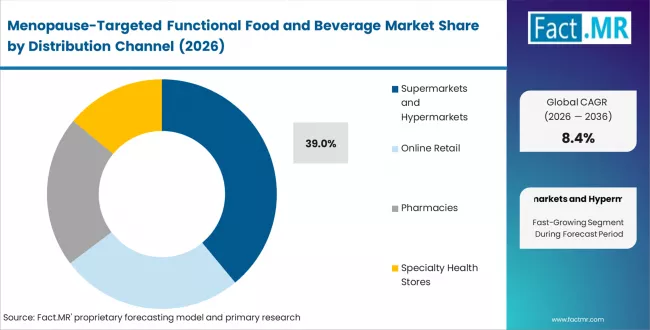
Menopause Targeted Functional Food And Beverage Market Analysis By Distribution Channel | Source: Fact.MR
- Market Overview: Based on Fact MR assessment, supermarkets and hypermarkets are projected to account for 39% share of the menopause-targeted functional food and beverage market in 2026. Organized retail environments support structured shelf placement of condition-specific nutrition products addressing hormonal balance, bone health, and metabolic support requirements. Functional food and beverage products positioned for menopausal nutrition are incorporated into health focused retail aisles where ingredient disclosure, nutrient fortification claims, and dosage format clarity influence purchasing patterns. Retail distribution frameworks support availability of fortified dairy alternatives, botanical beverage formulations, and micronutrient enriched packaged foods aligned with menopausal dietary protocols.
- Demand Drivers:
- Health Condition Category Placement: Supermarkets allocate shelf segments for functional nutrition products formulated for age related physiological requirements linked with hormonal transition stages.
- Product Accessibility Structure: Organized retail supports availability of menopause-support beverage formulations and fortified food products across standardized refrigerated and ambient display environments.
- Label Transparency Preference: Nutrient composition disclosure supports consumer evaluation of calcium, phytoestrogen, vitamin D, and botanical ingredient inclusion associated with menopausal dietary management.
Menopause-Targeted Functional Food and Beverage Market Analysis by Product Type
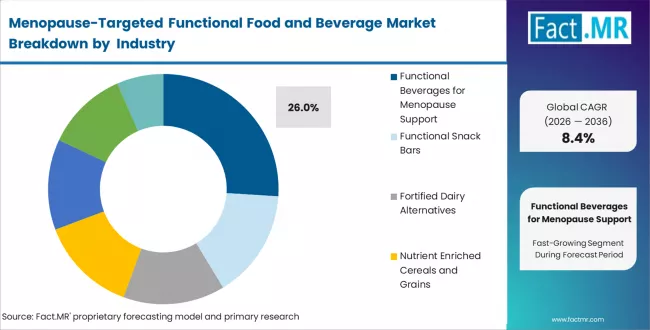
Menopause Targeted Functional Food And Beverage Market Analysis By Product Type | Source: Fact.MR
- Market Overview: Functional beverages for menopause support are estimated to hold 26% share of the menopause-targeted functional food and beverage market in 2026. Beverage formulations are structured to deliver phytonutrients, plant-derived compounds, and micronutrients associated with hormonal balance support and bone density maintenance. Liquid dosage formats support rapid nutrient delivery and simplified daily consumption patterns across targeted demographic groups managing menopausal symptoms. Beverage matrices are designed to incorporate soy isoflavones, botanical extracts, and fortified mineral compositions aligned with condition-specific nutrition formulation standards.
- Demand Drivers:
- Nutrient Delivery Efficiency: Beverage format supports controlled intake of micronutrients associated with bone metabolism and hormonal balance regulation across menopause specific dietary protocols.
- Convenient Consumption Patterns: Ready to drink functional beverages enable integration into daily routines requiring minimal preparation across structured nutrition intake schedules.
- Formulation Adaptability: Beverage systems allow incorporation of plant derived bioactive compounds and mineral fortification supporting condition specific functional nutrition product development.
Key Dynamics
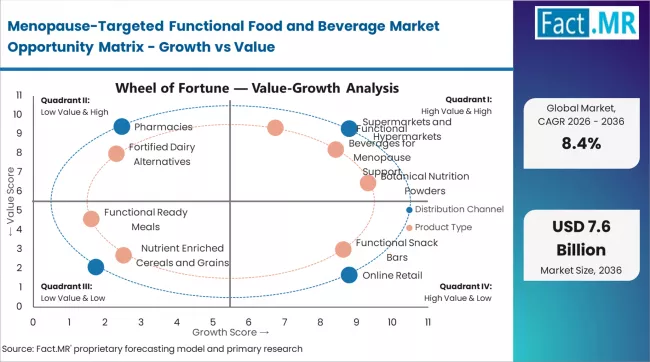
Menopause Targeted Functional Food And Beverage Market Opportunity Matrix Growth Vs Value | Source: Fact.MR
Menopause-Targeted Functional Food and Beverage Market Drivers, Restraints, and Opportunities
Fact MR analysis indicates that the menopause-targeted functional food and beverage market developed from clinical nutrition practices addressing hormonal changes affecting women during midlife. Early nutritional interventions focused on calcium and vitamin supplementation used to support bone health and metabolic balance. The current market valuation reflects expanded formulation of functional foods containing phytoestrogens, plant proteins, omega fatty acids, and micronutrients designed to support physiological changes associated with menopause. Demand persists because targeted nutritional products provide convenient delivery of bioactive compounds integrated into daily dietary consumption.
A structural shift is occurring as conventional general wellness products transition toward life-stage-specific functional nutrition categories. Standard dietary supplements remain widely used where consumers seek broad nutritional support across age groups. Menopause-focused food and beverage products require specialized formulation approaches that incorporate ingredients such as soy isoflavones, botanical extracts, and fortified nutrients designed to support hormone-related metabolic changes. These products involve higher formulation and validation costs due to ingredient sourcing and regulatory labeling considerations. Even with moderate category adoption, higher pricing associated with targeted functional nutrition supports gradual market value expansion.
- Life Stage Nutrition: Manufacturers develop functional beverages, snack products, and fortified foods formulated with phytoestrogens, vitamins, and minerals associated with menopause-related nutritional requirements.
- Health Claim Regulation: Standards such as European Food Safety Authority nutrition claim regulations and U.S. Food and Drug Administration functional food labeling guidelines influence ingredient claims and product communication.
- North America Functional Food Demand: The United States maintains strong retail presence of condition-specific nutrition products supported by organized health food distribution channels.
Regional Analysis
The menopause-targeted functional food and beverage market is assessed across North America, Europe, Asia Pacific, Latin America, and Middle East & Africa, segmented by country-level demand for hormonal health nutrition, fortified foods, and condition-specific dietary formulations. Regional demand reflects women health awareness, nutraceutical adoption, and functional ingredient innovation. The full report offers market attractiveness analysis.
.webp "Top Country Growth Comparison Menopause Targeted Functional Food And Beverage Market Cagr (2026 2036)")
Top Country Growth Comparison Menopause Targeted Functional Food And Beverage Market Cagr (2026 2036) | Source: Fact.MR
| Country | CAGR (2026-2036) |
|---|---|
| India | 9.6% |
| China | 9.1% |
| United States | 8.0% |
| United Kingdom | 7.6% |
| Germany | 7.3% |
Source: Fact MR analysis, based on proprietary forecasting model and primary research
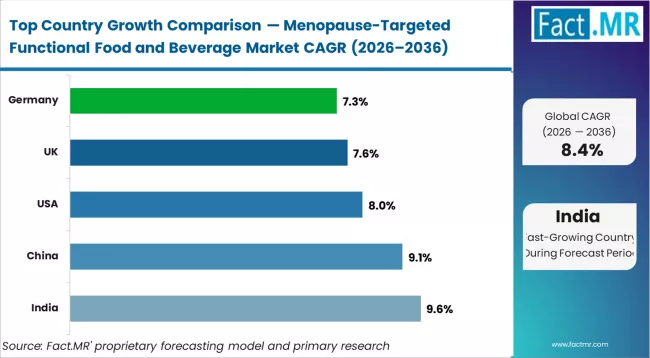
Menopause Targeted Functional Food And Beverage Market Cagr Analysis By Country | Source: Fact.MR
North America
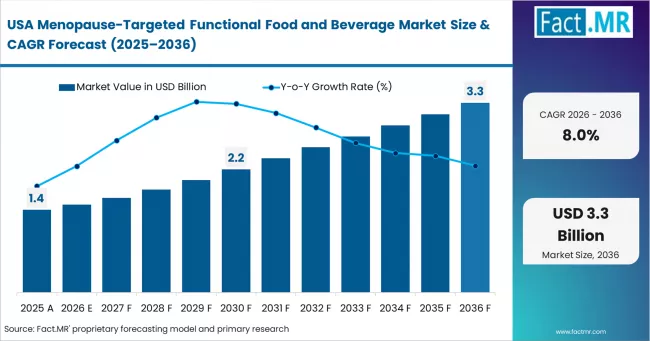
Menopause Targeted Functional Food And Beverage Market Country Value Analysis | Source: Fact.MR
North America functions as the women health nutrition and condition-specific functional food innovation hub, supported by strong nutraceutical distribution and clinical nutrition product development. General Mills, Inc. expands functional food portfolios targeting health-specific nutrition. Abbott Laboratories supports specialized dietary formulations. Glanbia plc strengthens functional ingredient integration.
- United States: Demand for menopause-targeted functional food and beverage in United States is projected to rise at 8.0% CAGR through 2036. Growth is supported by FDA dietary supplement regulations (U.S. FDA, ongoing), governing health-focused nutritional products. Abbott Laboratories expanded condition-specific nutrition product offerings (March 2023), supporting market availability.
Europe
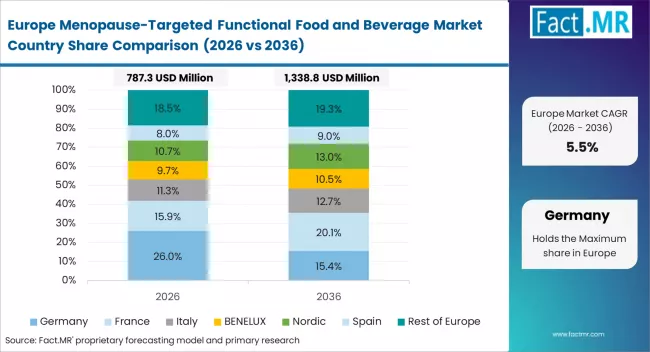
Menopause Targeted Functional Food And Beverage Market Europe Country Market Share Analysis, 2026 & 2036 | Source: Fact.MR
Europe operates as the regulated functional nutrition and specialty health ingredient base, shaped by structured food health claims regulations and product formulation standards. Nestlé S.A. supports functional health product innovation. Danone S.A. expands specialized nutrition offerings. Arla Foods amba strengthens fortified dairy product lines.
- United Kingdom: Demand for menopause-targeted functional food and beverage in United Kingdom is projected to rise at 7.6% CAGR through 2036. The UK Nutrition and Health Claims Regulation (updated 2021) supports functional product positioning. Arla Foods amba expanded fortified functional dairy products (February 2023), supporting adoption.
- Germany: Demand for menopause-targeted functional food and beverage in Germany is projected to rise at 7.3% CAGR through 2036. EU health claims regulation (European Commission, ongoing) supports condition-specific nutrition formulations. Nestlé S.A. expanded women health nutrition product lines (January 2023), supporting market growth.
Asia Pacific
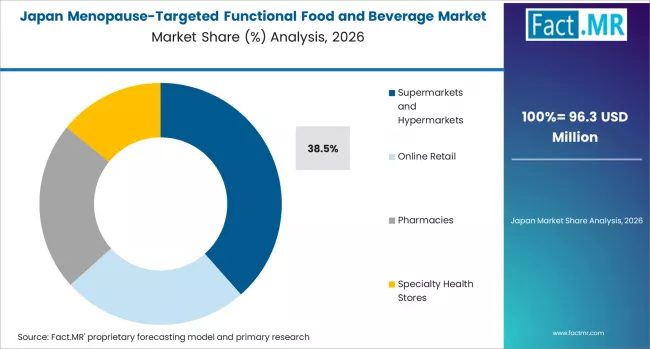
Menopause Targeted Functional Food And Beverage Market Japan Market Share Analysis By Distribution Channel | Source: Fact.MR
Asia Pacific serves as the high-growth functional nutrition and women health dietary market, supported by rising health awareness and expanding fortified food availability. Yakult Honsha Co., Ltd. strengthens functional beverage product offerings. By-Health Co., Ltd. expands women health supplement portfolio. Himalayan Organics supports plant-based functional nutrition products.
- China: Demand for menopause-targeted functional food and beverage in China is projected to rise at 9.1% CAGR through 2036. The Healthy China initiative (State Council, ongoing) promotes preventive nutrition awareness. By-Health Co., Ltd. expanded women health nutritional product lines (April 2023), supporting demand.
- India: Demand for menopause-targeted functional food and beverage in India is projected to rise at 9.6% CAGR through 2036. The National Nutrition Mission (Government of India, ongoing) supports dietary health awareness initiatives. Himalayan Organics expanded women health nutrition product offerings (May 2023), supporting domestic market growth.
Fact MR's analysis of menopause-targeted functional food and beverage market in global regions consists of country-wise assessment that includes India, China, United States, United Kingdom, and Germany. Readers can find condition-specific nutrition trends, regulatory developments, functional ingredient adoption patterns, and competitive positioning across key markets.
Competitive Landscape of Cold Plasma Food Processing Market
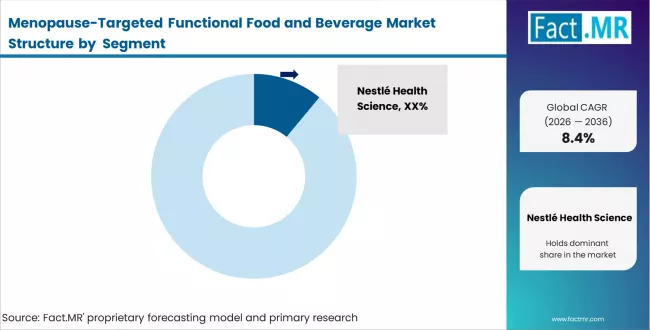
Menopause Targeted Functional Food And Beverage Market Analysis By Company | Source: Fact.MR
Competitive Structure and Buyer Dynamics in the Menopause-Targeted Functional Food and Beverage Market
The competitive structure of the Menopause-Targeted Functional Food and Beverage Market is moderately fragmented, with global nutrition companies and supplement manufacturers participating across functional product development. Companies such as Nestlé Health Science, Danone SA, Abbott Laboratories, Bayer AG, and Otsuka Holdings maintain strong positions through established nutritional science capabilities and broad health product portfolios. These firms provide functional beverages, fortified foods, and dietary supplements formulated to support hormonal balance and nutritional requirements during menopause. Additional participants including GNC Holdings, Amway, Herbalife Nutrition, Nature’s Way, Blackmores, Jamieson Wellness, and NOW Foods compete through specialized formulations targeting bone health, metabolic balance, and general wellness. Competition is primarily influenced by ingredient efficacy, clinical validation support, brand credibility, and regulatory compliance within dietary supplement and functional food categories.
Several companies maintain structural advantages through strong research capabilities and established distribution networks across health and wellness channels. Firms such as Nestlé Health Science, Abbott Laboratories, and Danone SA benefit from extensive clinical nutrition expertise and global supply infrastructure. Bayer AG and Otsuka Holdings maintain advantages through pharmaceutical research capabilities that support product formulation credibility. Supplement focused companies including Amway, Herbalife Nutrition, and GNC Holdings leverage direct distribution and established consumer health positioning. Retailers and online health platforms typically offer multiple functional nutrition brands to reduce dependence on a single supplier and respond to evolving consumer preferences. Procurement decisions evaluate suppliers based on formulation quality, regulatory compliance, and brand trust. This purchasing behavior moderates supplier pricing leverage, while companies with validated formulations and strong brand recognition retain moderate negotiating influence.
Key Players of the Menopause-Targeted Functional Food and Beverage Market
- Nestlé Health Science
- Danone SA
- Abbott Laboratories
- GNC Holdings
- Amway
- Herbalife Nutrition
- Nature’s Way
- Bayer AG
- Blackmores
- Otsuka Holdings
- Jamieson Wellness
- NOW Foods
Bibliographies
- [1] European Food Safety Authority / European Journal of Clinical Nutrition Specialists. (2023). Dietary interventions and nutritional strategies for menopausal women: A review of anti-inflammatory and phytoestrogen-enriched diets. Frontiers in Nutrition, 10. Retrieved March 24, 2026.
- [2] Food and Agriculture Organization / Monograph on Functional Foods. (2023). Functional foods in health and disease: Definitions and regulatory frameworks for health-benefit claims. Functional Foods in Health and Disease, 13(9). Retrieved March 24, 2026.
- [3] U.S. Food and Drug Administration. (2023–2024). Health claim review process for nutrients and chronic disease risk reduction: Guidance for functional food labeling. U.S. FDA. Retrieved March 24, 2026.
- [4] PeerJ. (2025, July 22). Effects of soy isoflavones on menopausal symptoms in perimenopausal women: A systematic review and meta-analysis. PeerJ, 13:e19715. Retrieved March 24, 2026.
- [5] FoodNavigator-Asia. (2025, October 15). Perimenopause: Functional food opportunities for brands – protein, omega-3s, and fibre for symptom management. FoodNavigator-Asia. Retrieved March 24, 2026.
This Report Addresses
- Market size estimation and revenue forecasts for the Menopause-Targeted Functional Food and Beverage Market from 2026 to 2036, supported by lifecycle-specific nutrition demand patterns and functional ingredient consumption benchmarks.
- Growth opportunity mapping across functional beverages, fortified dairy alternatives, botanical nutrition powders, cereals, snack bars, ready meals, and confectionery, reflecting expansion of condition-specific dietary formulations targeting menopausal health requirements.
- Segment and regional revenue forecasts covering functional benefits, ingredient categories, distribution channels, and major consumption regions including India, China, United States, United Kingdom, and Germany.
- Competition strategy assessment of leading companies such as Nestlé Health Science, Danone S.A., Abbott Laboratories, Bayer AG, and Otsuka Holdings, including functional formulation capability and women health nutrition portfolio benchmarking.
- Regulatory impact analysis covering European Food Safety Authority nutrition claims regulation, U.S. Food and Drug Administration functional food labeling requirements, and global nutraceutical compliance frameworks affecting product positioning and communication.
- Market report delivery in PDF, Excel, PPT, and interactive dashboard formats designed for product development strategy, functional ingredient evaluation, and targeted nutrition category expansion.
- Supply chain vulnerability assessments examining availability of phytoestrogen ingredients, formulation standardization complexity, regulatory claim substantiation requirements, and substitution risk from dietary supplements and general wellness products influencing market growth structure.
Menopause-Targeted Functional Food and Beverage Market Definition
The Menopause-Targeted Functional Food and Beverage Market includes food and drink products formulated to support nutritional needs associated with menopause related physiological changes. These products are developed with functional ingredients such as vitamins, minerals, plant extracts, phytoestrogens, and protein sources intended to support bone health, metabolic balance, and overall wellness. Common formats include fortified beverages, nutritional snacks, dairy alternatives, cereals, and dietary food products designed for women in midlife stages. The primary function of menopause targeted functional foods and beverages is to provide convenient nutritional options formulated to address specific dietary considerations during menopause.
Cold Plasma Food Processing Market Inclusions
This report covers global and regional market sizes for menopause targeted functional foods and beverages with forecast analysis for the study period. The market is segmented by product type including fortified beverages, functional snacks, cereals, dairy alternatives, and nutritional food products. Ingredient segmentation includes plant based compounds, vitamins, minerals, and protein enriched formulations. Distribution segmentation includes supermarkets and hypermarkets, online retail, specialty health stores, pharmacies, and convenience stores. The report also evaluates pricing patterns, production trends, and selected trade flow analysis across functional food markets.
Cold Plasma Food Processing Market Exclusions
The report excludes pharmaceutical hormone therapies and prescription medical treatments used for menopause management. Dietary supplements sold in capsule or tablet form are not included. The scope also excludes general functional foods that are not specifically formulated for menopause related nutritional requirements. Cosmetic and personal care products intended for menopause related skin or wellness applications are outside the defined market scope, as the analysis focuses strictly on food and beverage products designed for menopause targeted nutrition.
Cold Plasma Food Processing Market Research Methodology
- Primary Research: Interviews were conducted with functional food manufacturers, nutrition product developers, ingredient suppliers, and healthcare nutrition specialists.
- Desk Research: Public information was collected from food industry publications, company reports, regulatory guidelines, and nutrition research databases.
- Market-Sizing and Forecasting: A hybrid model combining bottom up production analysis with top down consumption assessment across functional food and beverage sectors was applied.
- Data Validation and Update Cycle: Findings were cross verified using multiple industry data sources and expert inputs, with periodic updates conducted as new market information becomes available.
Report Scope of Cold Plasma Food Processing Market
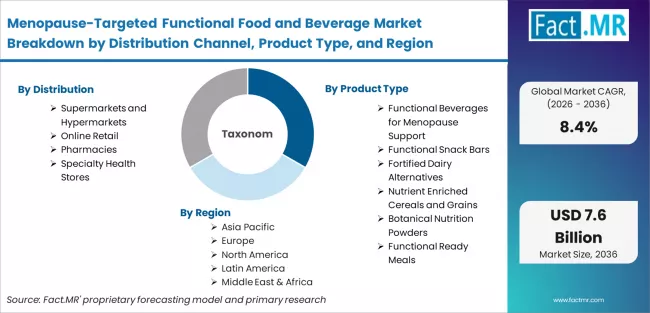
Menopause Targeted Functional Food And Beverage Market Breakdown By Distribution Channel, Product Type, And Region | Source: Fact.MR
| Metric | Value |
|---|---|
| Quantitative Units | USD 3.4 billion (2026) to USD 7.7 billion (2036), at a CAGR of 8.4% |
| Market Definition | The menopause-targeted functional food and beverage market includes global production and sales of nutritionally fortified foods and beverages formulated to support physiological changes associated with menopause, including products designed to address hormonal balance, bone health, cardiovascular function, metabolic support, cognitive performance, and stress management. |
| Product Type Segmentation | Functional beverages for menopause support, Functional snack bars, Fortified dairy alternatives, Nutrient-enriched cereals & grains, Botanical nutrition powders, Functional ready meals, Functional confectionery |
| Functional Benefit Segmentation | Hormonal balance support, Bone health support, Heart health support, Digestive health support, Cognitive health support, Sleep & stress management, Energy & metabolism |
| Ingredient Type Segmentation | Soy isoflavones, Flaxseed & lignans, Red clover extract, Black cohosh, Vitamins & minerals blends, Probiotics, Omega-3 fatty acids |
| Distribution Channel Segmentation | Supermarkets & hypermarkets, Online retail, Pharmacies, Specialty health stores |
| Regions Covered | North America, Latin America, Europe, East Asia, South Asia, Oceania, Middle East and Africa |
| Countries Covered | United States, Canada, Mexico, Brazil, Argentina, Germany, France, United Kingdom, Italy, Spain, China, India, Japan, South Korea, Australia, New Zealand, Singapore, United Arab Emirates, and 40+ countries |
| Key Companies Profiled | Nestlé Health Science, Danone SA, Abbott Laboratories, GNC Holdings, Amway, Herbalife Nutrition, Nature’s Way, Bayer AG, BlackmoresOtsuka HoldingsJamieson Wellness |
Menopause Targeted Functional Food and Beverage Market Key Segments
-
Product Type :
- Functional Beverages for Menopause Support
- Functional Snack Bars
- Fortified Dairy Alternatives
- Nutrient Enriched Cereals and Grains
- Botanical Nutrition Powders
- Functional Ready Meals
- Functional Confectionery
-
Functional Benefit :
- Hormonal Balance Support
- Bone Health Support
- Heart Health Support
- Digestive Health Support
- Cognitive Health Support
- Sleep and Stress Management
- Energy and Metabolism
-
Ingredient Type :
- Soy Isoflavones
- Flaxseed and Lignans
- Red Clover Extract
- Black Cohosh
- Vitamins and Minerals Blends
- Probiotics
- Omega 3 Fatty Acids
-
Distribution Channel :
- Supermarkets and Hypermarkets
- Online Retail
- Pharmacies
- Specialty Health Stores
-
Region :
- North America
- USA
- Canada
- Mexico
- Europe
- Germany
- UK
- France
- Italy
- Spain
- Nordic Countries
- BENELUX
- Rest of Europe
- Asia Pacific
- China
- Japan
- South Korea
- India
- Australia
- Rest of Asia Pacific
- Latin America
- Brazil
- Argentina
- Rest of Latin America
- Middle East and Africa
- Kingdom of Saudi Arabia
- United Arab Emirates
- South Africa
- Rest of Middle East and Africa
- Other Regions
- Oceania
- Central Asia
- Other Markets
- North America