- Base Value(2025): 0.56 Bn
- Estimated Value(2026): 0.62 Bn
- Forecast Value (2036): 1.78 Bn
- CAGR (2026 - 2036): 11.1%
Polyester Hot Melt Adhesives Market Size, Market Forecast and Outlook By Fact.MR
The polyester hot melt adhesives market was valued at USD 0.56 billion in 2025, projected to reach USD 0.62 billion in 2026, and is forecast to expand to USD 1.78 billion by 2036 at an 11.1% CAGR. Textile and apparel manufacturers replacing solvent-based adhesives with polyester hot melt bonding systems are driving specification changes across garment construction, footwear assembly, and technical textile lamination operations. Automotive interior trim assemblers specifying polyester hot melt adhesives for headliner and carpet bonding now require formulations that meet stringent low-VOC cabin air quality standards verified through vehicle-level emission testing.
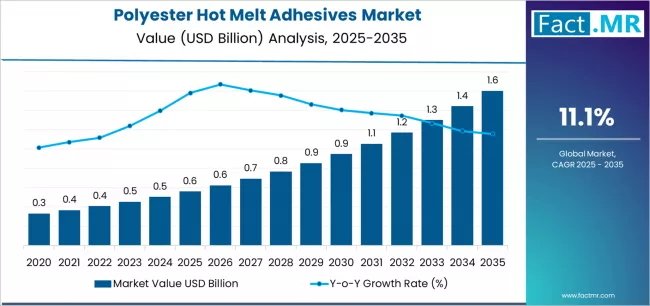
Polyester Hot Melt Adhesives Market Market Value Analysis | Source: Fact.MR
Summary of Polyester Hot Melt Adhesives Market
- Market Overview
- The polyester hot melt adhesives market is valued at USD 0.56 billion in 2025 and is projected to reach USD 1.78 billion by 2036.
- The industry is expected to grow at an 11.1% CAGR from 2026 to 2036, creating an incremental opportunity of USD 1.16 billion.
- The market is a performance-driven specialty adhesive category where textile wash resistance, automotive low-VOC compliance, and film lamination optical clarity requirements define specification selection.
- Demand and Growth Drivers
- Demand is accelerating as textile and apparel manufacturers replace solvent-based adhesives with polyester hot melt bonding systems for garment construction and technical textile lamination.
- Automotive interior trim assemblers require polyester hot melt formulations meeting stringent low-VOC cabin air quality standards verified through vehicle-level emission testing.
- Film and foil lamination applications specify copolyester hot melts for optical clarity and compatibility with recyclable mono-material packaging structures.
- Among key countries, India leads at 14.2% CAGR, followed by China at 13.0%, South Korea at 11.5%, the USA at 10.0%, Germany at 9.5%, the UK at 9.0%, and Japan at 8.5%.
- Product and Segment View
- Polyester hot melt adhesives are thermoplastic bonding materials based on copolyester resins that melt at elevated temperatures and form durable bonds upon cooling, offering superior wash resistance, heat resistance, and low-VOC emission profiles.
- Primary applications span textile and fabric bonding, packaging lamination, automotive interior trim assembly, electrical and electronics component bonding, and polymer film lamination.
- Textiles & Fabrics lead by Application with 33.7% share in 2026.
- Scope includes reactive and non-reactive polyester hot melt adhesives in pellet, film, web, and powder forms, excluding EVA hot melts, polyamide hot melts, and polyolefin hot melt adhesives.
- Geography and Competitive Outlook
- India and China are the fastest-growing markets due to textile manufacturing expansion and automotive interior assembly demand, while the USA and Germany represent mature markets driven by automotive low-VOC specification mandates.
- Competition is shaped by copolyester resin formulation technology, application equipment compatibility, and automotive OEM adhesive qualification status.
- Key companies include Henkel Corporation, H.B. Fuller, 3M, Arkema (Bostik), Dow, Avery Dennison, Sika India, Evonik, TEX YEAR INDUSTRIES INC., Jowat SE, Paramelt, and Palmetto Adhesives.
- Analyst Opinion at Fact.MR
- Shambhu Nath Jha, Principal Consultant for Chemicals and Materials, opines: 'In my analysis, I have observed that the true competitive differentiator for polyester hot melt adhesives is not bond strength alone but the ability to maintain adhesive performance through repeated textile laundering cycles and automotive thermal cycling without delamination. Garment manufacturers specifying polyester hot melts for seam bonding require adhesives that survive 50 or more industrial wash cycles without bond degradation. Automotive trim suppliers face OEM rejection if adhesive bonds fail accelerated thermal aging tests simulating 10 years of cabin temperature cycling. Companies lacking application-specific durability test data face extended qualification timelines that delay market entry.'
- Strategic Implications / Executive Takeaways
- Polyester hot melt producers must develop application-specific durability databases covering textile wash cycle endurance and automotive thermal cycling performance to accelerate customer qualification timelines.
- Textile garment manufacturers should qualify multiple polyester hot melt adhesive suppliers across different copolyester chemistries to maintain production flexibility during fabric bonding operations.
- Automotive tier-1 interior trim suppliers must secure polyester hot melt adhesive supply agreements specifying VOC emission limits that comply with vehicle-level cabin air quality certification standards.
Polyester Hot Melt Adhesives Market Key Takeaways
| Metric | Details |
|---|---|
| Industry Size (2026) | USD 0.62 billion |
| Industry Value (2036) | USD 1.78 billion |
| CAGR (2026 to 2036) | 11.1% |
Source: Fact.MR analysis. Updated Apr 8, 2026
Source: Future Market Insights, 2026
The absolute dollar opportunity of USD 1.16 billion between 2026 and 2036 reflects accelerating substitution of solvent-based and water-based adhesives with reactive and non-reactive polyester hot melt systems across applications demanding wash resistance, heat resistance, and low emission profiles. Polyester hot melts command price premiums over EVA and polyamide alternatives but deliver superior bond durability in textile laundering and automotive thermal cycling environments. Film and foil lamination applications increasingly specify copolyester hot melt adhesives for their optical clarity and compatibility with recyclable mono-material packaging structures.
All major polyester hot melt adhesive adoption corridors reflect accelerated growth. India sets the pace with a 14.2% CAGR as textile and garment manufacturing expansion drives bonding adhesive consumption volumes. China follows at 13.0% with apparel production growth and automotive interior trim assembly demand. South Korea tracks at 11.5% through electronics assembly and display panel lamination requirements. United States operations advance at 10.0%, supported by automotive cabin air quality specifications mandating low-VOC adhesive systems. Germany registers a 9.5% pace anchored by automotive OEM interior trim bonding specifications. United Kingdom expands at 9.0% through technical textile and packaging lamination demand. Japan tracks at 8.5% through electronics and precision assembly adhesive specification tightening.
Why is the Polyester Hot Melt Adhesives Market Growing?
Market expansion is being supported by the exponential increase in textile manufacturing activity and the corresponding need for sophisticated bonding solutions in industrial applications across global manufacturing operations. Modern industrial manufacturers are increasingly focused on advanced polyester adhesive systems that can improve production efficiency, enhance product durability, and optimize manufacturing protocols while meeting stringent quality requirements. The proven efficacy of polyester hot melt adhesives in various industrial applications makes them an essential component of comprehensive manufacturing strategies and product quality programs.
The growing emphasis on sustainable packaging standards and washable textile bonding integration is driving demand for advanced polyester hot melt adhesives that meet stringent performance specifications and operational requirements for industrial applications. Manufacturers' preference for reliable, high-performance bonding systems that can ensure consistent product outcomes is creating opportunities for innovative adhesive formulations and customized application solutions. The rising influence of circular economy initiatives and environmental regulations is also contributing to increased adoption of premium-grade polyester hot melt adhesives across different industry categories and manufacturing systems requiring advanced bonding technology.
Opportunity Pathways - Polyester Hot Melt Adhesives Market
The polyester hot melt adhesives market represents a transformative growth opportunity, expanding from USD 0.56 billion in 2025 to USD 1.6 billion by 2035 at an 11.1% CAGR. As industrial manufacturers prioritize production efficiency optimization, durable bonding solutions, and manufacturing excellence in complex textile and packaging environments, polyester hot melt adhesives have evolved from specialized industrial materials to essential manufacturing components enabling precise substrate bonding, comprehensive washability strategies, and multi-material lamination operations across textile platforms and packaging applications.
The convergence of sustainable packaging acceleration, increasing technical textile penetration, advanced adhesive formulation integration, and stringent environmental compliance mandates creates momentum in demand. High-performance co-polyester formulations offering superior heat resistance, cost-effective reactive polyester solutions balancing functionality with economics, and specialized adhesives for automotive interior applications will capture market premiums, while geographic expansion into high-growth Asian manufacturing hubs and emerging industrial ecosystems will drive volume leadership. Manufacturer emphasis on bonding innovation and application reliability provides structural support.
- Pathway A - Textiles & Fabrics Application Dominance: Leading with 33.7% market share, textile applications drive primary demand through comprehensive lamination workflows requiring sophisticated polyester adhesive solutions for fabric bonding and technical textile manufacturing optimization. Advanced co-polyester formulations enabling improved washability resistance, enhanced thermal stability, and superior substrate compatibility outcomes command premium pricing from textile manufacturers requiring stringent performance specifications and durability compliance. Expected revenue pool: USD 188.4-551.6 million.
- Pathway B - Packaging Application Leadership: Dominating fastest-growing segment with 28.4% market share through optimal balance of flexible packaging necessity and sustainable material requirements, packaging applications serve expanding e-commerce and consumer goods demands. This application addresses both flexible film lamination and paper-based packaging bonding requirements, making it the preferred category for packaging manufacturers and brand owners seeking comprehensive sustainability capabilities. Opportunity: USD 158.8-464.9 million.
- Pathway C - Asian Market Acceleration: China (12.8% CAGR) and India (13.4% CAGR) lead global growth through textile manufacturing expansion, packaging industry development, and adhesive technology capability advancement. Strategic partnerships with local manufacturers, formulation localization expertise, and supply chain optimization enable the expansion of polyester hot melt adhesive applications in major textile production hubs and packaging manufacturing centers. Geographic expansion upside: USD 138.0-464.8 million.
- Pathway D - Automotive & Electronics Applications: Automotive and electrical & electronics segments with combined significant market presence serve critical industrial bonding applications requiring specialized heat-resistant adhesives for interior components and electronic assemblies. Optimized polyester formulations supporting multiple substrate types, automotive qualification requirements, and proven thermal performance maintain substantial volumes from automotive manufacturers and electronics assembly facilities. Revenue potential: USD 89.5-262.1 million.
- Pathway E - Advanced Formulation Technologies & Co-Polyester Innovation: Companies investing in sophisticated reactive polyester systems, advanced crystalline polymer technologies, and low-temperature application formulations gain competitive advantages through consistent bond performance and manufacturing efficiency. Advanced capabilities enabling customized viscosity specifications and rapid product development capture premium industrial partnerships. Technology premium: USD 78.3-229.2 million.
- Pathway F - Distribution Network Optimization & Technical Service Excellence: Specialized adhesive distribution networks, strategic industrial partnership integration, and reliable technical support systems create competitive differentiation in manufacturing markets requiring consistent polyester hot melt adhesive availability. Companies offering guaranteed product quality, comprehensive application training services, and customized formulation development support gain preferred supplier status with quality-focused industrial manufacturers. Distribution network value: USD 67.1-196.4 million.
- Pathway G - Emerging Applications & Market Development: Beyond traditional textile and packaging applications, polyester hot melt adhesives in polymer film lamination, specialty automotive applications, and advanced technical fabric manufacturing represent growth opportunities. Companies developing novel formulations, supporting sustainability initiatives, and expanding into adjacent specialty bonding and emerging material markets capture incremental demand while diversifying revenue streams. Emerging opportunity: USD 55.9-163.7 million.
Segmental Analysis
The market is segmented by application and region. By application, the market is divided into textiles & fabrics, packaging, automotive, electrical & electronics, polymer films & foils, and other applications. Regionally, the market is divided into Asia Pacific, North America, Europe, Latin America, and Middle East & Africa.
Why do Textiles & Fabrics Command Application Market Leadership?
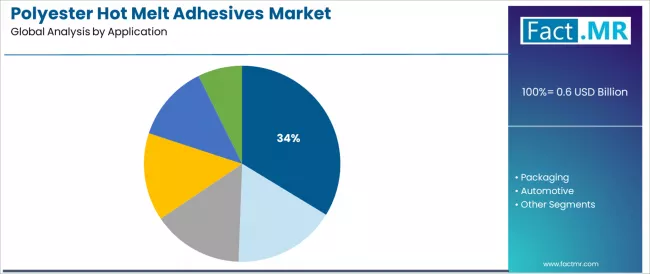
Polyester Hot Melt Adhesives Market Analysis By Application | Source: Fact.MR
The textiles & fabrics application is projected to account for 33.7% of the polyester hot melt adhesives market in 2025, reaffirming its position as the category's dominant application specification. Textile manufacturers increasingly recognize the optimal balance of washability performance and bonding durability offered by polyester hot melt adhesives for technical fabric lamination applications and apparel manufacturing environments. This application category addresses both performance textile requirements and fashion fabric demands while providing reliable bonding outcomes across diverse textile manufacturing operations.
This segment forms the foundation of most industrial textile protocols for fabric lamination and composite textile production, as it represents the most commercially significant and technically demanding application category in the polyester hot melt adhesives industry. Quality validation standards and extensive textile application experience continue to strengthen confidence in polyester adhesive systems among textile manufacturers and fabric converters.
With increasing recognition of washability impact on garment performance and consumer satisfaction requirements, polyester hot melt adhesives for textiles align with both current manufacturing practices and sustainable textile evolution goals, making them the central growth driver of comprehensive textile manufacturing strategies across multiple fabric platforms. The segment encompasses technical textile lamination for sportswear and outdoor apparel, fashion fabric bonding for garment manufacturing, automotive textile applications for interior components, and specialized industrial fabric assembly for protective equipment and filtration materials.
What Drives Packaging Application Segment Prominence as Fastest-Growing Category?
The packaging application is projected to account for 28.4% of the polyester hot melt adhesives market in 2025, establishing its position as the fastest-growing application segment. Packaging manufacturers increasingly recognize that polyester-based adhesives, offering superior heat resistance and chemical stability, represent the most performance-capable and environmentally compatible category enabling comprehensive flexible packaging assembly due to recyclability advantages and substrate versatility.
This application addresses both flexible film lamination requirements and paper-based packaging bonding applications while delivering critical sustainability outcomes across varied packaging operations. The segment is supported by the accelerating nature of sustainable packaging adoption in consumer goods industries, driven by circular economy requirements, brand owner sustainability commitments, and regulatory recyclability mandates necessitating adhesive solutions compatible with packaging recycling streams.
Packaging manufacturers are increasingly focusing on mono-material packaging structures that enhance end-of-life recyclability and material recovery while maintaining product protection standards. As packaging sustainability requirements intensify and consumer preferences evolve, polyester hot melt adhesives will continue to serve a crucial role in ensuring packaging performance and environmental responsibility within the global packaging market. The segment includes flexible packaging lamination for food and beverage pouches, carton sealing for consumer goods, label application for product identification, and specialty packaging assembly for pharmaceutical and industrial products requiring enhanced barrier properties and tamper-evidence features.
What are the Drivers, Restraints, and Key Trends of the Polyester Hot Melt Adhesives Market?
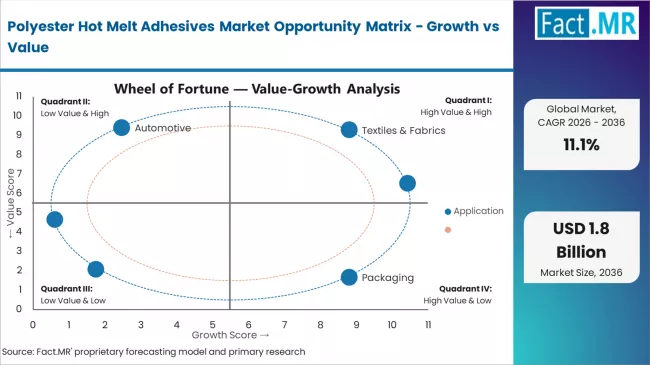
Polyester Hot Melt Adhesives Market Opportunity Matrix Growth Vs Value | Source: Fact.MR
The polyester hot melt adhesives market is advancing rapidly due to increasing recognition of superior adhesive performance characteristics and growing demand for specialized bonding solutions across the textile and packaging sectors.
However, the market faces challenges, including raw material cost pressures affecting pricing strategies, limited availability of specialized application equipment in small-scale operations, and concerns about initial investment requirements in emerging manufacturing markets. Innovation in co-polyester formulation technologies and advanced reactive adhesive systems continues to influence product development and market expansion patterns.
Proliferation of Sustainable Packaging Solutions and Recyclability Requirements
The accelerating adoption of circular economy principles is enabling the development of more environmentally compatible polyester adhesive applications and packaging protocols that can meet stringent sustainability and recyclability requirements.
Packaging manufacturers demand comprehensive recyclability integration for adhesive systems, including mono-material compatibility capabilities and easy delamination formulations that are particularly important for achieving packaging waste reduction requirements in complex sustainability applications.
Sustainable polyester adhesive technologies provide access to recyclable packaging structures that can optimize environmental performance strategies and enhance brand sustainability credentials while maintaining cost-effectiveness for diverse packaging environments.
Integration of Technical Textile Manufacturing and High-Performance Fabric Applications
Modern textile manufacturers are incorporating advanced technologies such as multi-layer fabric lamination systems, breathable membrane bonding capabilities, and specialized technical textile assembly interfaces to enhance product performance utility and functional textile effectiveness.
These systems improve moisture management properties, enable seamless performance fabric integration, and provide better compatibility between textile layers and functional membranes throughout the garment manufacturing and technical textile production experience.
Advanced polyester adhesive capabilities also enable customized bonding protocols and enhanced washability performance through superior thermal stability characteristics, supporting improved product durability and consumer satisfaction outcomes.
Analysis of the Polyester Hot Melt Adhesives Market by Key Countries
.webp "Top Country Growth Comparison Polyester Hot Melt Adhesives Market Cagr (2026 2036)")
Top Country Growth Comparison Polyester Hot Melt Adhesives Market Cagr (2026 2036) | Source: Fact.MR
| Country | CAGR (2025 to 2035) |
|---|---|
| India | 13.4% |
| China | 12.8% |
| Brazil | 11.1% |
| South Korea | 10.9% |
| USA | 10.4% |
| Germany | 9.8% |
| Japan | 9.2% |
Source: Fact.MR analysis. Updated Apr 8, 2026
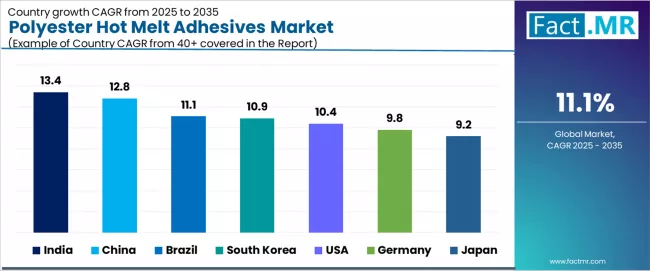
Polyester Hot Melt Adhesives Market Cagr Analysis By Country | Source: Fact.MR
The polyester hot melt adhesives market is experiencing exceptional growth globally, with India leading at a 13.4% CAGR through 2035, driven by expanding textile manufacturing scale, growing packaging industry, and increasing adhesive technology development across major industrial and metropolitan centers. China follows at 12.8%, supported by massive textile production capacity, flexible packaging expansion, and comprehensive manufacturing modernization initiatives.
Brazil records 11.1% growth, benefiting from automotive manufacturing development and expanding packaging operations. South Korea demonstrates 10.9% growth with advanced manufacturing capabilities and technical textile industry focus. The USA shows 10.4% growth, emphasizing sustainable packaging adoption and automotive interior manufacturing advancement. Germany records 9.8% growth, representing automotive industry excellence and technical textile leadership emphasis, while Japan shows 9.2% growth, representing advanced manufacturing standards and quality control excellence emphasis.
How Does India Demonstrate Exceptional Market Potential with Textile Manufacturing Expansion?
The polyester hot melt adhesives market in India is projected to exhibit exceptional growth with a CAGR of 13.4% through 2035, driven by the country's rapidly expanding textile manufacturing industry and increasing recognition of advanced bonding technologies as essential components for production efficiency and product quality enhancement.
The country's massive textile production ecosystem and growing availability of specialized adhesive application infrastructure are creating significant opportunities for polyester hot melt adhesive deployment across both garment manufacturing and technical textile production segments.
Major international adhesive manufacturers and domestic suppliers are establishing comprehensive distribution facilities to serve the expanding population of textile manufacturers and packaging converters requiring advanced bonding solutions across textile mills, garment factories, and flexible packaging facilities throughout India's diverse industrial regions.
The Indian government's strategic emphasis on textile industry advancement and manufacturing capability development is driving substantial investments in production technology capabilities and material innovation availability.
This policy support, combined with the country's position as a leading textile exporter and growing domestic packaging demand, creates a favorable environment for polyester hot melt adhesives market development. Indian manufacturers are increasingly focusing on quality improvement and production efficiency enhancement to improve global competitiveness, with advanced adhesive systems representing a key component in this manufacturing capability building.
- Government initiatives supporting textile industry modernization and packaging infrastructure expansion are driving demand for specialized polyester hot melt adhesive solutions across manufacturing segments
- Production capacity expansion and technology adoption advancement are supporting appropriate utilization of advanced bonding systems among manufacturers and industrial facilities nationwide
- Textile manufacturers and packaging converters are increasingly recognizing adhesive performance importance in product quality, creating new material demand capabilities
- Rising manufacturing investment and growing awareness of production efficiency benefits are accelerating polyester hot melt adhesive adoption across industrial categories
What Makes China Demonstrate Market Leadership with Manufacturing Excellence?
The polyester hot melt adhesives market in China is expanding at a CAGR of 12.8%, supported by the world's largest textile manufacturing industry, rapidly advancing flexible packaging sector, and comprehensive industrial modernization integration across the country's developing coastal and inland manufacturing corridors.
The country's massive textile production scale and increasing sophistication of adhesive application platforms are driving demand for specialized polyester hot melt adhesive solutions in both textile and packaging applications. International adhesive manufacturers and domestic chemical companies are establishing production capacity to serve the growing demand for high-performance bonding materials while supporting the country's position as a global manufacturing leader.
China's adhesive sector continues to benefit from favorable industrial policies, developing technical textile infrastructure, and substantial investment in sustainable packaging technologies. The country's focus on manufacturing quality improvement is driving investments in critical adhesive technologies including co-polyester formulations and reactive polyester systems. This development is particularly important for polyester hot melt adhesive applications, as manufacturers seek reliable material sources for advanced bonding procedures to enhance product quality and maintain export competitiveness.
- Rising focus on quality manufacturing and improving domestic adhesive formulation capabilities are creating opportunities for advanced polyester hot melt adhesive solutions
- Growing technical textile production and packaging modernization are supporting increased deployment of specialized bonding systems across manufacturing categories
- Expanding chemical industry expertise and emerging sustainability standards are driving innovative applications of polyester adhesives in textile and packaging applications
- Manufacturing capability advancement is enabling implementation of sophisticated bonding protocols, supporting market growth and enhancing global manufacturing competitiveness
Why Does Brazil Maintain Manufacturing Growth Momentum?
The polyester hot melt adhesives market in Brazil is projected to exhibit strong growth with a CAGR of 11.1% through 2035, driven by expanding automotive manufacturing operations and growing packaging industry. The country's position as a regional manufacturing leader and increasing industrial sophistication are creating significant opportunities for adhesive integration across both automotive interior and flexible packaging applications. Brazilian manufacturers are leveraging production expertise to serve the growing demand for advanced bonding materials while supporting the country's position as Latin America's largest industrial economy.
The Brazilian market benefits from established automotive manufacturing infrastructure supporting interior component production, enabling optimized adhesive deployment and comprehensive manufacturing integration. This development is particularly important for polyester hot melt adhesive applications, as manufacturers seek high-performance bonding solutions that maximize production efficiency while ensuring product durability in automotive and packaging environments.
Strategic Market Considerations:
- Automotive and packaging segments leading growth with focus on production efficiency and quality enhancement applications
- Manufacturing economics and industrial modernization are driving diverse adhesive portfolios from standard textile bonding to advanced automotive interior platforms
- Industrial expertise and regional manufacturing leadership supporting competitive positioning in Latin American markets
- Quality standards and environmental regulations beginning to influence material specifications and technology adoption timelines
How does South Korea Maintain Advanced Manufacturing Leadership?
South Korea's advanced manufacturing market demonstrates sophisticated polyester hot melt adhesive deployment with documented effectiveness in technical textile platforms and automotive applications through integration with cutting-edge production technologies and quality control protocols.
The country leverages manufacturing excellence and precision industrial methodology to maintain a 10.9% CAGR through 2035. Leading textile manufacturers and automotive component suppliers, including major production facilities in industrial regions, showcase advanced adhesive implementations where sophisticated bonding systems integrate with comprehensive quality assurance platforms and ongoing process optimization to maximize production efficiency and product performance.
South Korean manufacturers prioritize quality excellence and innovation leadership in industrial operations, creating demand for premium polyester hot melt adhesive solutions with advanced capabilities, including high-temperature resistance and integration with automated manufacturing systems. The market benefits from established industrial infrastructure and commitment to manufacturing technology advancement that drives continuous adhesive performance improvement.
Strategic Market Considerations:
- Technical textile and automotive segments leading growth with focus on advanced bonding techniques and comprehensive quality control applications
- High manufacturing standards are driving sophisticated adhesive portfolios from conventional textile bonding to advanced automotive interior assembly platforms
- Industrial excellence and technology leadership supporting continued innovation in polyester hot melt adhesive applications
- Quality standards and performance requirements ensuring consistent bonding reliability and manufacturing outcome optimization
What Drives USA Market Growth with Sustainable Packaging Focus?
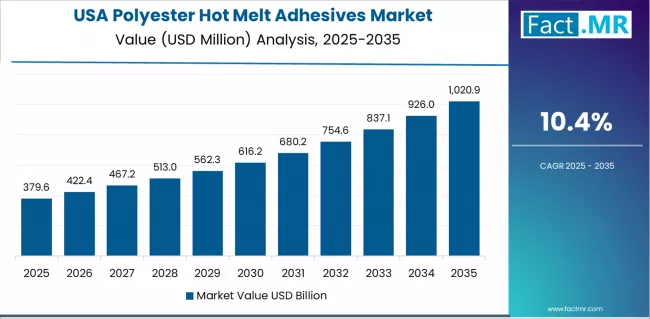
Polyester Hot Melt Adhesives Market Country Value Analysis | Source: Fact.MR
The USA's advanced manufacturing market demonstrates accelerating polyester hot melt adhesive adoption with a 10.4% CAGR through 2035, driven by sustainable packaging initiatives, automotive manufacturing advancement, and comprehensive quality standards across major industrial regions.
The country's emphasis on circular economy principles and recyclable packaging development is creating substantial demand for sophisticated polyester adhesive solutions across diverse packaging and manufacturing platforms. American manufacturers and brand owners are increasingly prioritizing advanced bonding systems that incorporate sustainability credentials for optimal environmental outcomes and consumer preference alignment.
Market dynamics focus on high-performance polyester hot melt adhesives that balance advanced bonding capabilities with recyclability considerations important to U.S. sustainability standards and circular economy requirements. Growing domestic adhesive formulation expertise creates opportunities for integrated sustainable packaging development and advanced manufacturing protocol deployment.
Strategic Market Considerations:
- Packaging and automotive segments leading growth with focus on sustainability excellence and performance optimization applications
- Environmental requirements are driving sophisticated adhesive portfolios from conventional bonding systems to recyclability-compatible platforms
- Manufacturing innovation supported by chemical industry expertise and sustainability leadership capabilities
- Brand owner preferences emphasizing proven environmental credentials and comprehensive recyclability validation in polyester adhesive applications
How does Germany Demonstrate Technical Textile Excellence?
Germany's advanced manufacturing market demonstrates sophisticated polyester hot melt adhesive deployment with documented effectiveness in automotive platforms and technical textile applications through integration with cutting-edge quality control systems and manufacturing automation initiatives. The country leverages automotive industry leadership and precision manufacturing methodology to maintain a 9.8% CAGR through 2035.
Major automotive component manufacturers and technical textile producers, including facilities in leading industrial centers, showcase advanced adhesive implementations where sophisticated bonding protocols integrate with comprehensive research programs and ongoing innovation to optimize assembly efficiency and product durability.
German manufacturers prioritize engineering excellence and long-term performance reliability in industrial operations, creating demand for premium polyester hot melt adhesive solutions with advanced features, including superior heat resistance and integration with European automotive standards. The market benefits from established manufacturing infrastructure and commitment to technical innovation that drives continuous adhesive advancement.
Strategic Market Considerations:
- Automotive and technical textile segments leading growth with focus on bonding precision and comprehensive performance validation applications
- Stringent quality requirements are driving sophisticated adhesive portfolios from conventional systems to advanced automotive-qualified platforms
- Manufacturing excellence and automotive leadership supporting competitive positioning in European industrial markets
- Industry standards and technical specifications emphasizing rigorous approaches and continuous adhesive performance improvement
What drives Japan’s Market Growth with Quality Manufacturing Standards?
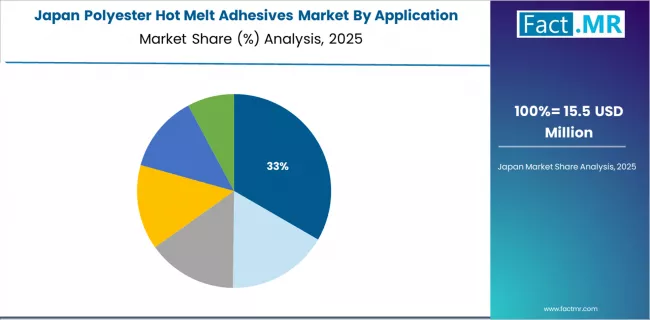
Polyester Hot Melt Adhesives Market Japan Market Share Analysis By Application | Source: Fact.MR
Japan's expanding polyester hot melt adhesives market demonstrates mature technology adoption with a 9.2% CAGR through 2035, driven by advanced manufacturing standards, precision production methodologies, and comprehensive quality control protocols across major industrial regions.
The country's emphasis on manufacturing excellence and meticulous production practice is creating sustained demand for sophisticated polyester adhesive solutions across diverse textile and automotive platforms. Japanese manufacturers are increasingly prioritizing advanced bonding systems that incorporate precision application technologies for optimal product outcomes and manufacturing quality enhancement.
Market dynamics focus on high-quality polyester hot melt adhesives that balance established performance capabilities with reliability considerations important to Japanese manufacturing practice standards and long-term product durability requirements. Mature domestic adhesive industry expertise creates opportunities for next-generation formulation development and advanced application technology deployment.
Strategic Market Considerations:
- Automotive and technical textile segments demonstrating steady growth with emphasis on bonding precision and comprehensive quality applications
- High-quality manufacturing requirements driving premium adhesive specifications with advanced thermal characteristics and performance optimization
- Industrial excellence supported by chemical industry expertise and precision manufacturing delivery capabilities
- Manufacturer preferences emphasizing proven reliability and comprehensive performance validation in specialized polyester adhesive applications
Europe Market Split by Country
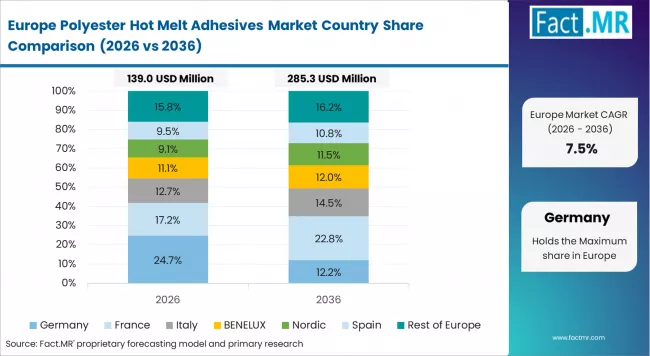
Polyester Hot Melt Adhesives Market Europe Country Market Share Analysis, 2026 & 2036 | Source: Fact.MR
The polyester hot melt adhesives market in Europe is projected to grow from USD 134.2 million in 2025 to USD 346.8 million by 2035, registering a CAGR of 9.9% over the forecast period. Germany is expected to maintain its leadership position with a 36.4% market share in 2025, rising to 37.1% by 2035, supported by its dominant automotive manufacturing infrastructure, comprehensive technical textile capabilities, and advanced adhesive formulation excellence throughout major industrial production facilities and research institutes.
France follows with a 22.8% share in 2025, projected to reach 23.2% by 2035, driven by automotive industry strength, packaging manufacturing capabilities, and expanding textile production sophistication serving both domestic and European markets. The UK holds a 17.2% share in 2025, expected to increase to 17.6% by 2035, supported by comprehensive packaging industry infrastructure and technical textile manufacturing leadership.
Italy commands a 13.6% share in 2025, projected to reach 13.1% by 2035, while Spain accounts for 8.4% in 2025, expected to reach 7.9% by 2035. The Rest of Europe region, including Nordic countries with advanced sustainability standards, Eastern European emerging manufacturing sites, and smaller Western European industrial centers, is anticipated to hold 1.6% in 2025, declining slightly to 1.1% by 2035, attributed to market consolidation toward larger core markets with established manufacturing infrastructure and adhesive application expertise.
Competitive Landscape of the Polyester Hot Melt Adhesives Market
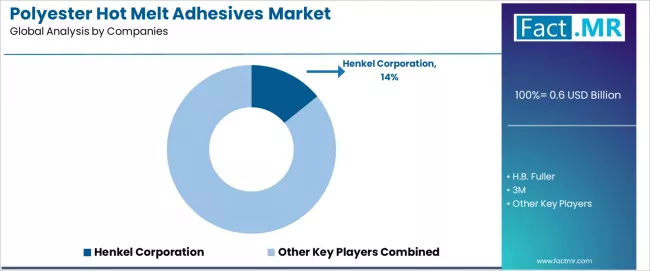
Polyester Hot Melt Adhesives Market Analysis By Company | Source: Fact.MR
The polyester hot melt adhesives market is characterized by intense competition among established adhesive manufacturers, specialized polyester formulation companies, and comprehensive industrial bonding solution providers focused on delivering high-performance, reliable, and application-optimized adhesive products.
Companies are investing in formulation innovation programs, advanced co-polyester development, strategic manufacturing partnerships, and comprehensive technical service initiatives to deliver effective, efficient, and reliable bonding solutions that meet stringent industrial quality standards and manufacturer performance expectations. Product innovation, application versatility enhancement, and sustainability optimization strategies are central to strengthening adhesive portfolios and market presence.
Henkel Corporation leads the market with a 14.2% market share, offering comprehensive polyester hot melt adhesive solutions with a focus on textile lamination expertise and automotive bonding capabilities for industrial applications. H.B. Fuller provides specialized adhesive platforms with emphasis on packaging solutions and comprehensive technical textile capabilities across global manufacturing markets.
3M focuses on advanced adhesive technologies and comprehensive industrial bonding solutions serving international manufacturing communities. Arkema (Bostik) delivers specialty adhesive excellence with strong polyester formulation capabilities and sustainability integration.
Dow operates with a focus on polymer technology and comprehensive adhesive system solutions for industrial applications. Avery Dennison provides dedicated pressure-sensitive and hot melt adhesive systems emphasizing packaging excellence and comprehensive labeling capabilities. Sika India specializes in regional adhesive solutions and construction bonding with emphasis on market accessibility enhancement.
Evonik delivers specialty chemical expertise to enhance adhesive performance and provide comprehensive polyester formulation solutions. TEX YEAR INDUSTRIES INC., Jowat SE, Paramelt, and Palmetto Adhesives focus on specialized textile adhesives, industrial bonding solutions, and technical service excellence, emphasizing application innovation and comprehensive manufacturing support through dedicated research and development strategies.
Key Players in the Polyester Hot Melt Adhesives Market
- Henkel Corporation
- H.B. Fuller
- 3M
- Arkema (Bostik)
- Dow
- Avery Dennison
- Sika India
- Evonik
- TEX YEAR INDUSTRIES INC.
- Jowat SE
- Paramelt
- Palmetto Adhesives
Bibliography
- ASTM International. (2024). ASTM D4499-24 Standard test method for heat seal strength of hot melt adhesives. ASTM.
- European Committee for Standardization. (2024). EN 14410:2024 Textile floor coverings, determination of bond strength of adhesives. CEN.
- Society of Automotive Engineers. (2024). SAE J1756:2024 Determination of volatile organic compound emissions from vehicle interior trim materials. SAE International.
- International Organization for Standardization. (2024). ISO 17706:2024 Footwear, test methods for uppers, bond strength determination. ISO.
- Bureau of Indian Standards. (2024). IS 16764:2024 Hot melt adhesives for textile applications, specification. BIS, Government of India.
This bibliography is provided for reader reference. The full Fact.MR report contains the complete reference list with primary research documentation.
This Report Addresses
- Market sizing and quantitative forecast metrics detailing polyester hot melt adhesive expenditure across textile, packaging, automotive, and electronics sectors through 2036.
- Segmentation analysis mapping adoption by application and evaluating wash resistance and thermal cycling specifications driving formulation selection.
- Regional deployment intelligence comparing textile manufacturing growth in Asia against automotive low-VOC specification conversion in North America and Europe.
- Performance specification assessment analyzing wash cycle durability, thermal aging resistance, and VOC emission requirements.
- Competitive posture evaluation tracking copolyester resin formulation technology and automotive OEM qualification portfolios.
- Application engineering guidance defining adhesive coverage rates and bonding parameters for target textile and automotive applications.
- Supply chain analysis identifying copolyester resin feedstock availability and adhesive film production capacity constraints.
- Custom data delivery formats encompassing interactive dashboards, raw Excel datasets, and comprehensive PDF narrative reports.
Polyester Hot Melt Adhesives Market Definition
Polyester hot melt adhesives are thermoplastic bonding materials based on saturated copolyester resins that melt at temperatures between 80 and 220 degrees Celsius and form durable bonds upon cooling and crystallization. These adhesives deliver superior wash resistance, heat resistance, chemical resistance, and low-VOC emission profiles compared to EVA and polyolefin hot melt alternatives. Primary industrial forms include pellets for roller and slot-die application, adhesive films and webs for textile lamination, and powder for scatter coating on fabrics.
Polyester Hot Melt Adhesives Market Inclusions
Market scope includes reactive and non-reactive polyester hot melt adhesives in pellet, film, web, and powder physical forms. The report covers global and regional market sizes, forecast period 2026 to 2036, and segment breakdowns by application.
Polyester Hot Melt Adhesives Market Exclusions
The scope excludes EVA-based hot melt adhesives, polyamide hot melts, polyolefin hot melts, pressure-sensitive adhesives, and solvent-based polyester adhesive systems.
Polyester Hot Melt Adhesives Market Research Methodology
Primary Research: Analysts engaged with hot melt adhesive formulators, textile garment bonding line operators, and automotive interior trim adhesive engineers to map qualification requirements and application-specific performance standards.
Desk Research: Data collection aggregated textile production statistics, automotive interior trim assembly capacity databases, and adhesive VOC emission regulation timelines.
Market-Sizing and Forecasting: Baseline values derive from a bottom-up aggregation of polyester hot melt consumption per garment produced, automotive interior trim set assembled, and square meter of film laminated, applying application-specific adhesive coverage rates.
Data Validation and Update Cycle: Projections are tested against publicly reported hot melt adhesive segment revenues from major adhesive companies and textile industry bonding technology adoption surveys.
Segmentation
Scope of the Report
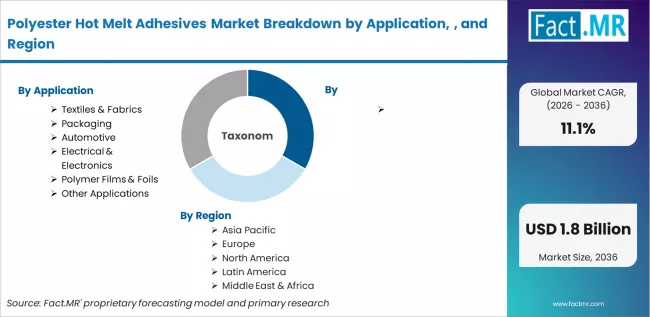
Polyester Hot Melt Adhesives Market Breakdown By Application And Region | Source: Fact.MR
| Metric | Value |
|---|---|
| Quantitative Units | USD 0.62 billion to USD 1.78 billion, at a CAGR of 11.1% |
| Market Definition | Polyester hot melt adhesives are thermoplastic bonding materials based on saturated copolyester resins that melt at temperatures between 80 and 220 degrees Celsius and form durable bonds upon cooling and crystallization. These adhesives deliver superior wash resistance, heat resistance, chemical resistance, and low-VOC emission profiles compared to EVA and polyolefin hot melt alternatives. Primary industrial forms include pellets for roller and slot-die application, adhesive films and webs for textile lamination, and powder for scatter coating on fabrics. |
| Application Segmentation | Textiles & Fabrics, Packaging, Automotive, Electrical & Electronics, Polymer Films & Foils, Other Applications |
| Regions Covered | North America, Latin America, Europe, East Asia, South Asia, Oceania, Middle East & Africa |
| Countries Covered | India, China, USA, Germany, Japan, South Korea, UK, and 40 plus countries |
| Key Companies Profiled | Henkel Corporation, H.B. Fuller, 3M, Arkema (Bostik), Dow, Avery Dennison, Sika India, Evonik, TEX YEAR INDUSTRIES INC., Jowat SE, Paramelt, Palmetto Adhesives |
| Forecast Period | 2026 to 2036 |
| Approach | Baseline values derive from a bottom-up aggregation of polyester hot melt consumption per garment produced, automotive interior trim set assembled, and square meter of film laminated, applying application-specific adhesive coverage rates. |
Source: Fact.MR analysis. Updated Apr 8, 2026
Polyester Hot Melt Adhesives Market by Segments
-
Application :
- Textiles & Fabrics
- Packaging
- Automotive
- Electrical & Electronics
- Polymer Films & Foils
- Other Applications
-
Region :
- Asia Pacific
- China
- India
- Japan
- South Korea
- ASEAN
- Australia & New Zealand
- Rest of Asia Pacific
- North America
- United States
- Canada
- Mexico
- Europe
- Germany
- France
- United Kingdom
- Italy
- Spain
- Nordic
- BENELUX
- Rest of Europe
- Latin America
- Brazil
- Argentina
- Chile
- Rest of Latin America
- Middle East & Africa
- Kingdom of Saudi Arabia
- Other GCC Countries
- Turkey
- South Africa
- Other African Countries
- Rest of Middle East & Africa
- Asia Pacific
Frequently Asked Questions
How large is the demand for polyester hot melt adhesives in the global market in 2026?
What will be the market size of polyester hot melt adhesives by 2036?
What is the expected demand growth between 2026 and 2036?
Which Application is poised to lead global sales by 2026?
What is the India growth outlook in this report?
What is China's growth outlook in this report?
What are polyester hot melt adhesives and what are they mainly used for?
Who worked on this report


Preview the report firsthand - request a free sample
Free SampleGet the brochure for pricing and purchase details
Download PDF