- Base Value(2025): 24.20 Bn
- Estimated Value(2026): 25.43 Bn
- Forecast Value (2036): 41.83 Bn
- CAGR (2026 - 2036): 5.10%
Semi-trailer Market Size, Market Forecast and Outlook By Fact.MR
The semi-trailer market was valued at USD 24.20 billion in 2025, projected to reach USD 25.43 billion in 2026, and is forecast to expand to USD 41.83 billion by 2036 at a 5.10% CAGR. Expanding freight transport volumes driven by e-commerce growth, industrial production recovery, and cross-border trade activity sustain fleet renewal and expansion demand for semi-trailers across all major logistics markets. Regulatory mandates tightening trailer safety standards, including rear underride protection, side guard requirements, and electronic stability control, compel fleet operators to procure compliant new trailers on accelerated replacement schedules.

Semi Trailer Market Market Value Analysis | Source: Fact.MR
Summary of Semi-trailer Market
- Semi-trailer Market Definition
- Semi-trailers are towed cargo transport units coupled to truck tractors via fifth-wheel connections, available in dry van, flatbed, refrigerated, tanker, and lowboy configurations serving the full spectrum of over-the-road freight transport applications.
- Demand Drivers in the Market
- E-commerce driven freight volume growth across North America, Europe, and Asia Pacific generates sustained fleet expansion demand for dry van and refrigerated semi-trailers to handle the increasing parcel and temperature-controlled shipment volumes.
- Regulatory safety mandates including rear underride guard requirements, side protection standards, and electronic stability control specifications compel fleet operators to replace aging trailers that cannot be cost-effectively retrofitted to meet new compliance thresholds.
- Highway infrastructure expansion in India, Southeast Asia, and Africa creates new long-haul freight corridors that require proportional semi-trailer fleet buildout to serve routes previously limited to smaller rigid-body trucks.
- Key Segments Analyzed in the Fact.MR Report
- Lowboy Trailers: 25.8% share in 2026, reflecting the dominant configuration within the type category across global markets.
- Tandem Axle: 55.0% share in 2026, as the leading sub-segment within axle configuration segmentation.
- India: 7.5% compound growth, representing the fastest-expanding national market within the forecast period.
- Analyst Opinion at Fact.MR
- The semi-trailer market operates on a fleet replacement cycle where average trailer age, regulatory compliance deadlines, and freight volume growth collectively determine annual procurement volumes. Fleet operators that extend trailer service life beyond the optimal replacement point face escalating maintenance costs, reduced fuel efficiency from aerodynamic degradation, and potential regulatory non-compliance as safety standards tighten. The lowboy segment commands the highest per-unit values because heavy equipment transport requires specialized low-deck engineering that limits manufacturing competition to a smaller number of qualified producers. Dry vans represent the volume backbone of the market but face margin pressure from manufacturing overcapacity in China and India that enables aggressive export pricing into developed markets. Fleet directors must evaluate total cost of ownership models that incorporate fuel savings from aerodynamic trailer designs, maintenance cost projections, and residual value at the planned replacement interval.
- Strategic Implications / Executive Takeaways
- Fleet procurement directors must align trailer replacement schedules with upcoming safety regulation implementation dates to avoid operating non-compliant trailers that face roadside enforcement penalties and insurance coverage restrictions.
- Trailer manufacturers should invest in aerodynamic design features including boat tails, side skirts, and low-rolling-resistance tire specifications that reduce per-mile fuel costs and create a measurable total cost of ownership advantage in fleet purchasing evaluations.
- Logistics companies expanding into emerging market corridors in India and Southeast Asia must specify trailer axle and suspension configurations rated for road surface conditions that differ substantially from the paved highway environments these trailers encounter in developed markets.
Semi-trailer Market Key Takeaways
| Metric | Details |
|---|---|
| Industry Size (2026) | USD 25.43 billion |
| Industry Value (2036) | USD 41.83 billion |
| CAGR (2026 to 2036) | 5.10% |
Source: Fact.MR analysis. Updated Mar 26, 2026
The absolute dollar opportunity between 2026 and 2036 amounts to approximately USD 16.40 billion. Growth is steady, reflecting the mature freight transport infrastructure where trailer demand correlates with trade volumes and fleet age replacement cycles. Lowboy trailers lead the type segment because their low-deck design serves the heavy equipment and construction machinery transport niche that generates the highest per-unit pricing. Fact.MR analysts note that dry vans represent the largest unit volume category because they serve the broadest range of general freight applications, but their commoditized pricing positions them below lowboy and tanker trailers in revenue share terms. Tandem axle configurations dominate because they provide the load distribution and gross vehicle weight ratings required for standard 40-foot trailer operations across highway networks.
India leads with a 7.5% CAGR as highway infrastructure expansion and freight formalization drive semi-trailer fleet modernization. China follows at 7.0%, supported by domestic manufacturing scale and Belt and Road logistics corridors. South Korea registers 5.0%. USA advances at 4.5%. Germany tracks at 4.2%. UK maintains 4.0%, and Japan at 3.5%.
Why is the Semi-trailer Market Experiencing Strong Growth?
The semi-trailer market grows by enabling logistics companies, freight carriers, and transportation operators to access reliable cargo handling equipment that supports operational efficiency while meeting commercial demand for consistent performance specifications.
Fleet operators and distribution companies face mounting pressure to develop cost-effective transportation solutions with proven payload capabilities and operational characteristics, with semi-trailer configurations typically providing 40-53 foot cargo capacity essential for long-haul freight operations and regional distribution networks, making these vehicles essential for competitive positioning in logistics, retail distribution, and industrial transportation categories.
The transportation industry's need for reliable equipment supply and consistent operational performance creates demand for diverse trailer types that can provide superior cargo handling characteristics, maintain predictable performance across different loading conditions, and ensure operational compliance without compromising fleet economics or equipment specifications.
Government initiatives promoting highway infrastructure development and commercial transportation efficiency drive adoption in freight carrier operations, logistics distribution centers, and intermodal transportation facilities, where semi-trailer utilization has a direct impact on delivery performance outcomes and operational efficiency.
The e-commerce industry's growing focus on rapid fulfillment and last-mile delivery capabilities further expands market opportunities, with logistics research demonstrating measurable performance advantages from specialized trailer configurations, including enhanced loading efficiency and improved cargo protection capabilities.
However, supply chain complexity during component sourcing and the technical requirements for trailer manufacturing operations and quality assurance processes may limit accessibility among smaller manufacturers and developing regions with limited infrastructure for advanced semi-trailer production and maintenance systems.
Segmental Analysis
The market is segmented by type and region. By type, the market is divided into lowboy trailers, dry vans, refrigerated trailers, flat bed trailers, tankers, and others. Regionally, the market is divided into Asia Pacific, North America, Europe, Latin America, and Middle East & Africa.
What Makes Lowboy Trailers the Dominant Type Segment in the Semi-trailer Market?
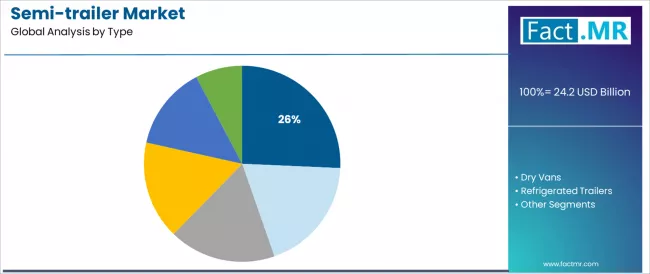
Semi Trailer Market Analysis By Type | Source: Fact.MR
The lowboy trailers segment represents the dominant force in the semi-trailer market, capturing approximately 25.7% of total market share in 2025. This established equipment category encompasses solutions featuring critical load-bearing functionality for heavy equipment transportation, construction machinery handling, and oversized cargo operations, including specialized deck configurations that enable improved clearance management, reduced loading angles, and enhanced stability characteristics across all heavy-haul transportation applications.
The lowboy trailers segment's market leadership stems from its essential role in construction equipment logistics, with specialized deck designs capable of meeting diverse hauling requirements while maintaining cost-effective operations and operational reliability across all heavy transportation environments. Within the lowboy trailers segment, construction and mining equipment applications account for the largest consumption share, driven by infrastructure development programs and continuous construction activity across global industrial operations.
The dry vans segment maintains substantial market presence serving freight carriers who require versatile enclosed cargo transportation for general merchandise, packaged goods, and consumer products distribution. These applications offer standard cargo solutions for retail distribution, manufacturing logistics, and commercial transportation markets while providing sufficient operational flexibility to meet performance demands and loading requirements. The dry vans segment demonstrates the fastest expected growth with a CAGR of 8.5%, driven by expanding e-commerce distribution networks and increasing demand for efficient freight transportation solutions.
Key advantages driving the lowboy trailers segment include:
- Established transportation infrastructure with integrated heavy-haul logistics networks that reduce operational complexity and ensure consistent equipment availability
- Critical load-bearing functionality allowing enhanced heavy equipment transportation across different cargo configurations without significant operational penalties
- Proven application compatibility, delivering reliable hauling performance while maintaining competitiveness against alternative transportation methods
- Broad industrial acceptance enabling straightforward equipment specification and operational standards across multiple construction and industrial sectors
What are the Drivers, Restraints, and Key Trends of the Semi-trailer Market?
The market is driven by three concrete demand factors tied to transportation activity and commercial expansion. First, increasing freight transportation volumes and logistics network development creates growing demand for semi-trailer equipment, with global freight tonnage expanding by 5-7% annually in major commercial regions worldwide, requiring comprehensive transportation equipment infrastructure. Second, expanding e-commerce operations and distribution center development drives increased adoption of specialized semi-trailer configurations, with many logistics companies implementing fleet expansion programs for distribution capacity enhancement by 2030. Third, technological advancements in trailer manufacturing and lightweight materials enable more effective and efficient cargo handling that reduces operational costs while improving fuel efficiency rates and payload capabilities.
Market restraints include fluctuating steel prices for trailer frame construction that can deter manufacturers from maintaining competitive pricing strategies, particularly in regions where material-intensive production operations face commodity price volatility or supply chain disruptions. Vehicle safety regulations and compliance requirements pose another significant challenge, as semi-trailer operations must meet comprehensive braking standards, lighting specifications, and load management protocols, potentially causing increased manufacturing costs and certification expenditures. Manufacturing capacity limitations and production lead times create additional market challenges for fleet expansion, demanding ongoing investment in production facility development and manufacturing process improvements.
Key trends indicate accelerated capacity expansion in Asia Pacific markets, particularly China and India, where industrial development and logistics growth drive comprehensive semi-trailer manufacturing adoption. Technology integration trends toward advanced trailer systems with telematics integration, remote monitoring capabilities, and automated cargo management enable optimized fleet approaches that reduce operational costs and minimize equipment downtime. However, the market thesis could face disruption if significant advances in alternative transportation technologies or major shifts in logistics strategies reduce reliance on traditional semi-trailer configurations.
Analysis of the Semi-trailer Market by Key Countries
.webp "Top Country Growth Comparison Semi Trailer Market Cagr (2026 2036)")
Top Country Growth Comparison Semi Trailer Market Cagr (2026 2036) | Source: Fact.MR
| Country | CAGR (2026-2036) |
|---|---|
| USA | 8.1% |
| China | 7.9% |
| Germany | 7.6% |
| India | 7.3% |
| Brazil | 6.9% |
| UK | 6.5% |
| Japan | 6.1% |
Source: Fact.MR analysis. Updated Mar 26, 2026
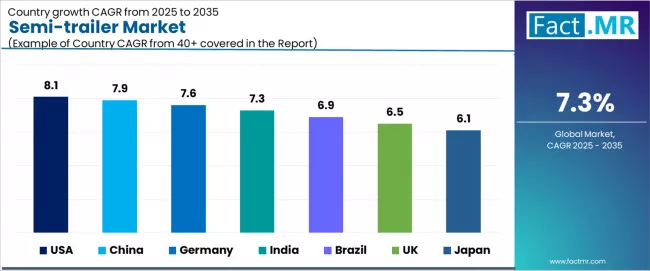
Semi Trailer Market Cagr Analysis By Country | Source: Fact.MR
The semi-trailer market is expanding robustly, with USA leading at an 8.1% CAGR through 2036, driven by extensive highway infrastructure, expanding e-commerce logistics, and comprehensive freight transportation networks. China follows at 7.9%, supported by massive manufacturing output, integrated supply chain systems, and accelerated demand from domestic distribution sectors. Germany records 7.6%, reflecting advanced logistics infrastructure and strong automotive industry integration. India posts 7.3%, anchored by emerging logistics sector development and growing commercial transportation operations.
Brazil grows at 6.9%, with expanding agricultural exports and regional distribution networks. UK advances at 6.5%, emphasizing logistics modernization and distribution efficiency improvements, while Japan grows steadily at 6.1%, focusing on specialized transportation applications through advanced manufacturing technologies and automotive industry requirements.
USA Leads Global Market Expansion

Semi Trailer Market Country Value Analysis | Source: Fact.MR
USA demonstrates the strongest growth potential in the semi-trailer market with a CAGR of 8.1% through 2036. The country's leadership position stems from extensive highway infrastructure, expanding e-commerce distribution networks, and increasing freight transportation operations enabling mainstream semi-trailer adoption.
Growth is concentrated in major logistics regions, including Texas, California, Illinois, and Pennsylvania, where distribution hubs and expanding transportation infrastructure are implementing semi-trailer procurement for enhanced freight capacity and logistics optimization applications.
Distribution channels through fleet operators, commercial carriers, and leasing companies expand deployment across transportation companies and distribution centers. The country's mature logistics sector provides policy support for transportation development, including investment incentives for equipment modernization.
Key market factors:
- Commercial demand concentrated in e-commerce fulfillment centers and freight transportation networks with comprehensive logistics infrastructure
- Infrastructure development through interstate highway improvements and distribution center expansion
- Comprehensive transportation ecosystem, including established trucking industry with proven operational capabilities
- Technology integration featuring advanced trailer systems, telematics platforms, and fleet management technologies
China Emerges as Production Powerhouse
In major industrial provinces including Shandong, Jiangsu, Zhejiang, and Guangdong, the production and consumption of semi-trailers is accelerating across logistics operations and manufacturing distribution segments, driven by integrated supply chains and massive production capacity. The market demonstrates strong growth momentum with a CAGR of 7.9% through 2036, linked to government infrastructure development policies, integrated manufacturing logistics networks, and sustained domestic commercial demand.
Chinese producers are implementing advanced semi-trailer manufacturing technologies and automated production systems to enhance manufacturing economics while meeting growing demand in expanding e-commerce sectors and industrial distribution networks. The country's Belt and Road initiatives create persistent demand for transportation equipment, while increasing emphasis on logistics efficiency drives adoption of specialized semi-trailer production systems.
Key development areas:
- Logistics and manufacturing sectors leading semi-trailer consumption with comprehensive equipment programs
- Integrated supply chains providing efficient distribution flow with extensive logistics infrastructure
- Technology partnerships between trailer manufacturers and fleet operators are expanding market reach
- Integration of lightweight materials and comprehensive quality management protocols
Germany Shows Industrial Leadership
Germany's market expansion is driven by automotive sector integration, including logistics operations in Bavaria and Baden-Württemberg, and expanding transportation operations across multiple industrial states. The country demonstrates strong growth potential with a CAGR of 7.6% through 2036, supported by advanced highway infrastructure for commercial transportation, increasing logistics efficiency requirements, and growing integration with European distribution networks.
German manufacturers face operational challenges related to environmental regulations and equipment standards, requiring investment in advanced manufacturing facilities and compliance with international quality providers. However, growing logistics volumes and central European positioning create compelling business cases for semi-trailer deployment, particularly in industrial regions where distribution centers have a direct impact on manufacturing supply chain operations.
Key market characteristics:
- Automotive and manufacturing logistics segments showing robust growth with substantial increase in semi-trailer requirements
- Regional expansion trends focused on logistics clusters in major industrial centers
- Future projections indicate the need for expanded manufacturing capabilities and technical innovation programs
- Growing emphasis on fleet efficiency and competitive positioning in European markets
India Demonstrates Emerging Potential
The Indian market shows promising opportunities for semi-trailer applications based on integration with expanding logistics infrastructure and growing commercial transportation operations for enhanced distribution performance. The country shows strong potential with a CAGR of 7.3% through 2036, driven by developing highway network presence, emerging logistics sector capabilities, and the expansion of organized freight operations in major commercial centers, including Maharashtra, Gujarat, Tamil Nadu, and Uttar Pradesh.
Indian operators are adopting modern semi-trailer configurations for distribution optimization and freight efficiency applications, particularly in regions with developing logistics requirements and commercial transportation demands requiring comprehensive equipment standards. Technology deployment channels through fleet operators and leasing companies expand coverage across commercial carriers and distribution companies.
Leading market segments:
- E-commerce logistics operations in major urban centers implementing comprehensive fleet development
- Strategic partnerships with international manufacturers, achieving improved equipment specifications and performance standards
- Collaborative programs between domestic operators and global suppliers are expanding operational capabilities
- Focus on cost-effective solutions and operational efficiency methodologies
Brazil Emphasizes Regional Leadership
In major commercial regions including São Paulo, Minas Gerais, Rio de Janeiro, and Paraná, logistics operators and freight carriers are implementing comprehensive semi-trailer procurement strategies to optimize existing distribution facilities and improve transportation efficiency outcomes, with documented case studies showing significant performance improvements through specialized equipment configurations and fleet management techniques. The market shows steady growth potential with a CAGR of 6.9% through 2036, linked to expanding agricultural exports, diversified manufacturing logistics, and ongoing commercial transportation requirements in major regions.
Brazilian operators are adopting consistent semi-trailer supply strategies and equipment maintenance protocols to enhance operational efficiency while maintaining performance standards demanded by distribution operations and commercial freight industries. The country's agricultural production infrastructure creates persistent demand for reliable equipment supply and operational consistency solutions that integrate with existing transportation systems.
Market development factors:
- Agricultural exporters and commercial carriers leading semi-trailer consumption across Brazil
- Infrastructure development and highway improvement programs providing support for transportation capacity expansion
- Strategic relationships between Brazilian operators and international manufacturers are expanding equipment availability
- Emphasis on operational reliability and maintenance support across logistics applications
UK Shows Modernization Focus
UK's semi-trailer market demonstrates competitive positioning focused on logistics efficiency and fleet optimization integration, with documented adoption of advanced trailer systems, achieving improved operational performance through technology integration in England and Scotland.
The country maintains steady growth momentum with a CAGR of 6.5% through 2036, driven by established logistics infrastructure, mature commercial transportation sector, and strategic positioning for European market connections. Major distribution operations, including facilities in England and Scotland, showcase advanced deployment of semi-trailer equipment where operational integration supports efficient distribution networks and comprehensive fleet management programs.
Key market characteristics:
- Retail distribution and commercial logistics driving semi-trailer deployment with emphasis on operational efficiency and competitive economics
- Fleet modernization initiatives enabling improved equipment standards with comprehensive performance management programs
- Technology collaboration between the operators and international suppliers is expanding operational capabilities
- Emphasis on equipment reliability and fleet optimization methodologies
Japan Emphasizes Quality Standards
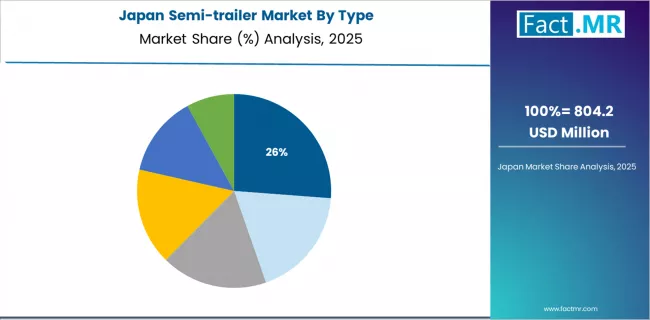
Semi Trailer Market Japan Market Share Analysis By Type | Source: Fact.MR
Japan's semi-trailer market demonstrates sophisticated and technology-focused landscape, characterized by advanced integration of specialized trailer equipment with existing logistics operations across manufacturing distribution, precision cargo handling, and specialized transportation applications.
The country shows steady growth momentum with a CAGR of 6.1% through 2036, driven by advanced manufacturing technologies for high-quality trailer production in specialized facilities concentrated in industrial regions. Japan's emphasis on operational excellence and equipment quality creates requirements for premium semi-trailer configurations that support comprehensive logistics initiatives and stringent operational requirements in transportation operations.
The market benefits from strong partnerships between international manufacturers and domestic logistics companies, creating comprehensive supply ecosystems that prioritize equipment quality and operational specification compliance. Distribution facilities in major logistics regions showcase advanced semi-trailer implementations where equipment quality achieves rigorous performance standards through integrated maintenance programs.
Key market characteristics:
- Manufacturing logistics and specialized carriers driving quality-focused equipment requirements with emphasis on operational excellence and consistency
- Quality assurance partnerships enabling stringent equipment specifications with comprehensive testing programs
- Technology collaboration between Japanese companies and international manufacturers is expanding supply capabilities
- Emphasis on continuous improvement and equipment technology optimization methodologies
Europe Market Split by Country
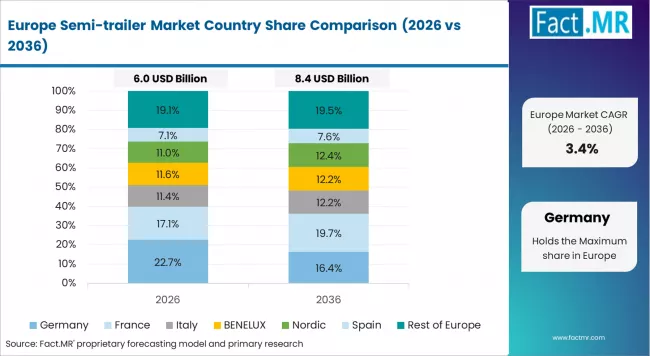
Semi Trailer Market Europe Country Market Share Analysis, 2026 & 2036 | Source: Fact.MR
The semi-trailer market in Europe is projected to grow from USD 6.8 billion in 2026 to USD 13.2 billion by 2036, registering a CAGR of 6.9% over the forecast period. Germany is expected to maintain its leadership position with a 31.2% market share in 2026, supported by its advanced highway infrastructure, comprehensive logistics networks, and strong commercial transportation presence across major industrial centers.
France follows with a 22.4% share in 2026, driven by established distribution operations and integrated logistics sectors. UK holds a 19.7% share in 2026 through its mature commercial transportation infrastructure and strategic European connectivity. Italy commands a 14.8% share, while Rest of Europe accounts for 11.9% in 2026.
By 2036, Germany is projected to hold 30.6% share, France 22.8%, UK 19.3%, Italy 15.1%, and Rest of Europe 12.2%, reflecting sustained growth momentum across all major European markets and increasing semi-trailer adoption in diversified logistics applications implementing advanced fleet management programs.
Competitive Landscape of the Semi-trailer Market
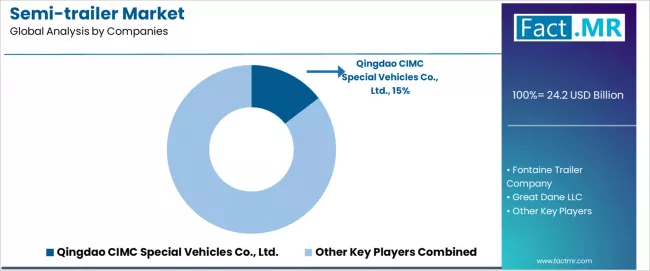
Semi Trailer Market Analysis By Company | Source: Fact.MR
The semi-trailer market features approximately 40-50 meaningful players with moderate concentration, where the top three companies control roughly 30-40% of global production capacity through established manufacturing operations and extensive distribution relationships across logistics and transportation sectors.
Market leaders include Qingdao CIMC Special Vehicles Co., Ltd, Great Dane A Division of Great Dane LLC., and Wabash National Corporation, which maintain competitive advantages through comprehensive semi-trailer product portfolios, global manufacturing networks, and deep expertise in the transportation equipment and logistics sectors, creating strong customer relationships among fleet operators and commercial carriers.
These companies leverage established production facilities and ongoing capacity expansion initiatives to defend market positions while expanding into adjacent specialized trailer applications and technology-integrated equipment markets. Qingdao CIMC Special Vehicles Co., Ltd commands a 14.6% market share through integrated production operations and strategic positioning in Asian markets.
Challengers encompass Schmitz Cargobull, KRONE Trailer, and Utility Trailer Manufacturing Company, which compete through diversified product portfolios and strong regional presence in key commercial markets. Specialty producers, including Fontaine Trailer, Kögel, and LAMBERET SAS, focus on specific geographical regions or customer segments, offering differentiated capabilities in regional distribution reliability, specialized configurations, and technical support services.
Regional players and emerging manufacturers create competitive pressure through cost-advantaged production capabilities and strategic market positioning, particularly in high-growth markets including China and India, where local presence provides advantages in logistics optimization and customer proximity.
Market dynamics favor companies that combine advanced manufacturing technologies with comprehensive quality management systems that address the complete value chain from component sourcing through assembly operations and equipment delivery. Strategic investments in lightweight materials and vertical integration initiatives enable cost optimization and product innovation across manufacturing operations.
Global Semi-trailer Market - Stakeholder Contribution Framework
Semi-trailer products represent a critical transportation asset that enables logistics companies, freight carriers, and distribution operators to enhance operational capacity and transportation efficiency without substantial infrastructure modifications, typically providing essential cargo handling functionality and fleet scalability capabilities while supporting diverse commercial applications.
With the market projected to grow from USD 24.2 billion in 2025 to USD 49.0 billion by 2035 at a 7.3% CAGR, these products offer compelling advantages - reliable operational performance, versatile application capabilities, and proven equipment durability - making them essential for freight transportation (largest segment), specialized cargo handling (expanding adoption), and diverse logistics applications seeking proven transportation equipment. Scaling production capacity and market development requires coordinated action across transportation policy, industry standards, equipment manufacturers, technology providers, and logistics institutions.
How Governments Could Spur Local Production and Adoption?
- Transportation Development Programs: Include semi-trailer manufacturing capabilities in national infrastructure strategies, providing targeted funding for production facilities in regions with established automotive clusters and supporting local equipment manufacturers through investment incentives and development support.
- Highway Infrastructure Support: Implement comprehensive road network improvements for commercial vehicle operations, provide access to efficient freight corridors for logistics optimization, and establish highway infrastructure that supports large-scale transportation operations.
- Trade Policy & Market Access: Create balanced import-export frameworks across equipment and logistics applications, establish fair trade practices for semi-trailer products, and develop international cooperation protocols that facilitate cross-border equipment trade and market development.
- Skills Development & Training: Fund technical education programs for equipment technicians, fleet managers, and maintenance specialists. Invest in technology transfer initiatives that bridge manufacturing institutions with commercial semi-trailer production and quality operations.
How Industry Bodies Could Support Market Development?
- Equipment Standards & Certification: Define standardized performance specifications for semi-trailer categories across freight, specialized cargo, and logistics applications, establish universal testing protocols and safety metrics, and create certification programs for equipment quality that operators can rely on.
- Market Education & Best Practices: Lead communication initiatives that demonstrate semi-trailer applications, emphasizing proven operational benefits, fleet efficiency advantages, and performance consistency compared to alternative transportation equipment and logistics methods.
- Safety Standards: Develop operational performance benchmarks for semi-trailer operations, comprehensive maintenance methodologies, and equipment safety best practices, ensuring responsible fleet management across different transportation environments and operational scales.
How Manufacturers and Technology Players Could Strengthen the Ecosystem?
- Production Technology Development: Develop next-generation manufacturing technologies with enhanced production efficiency capabilities, improved quality control systems, and application-specific features that enhance equipment performance while improving production economics and operational standards.
- Technical Support Platforms: Provide comprehensive fleet management support that integrates equipment maintenance, operational optimization, performance monitoring, and reliability validation, enabling customers to maximize equipment performance and operational efficiency.
- Supply Chain Integration: Offer flexible distribution arrangements for fleet operators and commercial carriers, including equipment leasing programs, maintenance service contracts, and logistics optimization pathways that keep semi-trailer supply consistent with customer operational requirements.
Key Players in the Semi-trailer Market
- Qingdao CIMC Special Vehicles Co., Ltd.
- Fontaine Trailer Company
- Great Dane LLC
- Kögel Trailer GmbH
- Fahrzeugwerk Bernard Krone GmbH & Co. KG
- Lamberet SAS
- Polar Tank Trailer, LLC
- Schmitz Cargobull AG
- Utility Trailer Manufacturing Company
- Wabash National Corporation
- Hyundai Translead
Bibliography
- American Trucking Associations. (2024). ATA American trucking trends 2024: Trailer fleet size, age, and replacement cycle analysis. ATA.
- European Automobile Manufacturers Association. (2024). ACEA report: Commercial vehicle and trailer registration statistics, EU and EFTA 2023. ACEA.
- International Road Transport Union. (2024). IRU world transport data: Semi-trailer fleet census by region and type. IRU.
- National Highway Traffic Safety Administration. (2024). 49 CFR Part 571: Federal Motor Vehicle Safety Standards for trailers, including underride protection and stability requirements. NHTSA.
- United Nations Economic Commission for Europe. (2024). UNECE Regulation No. 73: Uniform provisions for the approval of goods vehicles, trailers, and semi-trailers with regard to lateral protection. UNECE.
- China Association of Automobile Manufacturers. (2024). CAAM commercial vehicle statistics 2024: Semi-trailer production and registration data. CAAM.
This bibliography is provided for reader reference. The full Fact.MR report contains the complete reference list with primary research documentation.
This Report Addresses
- Market sizing and quantitative forecast metrics detailing global and regional expenditure on semi-trailer through 2036.
- Segmentation analysis evaluating adoption patterns across type, axle configuration, end use categories and their respective sub-segments.
- Regional deployment intelligence comparing growth trajectories, regulatory environments, and competitive dynamics across North America, Europe, Asia Pacific, Latin America, and the Middle East & Africa.
- Regulatory compliance assessment analyzing how safety, environmental, or performance standards shape procurement specifications and product development priorities.
- Competitive landscape evaluation tracking market structure, supplier positioning, and integration strategies among leading industry participants.
- Strategic investment guidance defining the procurement specifications, technology transitions, and capacity allocation decisions required for market positioning through the forecast period.
- Supply chain risk analysis identifying material sourcing constraints, manufacturing concentration vulnerabilities, and logistics dependencies affecting market participants.
- Custom data delivery formats encompassing interactive dashboards, raw Excel datasets, and comprehensive PDF narrative reports.
Semi-trailer Market Definition
Semi-trailers are non-motorized cargo transport units designed to be coupled to a truck tractor via a fifth-wheel hitch, with the forward portion of the trailer weight supported by the tractor and the rear portion supported by the trailer axle assembly. The market covers lowboy, dry van, refrigerated, flatbed, tanker, and specialty trailer types across tandem, single, and tri-axle configurations serving logistics, construction, oil and gas, agricultural, and other freight transport applications.
Semi-trailer Market Inclusions
The report covers lowboy, dry van, refrigerated, flatbed, tanker, and other trailer types. Axle configuration analysis includes tandem, single, and tri-axle designs. End-use segmentation spans logistics, construction, oil and gas, agriculture, and other applications across global regions for 2026 to 2036.
Semi-trailer Market Exclusions
Full trailers with independent front and rear axle assemblies, truck bodies permanently mounted on rigid chassis, intermodal shipping containers, and light-duty utility trailers under 3.5 tons gross vehicle weight are excluded. Truck tractor manufacturing, trailer leasing financial services, and freight brokerage platforms fall outside the analytical scope.
Semi-trailer Market Research Methodology
- Primary Research: Analysts engaged with procurement directors, product engineers, and operations leads across the semi-trailer value chain to map adoption triggers and specification thresholds.
- Desk Research: Data collection aggregated regulatory filings, standards ratification records, trade body publications, and corporate annual reports from allowed source categories.
- Market-Sizing and Forecasting: Baseline values derive from a hybrid top-down and bottom-up aggregation, applying region-specific adoption curves to project demand velocity through 2036.
- Data Validation and Update Cycle: Projections undergo cross-validation against publicly reported financial guidance, regulatory compliance databases, and independent industry association benchmarks.
Segmentation
Scope of the Report
| Metric | Value |
|---|---|
| Quantitative Units | USD 25.43 billion to USD 41.83 billion, at a CAGR of 5.10% |
| Market Definition | Semi-trailers are towed cargo transport units coupled to truck tractors via fifth-wheel connections, available in dry van, flatbed, refrigerated, tanker, and lowboy configurations serving the full spectrum of over-the-road freight transport applications. |
| Type Segmentation | Lowboy Trailers, Dry Vans, Refrigerated Trailers, Flat Bed Trailers, Tankers, Others |
| Axle Configuration Segmentation | Tandem Axle, Single Axle, Tri-Axle |
| End Use Segmentation | Logistics & Transportation, Construction, Oil & Gas, Agriculture, Others |
| Regions Covered | North America, Latin America, Europe, East Asia, South Asia, Oceania, Middle East & Africa |
| Countries Covered | India, China, USA, Canada, UK, Germany, Japan, and 40 plus countries |
| Key Companies Profiled | Qingdao CIMC Special Vehicles Co., Ltd., Fontaine Trailer Company, Great Dane LLC, Kogel Trailer GmbH, Fahrzeugwerk Bernard Krone GmbH & Co. KG, Lamberet SAS, Polar Tank Trailer, LLC, Schmitz Cargobull AG, Utility Trailer Manufacturing Company, Wabash National Corporation, Hyundai Translead |
| Forecast Period | 2026 to 2036 |
| Approach | Forecasting models apply a hybrid top-down and bottom-up methodology, cross-validated against primary research and public industry filings. |
Source: Fact.MR analysis. Updated Mar 26, 2026
Semi-trailer Market by Segments
-
Type :
- Lowboy Trailers
- Dry Vans
- Refrigerated Trailers
- Flat Bed Trailers
- Tankers
- Others
-
Region :
- Asia Pacific
- China
- Japan
- South Korea
- India
- Australia & New Zealand
- ASEAN
- Rest of Asia Pacific
- North America
- USA
- Canada
- Mexico
- Europe
- Germany
- France
- UK
- Italy
- Rest of Europe
- Latin America
- Brazil
- Rest of Latin America
- Middle East & Africa
- Kingdom of Saudi Arabia
- Other GCC Countries
- Turkey
- South Africa
- Rest of Middle East & Africa
- Asia Pacific
Frequently Asked Questions
How large is the semi-trailer market in 2026?
What will the semi-trailer market size be by 2036?
What is the expected CAGR for the semi-trailer market between 2026 and 2036?
Which type segment is poised to lead in 2026?
Which country is the fastest-growing market?
What is the scope of this semi-trailer market report?
What methodology does Fact.MR use for this forecast?
Which companies are profiled in this report?
Who worked on this report


Preview the report firsthand - request a free sample
Free SampleGet the brochure for pricing and purchase details
Download PDF