- Base Value(2026): 56.8 Mn
- Estimated Value(2026): 56.8 Mn
- Forecast Value (2036): 103.2 Mn
- CAGR (2026 - 2036): 6.2%
Demand for Anti-Static Polymer Compounds in UK 2026 to 2036
Demand for anti-static polymer compounds in the UK is projected to rise from USD 56.8 million in 2026 to nearly USD 103.2 million by 2036, reflecting a CAGR of 6.1% across the forecast window. Growth reflects expanding electronics manufacturing activity in the UK and stronger adoption of ESD protection solutions across industrial environments.
Key Takeaways from the UK Anti-Static Polymer Compounds Industry
- UK Anti-Static Polymer Compounds Sales Value (2026): USD 56.8 million
- UK Anti-Static Polymer Compounds Forecast Value (2036): USD 103.2 million
- UK Anti-Static Polymer Compounds Forecast CAGR: 6.2%
- Leading Product Type in UK Anti-Static Polymer Compounds Industry: Masterbatches (42.3%)
- Key Growth Regions in UK Anti-Static Polymer Compounds Industry: England, Scotland, Wales, and Northern Ireland
- Regional Leadership: England holds the leading position in demand
- Key Players in UK Anti-Static Polymer Compounds Industry: 3M Company, E. I. du Pont de Nemours and Company, BASF SE, Arkema Group, Clariant AG, Evonik Industries AG, Solvay S.A., Avient Corporation, RTP Company, Premix Group
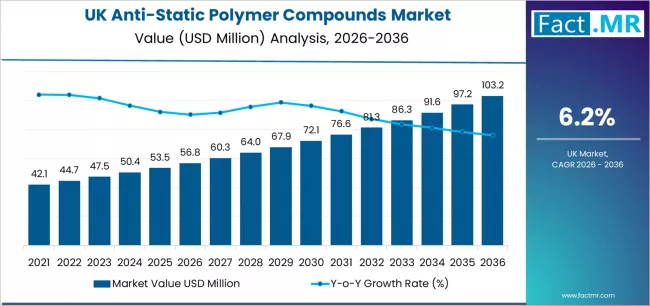
Uk Anti Static Polymer Compounds Market Market Value Analysis | Source: Fact.MR
England continues to lead deployment due to ongoing technological modernization programs, advanced connectivity systems, and increasing integration of conductive additives in high-performance manufacturing applications. Industrial facilities are directing greater investment toward anti-static polymer compounds to address evolving production complexity, component sensitivity, and ESD compliance standards.
The masterbatches category is expected to represent 42.3% of UK demand in 2026. Masterbatch formats retain prominence because they support efficient additive delivery, stable processing behavior, and consistent anti-static performance. Their adaptability across diverse processing conditions strengthens manufacturing reliability and reinforces protective characteristics for sensitive applications.
Electronics and electricals are projected to hold 36.8% of overall demand in 2026. Anti-static formulations strengthen ESD protection capability and support precision-oriented manufacturing workflows, enabling safer component handling, improved product stability, and dependable integration within high-volume production lines.
Between 2030 and 2036, demand is set to increase from USD 76.4 million to USD 103.2 million, contributing 57.4% of total ten-year expansion. Advances in conductive integration, development of specialized compound formulations, and broader adoption of customized ESD protection platforms shape this phase across UK industrial clusters, particularly in England and Scotland.
UK Anti-Static Polymer Compounds Industry
| Metric | Value |
|---|---|
| UK Anti-Static Polymer Compounds Sales Value (2026) | USD 56.8 million |
| UK Anti-Static Polymer Compounds Forecast Value (2036) | USD 103.2 million |
| UK Anti-Static Polymer Compounds Forecast CAGR (2026-2036) | 6.2% |
Source: Fact.MR analysis. Updated Dec 16, 2025
Category
| Category | Segments |
|---|---|
| Formulation | Masterbatches, Functional Coatings and Films, Pre-compounded Compounds, Additive Blends |
| End Use | Electronics and Electricals, Packaging, Automotive and Transportation, Medical and Healthcare |
| Region | England, Scotland, Wales, Northern Ireland |
Source: Fact.MR analysis. Updated Dec 16, 2025
Segmental Analysis
By Formulation Type, Which Segment Holds the Largest Share?
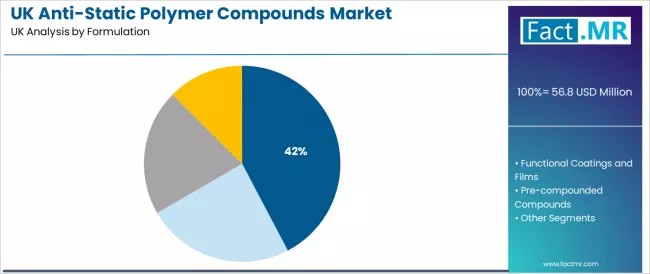
Uk Anti Static Polymer Compounds Market Analysis By Formulation | Source: Fact.MR
Masterbatches will likely account for 42.3% of the anti-static polymer compounds market in 2026, making them the leading formulation type. Manufacturers prefer masterbatch systems for their processing compatibility, established conductive performance, and ability to integrate into existing production lines without major operational adjustments.Their reliability and ease of adoption support widespread use across UK manufacturing environments, where stable ESD protection and consistent processing efficiency remain key requirements.
- Compatibility with existing workflows strengthens adoption across industrial facilities.
- Proven performance and commercial reliability support large-scale utilization across the sector.
By End-Use, Which Segment Registers the Highest Share?

Uk Anti Static Polymer Compounds Market Analysis By End Use | Source: Fact.MR
Electronics and electricals end-use applications are expected to represent 36.8% of market demand in 2026, reflecting strong requirements for dependable ESD protection and integration-ready anti-static materials. Production plants and component manufacturers rely on these compounds to maintain process stability, protect sensitive components, and support optimized manufacturing outcomes.
The segment’s position is reinforced by the UK’s substantial electronics manufacturing base, where consistent quality standards and operational efficiency drive continued adoption of anti-static polymer solutions.
- Manufacturing needs across electronics facilities sustain steady demand for ESD-focused materials.
- Anti-static compound integration enhances production consistency and supports high-performance operational standards.
What are the Drivers, Restraints, and Key Trends in the UK Anti-Static Polymer Compounds Industry?
The UK anti-static polymer compounds industry is being pulled by rising electronics manufacturing activity and stronger emphasis on electrostatic discharge (ESD) protection, with England leading application development and innovation. National manufacturing guidelines and regional industrial programs shape adoption across England and Scotland. Headwinds include competition from alternative protection systems, the need for rigorous compound validation, material cost pressures, and evolving regulatory requirements that slow procurement cycles.
Trends point to tighter performance standards and centralized quality-validation systems that let suppliers differentiate through demonstrable ESD performance rather than price alone. Suppliers investing in conductive integration, standardized testing networks, and cross-region supply coordination are positioned to capture manufacturing agreements and scale validation costs across partners. Collaborative research and consolidated quality management are accelerating certification timelines and enabling more predictable, system-level solutions for advanced electronics applications.
Analysis of UK Anti-Static Polymer Compounds Industry by Key Countries
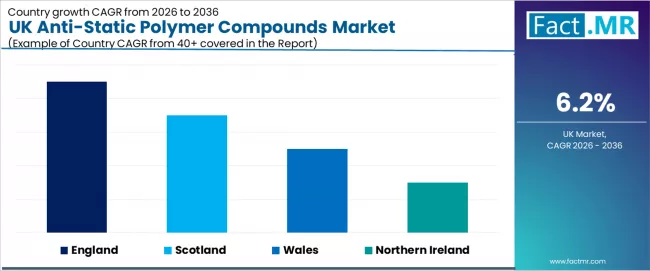
Uk Anti Static Polymer Compounds Market Cagr Analysis By Country | Source: Fact.MR
| Region | CAGR (2026-2036) |
|---|---|
| England | 6.3% |
| Scotland | 6.1% |
| Wales | 5.9% |
| Northern Ireland | 5.7% |
Source: Fact.MR analysis. Updated Dec 16, 2025
Why Does England Lead Anti-Static Polymer Compounds Demand?
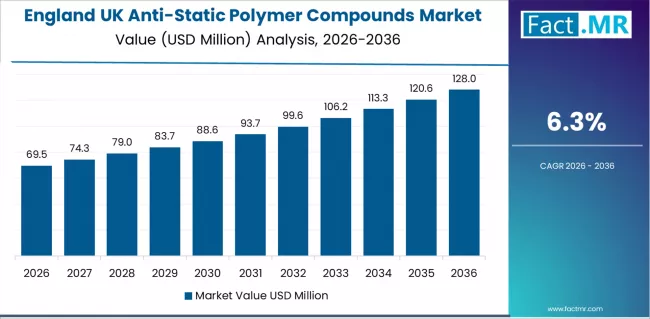
Uk Anti Static Polymer Compounds Market Country Value Analysis | Source: Fact.MR
Demand for anti-static polymer compounds in England is projected to exhibit strong growth with a CAGR of 6.3% through 2036, driven by progressive manufacturing preferences, substantial industrial development creating advanced anti-static polymer compound opportunities, and concentration of electronics advancement across London and surrounding metropolitan areas.
As the dominant region with extensive manufacturing infrastructure and quality-focused industrial policies, England's emphasis on comprehensive manufacturing excellence and industrial leadership is creating significant demand for professional anti-static polymer compound systems with proven effectiveness and reliable application potential. Major anti-static polymer compound suppliers and manufacturing companies are establishing comprehensive industrial development programs to support innovation advancement and advanced system deployment across diverse applications.
- Industrial development trends and manufacturing preferences are requiring comprehensive production management strategies and anti-static polymer compound solutions, driving demand for systems with demonstrated performance enhancement capabilities and permanent protection assurance throughout diverse manufacturing operations.
- Innovation ecosystem strength and industrial capital availability are supporting deployment of next-generation anti-static polymer compound technologies and novel application pathways that enhance commercial viability, reduce protection costs, and create new manufacturing opportunities across industrial and quality-focused applications, positioning England as a national manufacturing leadership region.
Why Does Scotland Show Strong Growth?
Demand for anti-static polymer compounds in Scotland is expanding at a CAGR of 6.1%, supported by extensive manufacturing facilities including large-scale industrial programs, production operations, and electronics companies generating concentrated demand favorable for anti-static polymer compound systems. The region's manufacturing characteristics, featuring substantial industrial networks and production requirements ideal for anti-static polymer compound integration, provide natural advantages.
Industrial expertise concentrated in Edinburgh, Glasgow, and regional manufacturing corridors facilitates application development and production management. Anti-static polymer compound suppliers and manufacturing companies are implementing comprehensive industrial strategies to serve expanding quality-focused requirements throughout Scotland.
- Manufacturing concentration and favorable application economics are creating opportunities for specialized anti-static polymer compound suppliers that can integrate protection systems with existing industrial operations.
- Anti-static polymer compound positioning and manufacturing awareness are building regional competitive advantages in industrial applications, enabling comprehensive electronics development and manufacturing cluster enhancement that meets performance targets while accessing advanced pricing opportunities.
Why Does Wales Show Consistent Expansion?
Demand for anti-static polymer compounds in Wales is growing at a CAGR of 5.9%, driven by substantial manufacturing facilities from industrial operations, electronics distributors, and regional operators requiring anti-static polymer compound pathways.
The region's manufacturing base, supporting critical industrial operations, is increasingly adopting anti-static polymer compound technologies to maintain competitiveness while meeting production expectations. Manufacturing companies and anti-static polymer compound suppliers are investing in performance integration systems and regional supply infrastructure to address growing production management requirements.
- Industrial modernization imperatives and manufacturing competitiveness concerns are facilitating adoption of anti-static polymer compound technologies that enable continued electronics operations while achieving performance enhancement across industrial operations, electronics distributors, and operator facilities.
- Performance optimization opportunities including regional manufacturing development and anti-static polymer compound utilization for enhanced industrial operations are creating unique regional advantages and diversified application types throughout Wales manufacturing operations.
What Factors Underpin Anti-Static Polymer Compounds Demand in Northern Ireland?
Demand for anti-static polymer compounds in Northern Ireland is advancing at a CAGR of 5.7%, supported by expanding manufacturing facilities, regional industrial development including production and performance operations, and growing emphasis on electronics solutions across the region.
Manufacturing modernization and industrial facility expansion are driving consideration of anti-static polymer compound systems as performance enhancement pathways. Manufacturing companies and anti-static polymer compound suppliers are developing regional capabilities to support emerging performance deployment requirements.
- Manufacturing expansion and industrial diversification are creating economic drivers for anti-static polymer compound technologies and system adoption across production and industrial facilities seeking competitive differentiation pathways.
- Regional manufacturing cooperation and coordinated industrial development are establishing consistent anti-static polymer compound environments and shared performance infrastructure that support multi-regional electronics projects throughout Northern Ireland manufacturing operations.
Competitive Landscape of UK Anti-Static Polymer Compounds Industry
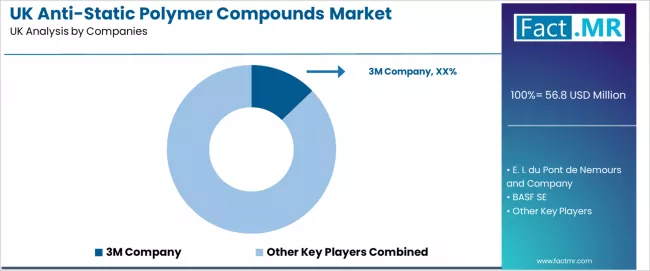
Uk Anti Static Polymer Compounds Market Analysis By Company | Source: Fact.MR
The UK anti-static polymer compounds landscape is shaped by competition among specialized suppliers, performance materials companies, and integrated solution developers that leverage strong research capabilities and application engineering strength. Companies continue investing in performance improvement, quality assurance systems, and distribution efficiency to deliver stable, scalable, and high-compliance solutions for industrial and manufacturing environments across the country. Strategic partnerships and early deployment of new application technologies remain essential for reinforcing competitive positions and ensuring alignment with evolving industrial performance requirements.
DuPont maintains a strong UK presence through customized integration support, advanced materials supply, and wide industrial coverage. BASF SE reinforces its position through comprehensive performance capabilities and electronics-focused material enhancements, while Arkema Group concentrates on application development, formulation optimization, and targeted industrial deployments across the region. These companies benefit from long-term relationships with manufacturing operators, component suppliers, and engineering contractors that depend on consistent quality and technical validation.
Government bodies influence growth potential through financial incentives, industrial modernization programs, streamlined approval pathways, and unified technical standards that improve investor confidence. Industry associations play a coordination role by developing training pathways, establishing production and performance benchmarks, and driving collaborative R&D initiatives aimed at next-generation conductive technologies. These efforts help reduce fragmentation, enhance workforce readiness, and expand the technical depth needed for complex manufacturing applications.
Producers, manufacturing operators, EPC firms, and investors form the execution backbone of deployment, scaling, and long-term value creation. Producers gain advantage by modernizing domestic facilities, integrating monitoring technologies, and adopting digital traceability across supply flows. Manufacturing operators unlock efficiency through digital asset integration, strategic procurement partnerships, and lifecycle-focused system planning.
EPC firms shape project outcomes by standardizing modular installation solutions, developing advanced delivery platforms, and co-engineering systems for long-term operability. Investors support expansion through venture funding, infrastructure financing, consolidation strategies, and performance-linked capital frameworks that accelerate technology diffusion and reinforce national manufacturing capabilities.
Key Players in UK Anti-Static Polymer Compounds Industry
- 3M Company
- E. I. du Pont de Nemours and Company
- BASF SE
- Arkema Group
- Clariant AG
- Evonik Industries AG
- Solvay S.A.
- Avient Corporation
- RTP Company
- Premix Group
Segmentation
Scope of the Report
| Item | Value |
|---|---|
| Quantitative Units | USD 103.2 million |
| Formulation | Masterbatches, Functional Coatings and Films, Pre-compounded Compounds, Additive Blends |
| End-Use | Electronics and Electricals, Packaging, Automotive and Transportation, Medical and Healthcare |
| Regions Covered | England, Scotland, Wales, Northern Ireland |
| Key Companies | 3M Company, E. I. du Pont de Nemours and Company, BASF SE, Arkema Group, Clariant AG, Evonik Industries AG, Solvay S.A., Avient Corporation, RTP Company, Premix Group, Regional anti-static polymer compound specialists |
| Additional Attributes | Sales by formulation and end-use segment; regional demand trends across England, Scotland, Wales, and Northern Ireland; competitive landscape with established anti-static polymer compound suppliers and specialized industrial developers; quality preferences for masterbatch versus functional coating technologies; integration with industrial programs and advanced manufacturing policies, particularly advanced in the England region |
Source: Fact.MR analysis. Updated Dec 16, 2025
UK Anti-Static Polymer Compounds Industry by Segments
-
Formulation :
- Masterbatches
- Functional Coatings and Films
- Pre-compounded Compounds
- Additive Blends
-
End-Use :
- Electronics and Electricals
- Packaging
- Automotive and Transportation
- Medical and Healthcare
-
Country :
- England
- Scotland
- Wales
- Northern Ireland
Frequently Asked Questions
How big is the demand for anti-static polymer compounds in UK in 2026?
What will be the size of anti-static polymer compounds in UK in 2036?
How much will be the demand for anti-static polymer compounds in UK growth between 2026 and 2036?
What are the key product types in the anti-static polymer compounds in UK?
Which end-use segment is expected to contribute significant share in the anti-static polymer compounds in UK in 2026?
Who worked on this report


Preview the report firsthand - request a free sample
Free SampleGet the brochure for pricing and purchase details
Download PDF