- Base Value(2026): 4.1 Bn
- Estimated Value(2026): 4.1 Bn
- Forecast Value (2036): 9.3 Bn
- CAGR (2026 - 2036): 8.5%
Demand for Copper Scrap in the UK 2026 to 2036
Demand for copper scrap in the UK is projected to rise from USD 4.1 billion in 2026 to nearly USD 9.3 billion by 2036, supported by an 8.5% CAGR through the period. Growth reflects stronger alignment with circular economy priorities and expanding reliance on secondary copper streams across core industrial clusters. England’s manufacturing base continues to influence adoption patterns as facilities introduce modern recovery systems and digital support tools to lift material efficiency.
Key Takeaways from the UK Copper Scrap Industry Analysis
- UK Copper Scrap Sales Value (2026): USD 4.1 billion
- UK Copper Scrap Forecast Value (2036): USD 9.3 billion
- UK Copper Scrap Forecast CAGR: 8.5%
- Leading Feed Material Type in UK Copper Scrap Industry: Old Scrap (52.3%)
- Key Growth Regions in UK Copper Scrap Industry: England, Scotland, Wales, and Northern Ireland
- Regional Leadership: England holds the leading position in demand
- Key Players in UK Copper Scrap Industry: Aurubis AG, Glencore plc, Commercial Metals Company, OmniSource LLC, Ames Copper Group, Jain Resource Recycling Private Limited, KGHM Metraco S.A., Global Metals & Iron Incorporated, S.I.C. Recycling Incorporated, Pascha GmbH
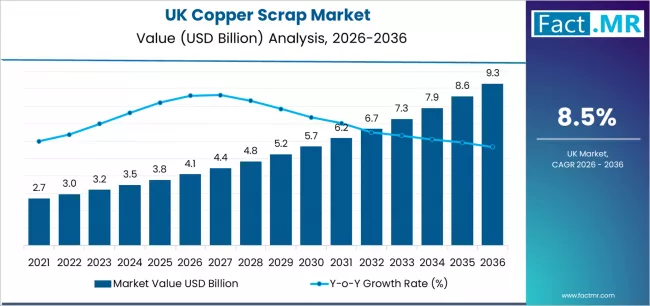
Uk Copper Scrap Market Market Value Analysis | Source: Fact.MR
UK recyclers and metal consumers are reassessing sourcing practices as sustainability expectations reshape procurement models. Investments now lean toward technologies that raise purity consistency, streamline throughput, and strengthen traceability across processing lines. This shift is encouraging broader use of automated platforms and structured verification frameworks within large facilities.
Between 2030 and 2036, demand is projected to climb from USD 6.2 billion to USD 9.3 billion, adding USD 3.1 billion during the period. Momentum is expected from advanced sorting innovation, specialized recovery techniques, and stronger integration of quality assurance systems across industrial operations. England and Scotland are positioned to guide system upgrades as regional programs emphasize long-term resource efficiency and higher material utilization standards.
UK Copper Scrap Industry
| Metric | Value |
|---|---|
| UK Copper Scrap Sales Value (2026) | USD 4.1 billion |
| UK Copper Scrap Forecast Value (2036) | USD 9.3 billion |
| UK Copper Scrap Forecast CAGR (2026-2036) | 8.5% |
Source: Fact.MR analysis. Updated Dec 16, 2025
Category
| Category | Segments |
|---|---|
| Feed Material | Old Scrap, New Scrap |
| Grade | #2 Copper Scrap, Bare Bright Copper, Others |
| End Use | Electrical and Electronics, Building and Construction, Industrial Machinery, Transportation Equipment, Consumer and General Products |
| Country | England, Scotland, Wales, Northern Ireland |
Source: Fact.MR analysis. Updated Dec 16, 2025
Segmental Analysis
Why do Old Scrap Applications Account for a High Share?

Uk Copper Scrap Market Analysis By Feed Material | Source: Fact.MR
Old scrap is set to hold 52.3% of copper scrap demand in 2026, reflecting its deep alignment with long-established recycling systems across the UK. Industrial facilities rely on old scrap because it fits seamlessly into existing recovery lines, allowing them to maintain reliability without reconfiguring supply frameworks.
The material’s consistency supports predictable processing outcomes, which matters greatly in sectors where stable recovery quality shapes operational performance. Continuous refinements in sorting, purification, and yield management are strengthening its appeal, giving facilities a route to higher efficiency without risking material variability. A broad supplier base with proven commercial maturity further reinforces the segment’s leading position.
- Strong compatibility with existing processing setups makes old scrap the practical choice for high-volume recycling operations.
- Reliable performance histories are supporting greater adoption across facilities seeking steady throughput and assured material quality.
Why do Electrical and Electronics Applications Hold a Significant Share?

Uk Copper Scrap Market Analysis By End Use | Source: Fact.MR
Electrical and electronics applications are expected to represent 41.5% of copper scrap demand in 2026, shaped by the sector’s need for materials that deliver both functional reliability and cost efficiency. Manufacturing plants, component producers, and assembly environments depend on copper scrap because its conductivity profile aligns naturally with electrical performance requirements.
This creates a steady pull for recycled material across a wide industrial base. In the UK, production clusters dedicated to electrical systems rely on copper scrap integration to support output consistency while managing resource intensity. England’s dense manufacturing regions strengthen this trend, as facilities pursue operational excellence grounded in dependable material flows.
- Manufacturing ecosystems generate continual demand for copper scrap that supports performance stability across diverse electrical applications.
- Copper scrap integration enhances workflow efficiency and supports the sector’s drive for durable, conductivity-aligned material systems.
What are the Drivers, Restraints, and Key Trends in the UK Copper Scrap Industry?
Copper scrap demand in UK continues to rise as recycling gains stronger relevance across manufacturing. England maintains a central role in setting processing expectations through established recovery infrastructure and active regional programs. Participants operate within strict environmental rules that shape sourcing decisions, operational timelines, and technology investments.
Competition from substitute materials influences procurement behaviour while specialized processing requirements add operational complexity. Cost volatility also affects purchasing strategies and long-term contracting practices across industrial users.
Circular economy policies are expanding technical standards that support supplier differentiation without excessive investment. Material specifications and recovery programs create structured demand patterns that benefit suppliers offering consistent quality. These shifts open space for companies with strong processing capabilities to secure long-duration partnerships and build scalable recovery models.
Advanced sorting and validation systems are becoming core to operational performance. Suppliers are building centralized facilities that enable uniform quality, high-precision separation, and improved throughput across dispersed industrial sites. Technology-driven processing is strengthening the feasibility of next-generation applications, including specialized alloys and region-specific integration models. Collaborative research initiatives are gaining traction across the UK as companies seek to manage development costs while improving validation speed and system reliability.
Analysis of UK Copper Scrap Industry by Key Countries
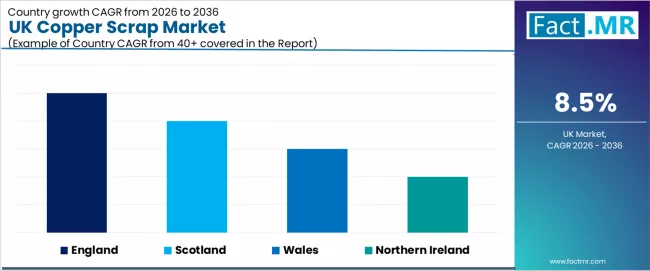
Uk Copper Scrap Market Cagr Analysis By Country | Source: Fact.MR
| Region | CAGR (2026-2036) |
|---|---|
| England | 8.6% |
| Scotland | 8.4% |
| Wales | 8.2% |
| Northern Ireland | 8.0% |
Source: Fact.MR analysis. Updated Dec 16, 2025
Why does England Lead Copper Scrap Demand?
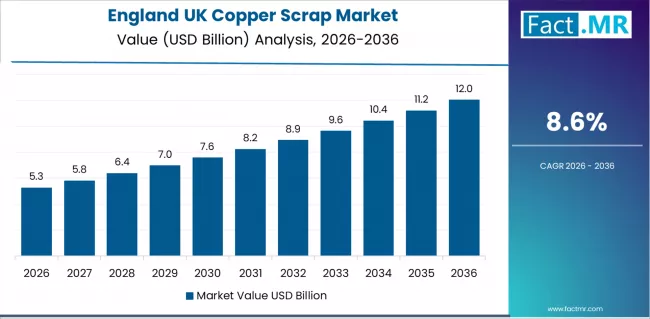
Uk Copper Scrap Market Country Value Analysis | Source: Fact.MR
England records strong copper scrap usage due to its concentrated industrial corridors and recycling-oriented policies. A CAGR of 8.6% reflects steady expansion supported by manufacturing networks across London and major metropolitan zones. Companies are scaling material recovery systems that align with efficiency objectives and long-term sustainability targets. Suppliers continue to invest in advanced processing technologies suited for high-volume, reliability-driven applications across diverse industries.
- Manufacturing trends are strengthening demand for scrap systems that deliver consistent material recovery and operational assurance across varied industrial settings.
- Innovation funding and recycling-focused capital pools enable deployment of next-generation scrap technologies that improve cost structures and widen application possibilities across England.
Why does Scotland Show Strong Growth in Copper Scrap Demand?
Scotland advances at a CAGR of 8.4% driven by its industrial clusters and structured recycling activities. Facilities across Edinburgh, Glasgow, and regional manufacturing belts rely on recovery practices that support efficiency outcomes. Companies adopt coordinated material strategies suited for heavy processing workloads and integrated facility management.
- Industrial concentration creates openings for suppliers offering systems that fit established manufacturing infrastructure.
- Regional expertise and material-focused initiatives strengthen Scotland’s position as a favorable zone for expanding recovery applications.
Why is Wales Showing Steady Expansion in Copper Scrap Usage?
Wales grows at a CAGR of 8.2% supported by manufacturing sites and regional recyclers seeking improved material utilization. Firms focus on scrap integration to maintain competitiveness and reduce input dependencies. Local suppliers are enhancing distribution and processing capacity to support rising efficiency expectations across the region.
- Modernization plans across manufacturing corridors encourage adoption of scrap solutions that reinforce operational continuity and material reliability.
- Diversified applications and regional development activities create consistent opportunities for scrap utilization across Welsh industrial operations.
What Factors shape Copper Scrap Demand in Northern Ireland?
Northern Ireland expands at a CAGR of 8.0%, supported by facility upgrades and growing interest in material-efficient production. Processing companies and recyclers are building capabilities that align with evolving industrial needs. Collaborative initiatives across regional operators promote coherent adoption practices and stronger material recovery frameworks.
- Industrial diversification and facility expansion encourage use of scrap systems that enhance operational performance across processing and manufacturing units.
- Shared infrastructure and coordinated development models enable multi-site deployment, supporting sustained recovery efforts across Northern Ireland.
Competitive Landscape of UK Copper Scrap Industry
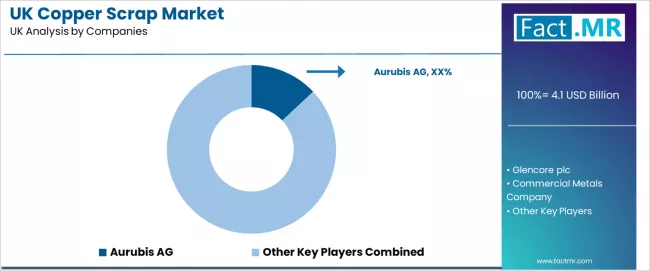
Uk Copper Scrap Market Analysis By Company | Source: Fact.MR
The UK copper scrap industry operates within a competitive environment shaped by specialist recycling manufacturers, material processors, and integrated solution providers. Large industrial groups influence sector direction through research strength and established application development platforms. Companies continue to expand material technologies, refine quality assurance systems, and strengthen processing networks to support reliable and scalable operations across domestic manufacturing.
Aurubis AG maintains a broad presence built on extensive copper recovery capabilities, technical services, and consistent accessibility across UK industrial settings. Glencore plc supports industrial and cross-border projects through wide material supply channels, custom integration, and technical assistance.
Commercial Metals Company positions its portfolio around advanced recovery solutions supported by quality management and recycling expertise. OmniSource LLC focuses on application development and material performance improvement across UK recycling and industrial applications.
Sector competitiveness depends on the ability to integrate new processing methods, improve throughput, and build resilient sourcing structures. Companies continue investing in upgraded sorting technologies, data-driven validation processes, and efficient logistics frameworks that reinforce material consistency. Workforce capability is gaining importance as operators require technical skills suited to modern recovery systems.
Firms with strong supply stability, reliable quality systems, and scalable recovery platforms reinforce their standing across UK manufacturing. Operational visibility, digital traceability, and next-generation processing technologies are emerging as core differentiators for companies seeking sustained competitive advantage.
Key Players in UK Copper Scrap Industry
- Aurubis AG
- Glencore plc
- Commercial Metals Company
- OmniSource LLC
- Ames Copper Group
- Jain Resource Recycling Private Limited
- KGHM Metraco S.A.
- Global Metals & Iron Incorporated
- S.I.C. Recycling Incorporated
- Pascha GmbH
Segmentation
Scope of the Report
| Item | Value |
|---|---|
| Quantitative Units | USD 9.3 billion |
| Feed Material | Old Scrap, New Scrap |
| Grade | #2 Copper Scrap, Bare Bright Copper, Others |
| End Use | Electrical & Electronics, Building & Construction, Industrial Machinery, Transportation Equipment, Consumer & General Products |
| Regions Covered | England, Scotland, Wales, Northern Ireland |
| Key Companies | Aurubis AG, Glencore plc, Commercial Metals Company, OmniSource LLC, Ames Copper Group, Jain Resource Recycling Private Limited, KGHM Metraco S.A., Global Metals & Iron Incorporated, S.I.C. Recycling Incorporated, Pascha GmbH, Regional copper scrap specialists |
| Additional Attributes | Sales by feed material and grade segment; regional demand trends across England, Scotland, Wales, and Northern Ireland; competitive landscape with established copper scrap suppliers and specialized recycling developers; quality preferences for old scrap versus new scrap technologies; integration with efficiency programs and advanced environmental policies, particularly advanced in the England region |
Source: Fact.MR analysis. Updated Dec 16, 2025
UK Copper Scrap Industry by Segments
-
Feed Material :
- Old Scrap
- New Scrap
-
Grade :
- #2 Copper Scrap
- Bare Bright Copper
- Others
-
End Use :
- Electrical & Electronics
- Building & Construction
- Industrial Machinery
- Transportation Equipment
- Consumer & General Products
-
Region :
- England
- Scotland
- Wales
- Northern Ireland
Frequently Asked Questions
How big is the demand for copper scrap in UK in 2026?
What will be the size of copper scrap in UK in 2036?
How much will be the demand for copper scrap in UK growth between 2026 and 2036?
What are the key product types in the copper scrap in UK?
Which end use segment is expected to contribute significant share in the copper scrap in UK in 2026?
Who worked on this report


Preview the report firsthand - request a free sample
Free SampleGet the brochure for pricing and purchase details
Download PDF