- Base Value(2026): 301.2 Mn
- Estimated Value(2026): 301.2 Mn
- Forecast Value (2036): 505.8 Mn
- CAGR (2026 - 2036): 5.3%
Demand for Epoxy Adhesives in the UK 2026 to 2036
Demand for epoxy adhesives in the UK is projected to rise from USD 301.2 million in 2026 to nearly USD 505.8 million by 2036, reflecting a 1.7x expansion across the decade. The gain of USD 204.6 million represents a 68% increase from 2026. Annual additions shift from USD 16 million in the first measured interval to USD 27 million in the final year, indicating a steadily rising investment curve.
Sales of epoxy adhesives in the UK will likely expand at a 5.3% CAGR. England accounts for a large share of early-period consumption due to concentrated activity in automotive assembly and contractor networks managing high-strength bonding requirements. Adoption in transportation equipment manufacturing is expected to exceed 40% of new epoxy-linked installations in 2026, while advanced structural bonding solutions in engineered materials are projected to capture over one-third of specialised demand.
Key Takeaways from UK Epoxy Adhesives Industry Analysis
- UK Epoxy Adhesives Sales Value (2026): USD 301.2 million
- UK Epoxy Adhesives Forecast Value (2036): USD 505.8 million
- UK Epoxy Adhesives Forecast CAGR: 5.3%
- Leading Technology Type in UK Epoxy Adhesives Industry: Two-Component (44.7%)
- Key Growth Regions in UK Epoxy Adhesives Industry: England, Scotland, Wales, and Northern Ireland
- Regional Leadership: England holds the leading position in demand
- Key Players in UK Epoxy Adhesives Industry: Henkel AG & Co. KGaA, 3M Company, H.B. Fuller Company, Sika AG, Dow Inc., Bostik (Arkema Group), Ashland Global Holdings Inc., Parker Hannifin Corporation, Mapei S.p.A., Permabond LLC
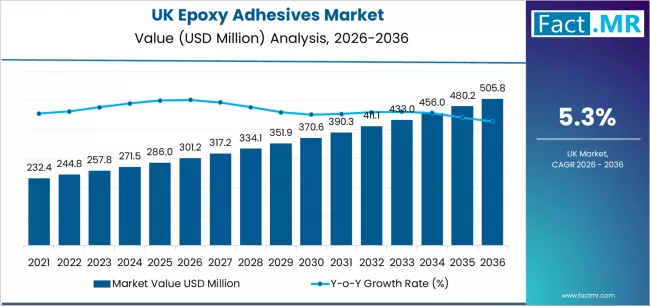
Uk Epoxy Adhesives Market Market Value Analysis | Source: Fact.MR
Hybrid curing technologies gain prominence in 2026 across precision fabrication settings, supported by the need for tighter bonding tolerances and improved heat resilience. This movement aligns with rising interest in composite-intensive production cycles. Industry behaviour reflects broader movement toward lightweighting compatibility and long-life bonding performance. Facilities engaged in high-throughput manufacturing are directing resources toward epoxy systems capable of maintaining reliable structural continuity across diverse load conditions and extended operational timelines.
UK Epoxy Adhesives Industry Key Takeaways
| Metric | Value |
|---|---|
| UK Epoxy Adhesives Sales Value (2026) | USD 301.2 million |
| UK Epoxy Adhesives Forecast Value (2036) | USD 505.8 million |
| UK Epoxy Adhesives Forecast CAGR (2026-2036) | 5.3% |
Source: Fact.MR analysis. Updated Dec 15, 2025
Category
| Category | Segments |
|---|---|
| Technology Type | Two-Component, One-Component, Others |
| Application | Building and Construction, Automotive and Transportation, Electrical and Electronics, Power and Energy, Others |
| Country | England, Scotland, Wales, Northern Ireland |
Source: Fact.MR analysis. Updated Dec 15, 2025
What drives Two-component Epoxy Adhesives Technology Demand in the UK?

Uk Epoxy Adhesives Market Analysis By Technology Type | Source: Fact.MR
Two-component systems are projected to hold 44.7% of UK epoxy adhesive consumption in 2026. Their balanced cure control, strong mechanical performance, and versatility make them a dependable choice for industrial environments that require stable bonding outcomes across varied processes.
Manufacturers value this format because it adapts to existing workflows while delivering consistent structural integrity. Advances in resin–hardener chemistries continue to refine bond stability, heat resistance, and application precision, reinforcing the segment’s position across large and established production settings.
- Strong structural alignment supports integration into routine assembly operations.
- Proven performance strengthens manufacturer confidence and encourages wide industrial use.
How do Building and Construction Applications Shape Epoxy Adhesives Sales in the UK?

Uk Epoxy Adhesives Market Analysis By Application | Source: Fact.MR
Building and construction applications are expected to represent 38.4% of consumption in 2026. These environments rely on adhesives that support load-bearing reliability, long-term durability, and precise installation needs across infrastructure work, residential projects, and commercial development.
The scale of construction activity sustains steady usage as contractors seek bonding solutions that enhance material performance while maintaining structural consistency. UK construction sites depend on adhesive systems that stabilize components and reinforce installation efficiency across diverse project types.
- Structural tasks maintain continuous adhesive needs across major construction activities.
- Adhesive integration strengthens durability, precision, and overall project resilience.
What are the Drivers, Restraints, and Key Trends in the UK Epoxy Adhesives Industry?
The epoxy adhesives industry in UK is expanding as manufacturers pursue lightweight structures and higher-strength bonding solutions across automotive, aerospace, and engineered components. England continues to play a central role, supported by specialised production clusters and sustained investment in advanced assembly techniques.
Growth remains steady, although suppliers face competition from mechanical fasteners, the need to refine curing processes, and cost sensitivities associated with high-performance formulations. Regional aerospace initiatives in England and Scotland also shape adoption by defining technical expectations and preferred integration practices.
Lightweighting requirements and clearer performance standards are giving suppliers a more stable operating environment. Updated regulations and structured production frameworks enable differentiation through material capability rather than excessive development expenditure. Stronger quality benchmarks also expand opportunities for advanced structural bonding systems that align with long-term manufacturing partnerships and high-precision assembly objectives.
Key trends include broader automation in dispensing and curing lines, along with deeper integration of quality validation systems. Companies are investing in standardized bonding platforms, precision application technologies, and coordinated quality oversight across multiple facilities. These developments support next-generation structural applications, improve process reliability, and create unified supply networks that strengthen performance monitoring. Collaborative research activity in the UK is further reducing development risks while accelerating validation for new epoxy adhesive technologies.
Analysis of UK Epoxy Adhesives Industry by Key Countries
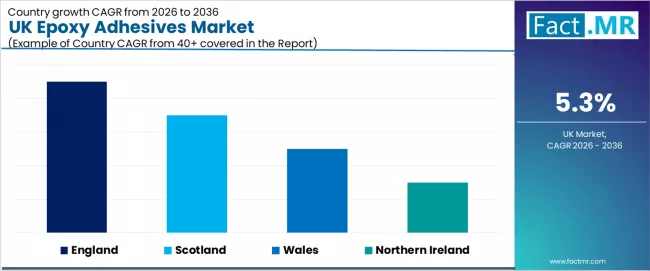
Uk Epoxy Adhesives Market Cagr Analysis By Country | Source: Fact.MR
| Region | CAGR (2026 to 2036) |
|---|---|
| England | 5.5% |
| Scotland | 5.3% |
| Wales | 5.1% |
| Northern Ireland | 4.9% |
Source: Fact.MR analysis. Updated Dec 15, 2025
How does Manufacturing Modernization generate Epoxy Adhesive Demand in England?
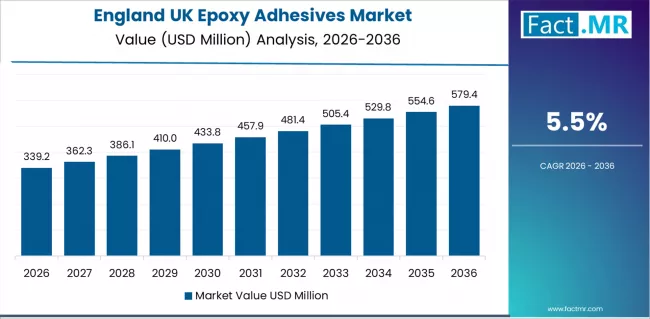
Uk Epoxy Adhesives Market Country Value Analysis | Source: Fact.MR
England’s epoxy adhesive demand is set to grow at a CAGR of 5.5% through 2036, supported by a broad industrial base and sustained manufacturing upgrades across key metropolitan regions. Production programs in London and surrounding hubs continue to shape requirements for structural bonding systems that offer predictable performance across diverse workflows.
Companies working within England’s mature manufacturing corridors are reinforcing their focus on reliability, repeatability, and long-term application consistency, which keeps epoxy systems central to process design. Suppliers are expanding technical support, validation resources, and development capabilities to match England’s emphasis on dependable production outcomes.
- Manufacturing development patterns are strengthening demand for epoxy systems that provide structural stability and long-term assurance across established industrial operations.
- A strong innovation ecosystem and available capital are enabling adoption of next-generation epoxy technologies that improve production economics and open new application pathways across assembly-focused environments.
How is Scotland’s Concentrated Manufacturing Activity accelerating Epoxy Adhesives Adoption?
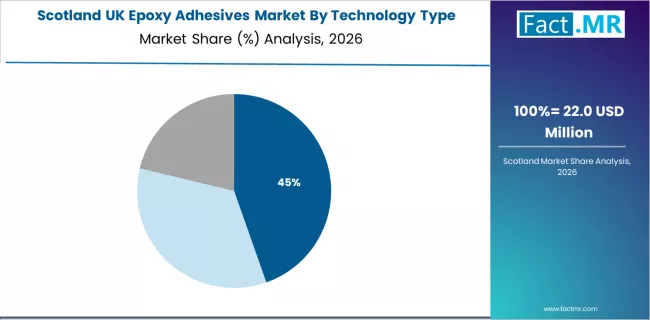
Uk Epoxy Adhesives Market Scotland Market Share Analysis By Technology Type | Source: Fact.MR
Epoxy adhesive demand in Scotland is increasing at a CAGR of 5.3%, supported by extensive industrial facilities and production corridors around Glasgow, Edinburgh, and adjoining regions. These hubs anchor large assembly programs, heavy industrial activities, and specialized manufacturing operations that rely on stable bonding systems.
Scotland’s industrial profile, marked by engineering-driven processes and consistent quality expectations, aligns well with epoxy adhesives and their performance requirements. Suppliers are strengthening regional service capabilities to meet needs linked to assembly precision, material durability, and production continuity.
- Concentrated manufacturing activity and favorable application economics are creating room for suppliers that integrate epoxy solutions with existing workflows.
- Growing awareness of bonding technologies is reinforcing Scotland’s competitive position, enabling industries to enhance product clusters, meet production objectives, and pursue improved pricing conditions within specialized manufacturing environments.
How is Manufacturing Modernization Supporting Epoxy Adhesives Adoption in Wales?

Uk Epoxy Adhesives Market Wales Market Share Analysis By Application | Source: Fact.MR
Wales’ epoxy adhesive demand is growing at a CAGR of 5.1%, influenced by its industrial facilities, assembly networks, and regional operators that require dependable bonding solutions. Wales continues to strengthen its manufacturing capabilities across automotive, engineered products, and heavy-duty assembly, creating an environment that supports epoxy integration.
Companies are recalibrating workflows to incorporate adhesive-based methods that improve component consistency and maintain competitiveness. Suppliers are expanding regional support systems that align epoxy technologies with Wales’ process needs, particularly where modernization programs call for higher reliability.
- Modernization efforts and competitiveness requirements are encouraging industries to adopt epoxy systems that reinforce product quality across manufacturing and assembly networks.
- Regional development initiatives and the search for optimized production outcomes are broadening epoxy usage, supporting diversified applications across the manufacturing landscape in Wales.
Which factors shape Epoxy Adhesives Demand across Northern Ireland’s Industrial Sector?
Northern Ireland’s epoxy adhesive market is advancing at a CAGR of 4.9%, driven by expanding manufacturing activities, new assembly programs, and production investments across regional industrial zones. Companies are prioritizing bonding solutions that support equipment upgrades, material transitions, and process improvements.
As facilities expand, epoxy adhesives are gaining traction as a dependable method for strengthening product performance and supporting long-term operational goals. Suppliers are building localized capabilities to match evolving deployment requirements and ensure consistent supply support.
- Manufacturing expansion and diversification are increasing demand for epoxy systems across assembly and production units seeking stable performance and competitive differentiation.
- Collaborative industrial development and shared infrastructure initiatives are helping create a consistent environment for epoxy adoption, supporting cross-regional manufacturing activities within Northern Ireland.
Competitive Landscape of UK Epoxy Adhesives Industry
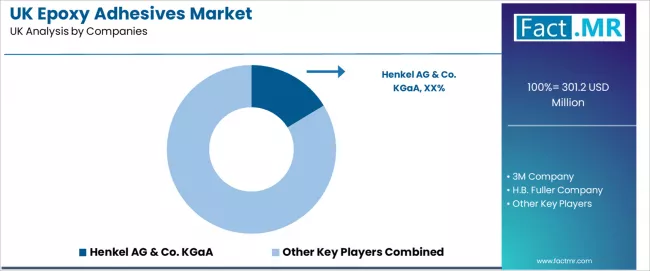
Uk Epoxy Adhesives Market Analysis By Company | Source: Fact.MR
Specialized chemical producers, structural bonding specialists, and integrated solution providers that support a wide range of industrial and manufacturing operations shape competition in UK’s epoxy adhesives industry. Large industrial corporations continue to influence sector development through strong research capabilities, advanced formulation work, and consistent investment in application testing.
Companies across the industry are prioritizing improvements in formulation stability, curing performance, environmental compliance, and structural integrity to meet the expectations of construction firms, automotive manufacturers, and engineered product assemblers.
Quality assurance systems are becoming more sophisticated as customers demand higher reliability and predictable performance in challenging operational environments. Firms are strengthening testing protocols that evaluate adhesion strength, temperature resistance, chemical tolerance, and long-term durability. These measures support procurement decisions and allow manufacturers to align with UK regulatory standards and international certification requirements.
Supply chain and distribution capabilities also influence competitive positioning. Companies are expanding partnerships with industrial distributors, engineering contractors, and OEMs to improve delivery timelines and product availability. Technical support services, including on-site guidance, custom formulation assistance, and troubleshooting, are used to build customer loyalty and support complex bonding applications.
Key participants such as 3M Company, H.B. Fuller Company, Sika AG, and Henkel AG & Co. KGaA focus on integrated development strategies that combine material science expertise, advanced bonding technologies, and robust customer support infrastructures. Their ability to provide complete solutions for industrial and manufacturing environments continues to shape the competitive direction of the UK epoxy adhesives industry.
Key Players in UK Epoxy Adhesives Industry
- Henkel AG & Co. KGaA
- 3M Company
- H.B. Fuller Company
- Sika AG
- Dow Inc.
- Bostik (Arkema Group)
- Ashland Global Holdings Inc.
- Parker Hannifin Corporation
- Mapei S.p.A.
- Permabond LLC
Segmentation
Scope of the Report
| Item | Value |
|---|---|
| Quantitative Units | USD 505.8 million |
| Technology Type | Two-Component, One-Component, Others |
| Application | Building & Construction, Automotive & Transportation, Electrical & Electronics, Power & Energy, Others |
| Regions Covered | England, Scotland, Wales, Northern Ireland |
| Key Companies | Henkel AG & Co. KGaA, 3M Company, H.B. Fuller Company, Sika AG, Dow Inc., Bostik (Arkema Group), Ashland Global Holdings Inc., Parker Hannifin Corporation, Mapei S.p.A., Permabond LLC, Regional epoxy adhesive specialists |
| Additional Attributes | Sales by technology type and application segment; regional demand trends across England, Scotland, Wales, and Northern Ireland; competitive landscape with established epoxy adhesive suppliers and specialized chemical developers; quality preferences for two-component versus one-component technologies; integration with manufacturing programs and advanced industrial policies, particularly advanced in the England region |
Source: Fact.MR analysis. Updated Dec 15, 2025
UK Epoxy Adhesives Industry by Segments
-
Technology Type :
- Two-Component
- One-Component
- Others
-
Application :
- Building & Construction
- Automotive & Transportation
- Electrical & Electronics
- Power & Energy
- Others
-
Country :
- England
- Scotland
- Wales
- Northern Ireland
Frequently Asked Questions
How big is the demand for epoxy adhesives in UK in 2026?
What will be the size of epoxy adhesives in UK in 2036?
How much will be the demand for epoxy adhesives in UK growth between 2026 and 2036?
What are the key product types in the epoxy adhesives in UK?
Which application segment is expected to contribute significant share in the epoxy adhesives in UK in 2026?
Who worked on this report


Preview the report firsthand - request a free sample
Free SampleGet the brochure for pricing and purchase details
Download PDF