- Base Value(2026): 39.9 Mn
- Estimated Value(2026): 39.9 Mn
- Forecast Value (2036): 67.6 Mn
- CAGR (2026 - 2036): 5.4%
Demand for Fluorosurfactant in UK 2036 to 2036
Demand for fluorosurfactants in the UK is projected to rise from USD 39.90 million in 2026 to USD 67.76 million by 2036, reflecting a 1.7x expansion across the period. The gain of USD 27.86 million constitutes a 70% increase from the 2026 baseline. Annual additions shift from USD 2.1 million in the opening interval to nearly USD 3.6 million in the final year, indicating steady uplift across industrial adoption cycles. A CAGR of 5.4% is expected for fluorosurfactant demand expansion in UK.
Key Takeaways from UK Fluorosurfactant Industry Analysis
- UK Fluorosurfactant Sales Value (2036): USD 39.90 million
- UK Fluorosurfactant Forecast Value (2036): USD 67.76 million
- UK Fluorosurfactant Forecast CAGR: 5.4%
- Leading Product Type in UK Fluorosurfactant Industry: Anionic (52.3%)
- Key Growth Regions in UK Fluorosurfactant Industry: England, Scotland, Wales, and Northern Ireland
- Regional Leadership: England holds the leading position in demand
- Key Players in UK Fluorosurfactant Industry: 3M Company, The Chemours Company, DIC Corporation, AGC SEIMI CHEMICAL CO., LTD., Merck KGaA, Pilot Chemical Corporation, OMNOVA Solutions Incorporated, Dynax Corporation, Maflon SpA, Clariant AG
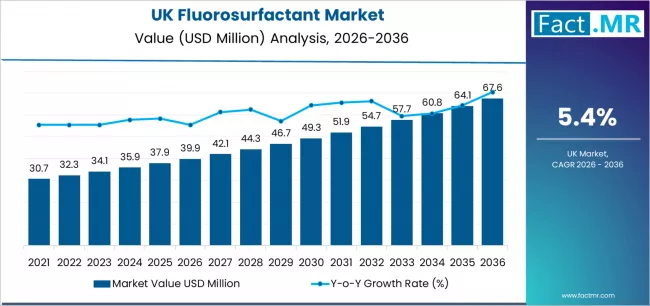
Uk Fluorosurfactant Market Market Value Analysis | Source: Fact.MR
Advanced fluorinated additives used in engineered materials are expected to capture more than one-third of specialised demand in 2026, reinforcing the sector’s reliance on high-performance surface-active ingredients. Short-chain fluorosurfactant technologies gain traction in 2026 across formulation labs and controlled-environment coating units, supported by the need for tight application stability and improved environmental compatibility. This reflects a broader movement toward refined performance chemistry within UK production ecosystems.
Sector activity mirrors the country’s push toward modernised industrial processes. Facilities handling performance-critical coatings and engineered surfaces are directing resources toward fluorosurfactant systems capable of supporting consistent wetting behaviour, uniform substrate coverage and stable formulation characteristics across varied industrial conditions.
UK Fluorosurfactant Industry Key Takeaways
| Metric | Value |
|---|---|
| UK Fluorosurfactant Sales Value (2036) | USD 39.90 million |
| UK Fluorosurfactant Forecast Value (2036) | USD 67.76 million |
| UK Fluorosurfactant Forecast CAGR (2036-2036) | 5.4% |
Source: Fact.MR analysis. Updated Dec 15, 2025
Category
| Category | Segment |
|---|---|
| Product | Anionic, Cationic, Non-ionic, Amphoteric |
| Application | Paints and Coatings, Firefighting Foams, Adhesives and Sealants, Detergents |
| End Use Industry | Industrial and Construction, Electronics, Oil and Gas, Pharmaceuticals |
| Country | England, Scotland, Wales, Northern Ireland |
Source: Fact.MR analysis. Updated Dec 15, 2025
Segmental Analysis
Why are Anionic Fluorosurfactants in High Demand in the UK?
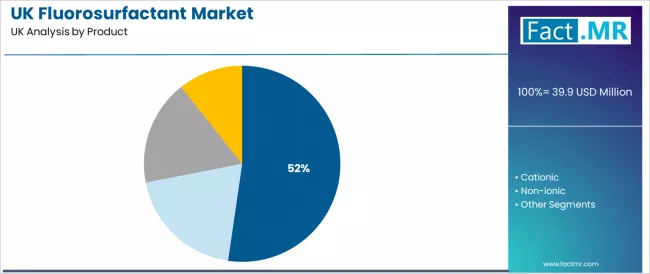
Uk Fluorosurfactant Market Analysis By Product | Source: Fact.MR
Anionic fluorosurfactants will capture 52.3% of UK’s fluorosurfactant demand in 2026, supported by strong formulation compatibility and consistent wetting behavior across industrial environments. Manufacturers across the UK continue to depend on anionic systems due to their stable interaction with legacy chemistries and their ability to maintain interface performance without disrupting established production routines.
Facilities focused on coating operations and chemical processing value predictable outputs, which strengthens alignment with anionic structures. Long-standing supplier experience reinforces adoption because operational teams trust proven outcomes under varied production loads. Technical improvements in surface uniformity and integration efficiency continue to anchor the segment’s position across high-volume installations.
- Chemical stability and smooth incorporation into existing formulations position anionic platforms as the practical choice for high-volume industrial activity.
- Demonstrated reliability across commercial deployments reinforces purchasing confidence among UK manufacturers pursuing predictable output quality.
How will Paints and Coatings Applications drive Fluorosurfactant Sales in the UK?
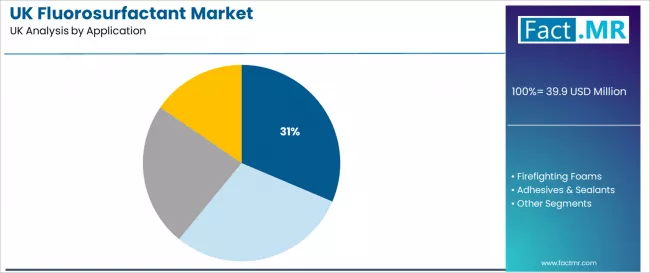
Uk Fluorosurfactant Market Analysis By Application | Source: Fact.MR
Paints and coatings applications hold 31.4% of fluorosurfactant demand in 2026, reflecting the sector’s need for additives that enhance spreading behavior and film consistency. Coating producers operating architectural, industrial, and specialty lines require materials that support predictable surface performance across diverse substrates. UK coating hubs rely on fluorosurfactants to align with strict performance expectations within regulated manufacturing environments.
Operational teams value formulation steadiness, which strengthens the role of fluorosurfactants in production planning. High-throughput coating workflows gain from additives that sustain uniformity during application, anchoring steady demand across national manufacturing corridors.
- Coating workflows benefit from reliable spreading behavior and formulation steadiness, supporting consistent output across large and specialized facilities.
- Fluorosurfactant integration elevates process precision and strengthens application consistency, supporting sector-wide surface-quality requirements.
What are the Drivers, Restraints, and Key Trends in the UK Fluorosurfactant Industry?
Demand for fluorosurfactants in the UK is rising as industries prioritise dependable functional performance across coatings, cleaning systems, and engineered formulations. England maintains a central role through active application development clusters and expanding high-specification chemistry programmes. Growing emphasis on precision manufacturing strengthens the requirement for surfactants that deliver stable outcomes under varied process conditions.
Non-fluorinated alternatives continue to slow certain adoption decisions across regional industries. Environmental validation adds technical and financial weight to qualification procedures. Cost sensitivity persists since production involves complex processing steps and stringent quality controls. Regulatory expectations expand documentation workloads and lengthen approval cycles for many suppliers.
Industrial standards across the UK are progressing toward higher performance thresholds, prompting structured testing and longer development pipelines. Environmental chemistry is gaining prominence as suppliers build integrated validation networks and refine cleaner processing routes. Collaborative research activity in England and Scotland is intensifying, enabling shared testing platforms and more efficient qualification of emerging fluorosurfactant technologies.
Analysis of UK Fluorosurfactant Industry by Key Countries
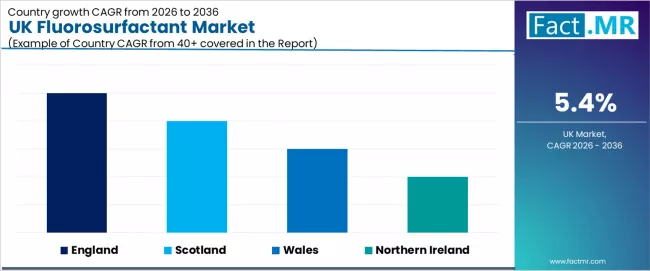
Uk Fluorosurfactant Market Cagr Analysis By Country | Source: Fact.MR
| Region | CAGR (2036 to 2036) |
|---|---|
| England | 5.8% |
| Scotland | 5.7% |
| Wales | 5.6% |
| Northern Ireland | 5.5% |
Source: Fact.MR analysis. Updated Dec 15, 2025
Why does England Prioritize High-reliability Fluorosurfactant Demand?
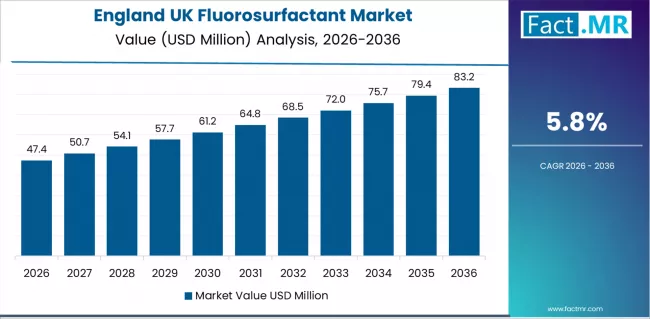
Uk Fluorosurfactant Market Country Value Analysis | Source: Fact.MR
Demand for fluorosurfactants in England grows at a CAGR of 5.8% due to advanced performance expectations across major industrial centres. London and surrounding regions maintain extensive infrastructure that supports structured uptake of high-reliability systems. Manufacturers seek consistent surface outcomes and predictable operational results, creating steady preference for established fluorosurfactant technologies. Suppliers expand targeted programs that strengthen deployment efficiency and technical support capabilities.
- Performance requirements across coating and formulation activities elevate use of systems with verified enhancement results.
- Strong innovation ecosystems enable next-generation projects that reinforce England’s leadership role.
Why does Scotland Strengthen Integration-Focused Fluorosurfactant Demand across Industrial Corridors?
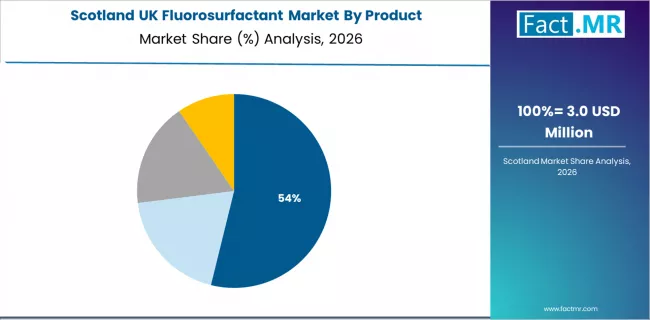
Uk Fluorosurfactant Market Scotland Market Share Analysis By Product | Source: Fact.MR
Scotland records a CAGR of 5.7%, supported by dense industrial zones across Edinburgh, Glasgow, and nearby regions. Facilities engaged in coatings, specialty chemicals, and engineered products rely on dependable performance outcomes, creating favorable conditions for fluorosurfactant uptake. Manufacturers prefer systems that integrate smoothly with existing lines and stabilize operational workflows. Suppliers adjust service models to meet rising expectations for applied consistency.
- Concentrated industrial networks generate openings for suppliers delivering easily integrated performance systems.
- Growing awareness of system capabilities strengthens competitive positioning across Scotland’s industrial clusters.
How does Wales Emphasize Stability-Driven Fluorosurfactant Demand amid Industrial Modernization?
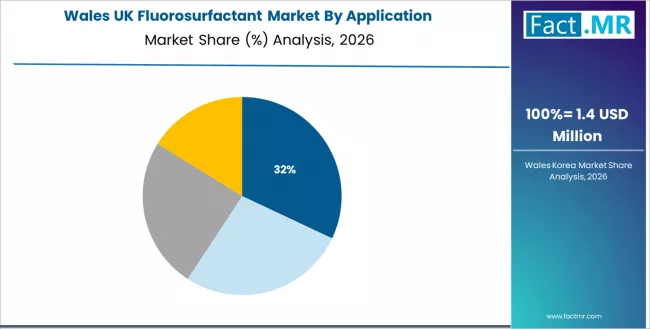
Uk Fluorosurfactant Market Wales Market Share Analysis By Application | Source: Fact.MR
Wales records a CAGR of 5.6%, supported by industrial facilities seeking reliable surface behavior and stable operational outcomes. Local manufacturers adopt fluorosurfactant technologies to preserve competitiveness within evolving production environments. Specialty chemical suppliers extend regional presence through structured formulation support and improved logistical access. Facilities depend on predictable enhancement results as modernization reshapes operational priorities.
- Modernization goals increase interest in systems that maintain consistent enhancement outcomes across varied sites.
- Formulation improvement efforts encourage broader fluorosurfactant utilization across Wales’ industrial base.
How does Northern Ireland Advance Dependability-Focused Fluorosurfactant Demand in Expanding Facilities?
Northern Ireland grows at a CAGR of 5.5%, supported by expanding coating, formulation, and engineered-product operations. Facilities aim for controlled surface behavior across multiple production steps, strengthening interest in fluorosurfactant solutions. Regional development programs encourage suppliers to scale technical guidance and service structures. Manufacturers incorporate fluorosurfactants into modernization plans that require stable enhancement results.
- Diversifying facilities generate consistent demand for systems that reinforce performance reliability.
- Coordinated regional development supports shared formulation resources aligned with multi-facility performance objectives.
Competitive Landscape of UK Fluorosurfactant Industry
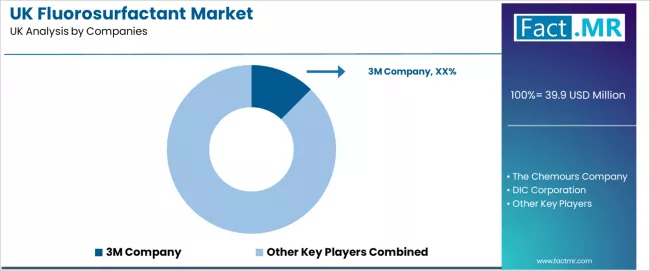
Uk Fluorosurfactant Market Analysis By Company | Source: Fact.MR
The UK fluorosurfactant industry reflects active competition among chemical manufacturers, formulation specialists, and integrated solution providers supported by strong research and application engineering capabilities. Companies continue to advance formulation methods, strengthen quality assurance systems, and refine distribution structures to improve reliability and performance across manufacturing and industrial environments.
Technical validation services are becoming more important as customers seek consistent functionality and predictable behaviour in complex production settings. Collaborative initiatives and research infrastructure expansion support broader formulation enhancement and help firms maintain strong positions in coating and performance driven applications.
3M Company offers a broad suite of fluorosurfactant solutions supported by formulation development, quality oversight, and extensive distribution reach that aligns with industrial performance needs across the UK. The Chemours Company provides full service chemical supply with a focus on high performance formulations, custom integration, and technical support for industrial programs within domestic and international operations.
DIC Corporation brings advanced formulation capabilities and strong quality management structures supported by deep specialty chemical expertise. The company continues to focus on performance features that support coating and manufacturing use. AGC SEIMI CHEMICAL CO LTD contributes through application development services and formulation optimization activities that strengthen product performance across UK industrial applications.
Key Players in UK Fluorosurfactant Industry
- 3M Company
- The Chemours Company
- DIC Corporation
- AGC Seimi Chemical Co., Ltd.
- Merck & Co. KGaA
- Pilot Chemical Corporation
- OMNOVA Solutions Incorporated
- Dynax Corporation
- Maflon SpA
- Clariant AG
Segmentation
Scope of the Report
| Item | Value |
|---|---|
| Quantitative Units | USD 67.76 million |
| Product | Anionic, Cationic, Non-ionic, Amphoteric |
| Application | Paints & Coatings, Firefighting Foams, Adhesives & Sealants, Detergents |
| End-Use Industry | Industrial & Construction, Electronics, Oil & Gas, Pharmaceuticals |
| Regions Covered | England, Scotland, Wales, Northern Ireland |
| Key Companies | 3M Company, The Chemours Company, DIC Corporation, AGC SEIMI CHEMICAL CO., LTD., Merck KGaA, Pilot Chemical Corporation, OMNOVA Solutions Incorporated, Dynax Corporation, Maflon SpA, Clariant AG, Regional fluorosurfactant specialists |
| Additional Attributes | Sales by product and application segment; regional demand trends across England, Scotland, Wales, and Northern Ireland; competitive landscape with established fluorosurfactant suppliers and specialized chemical developers; quality preferences for anionic versus cationic technologies; integration with industrial programs and advanced performance policies, particularly advanced in the England region |
Source: Fact.MR analysis. Updated Dec 15, 2025
UK Fluorosurfactant Industry by Segments
-
Product :
- Anionic
- Cationic
- Non-ionic
- Amphoteric
-
Application :
- Paints & Coatings
- Firefighting Foams
- Adhesives & Sealants
- Detergents
-
End-Use Industry :
- Industrial & Construction
- Electronics
- Oil & Gas
- Pharmaceuticals
-
Country :
- England
- Scotland
- Wales
- Northern Ireland
Frequently Asked Questions
How big is the demand for fluorosurfactant in UK in 2026?
What will be the size of fluorosurfactant in UK in 2036?
How much will be the demand for fluorosurfactant in UK growth between 2026 and 2036?
What are the key product types in the fluorosurfactant in UK?
Which application segment is expected to contribute significant share in the fluorosurfactant in UK in 2026?
Who worked on this report


Preview the report firsthand - request a free sample
Free SampleGet the brochure for pricing and purchase details
Download PDF