- Market Value (2025): USD 5.1 Bn
- Estimated Value (2026): USD 5.4 Bn
- Forecast Value (2036): USD 8.7 Bn
- CAGR (2026-2036): 4.9%
What is the Winding Machines Market forecast to be worth by 2036?
USD 5.4 billion in 2026 to USD 8.7 billion by 2036 at a 4.9% CAGR.
- The winding machines market reached USD 5.1 billion in 2025.
- Demand is projected to increase from USD 5.4 billion in 2026 to USD 8.7 billion by 2036.
- The market is projected to expand at a 4.9% CAGR from 2026 to 2036.
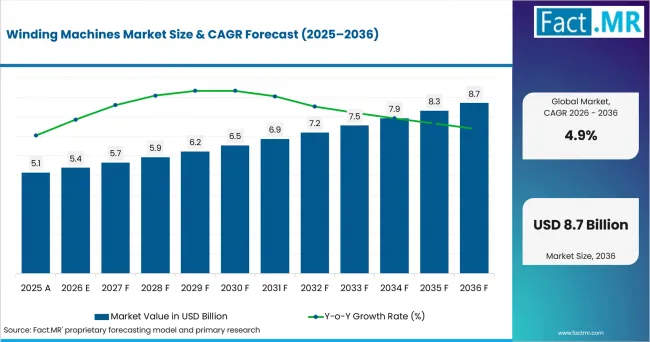
Winding Machines Market Value Analysis | Source: Fact.MR
What are the defining numbers behind Winding Machines Market growth?
An absolute opportunity of USD 3.3 billion is expected between 2026 and 2036. Automatic Winding Machines account for 51.8% of Technology in 2026, Electrical And Electronics represents 46.9% of Application, Electrical Equipment Manufacturers hold 38.4% of End Use, and Fully Automatic Systems account for 54.7% of Automation Level.
- Demand Drivers in the Market
- Grid expansion is increasing the manufacturing burden on transformers and cables, which sustains demand for winding equipment used in coil formation and finished cable handling. The International Energy Agency reported that global grid investment was running at about USD 400 billion per year in 2025 while tight transformer and cable supply chains were constraining expansion. This creates a direct equipment requirement across coil winding and related transformer-production operations.
- Transformer production bottlenecks are encouraging manufacturers to add capacity and simplify product changeovers. The U.S. Department of Energy identifies distribution transformers as foundational grid components facing long lead times and component shortages, while its supply-chain analysis documents more than 80,000 transformer varieties in the United States. Programmable winding recipes and repeatable setup become more valuable when plants must serve many specifications without excessive manual rework.
- Manufacturers are replacing mechanically adjusted winding processes with programmable motion, tension and feedback control. The International Federation of Robotics recorded 542,000 industrial robot installations in 2024, including 128,899 in electrical and electronics manufacturing. The same investment logic supports industrial automation around winding cells where repeatability, traceability and lower operator intervention determine line economics.
- Servo-based motion control raises the value of automatic equipment because spindle speed, traverse position and torque can be coordinated as one recipe. Siemens states that its SINAMICS S200 servo system is designed for precision in speed and torque and specifically identifies winding and unwinding machines as an application. This supports adoption of servo motors in winding systems that need faster changeovers and tighter process control.
- Demand extends beyond electrical coils. Textile mills, packaging converters and cable producers use winders to form consistent packages, reels and rolls before downstream processing or shipment. Equipment upgrades focus on tension stability, package geometry and recipe repeatability, linking winding-machine investment to textile winding and wire and cable production as well as film, foil and paper handling.
- Key Segments Analyzed
- Automatic Winding Machines account for 51.8% of Technology in 2026 because programmed spindle, traverse and tension control improve repeatability while reducing manual adjustment across recurring production runs.
- Electrical And Electronics represents 46.9% of Application in 2026 because transformers, electric motors, inductors and coils all depend on controlled winding geometry and consistent conductor placement.
- Electrical Equipment Manufacturers hold 38.4% of End Use in 2026 because winding is a core production step for transformers, motors and related components, making machine availability and process stability directly relevant to output.
- Fully Automatic Systems account for 54.7% of Automation Level in 2026 as integrated feeding, programmable motion, sensor feedback and automated handling reduce operator intervention and make quality control easier to standardize.
- Analyst Opinion at Fact.MR
- Shambhu Nath Jha, Senior Consultant, Fact.MR, states, “Winding-machine procurement is shifting from simple spindle-speed decisions toward controlled tension, repeatable motion and fast recipe changeover. Transformer, motor, cable and converting plants increasingly need equipment that can hold quality across more product variants while reducing manual correction. That operating requirement explains why automatic machines and fully automatic systems lead their respective 2026 segments.”
- Strategic Implications
- Winding-machine suppliers should modularize servo, tension-control and software architectures so one platform can be configured for different wire sizes, package geometries and production volumes without a complete redesign.
- Electrical-equipment manufacturers should compare winding systems on changeover time, process repeatability and quality traceability rather than spindle speed alone, because product variety can erode nominal throughput gains.
- Automation upgrades should prioritize closed-loop tension and position feedback where winding quality affects electrical performance, downstream assembly or material waste.
- Service coverage, programming support and spare-part availability should be treated as part of the equipment decision because a winding-cell stoppage can interrupt several downstream production steps.
How does the Winding Machines Market break down by segment?
The market is segmented by Technology, Application, End Use and Automation Level.
Why do Automatic Winding Machines lead Technology?
Automatic Winding Machines are projected to account for a 51.8% share in 2026.
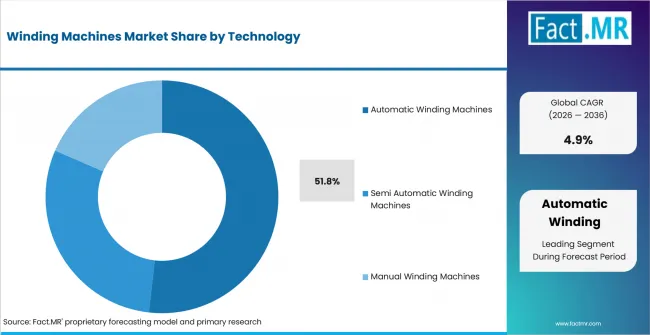
Winding Machines Market Analysis By Technology | Source: Fact.MR
Automatic equipment leads because the winding path can be programmed and repeated instead of being recreated through manual adjustment. This is important where product quality depends on consistent turns, pitch, tension, layer build and package geometry. CNC Controlled Winding Machines and Servo Controlled Winding Machines extend that advantage by coordinating axes and storing production recipes for repeat jobs.
The operational benefit is strongest in plants with frequent production runs or multiple product variants. A programmed setup reduces the time between jobs, limits operator-dependent variation and creates a clearer path to in-process monitoring. Siemens identifies winding and unwinding as a precision servo application, illustrating why motion-control capability is becoming part of the winding-machine purchase rather than an add-on after installation.
Why does Electrical and Electronics lead Application?
Electrical and Electronics is projected to account for a 46.9% share in 2026.
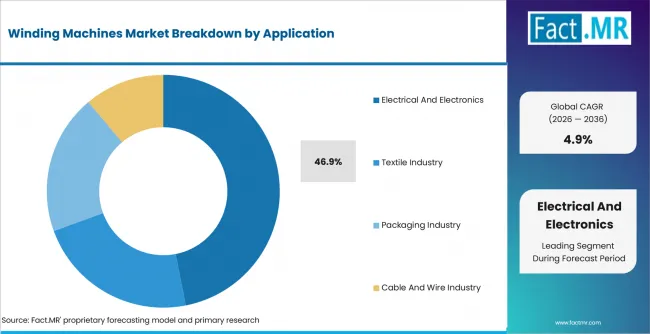
Winding Machines Market Analysis By Application | Source: Fact.MR
The category leads because Transformers, Electric Motors, Inductors And Coils all require controlled conductor placement as part of the product itself. Errors in layer build, turn placement or tension can create rework or complicate later insulation, impregnation and assembly steps, so winding-machine performance is tied directly to manufacturing quality.
Grid investment reinforces this demand channel. The International Energy Agency has highlighted transformer and cable supply-chain constraints, while the U.S. Department of Energy is working with utilities and manufacturers to reduce transformer production times. Capacity additions in these products therefore translate into demand for machines that can run predictable recipes across a broad specification range.
Why do Electrical Equipment Manufacturers lead End Use?
Electrical Equipment Manufacturers are projected to account for a 38.4% share in 2026.
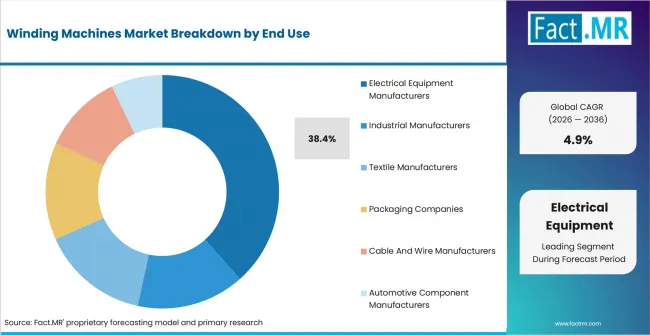
Winding Machines Market Analysis By End Use | Source: Fact.MR
Electrical-equipment producers purchase winding machinery because the process sits inside their core manufacturing flow rather than at the edge of the plant. Transformer coils, motor stators and rotors, inductors and other wound components require dedicated equipment, tooling and process settings that must remain available for production schedules and customer specifications.
The buying decision therefore combines throughput with flexibility. A plant that serves multiple ratings or motor platforms needs a machine that can change recipes without losing repeatability, while a higher-volume line needs automated loading, winding and transfer to protect cycle time. The ability to integrate winding with testing, marking and assembly also supports investment in complete cells instead of isolated machines.
Why do Fully Automatic Systems lead Automation Level?
Fully Automatic Systems are projected to account for a 54.7% share in 2026.
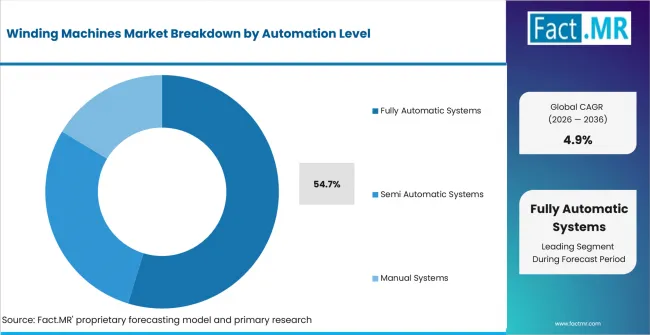
Winding Machines Market Analysis By Automation Level | Source: Fact.MR
Fully automatic systems lead because the economic value comes from coordinating several steps, not simply rotating a spindle without an operator. Automated material feeding, controlled tension, axis motion, part transfer and recipe management reduce handling between operations and make quality checks easier to place inside the line. AI Assisted Winding Systems and Sensor Based Control Systems extend this structure toward more responsive process monitoring.
The International Federation of Robotics recorded sustained industrial automation deployment across major manufacturing economies in 2024. ABB also maintains a dedicated ACS880 winder control program within its drive platform, showing how tension, roll diameter and motor-speed logic are being packaged into reusable control architectures for winding applications.
What is accelerating Winding Machines Market adoption, and what is holding it back?
Adoption is being accelerated by transformer and motor capacity additions, cable and converting-line investment, replacement of manual adjustment with programmable control, and the need for repeatable quality across more product variants. Adoption is restrained by the capital cost of automated machines, application-specific tooling, integration time, operator and maintenance skills, and the cyclical timing of downstream manufacturing investment.
Drivers Impact Analysis
| Factor | (~) % Impact on CAGR | Geographic Relevance | Impact Timeline |
|---|---|---|---|
| Transformer and grid-equipment capacity expansion | +0.8% | Germany, Brazil and USA | Short term (<= 2 years) |
| Servo and CNC replacement of manual winding | +0.6% | Germany, USA and Japan | Medium term (2-4 years) |
| Motor and electrical-equipment production | +0.5% | Global | Medium term (2-4 years) |
| Cable and wire capacity additions | +0.4% | Brazil, UK and USA | Medium term (2-4 years) |
| Textile and packaging line modernization | +0.3% | Brazil, UK and Japan | Long term (>= 4 years) |
Opportunity Impact Analysis
| Factor | (~) % Impact on CAGR | Geographic Relevance | Impact Timeline |
|---|---|---|---|
| Fully automatic multi-process winding cells | +0.5% | Germany, USA and Japan | Medium term (2-4 years) |
| Sensor-based closed-loop tension and defect monitoring | +0.4% | Global | Medium term (2-4 years) |
| Retrofit controls for installed winding machines | +0.3% | UK, USA and Germany | Short term (<= 2 years) |
| Flexible recipe-driven equipment for multi-product plants | +0.2% | Global | Long term (>= 4 years) |
Restraints Impact Analysis
| Factor | (~) % Impact on CAGR | Geographic Relevance | Impact Timeline |
|---|---|---|---|
| High machine and tooling capital cost | -0.5% | Global | Short term (<= 2 years) |
| Custom engineering and qualification time | -0.4% | Global | Medium term (2-4 years) |
| Programming and maintenance skill gaps | -0.3% | Brazil, UK and USA | Medium term (2-4 years) |
| Downstream manufacturing capex cyclicality | -0.2% | Germany, Japan and UK | Short term (<= 2 years) |
Which countries are scaling the Winding Machines Market through 2036?
- Germany: Electricity-network expansion and a deep electrical-equipment manufacturing base support investment in automatic winding systems for transformers, motors and industrial components.
- Brazil: Transmission-line and substation expansion supports transformer and cable production, creating equipment demand around coil winding, cable handling and related factory capacity.
- USA: Transformer supply-chain constraints and efforts to expand domestic grid-component production are increasing the value of productive, flexible winding capacity at electrical-equipment plants.
- UK: Earlier procurement of transmission cables and related equipment, together with policy support for advanced manufacturing, supports winding-system modernization and control retrofits.
- Japan: Manufacturing policy is emphasizing AI and digital technology adoption, reinforcing demand for precise, automated winding equipment in motor, electronics and electrical-component production.
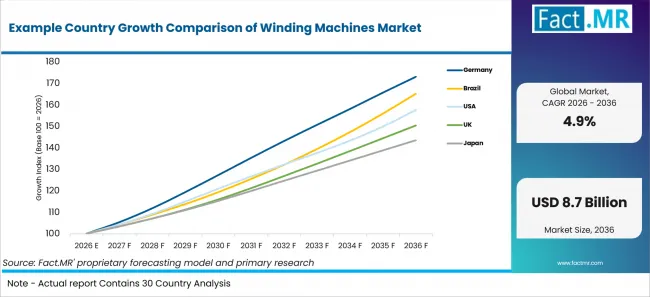
Example Country Growth Comparison Of Winding Machines Market | Source: Fact.MR
Country CAGR (2026-2036)
| Country | CAGR, 2026-2036 |
|---|---|
| Germany | 5.6% |
| Brazil | 5.2% |
| USA | 4.7% |
| UK | 4.2% |
| Japan | 3.7% |
What is driving Germany's growth through 2036?
Germany is projected to expand at a 5.6% CAGR from 2026 to 2036.
The demand mechanism combines grid expansion with an established electrical and machinery manufacturing base. In June 2026, the Bundesnetzagentur opened consultation on the electricity Network Development Plan for expansion through 2037 and 2045 and stated that further extra-high-voltage network expansion is necessary. That long-cycle grid work supports transformer, cable and associated electrical-equipment production, where winding equipment is a core manufacturing asset.
Near-term industrial activity also shows demand in relevant equipment categories. Destatis reported that German new orders for electrical equipment increased 9.8% month on month in December 2025, while machinery and equipment orders increased 11.5%. A single month does not define the long-term forecast, but it shows active order flow in industries that purchase programmable winding, motion-control and automation equipment.
What is driving Brazil's growth through 2036?
Brazil is projected to expand at a 5.2% CAGR from 2026 to 2036.
Transmission-system expansion creates a direct equipment route into transformer and cable manufacturing. Empresa de Pesquisa Energetica reported that Brazil’s 2026 transmission auction covered 859 km of transmission lines and 4,350 MVA of substation transformation capacity across nine lots. Projects of this type increase requirements for wound transformer components and power-cable handling as new grid assets move from planning into manufacturing and construction.
The resulting opportunity is less about one machine type and more about production flexibility. Suppliers serving Brazil can address transformer coils, power cables and industrial electrical equipment with programmable winding platforms that accommodate multiple conductor sizes, reel formats and output levels without excessive manual reset time.
What is driving USA's growth through 2036?
USA is projected to expand at a 4.7% CAGR from 2026 to 2036.
U.S. demand is tied to the need to shorten grid-equipment lead times and expand domestic component capacity. The Department of Energy describes transformers, circuit breakers, substation components and power electronics as areas facing supply-chain challenges and has highlighted limited domestic production capacity and excessive customization as contributors to long lead times. This raises the value of flexible production equipment that can increase output without locking a plant into one specification.
For winding-machine buyers, the practical requirement is recipe flexibility combined with traceable quality. Transformer and motor manufacturers can use CNC or servo-controlled winding to standardize motion and tension while retaining the ability to switch across ratings and designs. The presence of a large system-integration base also supports retrofits where manufacturers retain mechanical equipment but modernize drives, controls and sensing.
What is driving UK's growth through 2036?
UK is projected to expand at a 4.2% CAGR from 2026 to 2036.
The UK electricity-transmission buildout is creating earlier supply-chain commitments for equipment that ultimately depends on cable, coil and electrical-component manufacturing. Ofgem’s Advanced Procurement Mechanism allows transmission owners to reserve supply-chain capacity earlier, and the regulator specifically identifies equipment such as switchgear and cables as items that can be procured in advance. That procurement visibility supports capacity planning at upstream manufacturers and their equipment suppliers.
Manufacturing policy also favors digital modernization. The UK Advanced Manufacturing Sector Plan, published in 2025, links future competitiveness with decarbonisation, AI and higher business investment. For winding machinery, the practical opportunity is in upgrading installed equipment with servo motion, programmable recipes, sensor feedback and production data rather than relying only on greenfield machine purchases.
What is driving Japan's growth through 2036?
Japan is projected to expand at a 3.7% CAGR from 2026 to 2036.
Japan’s market is supported by precision-manufacturing requirements and a policy focus on digital production. The Ministry of Economy, Trade and Industry’s White Paper on Manufacturing Industries 2026 identifies AI and digital technologies as essential to strengthening manufacturing competitiveness and calls for medium- to long-term growth investment. This aligns with fully automatic winding systems where motion, sensing and process data can be integrated at machine level.
The installed automation base gives suppliers a receptive environment for high-precision winding systems. The International Federation of Robotics recorded 44,500 industrial robot installations in Japan in 2024. Winding-machine demand therefore centers on reliable automation, compact integration and repeatable control for electrical components, motors and electronics rather than on manual capacity expansion alone.
Who Leads the Winding Machines Market?
Key players in the Winding Machines Market include Siemens AG, ABB Ltd., Jendamark Automation, Odawara Engineering Co., Ltd., Marsilli S.p.A., Nidec Corporation and ACME Mechatronics.
Competition is divided between dedicated winding-equipment specialists, manufacturing-line integrators and motion-control suppliers. Odawara Engineering develops custom motor-winding equipment and fully automatic high-speed line systems. Marsilli combines spindle, flyer and needle winding with assembly and testing processes. Nidec develops winding machines across fine-wire, appliance and automotive motor applications, while ACME Mechatronics offers PLC- and servo-controlled winding platforms for standard and customized coil production.
Siemens AG and ABB Ltd. contribute control technology that can be designed into winding architectures. Siemens identifies winding and unwinding as a precision application for its SINAMICS S200 servo platform, while ABB maintains a dedicated ACS880 winder control program. Jendamark Automation integrates motor winding into automated electric-motor assembly lines and adds process security, testing and traceability. This makes technical integration, application engineering, changeover flexibility and service support central competitive factors.
Which companies are the key providers?
The key providers are Siemens AG, ABB Ltd., Jendamark Automation, Odawara Engineering Co., Ltd., Marsilli S.p.A., Nidec Corporation and ACME Mechatronics.
- Siemens AG
- ABB Ltd.
- Jendamark Automation
- Odawara Engineering Co., Ltd.
- Marsilli S.p.A.
- Nidec Corporation
- ACME Mechatronics
Bibliography
- International Energy Agency. (2025). World Energy Investment 2025. IEA.
- International Federation of Robotics. (2025). World Robotics 2025: Industrial Robots. IFR.
- U.S. Department of Energy, Office of Electricity. (2026). Distribution Transformers. U.S. Department of Energy.
- U.S. Department of Energy, Office of Electricity. (2026). Supply Chain and Market Analysis. U.S. Department of Energy.
- U.S. Department of Energy, Office of Electricity. (2026). Strengthening America’s Grid Supply Chain. U.S. Department of Energy.
- Bundesnetzagentur. (2026). Network Development Plan Electricity 2025-2037/2045 Consultation. Federal Network Agency, Germany.
- Federal Statistical Office of Germany. (2026). New Orders in Manufacturing in December 2025. Destatis.
- Empresa de Pesquisa Energetica. (2026). Transmission Auction No. 01/2026. EPE, Brazil.
- Office of Gas and Electricity Markets. (2025). Electricity Transmission Advanced Procurement Mechanism. Ofgem.
- Department for Business and Trade. (2025). Advanced Manufacturing Sector Plan. UK Government.
- Ministry of Economy, Trade and Industry, Japan. (2026). White Paper on Manufacturing Industries 2026. Government of Japan.
- Siemens AG. (2023). Siemens Launches New Servo Drive System Specifically for the Battery and Electronics Industry. Siemens.
- ABB. (2026). ACS880 Winder Control Program Firmware Manual. ABB.
- Jendamark Automation. (n.d.). Electric Vehicle Power Assembly Systems. Jendamark.
- Odawara Engineering Co., Ltd. (n.d.). Business and Features. Odawara Engineering.
- Marsilli S.p.A. (n.d.). Winding and Assembly Systems for Motors and Coils. Marsilli.
- Nidec Corporation. (n.d.). Winding Machine. Nidec.
- ACME Mechatronics. (n.d.). Winding Machines with PLC and Servo Technology. ACME Mechatronics.
This Report Answers
- How are grid expansion and electrical-equipment production shaping winding-machine demand?
- Why are automatic and fully automatic winding systems gaining preference in recurring production?
- Which applications and end users account for the leading 2026 shares?
- How do country manufacturing and infrastructure programs translate into winding-equipment procurement?
- Which technical capabilities differentiate winding-machine providers and automation partners?
What does the Winding Machines Market cover?
The Winding Machines Market covers industrial machinery and integrated winding systems used to form, place or package wire, conductive coils, yarn, film, foil, paper and cable materials under controlled motion and tension. Revenue is counted at machine or winding-system level for equipment supplied into the specified Technology, Application, End Use and Automation Level categories.
The assessment includes standalone winding machines and integrated winding cells where winding is the core production function. Controls, tension devices, feeders, sensors and handling modules are included when they are supplied as part of the winding machine or integrated winding system.
What is included in the scope?
The scope includes Automatic Winding Machines, Semi Automatic Winding Machines and Manual Winding Machines. Automatic equipment includes CNC Controlled Winding Machines and Servo Controlled Winding Machines. Application coverage includes Electrical And Electronics, Textile Industry, Packaging Industry and Cable And Wire Industry, together with their specified sub-applications.
End-use coverage includes Electrical Equipment Manufacturers, Industrial Manufacturers, Textile Manufacturers, Packaging Companies, Cable And Wire Manufacturers and Automotive Component Manufacturers. Automation coverage includes Fully Automatic Systems, Semi Automatic Systems and Manual Systems, with AI Assisted Winding Systems and Sensor Based Control Systems included under Fully Automatic Systems.
What is excluded from the scope?
The scope excludes raw wire, yarn, film, foil, paper and cable materials sold without winding machinery; finished transformers, motors, inductors, coils and packaged reels; and standalone drives, PLCs, sensors or motion-control components sold independently of a winding machine or integrated winding system.
Wire drawing, extrusion, stranding, weaving, knitting and general assembly equipment are outside the market unless the supplied system contains a separately identifiable winding function covered by the segmentation. Spools, bobbins and reels sold as consumables are also excluded.
How Was the Analysis Built?
The analysis combines primary discussions with winding-equipment manufacturers, automation integrators, electrical-equipment producers, textile and packaging machinery users, cable manufacturers and industrial buyers with desk research covering grid investment, manufacturing activity, industrial automation, company technical literature and equipment applications.
- Primary Research: Interviews and industry discussions focus on machine selection, product changeover, tension and motion-control requirements, automation depth, qualification, service expectations and purchase timing across the covered end uses.
- Desk Research: The review covers electricity-network expansion, transformer and cable supply conditions, industrial production, manufacturing automation, official policy documents, supplier product portfolios and technical control architectures. External references used in the article are recorded in the bibliography.
- Market Sizing and Forecasting: Estimates combine machine demand across covered applications, technology and automation mix, replacement cycles, downstream manufacturing investment and country-specific activity. The forecast also considers the shift from manual and semi automatic processes toward programmable and fully automatic systems.
- Data Validation and Update Cycle: Findings are cross-checked against supplier capabilities, end-use production requirements, country activity and the consistency of segment and country relationships. Updates incorporate changes in grid investment, manufacturing capex, automation adoption and product architecture.
What is the report's scope and coverage?
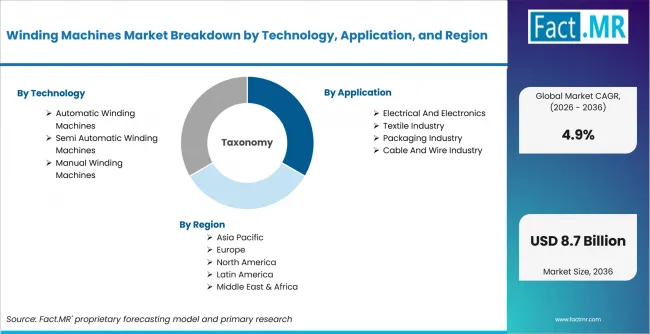
Winding Machines Market Breakdown By Technology, Application, And Region | Source: Fact.MR
| Attribute | Details |
|---|---|
| Quantitative Units | USD billion |
| Market Definition | Industrial winding machines and integrated winding systems supplied across the specified materials, applications, end uses and automation levels |
| Segments Covered | Technology; Application; End Use; Automation Level |
| Regions Covered | North America; Latin America; Europe; East Asia; South Asia and Pacific; Middle East and Africa |
| Countries Covered | Germany; Brazil; USA; UK; Japan |
| Key Companies Profiled | Siemens AG; ABB Ltd.; Jendamark Automation; Odawara Engineering Co., Ltd.; Marsilli S.p.A.; Nidec Corporation; ACME Mechatronics |
| Forecast Period | 2026 to 2036 |
| Base Year | 2025 |
| Market Value, 2026 | USD 5.4 billion |
| Market Value, 2036 | USD 8.7 billion |
| CAGR, 2026-2036 | 4.9% |
| Absolute Opportunity | USD 3.3 billion |
| Approach | Hybrid demand-side and supplier-validation approach using application demand, machine replacement, automation mix and country manufacturing activity |
How is the market segmented?
-
By Technology:
- Automatic Winding Machines
- CNC Controlled Winding Machines
- Servo Controlled Winding Machines
- Semi Automatic Winding Machines
- Manual Winding Machines
- Automatic Winding Machines
-
By Application:
- Electrical And Electronics
- Transformers
- Electric Motors
- Inductors And Coils
- Textile Industry
- Yarn Processing
- Fabric Processing
- Packaging Industry
- Film And Foil Winding
- Paper Packaging
- Cable And Wire Industry
- Power Cables
- Telecom Cables
- Electrical And Electronics
-
By End Use:
- Electrical Equipment Manufacturers
- Industrial Manufacturers
- Textile Manufacturers
- Packaging Companies
- Cable And Wire Manufacturers
- Automotive Component Manufacturers
-
By Automation Level:
- Fully Automatic Systems
- AI Assisted Winding Systems
- Sensor Based Control Systems
- Semi Automatic Systems
- Manual Systems
- Fully Automatic Systems
-
By Region:
- North America
- Latin America
- Western Europe
- Eastern Europe
- East Asia
- South Asia and Pacific
- Middle East & Africa