- Base Value(2025): 72.00 Bn
- Estimated Value(2026): 73.66 Bn
- Forecast Value (2036): 92.46 Bn
- CAGR (2026 - 2036): 2.3%
Plastic Protective Packaging Market Size, Market Forecast and Outlook By Fact.MR
The plastic protective packaging market was valued at USD 72.00 billion in 2025, projected to reach USD 73.66 billion in 2026, and is forecast to expand to USD 92.46 billion by 2036 at a 2.3% CAGR. Expanding e-commerce fulfillment volumes and tightening transit damage reduction targets are sustaining consistent demand growth for plastic protective packaging formats across global logistics networks. Fulfillment center operations managers treat protective packaging material selection as a direct margin lever where damage claim reduction offsets material cost premiums within single-quarter payback windows.
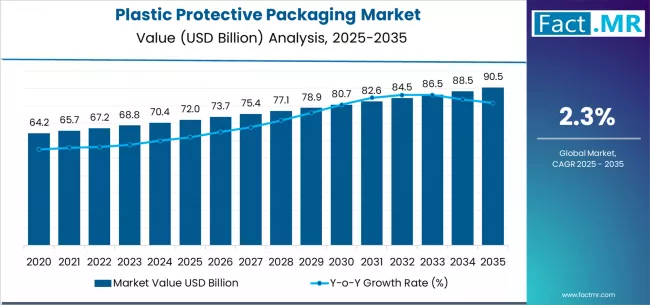
Plastic Protective Packaging Market Market Value Analysis | Source: Fact.MR
Summary of Plastic Protective Packaging Market
- Market Overview
- The plastic protective packaging market is valued at USD 72.00 billion in 2025 and is projected to reach USD 92.46 billion by 2036.
- The industry is expected to grow at a 2.3% CAGR from 2026 to 2036, creating an incremental opportunity of USD 18.80 billion.
- The market functions as a logistics cost optimization category where transit damage reduction economics, e-commerce return rate targets, and automated fulfillment line compatibility requirements determine material format selection and supplier qualification across distribution networks.
- Demand and Growth Drivers
- Demand is rising as e-commerce fulfillment volumes expand globally and major marketplace platforms mandate documented protective packaging performance testing as a vendor packaging approval prerequisite.
- Transit damage reduction economics are driving material format upgrades as fulfillment center operations managers demonstrate that protective packaging cost premiums are recovered through damage claim reduction within single-quarter payback windows.
- Automated fulfillment line compatibility requirements are accelerating the migration from manual cushioning materials to machine-dispensed air cushion and foam-in-place systems that eliminate dimensional variability in protective packaging application.
- Among tracked countries, USA leads at 3% CAGR, followed by Mexico at 2.8%, Germany at 2.3%, France at 2.2%, UK at 2.1%, South Korea at 2%, and Japan at 1.9%.
- Product and Segment View
- Plastic protective packaging includes polymer-based cushioning, void-fill, and surface protection materials designed to prevent transit damage during shipping, warehousing, and handling operations.
- Primary product formats include bubble wrap and air cushion systems, foam-in-place dispensing solutions, and corrugated plastic sheets used across e-commerce, industrial, and consumer goods logistics.
- Bubble and Air Cushions leads by product with 38% share in 2026, reflecting the format compatibility with automated fulfillment line dispensing systems and the favorable material-to-protection-volume ratio.
- E-commerce Packaging leads by end use with 46% share in 2026, driven by expanding online retail fulfillment volumes and marketplace platform packaging performance mandates.
- Scope includes bubble wrap, air cushion systems, foam-in-place solutions, and corrugated plastic protective formats across LDPE/LLDPE, PET/PVC, and recycled polymer materials, excluding paper-based protective packaging, wooden crating, and metal transit containers.
- Geography and Competitive Outlook
- USA and Mexico are the fastest-growing markets at 3.0% and 2.8% CAGR respectively, supported by sustained e-commerce fulfillment expansion and cross-border logistics infrastructure investment accelerating protective packaging specification adoption.
- Germany and France represent mature, sustainability-driven demand bases where European packaging waste reduction regulations force protective packaging material reformulation toward recycled polymer content and design-for-recyclability compliance.
- Competition is shaped by automated dispensing system integration, recycled content capability, and e-commerce fulfillment line compatibility, with Sealed Air Corporation, Pregis LLC, Storopack Hans Reichenecker GmbH, Berry Global Group Inc., Amcor plc, Mondi Group plc, DS Smith plc among the tracked participants.
- Analyst Opinion at Fact.MR
- Shambhu Nath Jha , Principal Consultant for Chemicals, opines: 'In my analysis, I have observed that the critical constraint in protective packaging procurement is not material unit cost but damage claim economics. Fulfillment center operators attempting to reduce packaging material expenditure by downgrading protective formats face transit damage claim increases that exceed the material savings within a single shipping quarter. Distribution network planners who continue manual cushioning material application processes will find their per-unit packing labor costs uncompetitive against automated air cushion and foam-in-place dispensing systems that competitors deploy. Investing in automated protective packaging integration now determines fulfillment cost competitiveness for the next three to five peak shipping seasons.'
- Strategic Implications / Executive Takeaways
- Fulfillment center operators must invest in automated air cushion and foam-in-place dispensing systems to eliminate the per-unit packing labor cost disadvantage that manual cushioning material application creates against competitors with automated lines.
- Protective packaging manufacturers should develop recycled polymer content capability to meet the European packaging waste reduction regulations that force material reformulation across e-commerce and industrial distribution supply chains.
- Distribution network planners must implement documented protective packaging performance testing protocols to satisfy the marketplace platform vendor approval requirements that gate access to high-volume e-commerce fulfillment contracts.
Plastic Protective Packaging Market Key Takeaways
| Metric | Details |
|---|---|
| Industry Size (2026) | USD 73.66 billion |
| Industry Value (2036) | USD 92.46 billion |
| CAGR (2026 to 2036) | 2.3% |
Source: Fact.MR analysis. Updated Mar 31, 2026
E-commerce return rate reduction programs now mandate documented protective packaging performance testing data as a prerequisite for vendor packaging approval across major marketplace platforms. Distribution center engineers evaluating void-fill material alternatives reject options that fail standardized drop-test and vibration-test protocols calibrated to actual parcel carrier handling conditions. Industrial shipping operations managing high-value component logistics specify custom foam-in-place protection systems that eliminate the dimensional variability inherent in manual cushioning material application processes.
Consumption growth rates track e-commerce penetration expansion and industrial logistics modernization across national markets. USA leads with a 3.0% CAGR, supported by sustained e-commerce fulfillment volume growth and parcel carrier damage reduction mandates. Mexico follows at 2.8% as cross-border e-commerce logistics infrastructure investment accelerates protective packaging specification adoption. Germany registers 2.3% growth tied to European sustainability-compliant protective packaging reformulation requirements. France advances at 2.2%, driven by expanding e-commerce distribution network capacity. UK tracks at 2.1% reflecting steady online retail fulfillment growth. South Korea maintains 2.0% growth supported by its advanced e-commerce logistics ecosystem. Japan records 1.9% expansion anchored by precision industrial component shipping requirements.
Why is the Plastic Protective Packaging Market Growing?
Market expansion is being supported by the increasing global e-commerce growth and logistics expansion driven by digital commerce adoption and consumer convenience demands, alongside the corresponding demand for advanced protective packaging materials that can enhance product safety, enable efficient shipping operations, and maintain product integrity across various e-commerce platforms, industrial facilities, consumer goods packaging, and logistics operations. Modern packaging engineers and logistics managers are increasingly focused on implementing protective packaging solutions that can improve shipping performance, enhance product protection, and provide reliable packaging performance in demanding logistics environments.
The growing emphasis on sustainable packaging and circular economy principles is driving demand for plastic protective packaging that can support recyclability features, enable material efficiency optimization, and ensure comprehensive environmental effectiveness. Packaging industry manufacturers' preference for innovative materials that combine protection excellence with sustainability credentials and cost-effectiveness is creating opportunities for advanced protective packaging implementations. The rising influence of automation and smart packaging technologies is also contributing to increased adoption of plastic protective packaging that can provide superior protection performance without compromising operational efficiency or environmental responsibility.
Segmental Analysis
The market is segmented by product, end use, and material. By product, the market is divided into bubble & air cushions, foam-in-place, and corrugated plastic/sheets. Based on end use, the market is categorized into e-commerce packaging, industrial, and consumer goods. By material, the market is split between LDPE/LLDPE films, PET/PVC sheets, and recycled polymers.
By Product, the Bubble & Air Cushions Segment Leads the Market
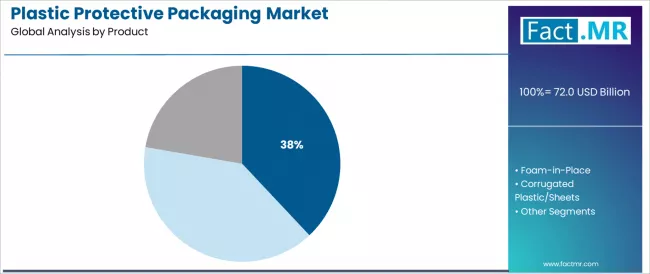
Plastic Protective Packaging Market Analysis By Product | Source: Fact.MR
The bubble & air cushions product segment is projected to maintain its leading position in the plastic protective packaging market in 2025 with a 38.0% market share, reaffirming its role as the preferred protective material for lightweight packaging applications and comprehensive product protection.
Packaging engineers and logistics operators increasingly utilize bubble & air cushions for their superior cushioning properties, excellent cost-effectiveness, and proven performance in various shipping applications while maintaining packaging efficiency and protection reliability.
Bubble & air cushion technology's established performance and application versatility directly address the packaging industry requirements for reliable product protection and consistent shipping outcomes across diverse product categories and logistics applications.
This product segment forms the foundation of modern protective packaging systems, as it represents the packaging technology with the greatest contribution to lightweight protection and established performance record across multiple shipping applications and logistics protocols.
Packaging industry investments in protective materials continue to strengthen adoption among engineers and operators. With increasing demand for cost-effective packaging solutions and reliable product protection materials, bubble & air cushions align with both performance objectives and economic requirements, making them the central component of comprehensive protective packaging strategies.
By End Use, the E-commerce Packaging Segment Dominates Market Demand
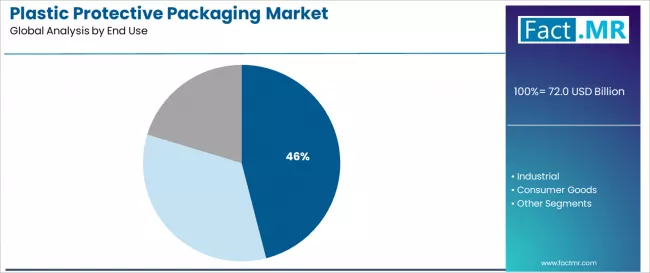
Plastic Protective Packaging Market Analysis By End Use | Source: Fact.MR
The e-commerce packaging end use segment is projected to represent the largest share of plastic protective packaging demand in 2025 with a 46.0% market share, underscoring its critical role as the primary application for protective packaging adoption across online retail platforms, fulfillment centers, and direct-to-consumer shipping operations.
E-commerce operators prefer protective packaging applications due to their comprehensive shipping requirements, varied product protection needs, and ability to support diverse packaging applications while maintaining customer satisfaction and logistics efficiency objectives.
Positioned as essential materials for modern e-commerce operations, plastic protective packaging offers both shipping advantages and cost benefits. The segment is supported by continuous innovation in e-commerce technology and the growing availability of automated packaging systems that enable superior shipping performance with enhanced protection features and improved packaging efficiency characteristics.
E-commerce companies are investing in comprehensive packaging programs to support increasingly demanding customer expectations and shipping requirements for reliable and efficient product protection. As e-commerce growth advances and packaging complexity requirements increase, the e-commerce packaging segment will continue to dominate the market while supporting advanced protective packaging utilization and logistics optimization strategies.
By Material, the LDPE/LLDPE Films Segment Commands Market Leadership
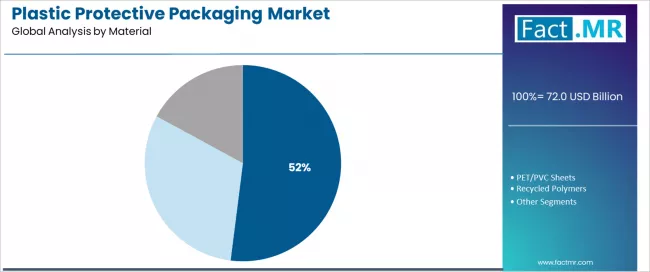
Plastic Protective Packaging Market Analysis By Material | Source: Fact.MR
The LDPE/LLDPE films material segment is projected to maintain the largest share of plastic protective packaging production in 2025 with a 52.0% market share, highlighting its fundamental role in flexible packaging applications, material efficiency optimization, and cost-effective protection solutions.
Packaging manufacturers prefer LDPE/LLDPE materials for their comprehensive processing benefits, excellent barrier properties, and proven effectiveness in various protective applications with superior flexibility performance and reliable material characteristics. This segment represents the backbone of plastic protective packaging across multiple packaging applications and material processing environments.
The LDPE/LLDPE films segment benefits from ongoing technological advancement in polymer processing and the expanding adoption of flexible packaging technologies in protective packaging applications.
Material demand continues to grow due to increasing manufacturer preference for versatile packaging materials, rising cost efficiency requirements, and the need for materials that can support diverse applications while maintaining protection effectiveness and processing reliability.
As packaging becomes more sophisticated and efficiency requirements increase, the LDPE/LLDPE films segment will continue to drive market growth while supporting advanced protective packaging production and material optimization strategies.
What are the Drivers, Restraints, and Key Trends of the Plastic Protective Packaging Market?
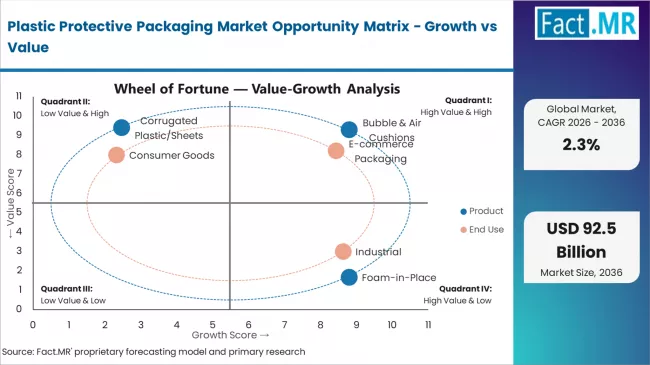
Plastic Protective Packaging Market Opportunity Matrix Growth Vs Value | Source: Fact.MR
The plastic protective packaging market is advancing steadily due to increasing e-commerce growth and logistics expansion driven by digital commerce adoption and supply chain modernization, growing adoption of automated packaging technologies that require specialized materials providing enhanced protection and efficiency capabilities across diverse e-commerce platforms, industrial facilities, consumer goods packaging, and logistics operations.
However, the market faces challenges, including environmental concerns and plastic waste regulations, pressure for sustainable packaging alternatives and biodegradable materials, and competition from paper-based protection systems and reusable packaging solutions. Innovation in recycling technologies and sustainable materials continues to influence product development and market expansion patterns.
Expansion of E-commerce and Direct-to-Consumer Shipping
The growing development of e-commerce platforms is driving demand for advanced protective packaging that addresses varied shipping requirements including product protection diversity, packaging automation compatibility, and comprehensive logistics efficiency in online retail and direct-to-consumer shipping settings.
E-commerce applications require advanced plastic protective packaging that delivers superior protection across multiple product categories while maintaining packaging efficiency and cost-effectiveness standards.
Logistics companies are increasingly recognizing the competitive advantages of specialized protective packaging integration for customer satisfaction and shipping optimization, creating opportunities for innovative packaging materials specifically designed for next-generation e-commerce fulfillment and automated packaging applications.
Integration of Sustainability and Circular Economy Principles
Modern packaging companies are incorporating sustainability initiatives and circular economy technologies to enhance environmental performance, address regulatory requirements, and support comprehensive environmental objectives through optimized material usage and intelligent recycling systems.
Leading companies are developing sustainable packaging platforms, implementing recycling integration systems, and advancing biodegradable technologies that maximize environmental effectiveness while supporting circular economy approaches.
These technologies improve environmental outcomes while enabling new market opportunities, including sustainable packaging applications, recycling optimization methods, and biodegradable protection systems.
Development of Advanced Materials and Smart Packaging Technologies
The expansion of advanced polymer methods, smart packaging technologies, and intelligent protection systems is driving demand for plastic protective packaging with enhanced performance capabilities and specialized functionality characteristics.
These advanced applications require specialized packaging platforms with precise protection control and exceptional material reliability that exceed traditional packaging requirements, creating premium market segments with differentiated protection propositions.
Manufacturers are investing in advanced materials capabilities and smart packaging system development to serve emerging high-performance applications while supporting innovation in advanced logistics packaging and intelligent protection sectors.
Analysis of the Plastic Protective Packaging Market by Key Countries
.webp "Top Country Growth Comparison Plastic Protective Packaging Market Cagr (2026 2036)")
Top Country Growth Comparison Plastic Protective Packaging Market Cagr (2026 2036) | Source: Fact.MR
| Country | CAGR (2026-2036) |
|---|---|
| USA | 3.0% |
| Mexico | 2.8% |
| Germany | 2.3% |
| France | 2.2% |
| UK | 2.1% |
| South Korea | 2.0% |
| Japan | 1.9% |
Source: Fact.MR analysis. Updated Mar 31, 2026
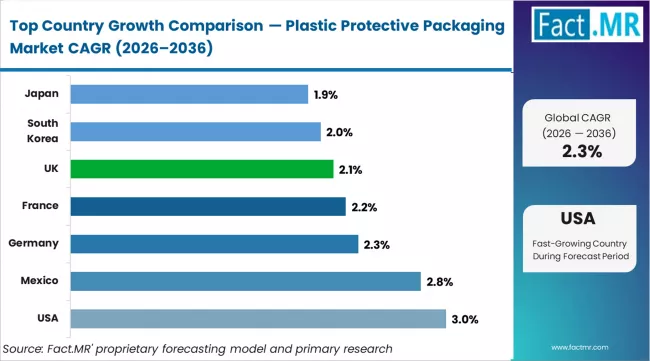
Plastic Protective Packaging Market Cagr Analysis By Country | Source: Fact.MR
The plastic protective packaging market is experiencing moderate growth globally, with the USA leading at a 3.0% CAGR through 2036, driven by expanding e-commerce infrastructure and growing logistics automation, alongside increasing investment in packaging technologies and sustainable protection solutions.
Mexico follows at 2.8%, supported by manufacturing expansion programs, growing packaging sector, and increasing demand for advanced protective materials in domestic and export markets.
Germany shows growth at 2.3%, emphasizing packaging technology innovation, sustainability excellence, and advanced material development. France demonstrates 2.2% growth, supported by packaging system advancement and logistics technology adoption. The UK records 2.1%, focusing on packaging innovation and sustainability technology development.
South Korea exhibits 2.0% growth, emphasizing packaging modernization and logistics technology applications. Japan shows 1.9% growth, emphasizing quality standards and specialized packaging applications.
USA Leads Global Market Growth with E-commerce Infrastructure and Packaging Innovation
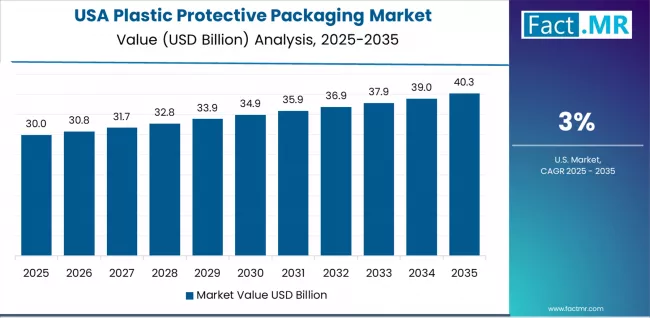
Plastic Protective Packaging Market Country Value Analysis | Source: Fact.MR
Revenue from plastic protective packaging in the USA is projected to exhibit moderate growth with a CAGR of 3.0% through 2036, driven by expanding e-commerce infrastructure and rapidly growing online retail sector supported by digital commerce expansion and advanced packaging technology adoption. The country's substantial e-commerce industry and increasing investment in logistics technologies are creating substantial demand for protective packaging solutions. Major e-commerce companies and packaging manufacturers are establishing comprehensive protective packaging capabilities to serve both domestic markets and export opportunities.
- Strong e-commerce expansion and growing logistics automation are driving demand for plastic protective packaging throughout major logistics regions including California, Texas, and the E-commerce Belt corridors, supporting both fulfillment centers and distribution facilities.
- Growing consumer expectations and shipping efficiency requirements are supporting the rapid adoption of protective packaging technologies among logistics operators seeking enhanced protection capabilities and packaging performance excellence in competitive e-commerce markets.
Mexico Demonstrates Packaging Integration with Manufacturing Development
Revenue from plastic protective packaging in Mexico is expanding at a CAGR of 2.8%, supported by manufacturing expansion initiatives, growing packaging sector, and strategic position as a packaging production hub for North American markets. Mexico's manufacturing development and packaging technology advancement are driving protective packaging capabilities throughout industrial sectors. Leading packaging manufacturers and logistics companies are establishing extensive production capabilities to address growing domestic packaging and export market demand.
- Manufacturing expansion and growing packaging activities are creating opportunities for protective packaging adoption across industrial facilities, packaging plants, and production centers in major manufacturing regions including Bajio and packaging development zones.
- Growing packaging sector and manufacturing technology expansion are supporting the adoption of advanced protective materials among manufacturers seeking to serve both domestic and international markets while maintaining packaging standards and production effectiveness.
Germany Demonstrates Packaging Technology Excellence with Sustainability Innovation
Revenue from plastic protective packaging in Germany is expanding at a CAGR of 2.3%, driven by the country's packaging technology leadership, sustainability innovation capabilities, and precision manufacturing excellence supporting high-performance protective packaging applications. Germany's packaging expertise and sustainability innovation are driving demand for specialized protective packaging solutions throughout packaging sectors. Leading packaging manufacturers and logistics providers are establishing comprehensive innovation programs for next-generation packaging technologies.
- Advanced packaging technology development and sustainability innovation requirements are creating demand for specialized protective packaging among manufacturers and logistics companies seeking enhanced protection performance and environmental reliability in competitive European markets.
- Strong packaging industry expertise and sustainability technology leadership are supporting the adoption of advanced protective packaging technologies and logistics optimization across packaging facilities throughout major industrial regions including North Rhine-Westphalia and Bavaria.
France Shows Packaging Excellence and Sustainability Technology Innovation Leadership
Revenue from plastic protective packaging in France is expanding at a CAGR of 2.2%, supported by the country's packaging system excellence, sustainability technology innovation leadership, and pioneering logistics advancement initiatives including circular economy development and advanced packaging manufacturing. France's packaging heritage and sustainability expertise are supporting investment in advanced protective packaging technologies. Major packaging providers and logistics companies are establishing comprehensive packaging programs incorporating protective packaging advancement and sustainability innovation.
- Advanced packaging innovation and sustainability technology capabilities are creating demand for premium protective packaging products supporting packaging excellence, logistics advancement, and environmental optimization throughout major packaging and sustainability technology regions.
- Strong packaging focus and sustainability technology leadership are driving the adoption of advanced protective materials and packaging enhancement throughout logistics facilities across packaging excellence clusters and innovation zones.
UK Focuses on Packaging Innovation and Sustainability Technology Development
Revenue from plastic protective packaging in the UK is growing at a CAGR of 2.1%, driven by the country's packaging innovation, sustainability technology development initiatives, and emphasis on advanced protection solutions for e-commerce and logistics applications. The UK's packaging research excellence and sustainability commitments are supporting investment in advanced protective packaging technologies. Major packaging providers and logistics companies are establishing comprehensive packaging programs incorporating advanced protective packaging formulations.
- Packaging innovation and sustainability development requirements are creating demand for high-performance protective packaging supporting logistics advancement, packaging innovation, and environmental optimization throughout major packaging and sustainability technology regions.
- Strong research capabilities and packaging mandates are driving the adoption of advanced protective materials and packaging enhancement supporting superior logistics performance and packaging leadership in competitive global markets.
South Korea Demonstrates Packaging Leadership with Logistics Technology Focus
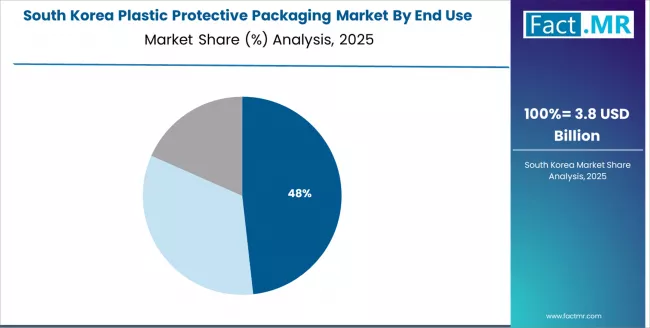
Plastic Protective Packaging Market South Korea Market Share Analysis By End Use | Source: Fact.MR
Revenue from plastic protective packaging in South Korea is expanding at a CAGR of 2.0%, supported by the country's packaging modernization, logistics technology expertise, and strong emphasis on advanced protection solutions for comprehensive e-commerce and logistics applications. South Korea's packaging sophistication and logistics innovation focus are driving protective packaging capabilities throughout e-commerce sectors. Leading packaging providers and logistics companies are investing extensively in advanced packaging technologies.
- Advanced packaging development and logistics technology innovation are creating demand for specialized protective packaging products throughout e-commerce applications, logistics systems, and packaging facilities in major logistics regions including Seoul Capital Area and e-commerce innovation zones.
- Strong packaging industry and logistics expertise are supporting the adoption of innovative protective materials and packaging optimization for next-generation applications requiring superior protection performance and logistics excellence.
Japan Shows Quality Excellence Focus with Specialized Packaging Applications
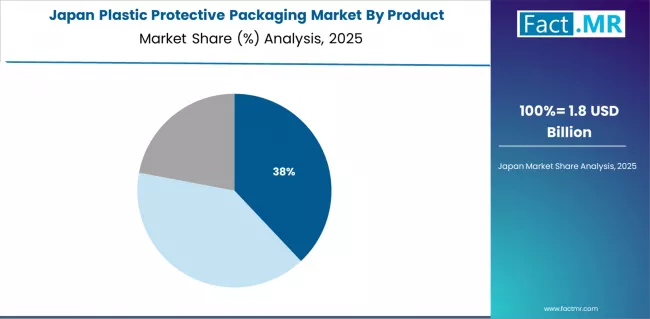
Plastic Protective Packaging Market Japan Market Share Analysis By Product | Source: Fact.MR
Revenue from plastic protective packaging in Japan is expanding at a CAGR of 1.9%, supported by the country's quality excellence standards, specialized packaging capabilities, and strong emphasis on high-specification protective materials for advanced logistics and packaging sectors. Japan's quality sophistication and packaging excellence are driving demand for premium protective packaging products. Leading packaging providers and logistics companies are investing in specialized capabilities for advanced packaging applications.
- Advanced packaging processing and quality manufacturing requirements are creating opportunities for high-quality protective packaging products throughout specialized logistics production, packaging manufacturing, and protection applications meeting stringent quality and performance standards.
- Strong packaging industry and logistics sector are driving adoption of specialized protective packaging systems and advanced material technologies supporting innovation in logistics packaging, packaging advancement, and protection sectors requiring superior packaging performance and consistency.
Europe Market Split by Country
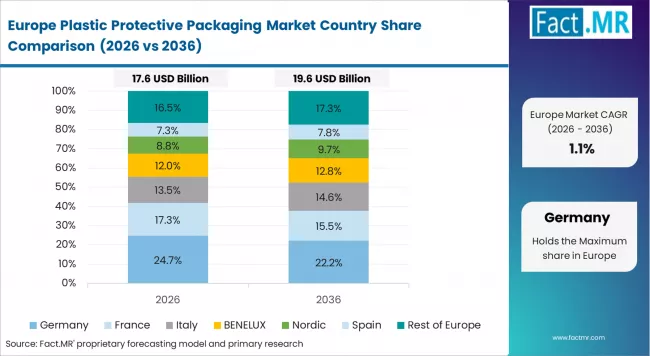
Plastic Protective Packaging Market Europe Country Market Share Analysis, 2026 & 2036 | Source: Fact.MR
The plastic protective packaging market in Europe is projected to grow from USD 20.2 billion in 2026 to USD 24.8 billion by 2036, registering a CAGR of 2.1% over the forecast period. Germany is expected to maintain its leadership position with a 32.2% market share in 2026, declining slightly to 31.7% by 2036, supported by its advanced packaging industry and strong logistics infrastructure capabilities.
France follows with a 21.8% share in 2026, projected to reach 22.1% by 2036, driven by comprehensive packaging development and logistics technology industry applications. The United Kingdom holds a 18.3% share in 2026, expected to decrease to 17.9% by 2036 due to market diversification. Italy commands a 15.4% share, while Spain accounts for 8.9% in 2026. The Rest of Europe region is anticipated to gain momentum, expanding its collective share from 3.4% to 3.9% by 2036, attributed to increasing e-commerce adoption in Nordic countries and emerging Eastern European logistics markets implementing advanced packaging technologies.
Bubble & Air Cushion Applications Dominate Packaging Systems in Japan
The Japanese plastic protective packaging market demonstrates a mature and quality-focused landscape, characterized by advanced integration of bubble & air cushion technologies with existing logistics infrastructure across e-commerce facilities, packaging networks, and distribution operations.
Japan's emphasis on quality excellence and packaging precision drives demand for high-reliability protective packaging solutions that support comprehensive logistics initiatives and regulatory requirements in shipping operations.
The market benefits from strong partnerships between international packaging providers like Sealed Air, Pregis, and domestic logistics leaders, including established e-commerce companies and packaging specialists, creating comprehensive service ecosystems that prioritize packaging quality and protection precision programs.
E-commerce Packaging Applications Lead Logistics Services in South Korea
The South Korean plastic protective packaging market is characterized by strong international logistics application presence, with companies like Storopack, Berry Global, and Amcor maintaining dominant positions through comprehensive system integration and packaging services capabilities for e-commerce modernization and logistics applications.
The market is demonstrating a growing emphasis on localized packaging support and rapid deployment capabilities, as Korean e-commerce operators increasingly demand customized solutions that integrate with domestic logistics infrastructure and advanced packaging systems deployed across major fulfillment centers and distribution facilities.
Local packaging companies and regional logistics integrators are gaining market share through strategic partnerships with global providers, offering specialized services including technical training programs and certification services for packaging specialists.
Competitive Landscape of the Plastic Protective Packaging Market
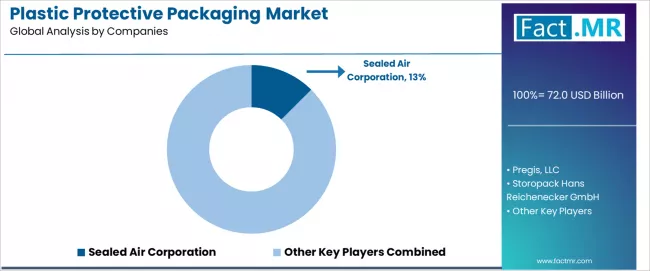
Plastic Protective Packaging Market Analysis By Company | Source: Fact.MR
The plastic protective packaging market is characterized by competition among established packaging manufacturers, specialized protective material producers, and diversified packaging technology companies. Companies are investing in advanced packaging material development, sustainability integration innovation, product portfolio expansion, and application-specific protection development to deliver high-performance, cost-effective, and environmentally responsible protective packaging solutions.
Innovation in sustainable materials advancement, automation integration development, and intelligent packaging systems is central to strengthening market position and competitive advantage.
Sealed Air leads the market with a 13.0% share, offering comprehensive protective packaging solutions with a focus on e-commerce applications, advanced packaging technologies, and integrated logistics platforms across diverse e-commerce, industrial, and consumer goods distribution channels.
The company has announced major sustainability initiatives and investments in circular economy integration to support growing global demand for advanced protective packaging and environmentally responsible packaging solutions.
Pregis provides innovative packaging solutions with emphasis on automation excellence and protective material technologies, while Storopack delivers specialized packaging products with focus on custom protection and logistics applications. Berry Global offers comprehensive packaging solutions with protective packaging offerings for multiple market categories, and Amcor provides advanced packaging technologies with emphasis on sustainable materials and packaging optimization.
Mondi specializes in sustainable packaging solutions with advanced protective technologies, while other key players including DS Smith, Hoffmann Neopac, and Winpak contribute to market competition through specialized packaging capabilities and protective material expertise.
Plastic Protective Packaging Market - Stakeholder Contribution Framework
Plastic protective packaging represents a specialized packaging material segment within logistics and e-commerce applications, projected to grow from USD 72.0 billion in 2025 to USD 90.5 billion by 2035 at a 2.3% CAGR. These packaging material products—primarily bubble & air cushions, foam-in-place, and corrugated plastic configurations for multiple applications—serve as critical protection components in e-commerce platforms, industrial facilities, consumer goods packaging, and logistics operations where product protection, shipping safety, and packaging effectiveness are essential. Market expansion is driven by increasing e-commerce growth, growing logistics automation, expanding sustainability requirements, and rising demand for advanced protective solutions across diverse e-commerce, industrial, consumer goods, and logistics sectors.
How Packaging Regulators Could Strengthen Material Standards and Environmental Safety?
- Packaging Material Standards: Establish comprehensive technical specifications for plastic protective packaging, including safety requirements, performance standards, sustainability validation protocols, and quality guidelines that ensure consistent performance across e-commerce platforms, industrial facilities, consumer goods packaging, and logistics operations.
- Environmental Safety Integration: Develop regulatory frameworks that incentivize advanced packaging practices, requiring manufacturers to implement quality management systems, utilize sustainability validation protocols, incorporate environmental protection procedures, and achieve measurable sustainability improvements in protective packaging development.
- Quality Assurance Requirements: Implement mandatory quality control standards for protective packaging manufacturing, including performance testing protocols, safety verification measures, and sustainability validation systems that ensure material effectiveness and environmental safety across diverse packaging applications.
- Sustainable Grade Guidelines: Create specialized regulations for sustainable-grade protective packaging used in e-commerce applications, addressing stringent environmental specifications, recyclability requirements, and regulatory validation specific to packaging applications requiring enhanced sustainability and environmental protection.
- Innovation Support Programs: Provide regulatory facilitation and research incentives for development of next-generation packaging technologies that improve environmental outcomes, enhance safety, and enable emerging applications in sustainable packaging and circular economy systems.
How Industry Associations Could Advance Packaging Technology Standards and Market Development?
- Packaging Best Practices: Develop comprehensive technical guidelines for protective packaging selection, logistics optimization, and sustainability validation techniques that maximize protection effectiveness, ensure safety, and maintain cost-effectiveness across e-commerce platforms, industrial facilities, and packaging applications.
- Environmental Safety Benchmarking: Establish industry-wide metrics for packaging performance, including protection efficacy assessment, safety measurement, environmental outcome evaluation, and application documentation that enable comparative analysis and drive continuous improvement toward packaging optimization objectives.
- Professional Training Programs: Create specialized education initiatives for packaging engineers, logistics technicians, and sustainability professionals covering protective packaging characteristics, packaging applications, safety requirements, and protection techniques across diverse logistics applications.
- Packaging Standardization: Develop standardized testing methodologies for protective packaging evaluation, including performance assessment, safety analysis, sustainability validation, and application-specific performance metrics that facilitate objective material comparison and packaging validation.
- Logistics Collaboration: Facilitate partnerships between protective packaging suppliers, logistics companies, research institutions, and sustainability organizations to advance packaging technology development, address emerging environmental challenges, and accelerate innovation in packaging applications.
How Plastic Protective Packaging Manufacturers Could Drive Innovation and Market Leadership?
- Advanced Packaging Technologies: Invest in material enhancement, sustainability optimization, automation integration development, and environmental safety improvement initiatives that enhance packaging effectiveness while maintaining protection reliability and regulatory compliance in global markets.
- Specialized Material Development: Develop specialized protective packaging with enhanced sustainability characteristics, including optimized recyclability performance, improved environmental integration, increased packaging efficiency, and application-specific performance attributes for emerging logistics segments.
- Packaging Quality Integration: Implement intelligent quality control systems with real-time packaging monitoring, predictive safety assessment, automated sustainability verification, and data analytics that optimize material performance, ensure packaging reliability, and reduce environmental complexity.
- Logistics Support Services: Establish comprehensive customer service capabilities providing technical consultation, installation assistance, packaging troubleshooting, and application expertise that strengthen customer relationships and enable successful logistics implementation.
- Global Packaging Excellence: Develop regional service networks, specialized technical support management, reliable supply systems, and responsive customer service that ensure consistent material availability, maintain packaging quality, and support customer logistics requirements worldwide.
How End-User Industries Could Optimize Packaging Performance and Logistics Success?
- Strategic Material Selection: Conduct comprehensive assessments of packaging requirements, logistics needs, regulatory constraints, and operational considerations to optimize protective packaging selection and achieve desired protection characteristics while managing total logistics costs and performance outcomes.
- Packaging System Optimization: Implement advanced logistics methodologies utilizing packaging validation, performance evaluation, and systematic assessment to maximize protective packaging benefits, minimize logistics complexity, and optimize overall packaging effectiveness and logistics satisfaction.
- Logistics Safety Management: Develop optimized packaging protocols, safety control procedures, and performance validation that ensure effective protective packaging utilization, maximize protection benefits, and maintain consistent logistics performance throughout operations.
- Quality Packaging Integration: Incorporate packaging best practices, logistics safety principles, and quality considerations into logistics planning and packaging processes that support comprehensive logistics objectives and packaging excellence.
- Strategic Packaging Partnerships: Establish strategic partnerships with protective packaging suppliers for joint logistics programs, packaging optimization initiatives, and co-innovation projects that address specific logistics challenges and accelerate packaging technology commercialization.
How Research Institutions Could Enable Packaging Technology Advancement?
- Packaging Research Programs: Conduct fundamental investigations into protective packaging technology, material mechanisms, logistics optimization, and sustainability applications that advance packaging understanding and enable breakthrough innovations in packaging technology and logistics science.
- Packaging Technology Development: Develop novel logistics methods, including advanced packaging techniques, sustainability approaches, and packaging enhancement technologies that improve logistics performance while maintaining safety and cost effectiveness.
- Logistics Application Innovation: Investigate emerging applications for protective packaging in sustainable logistics, automation integration, advanced e-commerce, and specialized packaging applications that create new market opportunities and expand packaging potential.
- Packaging Validation Services: Provide advanced packaging research services utilizing logistics validation, material testing, performance assessment, and application evaluation methodologies that enable detailed understanding of protective packaging properties and logistics applications.
- Packaging Technology Transfer: Facilitate technology commercialization through licensing agreements, startup incubation programs, packaging publications, and collaborative research projects that accelerate packaging innovation adoption and strengthen industry-academia partnerships.
How Investors and Financial Enablers Could Support Packaging Technology Market Growth?
- Packaging Infrastructure Investment: Provide capital for protective packaging manufacturing facility construction, production capacity expansion, and technology upgrade projects that address growing logistics demand while improving operational efficiency and packaging performance.
- Packaging Innovation Financing: Fund research and development of breakthrough protective packaging technologies, including advanced material methods, sustainable packaging systems, and novel logistics applications that address current market limitations and create competitive advantages.
- Packaging Development Support: Finance packaging technology innovation initiatives, logistics validation programs, regulatory development, and packaging advancement that enhance logistics capabilities and position manufacturers for long-term market acceptance and growth.
- Packaging Market Expansion: Support strategic acquisitions, market entry initiatives, distribution network development, and customer packaging service capabilities that accelerate geographic expansion and strengthen competitive positions in high-growth logistics markets.
- Global Packaging Development: Provide financing and technical assistance for protective packaging facilities in developing economies, creating new packaging supply capabilities, supporting local logistics development, and expanding global market access for packaging solutions.
Key Players in the Plastic Protective Packaging Market
- Sealed Air Corporation
- Pregis, LLC
- Storopack Hans Reichenecker GmbH
- Berry Global Group, Inc.
- Amcor plc
- Mondi Group plc
- DS Smith plc
- Hoffmann Neopac AG
- Winpak Ltd.
Bibliography
- 1. International Organization for Standardization. (2024). ISO 2247:2000, Packaging, Complete Filled Transport Packages, Vibration Tests. ISO.
- 2. ASTM International. (2024). ASTM D4169, Standard Practice for Performance Testing of Shipping Containers and Systems. ASTM.
- 3. European Commission, Directorate-General for Environment. (2024). Packaging and Packaging Waste Regulation (PPWR) Implementation Guidance. European Commission.
- 4. International Safe Transit Association. (2024). ISTA 6-Amazon.com SIOC Testing Procedures. ISTA.
- 5. U.S. Environmental Protection Agency. (2024). National Strategy to Prevent Plastic Pollution. EPA.
This bibliography is provided for reader reference. The full Fact.MR report contains the complete reference list with primary research documentation.
This Report Addresses
- Market sizing and quantitative forecast metrics detailing the logistics material expenditure dedicated to plastic protective packaging across e-commerce, industrial, and consumer goods distribution sectors through 2036.
- Segmentation analysis mapping the material format adoption across bubble and air cushion, foam-in-place, and corrugated plastic systems and evaluating the automated dispensing compatibility requirements driving format selection.
- Regional deployment intelligence comparing the e-commerce fulfillment expansion intensity in North America against the sustainability-driven material reformulation requirements across European distribution markets.
- Regulatory compliance assessment analyzing how packaging waste reduction directives, recycled content mandates, and Extended Producer Responsibility schemes force protective packaging material composition changes.
- Competitive posture evaluation tracking the automated dispensing system integration capability and recycled polymer content qualification that define supplier competitiveness across e-commerce fulfillment supply chains.
- Damage economics analysis quantifying the transit claim reduction payback periods that justify protective packaging material investment decisions across different distribution channel configurations.
- Custom data delivery formats encompassing interactive dashboards, raw Excel datasets, and PDF narrative reports.
Plastic Protective Packaging Market Definition
Plastic protective packaging includes polymer-based cushioning, void-fill, and surface protection materials engineered to prevent product damage during shipping, warehousing, and handling operations. Product formats include bubble wrap and air cushion systems, foam-in-place dispensing solutions, and corrugated plastic sheet protectors. These materials are specified by fulfillment center engineers, industrial logistics managers, and distribution network planners based on documented drop-test performance, material-to-protection-volume ratio, and automated dispensing line compatibility.
Plastic Protective Packaging Market Inclusions
Market scope includes bubble wrap, air cushion systems, foam-in-place solutions, and corrugated plastic protective formats across LDPE/LLDPE film, PET/PVC sheet, and recycled polymer material compositions. Coverage spans global and regional market sizes, forecast period 2026 to 2036, segmentation by product, end use, material, and region.
Plastic Protective Packaging Market Exclusions
The scope excludes paper-based protective packaging, wooden crating systems, metal transit containers, and non-plastic void-fill materials. Primary product packaging, branded retail packaging, and non-protective secondary packaging are explicitly omitted from the valuation.
Plastic Protective Packaging Market Research Methodology
- Primary Research: Analysts engaged with e-commerce fulfillment engineering directors, industrial distribution packaging specification managers, and automated packaging line integration specialists to map the performance testing and cost justification parameters governing material format selection.
- Desk Research: Data collection phases aggregated e-commerce packaging performance standard publications, parcel carrier damage claim trend reports, and packaging sustainability regulation implementation schedules across tracked jurisdictions.
- Market-Sizing and Forecasting: Baseline values derive from a bottom-up aggregation of plastic protective packaging material production capacities, applying e-commerce penetration growth rates and industrial shipping volume coefficients to project consumption demand.
- Data Validation and Update Cycle: Projections are tested against publicly reported packaging segment revenue data from producers with documented protective packaging manufacturing and distribution operations.
Segmentation
Scope of the Report
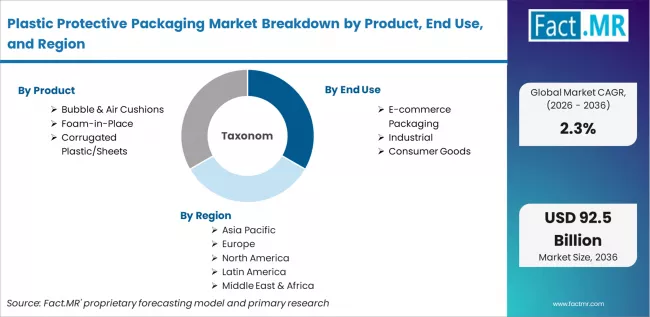
Plastic Protective Packaging Market Breakdown By Product, End Use, And Region | Source: Fact.MR
| Metric | Value |
|---|---|
| Quantitative Units | USD 73.66 billion to USD 92.46 billion, at a CAGR of 2.3% |
| Market Definition | Plastic protective packaging encompasses polymer-based cushioning, void-fill, and surface protection materials engineered to prevent product damage during shipping, warehousing, and handling operations. |
| Product Segmentation | Bubble and Air Cushions, Foam-in-Place, Corrugated Plastic/Sheets |
| End Use Segmentation | E-commerce Packaging, Industrial, Consumer Goods |
| Material Segmentation | LDPE/LLDPE Films, PET/PVC Sheets, Recycled Polymers |
| Regions Covered | North America, Latin America, Europe, East Asia, South Asia, Oceania, Middle East and Africa |
| Countries Covered | USA, Mexico, Germany, France, UK, South Korea, Japan, and 40 plus countries |
| Key Companies Profiled | Sealed Air Corporation, Pregis LLC, Storopack Hans Reichenecker GmbH, Berry Global Group Inc., Amcor plc, Mondi Group plc, DS Smith plc, Hoffmann Neopac AG |
| Forecast Period | 2026 to 2036 |
| Approach | Forecasting models apply a bottom-up methodology starting with global protective packaging material production capacities and projecting e-commerce and industrial shipping consumption intensity factors. |
Source: Fact.MR analysis. Updated Mar 31, 2026
Plastic Protective Packaging Market by Segments
-
Product :
- Bubble & Air Cushions
- Foam-in-Place
- Corrugated Plastic/Sheets
-
End Use :
- E-commerce Packaging
- Industrial
- Consumer Goods
-
Material :
- LDPE/LLDPE Films
- PET/PVC Sheets
- Recycled Polymers
-
Region :
-
North America
- United States
- Canada
- Mexico
-
Europe
- Germany
- United Kingdom
- France
- Italy
- Spain
- Netherlands
- Nordic
- BENELUX
- Rest of Europe
-
Asia Pacific
- China
- Japan
- South Korea
- India
- Australia
- Rest of Asia Pacific
-
Latin America
- Brazil
- Argentina
- Chile
- Rest of Latin America
-
Middle East & Africa
- Kingdom of Saudi Arabia
- Other GCC Countries
- Turkey
- South Africa
- Other African Union
- Rest of Middle East & Africa
-
Frequently Asked Questions
How large is the demand for Plastic Protective Packaging in the global market in 2026?
What will be the market size of Plastic Protective Packaging in the global market by 2036?
What is the expected demand growth for Plastic Protective Packaging in the global market between 2026 and 2036?
Which Product is poised to lead global sales by 2026?
How significant is the role of E-commerce Packaging in driving Plastic Protective Packaging adoption in 2026?
What is the USA growth outlook in this report?
What is Plastic Protective Packaging and what is it mainly used for?
What is included in the scope of this Plastic Protective Packaging Market report?
Who worked on this report


Preview the report firsthand - request a free sample
Free SampleGet the brochure for pricing and purchase details
Download PDF