- Market Value (2025): USD 790.4 Mn
- Estimated Value (2026): USD 842.6 Mn
- Forecast Value (2036): USD 1,596.6 Mn
- CAGR (2026-2036): 6.6%
What is the Acinetobacter Pneumonia Therapeutics Market forecast to be worth by 2036?
USD 842.6 million in 2026 to USD 1,596.6 million by 2036 at 6.6% CAGR.
- The acinetobacter pneumonia therapeutics market reached USD 790.4 million in 2025 as resistant-pathogen care moved toward labeled hospital regimens.
- Demand is projected to increase from USD 842.6 million in 2026 to USD 1,596.6 million by 2036.
- The market is forecast to record 6.6% CAGR from 2026 to 2036 due to protocol-led adoption and reserve antibiotic access work.
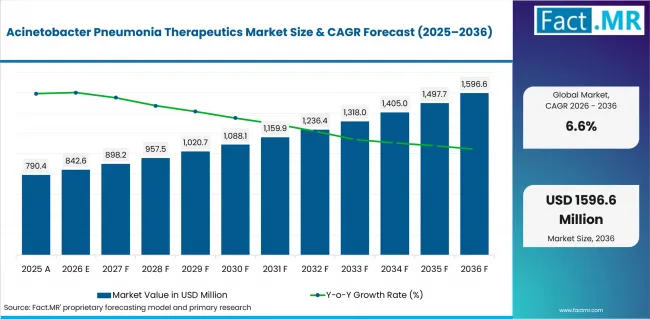
Acinetobacter Pneumonia Therapeutics Market Value Analysis | Source: Fact.MR
What are the defining numbers behind Acinetobacter Pneumonia Therapeutics Market growth?
USD 754.0 million absolute opportunity by 2036.
- Demand Drivers in the Market
- Resistant Acinetobacter cases require therapies that match microbiology evidence before hospital protocols approve wider use.
- ICU care settings are expected to support demand since severe pneumonia treatment depends on IV stock and specialist dosing review.
- Manufacturers need susceptibility guidance so hospital teams can separate eligible patients from broader pneumonia cases.
- Key Segments Analyzed
- By Drug Class: Beta-Lactam Antibiotics are expected to hold 32.0% share in 2026 since beta-lactam backbones anchor recommended CRAB treatment pathways.
- By Application: Hospital-Acquired Pneumonia is projected to account for 38.0% share in 2026 when treatment begins after healthcare exposure and culture confirmation.
- By End User: Hospitals are anticipated to capture 48.0% share in 2026 where protocol review and IV delivery are handled together.
- By Distribution Channel: Hospital Pharmacies are projected to account for 46.0% share in 2026 because restricted stock and protocol-controlled dispensing occur within hospital pharmacy workflows.
- By Route of Administration: Intravenous administration is estimated to represent 54.0% share in 2026 since severe cases need monitored infusion.
- Analyst Opinion at Fact.MR
- Shambhu Nath Jha, Sr. Consultant at Fact.MR, opines: "For Acinetobacter pneumonia, a therapy must fit the treatment pathway after culture confirmation. Hospital adoption depends on an appropriate indication, formulary acceptance and dependable supply for the eligible patient population."
- Strategic Implications
- Hospital teams need a formulary pathway that connects laboratory confirmation with reserve antibiotic stock.
- Suppliers can improve account access by pairing therapy evidence with susceptibility-testing support. Product selection depends on confirmed organism response before pharmacy approval.
- Investors should separate broad anti-infective exposure from hospital-administered CRAB regimens.
Germany is expected to record a 7.6% CAGR from 2026 to 2036 through stewardship-led hospital review. Brazil is projected at 7.0% as procurement and ICU access shape purchasing. The USA is estimated at 6.7%. Canada follows at 6.4%. Australia records 6.1%. The UK reaches 5.6%. Japan records 5.0%.
How does the Acinetobacter Pneumonia Therapeutics Market break down by segment?
Beta-Lactam Antibiotics are expected to lead Drug Class at 32.0% share in 2026. Hospital-Acquired Pneumonia is projected to lead Application at 38.0% share in 2026.
Which Drug Class dominates?
Beta-Lactam Antibiotics are projected to account for 32.0% share in 2026.
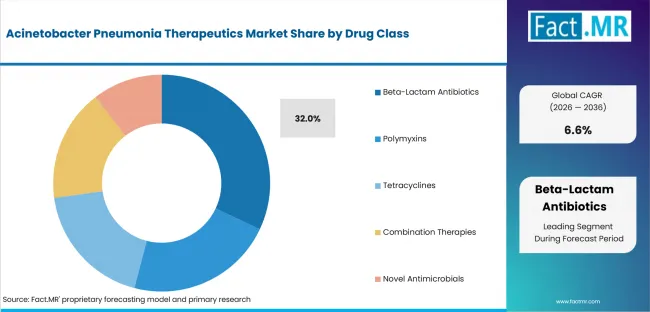
Acinetobacter Pneumonia Therapeutics Market Analysis By Drug Class | Source: Fact.MR
This class leads because hospital protocols need familiar antibiotic backbones. Carbapenems and cephalosporins remain part of review. Polymyxins retain salvage use where safety review is strict.
What leads the Application segment?
Hospital-Acquired Pneumonia is expected to hold 38.0% share in 2026.
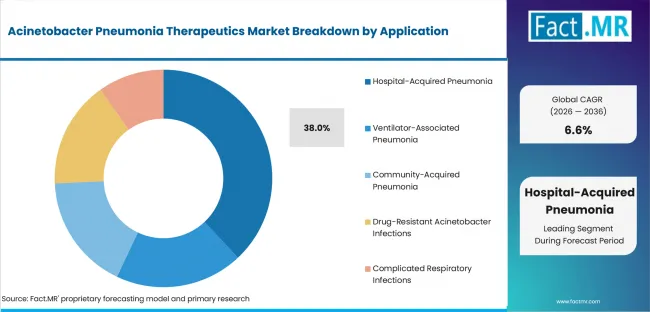
Acinetobacter Pneumonia Therapeutics Market Analysis By Application | Source: Fact.MR
Demand concentrates in hospital-acquired cases since treatment starts after healthcare exposure. The FDA approval pathway confirms why labeled hospital use matters. Ventilator-associated cases remain important when ICU teams need culture-led decisions.
Why do Hospitals lead End User?
Hospitals are anticipated to capture 48.0% share in 2026.
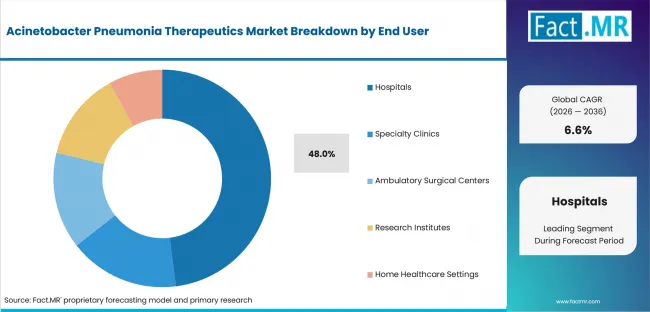
Acinetobacter Pneumonia Therapeutics Market Analysis By End User | Source: Fact.MR
Hospitals control laboratory and pharmacy steps for safe therapy use. Severe cases may require ventilation support before a regimen is continued. Community clinics have less direct influence.
How do Hospital Pharmacies shape Distribution Channel?
Hospital Pharmacies are projected to account for 46.0% share in 2026.
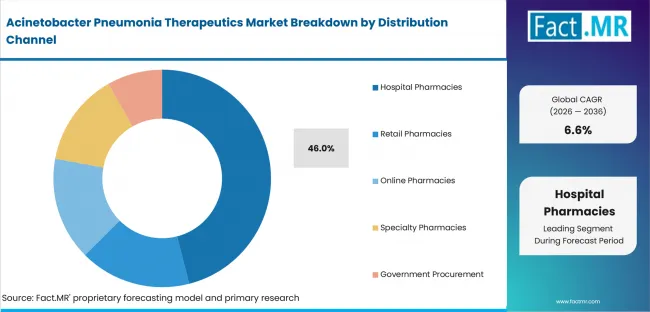
Acinetobacter Pneumonia Therapeutics Market Analysis By Distribution Channel | Source: Fact.MR
These pharmacies manage restricted stock inside approved protocols. Their role matters because therapy cannot become routine unless pharmacy teams can store and release it safely.
What supports Intravenous administration?
Intravenous administration is estimated to hold 54.0% share in 2026.
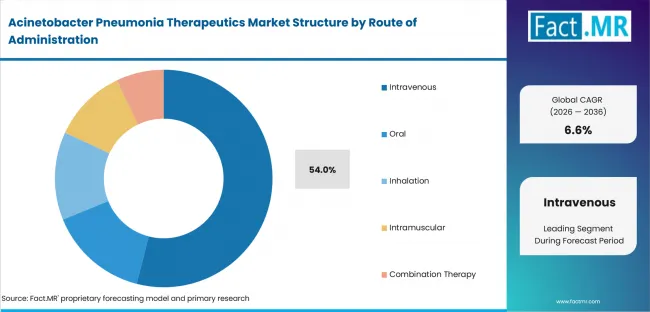
Acinetobacter Pneumonia Therapeutics Market Analysis By Route Of Administration | Source: Fact.MR
Severe Acinetobacter pneumonia requires controlled infusion and monitoring. This route remains central because confirmed resistant cases are usually managed inside hospital care. Oral therapy has a smaller role.
What is accelerating Acinetobacter Pneumonia Therapeutics Market adoption, and what is holding it back?
Demand is expected to rise through hospital treatment of resistant infections. Growth may be limited by narrow patient eligibility and strict antibiotic-use controls.
Drivers Impact Analysis
| DRIVER | RELATIVE IMPACT | GEOGRAPHIC RELEVANCE | IMPACT TIMELINE |
|---|---|---|---|
| Resistant-pathogen treatment pathways | High | Germany, USA | Short term (<= 2 years) |
| Guideline-recognized regimen use | High | USA, UK | Short term (<= 2 years) |
| Hospital microbiology confirmation | Moderate | Germany, Japan | Medium term (2-4 years) |
| ICU intravenous administration | Moderate | Brazil, Australia | Medium term (2-4 years) |
| Formulary and stewardship alignment | Moderate | Canada, UK | Long term (>= 4 years) |
- Resistant-pathogen treatment pathways: Hospitals are expected to use targeted therapies when culture results confirm difficult Gram-negative pneumonia.
- Guideline-recognized regimen use: Clearer clinical pathways are expected to make pharmacy review easier for confirmed CRAB cases.
- Hospital microbiology confirmation: Laboratory identification is expected to decide patient eligibility before reserve therapy is stocked or continued.
Opportunity Impact Analysis
| OPPORTUNITY | RELATIVE IMPACT | GEOGRAPHIC RELEVANCE | IMPACT TIMELINE |
|---|---|---|---|
| Pull-style antibiotic access models | Moderate | UK and Canada | Medium term (2-4 years) |
| Susceptibility-focused hospital support | Moderate | USA and Germany | Short term (<= 2 years) |
| Licensed access partnerships | Moderate | Brazil and South Asia and Pacific | Long term (>= 4 years) |
| Regional stock assurance | Low | Brazil and Australia | Medium term (2-4 years) |
- Pull-style antibiotic access models: Payment designs are expected to narrow the gap between reserve availability and low prescription volume.
- Susceptibility-focused hospital support: Suppliers that help hospitals interpret eligible use are expected to gain better formulary access.
- Licensed access partnerships: Broader manufacturing routes are expected to improve supply confidence in markets with procurement limits.
Restraints Impact Analysis
| RESTRAINT | RELATIVE IMPACT | GEOGRAPHIC RELEVANCE | IMPACT TIMELINE |
|---|---|---|---|
| Narrow eligible patient pool | High | Global | Short term (<= 2 years) |
| Susceptibility testing delays | Moderate | Brazil and selected hospitals | Short term (<= 2 years) |
| IV monitoring burden | Moderate | Hospitals | Medium term (2-4 years) |
| Stewardship-restricted use | Low | Mature hospital systems | Long term (>= 4 years) |
- Narrow eligible patient pool: Appropriate use is expected to remain limited to confirmed or strongly suspected resistant infections.
- Susceptibility testing delays: Slow lab turnaround can delay treatment decisions and weaken the case for routine stock expansion.
- IV monitoring burden: Infusion staffing and renal-safety review are expected to raise the operating load for smaller hospitals.
Which countries are scaling Acinetobacter Pneumonia Therapeutics Market fastest?
- Germany leads through stewardship-focused hospitals and dependable reserve antibiotic supply. Brazil follows as public procurement and ICU demand increase access-planning needs.
- The USA grows through microbiology review and pharmacy committee approval. Canada and Australia hold middle positions through hospital access programs, tertiary care demand and specialist oversight.
- The UK and Japan remain cautious because national review and reimbursement controls limit wider uptake. Market entry depends on protocol evidence, stocking confidence and approval speed.
The full report provides country-level CAGR analysis across North America, Latin America, Western Europe, Eastern Europe, East Asia, South Asia and Pacific, and Middle East & Africa.
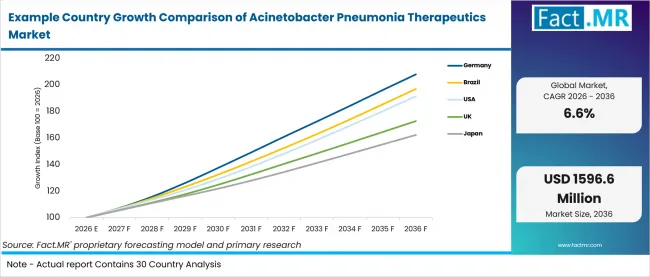
Example Country Growth Comparison Of Acinetobacter Pneumonia Therapeutics Market | Source: Fact.MR
| Country | CAGR (2026-2036) |
|---|---|
| Germany | 7.6% |
| Brazil | 7.0% |
| USA | 6.7% |
| Canada | 6.4% |
| Australia | 6.1% |
| UK | 5.6% |
| Japan | 5.0% |
What supports Germany adoption?
7.6% CAGR, supported by stewardship depth and protocol-led purchasing.
German hospitals place evidence review ahead of unrestricted antibiotic volume. Reserve therapies gain use when suppliers show protocol fit and supply assurance.
How is Brazil scaling demand?
7.0% CAGR, backed by public procurement and ICU treatment needs.
Brazilian demand is shaped by hospital purchasing where ICU need can vary by region. Suppliers gain preference when tender pricing and stock planning are practical.
What supports USA growth?
6.7% CAGR, led by microbiology-led hospital adoption.
USA hospitals activate resistant-pathogen therapies after microbiology results and infectious-disease consultation. Pharmacy committees decide whether a therapy enters routine protocol use.
How does Canada perform?
6.4% CAGR, shaped by access pilots and hospital evaluation.
Canada’s route is expected to depend on hospital evidence review and payment approaches that recognize reserve antibiotic value. Suppliers need a clear case for stock continuity.
What supports Australia adoption?
6.1% CAGR, supported by tertiary hospital care and specialist oversight.
Australia’s growth reflects severe pneumonia care concentrated in larger hospitals. Specialist review and pharmacy control shape therapy use when suitable cases are uncommon.
What shapes UK adoption?
5.6% CAGR, guided by NHS access review and controlled procurement.
UK demand is expected to move through national evaluation and procurement pathways. Hospital use remains controlled through stewardship rules.
How is Japan developing demand?
5.0% CAGR, led by reimbursement review and careful hospital qualification.
Japan’s growth is shaped by reimbursement practice and detailed hospital review. Infectious-disease expertise and laboratory confirmation guide adoption in leading accounts.
Who leads the Acinetobacter Pneumonia Therapeutics Market?
Innoviva Specialty Therapeutics and Shionogi have direct public evidence of products indicated for Acinetobacter-associated hospital-acquired and ventilator-associated bacterial pneumonia.
Innoviva Specialty Therapeutics markets Xacduro (sulbactam-durlobactam), which is approved in the United States for hospital-acquired and ventilator-associated bacterial pneumonia caused by susceptible Acinetobacter baumannii-calcoaceticus complex. Shionogi markets Fetroja (cefiderocol), which is indicated in the United States for hospital-acquired and ventilator-associated bacterial pneumonia caused by susceptible Acinetobacter baumannii complex. Other broad anti-infective suppliers are not presented as direct providers unless public product-level evidence establishes this indication.
Which companies are the key providers?
Key companies with direct public product evidence include Innoviva Specialty Therapeutics and Shionogi & Co., Ltd.
- Innoviva Specialty Therapeutics
- Shionogi & Co., Ltd.
Bibliography
- World Health Organization. (2024, May 17). WHO updates list of drug-resistant bacteria most threatening to human health.
- Centers for Disease Control and Prevention. (2025, June 12). About Acinetobacter.
- U.S. Food and Drug Administration. (2023, May 23). FDA approves new treatment for pneumonia caused by certain difficult-to-treat bacteria.
- Innoviva, Inc. (2026). Form 10-K: Xacduro product and hospital-use disclosure.
- Shionogi. (2020, September 28). FDA approval of Fetroja for hospital-acquired and ventilator-associated bacterial pneumonia.
This Report Answers
- The report provides strategic intelligence on the Acinetobacter Pneumonia Therapeutics Market across Drug Class, Application, End User, Distribution Channel and Route of Administration.
- Segment analysis covers Beta-Lactam Antibiotics and Hospital-Acquired Pneumonia as the share leaders within the 2026 market.
- Country outlook evaluates Germany, Brazil, USA, Canada, Australia, UK and Japan.
- Competitive analysis focuses on Innoviva Specialty Therapeutics and Shionogi, whose products have public evidence for Acinetobacter-associated hospital-acquired and ventilator-associated bacterial pneumonia.
- Scope analysis covers Distribution Channel and Route of Administration. Hospital Pharmacies and Intravenous administration define the main access route for inpatient use.
What does the Acinetobacter Pneumonia Therapeutics Market cover?
Acinetobacter pneumonia therapeutics are antibacterial therapies used for suspected or confirmed Acinetobacter pneumonia in hospital care.
The market includes treatment revenue for hospital-acquired and ventilator-associated pneumonia where product selection follows clinical assessment and microbiological evidence. Diagnostic revenue, infection-control supplies, supportive-care services and downstream pharmacy markups are excluded.
What is included in the scope?
The scope includes Drug Class, Application, End User, Distribution Channel, Route of Administration and Region.
Coverage includes inpatient therapy pathways and the pharmacy channels through which listed products are supplied. The market covers the specified therapeutic categories and does not count broad antibacterial revenue outside the stated treatment pathway.
What is excluded from the scope?
Diagnostics, general infection-control supplies and unrelated antibacterial sales remain outside the scope.
Revenue is excluded when it does not relate to treatment of suspected or confirmed Acinetobacter pneumonia. The scope also excludes supportive-care services and pharmacy markups that are not manufacturer-level therapy revenue.
How Was the Analysis Built?
The analysis integrates regulatory documents, product labels, public company disclosures, clinical literature and health-agency materials.
- Evidence Review: The review considers regulatory approvals, prescribing information, public company disclosures, health-agency publications and clinical literature relevant to Acinetobacter pneumonia treatment.
- Market Sizing and Forecasting: Estimates combine therapy revenue, treatment volumes, pricing, product availability, hospital channel use and country access conditions within the stated market boundary.
- Market Monitoring: The analysis is reviewed as regulatory actions, product availability, clinical evidence and antimicrobial-resistance developments change.
What is the report’s scope and coverage?
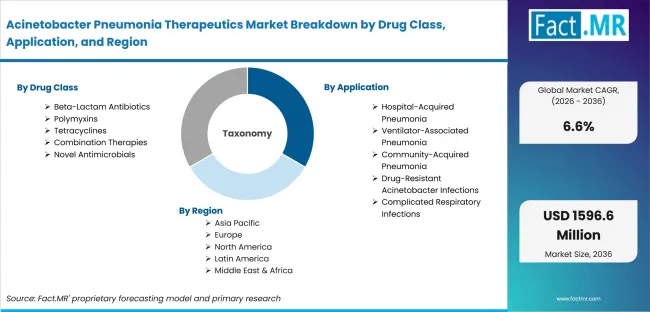
Acinetobacter Pneumonia Therapeutics Market Breakdown By Drug Class, Application, And Region | Source: Fact.MR
| Attribute | Details |
|---|---|
| Quantitative Units | USD 842.6 million in 2026 to USD 1,596.6 million by 2036 at 6.6% CAGR |
| Market Definition | Manufacturer-level revenue from antibacterial therapies used for suspected or confirmed Acinetobacter pneumonia, excluding diagnostics, infection-control supplies and downstream pharmacy markups. |
| Drug Class | Beta-Lactam Antibiotics; Carbapenems; Cephalosporins; Polymyxins; Colistin; Polymyxin B; Tetracyclines; Tigecycline; Minocycline; Combination Therapies; Beta-Lactam/Beta-Lactamase Inhibitors; Multi-Drug Combination Regimens; Novel Antimicrobials; Sulbactam-Based Therapies; Investigational Antibiotics |
| Application | Hospital-Acquired Pneumonia; Ventilator-Associated Pneumonia; Non-Ventilated HAP; Ventilator-Associated Pneumonia; ICU Patients; Long-Term Ventilation; Community-Acquired Pneumonia; Adult Patients; Pediatric Patients; Drug-Resistant Acinetobacter Infections; Carbapenem-Resistant Infections; Multidrug-Resistant Infections; Complicated Respiratory Infections; Post-Surgical Pneumonia; Immunocompromised Patients |
| End User | Hospitals; Tertiary Care Hospitals; Community Hospitals; Specialty Clinics; Pulmonology Clinics; Infectious Disease Clinics; Ambulatory Surgical Centers; Day Care Centers; Outpatient Surgical Facilities; Research Institutes; Clinical Research Centers; Academic Medical Centers; Home Healthcare Settings; Home Infusion Services; Long-Term Care Facilities |
| Distribution Channel | Hospital Pharmacies; Public Hospitals; Private Hospitals; Retail Pharmacies; Chain Pharmacies; Independent Pharmacies; Online Pharmacies; E-Pharmacy Platforms; Hospital E-Dispensing; Specialty Pharmacies; Infectious Disease Pharmacies; High-Cost Drug Pharmacies; Government Procurement; Public Health Programs; Defense Healthcare Procurement |
| Route of Administration | Intravenous; Infusion Therapy; Hospital IV Administration; Oral; Tablets; Capsules; Inhalation; Nebulized Antibiotics; Dry Powder Inhalers; Intramuscular; Single-Dose Injection; Multiple-Dose Injection; Combination Therapy; IV Followed by Oral; Multi-Route Administration |
| Regions Covered | North America; Latin America; Western Europe; Eastern Europe; East Asia; South Asia and Pacific; Middle East & Africa |
| Key Countries Highlighted | Germany; Brazil; USA; Canada; Australia; UK; Japan |
| Key Companies Profiled | Innoviva Specialty Therapeutics; Shionogi & Co., Ltd. |
| Forecast Period | 2026 to 2036 |
| Approach | Market sizing combines therapy revenue, treatment volumes, pricing, hospital channel use, resistance patterns, product availability and country access conditions within the stated market boundary. |
How is the market segmented?
-
By Drug Class
- Beta-Lactam Antibiotics
- Carbapenems
- Cephalosporins
- Polymyxins
- Colistin
- Polymyxin B
- Tetracyclines
- Tigecycline
- Minocycline
- Combination Therapies
- Beta-Lactam/Beta-Lactamase Inhibitors
- Multi-Drug Combination Regimens
- Novel Antimicrobials
- Sulbactam-Based Therapies
- Investigational Antibiotics
- Beta-Lactam Antibiotics
-
By Application
- Hospital-Acquired Pneumonia
- Ventilator-Associated Pneumonia
- Non-Ventilated HAP
- Ventilator-Associated Pneumonia
- ICU Patients
- Long-Term Ventilation
- Community-Acquired Pneumonia
- Adult Patients
- Pediatric Patients
- Drug-Resistant Acinetobacter Infections
- Carbapenem-Resistant Infections
- Multidrug-Resistant Infections
- Complicated Respiratory Infections
- Post-Surgical Pneumonia
- Immunocompromised Patients
- Hospital-Acquired Pneumonia
-
By End User
- Hospitals
- Tertiary Care Hospitals
- Community Hospitals
- Specialty Clinics
- Pulmonology Clinics
- Infectious Disease Clinics
- Ambulatory Surgical Centers
- Day Care Centers
- Outpatient Surgical Facilities
- Research Institutes
- Clinical Research Centers
- Academic Medical Centers
- Home Healthcare Settings
- Home Infusion Services
- Long-Term Care Facilities
- Hospitals
-
By Distribution Channel
- Hospital Pharmacies
- Public Hospitals
- Private Hospitals
- Retail Pharmacies
- Chain Pharmacies
- Independent Pharmacies
- Online Pharmacies
- E-Pharmacy Platforms
- Hospital E-Dispensing
- Specialty Pharmacies
- Infectious Disease Pharmacies
- High-Cost Drug Pharmacies
- Government Procurement
- Public Health Programs
- Defense Healthcare Procurement
- Hospital Pharmacies
-
By Route of Administration
- Intravenous
- Infusion Therapy
- Hospital IV Administration
- Oral
- Tablets
- Capsules
- Inhalation
- Nebulized Antibiotics
- Dry Powder Inhalers
- Intramuscular
- Single-Dose Injection
- Multiple-Dose Injection
- Combination Therapy
- IV Followed by Oral
- Multi-Route Administration
- Intravenous
-
By Region
- North America
- Latin America
- Western Europe
- Eastern Europe
- East Asia
- South Asia and Pacific
- Middle East & Africa