- Market Value (2025): USD 327.1 Mn
- Estimated Value (2026): USD 420.0 Mn
- Forecast Value (2036): USD 5115.6 Mn
- CAGR (2026-2036): 28.4%
What is the Air-Breathing Electric Propulsion Market forecast to be worth by 2036?
USD 420.0 million in 2026 to USD 5115.6 million by 2036 at a 28.4% CAGR.
- The Air-Breathing Electric Propulsion Market surpassed a value of USD 327.1 million in 2025.
- Demand is projected to increase from USD 420.0 million in 2026 to USD 5115.6 million by 2036.
- The market is forecast to record 28.4% CAGR from 2026 to 2036 as satellite builders, defense programs and VLEO mission designers shift propulsion planning toward sustained low-altitude operation.
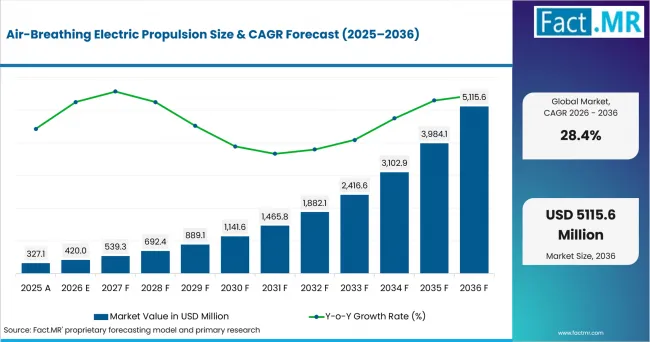
Air Breathing Electric Propulsion Value Analysis | Source: Fact.MR
What are the defining numbers behind Air-Breathing Electric Propulsion Market growth?
An absolute opportunity of USD 4695.6 million is expected between 2026 and 2036.
- Demand Drivers in the Market
- VLEO mission designers need propulsion that offsets drag without large stored-propellant mass.
- Earth observation operators need lower altitudes for sharper imagery. ESA links VLEO below 450 km to better resolution.
- Defense programs need persistent low-altitude maneuver. DARPA Otter gives ABEP suppliers a defined VLEO flight-data path.
- Propulsion suppliers need qualification assets. SITAEL opened its Pisa electric-propulsion factory in July 2025.
- Key Segments Analyzed
- By Intake Type: Passive scoop intake is expected to hold 36.0% share in 2026 because it offers simpler early platform integration.
- By Thruster: Hall-effect is projected to account for 31.0% share in 2026 owing to established electric-propulsion use.
- By Orbit: 181-250 km is anticipated to capture 34.0% share in 2026 as missions balance imaging gains and drag risk.
- By Mission: Earth observation is estimated to represent 32.0% share in 2026 due to low-altitude imaging value.
- Analyst Opinion at Fact.MR
- Shambhu Nath Jha, Principal Consultant at Fact.MR, states, “Air-breathing electric propulsion changes the mass equation for very low orbits. Flight programs are expected to test intake design, plasma generation and oxygen-tolerant materials as one system. Suppliers should combine ground-test evidence, flight-data access and platform integration support.”
- Strategic Implications
- Satellite manufacturers should design intake, power processing and thermal control as one propulsion bay.
- Thruster developers should document performance with oxygen-rich gas mixtures.
- Mission operators should compare imaging benefits with station-keeping effort.
- Government programs should fund shared test assets for intake and plasma validation.
Japan is forecast to post 29.1% CAGR through 2036, supported by national space-technology funding and electric-propulsion satellite work. The USA is projected to record 28.8% CAGR as DARPA and Air Force-backed demonstrations move ABEP toward flight evidence. Germany is anticipated to advance at 28.5% CAGR due to ESA funding participation and test capability. Italy is estimated to hold 28.0% CAGR owing to propulsion production assets and IRIDE deployment. France is expected to reach 27.6% CAGR through CNES low-orbit programs and satellite manufacturing depth.
How does the Air-Breathing Electric Propulsion Market break down by segment?
Passive scoop intake leads Intake Type at 36.0% share in 2026; Hall-effect leads Thruster at 31.0% share.
Which Intake Type dominates?
Passive scoop intake is expected to hold 36.0% share in 2026.
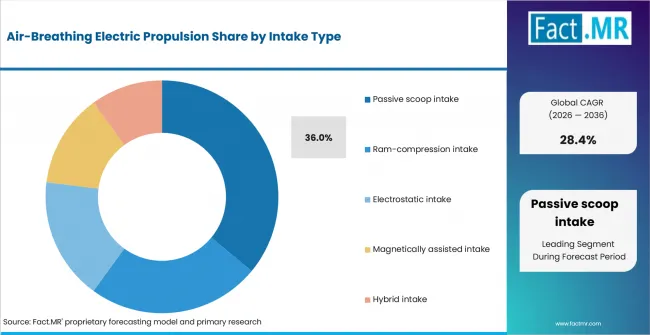
Air Breathing Electric Propulsion Analysis By Intake Type | Source: Fact.MR
Passive scoop intake leads because early ABEP platforms need a lower-complexity route for collecting residual gases. It avoids the control burden of active compression and gives small-satellite teams a practical baseline for mass budgeting. Ram-compression intake gains relevance where mission profiles need stronger collection efficiency. Electrostatic and magnetically assisted designs remain more technical because they depend on stronger plasma and field-control performance. ESA funded 72 OSIP activities between July and December 2025 and highlighted VOLTA air-breathing propulsion validation for VLEO platforms.
What leads the Thruster segment?
Hall-effect is projected to account for 31.0% share in 2026.
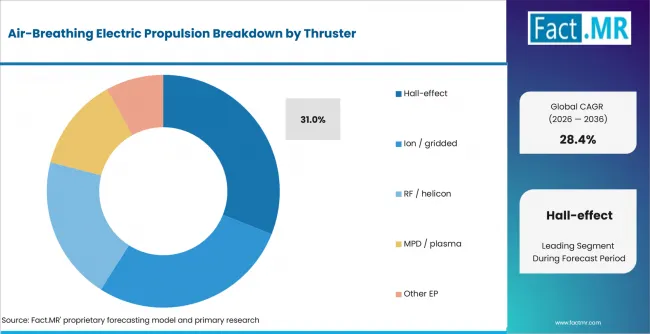
Air Breathing Electric Propulsion Analysis By Thruster | Source: Fact.MR
Hall-effect thrusters lead the thruster segment owing to their installed base in satellite electric propulsion and direct use in VLEO development awards. Ion or gridded options remain relevant where high specific impulse is prioritized over compact thrust density. RF and helicon systems attract research attention because they avoid some electrode wear issues. MPD or plasma concepts remain in early evaluation.
How does Orbit shape demand?
181-250 km is anticipated to capture 23.0% share in 2026.
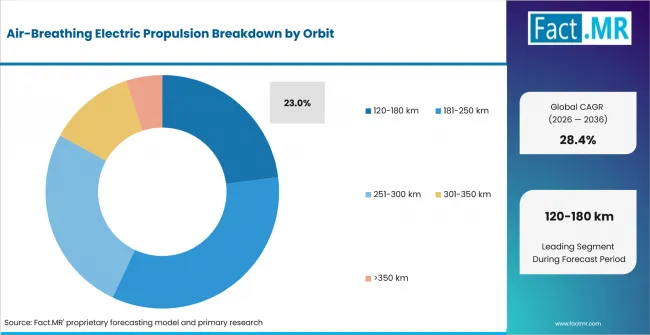
Air Breathing Electric Propulsion Analysis By Orbit | Source: Fact.MR
The 181-250 km orbit band leads because it operates close enough to improve imaging value while giving engineers more room to manage drag. The 120-180 km band offers sharper proximity benefits while exposing spacecraft to steeper decay risk. Higher bands from 251 km upward reduce drag pressure and weaken the case for air-breathing propulsion. Flight-oriented ABEP tests are expected to clarify where low-altitude benefits offset drag and oxygen exposure.
What supports Earth observation within Mission?
Earth observation is estimated to represent 32.0% share in 2026.
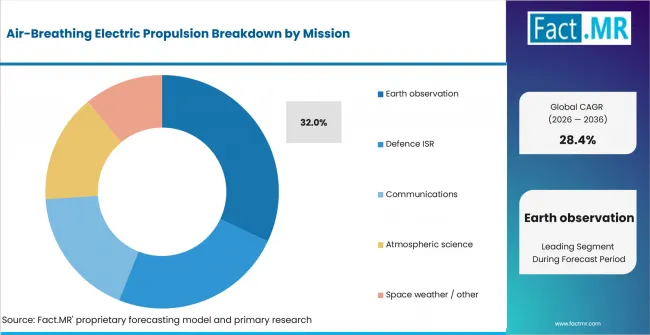
Air Breathing Electric Propulsion Analysis By Mission | Source: Fact.MR
Earth observation leads mission demand due to the visible gain from flying closer to Earth. Lower altitude improves ground sampling distance and reduces path delay, which helps civil mapping and defense monitoring. Defence ISR follows because persistent low-orbit access improves revisit planning for tactical users. Communications remains relevant where low latency offsets shorter satellite lifetime risk. Airbus and CNES launched four CO3D satellites in July 2025, with each spacecraft operating at 502 km and supporting 50 cm imagery.
What is accelerating Air-Breathing Electric Propulsion Market adoption, and what is holding it back?
VLEO endurance drives it; oxygen exposure and flight qualification restrain it.
Drivers Impact Analysis
| Driver | (~) % Impact on CAGR | Geographic Relevance | Impact Timeline |
|---|---|---|---|
| VLEO drag compensation | +3.4% | Global | Short term (<= 2 years) |
| Earth observation resolution | +2.6% | USA, France, Italy, Japan | Medium term (2-4 years) |
| Defense ISR maneuverability | +2.1% | USA, France, Germany | Short term (<= 2 years) |
| Hall-effect supply depth | +1.5% | USA, Italy, Japan | Medium term (2-4 years) |
Opportunity Impact Analysis
| Opportunity | (~) % Impact on CAGR | Geographic Relevance | Impact Timeline |
|---|---|---|---|
| Integrated VLEO satellite platforms | +2.0% | Global | Medium term (2-4 years) |
| Oxygen-tolerant materials | +1.5% | USA, Japan, Europe | Short term (<= 2 years) |
| Rarefied-air test facilities | +1.1% | Italy, Germany, USA | Medium term (2-4 years) |
Restraints Impact Analysis
| Restraint | (~) % Impact on CAGR | Geographic Relevance | Impact Timeline |
|---|---|---|---|
| Atomic oxygen erosion | -1.0% | Global | Short term (<= 2 years) |
| Limited flight heritage | -0.8% | Global | Medium term (2-4 years) |
| Power and thermal limits | -0.6% | USA, Europe, Japan | Medium term (2-4 years) |
Which countries are scaling the Air-Breathing Electric Propulsion Market through 2036?
- The country comparison spans 1.5 percentage points across the forecast period.
- Japan remains 0.3 percentage point above the USA through space-fund support and electric-propulsion work.
- The USA remains 0.3 percentage point above Germany as DARPA and Air Force programs finance VLEO demonstration paths.
- Germany remains 0.5 percentage point above Italy through ESA participation and German test capability.
- Italy remains 0.4 percentage point above France as electric-propulsion factories and IRIDE deployment support local demand.
- France closes the displayed range through CNES low-orbit missions and satellite manufacturing depth.
Comparable CAGRs create different entry conditions because ABEP depends on mission funding, rarefied-air tests and oxygen-tolerant hardware. Full report coverage includes North America, Latin America, Western Europe, Eastern Europe, East Asia, South Asia & Pacific, Middle East & Africa.
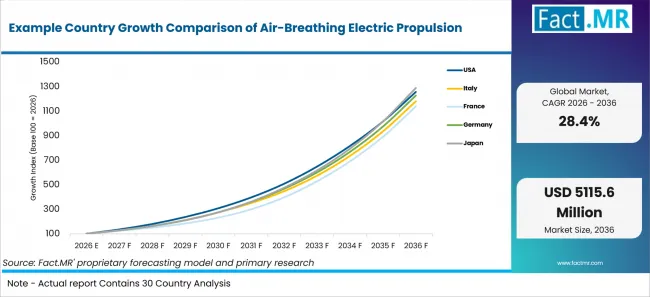
Example Country Growth Comparison Of Air Breathing Electric Propulsion | Source: Fact.MR
| Country | CAGR |
|---|---|
| Japan | 29.1% |
| USA | 28.8% |
| Germany | 28.5% |
| Italy | 28.0% |
| France | 27.6% |
What supports Japan's outlook?
29.1% CAGR, led by space-technology funding and electric-propulsion satellite work.
Japan’s space-technology funding is expected to support electric propulsion suppliers working near VLEO concepts. The Cabinet Office said in March 2026 that the Space Strategy Fund targets about JPY 1 trillion over a 10-year period. Japan is forecast to post 29.1% CAGR through 2036 as national satellite bus programs keep electric propulsion visible.
What supports USA adoption?
28.8% CAGR, supported by defense demonstration funding and VLEO maneuver requirements.
U.S. mission teams are expected to move first where ABEP extends low-orbit ISR value. SBIR records show Viridian Space received a USD 1,247,690 award starting in July 2025 for oxygen-resilient ABEP operation in VLEO. The USA is projected to record 28.8% CAGR through 2036 as Air Force awards give propulsion suppliers defined hardware paths.
What is supporting Germany’s adoption?
28.5% CAGR, supported by ESA participation and European VLEO technology work.
German demand is expected to follow ESA technology programs and national space funding tied to low-orbit missions. DLR reported in November 2025 that Germany is contributing about EUR 5.4 billion to ESA programs. Germany is anticipated to advance at 28.5% CAGR through 2036 as test assets support ABEP qualification.
How is Italy scaling demand?
28.0% CAGR, driven by propulsion manufacturing assets and Earth observation deployment.
Italy’s ABEP outlook is expected to benefit from electric-propulsion assembly capacity and IRIDE Earth observation deployment. ASI reported in March 2026 that the Eaglet II constellation had reached 16 satellites in orbit following the launch of eight additional spacecraft, with eight more planned later in 2026. Italy is estimated to hold 28.0% CAGR through 2036 as SITAEL supports Hall-effect thruster assembly and testing.
How does France perform?
27.6% CAGR, backed by CNES low-orbit missions and satellite manufacturing depth.
France’s outlook is expected to draw on CNES mission depth. France’s National Space Strategy 2025-2040 states that the public space budget is around EUR 3 billion per year. France is expected to reach 27.6% CAGR through 2036 as satellite-program continuity supports future low-altitude propulsion evaluation.
Who leads the Air-Breathing Electric Propulsion Market?
Kreios Space and SITAEL lead European satellite and propulsion depth, while Redwire strengthen VLEO platform coverage.
SITAEL provides direct propulsion relevance through Hall-effect electric-propulsion systems and its Pisa production center. Redwire provides an air-breathing electric-propulsion demonstration route through DARPA’s Otter program and its SabreSat VLEO platform. Competitive differentiation is likely to depend on flight-demonstrated performance, oxygen-resistant propulsion hardware and integrated spacecraft-platform support.
Which companies are the key providers?
Kreios Space and SITAEL are key providers. Redwire completes the company set.
- Kreios Space
- SITAEL
- Redwire
- NewOrbit Space
Bibliography
- European Space Agency. (2026, May 6). OSIP highlights July–December 2025.
- General Secretariat for Defence and National Security. (2025, November 12). National space strategy 2025–2040.
- German Aerospace Center (DLR). (2025, November 28). Germany invests 5.4 billion euros in the future of European space.
- Italian Space Agency. (2026, March 30). IRIDE continues its development: Eight more Eaglet II satellites in orbit.
- National Space Policy Secretariat, Cabinet Office, Government of Japan. (2026, March 9). Japan’s space policy and law for lunar resource development [Presentation slides].
- Redwire Corporation. (2025, November 19). Redwire awarded $44 million DARPA contract to advance very low-Earth orbit mission.
- SITAEL S.p.A. (2025, July 22). SITAEL inaugurates the Smart Factory in Pisa: The new made in Italy production hub for space electric propulsion.
This Report Answers
- The report explains ABEP use across intake type, thruster architecture, orbit, mission and region.
- Segment analysis identifies the leading subsegments and buyer reasons.
- Country analysis covers Japan, the USA, Germany, Italy and France.
- Competitive analysis reviews the listed satellite and propulsion providers.
- Mission analysis covers Earth observation, Defence ISR and communications use.
What does the Air-Breathing Electric Propulsion Market cover?
The Air-Breathing Electric Propulsion Market covers propulsion systems that ingest rarefied atmospheric gases in VLEO and use electric acceleration for drag compensation. The assessment includes intake devices, Hall-effect and RF-type thrusters, power processing and integrated platform interfaces where air collection is part of the propulsion concept. Demand is linked to earth observation, defense surveillance and low-latency communications missions.
The market differs from broader all electric satellites because the intake function is central to scope inclusion. Standard electric propulsion systems remain outside the core boundary unless they are designed or adapted for atmospheric gas use in very low orbit.
What is included in the scope?
The scope includes passive scoop, ram-compression, electrostatic, magnetically assisted and hybrid intake systems used with electric thrusters for VLEO station keeping.
It includes Hall-effect, ion / gridded, RF / helicon and MPD / plasma configurations when paired with an air-breathing architecture. Test assets are considered where they support electric propulsion thruster test equipment for rarefied-air operation. Mission coverage includes Earth observation, Defence ISR, communications, atmospheric science and space-weather monitoring. Adjacent use cases are measured alongside software-defined defence satellites programs, satellite internet services and satellite communication systems when VLEO endurance changes spacecraft design.
What is excluded from the scope?
The scope excludes chemical propulsion, standalone xenon or krypton electric propulsion and conventional station-keeping systems when atmospheric gas collection is absent. Launch-vehicle air-breathing engines, aircraft propulsion and ramjet technologies are also outside the scope. Broader green propellants are covered only when the system is part of a VLEO air-breathing propulsion package.
Satellite buses, deployable structures and 3D printed satellite platforms are adjacent hardware when propulsion architecture is sold separately. Mobile satellite services and resilient networks remain downstream use cases instead of direct market revenue.
How Was the Analysis Built?
The analysis draws on 120+ sources, 35+ portfolios, 25+ countries, and 20+ interviews.
- Primary Research: Primary research includes discussions with satellite manufacturers, propulsion developers, space agencies, integrators and mission operators. Interviews examine mission altitude choices, qualification needs, test access and oxygen exposure.
- Desk Research: Desk research covers government programs, space-agency releases, company announcements, SBIR awards, technical project pages, satellite mission records and policy documents. Every source used in the analysis is documented in the bibliography.
- Market Sizing and Forecasting: Market estimates combine VLEO mission activity, propulsion subsystem adoption, country-level funding, mission mix, altitude bands, thruster selection and supplier participation. The model keeps stated 2026 and 2036 values unchanged.
- Data Validation and Update Cycle: Findings are validated by comparing public program evidence with company activity and country investment signals. Updates review demonstration awards, satellite launches, facility openings and VLEO planning.
What is the report’s scope and coverage?
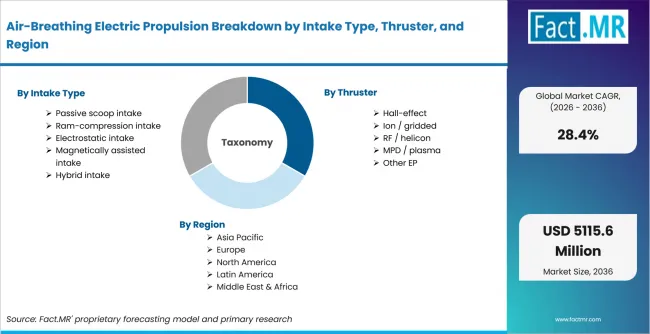
Air Breathing Electric Propulsion Breakdown By Intake Type, Thruster, And Region | Source: Fact.MR
| Attribute | Details |
|---|---|
| Quantitative Units | USD million in 2026 to USD million by 2036 at a CAGR |
| Market Definition | Systems that collect residual gases in VLEO and use electric thrusters for drag compensation. |
| Intake Type | Passive scoop; Ram-compression; Electrostatic; Magnetically assisted; Hybrid |
| Thruster | Hall-effect; Ion / gridded; RF / helicon; MPD / plasma; Other EP |
| Orbit | 120-180 km; 181-250 km; 251-300 km; 301-350 km; >350 km |
| Mission | Earth observation; Defence ISR; Communications; Atmospheric science; Space weather |
| Regions Covered | North America; Latin America; Western Europe; Eastern Europe; East Asia; South Asia & Pacific; Middle East & Africa |
| Countries Covered | USA; Italy; France; Germany; Japan |
| Key Companies Profiled | Kreios Space; SITAEL; Redwire; NewOrbit Space |
| Forecast Period | 2026 to 2036 |
| Approach | Hybrid approach using VLEO missions, propulsion activity, country funding and provider portfolios. |
How is the market segmented?
-
By Intake Type
- Passive scoop intake
- Ram-compression intake
- Electrostatic intake
- Magnetically assisted intake
- Hybrid intake
-
By Thruster
- Hall-effect
- Ion / gridded
- RF / helicon
- MPD / plasma
- Other EP
-
By Orbit
- 120-180 km
- 181-250 km
- 251-300 km
- 301-350 km
- >350 km
-
By Mission
- Earth observation
- Defence ISR
- Communications
- Atmospheric science
- Space weather / other
-
By Region
- North America
- Latin America
- Western Europe
- Eastern Europe
- East Asia
- South Asia & Pacific
- Middle East & Africa