Air Conveyors System Market Size, Share, Growth and Forecast (2026 - 2036)

The Air Conveyors System Market is segmented by System , Phase Type System Configuration, End Use Industry, and Region, with forecasts covering the period from 2026 to 2036.

According to market estimates, the global Air Conveyors System Market stood at approximately USD 9.2 billion in 2025. The market is projected to reach around USD 9.8 billion in 2026 and is expected to grow significantly to approximately USD 17.5 billion by 2036, progressing at a CAGR of around 6.0% during the forecast period. Positive Pressure Conveying Systems are anticipated to account for nearly 58.3% share by 2026, driven by their high efficiency, cost-effectiveness, and widespread use in long-distance bulk material transportation across manufacturing industries, while Dilute Phase Conveying Systems are expected to remain the leading phase segment with around 60.2% share by 2026.
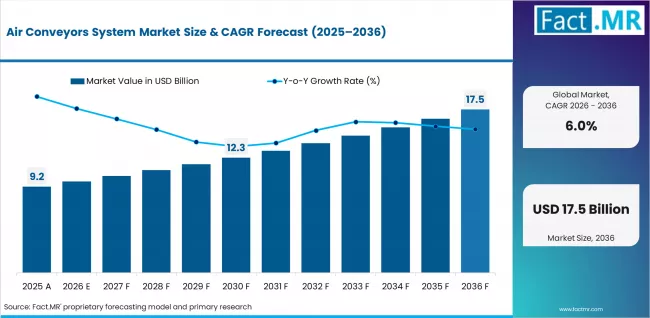
Air Conveyors System Market Overview, Growth Outlook, and Forecast By Fact.MR

  • In 2025, the global air conveyors system market was valued at approximately USD 9.2 billion.
  • Based on Fact.MR analysis, demand for Air Conveyors System is estimated to grow to around USD 9.8 billion in 2026 and USD 17.5 billion by 2036.
  • The market is projected to expand at a CAGR of around 6.0% during the forecast period.

Air Conveyors System Market  Value Analysis

Summary of the Air Conveyors System Market

  • Market Snapshot
    • In 2025, the global air conveyors system market was valued at approximately USD 9.2 billion.
    • The market is estimated to reach around USD 9.8 billion in 2026 and is projected to attain nearly USD 17.5 billion by 2036.
    • The market is expected to expand at a CAGR of approximately 6.0% during the forecast period.
    • The market is anticipated to create an absolute dollar opportunity of approximately USD 7.7 billion between 2026 and 2036.
    • In terms of system type, Positive Pressure Conveying Systems dominate with a share of approximately 58.3% in 2026, driven by their high efficiency, cost-effectiveness, and widespread use in long-distance bulk material handling applications.
    • From a phase type perspective, Dilute Phase Systems lead the segment with a share of approximately 60.2% in 2026, supported by broad industrial adoption due to simpler design, lower installation cost, and flexible material handling capability.
    • Based on system configuration, Single Line Systems account for approximately 39.8% share in 2026, followed by Centralized Network Systems and Multi Line Systems, driven by increasing automation and scalable industrial conveying requirements.
  • Demand and Growth Drivers
    • Air conveyance systems are becoming a more popular choice due to increased need for bulk material handling in a wide variety of industries, including manufacturing, food processing, chemical manufacturing and pharmaceuticals.
    • The increasing rate of industrial automation and the rise of smart manufacturing are driving the use of pneumatic conveying systems.
    • In addition to the above factors, increasing investments in infrastructure, mining, cement and other heavy industries are also contributing to the overall growth of the pneumatic conveyor market.
  • Product and Segment View
    • Increasing demand for Positive Pressure Conveying Systems with 58.3% share is driven by high efficiency and cost-effective long-distance bulk material handling across manufacturing, food, and chemical industries.
    • Rising adoption of Vacuum Conveying Systems with 28.4% share is supported by contamination-free transport needs in pharmaceuticals, food processing, and specialty chemical applications.
    • Growing demand for Dilute Phase Systems with 60.2% share is driven by simple design, low cost, and wide industrial applicability in bulk material handling operations.
    • Increasing adoption of Dense Phase Systems with 35.1% share is supported by energy-efficient conveying of fragile and abrasive materials with minimal degradation.
    • Rising deployment of Single Line Systems with 39.8% share is driven by cost-efficient dedicated conveying in small and medium industrial setups.
    • Growing adoption of Centralized Network Systems with 32.6% share is supported by Industry 4.0 integration enabling centralized and optimized material flow control.
    • Increasing demand for Food & Beverage with 18.9% share is driven by strict hygiene standards and automation in ingredient handling and processing.
    • Rising demand for Manufacturing with 14.2% share is supported by safe, enclosed handling of powders and bulk solids in hazardous industrial environments.
  • Geography and Competitive Outlook
    • With rapid industrialization and evolving manufacturing bases along with growth within food processing, chemicals, and logistics sectors requiring bulk material handling solutions all combining to create demand, both China and India offer some of the fastest growing air conveyors system markets.
    • North America and Europe currently represent the largest share of the overall air conveyors market, driven by mature industrial infrastructures, developed manufacturing ecosystems, and early adoption of automated energy-efficient pneumatic conveying technology.
    • Continued growth in the Americas & USA will fuel strong growth in demand for air conveyors systems across Asia Pacific Region due to rapidly growing smart manufacturing, increased construction of industrial corridors/logistics hubs, and evolved demand for efficient/cost effect continuous bulk material transport.
    • The global air conveyors system market includes key players such as Atlas Copco, Coperion, Alantech, Gerick, and Nilfisk.
  • Analyst Opinion
    • Shambhu Nath Jha, Principal Consultant at Fact.MR, says, “Air Conveyors System have become increasingly popular in the market because of the growing need for efficient automation in bulk materials handling within different sectors like manufacturing, food processing, chemical, and pharmaceutical. As productivity, energy efficiency, and process automation become increasingly important in the industries, more and more pneumatic conveying systems will be adopted with the help of sophisticated controls and industry 4.0 technologies.

Air Conveyors System Market — At a Glance

Market Value 2025 USD 9.2 Billion
Market Value 2026 USD 9.8 Billion
Market Value 2036 USD 17.5 Billion
Absolute Dollar Opportunity USD 7.7 Billion (2026–2036)
CAGR 6.00%
Growth Multiple ~1.8x
Key Demand Theme Rising demand for efficient bulk material handling systems across manufacturing, food processing, chemicals, pharmaceuticals, and heavy industries driven by automation and Industry 4.0 adoption
Leading System Type Positive Pressure Conveying Systems
System Type Share 58.30%
Leading Phase Type Dilute Phase Systems
Phase Type Share 60.20%
Leading System Configuration Single Line Systems
System Configuration Share 39.80%
Leading End-Use Industry Food & Beverage
End-Use Industry Share 18.90%
Key Growth Regions North America, Europe, Asia-Pacific
Fastest Growing Countries India (7.0% CAGR), China (6.8% CAGR)
Key Companies Atlas Copco, Dynamic AIR, Nilfisk, Nol Tec Systems, Rieco, GEA Group
System Type Segmentation Positive Pressure Conveying Systems, Vacuum Conveying Systems, Combined (Pressure + Vacuum) Systems
Phase Type Segmentation Dilute Phase Systems, Dense Phase Systems, Semi-Dense Phase Systems
System Configuration Segmentation Single Line Systems, Multi Line Systems, Centralized Network Systems
End Use Industry Segmentation Manufacturing, Power Generation, Food & Beverage, Pharmaceuticals, Chemicals, Petrochemicals, Metals & Minerals, Plastic & Rubber, Pulp & Paper
Region North America, Europe, Asia-Pacific, Middle East & Africa, Latin America

Key Growth Drivers, Constraints, and Opportunities
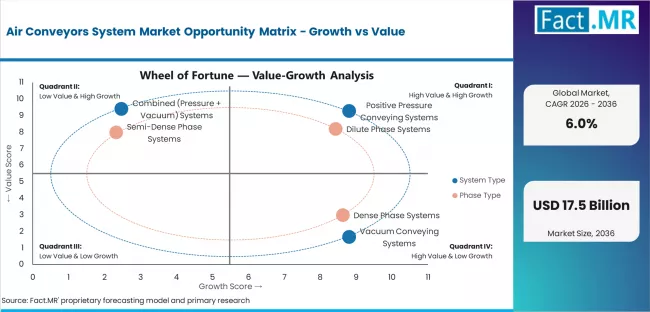
Air Conveyors System Market Opportunity Matrix Growth Vs Value

Key Factors Driving Growth

  • The trend worldwide is towards industrializing processes with automated systems, creating a greater necessity for Air Conveyors Systems to provide for efficient, continuous and automated bulk material handling in production environments.
  • The increased emphasis on operational efficiency, process safety and contamination-free materials will result in further adoption of pneumatic conveying systems in manufacturing, food processing, pharmaceuticals and chemicals.
  • The rapid growth of large-scale industrial infrastructure, including manufacturing plants, logistics centres and processing plants, will continue to drive the need for sophisticated Air Conveyors Systems which can support the transportation of high volumes of material in a manner that is both efficient and effective.
Growth Driver Demand Impact Time Horizon Key Impact Area Fact.MR Insight
Increasing adoption of industrial automation, smart manufacturing, and Industry 4.0 systems High Short–Mid Term Adoption acceleration Rising deployment of automated bulk material handling systems in manufacturing and processing industries is driving strong demand for Air Conveyors System
Rapid expansion of manufacturing industries, food processing plants, and chemical production facilities High Short–Mid Term System deployment & scaling Growth in large-scale production facilities is increasing the need for efficient pneumatic conveying systems for continuous material transport
Growing demand for energy-efficient, contamination-free, and closed-loop material handling systems High Mid Term Performance optimization Industries such as food, pharmaceuticals, and chemicals are increasingly adopting Air Conveyors System to ensure hygiene and operational efficiency
Increasing integration of advanced control systems, sensors, and process automation technologies High Mid–Long Term Technology advancement Advancements in system monitoring and automation are improving accuracy, efficiency, and real-time control of bulk material flow
Rising demand for smart factories, industrial infrastructure, and modern production facilities Medium-High Mid Term Infrastructure modernization Development of smart manufacturing plants and industrial corridors is accelerating adoption of advanced pneumatic conveying systems

Key Market Constraints

  • The high capital costs associated with pneumatic conveying systems limit their adoption in most small and medium-sized industries.
  • The shortage of technical expertise and knowledge of system design/installation/optimization will likely slow their growth in the global market, especially among smaller manufacturers and in developing regions.
  • The need to integrate new systems with existing production equipment, legacy material handling systems, and plant layouts can often necessitate customization, which creates greater problems for installing pneumatic conveying systems and increases the overall cost of implementation.

Key Opportunity Areas

  • Strong growth potential exists due to increasing adoption of industrial automation, smart manufacturing, and Industry 4.0 practices across developed and emerging economies, driving demand for efficient Air Conveyors System.
  • Expansion of manufacturing facilities, food processing plants, and chemical production units is creating significant opportunities for continuous and automated bulk material handling solutions.
  • Rising development of smart factories, modern industrial infrastructure, and large-scale processing plants is further driving demand for modular, energy-efficient, and scalable pneumatic conveying systems across global industries.

Segment-wise Analysis of the Air Conveyors System Market

  • Positive Pressure Conveying Systems hold 58.30% share in the system type segment, driven by high efficiency, cost-effectiveness, and widespread use in long-distance bulk material handling across manufacturing, food, and chemical industries.
  • Dilute Phase Systems account for 60.20% share in the phase type segment, supported by simple system design, lower operational cost, and broad industrial applicability in continuous bulk material transportation.
  • Food & Beverage sector holds 18.90% share, driven by increasing demand for hygienic, automated, and contamination-free material handling in processing and production environments.

The market is segmented by system type, phase type, system configuration, end-use industry, and region. In terms of system configuration, Single Line Systems account for 39.80% share, driven by cost-efficient dedicated conveying routes in small and medium-scale industrial operations, while Centralized Network Systems are gaining traction due to Industry 4.0 integration enabling centralized control and optimized material flow across multiple production units.

Which System Type Segment Dominates the Market?
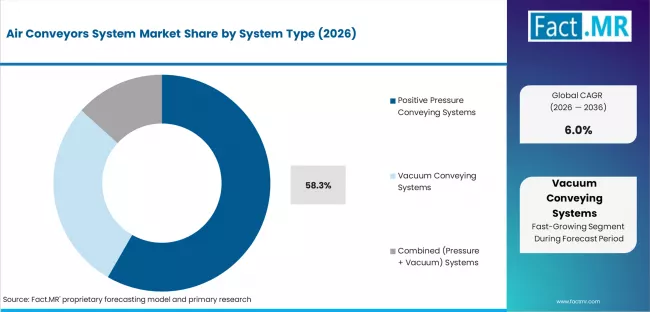
Air Conveyors System Market Analysis By System Type

The Positive Pressure Conveying Systems will continue to dominate the segment with an estimated market share of 58.3%. The key drivers behind their dominant position include efficiency, affordability, and extensive use in long-distance bulk material transportation in various industries such as manufacturing, food processing, and chemicals.

Which Phase Type Segment Dominates the Market?
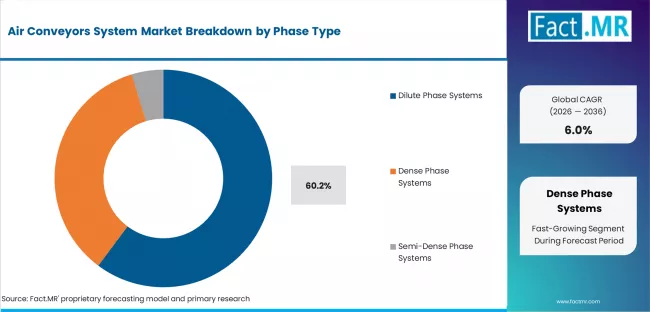
Air Conveyors System Market Analysis By Phase Type

Dilute Phase Systems is projected to continue its market dominance throughout 2026, holding an estimated market share of 60.2%. The main reason behind this market dominance is the simplicity of the systems, low installation and operation cost, and applicability in a variety of applications.

Which System Configuration Segment Dominates the Market?
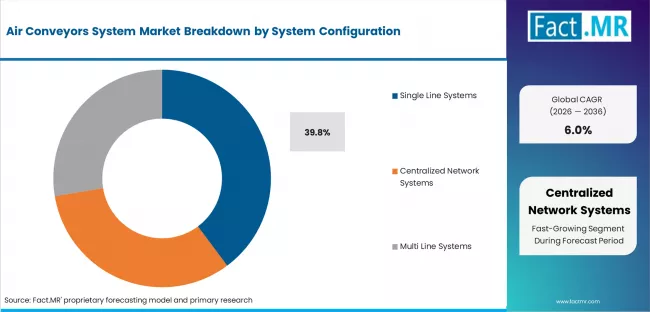
Air Conveyors System Market Analysis By System Configuration

The Single Line Systems are forecasted to continue dominating the market, with an anticipated market share of about 39.8% by 2026. Their dominance is due to their economic structure, easy installation process, and applicability in exclusive cargo handling lanes within small to medium industries.

Which End-Use Industry Segment Dominates the Market?
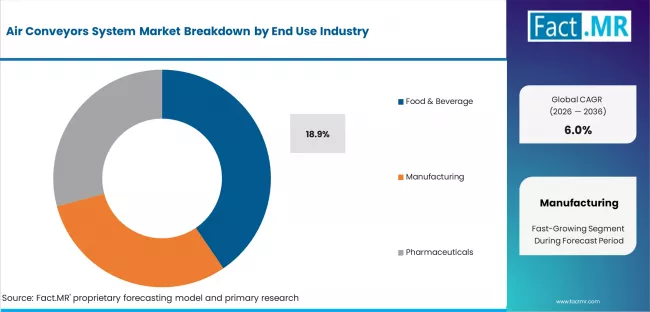
Air Conveyors System Market Analysis By End Use Industry

It is anticipated that the Food & Beverages end-use industry will continue to be the leading one having a market share of about 18.9%. This is attributed to the high demand for clean, contamination-free, and automatic bulk material handling systems.

Regional Outlook Across Key Markets

The market analysis covers key global regions, including South Asia and Pacific, Middle East & Africa, North America, Latin America, Western Europe, and Eastern Europe. It is segmented geographically, with specific market dynamics for each region. The full report provides a detailed market attractiveness analysis.

Top Country Growth Comparison Air Conveyors System Market Cagr (2026 2036)

CAGR Table

Country CAGR (%)
U.S.A 5.8%
China 6.8%
Germany 6.0%
India 7.0%
Japan 5.8%
South Korea 6.1%
U.K. 7.7%

Source: Fact.MR (FMR) analysis, based on proprietary forecasting model and primary research.
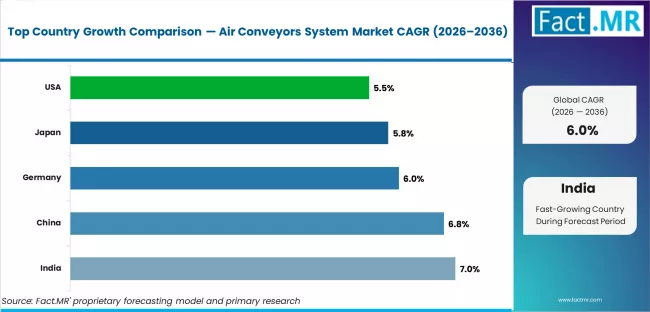
Air Conveyors System Market Cagr Analysis By Country

North America – The Industrial Automation & Bulk Material Handling Hub

Steady growth in the market of North America air conveyors system market will be witnessed, due to high adoption of industrial automation, increased requirement for efficient bulk material handling, and growth in the food processing sector.

U.S.: Demand for air conveyors system in the U.S. is projected to grow at around 5.5% CAGR, supported by strong investments in manufacturing automation, modernization of processing facilities, and increasing deployment of energy-efficient pneumatic conveying systems.

Western Europe – The Industrial & Engineering Excellence Hub
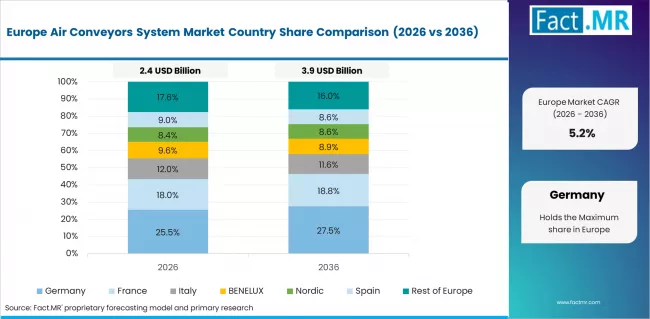
Air Conveyors System Market Europe Country Market Share Analysis, 2026 & 2036

The growth in the market of Western Europe air conveyors system market is attributed to increasing adoption of industrial automation, growth in advanced manufacturing environments, and the need for efficient bulk material handling systems.

Germany: Demand for air conveyors system in Germany is projected to grow at a 6.0% CAGR through 2036, supported by its strong industrial manufacturing base, advanced engineering capabilities, and increasing integration of automated pneumatic conveying systems.

East Asia – The High-Growth Manufacturing & Industrial Automation Hub

Growth in the air conveyors system market is being accelerated by the rapid industrialization of East Asia, expansion of Advanced Manufacturing Ecosystems, and greater usage of Automated Bulk Material Handling Systems in the food processing, chemical, pharmaceutical, and heavy industrial manufacturing sectors.

China: Demand for air conveyors system in China is projected to grow at around a 6.8% CAGR through 2036, supported by large-scale industrial automation, expansion of manufacturing infrastructure, and rising deployment of efficient pneumatic conveying systems across chemical plants, food production facilities, and industrial processing units.

South Asia & Pacific – The Rapid Infrastructure & Industrial Expansion Region

The South Asia & Pacific air conveyors system markets are experiencing controlled but steady growth due to rapid expansion of the industrial sector, increasing levels of infrastructure development, and implementation of Automated Bulk Material Handling Systems in the manufacturing, food processing, cement, chemical and pharmaceutical industries.

India: Demand for air conveyors system in India is projected to grow steadily at around a 7.0% CAGR through 2036, driven by rapid expansion of manufacturing industries, growth in food processing and chemical sectors.

Latin America – The Emerging Industrial & Bulk Material Handling Region

Latin America air conveyors system market is expected to grow steadily, owing to the continuous industrialization process, growth in the manufacturing industry and food processing industry, and increasing use of automated bulk material handling systems in the chemicals, mining, cement, and agro-processing industries.

Brazil: Demand for Air Conveyors System in Brazil is projected to grow steadily at around a 7.1% CAGR through 2036, supported by expansion of industrial production capacity, rising investments in process automation.

Middle East & Africa – The Infrastructure & Defense Expansion Zone

Middle East & Africa air conveyors system market is expected to witness steady growth, owing to the huge infrastructural developments, diversification of the industries, and growing use of automated bulk material handling systems in the construction materials sector.

KSA: Demand for air conveyors system in Saudi Arabia is projected to grow steadily at around a 6.9% CAGR through 2036, supported by Vision 2030 initiatives, rapid industrial expansion, and large-scale investments in smart manufacturing zones.

Fact.MR’s analysis of the air conveyors system market provides a comprehensive regional outlook covering North America, Western Europe, East Asia, South Asia & Pacific, Latin America, and Middle East & Africa. Readers can access country-wise insights, growth trends, industrial automation expansion patterns, and adoption dynamics shaping both mature and emerging markets, driven by increasing deployment of efficient pneumatic conveying systems across manufacturing, food processing, chemicals, pharmaceuticals, and heavy industrial infrastructure globally.

Competitive Benchmarking and Company Positioning

Leading Companies Shaping the Air Conveyors System Market
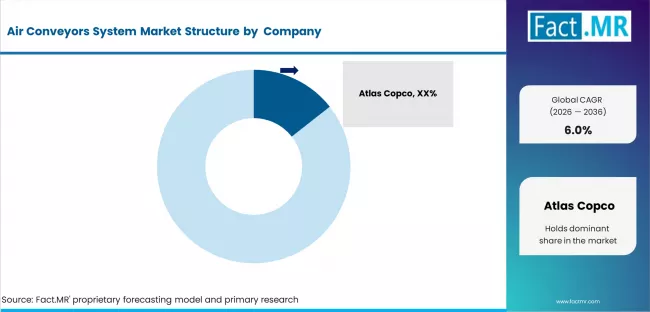
Air Conveyors System Market Analysis By Company

The air conveyors system industry is extremely competitive in nature; however, it is dominated by some of the prominent international players dealing with the designing and development of pneumatic conveying and material handling systems such as Atlas Copco, Coperion, Alantech, Gerick, and Nilfisk, collectively contributing towards about 35-40% of the entire market share globally. Their dominance in the industry can be attributed to constant innovation in areas like pneumatic conveying technology, energy-efficient system designs, and automation & process control solutions.

Key Players of the Air Conveyors System Market

  • KI Conequip
  • Macawber Engineering Systems
  • Coperion
  • Alantech
  • Samarth Engineering
  • Dynamic Air
  • Gerick
  • Nilfisk
  • Zeppelin
  • Nol Tec Systems
  • Cyclonaire Corporation
  • VAC-U-MAX
  • Atlas Copco
  • Rieco
  • GEA Group

Recent Industry Developments

  • CPM|Crown expands offering with full line of conveyor solutions (2026), Crown has expanded its industry-leading equipment and service offering to include a full portfolio of conveyor solutions, strengthening CPM Crown’s ability to deliver integrated, end-to-end systems. [1]
  • AGI Launches Diesel-Powered Auger and Conveyor (2026): unveils two innovative diesel-powered grain handling solutions – the STX3 Auger and the UCX4 Conveyor. [2]
  • Formpak Inc. Acquires Pneumatic Conveying Inc. (2025): Formpak Inc., a leading provider of bulk handling equipment and integrated material transfer solutions, is proud to announce the acquisition of Pneumatic Conveying Inc, an industry innovator in pneumatic material handling systems.[3]
  • Ultimation Industries Launches VectoRoller™ to Boost Pick Stations (2025): New patent-pending roller design reduces lateral friction by up to 80% and retrofits into existing conveyor systems. [4]
  • Aerzen acquiring ACI - Air Center International GmbH (2025): AERZEN, one of the world's leading manufacturers of machines for conveying and compressing gases, is opening a new chapter in its more than 160-year company history: with the acquisition of ACI - Air Center International GmbH, the pioneer in compressor technology.  [5]

Sources and Research References

  • [1] “CPM|Crown expands offering with full line of conveyor solutions”, 2026
  • [2] “AGI unveils two innovative diesel-powered grain handling solutions – the STX3 Auger and the UCX4 Conveyor.”, 2025
  • [3] “Formpak Acquires Pneumatic Conveying Inc., Expanding Capabilities and Customer Value”, 2025
  • [4] “Ultimation Industries Launches VectoRoller™ to Boost Pick Stations, Manual Diverts, and Warehouse Efficiency”, 2026
  • [5] “AERZEN, one of the world's leading manufacturers of machines for conveying and compressing gases, is acquiring of ACI - Air Center International GmbH”, 2025

Air Conveyors System Market Definition

Air conveyors system market includes pneumatic and air conveyance systems used for carrying dry bulk materials such as powders and granules from one place to another without manual effort.

Air Conveyors System Market Inclusions

The market for air conveyors system encompasses all pneumatic conveying and Air Conveyors System for the transport of powders, granules, and dry bulk solids from one end to another in industries, such as manufacturing industry, food industry, chemical industries, pharmaceutical industries, and logistics industry. Some of the systems in the air conveying system are positive pressure conveying system, vacuum conveying system, and combined conveying system.

Air Conveyors System Market Exclusions

Air conveyors system market does not cover any kind of traditional mechanical material handling systems like conveyor belts, screw conveyors, bucket elevators, and others, which do not involve pneumatic systems to move bulk materials using air pressure/vacuum systems.

Air Conveyors System Market Research Methodology

  • Primary Research
    • The present-day industry trends in the air conveyors system market have been identified on the basis of inputs provided by stakeholders in the value chain. These include producers of pneumatic conveyance systems, suppliers of components, and automation companies. Input was also obtained from the consumers who use air conveyors in their operations.
  • Desk Research
    • The air conveyors system market analysis was based on secondary research through the use of annual reports of the companies and relevant publications within the industry. Other findings included those related to bulk material handling systems and automation within industries.
  • Market-Sizing and Forecasting
    • The valuation of the air conveyors system market was calculated through the aggregation of revenues earned by companies offering pneumatic conveyors systems, bulk material handling systems, compressors and blowers, and automation solutions.
  • Data Validation and Update Cycle
    • Air conveyors systems market data goes through several verification processes with industry and company-level references. Updates are regularly made according to the advancements in industrial automation and process engineering technologies.

Scope of Analysis

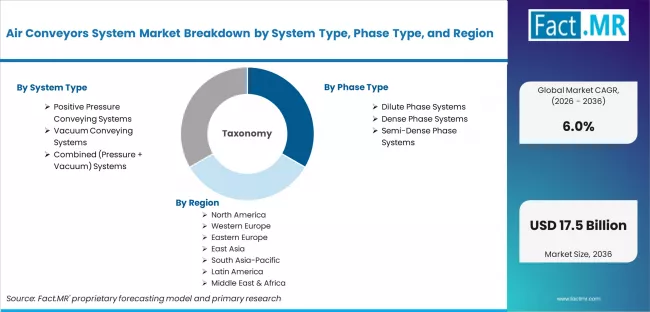
Air Conveyors System Market Breakdown By System Type, Phase Type, And Region

Parameter Details
Quantitative Units USD 9.2 billion in 2025 to USD 17.5 billion in 2036, at a CAGR of 6.0%
Market Definition The Air Conveyors System Market comprises pneumatic and air-based bulk material handling systems used for transporting powders, granules, and other dry bulk materials across industrial facilities. These systems operate using positive pressure, vacuum, or combined conveying mechanisms to enable efficient, continuous, and contamination-free material.
Regions Covered North America, Latin America, Europe, East Asia, South Asia & Pacific, Middle East & Africa
Countries Covered USA, Canada, UK, Germany, China, India, 30 plus countries
Key Companies Atlas Copco, Coperion, Alantech, Gerick, Nilfisk, and others
Forecast Period 2026 to 2036
Approach Hybrid demand-side and top-down methodology based on industrial automation trends, expansion of manufacturing and processing industries, increasing adoption of energy-efficient bulk material handling systems, and growth in smart factory and process optimization technologies across global industries.

Analysis by Product Type, by Phase Type, by System Configuration, by Operation Mode, and by Region

  • Air Conveyors System Market By System Type

    • Positive Pressure Conveying Systems
    • Vacuum Conveying Systems
    • Combined (Pressure + Vacuum) Systems
  • Air Conveyors System Market By Phase Type

    • Dilute Phase Systems
      • Lean Phase Conveying
      • Suspended Flow Conveying
    • Dense Phase Systems
      • Plug Flow Conveying
      • Pulse/Slug Flow Conveying
    • Semi-Dense Phase Systems
      • Intermediate Velocity Systems
      • Controlled Flow Systems
  • Air Conveyors System Market By System Configuration

    • Single Line Systems
      • One Source to One Destination
      • Dedicated Transfer Lines
    • Multi Line Systems
      • Multiple Sources to Multiple Destinations
      • Parallel Conveying Networks
    • Centralized Network Systems
      • Central Air Generation Unit
      • Plant-Wide Distribution Systems
  • Air Conveyors System Market By End-Use Industry

    • Manufacturing
    • Power Generation
    • Food and Beverage
    • Pharmaceuticals
    • Chemicals
    • Petrochemicals
    • Metals, Minerals, and Ceramics
    • Plastic and Rubber
    • Pulp and Paper
    • Others
  • Air Conveyors System Market By Region

    • North America
      • USA
      • Canada
      • Mexico
    • Latin America
      • Brazil
      • Chile
      • Rest of LATAM
    • East Asia
      • China
      • Japan
      • South Korea
    • Western Europe
      • Germany
      • Italy
      • France
      • U.K.
      • Spain
      • BENELUX
      • Nordic
      • Rest of W. Europe
    • Eastern Europe
      • Russia
      • Hungary
      • Poland
      • Balkan & Baltics
      • Rest of E. Europe
    • Middle East and Africa
      • Kingdom of Saudi Arabia
      • United Arab Emirates
      • South Africa
      • Rest of Middle East and Africa

- Frequently Asked Questions -

How large is the demand for Air Conveyors System in the global market in 2025?

Demand for Air Conveyors System in the global market is estimated to be valued at USD 9.2 billion in 2025.

What will be the market size of Air Conveyors System in the global market by 2036?

The market size for Air Conveyors System is projected to reach USD 17.5 billion by 2036.

What is the expected demand growth for Air Conveyors System in the global market between 2026 and 2036?

Demand for Air Conveyors System in the global market is expected to grow at a CAGR of 6.0% between 2026 and 2036.

Which system type segment is expected to dominate the Air Conveyors System Market?

Positive Pressure Conveying Systems are expected to dominate the market, accounting for around 58.3% share in 2026, driven by high efficiency, cost-effectiveness, and widespread use in long-distance bulk material handling across manufacturing, food, and chemical industries.

How significant is the growth outlook for India in this market?

India is expected to grow at a CAGR of 7.0% through 2036, reflecting strong demand from rapid industrial expansion, growth in food processing and chemical industries, and increasing adoption of automated pneumatic conveying systems in modern manufacturing facilities.

Which company is identified as a leading player in the Air Conveyors System market?

Atlas Copco is recognized as a leading player in the market, offering advanced pneumatic conveying and material handling solutions supported by strong engineering capabilities, energy-efficient system designs, and wide industrial applications across manufacturing and processing industries.

Table of Content

  1. Air Conveyors System Market – Executive Summary
  2. Market Overview
    • Market Definition & Introduction
    • Market Taxonomy & Research Scope
  3. Global Air Conveyors System Market Demand Analysis 2021-2025 and Forecast, 2026–2036
    • Historical Market Volume (Units) Analysis, 2021-2025
    • Current and Future Market Volume (Units) Projections, 2026–2036
    • Y-o-Y Growth Trend Analysis
  4. Global Air Conveyors System Market - Pricing Analysis
    • Product Category and Country-Level Pricing Analysis
    • Region Average Pricing Analysis Benchmark
    • Price Trends and Forecasts
      • Historical price trends
      • Future price forecasts
    • Factors Influencing Pricing
    • Competitive Pricing Strategies
    • Cost Structure Analysis
  5. Global Air Conveyors System Market Demand (in Value or Size in US$ Mn) Analysis 2021-2025 and Forecast, 2026–2036
    • Historical Market Value (US$ Mn) Analysis, 2021-2025
    • Current and Future Market Value (US$ Mn) Projections, 2026–2036
      • Y-o-Y Growth Trend Analysis
      • Absolute $ Opportunity Analysis
  6. Market Background and Foundational Data Points
    • Installed Base of Facility Spaces Requiring Air Conveying Systems (%)
    • AI / Automation-Enabled System Penetration Rate (%)
    • Average Material Handling Load per Facility
    • System Lifecycle / Replacement Frequency (Years)
    • OEM vs Aftermarket Demand Split (%)
    • Industry-wise Operational Criticality Index (0–100)
    • Adoption Rate of Automated Conveying Systems (%)
    • Operational Intensity (Utilization Levels %)
    • Phase Type Mix Share (%)
    • Predictive Maintenance Adoption (%)
    • Energy Efficiency / Sensitivity Metrics (%)
    • Air Conveyors System Market Opportunity Assessment
      • Total Available Market (US$ Mn)
      • Serviceable Addressable Market (US$ Mn)
      • Serviceable Obtainable Market (US$ Mn)
    • Porter’s Five Forces and PESTEL Analysis
    • Investment Feasibility Analysis
    • Macro-Economic Factors & Forecast Factors - Relevance & Impact
    • Industry Value and Supply Chain Analysis
      • List of Key Channel Partners
      • Profit Margin & Operating Margin at Each Node of Supply Chain.
      • Notes on Value Added at Each Node in the Value Chain
      • Factors Influencing Value Chain
    • Market Dynamics
      • Drivers
      • Restraints
      • Opportunity Analysis
    • Key Regulations & Certifications
  7. Air Conveyors System Market Analysis 2021-2025 and Forecast 2026–2036, By System Type
    • Introduction / Key Findings
    • Historical Market Size (US$ Mn) & Volume (Units) Trend Analysis By System Type, 2021-2025
    • Current and Future Market Size (US$ Mn) & Volume (Units) Analysis and Forecast By System Type, 2026-2036
      • Positive Pressure Conveying Systems
      • Vacuum Conveying Systems
      • Combined (Pressure + Vacuum) Systems
    • Market Attractiveness Analysis By System Type
  8. Air Conveyors System Market Analysis 2021-2025 and Forecast 2026–2036, By Phase Type
    • Introduction / Key Findings
    • Historical Market Size (US$ Mn) & Volume (Units) Trend Analysis By Phase Type, 2021-2025
    • Current and Future Market Size (US$ Mn) & Volume (Units) Analysis and Forecast By Phase Type, 2026-2036
      • Dilute Phase Systems
        • Lean Phase Conveying
        • Suspended Flow Conveying
      • Dense Phase Systems
        • Plug Flow Conveying
        • Pulse/Slug Flow Conveying
      • Semi-Dense Phase Systems
        • Intermediate Velocity Systems
        • Controlled Flow Systems
    • Market Attractiveness Analysis By Phase Type
  9. Air Conveyors System Market Analysis 2021-2025 and Forecast 2026–2036, By System Configuration
    • Introduction / Key Findings
    • Historical Market Size (US$ Mn) & Volume (Units) Trend Analysis By System Configuration, 2021-2025
    • Current and Future Market Size (US$ Mn) & Volume (Units) Analysis and Forecast By System Configuration, 2026-2036
      • Single Line Systems
        • One Source to One Destination
        • Dedicated Transfer Lines
      • Multi Line Systems
        • Multiple Sources to Multiple Destinations
        • Parallel Conveying Networks
      • Centralized Network Systems
        • Central Air Generation Unit
        • Plant-Wide Distribution Systems
    • Market Attractiveness Analysis By System Configuration
  10. Air Conveyors System Market Analysis 2021-2025 and Forecast 2026–2036, By End-Use Industry
    • Introduction / Key Findings
    • Historical Market Size (US$ Mn) & Volume (Units) Trend Analysis By End-Use Industry, 2021-2025
    • Current and Future Market Size (US$ Mn) & Volume (Units) Analysis and Forecast By End-Use Industry, 2026-2036
      • Manufacturing
      • Power Generation
      • Food and Beverage
      • Pharmaceuticals
      • Chemicals
      • Petrochemicals
      • Metals, Minerals, and Ceramics
      • Plastic and Rubber
      • Pulp and Paper
      • Others
    • Market Attractiveness Analysis By End-Use Industry
  11. Global Air Conveyors System Market Analysis and Forecast, by Region
    • Introduction / Key Findings
    • Historical Market Size (US$ Mn) & Volume (Units) Trend Analysis by Region, 2021-2025
    • Current and Future Market Size (US$ Mn) & Volume (Units) Analysis and Forecast by Region, 2026-2036
      • North America
      • Latin America
      • Western Europe
      • Eastern Europe
      • East Asia
      • South Asia & Pacific
      • Middle East & Africa
    • Market Attractiveness Analysis by Region
  12. North America Air Conveyors System Market Analysis and Forecast
    • Introduction / Key Findings
    • Pricing Analysis
    • Historical Market Size (US$ Mn) & Volume (Units) Trend Analysis by Market Taxonomy, 2021-2025
    • Current and Future Market Size (US$ Mn) and Volume (Units) Analysis & Forecast by Market Taxonomy, 2026-2036
    • By Country
      • United States
      • Canada
      • Mexico
    • By Taxonomy
    • Market Attractiveness Analysis By Country & Taxonomy
    • Market Trends
    • Key Market Participants – Intensity Mapping
    • Drivers and Restraints - Impact Analysis
  13. Latin America Air Conveyors System Market Analysis and Forecast
    • Introduction / Key Findings
    • Pricing Analysis
    • Historical Market Size (US$ Mn) & Volume (Units) Trend Analysis by Market Taxonomy, 2021-2025
    • Current and Future Market Size (US$ Mn) and Volume (Units) Analysis & Forecast by Market Taxonomy, 2026-2036
    • By Country
      • Brazil
      • Chile
      • Rest of LATAM
    • By Taxonomy
    • Market Attractiveness Analysis By Country & Taxonomy
    • Market Trends
    • Key Market Participants – Intensity Mapping
    • Drivers and Restraints - Impact Analysis
  14. Western Europe Air Conveyors System Market Analysis and Forecast
    • Introduction / Key Findings
    • Pricing Analysis
    • Historical Market Size (US$ Mn) & Volume (Units) Trend Analysis by Market Taxonomy, 2021-2025
    • Current and Future Market Size (US$ Mn) and Volume (Units) Analysis & Forecast by Market Taxonomy, 2026-2036
    • By Country
      • Germany
      • Italy
      • France
      • United Kingdom
      • Spain
      • BENELUX
      • Nordics
      • Rest of Western Europe
    • By Taxonomy
    • Market Attractiveness Analysis By Country & Taxonomy
    • Market Trends
    • Key Market Participants – Intensity Mapping
    • Drivers and Restraints - Impact Analysis
  15. Eastern Europe Air Conveyors System Market Analysis and Forecast
    • Introduction / Key Findings
    • Pricing Analysis
    • Historical Market Size (US$ Mn) & Volume (Units) Trend Analysis by Market Taxonomy, 2021-2025
    • Current and Future Market Size (US$ Mn) and Volume (Units) Analysis & Forecast by Market Taxonomy, 2026-2036
    • By Country
      • Russia
      • Hungary
      • Poland
      • Balkan & Baltics
      • Rest of Eastern Europe
    • By Taxonomy
    • Market Attractiveness Analysis By Country & Taxonomy
    • Market Trends
    • Key Market Participants – Intensity Mapping
    • Drivers and Restraints - Impact Analysis
  16. East Asia Air Conveyors System Market Analysis and Forecast
    • Introduction / Key Findings
    • Pricing Analysis
    • Historical Market Size (US$ Mn) & Volume (Units) Trend Analysis by Market Taxonomy, 2021-2025
    • Current and Future Market Size (US$ Mn) and Volume (Units) Analysis & Forecast by Market Taxonomy, 2026-2036
    • By Country
      • China
      • Japan
      • South Korea
    • By Taxonomy
    • Market Attractiveness Analysis By Country & Taxonomy
    • Market Trends
    • Key Market Participants – Intensity Mapping
    • Drivers and Restraints - Impact Analysis
  17. South Asia & Pacific Air Conveyors System Market Analysis and Forecast
    • Introduction / Key Findings
    • Pricing Analysis
    • Historical Market Size (US$ Mn) & Volume (Units) Trend Analysis by Market Taxonomy, 2021-2025
    • Current and Future Market Size (US$ Mn) and Volume (Units) Analysis & Forecast by Market Taxonomy, 2026-2036
    • By Country
      • India
      • ASEAN
      • Australia & New Zealand
      • Rest of South Asia & Pacific
    • By Taxonomy
    • Market Attractiveness Analysis By Country & Taxonomy
    • Market Trends
    • Key Market Participants – Intensity Mapping
    • Drivers and Restraints - Impact Analysis
  18. Middle East & Africa Air Conveyors System Market Analysis and Forecast
    • Introduction / Key Findings
    • Pricing Analysis
    • Historical Market Size (US$ Mn) & Volume (Units) Trend Analysis by Market Taxonomy, 2021-2025
    • Current and Future Market Size (US$ Mn) and Volume (Units) Analysis & Forecast by Market Taxonomy, 2026-2036
    • By Country
      • Kingdom of Saudi Arabia
      • Other GCC Countries
      • Turkiye
      • South Africa
      • Other African Union
    • By Taxonomy
    • Market Attractiveness Analysis By Country & Taxonomy
    • Market Trends
    • Key Market Participants – Intensity Mapping
    • Drivers and Restraints - Impact Analysis
  19. Country-level Air Conveyors System Market Analysis and ForecastCanada Air Conveyors System Market Analysis
    • Introduction
    • Market Value Proportion Analysis, By Key Countries
    • Global Vs. Country Growth Comparison
      • United States Air Conveyors System Market Analysis
        • Market Size (US$ Mn) & Volume (Units) Analysis by Market Taxonomy, 2021–2036
        • By System Type
        • By Phase Type
        • By System Configuration
        • By End-Use Industry
          • Mexico Air Conveyors System Market Analysis
          • Brazil Air Conveyors System Market Analysis
          • Chile Air Conveyors System Market Analysis
          • Germany Air Conveyors System Market Analysis
          • France Air Conveyors System Market Analysis
          • Italy Air Conveyors System Market Analysis
          • Spain Air Conveyors System Market Analysis
          • United Kingdom Air Conveyors System Market Analysis
          • BENELUX Air Conveyors System Market Analysis
          • Nordics Air Conveyors System Market Analysis
          • Poland Air Conveyors System Market Analysis
          • Russia Air Conveyors System Market Analysis
          • Hungary Air Conveyors System Market Analysis
          • Balkan & Baltics Air Conveyors System Market Analysis
          • China Air Conveyors System Market Analysis
          • Japan Air Conveyors System Market Analysis
          • South Korea Air Conveyors System Market Analysis
          • India Air Conveyors System Market Analysis
          • ASEAN Air Conveyors System Market Analysis
          • ANZ Air Conveyors System Market Analysis
          • KSA Air Conveyors System Market Analysis
          • Other GCC Countries Air Conveyors System Market Analysis
          • South Africa Air Conveyors System Market Analysis
          • Turkiye Air Conveyors System Market Analysis
    • Air Conveyors System Market Structure Analysis
      • Market Analysis by Tier of Companies
      • Market Concentration
      • Market Share Analysis of Top Players
      • Market Space for New Brands and Dollar Opportunity
      • Market Presence Analysis
        • Regional Footprint of Players
        • Product Footprint by Players
    • Air Conveyors System Competition Analysis
      • Competition Dashboard
      • Pricing Analysis by Competition
      • Competition Benchmarking
      • Competition Deep Dive
        • KI Conequip
          • Overview
          • Product Portfolio
          • Sales Footprint
          • Key Developments
          • SWOT Analysis
          • Strategy Overview
          • Key Financials
        • Macawber Engineering Systems
        • Coperion
        • Alantech
        • Samarth Engineering
        • Dynamic Air
        • Gerick
        • Nilfisk
        • Zeppelin
        • Nol Tec Systems
        • Cyclonaire Corporation
        • VAC-U-MAX
        • Atlas Copco
        • Rieco
        • GEA Group
        • Other Prominent Players
    • Primary insights
    • Assumptions & Acronyms Used
    • Research Methodology & Data Source 

List Of Table

  • Table 1: Global Market Value (USD Mn) Forecast by Region, 2021 to 2036
  • Table 2: Global Market Volume (Units) Forecast by Region, 2021 to 2036
  • Table 3: Global Market Value (USD Mn) Forecast by System Type, 2021 to 2036
  • Table 4: Global Market Volume (Units) Forecast by System Type, 2021 to 2036
  • Table 5: Global Market Value (USD Mn) Forecast by Phase Type, 2021 to 2036
  • Table 6: Global Market Volume (Units) Forecast by Phase Type, 2021 to 2036
  • Table 7: Global Market Value (USD Mn) Forecast by System Configuration, 2021 to 2036
  • Table 8: Global Market Volume (Units) Forecast by System Configuration, 2021 to 2036
  • Table 9: Global Market Value (USD Mn) Forecast by End-Use Industry, 2021 to 2036
  • Table 10: Global Market Volume (Units) Forecast by End-Use Industry, 2021 to 2036
  • Table 11: North America Market Value (USD Mn) Forecast by Country, 2021 to 2036
  • Table 12: North America Market Volume (Units) Forecast by Country, 2021 to 2036
  • Table 13: North America Market Value (USD Mn) Forecast by System Type, 2021 to 2036
  • Table 14: North America Market Volume (Units) Forecast by System Type, 2021 to 2036
  • Table 15: North America Market Value (USD Mn) Forecast by Phase Type, 2021 to 2036
  • Table 16: North America Market Volume (Units) Forecast by Phase Type, 2021 to 2036
  • Table 17: North America Market Value (USD Mn) Forecast by System Configuration, 2021 to 2036
  • Table 18: North America Market Volume (Units) Forecast by System Configuration, 2021 to 2036
  • Table 19: North America Market Value (USD Mn) Forecast by End-Use Industry, 2021 to 2036
  • Table 20: North America Market Volume (Units) Forecast by End-Use Industry, 2021 to 2036
  • Table 21: Latin America Market Value (USD Mn) Forecast by Country, 2021 to 2036
  • Table 22: Latin America Market Volume (Units) Forecast by Country, 2021 to 2036
  • Table 23: Latin America Market Value (USD Mn) Forecast by System Type, 2021 to 2036
  • Table 24: Latin America Market Volume (Units) Forecast by System Type, 2021 to 2036
  • Table 25: Latin America Market Value (USD Mn) Forecast by Phase Type, 2021 to 2036
  • Table 26: Latin America Market Volume (Units) Forecast by Phase Type, 2021 to 2036
  • Table 27: Latin America Market Value (USD Mn) Forecast by System Configuration, 2021 to 2036
  • Table 28: Latin America Market Volume (Units) Forecast by System Configuration, 2021 to 2036
  • Table 29: Latin America Market Value (USD Mn) Forecast by End-Use Industry, 2021 to 2036
  • Table 30: Latin America Market Volume (Units) Forecast by End-Use Industry, 2021 to 2036
  • Table 31: Western Europe Market Value (USD Mn) Forecast by Country, 2021 to 2036
  • Table 32: Western Europe Market Volume (Units) Forecast by Country, 2021 to 2036
  • Table 33: Western Europe Market Value (USD Mn) Forecast by System Type, 2021 to 2036
  • Table 34: Western Europe Market Volume (Units) Forecast by System Type, 2021 to 2036
  • Table 35: Western Europe Market Value (USD Mn) Forecast by Phase Type, 2021 to 2036
  • Table 36: Western Europe Market Volume (Units) Forecast by Phase Type, 2021 to 2036
  • Table 37: Western Europe Market Value (USD Mn) Forecast by System Configuration, 2021 to 2036
  • Table 38: Western Europe Market Volume (Units) Forecast by System Configuration, 2021 to 2036
  • Table 39: Western Europe Market Value (USD Mn) Forecast by End-Use Industry, 2021 to 2036
  • Table 40: Western Europe Market Volume (Units) Forecast by End-Use Industry, 2021 to 2036
  • Table 41: Eastern Europe Market Value (USD Mn) Forecast by Country, 2021 to 2036
  • Table 42: Eastern Europe Market Volume (Units) Forecast by Country, 2021 to 2036
  • Table 43: Eastern Europe Market Value (USD Mn) Forecast by System Type, 2021 to 2036
  • Table 44: Eastern Europe Market Volume (Units) Forecast by System Type, 2021 to 2036
  • Table 45: Eastern Europe Market Value (USD Mn) Forecast by Phase Type, 2021 to 2036
  • Table 46: Eastern Europe Market Volume (Units) Forecast by Phase Type, 2021 to 2036
  • Table 47: Eastern Europe Market Value (USD Mn) Forecast by System Configuration, 2021 to 2036
  • Table 48: Eastern Europe Market Volume (Units) Forecast by System Configuration, 2021 to 2036
  • Table 49: Eastern Europe Market Value (USD Mn) Forecast by End-Use Industry, 2021 to 2036
  • Table 50: Eastern Europe Market Volume (Units) Forecast by End-Use Industry, 2021 to 2036
  • Table 51: East Asia Market Value (USD Mn) Forecast by Country, 2021 to 2036
  • Table 52: East Asia Market Volume (Units) Forecast by Country, 2021 to 2036
  • Table 53: East Asia Market Value (USD Mn) Forecast by System Type, 2021 to 2036
  • Table 54: East Asia Market Volume (Units) Forecast by System Type, 2021 to 2036
  • Table 55: East Asia Market Value (USD Mn) Forecast by Phase Type, 2021 to 2036
  • Table 56: East Asia Market Volume (Units) Forecast by Phase Type, 2021 to 2036
  • Table 57: East Asia Market Value (USD Mn) Forecast by System Configuration, 2021 to 2036
  • Table 58: East Asia Market Volume (Units) Forecast by System Configuration, 2021 to 2036
  • Table 59: East Asia Market Value (USD Mn) Forecast by End-Use Industry, 2021 to 2036
  • Table 60: East Asia Market Volume (Units) Forecast by End-Use Industry, 2021 to 2036
  • Table 61: South Asia and Pacific Market Value (USD Mn) Forecast by Country, 2021 to 2036
  • Table 62: South Asia and Pacific Market Volume (Units) Forecast by Country, 2021 to 2036
  • Table 63: South Asia and Pacific Market Value (USD Mn) Forecast by System Type, 2021 to 2036
  • Table 64: South Asia and Pacific Market Volume (Units) Forecast by System Type, 2021 to 2036
  • Table 65: South Asia and Pacific Market Value (USD Mn) Forecast by Phase Type, 2021 to 2036
  • Table 66: South Asia and Pacific Market Volume (Units) Forecast by Phase Type, 2021 to 2036
  • Table 67: South Asia and Pacific Market Value (USD Mn) Forecast by System Configuration, 2021 to 2036
  • Table 68: South Asia and Pacific Market Volume (Units) Forecast by System Configuration, 2021 to 2036
  • Table 69: South Asia and Pacific Market Value (USD Mn) Forecast by End-Use Industry, 2021 to 2036
  • Table 70: South Asia and Pacific Market Volume (Units) Forecast by End-Use Industry, 2021 to 2036
  • Table 71: Middle East & Africa Market Value (USD Mn) Forecast by Country, 2021 to 2036
  • Table 72: Middle East & Africa Market Volume (Units) Forecast by Country, 2021 to 2036
  • Table 73: Middle East & Africa Market Value (USD Mn) Forecast by System Type, 2021 to 2036
  • Table 74: Middle East & Africa Market Volume (Units) Forecast by System Type, 2021 to 2036
  • Table 75: Middle East & Africa Market Value (USD Mn) Forecast by Phase Type, 2021 to 2036
  • Table 76: Middle East & Africa Market Volume (Units) Forecast by Phase Type, 2021 to 2036
  • Table 77: Middle East & Africa Market Value (USD Mn) Forecast by System Configuration, 2021 to 2036
  • Table 78: Middle East & Africa Market Volume (Units) Forecast by System Configuration, 2021 to 2036
  • Table 79: Middle East & Africa Market Value (USD Mn) Forecast by End-Use Industry, 2021 to 2036
  • Table 80: Middle East & Africa Market Volume (Units) Forecast by End-Use Industry, 2021 to 2036

List Of Figures

  • Figure 1: Global Market Volume (Units) Forecast 2021–2036
  • Figure 2: Global Market Pricing Analysis
  • Figure 3: Global Market Value (USD Mn) Forecast 2021–2036
  • Figure 4: Global Market Value Share and BPS Analysis by System Type, 2026 and 2036
  • Figure 5: Global Market Y-o-Y Growth Comparison by System Type, 2026 to 2036
  • Figure 6: Global Market Attractiveness Analysis by System Type
  • Figure 7: Global Market Value Share and BPS Analysis by Phase Type, 2026 and 2036
  • Figure 8: Global Market Y-o-Y Growth Comparison by Phase Type, 2026 to 2036
  • Figure 9: Global Market Attractiveness Analysis by Phase Type
  • Figure 10: Global Market Value Share and BPS Analysis by System Configuration, 2026 and 2036
  • Figure 11: Global Market Y-o-Y Growth Comparison by System Configuration, 2026 to 2036
  • Figure 12: Global Market Attractiveness Analysis by System Configuration
  • Figure 13: Global Market Value Share and BPS Analysis by End-Use Industry, 2026 and 2036
  • Figure 14: Global Market Y-o-Y Growth Comparison by End-Use Industry, 2026 to 2036
  • Figure 15: Global Market Attractiveness Analysis by End-Use Industry
  • Figure 16: Global Market Value (USD Mn) Share and BPS Analysis by Region, 2026 and 2036
  • Figure 17: Global Market Y-o-Y Growth Comparison by Region, 2026 to 2036
  • Figure 18: Global Market Attractiveness Analysis by Region
  • Figure 19: North America Market Incremental $ Opportunity, 2026 to 2036
  • Figure 20: Latin America Market Incremental $ Opportunity, 2026 to 2036
  • Figure 21: Western Europe Market Incremental $ Opportunity, 2026 to 2036
  • Figure 22: Eastern Europe Market Incremental $ Opportunity, 2026 to 2036
  • Figure 23: East Asia Market Incremental $ Opportunity, 2026 to 2036
  • Figure 24: South Asia and Pacific Market Incremental $ Opportunity, 2026 to 2036
  • Figure 25: Middle East & Africa Market Incremental $ Opportunity, 2026 to 2036
  • Figure 26: North America Market Value Share and BPS Analysis by Country, 2026 and 2036
  • Figure 27: North America Market Value Share and BPS Analysis by System Type, 2026 and 2036
  • Figure 28: North America Market Y-o-Y Growth Comparison by System Type, 2026 to 2036
  • Figure 29: North America Market Attractiveness Analysis by System Type
  • Figure 30: North America Market Value Share and BPS Analysis by Phase Type, 2026 and 2036
  • Figure 31: North America Market Y-o-Y Growth Comparison by Phase Type, 2026 to 2036
  • Figure 32: North America Market Attractiveness Analysis by Phase Type
  • Figure 33: North America Market Value Share and BPS Analysis by System Configuration, 2026 and 2036
  • Figure 34: North America Market Y-o-Y Growth Comparison by System Configuration, 2026 to 2036
  • Figure 35: North America Market Attractiveness Analysis by System Configuration
  • Figure 36: North America Market Value Share and BPS Analysis by End-Use Industry, 2026 and 2036
  • Figure 37: North America Market Y-o-Y Growth Comparison by End-Use Industry, 2026 to 2036
  • Figure 38: North America Market Attractiveness Analysis by End-Use Industry
  • Figure 39: Latin America Market Value Share and BPS Analysis by Country, 2026 and 2036
  • Figure 40: Latin America Market Value Share and BPS Analysis by System Type, 2026 and 2036
  • Figure 41: Latin America Market Y-o-Y Growth Comparison by System Type, 2026 to 2036
  • Figure 42: Latin America Market Attractiveness Analysis by System Type
  • Figure 43: Latin America Market Value Share and BPS Analysis by Phase Type, 2026 and 2036
  • Figure 44: Latin America Market Y-o-Y Growth Comparison by Phase Type, 2026 to 2036
  • Figure 45: Latin America Market Attractiveness Analysis by Phase Type
  • Figure 46: Latin America Market Value Share and BPS Analysis by System Configuration, 2026 and 2036
  • Figure 47: Latin America Market Y-o-Y Growth Comparison by System Configuration, 2026 to 2036
  • Figure 48: Latin America Market Attractiveness Analysis by System Configuration
  • Figure 49: Latin America Market Value Share and BPS Analysis by End-Use Industry, 2026 and 2036
  • Figure 50: Latin America Market Y-o-Y Growth Comparison by End-Use Industry, 2026 to 2036
  • Figure 51: Latin America Market Attractiveness Analysis by End-Use Industry
  • Figure 52: Western Europe Market Value Share and BPS Analysis by Country, 2026 and 2036
  • Figure 53: Western Europe Market Value Share and BPS Analysis by System Type, 2026 and 2036
  • Figure 54: Western Europe Market Y-o-Y Growth Comparison by System Type, 2026 to 2036
  • Figure 55: Western Europe Market Attractiveness Analysis by System Type
  • Figure 56: Western Europe Market Value Share and BPS Analysis by Phase Type, 2026 and 2036
  • Figure 57: Western Europe Market Y-o-Y Growth Comparison by Phase Type, 2026 to 2036
  • Figure 58: Western Europe Market Attractiveness Analysis by Phase Type
  • Figure 59: Western Europe Market Value Share and BPS Analysis by System Configuration, 2026 and 2036
  • Figure 60: Western Europe Market Y-o-Y Growth Comparison by System Configuration, 2026 to 2036
  • Figure 61: Western Europe Market Attractiveness Analysis by System Configuration
  • Figure 62: Western Europe Market Value Share and BPS Analysis by End-Use Industry, 2026 and 2036
  • Figure 63: Western Europe Market Y-o-Y Growth Comparison by End-Use Industry, 2026 to 2036
  • Figure 64: Western Europe Market Attractiveness Analysis by End-Use Industry
  • Figure 65: Eastern Europe Market Value Share and BPS Analysis by Country, 2026 and 2036
  • Figure 66: Eastern Europe Market Value Share and BPS Analysis by System Type, 2026 and 2036
  • Figure 67: Eastern Europe Market Y-o-Y Growth Comparison by System Type, 2026 to 2036
  • Figure 68: Eastern Europe Market Attractiveness Analysis by System Type
  • Figure 69: Eastern Europe Market Value Share and BPS Analysis by Phase Type, 2026 and 2036
  • Figure 70: Eastern Europe Market Y-o-Y Growth Comparison by Phase Type, 2026 to 2036
  • Figure 71: Eastern Europe Market Attractiveness Analysis by Phase Type
  • Figure 72: Eastern Europe Market Value Share and BPS Analysis by System Configuration, 2026 and 2036
  • Figure 73: Eastern Europe Market Y-o-Y Growth Comparison by System Configuration, 2026 to 2036
  • Figure 74: Eastern Europe Market Attractiveness Analysis by System Configuration
  • Figure 75: Eastern Europe Market Value Share and BPS Analysis by End-Use Industry, 2026 and 2036
  • Figure 76: Eastern Europe Market Y-o-Y Growth Comparison by End-Use Industry, 2026 to 2036
  • Figure 77: Eastern Europe Market Attractiveness Analysis by End-Use Industry
  • Figure 78: East Asia Market Value Share and BPS Analysis by Country, 2026 and 2036
  • Figure 79: East Asia Market Value Share and BPS Analysis by System Type, 2026 and 2036
  • Figure 80: East Asia Market Y-o-Y Growth Comparison by System Type, 2026 to 2036
  • Figure 81: East Asia Market Attractiveness Analysis by System Type
  • Figure 82: East Asia Market Value Share and BPS Analysis by Phase Type, 2026 and 2036
  • Figure 83: East Asia Market Y-o-Y Growth Comparison by Phase Type, 2026 to 2036
  • Figure 84: East Asia Market Attractiveness Analysis by Phase Type
  • Figure 85: East Asia Market Value Share and BPS Analysis by System Configuration, 2026 and 2036
  • Figure 86: East Asia Market Y-o-Y Growth Comparison by System Configuration, 2026 to 2036
  • Figure 87: East Asia Market Attractiveness Analysis by System Configuration
  • Figure 88: East Asia Market Value Share and BPS Analysis by End-Use Industry, 2026 and 2036
  • Figure 89: East Asia Market Y-o-Y Growth Comparison by End-Use Industry, 2026 to 2036
  • Figure 90: East Asia Market Attractiveness Analysis by End-Use Industry
  • Figure 91: South Asia and Pacific Market Value Share and BPS Analysis by Country, 2026 and 2036
  • Figure 92: South Asia and Pacific Market Value Share and BPS Analysis by System Type, 2026 and 2036
  • Figure 93: South Asia and Pacific Market Y-o-Y Growth Comparison by System Type, 2026 to 2036
  • Figure 94: South Asia and Pacific Market Attractiveness Analysis by System Type
  • Figure 95: South Asia and Pacific Market Value Share and BPS Analysis by Phase Type, 2026 and 2036
  • Figure 96: South Asia and Pacific Market Y-o-Y Growth Comparison by Phase Type, 2026 to 2036
  • Figure 97: South Asia and Pacific Market Attractiveness Analysis by Phase Type
  • Figure 98: South Asia and Pacific Market Value Share and BPS Analysis by System Configuration, 2026 and 2036
  • Figure 99: South Asia and Pacific Market Y-o-Y Growth Comparison by System Configuration, 2026 to 2036
  • Figure 100: South Asia and Pacific Market Attractiveness Analysis by System Configuration
  • Figure 101: South Asia and Pacific Market Value Share and BPS Analysis by End-Use Industry, 2026 and 2036
  • Figure 102: South Asia and Pacific Market Y-o-Y Growth Comparison by End-Use Industry, 2026 to 2036
  • Figure 103: South Asia and Pacific Market Attractiveness Analysis by End-Use Industry
  • Figure 104: Middle East & Africa Market Value Share and BPS Analysis by Country, 2026 and 2036
  • Figure 105: Middle East & Africa Market Value Share and BPS Analysis by System Type, 2026 and 2036
  • Figure 106: Middle East & Africa Market Y-o-Y Growth Comparison by System Type, 2026 to 2036
  • Figure 107: Middle East & Africa Market Attractiveness Analysis by System Type
  • Figure 108: Middle East & Africa Market Value Share and BPS Analysis by Phase Type, 2026 and 2036
  • Figure 109: Middle East & Africa Market Y-o-Y Growth Comparison by Phase Type, 2026 to 2036
  • Figure 110: Middle East & Africa Market Attractiveness Analysis by Phase Type
  • Figure 111: Middle East & Africa Market Value Share and BPS Analysis by System Configuration, 2026 and 2036
  • Figure 112: Middle East & Africa Market Y-o-Y Growth Comparison by System Configuration, 2026 to 2036
  • Figure 113: Middle East & Africa Market Attractiveness Analysis by System Configuration
  • Figure 114: Middle East & Africa Market Value Share and BPS Analysis by End-Use Industry, 2026 and 2036
  • Figure 115: Middle East & Africa Market Y-o-Y Growth Comparison by End-Use Industry, 2026 to 2036
  • Figure 116: Middle East & Africa Market Attractiveness Analysis by End-Use Industry
  • Figure 117: Global Market – Tier Structure Analysis
  • Figure 118: Global Market – Company Share Analysis

Air Conveyors System Market