- Base Value(2025): 637.0 Mn
- Estimated Value(2026): 690.0 Mn
- Forecast Value (2036): 1517.0 Mn
- CAGR (2026 - 2036): 8.2%
Bamboo Fiber Reinforced Panels Market Forecast and Outlook 2026 to 2036
In 2025, the bamboo fiber reinforced panels market was valued at USD 637.0 million. Based on Fact.MR analysis, demand for bamboo fiber reinforced panels is estimated to grow to USD 690.0 million in 2026 and USD 1,517.0 million by 2036. Fact.MR projects a CAGR of 8.2% during the forecast period. Growth reflects expanding use of engineered bamboo panels in interior construction, furniture manufacturing, and modular building components where dimensional control and mechanical consistency are specified.
The market adds approximately USD 880.0 million in value over the decade, indicating accelerated compounding driven by higher specification adoption rather than broad panel substitution. Demand progression follows interior fit out activity and prefabricated construction, while pricing reflects fiber processing, resin systems, and quality assurance protocols. Value growth is supported by wider acceptance of engineered bamboo panels in regulated building applications, even where overall panel volumes expand at a measured pace.
Industry disclosures and procurement patterns indicate that adoption is strongest among suppliers that demonstrate repeatable panel performance across batches and regions. Buyers increasingly prioritise certified mechanical properties, moisture tolerance, and dimensional stability over material novelty. This preference favours manufacturers with integrated sourcing, controlled processing, and documented compliance with engineered panel standards, reinforcing value capture among established producers rather than fragmented entrants.
India records the fastest growth at 9.5% CAGR due to public housing and interior construction activity. Vietnam follows at 8.9% through residential and institutional projects, while China grows at 8.6% supported by prefabricated building programs. Indonesia posts 8.4% driven by alternative material adoption in housing, and the Philippines reaches 8.1% through urban development works. Mature markets including the United States at 4.2% and Germany at 3.4% remain specification led, constrained by certification timelines and conservative material approval processes.
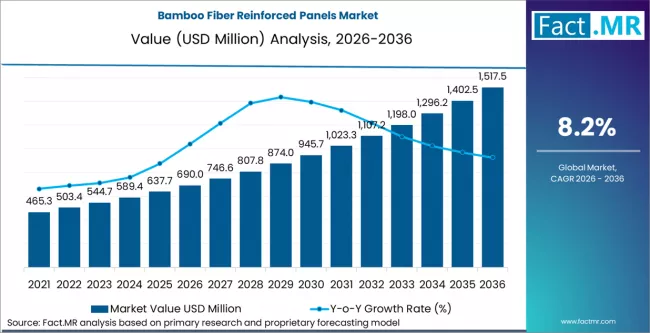
Bamboo Fiber Reinforced Panels Market Market Value Analysis | Source: Fact.MR
Bamboo Fiber Reinforced Panels Market Definition
The bamboo fiber reinforced panels market covers engineered panel products manufactured by combining processed bamboo fibers with resin binders and pressing them into rigid boards. Bamboo fibers provide tensile strength, while the binder holds the structure together under load. These panels are used as structural and semi structural materials in building interiors, furniture, and modular construction components. The products are traded as flat panels supplied to manufacturers, contractors, and fabricators. Material characteristics and panel performance align with engineered wood and natural fiber composite guidance issued by ISO for fiber based panels [1].
Bamboo Fiber Reinforced Panels Market Inclusions
The report covers global and regional market size estimates in volume and value terms with a forecast period from 2026 to 2036. It includes segmentation by panel type, density class, and binder system, along with application areas such as interior construction and furniture manufacturing. End use coverage includes residential and commercial building sectors. The scope also includes regional demand patterns and trade flows linked to bamboo based panel products reported by UN Comtrade [2].
Bamboo Fiber Reinforced Panels Market Exclusions
The scope excludes solid bamboo lumber, bamboo plywood without fiber reinforcement, and conventional wood based panels such as MDF, particleboard, and plywood. Downstream finished goods including furniture, flooring systems, and prefabricated building modules are not included. Decorative bamboo products, handicrafts, consumer items, laboratory scale materials, and experimental composites without commercial panel production are excluded from the analysis.
Bamboo Fiber Reinforced Panels Market Research Methodology
- Primary Research: Primary research involved interviews with panel manufacturers, bamboo processing firms, furniture producers, and construction material distributors active in regional supply chains.
- Desk Research: Desk research used ISO panel standards, forestry and bamboo production statistics from the Food and Agriculture Organization of the United Nations, customs trade data from UN Comtrade, and company annual reports and technical product datasheets filed with securities regulators.
- Market Sizing and Forecasting: Market sizing applied a hybrid top down and bottom up model using bamboo harvest volumes reported by FAO and panel yield assumptions based on industrial processing norms.
Data Validation and Update Cycle
Outputs were cross checked against trade statistics, production disclosures, and government forestry data, with updates applied when verified public sources release revisions.
Summary of Bamboo Fiber Reinforced Panels Market
Market Definition
- The bamboo fiber reinforced panels market covers engineered panels manufactured by bonding processed bamboo fibers with resin systems to produce rigid boards used in interior construction, furniture, and modular building components, aligned with ISO guidance for fiber-based and composite panels [3].
Demand Drivers
- Interior construction firms and furniture manufacturers are specifying bamboo fiber reinforced panels where dimensional stability, machining consistency, and repeatable mechanical performance are required, based on Fact.MR analysis.
- Growth in prefabricated housing and modular interior systems across Asia Pacific is increasing adoption of standardized bamboo composite panels supplied in controlled formats, as per Fact.MR.
- Public housing and institutional procurement programs are favouring engineered panels with documented performance and batch consistency rather than raw material novelty, according to Fact.MR.
Key Segments Analyzed
- Panel type: Bamboo fiber composite boards lead with an estimated 49% share in 2026 due to controlled fiber dispersion and consistent resin bonding that supports predictable panel performance, based on Fact.MR.
- Application: Interior wall and ceiling panels account for around 35% of demand, reflecting steady interior fit-out activity across residential, commercial, and institutional buildings, as per Fact.MR.
- Geography: Asia Pacific records the fastest growth led by India, Vietnam, China, Indonesia, and the Philippines, while North America and Europe remain certification-driven markets, based on Fact.MR analysis.
Analyst Opinion at Fact.MR
- Shambhu Nath Jha, Principal Consultant at Fact.MR, opines, ‘CXOs will find that demand for bamboo fiber reinforced panels depends on manufacturing discipline, certification compliance, and repeatable panel performance rather than raw bamboo availability alone.’
Strategic Implications and Executive Takeaways
- Fact.MR is of the opinion that manufacturers should prioritise process control and quality assurance to meet specification-led demand in interior and modular construction.
- Fact.MR opines that expanding certified product portfolios can improve acceptance in public housing and institutional procurement frameworks.
- Fact.MR analysts recommend strengthening regional supply reliability and compliance documentation to support multi-country adoption.
Methodology
- Based on Fact.MR’s report, estimates draw on primary interviews with panel manufacturers, bamboo processors, furniture producers, and construction material distributors.
- Fact.MR analysis integrates ISO panel standards, FAO bamboo production data, and international trade flows reported by UN Comtrade
- Outputs were validated through cross-checks against production disclosures, trade statistics, and government forestry and housing data.
Segmental Analysis
Bamboo Fiber Reinforced Panels Market Analysis by Panel Type
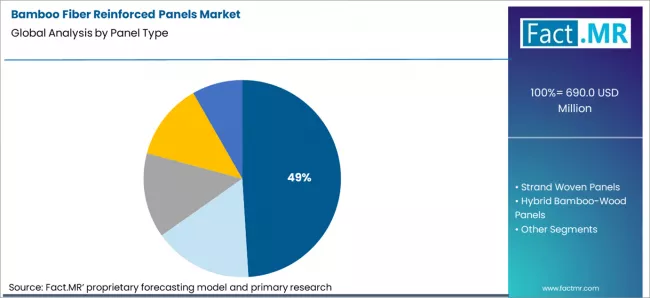
Bamboo Fiber Reinforced Panels Market Analysis By Panel Type | Source: Fact.MR
Based on Fact.MR analysis, consumption of bamboo fiber composite boards is estimated to hold 49% share in 2026. Fact.MR analysts note that composite boards dominate due to controlled fiber dispersion and resin bonding, which delivers consistent panel thickness and mechanical performance across production batches. As per Fact.MR, this panel type addresses buyer requirements for predictable machining, fastening reliability, and dimensional control in interior construction and furniture manufacturing.
- Manufacturing capacity: MOSO International reports industrial scale production of bamboo composite boards through dedicated processing facilities supplying standardized panel formats for building and interior applications.
- Material testing: International Organization for Standardization ISO 22156 defines mechanical property evaluation methods for bamboo-based composites, supporting their classification as engineered structural panel materials.
- Procurement pattern: Fact.MR analysts reference public construction specifications that list engineered fiber panels where uniform thickness and predictable load transfer are required for modular installation systems.
Bamboo Fiber Reinforced Panels Market Analysis by Application
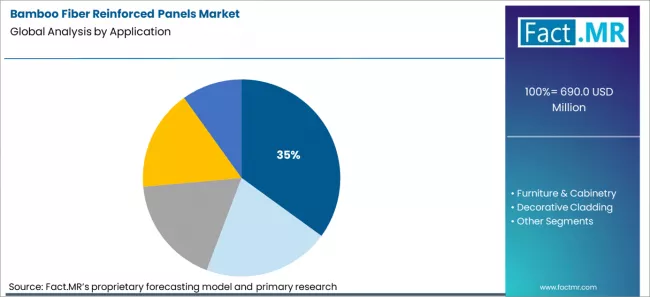
Bamboo Fiber Reinforced Panels Market Analysis By Application | Source: Fact.MR
Based on Fact.MR analysis, consumption in interior wall and ceiling panel applications is estimated to hold 35% share in 2026. Fact.MR opines that this segment leads due to steady interior fit out activity across residential, commercial, and institutional buildings. As per Fact.MR, bamboo fiber panels address handling and installation constraints by providing lighter weight alternatives to mineral boards while meeting stiffness and surface finish requirements for non-load bearing wall and ceiling systems.
- Building specification: Central Public Works Department specifications for public buildings include engineered fiber and wood based panels for interior wall and ceiling works.
- Product deployment: Plyboo publishes technical documentation for bamboo composite panels used in interior wall and ceiling installations across commercial and institutional projects.
- Construction linkage: Fact.MR analysts reference government housing and urban development programs that increase interior finishing volumes, supporting recurring demand for panelized wall and ceiling systems.
Bamboo Fiber Reinforced Panels Market Drivers, Restraints, And Opportunities
Fact.MR analysis indicates that the bamboo fiber reinforced panels market exists as a sub-segment of engineered wood and composite panel materials used in construction, furniture, interior cladding, and industrial applications. As per FACT.MR, bamboo fibers provide favourable physico-mechanical properties such as tensile strength and lightweight characteristics that enhance mechanical performance when combined with polymeric or cementitious matrices, supporting structural use cases that seek alternatives to traditional timber or synthetic fiber panels. FACT.MR analysts observe that market value is shaped by increasing demand for low-impact and renewable materials within construction and furniture segments, which aligns with sustainability goals and circular economy principles that drive material selection.
FACT.MR is of the opinion that current market dynamics reflect a transition from conventional composite panels toward more engineered bamboo fiber panels, even though full structural adoption is constrained by durability and performance benchmarking considerations. Based on FACT.MR’s report, standard particleboard and plywood maintain larger volume demand in traditional construction and interior applications, but bamboo fiber-reinforced panels grow where specifications call for lower environmental footprint and improved mechanical characteristics such as stiffness and strength. These engineered panels typically carry higher per-unit pricing because of manufacturing complexity and quality control protocols, resulting in value growth that can outstrip volume growth in specialised application niches despite moderate overall panel tonnage expansion.
- Renewable Materials Preference: FACT.MR analysts note that growing interest in renewable, fast-regenerating resources like bamboo, which can grow to maturity quickly and offers a low carbon footprint relative to traditional timber, supports adoption of bamboo fiber panels in certified green construction projects.
- Performance-Based Specification Shift: Based on FACT.MR’s report, engineered panel specifications in furniture, wall cladding, and partition applications increasingly call for enhanced mechanical strength and durability, prompting panel manufacturers to incorporate bamboo fibers to meet these performance criteria.
- Asia Pacific Production Dynamics: FACT.MR opines that abundant bamboo raw material availability and lower processing costs in China, India, and Southeast Asia create regional production advantages and export capacity for bamboo fiber reinforced panels that align with the global growth in eco-friendly composite materials.
Regional Analysis
Based on regional assessment, the bamboo fiber reinforced panels sector is analyzed across North America, Latin America, Europe, East Asia, South Asia, Oceania, and the Middle East & Africa, spanning more than 40 countries. Regional performance varies according to green construction adoption, availability of bamboo-based raw materials, and growth in interior panel and furniture manufacturing. The report also presents a comparative market attractiveness evaluation grounded in region-specific demand trends.
Bamboo Fiber Reinforced Panels Market CAGR Analysis by Country (2026-2036)
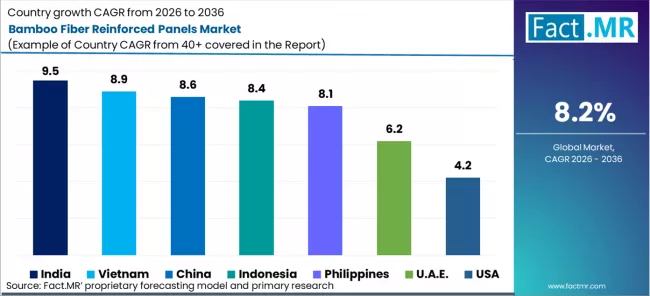
Bamboo Fiber Reinforced Panels Market Cagr Analysis By Country | Source: Fact.MR
| Country | CAGR |
|---|---|
| India | 9.5% |
| Vietnam | 8.9% |
| China | 8.6% |
| Indonesia | 8.4% |
| Philippines | 8.1% |
| U.A.E. | 6.2% |
| United States | 4.2% |
| Germany | 3.4% |
Source: Fact.MR analysis. Updated Feb 17, 2026
Source: Fact.MR analysis, based on proprietary forecasting models and primary research.
Asia Pacific Bamboo Fiber Reinforced Panels Market Analysis
Asia Pacific functions as a manufacturing- and adoption-led region for bamboo fiber reinforced panels, supported by domestic bamboo availability and public housing, furniture, and interior construction standards. Usage follows government building codes, procurement norms, and material specifications issued by national authorities across emerging economies.
- India: Demand for bamboo fiber reinforced panels in India is projected to rise at 9.5% CAGR through 2036. Use is referenced in building material guidelines issued by the Bureau of Indian Standards in July 2021 and reinforced through public housing and interior works under PMAY tenders released during September 2022, as per Fact.MR.
- Vietnam: Demand for bamboo fiber reinforced panels in Vietnam is projected to rise at 8.9% CAGR through 2036. Application is documented in green building material criteria issued by the Ministry of Construction in June 2020 and reinforced through public housing projects approved in October 2022, according to Fact.MR.
- China: Demand for bamboo fiber reinforced panels in China is projected to rise at 8.6% CAGR through 2036. Use follows engineered bamboo product standards under GB norms revised in August 2020 and reinforced through government-backed prefabricated housing programs tendered during May 2022, as per Fact.MR.
- Indonesia: Demand for bamboo fiber reinforced panels in Indonesia is projected to rise at 8.4% CAGR through 2036. Application is specified under alternative building material guidelines issued by the Ministry of Public Works in July 2021 and applied in public housing construction contracts released in February 2023, according to Fact.MR.
- Philippines: Demand for bamboo fiber reinforced panels in the Philippines is projected to rise at 8.1% CAGR through 2036. Use is referenced in construction material standards under the Department of Trade and Industry issued in May 2021 and reinforced through social housing projects tendered in November 2022, as per Fact.MR.
Fact.MR’s analysis of the bamboo fiber reinforced panels market in Asia Pacific consists of country-wise assessment that includes India, Vietnam, China, Indonesia, and the Philippines. Readers can find material standards, public housing procurement, and application-level references.
Middle East Bamboo Fiber Reinforced Panels Market Analysis
The Middle East operates as a specification-led adoption market for bamboo fiber reinforced panels, with use linked to interior fit-outs and non-structural building components. Demand follows municipal building codes and public project material approvals rather than domestic raw material availability.
- U.A.E.: Demand for bamboo fiber reinforced panels in the U.A.E. is projected to rise at 6.2% CAGR through 2036. Application is permitted under Dubai Municipality approved building material listings updated in March 2021 and reinforced through interior fit-out contracts for public buildings issued during October 2022, as per Fact.MR.
Fact.MR’s analysis of the bamboo fiber reinforced panels market in the Middle East consists of country-wise assessment that includes the U.A.E. Readers can find municipal approvals, material listings, and public procurement references.
North America Bamboo Fiber Reinforced Panels Market Analysis
North America functions as a standards- and certification-driven market for bamboo fiber reinforced panels, with use governed by building codes, interior material standards, and procurement policies for public projects.
- United States: Demand for bamboo fiber reinforced panels in the United States is projected to rise at 4.2% CAGR through 2036. Use is referenced in material compliance listings under ICC evaluation reports issued in April 2021 and reinforced through federal building interior specifications applied in public construction projects during 2022, according to Fact.MR.
Fact.MR’s analysis of the bamboo fiber reinforced panels market in North America consists of country-wise assessment that includes the United States. Readers can find certification requirements, code references, and application-level documentation.
Europe Bamboo Fiber Reinforced Panels Market Analysis
Europe operates as a regulation-led adoption market for bamboo fiber reinforced panels, with usage governed by harmonized construction product standards and public procurement rules.
- Germany: Demand for bamboo fiber reinforced panels in Germany is projected to rise at 3.4% CAGR through 2036. Application is permitted under construction product requirements aligned with DIN standards updated in June 2020 and reinforced through public building interior refurbishment projects tendered in February 2022, as per Fact.MR.
Fact.MR’s analysis of the bamboo fiber reinforced panels market in Europe consists of country-wise assessment that includes Germany. Readers can find regulatory approvals, procurement practices, and material compliance references.
How Are Supply Chain Alignment, Certification Compliance, and Material Performance Validation Creating Competitive Moats in the Bamboo Fiber Reinforced Panels Market?
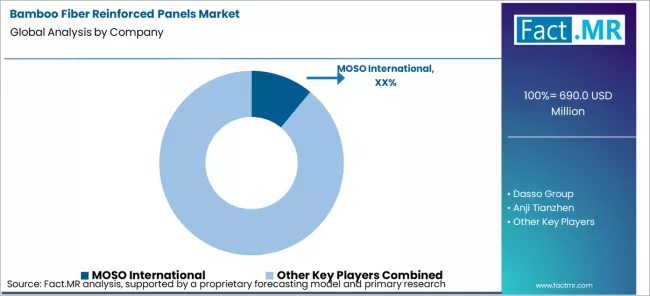
Bamboo Fiber Reinforced Panels Market Analysis By Company | Source: Fact.MR
As per Fact.MR analysis, the bamboo fiber reinforced panels market in 2026 is defined by a shift from basic panel products to performance‑validated composite solutions where supply network strength, certification adherence, and multi‑region compliance determine competitive advantage. MOSO International and Dasso Group leverage vertically integrated supply chains and long‑term sourcing agreements, which reinforce consistent fiber quality and dimensional stability demanded by builders and OEMs. Anji Tianzhen and Zhejiang Yongyu Bamboo emphasise validated mechanical properties and moisture resistance data, which increases adoption in structural and interior applications. Smith & Fong and Teragren focus on design‑ready composite finishes with documented performance across load, humidity, and thermal cycles, which strengthens specification in architectural markets. Fujian Huayu Bamboo, Guangdong Vanach, and Huabao Bamboo support regional responsiveness and tailored dimensional offerings, which improves delivery reliability in Asia‑Pacific markets. Regional composite panel makers enhance local market penetration through rapid fulfillment and compliance with regional building codes. Across the market, validated performance data, integrated supply networks, and multi‑region certification create enduring competitive moats that reduce reliance on material claims alone.
Recent Industry Developments
- The Launch of the "Rubin" AI Platform (January 2026): In January 2026, NVIDIA officially transitioned from the Blackwell architecture to the Rubin platform, its first "extreme-codesigned" six-chip AI platform. This development is significant because it introduces Vera CPUs, specifically engineered for "agentic processing"-hardware built specifically to handle the reasoning loops of autonomous AI agents rather than just raw data processing. [4]
- Implementation of the "India AI Governance Guidelines" (February 2026): On February 15, 2026, the Indian government released the India AI Governance Guidelines. This is a landmark shift in the industry as it moves from "voluntary safety" to a "techno-legal approach." It established the AI Safety Institute and integrated AI directly into Digital Public Infrastructure (DPI), providing 38,000+ GPUs to startups via an official government portal to decentralize AI compute power. [5]
Key Players in Bamboo Fiber Reinforced Panels Market
- MOSO International
- Dasso Group
- Anji Tianzhen
- Zhejiang Yongyu Bamboo
- Smith & Fong
- Teragren
- Fujian Huayu Bamboo
- Guangdong Vanach
- Huabao Bamboo
- Regional Composite Panel Makers
Bibliography
- [1] International Organization for Standardization. (2019). ISO 22156: Bamboo structures - Bamboo-based composite products - Structural design. ISO.
- [2] United Nations Statistics Division. (2024). UN Comtrade database. United Nations.
- [3] International Organization for Standardization. (2019). ISO 22156: Bamboo structures - Bamboo-based composite products - Structural design. ISO.
- [4] NVIDIA Corporation. (2026). CES 2026 special presentation: Introducing the Rubin AI platform. NVIDIA.
- [5] Press Information Bureau, Government of India. (2026). India AI governance guidelines released. Ministry of Electronics and Information Technology.
Segmentation
Scope of the Report
| Metric | Value |
|---|---|
| Quantitative Units | USD 690.0 million (2026) to USD 1,517.0 million (2036), CAGR 8.2% |
| Market Definition | The bamboo fiber reinforced panels market covers engineered panel products manufactured by combining processed bamboo fibers with resin binders into rigid boards. Panels provide tensile strength, dimensional stability, and mechanical consistency, used in interior construction, furniture, decorative cladding, and modular components. Material performance is aligned with ISO standards for fiber-based engineered panels (ISO 22156) and supports regulated building applications, as per Fact.MR analysis. |
| Panel Type Segmentation | Bamboo Fiber Composite Boards, Strand Woven Panels, Hybrid Bamboo-Wood Panels, Bamboo Cement/Structural Boards, Other |
| Application Segmentation | Interior Wall & Ceiling Panels, Furniture & Cabinetry, Decorative Cladding, Flooring Substrate, Partition Systems |
| End Use Segmentation | Residential, Commercial, Hospitality & Retail, Modular Construction, Other |
| Regions Covered | Asia Pacific, Europe, North America, Latin America, Middle East & Africa |
| Countries Covered | India, Vietnam, China, Indonesia, Philippines, U.A.E., United States, Germany, Japan, South Korea, Australia & New Zealand, ASEAN, Rest of Asia Pacific, Italy, France, United Kingdom, Spain, Benelux, Nordics, Central & Eastern Europe, Rest of Europe, Canada, Mexico, Brazil, Argentina, Chile, Rest of Latin America, Kingdom of Saudi Arabia, South Africa, Turkey, Rest of Middle East & Africa |
| Key Companies Profiled | MOSO International, Dasso Group, Anji Tianzhen, Zhejiang Yongyu Bamboo, Smith & Fong, Teragren, Fujian Huayu Bamboo, Guangdong Vanach, Huabao Bamboo, Regional Composite Panel Makers |
| Forecast Period | 2026 to 2036 |
| Approach | Hybrid top-down and bottom-up market modeling validated through primary interviews with panel manufacturers, bamboo processors, furniture producers, and construction distributors. Desk research included ISO panel standards, FAO bamboo production data, UN Comtrade trade statistics, and company annual reports. |
Source: Fact.MR analysis. Updated Feb 17, 2026
Bamboo Fiber Reinforced Panels Market Analysis by Segments
-
By Panel Type :
- Bamboo Fiber Composite Boards
- Strand Woven Panels
- Hybrid Bamboo-Wood Panels
- Bamboo Cement/Structural Boards
- Other
-
By Application :
- Interior Wall & Ceiling Panels
- Furniture & Cabinetry
- Decorative Cladding
- Flooring Substrate
- Partition Systems
-
By End Use :
- Residential
- Commercial
- Hospitality & Retail
- Modular Construction
- Other
-
Region :
- Asia Pacific
- India
- China
- Japan
- South Korea
- Indonesia
- Australia & New Zealand
- ASEAN
- Rest of Asia Pacific
- Europe
- Germany
- Italy
- France
- United Kingdom
- Spain
- Benelux
- Nordics
- Central & Eastern Europe
- Rest of Europe
- North America
- United States
- Canada
- Mexico
- Latin America
- Brazil
- Argentina
- Chile
- Rest of Latin America
- Middle East & Africa
- Kingdom of Saudi Arabia
- United Arab Emirates
- South Africa
- Turkey
- Rest of Middle East & Africa
- Asia Pacific
Frequently Asked Questions
How large is the bamboo fiber reinforced panels market in 2026?
What will the bamboo fiber reinforced panels market size be by 2036?
What is the expected CAGR of the bamboo fiber reinforced panels market during the forecast period?
What was the market valuation of bamboo fiber reinforced panels in 2025?
How much absolute value growth will the bamboo fiber reinforced panels market add over the decade?
Which panel type is expected to lead the market in 2026?
How significant are interior wall and ceiling panels as an application segment?
Which country is expected to record the fastest growth in bamboo fiber reinforced panels?
What is the growth outlook for Vietnam in this market?
How fast is the bamboo fiber reinforced panels market expected to grow in China?
What is the projected growth rate for Indonesia?
How strong is the growth outlook for the Philippines?
What is the expected CAGR for the U.A.E.?
How does the United States market perform in growth terms?
What is the projected growth rate for Germany?
Which region functions as the primary growth engine for bamboo fiber reinforced panels?
How does growth in emerging markets compare with mature markets?
What is the value trajectory of the market over the forecast period?
Is market growth driven by volume expansion or specification-led adoption?
How should executives assess the long-term opportunity size in bamboo fiber reinforced panels?
Who worked on this report


Preview the report firsthand - request a free sample
Free SampleGet the brochure for pricing and purchase details
Download PDF