- Market Value (2025): USD 1.6 Bn
- Estimated Value (2026): USD 1.7 Bn
- Forecast Value (2036): USD 3.6 Bn
- CAGR (2026-2036): 7.6%
What is the Berry Polyphenol Extracts Market forecast to be worth by 2036?
USD 1.7 billion in 2026 to USD 3.6 billion by 2036 at a 7.6% CAGR.
- The Berry Polyphenol Extracts Market crossed a valuation of USD 1.6 billion in 2025.
- Demand is projected to increase from USD 1.7 billion in 2026 to USD 3.6 billion by 2036.
- The market is forecast to record 7.6% CAGR from 2026 to 2036 as supplement brands and beverage developers use standardized berry actives in evidence-led formulations.
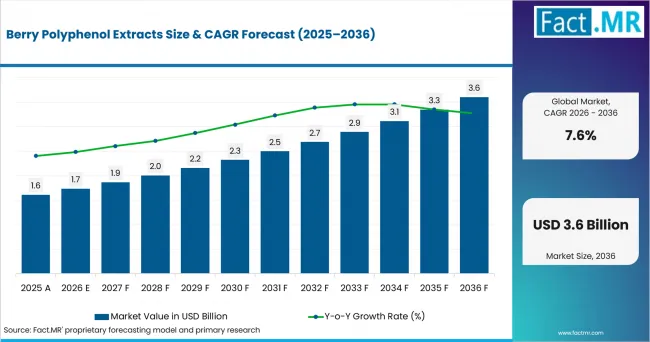
Berry Polyphenol Extracts Value Analysis | Source: Fact.MR
What are the defining numbers behind Berry Polyphenol Extracts Market growth?
An absolute opportunity of USD 1.9 billion is expected between 2026 and 2036.
- Demand Drivers in the Market
- Supplement brands need measurable anthocyanin and proanthocyanidin content so label claims, dosage decisions and quality checks stay consistent across production lots.
- Beverage formulators need water-compatible extracts because polyphenols must remain stable in acidic drinks and ready-to-mix powders without harsh sediment or bitterness.
- Berry supply supports extract standardization when processors need recognized fruit inputs. USDA NASS reported in May 2026 that U.S. cranberry utilized production totaled 7.47 million barrels in 2025.
- Fruit processors need better value from berry side streams, so membrane concentration and aqueous ethanol extraction create routes for color-rich extracts from pomace and juice solids.
- Beauty and healthy-aging formulators need berry actives that fit capsules, gummies and drink mixes while keeping a natural color cue that consumers understand quickly.
- Key Segments Analyzed
- By Berry Source: Blueberry is expected to hold 27.0% share in 2026 because it has wide consumer recognition and a strong fit with antioxidant-positioned supplements.
- By Extract Standardization: Anthocyanin-standardized extracts are projected to account for 38.0% share in 2026 due to their measurable color-active profile and clear testing route.
- By Application: Dietary supplements are anticipated to capture 35.0% share in 2026 owing to capsule, gummy and powder formats that carry defined daily doses.
- By Extraction Route: Water and aqueous ethanol are estimated to represent 41.0% share in 2026 since food and supplement formulators prefer familiar solvent systems.
- Analyst Opinion at Fact.MR
- Shambhu Nath Jha, Principal Consultant at Fact.MR, states, “Berry polyphenols are moving from color-rich botanical stories into measurable ingredient systems. The next phase is expected to favor extracts that pair marker chemistry with practical taste control. Suppliers need fruit traceability and validated standardization for repeat use in finished products.”
- Strategic Implications
- Ingredient suppliers should document anthocyanin, proanthocyanidin and total polyphenol testing methods so formulators compare extracts on the same basis.
- Beverage developers should test haze, acidity and shelf stability early because berry extracts often behave differently in liquid systems than in capsules.
- Supplement brands should connect berry choice with dosage, allowed claims and sensory format before moving a formula into commercial sampling.
- Contract manufacturers should qualify multiple berry sources to reduce disruption from weather swings in blueberry, cranberry and soft-fruit supply.
Japan is projected to post 9.9% CAGR through 2036, supported by healthy-aging nutrition and functional-food claim systems. The USA is expected to record 9.2% CAGR as cranberry and blueberry supply support ingredient development. Germany is anticipated to advance at 8.8% CAGR due to berry cultivation and online supplement buying. The UK is estimated to post 8.3% CAGR through soft-fruit value and food manufacturing scale. France is forecast to record 6.5% CAGR through strawberry output and botanical-extract capability.
How does the Berry Polyphenol Extracts Market break down by segment?
Blueberry leads at 27.0%; anthocyanin-standardized extracts lead at 38.0%.
Which Berry Source dominates?
Blueberry holds 27.0% share in 2026.
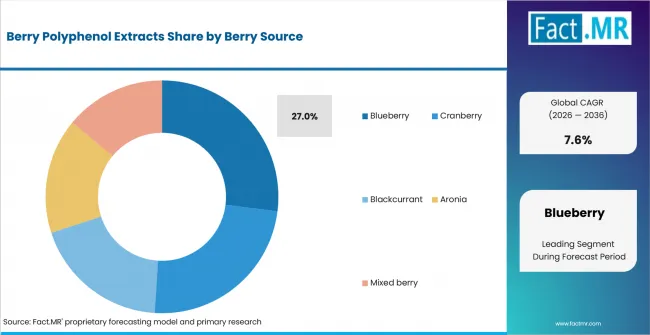
Berry Polyphenol Extracts Analysis By Berry Source | Source: Fact.MR
Blueberry leads because consumers already connect the fruit with antioxidants and daily wellness. USDA ERS reported in March 2026 that fresh cultivated blueberry imports increased 6% in 2025. That trade flow gives formulators a broad fruit story for powders, capsules and drink mixes.
Cranberry follows where urinary-health positioning needs proanthocyanidin documentation. Nexira reported in March 2026 that Exocyan™ is developed for dietary supplements, food and beverage applications, providing formulators with standardized PAC content and analytical verification of cranberry identity, purity and traceability.
What leads Extract Standardization?
Anthocyanin-standardized extracts account for 38.0% share in 2026.
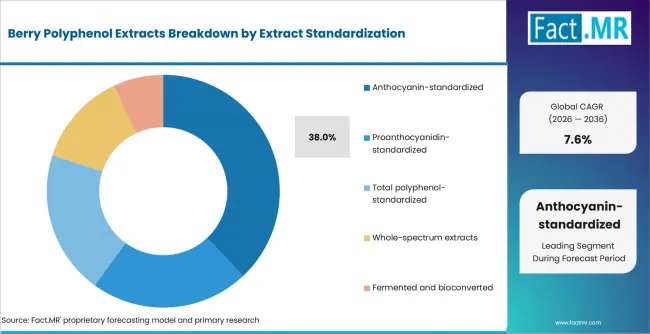
Berry Polyphenol Extracts Analysis By Extract Standardization | Source: Fact.MR
Anthocyanin-standardized extracts lead because the color-active fraction doubles as a quality marker. Artemis lists black currant extract formats with minimum anthocyanin levels from 8% to 36%, depending on origin and method. This supports ingredient comparisons where brands want a defined marker value.
Proanthocyanidin-standardized extracts remain relevant for cranberry platforms. Indena describes Anthocran as a cranberry extract standardized to 27-33% total PACs by BL-DMAC, which helps brands link ingredient choice with a documented assay.
How does Application shape demand?
Dietary supplements represent 35.0% share in 2026.
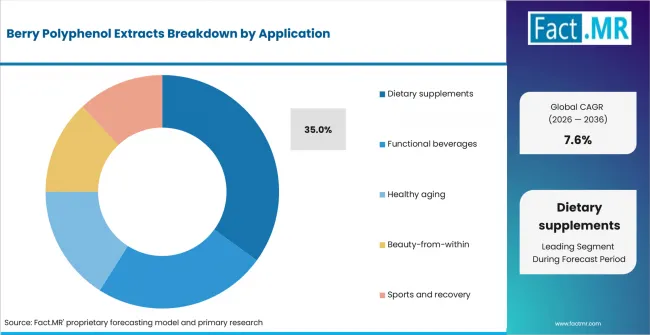
Berry Polyphenol Extracts Analysis By Application | Source: Fact.MR
Dietary supplements lead because capsules, tablets, gummies and powders allow a fixed daily dose. NCHS reported in May 2026 that 60.2% of U.S. adults age 20 and older used any dietary supplement in the past 30 days during August 2021-August 2023. That pattern supports standardized botanical actives with clear serving guidance.
Functional beverages follow because berry polyphenols bring a recognizable taste and natural color cue. Beverage developers still have to manage bitterness, haze and acidic pH behaviour before launch, especially in shots and ready-to-mix powders.
What supports Water and aqueous ethanol within Extraction Route?
Water and aqueous ethanol hold 41.0% share in 2026.
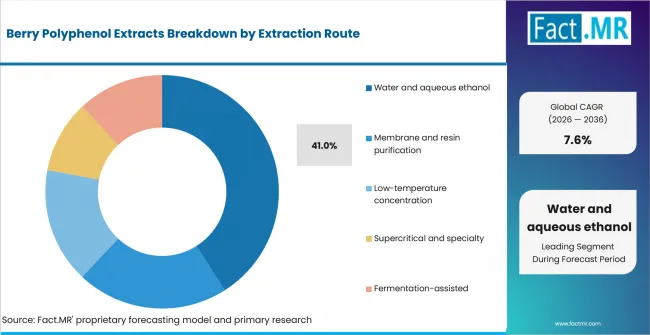
Berry Polyphenol Extracts Analysis By Extraction Route | Source: Fact.MR
Water and aqueous ethanol lead because they are familiar to food and supplement formulators. The route suits anthocyanin-rich berries where processors need clean extraction, acceptable sensory behaviour and a residue profile that quality teams review quickly.
Membrane and resin purification add value when brands need higher marker concentration or a narrower polyphenol profile. Artemis states that BerryDefense is standardized to a minimum 8% anthocyanins and at least 20% polyphenols, showing how concentrated berry blends are positioned for nutraceutical use.
What is accelerating Berry Polyphenol Extracts Market adoption, and what is holding it back?
Demand is expected to rise through standardized markers, supplement formats and berry-source recognition. Growth is constrained by crop swings, sensory limits and claim-control requirements.
Drivers Impact Analysis
| DRIVER | (~) % IMPACT ON CAGR | GEOGRAPHIC RELEVANCE | IMPACT TIMELINE |
|---|---|---|---|
| Standardized anthocyanin and PAC assays | +1.1% | Global | Short term (<= 2 years) |
| Dietary supplement format expansion | +0.9% | North America, Europe, East Asia | Medium term (2-4 years) |
| Functional beverage taste and color fit | +0.7% | USA, UK, Japan | Medium term (2-4 years) |
| Gentle extraction and concentration routes | +0.6% | Europe, North America | Long term (>= 4 years) |
- Standardized anthocyanin and PAC assays: Defined marker testing makes berry extracts easier to qualify across repeat batches. Clear analytical methods help brands compare blueberry, cranberry, aronia, and other berry ingredients while supporting more consistent specifications and supplier approval.
- Dietary supplement format expansion: Expansion beyond traditional pills is creating more entry points for berry-derived actives. Gummies, powders, sachets, and other convenient formats allow brands to position standardized berry polyphenols across wellness, healthy-aging, and functional nutrition products.
- Functional beverage taste and color fit: Berry extracts provide functional beverages with a recognizable natural color cue and plant-based positioning. Formula teams still need to manage bitterness, acidity, haze, and stability before concepts can move from bench development into scaled production.
Opportunity Impact Analysis
| OPPORTUNITY | (~) % IMPACT ON CAGR | GEOGRAPHIC RELEVANCE | IMPACT TIMELINE |
|---|---|---|---|
| Beauty-from-within and healthy-aging blends | +0.8% | Japan, USA, Europe | Medium term (2-4 years) |
| Cranberry PAC and urinary-health platforms | +0.6% | USA, France, Germany | Short term (<= 2 years) |
| Upcycled pomace and juice-solid extraction | +0.5% | North America, Europe | Long term (>= 4 years) |
- Beauty-from-within and healthy-aging blends: Berry polyphenols fit skin, eye and healthy-aging positioning when brands need plant actives that consumers recognize without long technical explanations.
- Cranberry PAC and urinary-health platforms: Cranberry extracts create a defined route for women-focused and urinary-comfort products when PAC testing is clear and dosage remains practical.
- Upcycled pomace and juice-solid extraction: Processors are expected to build value from fruit streams that already contain color and phenolic compounds when quality and contaminant controls remain tight.
Restraints Impact Analysis
| RESTRAINT | (~) % IMPACT ON CAGR | GEOGRAPHIC RELEVANCE | IMPACT TIMELINE |
|---|---|---|---|
| Crop yield and fruit-cost volatility | -0.6% | USA, Germany, UK, France | Short term (<= 2 years) |
| Taste, color and haze instability | -0.4% | Global | Medium term (2-4 years) |
| Claim and labeling controls | -0.3% | USA, EU, UK, Japan | Long term (>= 4 years) |
- Crop yield and fruit-cost volatility: Berry extracts depend on fruit supply that can shift with weather, harvest quality, and regional availability. Changes in raw-material supply can affect ingredient costs and consistency, creating sourcing challenges for manufacturers that rely on specific berry varieties.
- Taste, color and haze instability: Anthocyanin-rich extracts can darken, precipitate, or introduce astringency in beverage and gummy systems. These formulation challenges can lengthen development timelines for brands seeking to combine natural color, sensory appeal, and functional positioning in one ingredient.
- Claim and labeling controls: Dietary supplement claims require careful substantiation and compliant labeling. Brands need clear documentation linking the berry ingredient, active fraction, intended use, and finished-product positioning to applicable regulatory requirements before commercialization.
Which countries are scaling the Berry Polyphenol Extracts Market through 2036?
- The country comparison spans 3.36 percentage points and forms three practical growth bands across the forecast period.
- Japan remains 0.67 percentage point above the USA through healthy-aging demand and functional-food claim discipline.
- The USA remains 0.42 percentage point above Germany through cranberry production and supplement-channel depth.
- Germany remains 0.50 percentage point above the UK through cultivated berry output and online supplement purchasing.
- The UK remains 1.77 percentage points above France through soft-fruit value and food-manufacturing scale.
- France closes the displayed range through strawberry output, botanical-extract capability and careful claim review.
Comparable CAGRs create different entry conditions due to fruit supply, health-claim rules, processing capacity and brand tolerance for sensory reformulation. Full report coverage includes North America, Latin America, Western Europe, Eastern Europe, East Asia, South Asia & Pacific, Middle East & Africa.
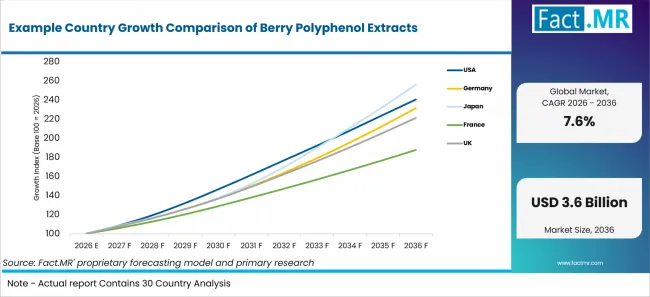
Example Country Growth Comparison Of Berry Polyphenol Extracts | Source: Fact.MR
| Country | CAGR (2026-2036) |
|---|---|
| Japan | 9.9% |
| USA | 9.2% |
| Germany | 8.8% |
| UK | 8.3% |
| France | 6.5% |
How does Japan perform?
9.9% CAGR, supported by healthy-aging nutrition and functional-food claim systems.
Japan gives berry polyphenol extract suppliers a clear healthy-aging route. The Statistics Bureau reported in September 2025 that people aged 65 and over reached 36.19 million and accounted for 29.4% of the population. That age profile supports capsules, stick packs and beauty-from-within formats where small daily servings are easier to explain.
What supports USA adoption?
9.2% CAGR, supported by cranberry production and supplement use.
The USA combines domestic berry inputs with a large supplement user base. USDA NASS reported in May 2026 that U.S. cultivated blueberry utilized production reached 761 million pounds in 2025. That gives blueberry extract makers a local fruit base and a familiar consumer story.
What is supporting Germany's adoption?
8.8% CAGR, led by shrub-berry cultivation and online supplement buying.
Germany benefits from a visible berry crop and a regulated supplement channel. Destatis reported in February 2026 that German shrub-berry harvest reached 45,747 tonnes in 2025. The same crop base helps local formulators discuss aronia, blackcurrant and blueberry extracts with clearer origin context.
What supports the United Kingdom's growth?
8.3% CAGR, backed by soft-fruit value and food manufacturing scale.
The UK outlook is tied to soft-fruit value and a sizeable food-manufacturing base. Defra reported in June 2026 that the value of soft-fruit production rose 6.0% to GBP 776 million in 2025. That value base supports ingredient stories around berries even when extract inputs are imported.
How is France developing demand?
6.5% CAGR, shaped by strawberry output and botanical-extract capability.
France develops demand through fruit knowledge and botanical formulation experience. The Ministry of Agriculture reported in May 2026 that 74,052 tonnes of strawberries were picked in France in 2025. That gives formulators a familiar soft-fruit reference even though cranberry and aronia extracts often depend on broader sourcing networks.
Who leads the Berry Polyphenol Extracts Market?
Givaudan, which acquired Naturex, participates through branded berry ingredients including Pacran™ cranberry and Aronox™ aronia. Givaudan Health & Nutrition describes Aronox™ as an aronia berry extract rich in polyphenols and anthocyanins and standardized to 40% polyphenols, while Pacran™ is positioned for urinary-tract health and is supported by peer-reviewed clinical research.
Nexira participates through Exocyan™ cranberry extracts standardized by PAC content or fruit solids. Indena adds cranberry and bilberry platforms through Anthocran®, standardized for PACs, and Mirtoselect®, standardized for anthocyanins. Artemis International offers standardized aronia and black-currant extracts alongside berry blends such as BerryDefense®, using anthocyanins, polyphenols and other analytical markers to support consistent ingredient specifications.
FutureCeuticals broadens the competitive field through berry and plant-extract ingredients, including VitaBlue blueberry extract standardized to 15% anthocyanins and VitaCurrant blackcurrant extract standardized to 25% anthocyanins. Competitive differentiation includes fruit authenticity and traceability, standardized marker testing, clinical substantiation and sensory performance across capsules, gummies, powders and drink formats.
Which companies are the key providers?
Key companies include Givaudan / Naturex; Nexira; Indena; Artemis International; and FutureCeuticals.
- Givaudan / Naturex
- Nexira
- Indena
- Artemis International
- FutureCeuticals
Bibliography
- U.S. Department of Agriculture, National Agricultural Statistics Service. (2026, May 1). Noncitrus fruits and nuts 2025 summary.
- Weber, C., Simnitt, S., & Wakefield, H. (2026, March 26). Fruit and tree nuts outlook: March 2026 (FTS-384). U.S. Department of Agriculture, Economic Research Service.
- Stierman, B., Couch, C. A., Gahche, J. J., & Mishra, S. (2026, May 21). Dietary supplement use: United States, August 2021–August 2023 (NCHS Data Brief No. 561). National Center for Health Statistics.
- U.S. Bureau of Labor Statistics. (2026, August 12). Consumer Price Index – July 2026.
- U.S. Food and Drug Administration. (2025, December 11). Letter to the dietary supplement industry on the DSHEA disclaimer.
- Department for Environment, Food & Rural Affairs. (2026, June 25). Horticulture statistics 2025.
- Office for National Statistics. (2026, July 24). UK manufacturers’ sales by product: 2025.
- Statistisches Bundesamt (Destatis). (2026, February 10). Strauchbeerenernte 2025 um gut 23 % gestiegen.
- Statistisches Bundesamt (Destatis). (2025, March 11). 21 % der 16- bis 74-Jährigen kaufen Arzneimittel oder Nahrungsergänzungsmittel online.
- Statistics Bureau of Japan. (2025, September 14). Statistical Topics No. 146: Statistics on the elderly in Japan—On the occasion of Respect-for-Senior-Citizens Day.
- Statistics Bureau of Japan. (2026, January 23). Consumer Price Index: 2025 yearly average results for Japan (2020-base).
- Ministère de l’Agriculture, de l’Agro-alimentaire et de la Souveraineté alimentaire. (2026, May 26). La fraise, un fruit de saison vitaminé.
- Stephan, N. (2026, June 30). Prix agricoles et alimentaires. En mai 2026, les prix à la production sont quasi stables sur un an (-0,3 %). Agreste.
- Nexira. (2026, March 19). Urinary health: Why cranberry is still the gold standard for women.
- Artemis International. (2025, May 6). Artemis Spotlight: Introducing ACE Blends.
This Report Answers
- The report explains where berry polyphenol extracts are positioned beside botanical extracts in ingredient portfolios. It reviews polyphenols as the broader functional class.
- Segment analysis reviews blueberry, cranberry, blackcurrant, aronia and mixed berry sources. It links berry extract sourcing with berry ingredients and adjacent vaccinium myrtillus extracts.
- Country analysis covers market entry conditions for the USA, Germany, Japan, the UK and France. It considers aronia positioning beside chokeberry extract.
- Application analysis covers dietary supplements, functional beverages and beauty-from-within products. The discussion connects berry extracts with dietary supplements and broader nutraceuticals.
- Competitive analysis reviews ingredient providers, marker testing and sensory support. It places berry polyphenols beside functional beverages, fermented berry polyphenols and natural antioxidant shelf extenders.
What does the Berry Polyphenol Extracts Market cover?
The Berry Polyphenol Extracts Market covers berry-derived extracts where polyphenols are the main functional value. The scope includes standardized extracts from blueberry, cranberry, blackcurrant, aronia and mixed berry sources.
The assessment covers anthocyanin-standardized, PAC-standardized, total-polyphenol and whole-spectrum extracts. It reviews water-based, aqueous ethanol, membrane, resin and low-temperature concentration routes used for food and supplement applications.
What is included in the scope?
The scope includes ingredient-grade berry extracts sold to dietary supplement, functional beverage, healthy-aging, beauty-from-within and sports nutrition brands. It includes powders, concentrates and standardized extract systems when berry polyphenols are the main value driver.
Technical support tied to extract sales is included, covering standardization guidance, assay documentation, taste support and formulation assistance for capsules, gummies, powders, shots and drink mixes.
What is excluded from the scope?
The scope excludes whole fresh berries, frozen fruit, fruit snacks and flavor-only berry preparations when polyphenol standardization is absent. Synthetic colors and isolated non-berry antioxidants fall outside the defined scope.
Finished consumer supplements and beverages are excluded when the company sells only the finished format. General fruit powders are excluded when marker assay or extract-process documentation is absent.
How Was the Analysis Built?
The analysis draws on 120+ sources, 35+ company portfolios, 25+ countries, and more than 20 industry interviews.
- Primary Research: Primary research includes discussions with manufacturers, service providers, technology developers, distributors, end users, and subject-matter experts. These conversations examine purchasing priorities, product adoption, operational challenges, approval requirements, competitive positioning, and the factors that influence wider market acceptance.
- Desk Research: Desk research covers government statistics, regulatory publications, company filings, trade data, technical studies, industry associations, standards, public policy, and other authoritative sources. Every source used in the analysis is documented in the bibliography.
- Market Sizing and Forecasting: Market estimates combine historical performance, demand indicators, pricing and volume trends, segment shares, company participation, country-level growth, adoption patterns, investment activity, and barriers to market expansion.
- Data Validation and Update Cycle: Findings are validated by comparing primary interviews with public data, company activity, regulatory changes, trade patterns, and industry developments. Regular updates review new product launches, capacity changes, partnerships, approvals, and shifts in commercial adoption.
What is the report's scope and coverage?
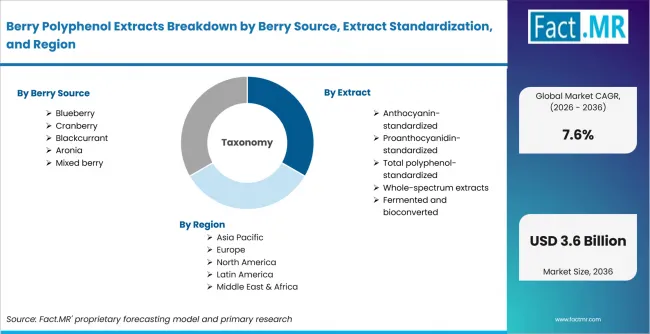
Berry Polyphenol Extracts Breakdown By Berry Source, Extract Standardization, And Region | Source: Fact.MR
| Attribute | Details |
|---|---|
| Quantitative Units | USD billion in 2026 to USD billion by 2036 at a CAGR |
| Market Definition | Standardized berry-derived polyphenol extracts used in dietary supplements, functional beverages, healthy-aging products, beauty-from-within formats, and sports or recovery formulations. |
| Berry Source | Blueberry; Cranberry; Blackcurrant; Aronia; Mixed berry |
| Extract Standardization | Anthocyanin-standardized; Proanthocyanidin-standardized; Total polyphenol-standardized; Whole-spectrum extracts; Fermented and bioconverted |
| Application | Dietary supplements; Functional beverages; Healthy aging; Beauty-from-within; Sports and recovery |
| Extraction Route | Water and aqueous ethanol; Membrane and resin purification; Low-temperature concentration; Supercritical and specialty; Fermentation-assisted |
| Regions Covered | North America; Latin America; Western Europe; Eastern Europe; East Asia; South Asia & Pacific; Middle East & Africa |
| Countries Covered | USA; Germany; Japan; France; UK |
| Key Companies Profiled | Givaudan / Naturex; Nexira; Indena; Artemis International; FutureCeuticals |
| Forecast Period | 2026 to 2036 |
| Approach | Hybrid top-down and bottom-up approach using fruit-source availability; standardized extract portfolios; supplement and beverage application demand; country indicators; and provider portfolio review. |
How is the market segmented?
-
By Berry Source
- Blueberry
- Cranberry
- Blackcurrant
- Aronia
- Mixed berry
-
By Extract Standardization
- Anthocyanin-standardized
- Proanthocyanidin-standardized
- Total polyphenol-standardized
- Whole-spectrum extracts
- Fermented and bioconverted
-
By Application
- Dietary supplements
- Functional beverages
- Healthy aging
- Beauty-from-within
- Sports and recovery
-
By Extraction Route
- Water and aqueous ethanol
- Membrane and resin purification
- Low-temperature concentration
- Supercritical and specialty
- Fermentation-assisted
-
By Region
- North America
- Latin America
- Western Europe
- Eastern Europe
- East Asia
- South Asia & Pacific
- Middle East & Africa