- Market Value (2025): USD 190.2 Mn
- Estimated Value (2026): USD 201.6 Mn
- Forecast Value (2036): USD 306.7 Mn
- CAGR (2026-2036): 4.3%
What is the Cranberry Wine Market forecast to be worth by 2036?
USD 201.6 million in 2026 to USD 306.7 million by 2036, at a 4.3% CAGR.
- The market reached USD 190.2 million in 2025.
- Demand is projected to increase from USD 201.6 million in 2026 to USD 306.7 million by 2036.
- The market is forecast to record a 4.3% CAGR from 2026 to 2036, creating an absolute opportunity of USD 105.1 million.
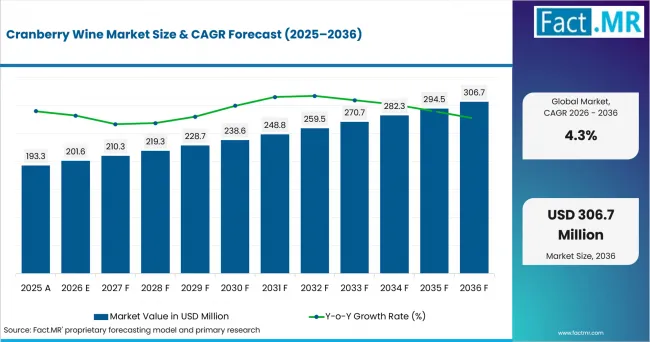
Cranberry Wine Market Value Analysis | Source: Fact.MR
What are the defining numbers behind Cranberry Wine Market growth?
USD 105.1 million absolute opportunity is expected between 2026 and 2036.
- Demand Drivers in the Market
- Fruit-wine producers use cranberry’s sharp acidity and colour to create a product that stands apart from grape wine and cider.
- Lower-alcohol and fruit-forward formats widen the drinking occasion, especially for chilled servings, holiday gifting and regional winery sales.
- Convenience stores, supermarkets, winery shops and online alcohol channels help smaller specialty wines reach consumers who may not search for them in traditional wine aisles.
- Crop variability, alcohol duty, distribution permissions and state or provincial rules still shape how quickly the category can scale.
- Key Segments Analyzed
- By Type: Alcohol by Volume: <11% is the leading type, accounting for 33.7% share in 2026.
- By Application: Convenience Store leads with 26.7% share in 2026.
- Analyst Opinion at Fact.MR
- Cranberry wine sells when producers make the use occasion clear. The category is too small to rely on generic wine cues alone. Labels, ABV, sweetness level as well as chilled-serving guidance as well as regional fruit provenance. Availability in convenience-oriented outlets all matter. Suppliers that position cranberry wine as a distinctive fruit-wine occasion, rather than a novelty bottle, will have a better chance of repeat purchase. Shambhu Nath Jha, Principal Consultant, Fact.MR.
- Strategic Implications
- Producers should make ABV, sweetness, acidity and serving occasion clear on the front end of the buying journey.
- Convenience and specialty retail work best when cranberry wine is tied to seasonal, local, chilled or gifting occasions.
- Country expansion depends on alcohol retail rules and fruit-wine discovery, not only on broader wine consumption.
Australia records the highest country CAGR at 6.5%, followed by the UK at 5.9%. Canada advances at 5.8%, the USA grows at 5.2%, and Germany expands at 4.4% through 2036.
How does the Cranberry Wine Market break down by segment?
Alcohol by Volume: <11% leads Type with 33.7% share and Convenience Store leads Application with 26.7% share in 2026.
Why does Alcohol by Volume: <11% lead Type?
Alcohol by Volume: <11% is projected to account for 33.7% share in 2026.
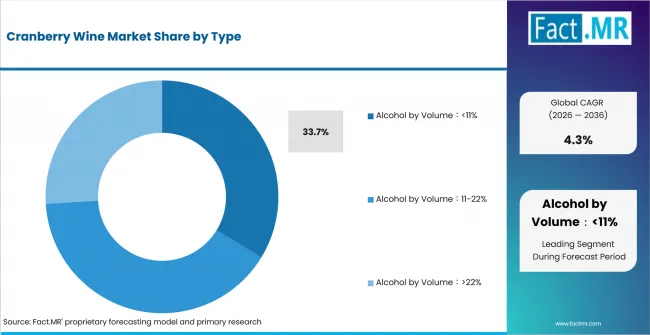
Cranberry Wine Market Analysis By Type | Source: Fact.MR
The <11% ABV segment leads because cranberry wine is commonly bought for lighter, fruit-forward occasions rather than for heavy table-wine consumption. Cranberry’s tartness works well in chilled, lower-strength formats, and lower ABV can make the product easier to place beside cider as well as fruit wine and seasonal beverages. Higher-ABV variants still serve specialty and fortified-style demand, but the largest share sits where the drink remains approachable for trial, gifting and casual at-home consumption.
Why does Convenience Store lead Application?
Convenience Store is projected to account for 26.7% share in 2026.
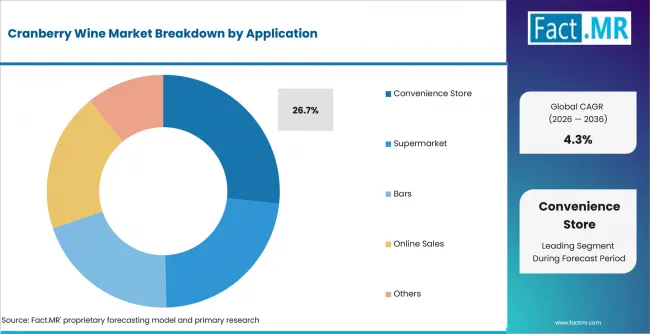
Cranberry Wine Market Analysis By Application | Source: Fact.MR
Convenience Store leads because cranberry wine is a discovery product. It benefits from nearby access, smaller baskets, seasonal displays and impulse buying more than from traditional cellar-led shopping. Convenience outlets also suit lower-ABV and fruit-forward bottles that consumers may pick up for gatherings, holiday meals, or chilled at-home drinking. Supermarkets and bars remain important, but convenience stores give the category a practical route to trial.
What is accelerating Cranberry Wine Market adoption, and what is holding it back?
Adoption is being supported by specialty fruit-wine discovery and lower-alcohol interest, while growth is limited by alcohol regulation, crop availability and the category’s narrow awareness compared with grape wine.
Drivers Impact Analysis
| DRIVER | (~) % IMPACT ON CAGR | GEOGRAPHIC RELEVANCE | IMPACT TIMELINE |
|---|---|---|---|
| Fruit-wine differentiation | +1.1% | Australia, UK and Canada | Short term (<= 2 years) |
| Lower-ABV demand | +0.9% | UK, Canada and USA | Short term (<= 2 years) |
| Retail discovery | +0.6% | Australia, UK and Canada | Medium term (2-4 years) |
| Regional supply stories | +0.5% | Global sourcing and import-dependent markets | Medium term (2-4 years) |
Source: Fact.MR analysis. Updated Aug 5, 2026
- Fruit-wine differentiation: Cranberry gives producers a sharp, coloured, seasonal profile that is different from standard grape wine.
- Lower-ABV demand: The leading <11% segment benefits from consumers looking for lighter drinking occasions.
- Retail discovery: Convenience stores and supermarkets can introduce cranberry wine through seasonal and local-product displays.
- Regional supply stories: North American cranberry production helps wineries and specialty beverage makers communicate provenance.
Opportunity Impact Analysis
| OPPORTUNITY | (~) % IMPACT ON CAGR | GEOGRAPHIC RELEVANCE | IMPACT TIMELINE |
|---|---|---|---|
| Occasion-based positioning | +0.7% | Australia, UK and Canada | Medium term (2-4 years) |
| Trial-size seasonal formats | +0.6% | UK, Canada and USA | Medium term (2-4 years) |
| Direct-to-consumer reach | +0.4% | Canada, USA and Germany | Long term (>= 4 years) |
Source: Fact.MR analysis. Updated Aug 5, 2026
- Producers can create clearer occasion-based positioning around chilled serving, festive meals, gifting and local fruit sourcing.
- Retailers can use small-format bottles and seasonal displays to reduce trial risk.
- Online and direct-to-consumer sales can help small wineries reach customers outside local tourism traffic where alcohol rules allow it.
Restraints Impact Analysis
| RESTRAINT | (~) % IMPACT ON CAGR | GEOGRAPHIC RELEVANCE | IMPACT TIMELINE |
|---|---|---|---|
| Alcohol regulation and duties | -0.8% | Australia, UK and Canada | Short term (<= 2 years) |
| Cranberry crop volatility | -0.6% | Global sourcing and import-dependent markets | Short term (<= 2 years) |
| Beverage-category competition | -0.5% | Established and price-sensitive markets | Medium term (2-4 years) |
| Novelty-led demand perception | -0.3% | USA, Germany and Australia | Medium term (2-4 years) |
Source: Fact.MR analysis. Updated Aug 5, 2026
- Alcohol sales rules and duty structures vary by country and can slow distribution.
- Cranberry crop swings affect ingredient cost, especially for producers that rely on local fruit identity.
- The category competes with grape wine, cider, RTDs and non-alcoholic alternatives for the same light-drinking occasion.
- Some consumers still see fruit wine as seasonal or novelty-led, which limits repeat purchasing unless quality cues are clear.
Which countries are scaling the Cranberry Wine Market fastest?
Country growth rates differ from the global 4.3% CAGR. Australia is the fastest in the listed country set. The UK and Canada also sit above the global rate, while the USA grows steadily from a larger cranberry supply base. Germany stays close to the global pace because grape wine remains the stronger everyday wine category.
- Australia leads the country set at 6.5% CAGR.
- The UK follows at 5.9% CAGR.
- Canada advances at 5.8% CAGR.
- The USA records 5.2% CAGR.
- Germany expands at 4.4% CAGR.
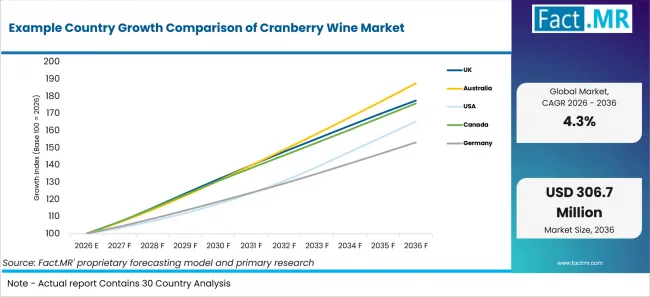
Example Country Growth Comparison Of Cranberry Wine Market | Source: Fact.MR
| Country | CAGR, 2026 to 2036 |
|---|---|
| Australia | 6.5% |
| UK | 5.9% |
| Canada | 5.8% |
| USA | 5.2% |
| Germany | 4.4% |
Source: Fact.MR analysis. Updated Aug 5, 2026
What is driving Australia's growth through 2036?
Australia is forecast to record 6.5% CAGR through 2036, the fastest pace in the listed country set. The growth case is tied to a developed wine-drinking culture and a willingness among producers and retailers to test lighter, fruit-forward, and lower-alcohol formats. Wine Australia has noted that no- and lower-alcohol wine remains small but is expected to grow, and that younger consumers are part of that shift. Cranberry wine remains a niche product, but the same retail and tourism infrastructure that supports specialty wine can give fruit wine more room to be discovered.
What is driving the UK's growth through 2036?
The UK is forecast to grow at 5.9% CAGR through 2036. Growth is helped by an off-trade alcohol market where shoppers are used to buying wine, cider, and other fermented products for home occasions. HMRC alcohol duty data shows wine, other fermented products, and cider remain a large alcohol-duty category. This matters because cranberry wine competes inside that broader fermented-beverage basket. The best route for the UK is not volume grape-wine replacement; it is chilled, seasonal, lower-ABV and convenience-led discovery.
What is driving Canada's growth through 2036?
Canada is forecast to expand at 5.8% CAGR through 2036. The country has a direct fruit-supply story: Agriculture and Agri-Food Canada reported that Quebec accounted for almost 73% of Canada’s cranberry production in 2024, while Statistics Canada identified Quebec as the largest share of national cranberry sales. That gives Canadian cranberry wine a more credible local-fruit route than in many import-led markets. Provincial retail changes and wine-store channels can also support discovery, although wine sales remain sensitive to price and changing alcohol habits.
What is driving the USA's growth through 2036?
The USA is projected to grow at 5.2% CAGR through 2036. The strongest support is raw-material depth. USDA ERS forecast the 2025 U.S. cranberry crop at 8.13 million barrels, close to the five-year average, with Wisconsin alone accounting for about 61% of the crop in recent years. This supply base helps fruit wineries and specialty beverage producers build products around a recognizable American crop. Growth is steady rather than explosive because wine shelves are crowded, and fruit wine has to compete with grape wine, cider as well as RTDs and non-alcoholic alternatives.
What is driving Germany's growth through 2036?
Germany is forecast to expand at 4.4% CAGR through 2036, close to the global rate. The country has a mature wine culture, but cranberry wine remains a specialty fruit-wine proposition rather than a mainstream household bottle. Destatis excise-duty reporting shows alcohol categories are closely tracked and taxed, which keeps distribution and pricing discipline important. German demand should therefore grow through gifting, specialty retail, online discovery and seasonal occasions as well as but grape wine’s local strength limits a faster crossover.
Who leads the Cranberry Wine Market?
Leelanau Cellars is the largest named company in the assessed set, with 11.0% share. Other listed participants are Pasek Cellars, Fort Wine Co., DNA Vintners and Lynfred Winery.
Competition is shaped by fruit sourcing, sweetness balance, ABV clarity as well as winery distribution as well as tasting-room reach and retail placement. Buyers are likely to compare cranberry wine on flavour profile, local identity, bottle size and use occasion rather than by wine-style convention alone.
Which companies are the key providers?
Key companies include Leelanau Cellars; Pasek Cellars; Fort Wine Co.; DNA Vintners; Lynfred Winery; Island Grove Ag Products (IGAP); Lakeshore Farms Wine; Robert Mazza, Inc.
- Leelanau Cellars
- Pasek Cellars
- Fort Wine Co.
- DNA Vintners
- Lynfred Winery
- Island Grove Ag Products (IGAP)
- Lakeshore Farms Wine
- Robert Mazza, Inc.
Bibliography
- Agriculture and Agri-Food Canada. (2025, July 16). Statistical overview of the Canadian fruit industry, 2024.
- HM Revenue & Customs. (2026). Alcohol Bulletin commentary, February 2026 to April 2026.
- Statistics Canada. (2025, February 17). Fruit and vegetable production, 2024.
- Statistics Canada. (2026, March 5). Control and sale of alcoholic beverages and cannabis, 2024/2025.
- U.S. Department of Agriculture, Economic Research Service. (2025, November 26). Cranberry production forecast to land near five-year average.
- U.S. Department of Agriculture, Foreign Agricultural Service. (n.d.). Wine & Related Products.
- Wine Australia. (2024, September). Market update: United Kingdom.
- Wine Australia. (2025, February 25). No and lower alcohol market update.
- Wine Australia. (2025, July 28). Australian wine export report: 12 months to 30 June 2025.
- Federal Statistical Office of Germany. (2026, July 7). Excise duties.
This Report Answers
- The report provides strategic intelligence on the Cranberry Wine Market across Type and Application choices that shape product positioning and channel planning.
- Segment analysis covers Alcohol by Volume:<11% and Convenience Store as the share leaders within the 2026 market.
- Country outlook evaluates the UK and Australia alongside the USA and Canada. Germany completes the growth comparison across the profiled markets.
- Competitive analysis profiles Leelanau Cellars and Pasek Cellars alongside Fort Wine Co. and DNA Vintners. Lynfred Winery completes the provider view.
- Channel assessment covers Convenience Store and Supermarket routes. Bars and Online Sales complete the main commercial view.
What does the Cranberry Wine Market cover?
The market covers cranberry wine and related fruit-wine products sold across the defined type, application, and regional categories.
What is included in the scope?
The scope includes cranberry wine products across the listed alcohol-by-volume bands and sales channels, including convenience stores, supermarkets as well as bars as well as online sales and other defined outlets.
What is excluded from the scope?
Standard grape wine with no cranberry content, cranberry juice, cranberry supplements as well as non-alcoholic cranberry beverages and products outside the defined categories are excluded.
How Was the Analysis Built?
The analysis combines desk research, company and product mapping, expert validation. Demand-side checks across major regions.
- Primary Research: Interviews with winery operators, alcohol distributors, retailers and category specialists test purchasing criteria as well as channel constraints as well as adoption barriers and replacement behavior.
- Desk Research: Public agricultural data, alcohol statistics, trade information as well as company literature and official wine-market publications establish market boundaries and demand context.
- Market Sizing and Forecasting: Demand indicators, fruit supply, channel access as well as alcohol regulation and supplier participation are reconciled across top-down and bottom-up views.
- Data Validation and Update Cycle: Findings are cross-checked across independent evidence routes and reviewed when material market, regulatory, or company changes occur.
Segmentation
What is the report's scope and coverage?
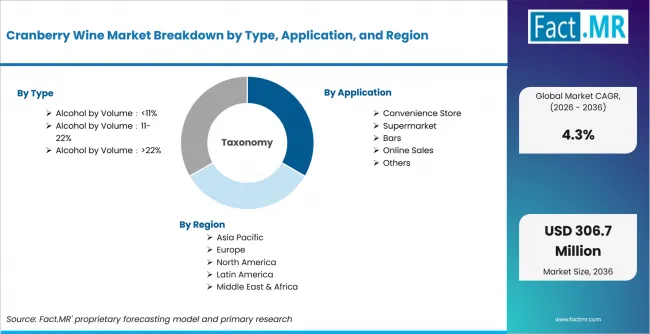
Cranberry Wine Market Breakdown By Type, Application, And Region | Source: Fact.MR
| Attribute | Details |
|---|---|
| Quantitative Units | USD Million in 2026 to USD Million by 2036, at CAGR |
| Market Definition | Cranberry wine products and related fruit-wine offerings across the assessed categories |
| Type | Alcohol by Volume:<11%; Alcohol by Volume:11-22%; Alcohol by Volume:>22% |
| Application | Convenience Store; Supermarket; Bars; Online Sales; Others |
| Regions Covered | North America; Latin America; Europe; East Asia; South Asia & Oceania; Middle East & Africa |
| Countries Covered | UK; Australia; USA; Canada; Germany |
| Key Companies Profiled | Leelanau Cellars; Pasek Cellars; Fort Wine Co.; DNA Vintners; Lynfred Winery; Island Grove Ag Products (IGAP); and others |
| Forecast Period | 2026 to 2036 |
| Approach | Hybrid top-down and bottom-up market assessment |
Source: Fact.MR analysis. Updated Aug 5, 2026
How is the market segmented?
-
By Type:
- Alcohol by Volume:<11%
- Alcohol by Volume:11-22%
- Alcohol by Volume:>22%
-
By Application:
- Convenience Store
- Supermarket
- Bars
- Online Sales
- Others
-
By Region:
- North America
- USA
- Canada
- Latin America
- Europe
- Germany
- UK
- East Asia
- South Asia & Oceania
- Australia
- Middle East & Africa
- USA
- North America
Frequently Asked Questions
How big is the Cranberry Wine Market in 2026?
What is the CAGR of the Cranberry Wine Market from 2026 to 2036?
Which type leads the Cranberry Wine Market?
How much will the Cranberry Wine Market add between 2026 and 2036?
Who are the leading companies in the Cranberry Wine Market?
Who worked on this report


Preview the report firsthand - request a free sample
Free SampleGet the brochure for pricing and purchase details
Download PDF