- Market Value (2025): USD 2.0 Bn
- Estimated Value (2026): USD 2.2 Bn
- Forecast Value (2036): USD 7.5 Bn
- CAGR (2026-2036): 13.0%
What is the Bio-Based Barrier Coatings Market forecast to be worth by 2036?
USD 2.2 billion in 2026 to USD 7.5 billion by 2036 at a 13.0% CAGR.
- The Bio-Based Barrier Coatings Market reached USD 2.0 billion in 2025.
- Demand is projected to increase from USD 2.2 billion in 2026 to USD 7.5 billion by 2036.
- The market is forecast to record 13.0% CAGR from 2026 to 2036 as foodservice operators shift toward coated fiber formats.
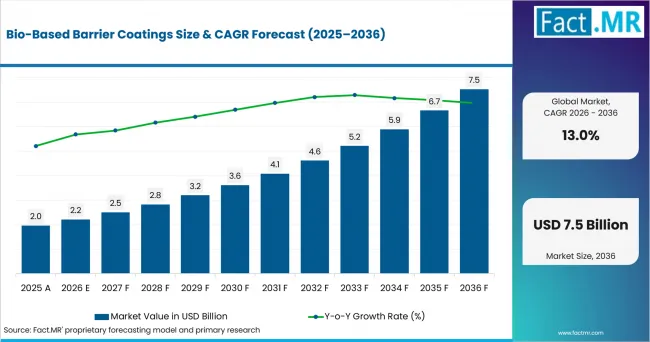
Bio Based Barrier Coatings Value Analysis | Source: Fact.MR
What are the defining numbers behind Bio-Based Barrier Coatings Market growth?
USD 5.3 billion absolute opportunity by 2036, led by aqueous biopolymer dispersion, heat seal and foodservice.
- Demand Drivers in the Market
- Foodservice chains need grease-resistant paper that holds oil and moisture during delivery.
- Paper converters need coatings that run on familiar equipment, supported by Solenis water-based and bio-wax ranges.
- Retail food brands need fiber packs with heat seal strength for snack pouches, wraps and sachets.
- Packaging teams need documented end-of-life routes under recycling rules.
- Key Segments Analyzed
- By Coating Chemistry: Aqueous biopolymer dispersion is expected to hold 36.0% share in 2026 because converters prefer water-based systems for paper-coating lines.
- By Performance: Heat seal is projected to account for 31.0% share in 2026 owing to use in pouches, wraps and lidding formats.
- By Substrate: Paper is anticipated to capture 29.0% share in 2026, supported by fiber-based wraps and sachets.
- By Application: Foodservice is estimated to represent 33.0% share in 2026, led by coated cups, trays and takeaway packs.
- Analyst Opinion at Fact.MR
- Shambhu Nath Jha, Principal Consultant at Fact.MR, states, “The commercial test for bio-based barrier coatings is moving beyond the chemistry label. Brands now ask whether a coating seals reliably and fits the selected recycling route. Suppliers are expected to gain traction when they combine food-contact readiness, line compatibility and clear performance data.”
- Strategic Implications
- Coating producers should document heat seal, grease resistance and repulpability.
- Paper converters should qualify aqueous coatings on existing coaters before scaling wraps, cups and paper pouches.
- Foodservice brands should separate hot, greasy and dry-food packaging needs before selecting coatings.
- Material distributors should keep coat-weight and drying-window guidance simple for smaller converters.
China is projected to record 13.9% CAGR through 2036, supported by online retail and fresh-food packaging guidance. The United States is expected to advance at 13.4% CAGR, driven by foodservice spending and PFAS replacement in grease-proof paper. Japan is forecast to hold 13.4% CAGR, reflecting packaged-food exports and compact retail formats. Germany is anticipated to post 13.2% CAGR, attributable to recycling targets and paper-packaging flows. France is estimated to reach 12.7% CAGR, owing to restaurant rules and food retail activity.
How does the Bio-Based Barrier Coatings Market break down by segment?
Aqueous biopolymer dispersion leads at 36.0%; foodservice leads at 33.0%.
Which Coating Chemistry dominates?
Aqueous biopolymer dispersion holds 36.0% share in 2026.
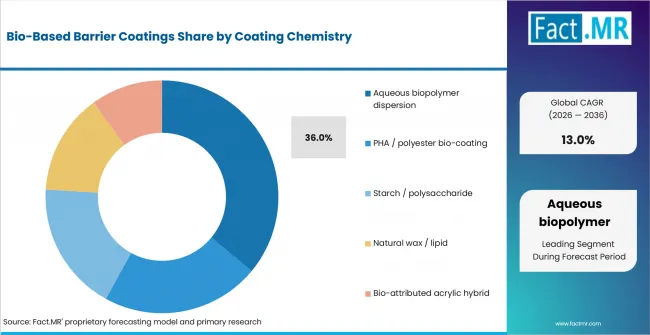
Bio Based Barrier Coatings Analysis By Coating Chemistry | Source: Fact.MR
Aqueous biopolymer dispersion leads because it can be coated from water on paper and board lines. This chemistry helps converters replace polyethylene films in applications where brands ask for bio barrier coatings with lower plastic content and simpler end-of-life claims.
Solenis stated in August 2025 that its packaging showcase would include flexographic-applied barrier coatings for cupstock board and flexible packaging, PHA-based coatings compatible with flexographic and extrusion processes, and TopScreen™ barrier coatings that protect against oil, water and grease.
What leads the Performance segment?
Heat seal leads with 31.0% share in 2026.
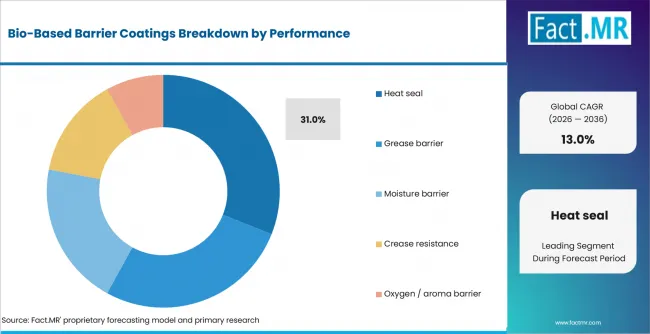
Bio Based Barrier Coatings Analysis By Performance | Source: Fact.MR
Heat seal leads because coated paper must close securely on pouches, wraps and lidding formats. Michelman stated in April 2026 that Nuvita® Life 4002 is a heat-seal barrier coating that provides oil-and-grease resistance and mineral-oil barrier performance for fiber-based retail food packaging applications.
How does Substrate shape demand?
Paper holds 29.0% share in 2026.
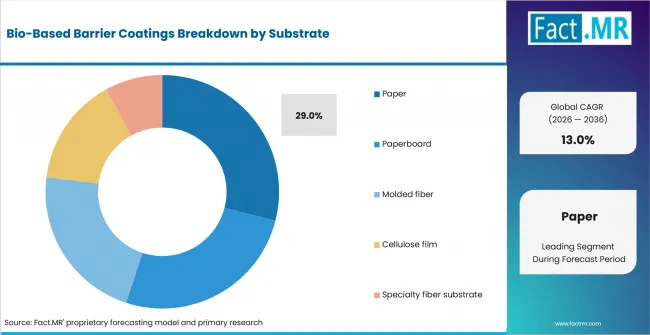
Bio Based Barrier Coatings Analysis By Substrate | Source: Fact.MR
Paper holds a large position because converters can pair fiber substrates with thin barrier layers for wraps, sachets and cartons. This supports the shift toward bio-based barrier resins where coating weight and paper recovery remain central to material approval.
BASF announced in May 2026 that UPM paper grades combined with waterborne Joncryl® HPB resins support the development of paper-based alternatives designed to replace plastic-based or PE-laminated structures. Dow’s 2025 Progress Report stated that RHOBARR™ 320 Barrier Dispersion coating supports 99% fiber recovery when coated paper products are recycled.
What supports Foodservice within Application?
Foodservice accounts for 33.0% share in 2026.
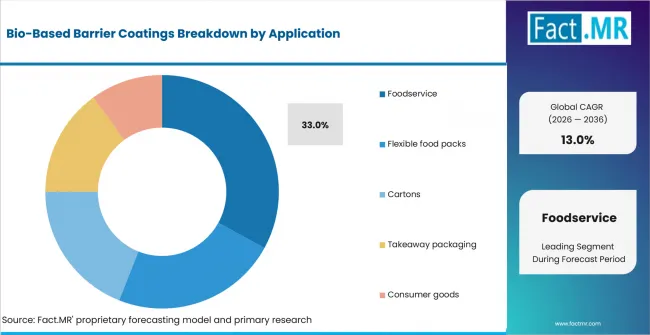
Bio Based Barrier Coatings Analysis By Application | Source: Fact.MR
Foodservice accounts for the main application share because cups, trays and wraps require short-use barrier performance. The shift is linked to compostable food service coatings and to restaurant packaging rules that favor recyclable or reusable formats.
Michelman, UPM Specialty Materials and BOBST introduced two validated paper-based packaging concepts in May 2026. The concepts combine fiber substrates and bio-based coatings for food-packaging formats.
What is accelerating Bio-Based Barrier Coatings Market adoption, and what is holding it back?
Demand is projected to rise through PFAS substitution, paperization and foodservice packaging conversion. Growth is constrained by barrier qualification and fiber-price exposure.
Drivers Impact Analysis
| DRIVER | (~) % IMPACT ON CAGR | GEOGRAPHIC RELEVANCE | IMPACT TIMELINE |
|---|---|---|---|
| PFAS replacement in grease-resistant food paper | +1.6% | North America, Europe | Short term (<= 2 years) |
| Foodservice conversion toward coated fiber packs | +1.3% | Global | Medium term (2-4 years) |
| Recycling targets for paper and board packaging | +1.0% | Europe, East Asia | Medium term (2-4 years) |
| Converter use of existing coating equipment | +0.9% | Global | Long term (>= 4 years) |
Opportunity Impact Analysis
| OPPORTUNITY | (~) % IMPACT ON CAGR | GEOGRAPHIC RELEVANCE | IMPACT TIMELINE |
|---|---|---|---|
| Aqueous coatings for dry-food paper pouches | +0.8% | North America, Europe | Medium term (2-4 years) |
| PHA and polyester bio-coatings for grease barrier | +0.7% | North America, East Asia | Long term (>= 4 years) |
| Molded fiber trays for takeaway packaging | +0.7% | Europe, China | Medium term (2-4 years) |
Restraints Impact Analysis
| RESTRAINT | (~) % IMPACT ON CAGR | GEOGRAPHIC RELEVANCE | IMPACT TIMELINE |
|---|---|---|---|
| Barrier performance testing across hot and greasy foods | -0.8% | Global | Short term (<= 2 years) |
| Paper and paperboard input-price pressure | -0.6% | North America, Europe | Medium term (2-4 years) |
| Recycling documentation burden for coated structures | -0.5% | Europe, East Asia | Long term (>= 4 years) |
Which countries are scaling the Bio-Based Barrier Coatings Market through 2036?
- The country comparison spans 1.2 percentage points and forms three practical growth bands across the forecast period.
- China remains 0.5 percentage point above the United States because online retail and foodservice scale raise coated fiber-packaging needs.
- The United States and Japan track at 13.4% CAGR, with foodservice in the United States and export packaging in Japan creating different entry routes.
- Japan remains 0.2 percentage point above Germany as compact retail and food-export packaging support coated paper formats.
- Germany remains 0.5 percentage point above France due to stricter recycling documentation and established paper-board recovery channels.
- France closes the displayed range as restaurant reuse rules and food retail activity support coated paper but extend packaging decisions.
- Full report coverage includes North America, Latin America, Western Europe, Eastern Europe, East Asia, South Asia & Pacific and Middle East & Africa.
Comparable CAGRs create different entry conditions because each country combines foodservice behavior, regulation and recycling systems differently. Suppliers need country-specific evidence for cups, wraps and trays.
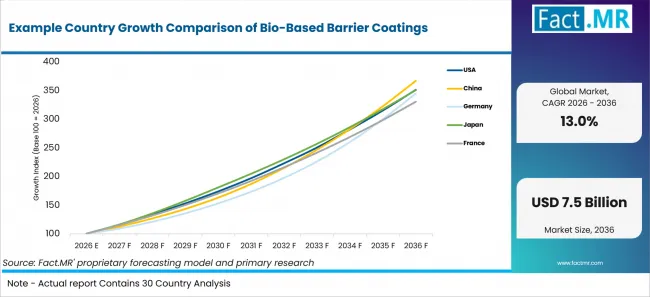
Example Country Growth Comparison Of Bio Based Barrier Coatings | Source: Fact.MR
| Country | CAGR (2026-2036) |
|---|---|
| China | 13.9% |
| United States | 13.4% |
| Japan | 13.4% |
| Germany | 13.2% |
| France | 12.7% |
What supports China adoption?
13.9% CAGR, supported by foodservice scale and recyclable packaging guidance.
China’s National Bureau of Statistics reported that value added from hotels and catering services reached 2,640.3 billion yuan in 2025. This large foodservice base supports demand for coated paper and molded-fiber packaging as converters work to improve grease, moisture and handling performance across prepared meals, fresh foods and short-delivery formats.
What supports USA adoption?
13.4% CAGR, backed by foodservice spending and PFAS replacement in grease-proof paper.
USDA ERS reported inflation-adjusted U.S. food-away-from-home spending of USD 1.41 trillion in 2025. This scale supports demand for coated cups, wraps, trays and paperboard formats as restaurants and converters evaluate aqueous barrier systems that can provide oil and moisture resistance while supporting fiber recovery and heat-seal performance.
How does Japan perform?
13.4% CAGR, led by food exports and compact convenience-store packaging.
MAFF reported that Japan’s agricultural, forestry, fishery and food exports reached 1.7005 trillion yen in 2025. Export activity and compact retail formats support demand for coated paper packaging that combines heat sealing, aroma protection and clean folding, particularly across portion packs, cartons and convenience-food applications.
What is supporting Germany’s adoption?
13.2% CAGR, reinforced by recycling targets and paper-board recovery channels.
The German Environment Agency and Central Agency Packaging Register reported that around 5.5 million tonnes of packaging waste collected through Germany’s dual systems were recycled in 2024. This established recovery infrastructure supports water-based barrier coatings for cartons, wraps and foodservice board where converters seek alternatives to conventional plastic lamination.
How is France developing demand?
12.7% CAGR, shaped by restaurant obligations and food-retail activity.
INSEE reported that in-store food-dominant retail sales increased 1.8% in volume in 2025. This supports continued demand for coated paper cartons, wraps and takeaway containers as food brands and operators balance food-contact performance, grease resistance and packaging choices with France’s wider anti-waste and reuse requirements.
Who leads the Bio-Based Barrier Coatings Market?
Solenis is active through TopScreen™ barrier coatings, PHA-based coatings and flexographic-applied barrier coatings for cupstock board, flexible packaging and flat-sheet paper. Michelman participates through Nuvita® Life 4002 and Nuvita® Life 4605, bio-based, plastic-free barrier coatings developed for fiber-based retail food packaging.
BASF participates through Joncryl® HPB high-performance barrier resins for paper-based packaging. Archroma is relevant through its Cartaseal® range of water-based barrier coatings, with grades providing oil-and-grease resistance, water and moisture barriers, and heat-seal functionality. Dow supplies RHOBARR™ barrier coatings for fiber-based packaging, including water-based systems offering liquid, oil and grease barriers, heat sealability and recyclability.
Mitsubishi Chemical adds direct technology relevance through its December 2025 development of a SoarnoL™ solution-coating process for paper packaging that provides gas-barrier properties and oil resistance. Across these suppliers, important development priorities include heat-seal performance, resistance to oil, grease and moisture, and demonstrable recyclability or fiber-recovery performance for coated paper structures.
Which companies are the key providers?
Key companies include Solenis, BASF, Michelman, Archroma, Dow.
- Solenis
- BASF
- Michelman
- Archroma
- Dow
Bibliography
- U.S. Bureau of Labor Statistics. (2026, July 15). Producer Price Indexes – June 2026 [News release].
- BASF. (2026, May 4). UPM and BASF accelerate the transition to recyclable, fiber-based packaging.
- Statistisches Bundesamt. (2026, February 23). Abfallentsorgung 2024: Art, Menge und Verbleib der im Berichtsjahr 2024 entsorgten Verpackungen.
- Direction générale de la concurrence, de la consommation et de la répression des fraudes. (2025, October 9). Transition écologique : quelles obligations pour les cafés et restaurateurs ?
- Dow Inc. (2026). 2025 progress report.
- European Parliament, & Council of the European Union. (2025, January 22). Regulation (EU) 2025/40 of the European Parliament and of the Council of 19 December 2024 on packaging and packaging waste, amending Regulation (EU) 2019/1020 and Directive (EU) 2019/904, and repealing Directive 94/62/EC.
- U.S. Food and Drug Administration. (2025, January 3). FDA determines authorization for 35 food contact notifications related to PFAS are no longer effective.
- Bonfils, J., Ceci-Renaud, N., Finot, J., Gallot, P., Gamrasni, A., & Lépine, N. (2026, June 18). Le compte du commerce en 2025 : l’activité accélère dans le commerce de détail et se contracte de nouveau dans le commerce de gros et dans le commerce et la réparation d’automobiles. Institut national de la statistique et des études économiques.
- Michelman. (2026, April 30). Michelman introduces Nuvita® Life 4002 & Nuvita® Life 4605: Bio-based barrier coatings for paper packaging applications.
- Michelman. (2026, May 7). UPM, Michelman, and BOBST introduce bio-based paper packaging concepts aligned with EU packaging rules.
- Mitsubishi Chemical Corporation. (2025, December 23). Mitsubishi Chemical Corporation develops technology to coat paper packaging material with gas barrier resin SoarnoL solution—Oil resistance makes SoarnoL aviable PFAS substitute—.
- National Bureau of Statistics of China. (2026, January 20). Total retail sales of consumer goods in December 2025.
- National Bureau of Statistics of China. (2026, February 28). Statistical communiqué of the People’s Republic of China on the 2025 national economic and social development.
- State Administration for Market Regulation, & Standardization Administration of China. (2025, October 31). GB/T 46685-2025: Technical guidelines for packaging of fresh edible agricultural products.
- Solenis. (2025, August 13). Solenis to showcase sustainable paper and packaging solutions at FACHPACK 2025 and PACK EXPO Las Vegas 2025.
- Statistics Bureau of Japan. (2026, February 6). 2025 yearly average [Family Income and Expenditure Survey].
- General Administration of Customs of the People’s Republic of China. (2026, January 8). China’s major imports by quantity and value, Dec 2025 (in USD).
- Zeballos, E., & Sinclair, W. (2026, June 11). Total U.S. food spending reached $2.51 trillion in 2025. U.S. Department of Agriculture, Economic Research Service.
- German Environment Agency, & Central Agency Packaging Register. (2026, January 27). Facts against myths: Packaging waste recycling in Germany is working.
This Report Answers
- The report explains where bio-based barrier coatings are used across chemistry, substrate and application.
- Segment analysis identifies leading subsegments and converter selection reasons.
- Country analysis examines foodservice, packaging and recycling mechanisms.
- Competitive analysis reviews providers across water-based, PHA and heat-seal coatings.
- Application analysis assesses grease resistance, heat seal and paper recovery.
What does the Bio-Based Barrier Coatings Market cover?
The Bio-Based Barrier Coatings Market covers water-based and bio-derived coating systems used to protect fiber packaging from oil, grease and moisture. The assessment includes coating layers used on paper and molded fiber where brands need food-contact performance and PHA paper coatings compatibility.
The market includes aqueous biopolymer dispersions, PHA or polyester bio-coatings, starch coatings and natural wax coatings. Demand is assessed across heat seal and barrier uses, including PHA extrusion coatings where converter trials move toward scalable coating lines.
What is included in the scope?
The scope includes coatings sold for foodservice packs, flexible food packs, cartons and takeaway packaging. It includes bio-based chemistries used to improve fiber packaging performance across seaweed-derived barrier coatings and other renewable barrier concepts.
It includes commercial coatings and application-ready coating systems used by converters, brands and paper packaging manufacturers. Adjacent coverage includes bio-based cartonboard coatings when the coating function directly supports barrier performance.
What is excluded from the scope?
The scope excludes conventional extrusion coatings, unsupported plastic films, structural adhesives and coatings used only for graphic finish. It also excludes paperboard production and converting services sold without a barrier coating component.
General waterborne coatings for wood, labels or industrial surfaces are excluded when sold outside packaging barrier applications. Additives are included only when sold as part of a barrier coating system.
How Was the Analysis Built?
The analysis draws on 120+ sources, 35+ company portfolios, 25+ countries and 20+ industry interviews.
- Primary Research: Primary research includes discussions with coating producers, paper converters, packaging manufacturers and foodservice operators. These conversations examine adoption, line trials, food-contact expectations and recycling requirements.
- Desk Research: Desk research covers government statistics, regulatory publications, standards, company releases and authoritative publications. Every publication used in the analysis is documented in the bibliography.
- Market Sizing and Forecasting: Market estimates combine demand indicators, pricing trends, segment shares, country-level growth, adoption patterns and barriers to expansion.
- Data Validation and Update Cycle: Findings are validated against public data, company activity, regulatory changes and material flows. Regular updates review launches, partnerships and adoption shifts.
What is the report’s scope and coverage?
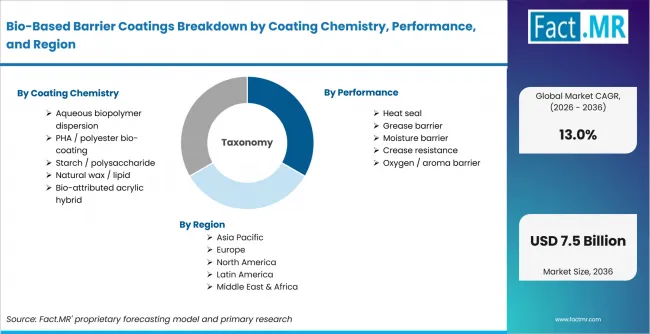
Bio Based Barrier Coatings Breakdown By Coating Chemistry, Performance, And Region | Source: Fact.MR
| Attribute | Details |
|---|---|
| Quantitative Units | USD billion in 2026 to USD billion by 2036 at a CAGR |
| Market Definition | Bio-based barrier coatings applied to paper, paperboard, molded fiber, cellulose film and specialty fiber substrates to provide heat seal, grease resistance, moisture barrier, crease resistance or oxygen and aroma barrier functions for packaging. |
| Coating Chemistry | Aqueous biopolymer dispersion; PHA or polyester bio-coating; Starch or polysaccharide; Natural wax or lipid; Bio-attributed acrylic hybrid |
| Performance | Heat seal; Grease barrier; Moisture barrier; Crease resistance; Oxygen or aroma barrier |
| Substrate | Paper; Paperboard; Molded fiber; Cellulose film; Specialty fiber substrate |
| Application | Foodservice; Flexible food packs; Cartons; Takeaway packaging; Consumer goods |
| Regions Covered | North America; Latin America; Western Europe; Eastern Europe; East Asia; South Asia & Pacific; Middle East & Africa |
| Countries Covered | China; United States; Japan; Germany; France |
| Key Companies Profiled | Solenis; BASF; Michelman; Archroma; Dow |
| Forecast Period | 2026 to 2036 |
| Approach | Hybrid top-down and bottom-up approach using packaging conversion activity, foodservice demand, substrate mix, coating chemistry adoption, country-level policy signals and provider portfolio review. |
How is the market segmented?
-
By Coating Chemistry
- Aqueous biopolymer dispersion
- PHA or polyester bio-coating
- Starch or polysaccharide
- Natural wax or lipid
- Bio-attributed acrylic hybrid
-
By Performance
- Heat seal
- Grease barrier
- Moisture barrier
- Crease resistance
- Oxygen or aroma barrier
-
By Substrate
- Paper
- Paperboard
- Molded fiber
- Cellulose film
- Specialty fiber substrate
-
By Application
- Foodservice
- Flexible food packs
- Cartons
- Takeaway packaging
- Consumer goods
-
By Region
- North America
- Latin America
- Western Europe
- Eastern Europe
- East Asia
- South Asia & Pacific
- Middle East & Africa