- Market Value (2025): USD 0.7 Bn
- Estimated Value (2026): USD 0.8 Bn
- Forecast Value (2036): USD 2.1 Bn
- CAGR (2026-2036): 10.2%
What is the Bio-Based Cartonboard Coatings Market forecast to be worth by 2036?
USD 0.8 billion in 2026 and USD 2.1 billion by 2036, representing a 10.2% CAGR.
- The bio-based cartonboard coatings market reached USD 0.7 billion in 2025 due to food packaging and consumer-goods carton applications.
- Bio-based cartonboard Coatings demand is expected to rise from USD 0.8 billion in 2026 to USD 2.1 billion by 2036.
- The market is forecast to record a 10.2% CAGR through 2036 as qualification programs expand across high-volume cartonboard specifications.
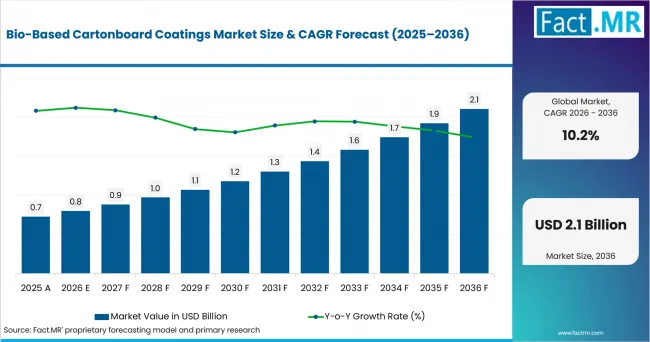
Bio Based Cartonboard Coatings Market Value Analysis | Source: Fact.MR
What are the defining numbers behind Bio-Based Cartonboard Coatings Market growth?
USD 1.3 billion absolute opportunity by 2036, led by Starch-Based and Grease & Oil Resistance alongside Food Packaging.
- Demand Drivers in the Market
- Food brands need grease and moisture protection that survives filling and supports documented fiber recovery.
- Cartonboard mills require waterborne coatings that preserve coat-weight control and drying speed on installed equipment.
- Manufacturers need barrier performance that remains stable after printing and creasing across repeated folding-carton production.
- Packaging teams prefer food-contact and recovery evidence before replacing established fluorochemical or fossil-heavy barrier layers.
- Key Segments Analyzed
- By feedstock: Starch-based is expected to hold 32.0% share in 2026 due to familiar papermaking controls.
- By barrier property: Grease and oil resistance is projected to capture 36.0% share in 2026 owing to visible failure risks.
- By application method: Blade and rod coating is anticipated to represent 38.0% share in 2026 due to installed-line compatibility.
- By end use: Food packaging is estimated to account for 50.0% share in 2026 attributable to combined compliance requirements.
- By substrate: Folding boxboard is forecast to hold 40.0% share in 2026 driven by predictable converting performance.
- Analyst Opinion at Fact.MR
- Senior Analyst Shambhu Nath Jha of Fact.MR states, “Finished-carton performance now governs coating approval across the customer’s actual printing, creasing, and filling lines. Providers are expected to secure repeat orders if barriers survive printing and creasing during commercial conversion. Food-contact and recovery documentation remains essential before brands approve recurring package specifications across several markets.”
- Strategic Implications
- Coating formulators should validate each chemistry on the customer’s board grade before presenting commercial performance claims.
- Cartonboard mills must compare drying load and coat-weight consistency before committing machine time to production qualification.
- Manufacturers need to test printing and crease durability because laboratory barrier results cannot predict finished-carton performance.
- Food brands should align food-contact and recovery evidence before approving package specifications across several national markets.
Commercial programs advance faster when compatible layers separate sealing and barrier functions within one carton specification. In April 2026, Michelman introduced a paired bio-based coating system combining heat-seal and barrier functions for commercial fiber packaging.
India is expected to record a 12.8% CAGR through 2036 as local qualification capacity expands. China is projected to post an 11.8% CAGR between 2026 and 2036 due to high-output converting. The United Kingdom is anticipated to advance at a 10.7% CAGR by 2036 as recyclability fees shape specifications. Germany is estimated to register a 9.8% CAGR over the assessment period owing to detailed recovery testing. Brazil is forecast to post a 9.8% CAGR during the forecast period as fiber substitution expands.
How does the Bio-Based Cartonboard Coatings Market break down by segment?
Starch-Based leads at 32.0%, Grease & Oil Resistance leads at 36.0%.
Which feedstock category dominates?
Starch-based holds 32.0% share in 2026.
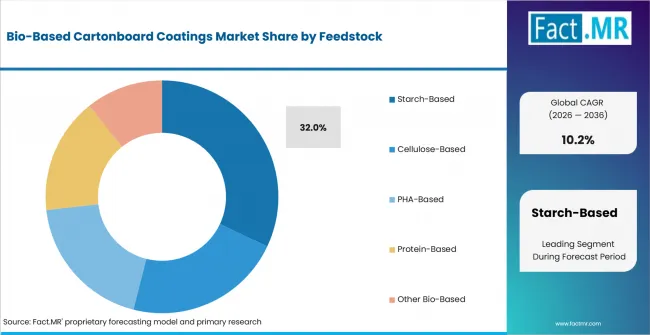
Bio Based Cartonboard Coatings Market Analysis By Feedstock | Source: Fact.MR
By feedstock, starch-based coatings are estimated to hold 32.0% share in 2026 owing to familiar handling. Adoption expands as formulation teams tune starch chemistry for board porosity and drying capacity during commercial trials. Starch-based coatings use familiar mill controls and allow binder modification on installed surface sizing starch equipment.
Why does grease and oil resistance dominate barrier property?
Grease and oil resistance accounts for 36.0% share in 2026.
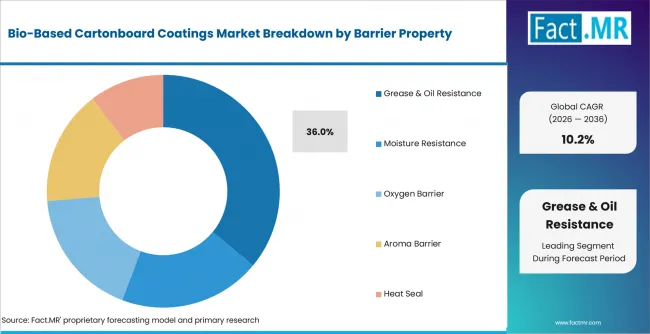
Bio Based Cartonboard Coatings Market Analysis By Barrier Property | Source: Fact.MR
In 2026, grease and oil resistance is expected to lead with 36.0% share due to visible carton failure. Grease failure creates visible staining and weakens finished cartons across bakery and prepared-food applications during handling. Food brands prioritize fluorine-free barriers that survive creasing without losing oil holdout during package qualification. Mineral oil barriers add migration-control requirements for recycled-fiber cartons used across sensitive food categories during distribution.
How does blade and rod coating shape application method?
Blade and rod coating captures 38.0% share in 2026.
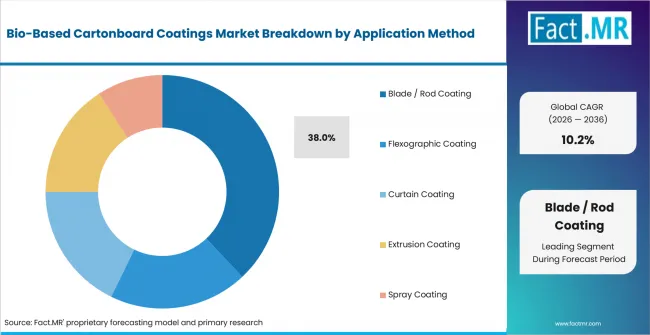
Bio Based Cartonboard Coatings Market Analysis By Application Method | Source: Fact.MR
By application method, blade and rod coating is forecast to represent 38.0% share in 2026 due to controlled deposition. Commercial adoption improves when coating chemistry and machine settings are validated together on production-relevant equipment. In May 2026, UPM joined Michelman and BOBST to introduce bio-based packaging concepts with dependable heat sealing.
What supports food packaging within end use?
Food packaging represents 50.0% share in 2026.
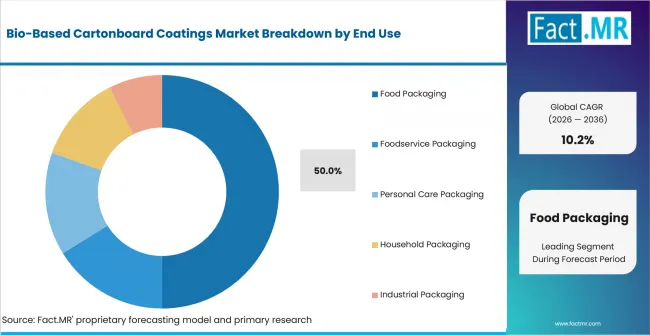
Bio Based Cartonboard Coatings Market Analysis By End Use | Source: Fact.MR
Food packaging is likely to capture 50.0% share in 2026 due to overlapping barrier and food-contact requirements. Adoption expands when food brands validate barrier performance on standard forming lines without changing established recovery routes.
Why does folding boxboard dominate substrate?
Folding boxboard holds 40.0% share in 2026.
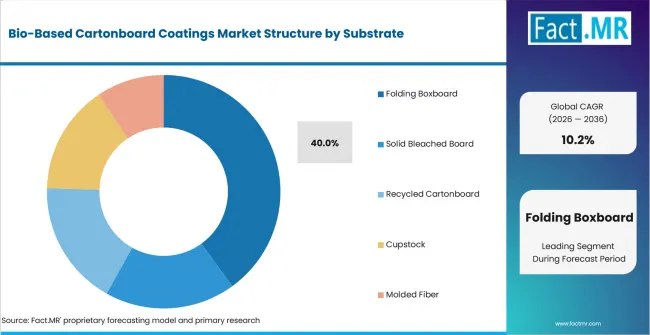
Bio Based Cartonboard Coatings Market Analysis By Substrate | Source: Fact.MR
Folding boxboard is forecast to lead the substrate category with 40.0% share in 2026 due to predictable converting. Commercial adoption improves when coating and substrate functions are engineered as one converting-ready structure for food packaging. In April 2026, Stora Enso launched Performa Natura Aqua with grease-resistant coating and a printable surface.
What is accelerating Bio-Based Cartonboard Coatings Market adoption, and what is holding it back?
Restricted-substance replacement is anticipated to drive broader adoption, while line-scale qualification costs restrain commercial conversion speed.
Drivers Impact Analysis
| DRIVER | (~) % IMPACT ON CAGR |
GEOGRAPHIC RELEVANCE | IMPACT TIMELINE |
|---|---|---|---|
| Restricted-substance replacement in food-contact cartons | +1.2% | North America and Europe | Short term (<= 2 years) |
| Recyclability and producer-fee qualification | +1.0% | Europe and United Kingdom | Medium term (2-4 years) |
| Food-packaging barrier conversion | +0.8% | Global food and retail hubs | Medium term (2-4 years) |
| Installed-line compatibility for waterborne systems | +0.6% | Asia Pacific and Europe | Medium term (2-4 years) |
| Bio-based feedstock development | +0.4% | China and India | Long term (>= 4 years) |
Source: Fact.MR analysis. Updated Jul 31, 2026
- Restricted-substance replacement: Food brands qualify grease barriers that satisfy revised authorization rules and finished-package requirements.
- Recyclability qualification: Approval depends on the completed fiber structure meeting documented recovery conditions during commercial testing.
- Producer-fee assessment: Lower recyclability classifications increase disposal costs and bring coating review forward during package design.
- Installed-line compatibility: Mills prioritize waterborne systems preserving coat-weight control and drying speed without dedicated extrusion equipment.
Opportunity Impact Analysis
| OPPORTUNITY | (~) % IMPACT ON CAGR |
GEOGRAPHIC RELEVANCE | IMPACT TIMELINE |
|---|---|---|---|
| Modular basecoat and topcoat systems | +0.7% | Europe and North America | Medium term (2-4 years) |
| Retrofit-compatible waterborne coatings | +0.6% | Asia Pacific and Europe | Medium term (2-4 years) |
| Plant-protein and PHA barrier options | +0.5% | United Kingdom and China | Short term (<= 2 years) |
| Local pilot and application support | +0.4% | India and Brazil | Long term (>= 4 years) |
Source: Fact.MR analysis. Updated Jul 31, 2026
- Modular coating systems: Separate basecoat and topcoat functions let formulators adjust grease and moisture performance independently.
- Retrofit-compatible systems: Waterborne coatings reduce equipment requirements if drying and sealing remain stable at commercial speed.
- Plant-protein and PHA options: Renewable chemistries expand barrier choices but require binder support for dependable films.
- Local pilot support: Regional coating centers reduce service distance and shorten correction cycles during commercial board trials.
Restraints Impact Analysis
| RESTRAINT | (~) % IMPACT ON CAGR |
GEOGRAPHIC RELEVANCE | IMPACT TIMELINE |
|---|---|---|---|
| Multi-stage package qualification | -0.8% | Global | Medium term (2-4 years) |
| Moisture and barrier trade-offs | -0.6% | Global food packaging | Medium term (2-4 years) |
| Drying and line-speed constraints | -0.4% | Asia Pacific and Europe | Short term (<= 2 years) |
| Feedstock cost and supply variability | -0.3% | Global | Long term (>= 4 years) |
Source: Fact.MR analysis. Updated Jul 31, 2026
- Multi-stage qualification: Coatings must survive application, printing, filling, distribution, and recovery tests before commercial approval.
- Recovery evidence: Barrier layers delay approval if pulping creates rejects or sticky particles during fiber-recovery testing.
- Drying constraints: Waterborne chemistry can increase oven demand or reduce web speed on limited thermal equipment.
- Feedstock variability: Mills qualify secondary sources because biopolymers differ across regional supply chains and production cycles.
Which countries are scaling Bio-Based Cartonboard Coatings Market fastest?
United Kingdom 10.7%, Germany 9.8%, Brazil 9.8%.
Regional analysis covers North America, Europe, Asia Pacific, Latin America, and the Middle East and Africa.
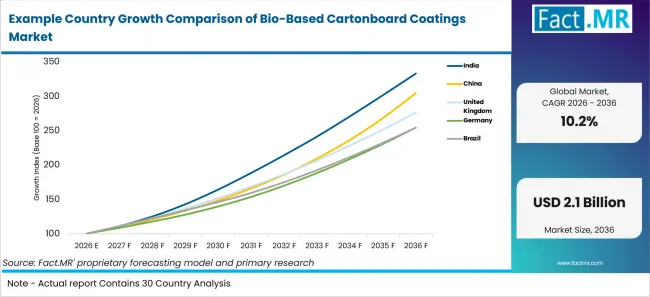
Example Country Growth Comparison Of Bio Based Cartonboard Coatings Market | Source: Fact.MR
| COUNTRY | CAGR |
|---|---|
| United Kingdom | 10.7% |
| Germany | 9.8% |
| Brazil | 9.8% |
Source: Fact.MR analysis. Updated Jul 31, 2026
What supports the United Kingdom outlook?
10.7% CAGR, owing to foodservice distribution and fee-linked recyclability assessment.
United Kingdom foodservice distributors give coating developers a practical route into trial packages and recurring orders. The industry in UK is anticipated to advance at a 10.7% CAGR by 2036 as recyclability assessments shape material selection. Household-packaging producers require documented recovery performance before improved classifications reduce national fee exposure during reporting.
What underpins Germany’s growth?
9.8% CAGR, shaped by practice-based recyclability rules and converter depth.
German converters expect coating evidence tied to actual sorting and paper-recovery practice across package categories. The market is estimated to register a 9.8% CAGR over the assessment period as structured testing guides material selection. German-language documentation and local laboratory access remain necessary because testing can lengthen approval for new carton designs.
How is Brazil developing Bio-Based Cartonboard Coatings demand?
9.8% CAGR, supported by plastic-package reverse logistics and food-carton substitution.
Brazilian converters outside major industrial centers face longer technical-service routes for coating trials and qualification. Demand is forecast to rise at a 9.8% CAGR during the forecast period as food-carton substitution expands. Limited local laboratories raise qualification costs, so providers need regional partners and adaptable local formulations.
Who leads the Bio-Based Cartonboard Coatings Market?
Solenis and Michelman anchor direct coating coverage, while Kemira and BASF strengthen polymer and mill-support capabilities.
The competitive field combines broad papermaking-chemistry groups with specialist coating developers serving mills and converters. Concentration remains moderate because no provider covers every renewable feedstock and barrier route with equal application depth. Different coating chemistries require distinct drying controls and film-forming expertise during commercial production trials at scale. New entrants can secure trials through documented food-contact performance, although regional supply and technical service determine commercial scale.
Solenis and Michelman compete through paper-barrier portfolios and converter testing across established commercial cartonboard lines. Kemira and BASF connect polymer development with mill support, while Archroma focuses on water-based grease barriers. Xampla differentiates directly through plant-protein coatings, and Stora Enso links coating design with folding-boxboard performance. Competition is expected to center on qualification speed and dependable support near regional production clusters.
Which companies are the key providers?
Some of the key players profiled include Solenis, Michelman, Kemira Oyj, BASF SE, Archroma, Xampla, and Stora Enso Oyj.
- Solenis
- Michelman
- Kemira Oyj
- BASF SE
- Archroma
- Xampla
- Stora Enso Oyj
Bibliography
- Michelman. (2026, April 30). Michelman introduces Nuvita® Life 4002 & Nuvita® Life 4605: Bio-based barrier coatings for paper packaging applications. Michelman.
- Michelman. (2026, May 7). UPM, Michelman, and BOBST introduce bio-based paper packaging aligned with EU packaging rules. Michelman.
- Stora Enso. (2026, April 30). Stora Enso launches Performa Natura Aqua, a dispersion-coated board for foodservice and bakery packaging. Stora Enso.
- U.S. Food and Drug Administration. (2025, January 3). FDA determines authorization for 35 food contact notifications related to PFAS are no longer effective. U.S. Food and Drug Administration.
- European Parliament and Council of the European Union. (2025, January 22). Regulation (EU) 2025/40 of the European Parliament and of the Council of 19 December 2024 on packaging and packaging waste, amending Regulation (EU) 2019/1020 and Directive (EU) 2019/904, and repealing Directive 94/62/EC. Official Journal of the European Union.
- Department for Environment, Food & Rural Affairs. (2024, December 23). Recyclability assessment methodology: How to assess your packaging waste. GOV.UK.
- Central Agency Packaging Register. (2025, August 29). 2025 minimum standard published – initial touchstone for companies preparing for the EU Packaging and Packaging Waste Regulation (PPWR). Central Agency Packaging Register.
- Government of Brazil. (2025, October 21). Decreto nº 12.688, de 21 de outubro de 2025. Presidência da República.
- Confederation of European Paper Industries. (2025, March 13). Cepi recyclability test method version 3. Cepi.
This Report Addresses
- Analysis compares feedstock and barrier property choices across the bio-based cartonboard coatings market.
- Segment positions assess Application Method demand alongside End Use qualification needs.
- India, China, United Kingdom, Germany, and Brazil outlooks provide the regional comparison base.
- Provider reviews compare conversion capabilities with customer approval requirements in Bio-Based Cartonboard Coatings.
- Commercial assessment links Substrate conditions to buyer purchasing behavior.
- Forecast inputs combine published indicators with interview-based checks for Bio-Based Cartonboard Coatings.
What does the Bio-Based Cartonboard Coatings Market cover?
Renewable barrier and functional coating systems applied to cartonboard for grease, moisture, oxygen, aroma, and heat-seal performance.
The market covers formulated bio-based layers that provide defined barrier or converting functions on cartonboard packaging.
Revenue reflects coating formulations sold for application and excludes finished cartons, coated board value, and fossil-only layers.
What is included in the scope?
Bio-based coatings sold for cartonboard applications across food, foodservice, personal-care, household, and industrial packaging.
Coverage includes basecoats and topcoats providing barrier or heat-seal performance across listed substrates and commercial application methods.
What is excluded from the scope?
Finished cartons, conventional fossil-only coatings, standalone films, printing inks, and raw biopolymers without a sold coating formulation are excluded.
The scope excludes downstream packaging revenue, standalone films, decorative varnishes, adhesives, and unformulated raw biopolymers.
How Was the Analysis Built?
The analysis draws on 120+ sources, 35+ company portfolios, 25+ countries, and more than 20 industry interviews.
- Primary Research: Primary research includes discussions with manufacturers, service providers, technology developers, distributors, end users, procurement teams, and subject-matter experts. These conversations examine purchasing priorities, product adoption, operational challenges, approval requirements, competitive positioning, and the factors that influence wider market acceptance.
- Desk Research: Desk research covers government statistics, regulatory publications, company filings, trade data, technical studies, industry associations, standards, public policy, and other authoritative sources. Every source used in the analysis is documented in the bibliography.
- Market Sizing and Forecasting: Market estimates combine historical performance, demand indicators, pricing and volume trends, segment shares, company participation, country-level growth, adoption patterns, investment activity, and barriers to market expansion.
- Data Validation and Update Cycle: Findings are validated by comparing primary interviews with public data, company activity, regulatory changes, trade patterns, and industry developments. Regular updates review new product launches, capacity changes, partnerships, approvals, procurement trends, and shifts in commercial adoption.
Segmentation
What is the report’s scope and coverage?
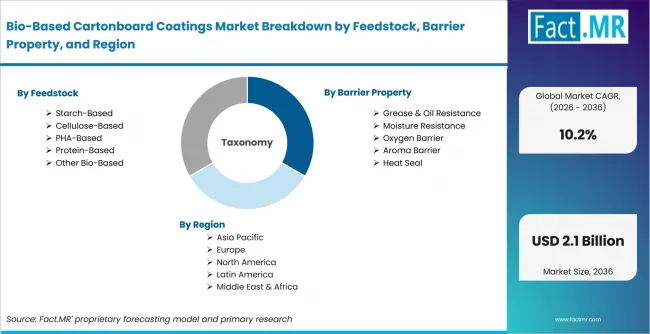
Bio Based Cartonboard Coatings Market Breakdown By Feedstock, Barrier Property, And Region | Source: Fact.MR
| Coverage field | Report scope |
|---|---|
| Quantitative Units | USD Billion |
| Market Definition | Revenue from formulated bio-based barrier and functional coatings sold for cartonboard within the stated segmentation. |
| Feedstock | Starch-Based, Cellulose-Based, PHA-Based, Protein-Based, Other Bio-Based |
| Barrier Property | Grease & Oil Resistance, Moisture Resistance, Oxygen Barrier, Aroma Barrier, Heat Seal |
| Application Method | Blade / Rod Coating, Flexographic Coating, Curtain Coating, Extrusion Coating, Spray Coating |
| End Use | Food Packaging, Foodservice Packaging, Personal Care Packaging, Household Packaging, Industrial Packaging |
| Substrate | Folding Boxboard, Solid Bleached Board, Recycled Cartonboard, Cupstock, Molded Fiber |
| Regions Covered | North America, Europe, Asia Pacific, Latin America, Middle East & Africa |
| Countries Covered | India, China, United Kingdom, Germany, Brazil, and more than twenty-five additional countries |
| Key Companies Profiled | Solenis, Michelman, Kemira Oyj, BASF SE, Archroma, Xampla, Stora Enso Oyj |
| Forecast Period | 2026 to 2036 |
| Approach | Hybrid top-down and bottom-up analysis using coating demand, cartonboard output, coat-weight assumptions, application volumes, supplier participation, country conditions, and the defined revenue boundary. |
Source: Fact.MR analysis. Updated Jul 31, 2026
How is the market segmented?
-
By Feedstock
- Starch-Based
- Cellulose-Based
- PHA-Based
- Protein-Based
- Other Bio-Based
-
By Barrier Property
- Grease & Oil Resistance
- Moisture Resistance
- Oxygen Barrier
- Aroma Barrier
- Heat Seal
-
By Application Method
- Blade / Rod Coating
- Flexographic Coating
- Curtain Coating
- Extrusion Coating
- Spray Coating
-
By End Use
- Food Packaging
- Foodservice Packaging
- Personal Care Packaging
- Household Packaging
- Industrial Packaging
-
By Substrate
- Folding Boxboard
- Solid Bleached Board
- Recycled Cartonboard
- Cupstock
- Molded Fiber
-
By Region
- North America
- United States
- Canada
- Europe
- Germany
- United Kingdom
- France
- Italy
- Spain
- Asia Pacific
- India
- China
- Japan
- South Korea
- Australia
- Latin America
- Brazil
- Argentina
- Mexico
- Chile
- Middle East & Africa
- UAE
- Saudi Arabia
- South Africa
- North America
Frequently Asked Questions
Which feedstock is projected to hold 32.0% share?
What barrier property accounts for 36.0% share?
Which application method captures leading share?
What end use represents dominant share?
Which substrate holds significant share?
Which country is projected to record a 12.8% CAGR?
What factor primarily drives coating adoption?
Which qualification issue restrains commercial conversion?
Who worked on this report


Preview the report firsthand - request a free sample
Free SampleGet the brochure for pricing and purchase details
Download PDF