- Market Value (2025): USD 4.0 Bn
- Estimated Value (2026): USD 4.4 Bn
- Forecast Value (2036): USD 12.8 Bn
- CAGR (2026-2036): 11.2%
What is the Building System Unifiers Market forecast to be worth by 2036?
USD 4.4 billion in 2026 to USD 12.8 billion by 2036 at an 11.2% CAGR.
- The Building System Unifiers Market crossed a valuation of USD 4.0 billion in 2025.
- Demand is projected to increase from USD 4.4 billion in 2026 to USD 12.8 billion by 2036.
- The market is forecast to record an 11.2% CAGR from 2026 to 2036 as facility teams standardize building data and alarms.
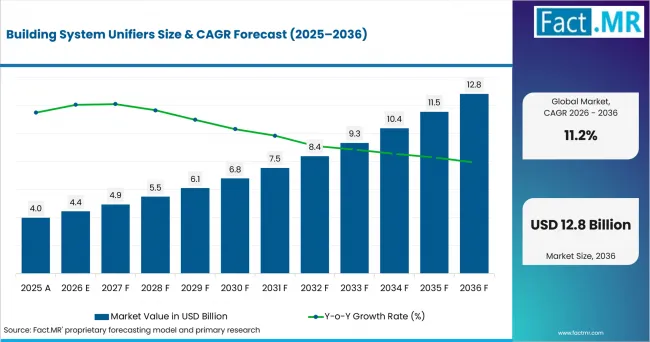
Building System Unifiers Value Analysis | Source: Fact.MR
What are the defining numbers behind Building System Unifiers Market growth?
USD 8.4 billion absolute opportunity between 2026 and 2036, led by supervisory software, BACnet and commercial offices.
- Demand Drivers in the Market
- Facility managers need one operating view for BMS and HVAC so comfort faults are traced before they become tenant complaints.
- Energy teams need metering data tied to controls schedules because efficiency programs depend on clear asset-level evidence.
- Data-center operators need linked cooling and power status to coordinate alarms across equipment rooms and building services.
- Key Segments Analyzed
- By Integration Scope: BMS + HVAC is expected to hold 28.0% share in 2026 because comfort systems create constant operating data.
- By Platform Layer: Supervisory software is projected to account for 36.0% share in 2026 as operators need one control layer.
- By Building Type: Commercial office is anticipated to represent 29.0% share in 2026 due to portfolio reporting and tenant comfort needs.
- By Protocol: BACnet is estimated to capture 36.0% share in 2026 owing to its broad use in building automation networks.
- Analyst Opinion at Fact.MR
- Shambhu Nath Jha, Principal Consultant at Fact.MR, states, “The commercial issue is less about adding dashboards and more about proving that every point name, alarm and meter value is trusted. Demand is expected to move toward platforms that reduce field mapping work and keep existing controllers useful. Suppliers with tested protocol libraries, commissioning discipline and clear energy reporting are positioned for better account retention.”
- Strategic Implications
- Platform vendors should connect supervisory software with energy reporting so facility managers see comfort, power and maintenance data together.
- Gateway vendors should publish tested BACnet, Modbus and KNX pathways so integrators shorten commissioning work on retrofit projects.
- Cloud building platform providers should keep open API structures visible during sales reviews. Siemens said in July 2025 that Building X with Microsoft Azure IoT Operations reduces integration effort by up to 80%.
- Building owners should define common point names before software rollout so alarms, meter reads and access events remain traceable.
France is expected to record 12.6% CAGR through 2036, supported by EU building automation rules and data-center supervision. Singapore is projected to post 12.3% CAGR as dense commercial estates raise the value of connected controls. The USA is anticipated to advance at 12.0% CAGR driven by data-center electricity demand. The UK is forecast to reach 11.6% CAGR as retrofit work supports unified building layers. Germany is estimated to record 11.1% CAGR owing to automation depth and standards-led integration.
How does the Building System Unifiers Market break down by segment?
Supervisory software leads Platform Layer at 36.0%; BACnet leads Protocol at 36.0%.
Which Integration Scope dominates?
BMS + HVAC holds 28.0% share in 2026.
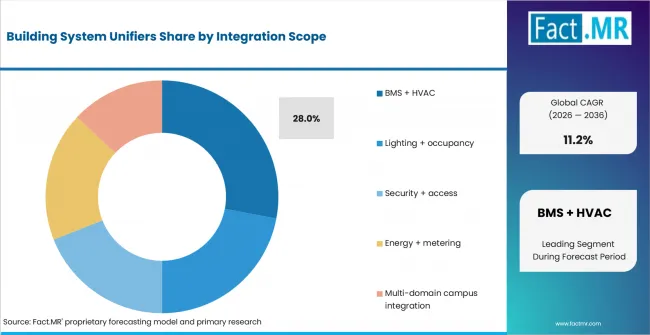
Building System Unifiers Analysis By Integration Scope | Source: Fact.MR
BMS + HVAC leads Integration Scope because comfort control is the most active source of building operating data. HVAC alarms, schedules and sensor values feed daily decisions for offices, hospitals and campuses. Unifiers reduce manual checks by joining plant-room status with space-level comfort information.
Lighting + occupancy follows as operators connect space utilization with energy schedules. Security + access gains relevance where a common event layer helps facility teams review incidents and building conditions in one workflow.
What leads the Platform Layer segment?
Supervisory software leads with 36.0% share in 2026.
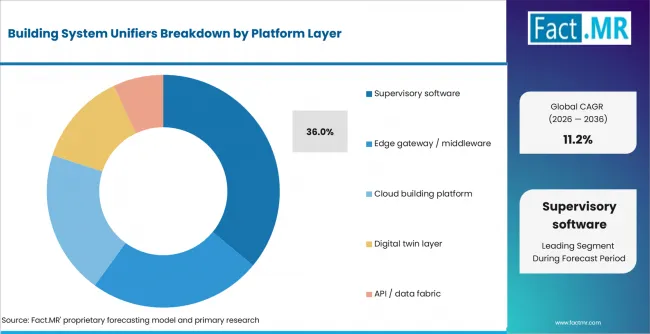
Building System Unifiers Analysis By Platform Layer | Source: Fact.MR
Supervisory software leads Platform Layer because it gives operators the control screen where alarms, trends and energy values are reviewed. These platforms translate point data from controllers into alarms and reports that facility teams use every day. That position makes supervisory software the preferred layer above field devices.
Edge gateway and middleware platforms remain important in older facilities where controllers use several protocols. Cloud building platforms and digital twin layers gain share as owners compare sites across portfolios.
How does Building Type shape demand?
Commercial office represents 29.0% share in 2026.
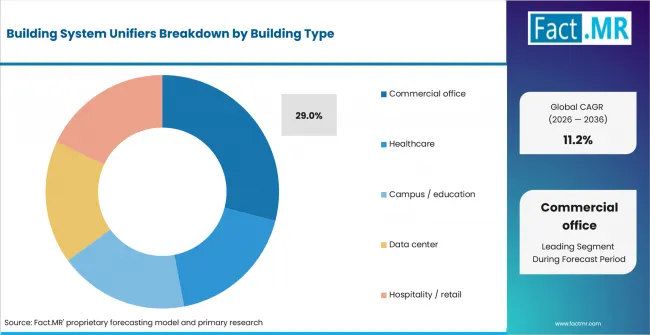
Building System Unifiers Analysis By Building Type | Source: Fact.MR
Commercial office leads Building Type because multi-tenant spaces need comfort control, access coordination and energy reporting. NIST reported in February 2026 that building automation systems are present in 60% of U.S. commercial buildings larger than 50,000 square feet. That installed automation base supports supervisory software and data-unification layers in larger commercial properties.
Healthcare buildings follow due to strict comfort and access workflows. Campus and education sites add multi-building use cases, while data centers push more power and cooling visibility into building-control systems.
What supports BACnet within Protocol?
BACnet accounts for 36.0% share in 2026.
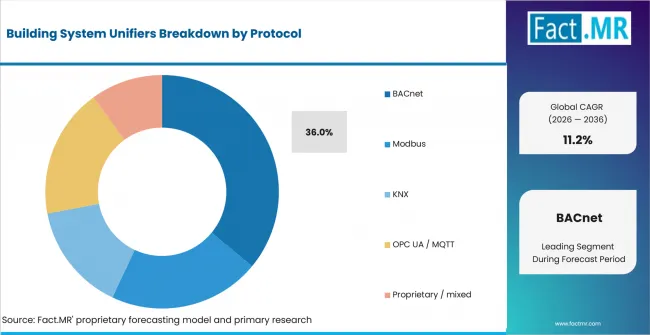
Building System Unifiers Analysis By Protocol | Source: Fact.MR
BACnet leads Protocol because it is widely used across HVAC controllers and building automation networks. A unifier built around BACnet can collect points from many equipment types and pass them to supervisory software. That position helps facility teams preserve installed controls during phased modernization.
Modbus remains relevant for meters and equipment interfaces. KNX supports building functions in many European sites, while OPC UA and MQTT help cloud and industrial data layers connect with building systems.
What is accelerating Building System Unifiers Market adoption, and what is holding it back?
Demand is expected to rise through BMS convergence and data-center visibility, while adoption is constrained by legacy mapping and cybersecurity review.
Drivers Impact Analysis
| DRIVER | (~) % IMPACT ON CAGR | GEOGRAPHIC RELEVANCE | IMPACT TIMELINE |
|---|---|---|---|
| BMS and HVAC operating convergence | +1.4% | Global | Short term (<= 2 years) |
| Data-center and campus visibility | +1.1% | North America, Western Europe, Singapore | Medium term (2-4 years) |
| Building-energy compliance | +0.9% | Western Europe, Singapore | Medium term (2-4 years) |
| Open protocols and gateway middleware | +0.7% | Global | Long term (>= 4 years) |
Opportunity Impact Analysis
| OPPORTUNITY | (~) % IMPACT ON CAGR | GEOGRAPHIC RELEVANCE | IMPACT TIMELINE |
|---|---|---|---|
| Portfolio-level cloud operations | +1.0% | North America, Western Europe | Medium term (2-4 years) |
| Digital twin layers for campuses | +0.8% | Global | Medium term (2-4 years) |
| Protocol conversion for existing assets | +0.6% | Europe, North America | Short term (<= 2 years) |
Restraints Impact Analysis
| RESTRAINT | (~) % IMPACT ON CAGR | GEOGRAPHIC RELEVANCE | IMPACT TIMELINE |
|---|---|---|---|
| Legacy point mapping and commissioning workload | -0.5% | Global | Short term (<= 2 years) |
| Cybersecurity approvals for connected controls | -0.4% | Europe, North America | Medium term (2-4 years) |
| Split facilities and IT budgets | -0.3% | Global | Medium term (2-4 years) |
Which countries are scaling the Building System Unifiers Market through 2036?
- The country comparison spans 1.5 percentage points and forms three practical growth bands across the forecast period.
- France remains 0.3 percentage point above Singapore through smart-building compliance and data-center supervision.
- Singapore remains 0.3 percentage point above the USA as dense estates increase the value of unified operating screens.
- The USA remains 0.4 percentage point above the UK as data-center load expands controls work in commercial facilities.
- The UK remains 0.5 percentage point above Germany as retrofit activity supports unified building layers.
- Germany closes the displayed range through automation depth and standards-led integration across complex sites.
Comparable CAGRs create different entry conditions due to building codes, retrofit budgets, data-center intensity and integrator depth. Full report coverage includes North America, Latin America, Western Europe, Eastern Europe, East Asia, South Asia & Pacific, and Middle East & Africa.
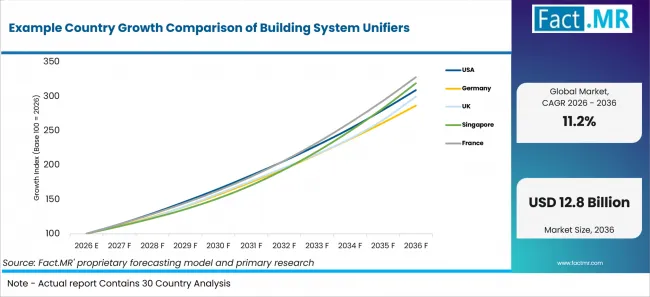
Example Country Growth Comparison Of Building System Unifiers | Source: Fact.MR
| COUNTRY | CAGR |
|---|---|
| France | 12.6% |
| Singapore | 12.3% |
| USA | 12.0% |
| UK | 11.6% |
| Germany | 11.1% |
What supports France adoption?
12.6% CAGR, supported by BACS-linked compliance and data-center visibility.
France’s commercial building owners are expected to use unifier platforms to connect BMS, HVAC and metering data under European smart-building rules. SDES reported in July 2026 that 471 data centers in metropolitan France were identified as exceeding 1 GWh of annual electricity consumption in at least one year between 2018 and 2024. Data-center cooling and power visibility gives supervisory software a clear operating role in large technical buildings.
How is Singapore scaling demand?
12.3% CAGR, led by building activity and dense commercial estates.
Singapore’s facility teams are expected to adopt unifiers where high-rise offices, healthcare assets and campuses rely on connected controls. BCA projected in January 2026 that total construction demand would reach S$47 billion to S$53 billion in nominal terms for 2026. New projects and retrofits give system integrators a steady base for middleware and supervisory software.
What supports USA adoption?
12.0% CAGR, driven by data-center load and commercial building operations.
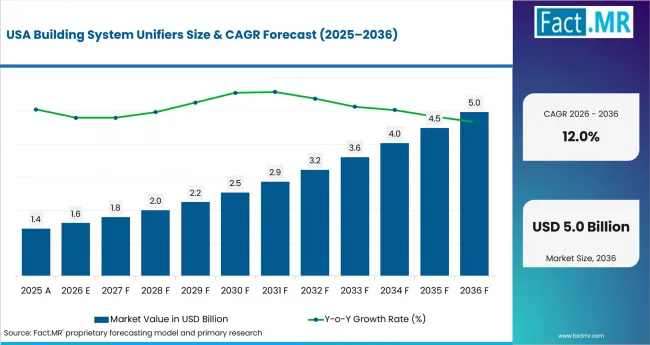
Building System Unifiers Country Value Analysis | Source: Fact.MR
U.S. demand is expected to expand as data centers place more pressure on cooling coordination and energy visibility. EIA reported in January 2026 that U.S. electricity use is expected to grow 3% in 2027, driven largely by large computing facilities. That load profile supports unifiers that connect power, HVAC and facility alarms in one operating view.
What supports the United Kingdom’s growth?
11.6% CAGR, backed by retrofit work and commercial asset management.
United Kingdom building owners are expected to use unifiers to compare comfort and energy performance across office and campus portfolios. ONS reported in August 2026 that total construction output in Great Britain increased 0.3% in Quarter 2 2026 compared with Quarter 1 2026. Retrofit planning and estate management create demand for common data layers across installed building systems.
What is supporting Germany’s adoption?
11.1% CAGR, supported by automation depth and technical-building standards.
Germany’s engineering base supports projects that connect HVAC control, metering and access data across complex buildings. Destatis reported in April 2026 that new orders in building construction rose 8.6% month-on-month in February 2026. That project activity supports suppliers that combine supervisory software with tested field-bus integration.
Who leads the Building System Unifiers Market?
Siemens supports building automation through Building X, Desigo and hardware and software gateways that connect building systems and data with Building X applications. Schneider Electric supports building and energy management through its EcoStruxure portfolio, with EcoStruxure Foresight Operation providing a unified platform for energy, power and building domains.
Honeywell launched Connected Solutions in June 2025 as a platform that integrates critical building software and technologies into a single interface and includes energy-management capabilities. Johnson Controls’ Metasys integrates HVAC, lighting, security and fire-protection systems on one building automation platform.
ABB launched ABB Ability BuildingPro in November 2025 as a cybersecure integration platform for building operations. ABB stated that BuildingPro is available in more than 40 countries and supports commercial real estate, education, healthcare, hospitality and government facilities.
Which companies are the key providers?
Key companies include Siemens; Schneider Electric; Honeywell; Johnson Controls; Trane Technologies; and ABB.
- Siemens
- Schneider Electric
- Honeywell
- Johnson Controls
- Trane Technologies
- ABB
Bibliography
- European Parliament, & Council of the European Union. (2024, April 24). Directive (EU) 2024/1275 of the European Parliament and of the Council of 24 April 2024 on the energy performance of buildings (recast).
- European Commission. (2025, June 30). Technical building systems, indoor environmental quality and inspections (Articles 13, 23 and 24).
- National Institute of Standards and Technology. (2026, February 19). AI-optimized building controls.
- U.S. Energy Information Administration. (2026, May 19). Data center server energy use grows across the commercial building stock.
- Stouffer, K., & Galler, M. (2026, August 19). NIST releases tips & tactics for building automation & control system cybersecurity. National Institute of Standards and Technology.
- Service des données et études statistiques. (2026, July 2). La consommation d’électricité des data centers en 2024.
- U.S. Energy Information Administration. (2026, January 13). EIA forecasts strongest four-year growth in U.S. electricity demand since 2000, fueled by data centers.
- Office for National Statistics. (2026, August 13). Construction output in Great Britain: June 2026, new orders and Construction Output Price Indices, April to June 2026.
- Building and Construction Authority. (2026, January 22). Steady construction demand in 2026 as Singapore steps up support for Built Environment firms through collaboration and innovation.
- Statistisches Bundesamt (Destatis). (2026, April 24). Auftragseingang im Bauhauptgewerbe im Februar 2026: +7,6 % zum Vormonat.
- Siemens. (2025, July 7). Siemens enters collaboration with Microsoft to enhance IoT interoperability for buildings.
- Schneider Electric. (2025, November 18). Schneider Electric’s EcoStruxure™ Foresight Operation ushers in a new era for the built environment.
- Honeywell. (2025, June 10). Honeywell unveils AI-powered building management solution.
- ABB. (2025, November 17). ABB unveils Ability™ BuildingPro to accelerate decarbonization and digital transformation in smart and sustainable buildings.
- Johnson Controls. (2026, June 30). Johnson Controls launches Metasys 16.0 to support high-performance environments where uptime and resilience are critical.
- Trane Technologies. (2025, January 3). Trane Technologies completes acquisition of BrainBox AI.
This Report Answers
- The report explains where building system unifiers are used across integration scope and platform layer. It covers building type and protocol requirements.
- Segment analysis identifies the listed subsegments and explains why facility teams prioritize supervisory software and BACnet-led integration.
- Country analysis examines France, Singapore, the USA, the UK and Germany through official building, energy and construction indicators.
- Competitive analysis reviews Siemens, Schneider Electric, Honeywell, Johnson Controls, Trane Technologies and ABB across building operations platforms.
- Application analysis assesses how building information modeling and industrial automation and control systems influence integration planning.
What does the Building System Unifiers Market cover?
The Building System Unifiers Market covers software and middleware that connect building control systems into one operating layer. It is adjacent coverage of energy intelligence solutions because metering data becomes useful when operators can act on it.
The assessment covers BMS, HVAC, lighting, access and metering integration across commercial offices, healthcare facilities, campuses, data centers and hospitality properties.
What is included in the scope?
The scope includes licensed software, cloud platforms, edge middleware, protocol gateways, dashboards and API fabrics used to connect building systems. Data-heavy facilities align with coverage of data center monitoring when cooling and power status require continuous review.
The scope includes access and occupancy workflows where they connect with facility operations. These use cases relate to coverage of physical access control systems and IoT sensor systems as endpoint data moves into building dashboards.
What is excluded from the scope?
The scope excludes standalone HVAC equipment, standalone lighting fixtures, physical security hardware and construction services sold apart from unifier software. It is separate from coverage of energy retrofit systems when the project covers hardware replacement only.
General facility labor and maintenance contracting fall outside the market unless software unification is part of the paid offering. That boundary separates the assessment from coverage of mechanical services where field labor is the primary purchase.
How Was the Analysis Built?
The analysis draws on 120+ sources, 35+ company portfolios, 25+ countries, and more than 20 industry interviews.
- Primary Research: Primary research includes discussions with manufacturers, service providers, technology developers, distributors, end users, and subject-matter experts. These conversations examine purchasing priorities, product adoption, operational challenges, approval requirements, competitive positioning, and the factors that influence wider market acceptance.
- Desk Research: Desk research covers government statistics, regulatory publications, company filings, trade data, technical studies, industry associations, standards, public policy, and other authoritative sources. Every source used in the analysis is documented in the bibliography.
- Market Sizing and Forecasting: Market estimates combine historical performance, demand indicators, pricing and volume trends, segment shares, company participation, country-level growth, adoption patterns, investment activity, and barriers to market expansion.
- Data Validation and Update Cycle: Findings are validated by comparing primary interviews with public data, company activity, regulatory changes, trade patterns, and industry developments. Regular updates review new product launches, capacity changes, partnerships, approvals, and shifts in commercial adoption.
What is the report’s scope and coverage?
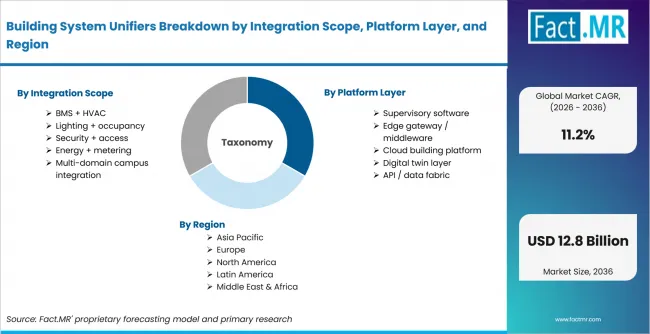
Building System Unifiers Breakdown By Integration Scope, Platform Layer, And Region | Source: Fact.MR
| Attribute | Details |
|---|---|
| Quantitative Units | USD billion in 2026 to USD billion by 2036 at an CAGR |
| Market Definition | Software and integration layers that unify BMS, HVAC, lighting, access, metering and building data across commercial and institutional facilities. |
| Integration Scope | BMS + HVAC; Lighting + occupancy; Security + access; Energy + metering; Multi-domain campus integration |
| Platform Layer | Supervisory software; Edge gateway/middleware; Cloud building platform; Digital twin layer; API/data fabric |
| Building Type | Commercial office; Healthcare; Campus/education; Data center; Hospitality/retail |
| Protocol | BACnet; Modbus; KNX; OPC UA/MQTT; Proprietary/mixed |
| Regions Covered | North America; Latin America; Western Europe; Eastern Europe; East Asia; South Asia & Pacific; Middle East & Africa |
| Countries Covered | USA; Germany; UK; Singapore; France |
| Key Companies Profiled | Siemens; Schneider Electric; Honeywell; Johnson Controls; Trane Technologies; ABB |
| Forecast Period | 2026 to 2036 |
| Approach | Hybrid top-down and bottom-up approach using building automation spend, retrofit intensity, platform layer mix, country adoption and provider portfolio review. |
How is the market segmented?
-
By Integration Scope
- BMS + HVAC
- Lighting + occupancy
- Security + access
- Energy + metering
- Multi-domain campus integration
-
By Platform Layer
- Supervisory software
- Edge gateway/middleware
- Cloud building platform
- Digital twin layer
- API/data fabric
-
By Building Type
- Commercial office
- Healthcare
- Campus/education
- Data center
- Hospitality/retail
-
By Protocol
- BACnet
- Modbus
- KNX
- OPC UA/MQTT
- Proprietary/mixed
-
By Region
- North America
- Latin America
- Western Europe
- Eastern Europe
- East Asia
- South Asia & Pacific
- Middle East & Africa