- Base Value(2025): 112.4 Bn
- Estimated Value(2026): 129.8 Bn
- Forecast Value (2036): 548.6 Bn
- CAGR (2026 - 2036): 15.5%
BYOD and Enterprise Mobility Market Forecast By Fact.MR
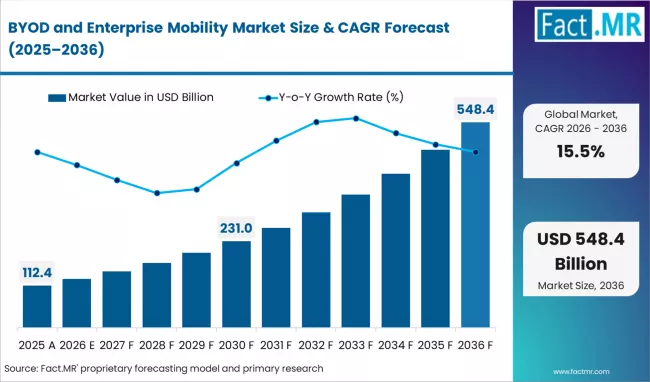
In 2025, the BYOD and enterprise mobility market was valued at USD 112.4 billion. Based on Fact MR analysis, demand for BYOD and enterprise mobility solutions is estimated to grow to USD 129.8 billion in 2026 and USD 548.6 billion by 2036. FMR projects a CAGR of 15.5% during the forecast period.
The absolute dollar growth from 2026 to 2036 is USD 418.8 billion. This scale of expansion reflects a structural shift in enterprise IT and workforce mobility rather than incremental upgrades to workplace systems. Organizations are increasingly adopting bring your own device policies and mobility platforms to support remote work, mobile access to enterprise applications, and secure data management across distributed environments. Demand continues to rise across industries as employees access corporate systems through smartphones, tablets, and laptops. Growth remains influenced by cybersecurity risks, device management complexity, and compliance requirements related to data protection and privacy.
Byod And Enterprise Mobility Market Market Value Analysis | Source: Fact.MR
BYOD and Enterprise Mobility Market
| Metric | Details |
|---|---|
| Industry Size (2026E) | USD 129.8 billion |
| Industry Value (2036F) | USD 548.6 billion |
| CAGR (2026 to 2036) | 15.5% |
Source: Fact.MR analysis. Updated Mar 24, 2026
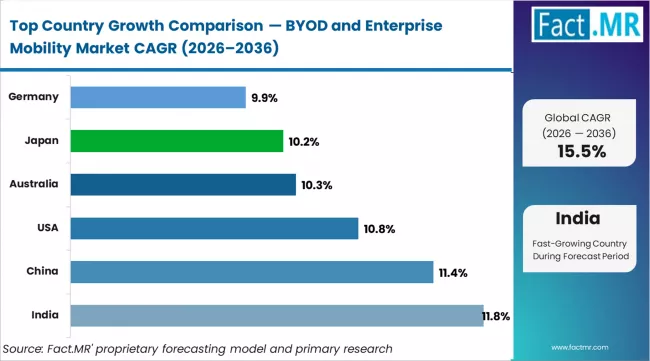
India leads with a projected CAGR of 11.8%, supported by rapid expansion of mobile workforce adoption and increasing enterprise digitization. China follows with a CAGR of 11.4%, driven by large scale enterprise mobility deployment and growing digital business ecosystems. The United States records a CAGR of 10.8%, supported by strong adoption of remote work infrastructure and mobile enterprise platforms. Australia shows a CAGR of 10.3%, reflecting steady uptake of mobility solutions across enterprise environments. Japan records a CAGR of 10.2%, supported by gradual integration of mobile enterprise systems. Germany shows the slowest growth at 9.9%, reflecting a mature enterprise IT market where demand increasingly relates to upgrades and security driven deployments.
Summary of the BYOD and Enterprise Mobility Market
- Market Definition
- The market includes policies, platforms, and solutions that enable employees to use personal devices such as smartphones, tablets, and laptops for work purposes while securely accessing enterprise systems. These solutions manage device access, application usage, and data security across corporate networks. Enterprise mobility platforms support remote work, mobile productivity, and secure enterprise connectivity.
- Demand Drivers
- Increasing adoption of remote and hybrid work models across enterprise environments
- Rising use of personal devices for accessing enterprise applications and data
- Growing need for secure mobile access and data protection across distributed workforces
- Expansion of cloud based enterprise systems supporting mobility and remote operations
- Key Segments Analyzed
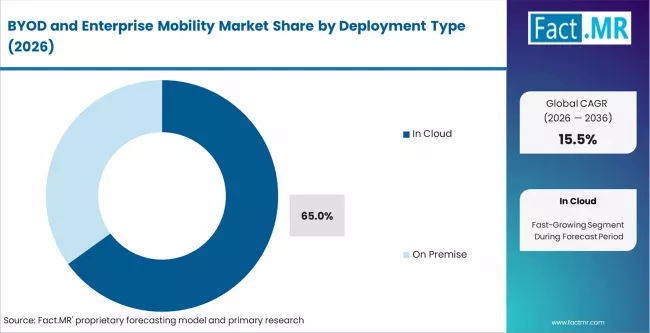
- Deployment Type: In cloud deployment leads with around 65% share in 2026 supported by scalability and remote access
- Software: Mobile device management dominates with about 55% share driven by device control and security requirements
- End Use: IT and telecommunication, BFSI, and healthcare sectors show strong adoption of enterprise mobility solutions
- Geography: Asia Pacific leads in growth, while North America maintains strong adoption across enterprise IT environments
- Analyst Opinion at Fact MR
- Shambhu Nath Jha, Principal Consultant, Fact MR, opines, "In this updated edition of the BYOD and Enterprise Mobility Market report, industry participants will observe that enterprise IT environments are transitioning toward flexible and mobile workforce models supported by secure device management platforms. Mobility solutions are evolving to integrate device management, application security, and identity access control across diverse device ecosystems. Providers that strengthen cybersecurity frameworks, cloud integration, and scalability will maintain competitive positioning as enterprise mobility adoption expands through 2036."
- Strategic Implications/Executive Takeaways
- Invest in cloud based mobility platforms to support remote workforce management and scalability
- Strengthen mobile device security frameworks including identity and access management systems
- Expand integration with enterprise applications and cloud infrastructure
- Focus on compliance with data protection and cybersecurity regulations across industries
- Methodology
- Primary interviews conducted with enterprise mobility providers, IT administrators, and cybersecurity specialists
- Desk research based on enterprise technology publications, company reports, regulatory filings, and digital workplace data
- Market sizing derived using a hybrid approach combining bottom up software revenue analysis with top down enterprise demand assessment
- Data validation performed through cross verification with industry datasets and internal peer review aligned with Fact MR standards
Segmental Analysis
BYOD and Enterprise Mobility Market Analysis by Deployment Type
Byod And Enterprise Mobility Market Analysis By Deployment Type | Source: Fact.MR
- Market Overview: In cloud deployment is projected to account for around 65% share of the BYOD and enterprise mobility market by 2026. Cloud based mobility solutions allow organizations to manage employee devices, applications, and data through centralized platforms accessible over the internet. Enterprises adopt in cloud deployment to support remote work environments and enable secure access to corporate systems from personal devices. Cloud mobility platforms provide scalability and allow IT teams to manage device policies, application access, and data security across distributed workforces. The increasing adoption of remote and hybrid work models continues to support demand for cloud based enterprise mobility solutions.
- Demand Drivers:
- Remote Workforce Enablement: Cloud deployment supports secure access to enterprise applications from personal devices used by employees.
- Centralized Device Management: Organizations use cloud platforms to monitor and manage employee devices and enforce security policies.
- Scalable Mobility Infrastructure: Cloud based systems allow enterprises to expand mobility solutions based on workforce requirements.
BYOD and Enterprise Mobility Market Analysis by Software
- Market Overview: Mobile device management software is expected to represent approximately 55% share of the BYOD and enterprise mobility market in 2026. MDM solutions provide tools for managing, monitoring, and securing mobile devices within enterprise environments. Organizations deploy MDM software to control device configurations, enforce security policies, and manage application usage on employee owned devices. These systems support functions such as remote device locking, data encryption, and application management. The need to secure corporate data across personal and corporate devices continues to drive adoption of MDM solutions.
- Demand Drivers:
- Device Security Management: MDM software enables organizations to enforce security policies and protect data on mobile devices.
- Application Control: Enterprises use MDM solutions to manage application installation and usage on employee devices.
- Remote Device Monitoring: MDM platforms allow IT teams to track device activity and manage devices remotely across enterprise networks.
BYOD and Enterprise Mobility Market Drivers, Restraints, and Opportunities
Byod And Enterprise Mobility Market Opportunity Matrix Growth Vs Value | Source: Fact.MR
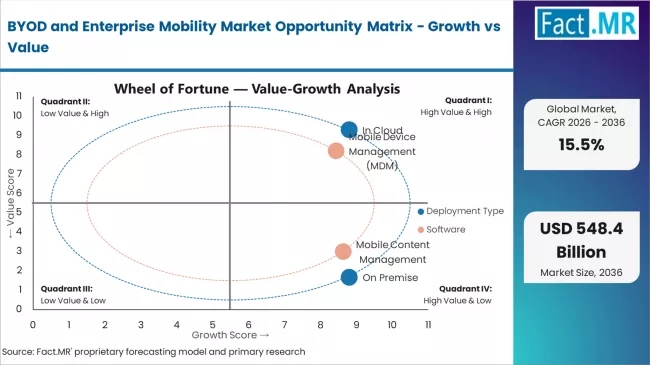
Fact MR analysis indicates that the BYOD and enterprise mobility market developed as organizations allowed employees to use personal devices for work-related tasks within corporate IT environments. Early adoption focused on email access and basic mobile productivity tools supported through enterprise mobile management systems. The current market valuation reflects widespread use of smartphones, tablets, and laptops integrated with enterprise applications, cloud platforms, and secure access systems. Demand persists because organizations require flexible work environments that support remote access, mobile productivity, and distributed workforce operations.
A structural shift is occurring as traditional corporate device provisioning models transition toward mixed environments where personal and enterprise-managed devices coexist. Company-issued devices remain widely used in regulated industries where security control and data governance remain strict. BYOD policies expand across sectors where cost efficiency and employee flexibility are prioritized. Enterprise mobility platforms integrate device management, application security, and identity access controls to manage diverse device ecosystems. These platforms require higher implementation and subscription costs due to cybersecurity requirements and system integration. Even with gradual policy adoption across enterprises, higher service pricing supports steady market value expansion.
- Mobile Workforce Enablement: Organizations deploy enterprise mobility solutions to support remote work, secure application access, and productivity across distributed employee bases.
- Data Security Regulation: Frameworks such as General Data Protection Regulation (GDPR) and ISO 27001 information security standards influence mobile device management and data protection policies.
- North America Enterprise Adoption: The United States hosts major enterprise software and cybersecurity providers that develop BYOD and mobility management platforms used across industries.
Regional Analysis
The BYOD and enterprise mobility market is assessed across North America, Europe, Asia Pacific, Latin America, and Middle East & Africa, segmented by country-level enterprise mobility adoption, device management policies, and cloud-based workforce integration. Regional demand reflects remote work trends, security frameworks, and mobile workforce expansion. The full report offers market attractiveness analysis.
.webp "Top Country Growth Comparison Byod And Enterprise Mobility Market Cagr (2026 2036)")
Top Country Growth Comparison Byod And Enterprise Mobility Market Cagr (2026 2036) | Source: Fact.MR
| Country | CAGR (2026-2036) |
|---|---|
| USA | 10.8% |
| China | 11.4% |
| Germany | 9.9% |
| Japan | 10.2% |
| India | 11.8% |
| Australia | 10.3% |
Source: Fact.MR analysis. Updated Mar 24, 2026
Source: Fact MR analysis, based on proprietary forecasting model and primary research
Byod And Enterprise Mobility Market Cagr Analysis By Country | Source: Fact.MR
North America
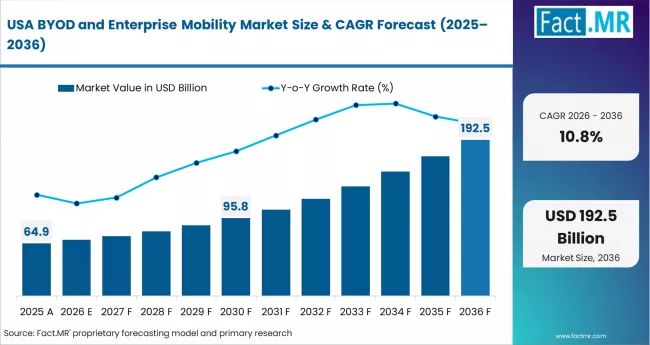
Byod And Enterprise Mobility Market Country Value Analysis | Source: Fact.MR
North America functions as the enterprise mobility and remote workforce enablement hub, supported by strong cloud adoption and device management frameworks. Microsoft Corporation maintains leadership in enterprise mobility management. VMware, Inc. strengthens digital workspace platforms. IBM Corporation expands enterprise mobility solutions.
- USA: Demand for BYOD and enterprise mobility in USA is projected to rise at 10.8% CAGR through 2036. Growth is supported by the Federal Zero Trust Strategy (OMB, January 2022), promoting secure device access. Microsoft Corporation expanded endpoint and mobility management solutions (March 2023), supporting enterprise adoption.
Europe
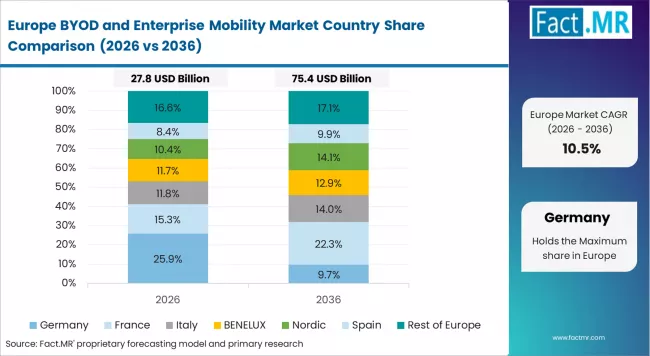
Byod And Enterprise Mobility Market Europe Country Market Share Analysis, 2026 & 2036 | Source: Fact.MR
Europe operates as the regulatory and data protection compliance base, shaped by strict privacy frameworks and enterprise governance requirements. SAP SE leads in enterprise mobility integration. Siemens AG supports industrial mobility systems. Atos SE expands secure mobility solutions.
- Germany: Demand for BYOD and enterprise mobility in Germany is projected to rise at 9.9% CAGR through 2036. The General Data Protection Regulation enforcement (European Union, ongoing) supports secure enterprise mobility frameworks. SAP SE expanded enterprise mobility services (February 2023), supporting adoption.
Asia Pacific
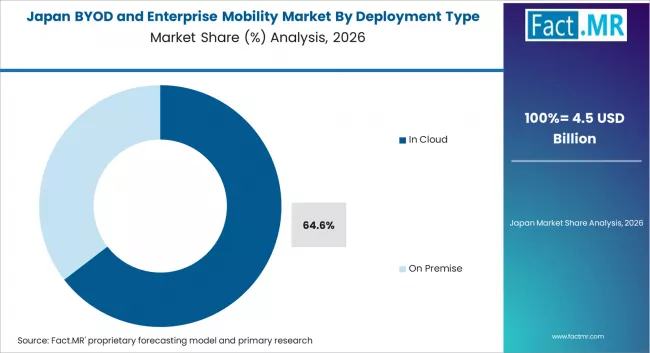
Byod And Enterprise Mobility Market Japan Market Share Analysis By Deployment Type | Source: Fact.MR
Asia Pacific serves as the high-growth mobile workforce and enterprise digitalization market, supported by expanding digital economies and cloud adoption. Huawei Technologies Co., Ltd. advances enterprise mobility solutions. Fujitsu Limited supports enterprise IT systems. Tata Consultancy Services Limited expands mobility and digital workplace services.
- China: Demand for BYOD and enterprise mobility in China is projected to rise at 11.4% CAGR through 2036. The Cybersecurity Law (revised 2021) supports secure enterprise device usage. Huawei Technologies Co., Ltd. expanded enterprise mobility platforms (April 2023), supporting adoption.
- Japan: Demand for BYOD and enterprise mobility in Japan is projected to rise at 10.2% CAGR through 2036. The Society 5.0 initiative (Cabinet Office, updated 2021) promotes digital workplace adoption. Fujitsu Limited expanded enterprise mobility solutions (January 2023), supporting market growth.
- India: Demand for BYOD and enterprise mobility in India is projected to rise at 11.8% CAGR through 2036. The Digital India programme (MeitY, ongoing) supports enterprise digitization. Tata Consultancy Services Limited expanded mobility and workplace services (May 2023), supporting adoption.
- Australia: Demand for BYOD and enterprise mobility in Australia is projected to rise at 10.3% CAGR through 2036. The Digital Economy Strategy (Australian Government, May 2021) supports remote workforce technologies. VMware, Inc. expanded digital workspace platforms in Australia (March 2023), supporting enterprise demand.
Fact MR's analysis of BYOD and enterprise mobility market in global regions consists of country-wise assessment that includes USA, China, Germany, Japan, India, and Australia. Readers can find workforce mobility trends, regulatory developments, cloud adoption patterns, and competitive positioning across key markets.
Competitive Structure and Buyer Dynamics in the BYOD and Enterprise Mobility Market
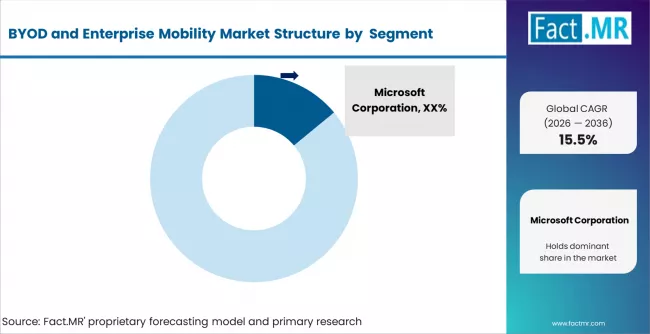
Byod And Enterprise Mobility Market Analysis By Company | Source: Fact.MR
The competitive structure of the BYOD and Enterprise Mobility Market is moderately concentrated, with a group of enterprise software and mobility management providers controlling a significant share of deployments. Microsoft Corporation, VMware, Inc., Citrix Systems, Inc., IBM, and Cisco Systems, Inc. maintain strong positions through unified endpoint management platforms and enterprise mobility solutions. These companies provide device management, application security, and remote access tools used across corporate environments. Additional participants including BlackBerry Limited, SAP SE, Oracle Corporation, Ivanti, Inc., MobileIron, Inc., and Jamf Holding Corp. contribute through mobile device management, identity security, and platform specific mobility solutions. Competition is primarily influenced by security capability, platform integration, scalability, and support for diverse device ecosystems across enterprise environments.
Several companies maintain structural advantages through integration with enterprise software ecosystems and strong security frameworks. Microsoft Corporation and VMware, Inc. benefit from integration with operating systems and enterprise productivity platforms widely used across organizations. Citrix Systems, Inc. and Cisco Systems, Inc. maintain advantages through secure access and networking capabilities. Jamf Holding Corp. holds a strong position in managing Apple device ecosystems within enterprises. Enterprises typically adopt multi vendor mobility strategies to reduce dependence on a single provider and maintain flexibility across device environments. Procurement decisions evaluate vendors based on security compliance, system interoperability, and long term support. This purchasing behavior moderates supplier pricing leverage, while vendors with integrated platforms and strong security capabilities retain stronger negotiating influence.
Key Players of the BYOD and Enterprise Mobility Market
- Microsoft Corporation
- VMware, Inc.
- Citrix Systems, Inc.
- IBM (International Business Machines Corporation)
- Cisco Systems, Inc.
- BlackBerry Limited
- SAP SE
- Oracle Corporation
- MobileIron, Inc. (now part of Ivanti, Inc.)
- Ivanti, Inc.
- Jamf Holding Corp.
Report Scope
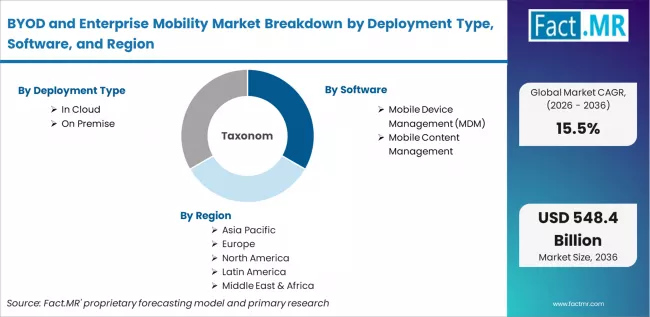
Byod And Enterprise Mobility Market Breakdown By Deployment Type, Software, And Region | Source: Fact.MR
| Metric | Value |
|---|---|
| Quantitative Units | USD 129.8 billion (2026) to USD 548.6 billion (2036), at a CAGR of 15.5% |
| Market Definition | The BYOD and enterprise mobility market includes solutions, platforms, and services that enable employees to use personal devices such as smartphones, tablets, and laptops for work purposes, supported by secure access, device management, and enterprise mobility frameworks across organizational environments. |
| Security Segmentation | Network Security, Device Security, Identity and Access Management (IAM) |
| Software Segmentation | Mobile Content Management, Mobile Device Management (MDM) |
| Deployment Type Segmentation | On-Premise, In-Cloud |
| End-Use Segmentation | Government and Defense, BFSI, Healthcare and Life Sciences, Manufacturing, Academia and Research, Energy and Utility, Media and Entertainment, Retail and Consumer Goods, IT and Telecommunication, Transportation and Logistics, Others |
| Organization Size Segmentation | Small and Medium Enterprise (SME), Large Enterprise |
| Regions Covered | North America, Latin America, Europe, East Asia, South Asia, Oceania, Middle East and Africa |
| Countries Covered | United States, Canada, Mexico, Brazil, Germany, United Kingdom, France, Italy, Spain, China, India, Japan, South Korea, Australia, and 40+ countries |
| Key Companies Profiled | Microsoft Corporation, VMware, Inc., Citrix Systems, Inc., IBM (International Business Machines Corporation), Cisco Systems, Inc., BlackBerry Limited, SAP SE, Oracle Corporation, MobileIron, Inc., Ivanti, Inc., Jamf Holding Corp. |
| Forecast Period | 2026 to 2036 |
| Approach | Hybrid top-down and bottom-up market modeling supported by enterprise mobility adoption trends, device usage patterns, cybersecurity spending analysis, and validation through interviews with IT administrators, mobility solution providers, and enterprise users. |
Source: Fact.MR analysis. Updated Mar 24, 2026
Bibliographies
- [1] CloudServus. (2023, March). Microsoft's Intune Suite updates March 2023.
- [2] Office of Management and Budget. (2022, January). M-22-09: Moving the U.S. Government toward Zero Trust Cybersecurity Principles.
- [3] Microsoft Tech Community. (2023, March). Microsoft Intune March 2023 release.
- [4] Forrester Research (via Microsoft Security Blog). (2023, November). Microsoft a leader in the 2023 Forrester Wave for Unified Endpoint Management.
- [5] Patch My PC. (2025, December). Microsoft Intune Suite changes and 2026 price update.
- [6] SAP SE. (2024, January). Enterprise mobility in the era of SAP technologies: A 2024 perspective.
This Report Addresses
- Market size estimation and revenue forecasts for the BYOD and Enterprise Mobility Market from 2026 to 2036, supported by enterprise IT spending trends and mobile workforce adoption benchmarks.
- Growth opportunity mapping across cloud and on premise deployment models, reflecting demand for remote access, device management, and secure enterprise mobility platforms.
- Segment and regional revenue forecasts covering security solutions, software categories, organization size, end use industries, and key markets including India, China, United States, Germany, Japan, and Australia.
- Competition strategy assessment of leading companies such as Microsoft Corporation, VMware, Inc., IBM, Cisco Systems, Inc., and Citrix Systems, Inc., including platform integration and security capability benchmarking.
- Regulatory impact analysis covering GDPR, ISO 27001 standards, and enterprise data protection frameworks influencing mobility deployment and compliance requirements.
- Market report delivery in PDF, Excel, PPT, and interactive dashboard formats designed for enterprise IT strategy, workforce management, and operational planning.
- Supply chain vulnerability assessments examining cybersecurity risks, device management complexity, and compliance challenges impacting enterprise mobility adoption and scalability.
BYOD and Enterprise Mobility Market Definition
The BYOD and Enterprise Mobility Market includes policies, platforms, and solutions that allow employees to use personal devices such as smartphones, tablets, and laptops for work purposes while securely accessing enterprise systems. These solutions manage device access, data security, application usage, and connectivity across corporate networks. Enterprise mobility platforms include mobile device management, mobile application management, and enterprise mobility management tools. They are widely used across industries to support remote work, workforce productivity, and secure data access. The primary function is to enable flexible work environments while maintaining control over enterprise data and systems.
BYOD and Enterprise Mobility Market Inclusions
This report covers global and regional market sizes for BYOD and enterprise mobility solutions with forecast analysis for the study period. The market is segmented by component including software platforms and related services. Functional segmentation includes mobile device management, mobile application management, and enterprise mobility management. Application segments include remote workforce management, secure enterprise access, and mobile productivity solutions. End users include enterprises across information technology, banking, healthcare, retail, and manufacturing sectors. The report also evaluates pricing models, deployment structures, and selected trade flow analysis across major enterprise mobility markets.
BYOD and Enterprise Mobility Market Exclusions
The report excludes general consumer mobile applications that are not used for enterprise purposes. Hardware devices such as smartphones, tablets, and laptops are not included. The scope also excludes standalone cybersecurity tools that do not manage mobile devices or enterprise mobility. Telecommunications services such as mobile network subscriptions are outside the defined market scope, as the analysis focuses strictly on enterprise mobility management solutions and BYOD related platforms.
BYOD and Enterprise Mobility Market Research Methodology
- Primary Research: Interviews were conducted with enterprise mobility solution providers, IT administrators, cybersecurity specialists, and corporate decision makers.
- Desk Research: Public information was collected from enterprise technology publications, company reports, regulatory filings, and digital workplace data sources.
- Market-Sizing and Forecasting: A hybrid model combining bottom up software revenue analysis with top down enterprise demand assessment across industries was applied.
- Data Validation and Update Cycle: Findings were cross verified using multiple industry data sources and expert inputs, with periodic updates conducted as new market information becomes available.
Segmentation
BYOD and Enterprise Mobility Market Key Segments
-
Security :
- Network Security
- Device Security
- Identity and Access Management (IAM)
-
Software :
- Mobile Content Management
- Mobile Device Management (MDM)
-
Deployment Type :
- On Premise
- In Cloud
-
End Use :
- Government and Defense
- BFSI
- Healthcare and Life Sciences
- Manufacturing
- Academia and Research
- Energy and Utility
- Media and Entertainment
- Retail and Consumer Goods
- IT and Telecommunication
- Transportation and Logistics
- Others
-
Organization Size :
- Small and Medium Enterprise (SME)
- Large Enterprise
-
Region :
- North America
- USA
- Canada
- Mexico
- Europe
- Germany
- UK
- France
- Italy
- Spain
- Nordic Countries
- BENELUX
- Rest of Europe
- Asia Pacific
- China
- Japan
- South Korea
- India
- Australia
- Rest of Asia Pacific
- Latin America
- Brazil
- Argentina
- Rest of Latin America
- Middle East and Africa
- Kingdom of Saudi Arabia
- United Arab Emirates
- South Africa
- Rest of Middle East and Africa
- Other Regions
- Oceania
- Central Asia
- Other Markets
- North America
Frequently Asked Questions
How large is the demand for BYOD and Enterprise Mobility in the global market in 2026?
What will be the market size of BYOD and Enterprise Mobility in the global market by 2036?
What is the expected demand growth for BYOD and Enterprise Mobility in the global market between 2026 and 2036?
Which Deployment Type Segment is poised to lead global demand by 2026?
Which Company is Identified as a Leading Participant in the BYOD and Enterprise Mobility Market?
What is Driving BYOD and Enterprise Mobility Demand in the United States?
What is the United States Growth Outlook in this Report?
Why is China an Important Market for BYOD and Enterprise Mobility?
What is the China Growth Outlook in this Report?
Why is Germany Considered an Important Market for BYOD and Enterprise Mobility in Europe?
What is the Germany Growth Outlook in this Report?
Why is Japan an Important Market for BYOD and Enterprise Mobility?
What is the Japan Growth Outlook in this Report?
What Factors Support BYOD and Enterprise Mobility Demand in India?
What is the India Growth Outlook in this Report?
Why is Australia Included in the BYOD and Enterprise Mobility Market Outlook?
What is the Australia Growth Outlook in this Report?
What is BYOD and Enterprise Mobility and What is It Mainly Used For?
What does BYOD and Enterprise Mobility Market Mean in this Report?
What is Included in the Scope of this BYOD and Enterprise Mobility Market Report?
What is Excluded from the Scope of this Report?
What does Market Forecast Mean on this Page?
How is the BYOD and Enterprise Mobility Market Forecast Developed in this Report?
Who worked on this report


Preview the report firsthand - request a free sample
Free SampleGet the brochure for pricing and purchase details
Download PDF