- Market Value (2025): USD 354.6 Mn
- Estimated Value (2026): 380.0 Mn
- Forecast Value (2036): USD 760.0 Mn
- CAGR (2026-2036): 7.2%
What is the Ceramic Slurry Dispersants Market forecast to be worth by 2036?
USD 380.0 million in 2026, climbing to USD 760.0 million by 2036 at a 7.2% CAGR.
- The market reached USD 354.6 million in 2025 as developers moved more ceramic additives and slurry dispersants through early approval stages. Material teams need to see that agglomerates can be broken down and solids loading can be increased without disrupting viscosity, binder compatibility, or green strength.
- A further USD 380.0 million is expected to be added by 2036, with technical ceramics and tape casting creating clearer opportunities for use. In both applications, an even particle distribution helps maintain steady feed behavior and consistent forming, reducing the risk of slurry variation carrying through to drying or firing.
- The market is forecast to grow at a 7.2% CAGR. Battery-related ceramic materials will remain under close technical review because of concerns around heat distribution and electrode life across the market. However, the main question is much the same: can the dispersant continue to perform under normal plant conditions and still produce a consistent formed part.
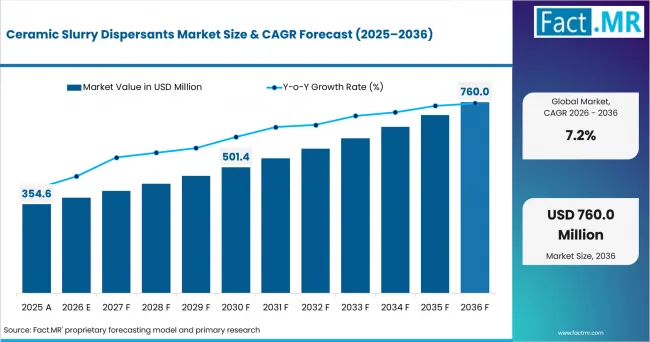
Ceramic Slurry Dispersants Market Market Value Analysis | Source: Fact.MR
What are the defining numbers behind Ceramic Slurry Dispersants Market growth?
The absolute opportunity through 2036 reaches USD 380.0 million, led by Advanced technical ceramics.
- Demand Drivers in the Market
- Technical ceramics place heavy demands on dispersant performance because slurry behavior affects everything from powder incorporation to the final green form. Buyers look for products that break down agglomerates during milling, support higher solids loading, and keep viscosity manageable during transfer and forming. The real test is whether those benefits remain after the slurry has been stored and aged, rather than only immediately after mixing.
- Tape casting requires tighter control over flow and leveling. The slurry must move through the coating stage without settling or developing uneven solids concentration. When dispersion remains stable, cast layers stay uniform. When it does not, the problems quickly appear as uneven coating and inconsistent drying.
- Polyacrylate dispersants receive close technical attention because their chemistry affects both particle stabilization and compatibility with the rest of the formulation. Formulators do not stop at checking the initial viscosity reduction. They also test whether the dispersant remains compatible with the binder, performs after pumping and storage, and continues to work through the selected forming process.
- Ceramic materials used in batteries face additional scrutiny because of concerns around cycling stress, heat distribution, and electrode life. Slurry consistency is especially important in these applications, since uneven coating or forming can carry material variation directly into the component being tested. For that reason, approvals increasingly depend on trials that reflect actual customer conditions rather than laboratory screening alone.
- Ceramic producers are more willing to approve a dispersant when it delivers repeatable results across milling, storage, and forming. Purchasing decisions move faster when plant teams see fewer slurry corrections, steadier feed behavior, and more consistent green bodies. They slow down when the only evidence available is a laboratory result that does not hold up in production.
- Key Segments Analyzed
- By Ceramic Type: Technical ceramics are expected to account for 36% of the market in 2026. Their leading position reflects the need to manage particle stability, solids loading, flow behavior, binder compatibility, and forming consistency at the same time. A dispersant is more likely to be approved when it maintains the required slurry condition through storage and aging without creating problems during drying.
- By Process: Tape casting is projected to hold 29% share in 2026. Dispersant performance becomes visible in how smoothly the slurry moves through casting and how uniformly the coated layer dries.
- By Chemistry: Polyacrylate is likely to represent 30% of the market in 2026. Buyers assess it on its ability to control agglomerates, manage viscosity, and work with the rest of the formulation.
- By Application: Electronics ceramics are expected to account for 33% share in 2026. The main advantage is repeatability across milling, shaping, drying, and firing.
- By End User: Ceramic producers are forecast to hold 36% share in 2026. They generate the most useful performance evidence because dispersants must work under real mixing, storage, pumping, coating, and casting conditions. Their purchasing decisions are shaped by process consistency and the cost of correcting unstable slurry behavior later in production.
- Analyst Opinion at Fact.MR
- Fact.MR expects suppliers to gain business gradually, with customers approving replacements one formulation at a time rather than changing products across the board. The strongest products will be those that keep particles evenly dispersed throughout mixing and forming. A slurry may look stable immediately after mixing but still settle during holding, change in storage, or respond differently once the binder is introduced. Technical support is therefore a major part of the purchase decision. Suppliers are more likely to succeed when their additives reduce the need for repeated slurry adjustments and help producers maintain a consistent green body without requiring major changes to the existing process, states Shambhu Nath Jha, Senior Analyst at Fact.MR.
- Strategic Implications
- Suppliers need to prove technical ceramics performance under real customer conditions. Trials should follow the actual sequence, aging, transfer, forming, so the result reflects the operating process instead of a shortcut version of it.
- Process teams should run approved and candidate grades side by side under the same solids loading and handling sequence. Good fluidity at the start means little if the formulation later throws sediment, drifts in viscosity, or shifts yield response right at the pump or the casting point.
- Formulators should fold binder compatibility into dispersant qualification rather than testing it separately. A powder dispersion that looks stable can change character once the binder package enters the slurry, so evaluation needs to carry through coating or forming, drying, and green-body inspection.
- Tape casting programs should track the full path from slurry holding through deposition and drying, not just the mixing stage. Stable pumping and consistent flow keep casting uniform, while local concentration changes can turn into thickness variation or inconsistent green material downstream.
- Distributors and technical teams should get safety and qualification files ready early. Paperwork can hold up adoption even for a formulation that performs well, especially with buyers who are protective of established recipes and running production lines.
- Public battery programs keep pushing for safer cell production and better pack design. Within this market, that pressure supports ceramic slurry materials evaluated on thermal spread or electrode life, but the dispersant still has the same job first: stabilize the particles and deliver a uniform ceramic layer or body before anyone can judge downstream performance.
How does the Ceramic Slurry Dispersants Market break down by segment?
Technical ceramics lead Ceramic Type with 36% share in 2026, Tape casting leads Process at 29%.
Which Ceramic Type dominates?
Technical ceramics hold 36% share in 2026.
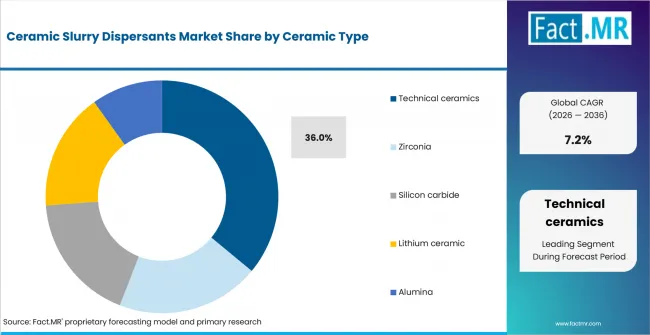
Ceramic Slurry Dispersants Market Analysis By Ceramic Type | Source: Fact.MR
Technical ceramics lead because dispersant performance affects several connected stages of production. Milling must break down agglomerates and stabilize the exposed particles, while the finished slurry still needs to support the required solids loading and remain workable during storage, pumping, and forming. When dispersion starts to weaken, settling or viscosity changes can alter the local powder concentration before the green body is formed.
Zirconia, silicon carbide, lithium ceramic, and alumina make up the rest of the ceramic type category. Each material requires buyers to consider the powder surface, formulation order, and production method before approving a dispersant. Repeat business is more likely when technical ceramic formulations behave consistently and produce uniform formed parts under normal operating conditions.
What leads the Process segment?
Tape casting holds 29% share in 2026.
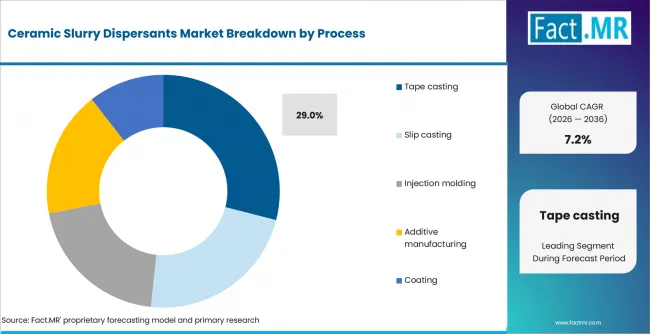
Ceramic Slurry Dispersants Market Analysis By Process | Source: Fact.MR
Tape casting leads because even small changes in slurry stability become visible quickly during production. The slurry must remain consistent as it moves from preparation and storage through pumping and deposition, with viscosity and flow behavior staying within a narrow operating range. Agglomerates can disrupt the cast surface, while settling can change the solids concentration over the course of a production run.
The dispersant must also work well with the binder system so that good flow during casting does not create problems during drying or affect the consistency of the green layer. Slip casting, injection molding, additive manufacturing, and coating remain important process options, but each places different demands on particle stabilization. Tape casting adoption tends to move faster when plant trials show uniform delivery, even coating, and predictable drying without requiring major changes to the existing formulation.
How does Chemistry shape demand?
Polyacrylate holds 30% share in 2026.
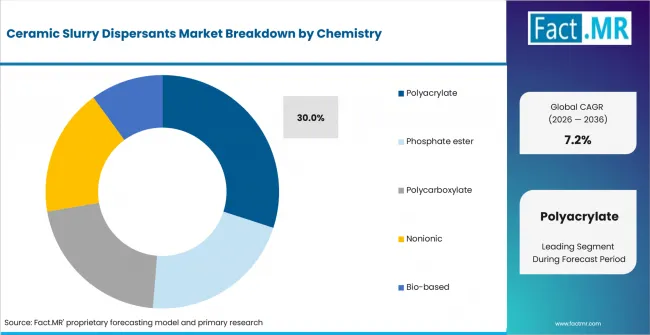
Ceramic Slurry Dispersants Market Analysis By Chemistry | Source: Fact.MR
Polyacrylate leads the chemistry category because it can separate particles effectively while keeping slurry flow under control. Formulators look beyond the initial viscosity reading and check whether the same performance holds after milling, during storage, after the binder is added, and when the slurry is pumped or formed.
Phosphate ester, polycarboxylate, nonionic, and bio-based chemistries remain part of the comparison because the best fit depends on the ceramic powder, liquid medium, solids loading, and order of processing steps. Polyacrylate is more likely to be approved when plant trials show consistent agglomerate control without settling, binder incompatibility, or unwanted changes in flow behavior.
Where is Application demand strongest?
Electronics ceramics hold 33% share in 2026.
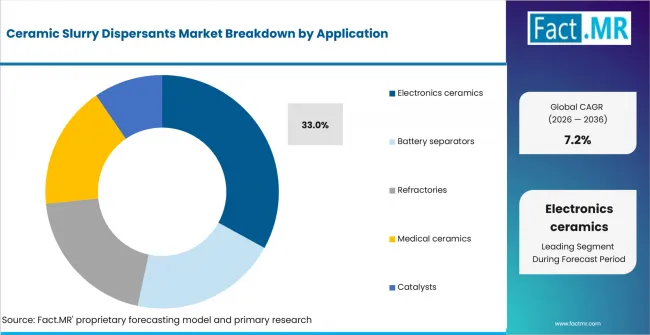
Ceramic Slurry Dispersants Market Analysis By Application | Source: Fact.MR
Electronics ceramics lead Application demand because production teams can trace a direct line from slurry preparation to forming consistency and the process review that follows. Stable dispersion keeps particle distribution uniform before drying and firing, while agglomerates or local solids variation can turn into defects that are hard to fix once the green form already exists. Battery separators, Refractories, Medical ceramics, and Catalysts round out the Application taxonomy, each with its own process requirements. For Electronics ceramics, storage, transfer, and forming conditions, where the formulation has to hold useful viscosity, resist sedimentation, and stay compatible with the binder package the whole way through.
What supports End User adoption?
Ceramic producers hold 36% share in 2026.
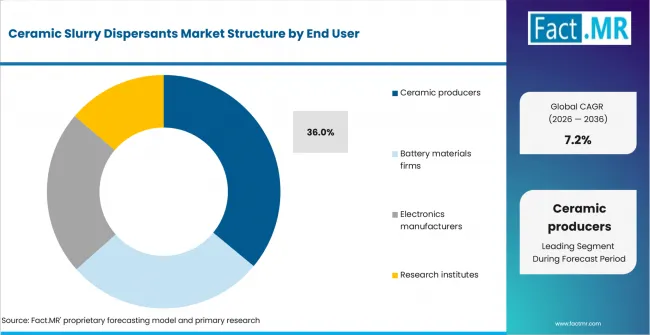
Ceramic Slurry Dispersants Market Analysis By End User | Source: Fact.MR
Ceramic producers lead End User demand because they carry the immediate risk when a slurry goes wrong. Their lines show whether a dispersant shortens milling work, sustains solids loading, stays pumpable after aging, and feeds tape casting, coating, or another forming step evenly. Battery materials firms, Electronics manufacturers, and Research institutes also take part in qualification, especially where thermal spread, electrode life, or customer-like trials factor into approval. Ceramic producers hold the lead because they see the whole process consequence. A formulation that works cuts corrective adjustments and keeps green-body behavior steady, while one that doesn't can generate sedimentation, drying stress, rework, or firing defects downstream.
What is accelerating Ceramic Slurry Dispersants Market adoption, and what is holding it back?
Cycling stress looks set to support adoption in battery-facing ceramic work, while qualification cost and process fit slow the pace everywhere else. Purchasing moves forward once customer teams confirm a dispersant holds particle stabilization and processable rheology through their own milling, aging, transfer, forming, and drying conditions.
Drivers Impact Analysis
| DRIVER | (~) % IMPACT ON CAGR | GEOGRAPHIC RELEVANCE | IMPACT TIMELINE |
|---|---|---|---|
| Cycling stress control in Technical ceramics | +0.8% | China and export suppliers | Medium term (2-4 years) |
| Thermal spread testing | +0.6% | Europe and North America | Short term (<= 2 years) |
| Advanced technical ceramics approval programs | +0.5% | Asia Pacific | Medium term (2-4 years) |
| Local support near cell engineers | +0.4% | Global | Long term (>= 4 years) |
Source: Fact.MR analysis. Updated Jul 15, 2026
- Cycling stress control in technical ceramics: Battery-related ceramic materials need to be uniform before engineers can properly assess how they behave under repeated cycling. Stable slurry preparation helps by reducing agglomerates and uneven particle concentration during forming, giving teams a more reliable material to test.
- Thermal spread testing: The dispersant does not determine thermal performance by itself, but it helps produce a consistent ceramic layer or body for evaluation. Adoption becomes more likely when slurry variation is controlled well enough for test results to reflect the ceramic design rather than inconsistencies introduced during processing.
- Advanced technical ceramics approval programs: A clear approval process gives suppliers a practical way to show how their products perform under agreed operating conditions. Buyers can compare milling efficiency, solids loading, storage stability, and forming consistency before moving from initial screening to repeat orders.
- Local support near cell engineers: Close application support helps suppliers respond quickly when a formulation needs to be adjusted for a customer's equipment or handling conditions. Technical teams can identify whether viscosity changes, settling, or binder interaction are causing problems and decide whether the dispersant remains suitable.
Opportunity Impact Analysis
| OPPORTUNITY | (~) % IMPACT ON CAGR | GEOGRAPHIC RELEVANCE | IMPACT TIMELINE |
|---|---|---|---|
| Grades tuned for Advanced technical ceramics | +0.5% | Global | Medium term (2-4 years) |
| Application labs for Tape casting | +0.4% | Asia Pacific and Europe | Short term (<= 2 years) |
| Rule-ready documentation | +0.4% | Europe and United Kingdom | Medium term (2-4 years) |
| Local trials with electrode developers | +0.3% | India and Brazil | Long term (>= 4 years) |
Source: Fact.MR analysis. Updated Jul 15, 2026
- Grades for advanced technical ceramics: The opportunity becomes more credible when laboratory results can be repeated under plant conditions. Product selection needs to reflect the customer's ceramic powder, solids loading, binder system, and forming method. The dispersant must continue controlling agglomerates during normal storage, transfer, and processing rather than performing well only in a laboratory test.
- Application laboratories for tape casting: Application labs can connect formulation data with actual casting performance. Useful trials follow the slurry through storage, pumping, deposition, and drying to show whether viscosity and flow remain stable and whether the cast layer stays uniform.
- Qualification-ready documentation: Clear technical records can make customer approval easier. Buyers need formulation, handling, and test information that fits directly into their qualification process and clearly explains how the slurry was prepared, tested, and evaluated.
- Local trials with electrode developers: Local testing allows customers to verify dispersant performance using their own equipment and process conditions. It can reveal pumping, coating, storage, or binder-compatibility issues before the customer moves to a larger production trial.
Restraints Impact Analysis
| RESTRAINT | (~) % IMPACT ON CAGR | GEOGRAPHIC RELEVANCE | IMPACT TIMELINE |
|---|---|---|---|
| Qualification cost | -0.4% | Global processors | Medium term (2-4 years) |
| Fit limits in Tape casting | -0.3% | Global | Short term (<= 2 years) |
| Documentation burden | -0.3% | Europe and North America | Medium term (2-4 years) |
| Scale-up risk | -0.2% | High-volume plants | Long term (>= 4 years) |
Source: Fact.MR analysis. Updated Jul 15, 2026
- Qualification cost: Approved ceramic recipes are expensive to touch because the test has to go well past mixing. Customers need to track slurry aging, pumping or casting, drying, green-body consistency, and downstream results before they'll accept a new grade, and that work eats up line access and technical attention.
- Fit limits in Tape casting: Even a small formulation change can shift flow, leveling, sedimentation, binder response, or drying behavior. That's what makes fit a genuine restraint, a viscosity improvement at preparation can still turn into rework later in the casting sequence.
- Documentation burden: Buyers protect running lines by demanding a clear qualification record. Suppliers have to describe the tested formulation and process conditions in enough detail for customer teams to repeat the result, and incomplete evidence slows everything down.
- Scale-up risk: Lab dispersion can fail to carry over once milling energy, residence time, tank volume, pumping, or slurry age changes at scale. High-volume plants move cautiously here because an unstable scale-up can hit process consistency, cost, and the quality of the formed ceramic material.
Which countries are scaling Ceramic Slurry Dispersants Market fastest?
Germany at 8.3%, Brazil at 7.5%, and the United States at 6.8%. Manufacturing strength, customer approval work, and access to local technical service shape this country view through 2036.
.webp "Top Country Growth Comparison Ceramic Slurry Dispersants Market Cagr (2026 2036)")
Top Country Growth Comparison Ceramic Slurry Dispersants Market Cagr (2026 2036) | Source: Fact.MR
| COUNTRY | CAGR |
|---|---|
| Germany | 8.3% |
| Brazil | 7.5% |
| United States | 6.8% |
Source: Fact.MR analysis. Updated Jul 15, 2026
What supports the Germany outlook?
Germany ceramic slurry dispersants market is set to grow at 8.3% CAGR through 2036.
Germany's 8.3% outlook combines manufacturing activity with customer tests of ceramic additives and slurry dispersants. Teams working alongside processors can watch a formulation from milling through drying rather than judging it only at the mixing vessel. Qualification asks whether solids distribution stays stable, viscosity stays manageable, binder compatibility holds, and forming stays uniform. Side-by-side plant work shows where aging or transfer changes the outcome and whether a candidate grade produces a dependable green body. This practical foundation supports adoption while keeping careful review of running recipes in place.
How is Brazil developing demand?
Brazil is projected to record 7.5% CAGR through 2036.
Brazil's 7.5% course reflects manufacturing activity and customer tests of ceramic additives and slurry dispersants. Plant trials let buyers judge whether a product handles their specific ceramic powder and process sequence consistently. Useful evidence includes agglomerate breakup during milling, viscosity after aging, resistance to sedimentation, and stable delivery into casting, coating, or forming. Local service helps when the lab recipe needs adjusting for plant-scale mixing and transfer conditions. Demand builds where trials show less correction work and steadier green material, not just a short-lived change in fluidity.
What underpins United States growth?
The United States is projected to record 6.8% CAGR through 2036.
The United States anticipated to reflect 6.8% as technical-ceramics manufacturing activity paired with structured supplier qualification programs. Public battery work adds another route for ceramic materials reviewed on thermal spread and electrode life, with application support positioned near high-volume users. Qualification still comes down to forming-process proof. The slurry has to stay stable after milling, holding, pumping, and binder addition, then produce uniform material through coating or another forming route. Documented conditions help buyers separate real formulation performance from variation caused by scale, equipment settings, or slurry age.
Who leads the Ceramic Slurry Dispersants Market?
BYK and Zschimmer & Schwarz lead the market, with Vanderbilt, Lubrizol, and BASF rounding out the group. Trial quality, supply reliability, and how quickly a supplier resolves slurry-specific problems decide competitive position.
Competition comes down to how well suppliers connect the dispersant to the entire ceramic process. Buyers need help with particle stabilization, milling conditions, solids loading, viscosity and yield behavior, slurry aging, sedimentation, binder compatibility, and the forming route they've chosen. A supplier pulls ahead when lab recommendations translate into a stable operating window without introducing drying or green-body inconsistency.
Which are the key companies in this market?
BYK and Zschimmer & Schwarz are the key providers, with Vanderbilt, Lubrizol, and BASF completing the named list. Buyer evaluation centers on proof inside the customer's own ceramic formulation and line conditions. The grade has to support repeatable slurry preparation and delivery while keeping coating, casting, or forming uniform through drying and everything after.
- BYK
- Zschimmer & Schwarz
- Vanderbilt
- Lubrizol
- BASF
Bibliography
- International Energy Agency. Electric vehicle batteries.
- U.S. Department of Energy. Platform technologies for transformative battery manufacturing.
- Oak Ridge National Laboratory. Dry processed electrodes.
- United Nations Economic Commission for Europe. Electric vehicle safety document.
- GOV.UK. Battery strategy.
- Japan's Ministry of Economy, Trade and Industry. Battery strategy.
- U.S. Department of Energy. Chemicals value chain decarbonization.
- Department of Chemicals and Petrochemicals, India. Annual reports.
- U.S. Environmental Protection Agency. Safer Choice criteria for chemicals.
- National Bureau of Statistics of China. Statistical press release.
- Federal Statistical Office of Germany. Industry and manufacturing.
- Brazilian Institute of Geography and Statistics. Industrial production release.
This Report Addresses
- The report provides strategic intelligence across Ceramic Type and Process choices, interpreted through particle stabilization, milling, slurry handling, and forming conditions.
- Segment analysis covers Technical ceramics and Tape casting as the share leaders, with Polyacrylate, Electronics ceramics, and Ceramic producers leading their respective categories.
- Country testing discussion covers the United States, Brazil, Germany, India, and China
- Competitive analysis profiles BYK and Zschimmer & Schwarz, followed by Vanderbilt, Lubrizol, and BASF, without unsupported portfolio claims.
- Use-case assessment covers Advanced technical ceramics and adjacent applications in Ceramic Additives / Slurry Dispersants, including forming uniformity and green-body consistency.
What does the Ceramic Slurry Dispersants Market cover?
The market covers dispersants purchased to stabilize ceramic slurries used in casting, tape casting, 3D printing, battery ceramics, and advanced ceramic production. Technical ceramics, Tape casting, and Advanced technical ceramics stand out as the prominent commercial reference points in this analysis.
The purchased value comes from keeping particle distribution useful and the slurry processable as material moves through preparation, aging, transfer, and forming. The dispersant is judged on its effect on milling efficiency, solids loading, viscosity, yield behavior, sedimentation, and compatibility with the binder package.
This market differs from broad chemical categories because products that don't perform this specific stabilization role fall outside its boundary. A material counts only when it's sold for that function in a named ceramic application.
What is included in the scope?
Included products are dispersants used to stabilize ceramic slurries for casting, tape casting,
3D printing, battery ceramics, and advanced ceramic production, spanning the full segmentation taxonomy.
Included sales cover qualified products, associated technical support, and recurring supply for named applications, tracking formulation fit, plant trials, approval, and continued customer use.
What is excluded from the scope?
The boundary excludes products that don't perform the defined ceramic slurry stabilization role.
It also leaves out equipment-only supply and commodity materials unless they're sold for a named application within the market.
How was the analysis built?
The analysis reviews the listed public materials and checks country signals, segment reasoning, and the market model. Values, shares, growth rates, impacts, providers, segmentation, scope, and forecast period all remain unchanged.
- Primary Research
- Primary Research draws on conversations with suppliers, formulators, purchasers, distributors, and application specialists. Attention centers on dispersion performance, process fit, customer qualification, technical service, and repeat supply for ceramic additives and slurry dispersants.
- Desk Research
- Desk Research works through non-commercial publications alongside standards guidance, public statistics, technical references, and official policy material.
- Data Validation and Update Cycle
- The Data Validation and Update Cycle revisits, policy movement, country signals, and qualification risk. Process interpretation is checked against consistency with milling, slurry aging, sedimentation, binder addition, transfer, forming, and downstream quality review.
Segmentation
What is the report's scope and coverage?
The report covers dispersants used to stabilize ceramic slurries for casting, tape casting, 3D printing, battery ceramics, and advanced ceramic production. It tracks the purchased function across Ceramic Type, Process, Chemistry, Application, End User, and Region, rather than treating every ceramic additive as part of the market.
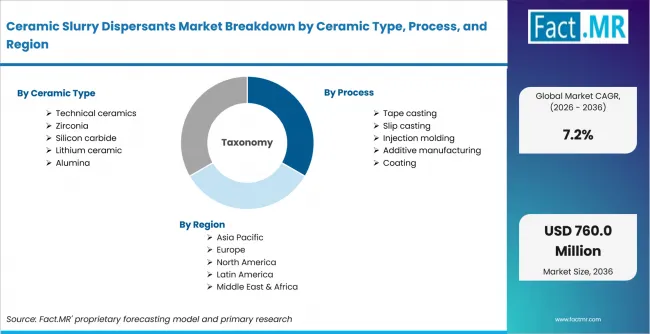
Ceramic Slurry Dispersants Market Breakdown By Ceramic Type, Process, And Region | Source: Fact.MR
| Attribute | Details |
|---|---|
| Quantitative Units | USD Million in 2026 to USD Million by 2036 at CAGR |
| Market Definition | Dispersants used to stabilize ceramic slurries for casting, tape casting, 3D printing, battery ceramics, and advanced ceramic production. |
| Ceramic Type | Alumina, Zirconia, Silicon carbide, Lithium ceramic, Technical ceramics |
| Process | Tape casting, Slip casting, Injection molding, Additive manufacturing, Coating |
| Chemistry | Polyacrylate, Phosphate ester, Polycarboxylate, Nonionic, Bio-based |
| Application | Electronics ceramics, Battery separators, Refractories, Medical ceramics, Catalysts |
| End User | Ceramic producers, Battery materials firms, Electronics manufacturers, Research institutes |
| Regions Covered | North America, Europe, Asia Pacific, Central and South America, Middle East and Africa |
| Countries Covered | Germany, Brazil, United States |
| Key Companies Profiled | BYK, Zschimmer & Schwarz, Vanderbilt, Lubrizol, BASF |
| Forecast Period | 2026 to 2036 |
| Approach | Hybrid top-down and bottom-up approach using Ceramic Additives / Slurry Dispersants, segment shares, country growth, and technical validation |
Source: Fact.MR analysis. Updated Jul 15, 2026
How is the market segmented?
-
By Ceramic Type
- Alumina
- Zirconia
- Silicon carbide
- Lithium ceramic
- Technical ceramics
-
By Process
- Tape casting
- Slip casting
- Injection molding
- Additive manufacturing
- Coating
-
By Chemistry
- Polyacrylate
- Phosphate ester
- Polycarboxylate
- Nonionic
- Bio-based
-
By Application
- Electronics ceramics
- Battery separators
- Refractories
- Medical ceramics
- Catalysts
-
By End User
- Ceramic producers
- Battery materials firms
- Electronics manufacturers
- Research institutes
-
By Region
- North America
- United States
- Canada
- Europe
- Germany
- United Kingdom
- France
- Italy
- Spain
- Asia Pacific
- Japan
- South Korea
- Australia
- Central & South America
- Brazil
- Argentina
- Mexico
- Chile
- Middle East & Africa
- UAE
- Saudi Arabia
- South Africa
- North America
Frequently Asked Questions
Which Ceramic Type leads the Ceramic Slurry Dispersants Market?
Which Process leads the Ceramic Slurry Dispersants Market?
Which Chemistry leads the Ceramic Slurry Dispersants Market?
Which Application leads the Ceramic Slurry Dispersants Market?
Which End User leads the Ceramic Slurry Dispersants Market?
Which country records the highest CAGR in the Ceramic Slurry Dispersants Market?
How does India perform in the Ceramic Slurry Dispersants Market?
How does Germany perform in the Ceramic Slurry Dispersants Market?
What is the primary driver in the Ceramic Slurry Dispersants Market?
What is the main restraint in the Ceramic Slurry Dispersants Market?
Why are Technical ceramics important?
Why do buyers continue testing ceramic slurry dispersants?
Who worked on this report


Preview the report firsthand - request a free sample
Free SampleGet the brochure for pricing and purchase details
Download PDF