Ceramic Binders Market Size, Share, Growth and Forecast (2026 - 2036)
The Ceramic Binders Market is segmented by Binder Type, by Chemistry, by Application, by Form, by Buyer Type and Region. Forecast for 2026 to 2036.
What is the ceramic binders market forecast to be worth by 2036?
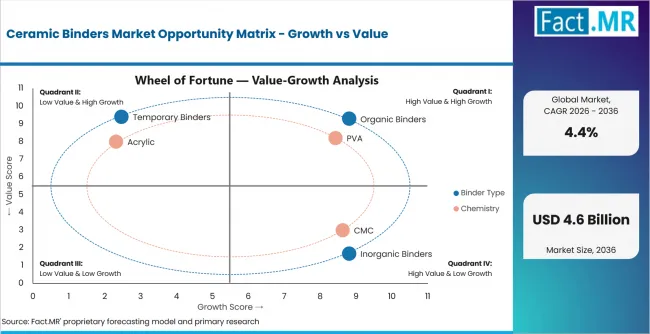
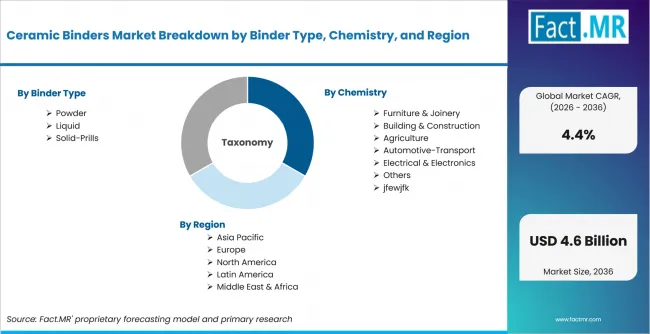
USD 3.0 billion in 2026 to USD 4.6 billion by 2036, at 4.4% CAGR.
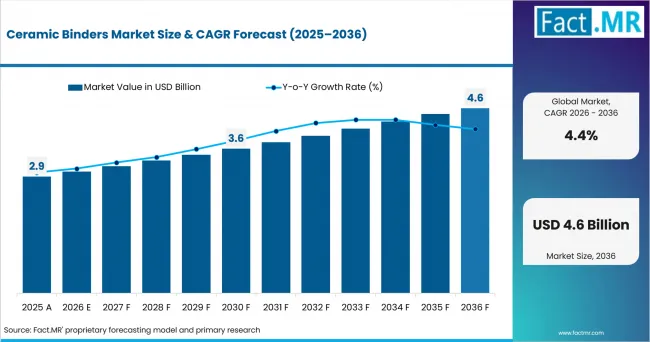
- The ceramic binders market crossed a valuation of USD 2.9 billion in 2025. Demand is estimated to increase from USD 3.0 billion in 2026 to USD 4.6 billion by 2036.
- The market is forecast to record 4.4% CAGR from 2026 to 2036 led by tile output, refractory repairs and technical ceramic processing.
What are the defining numbers behind ceramic binders growth?
USD 1.6 billion absolute opportunity by 2036, led by China and India.
Demand Drivers in the Market
- Tile producers need binder strength before pressed bodies move into dryers and kilns.
- Refractory producers require binders that support installation strength and controlled setting.
- Technical ceramic buyers specify lower residue binders for dimensional control after firing.
- Water-based formulations are favored where plants want cleaner handling and easier dosing.
Key Segments Analyzed
- By Binder Type: Organic binders are expected to hold 46.0% share in 2026 due to broad ceramic body use.
- By Chemistry: PVA leads because it supports green strength and cleaner burnout. The segment is projected to capture 32.0% share in 2026.
- By Application: Tiles are likely to account for 38.0% share in 2026 with high-volume pressing and spray-drying use.
- By Form: Liquid binders are projected to hold 44.0% share in 2026 because dosing is easier in slips and wet mixes.
- By Buyer Type: Ceramic manufacturers are expected to hold 41.0% share in 2026 due to repeat buying for plant operations.
- By Geography: China is projected to record 5.1% CAGR through 2036 due to ceramic scale and local supply depth.
Analyst Opinion at Fact.MR
- Shambhu Nath Jha, Senior Analyst at Fact.MR, states, “Ceramic binders look simple until a tile cracks before firing or a refractory mix sets too fast. I see buyers asking suppliers to prove burnout, green strength and dosing stability inside the plant. Suppliers that solve batch problems before the kiln run are the ones that protect long contracts.”
Strategic Implications
- Ceramic producers should test binder grades against real body recipes before annual sourcing decisions.
- Refractory suppliers need installation trials that show set behavior under site temperature ranges.
- Binder producers should document ash content, burnout profile and dosing guidance for each grade.
- Distributors can protect accounts by holding polymer and inorganic binders close to ceramic clusters.
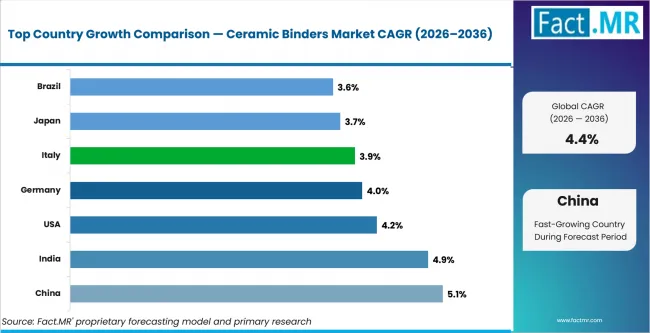
China is projected to record 5.1% CAGR through 2036 supported by ceramic output scale and local supplier depth. India is expected to expand at 4.9% CAGR led by tile clusters and export-linked production. The United States is forecast to advance at 4.2% CAGR through 2036 through industrial ceramics and refractory customers. Germany is expected to post 4.0% CAGR through 2036 due to process-controlled ceramic production. Italy is projected to rise at 3.9% CAGR through 2036 backed by tile know-how and export-grade output. Japan is forecast at 3.7% CAGR through 2036 with demand tied to precision ceramics. Brazil is expected to post 3.6% CAGR through 2036 due to a large regional tile base.
How does the ceramic binders market break down by segment?
Organic binders lead at 46.0%, while PVA leads chemistry at 32.0%.
Which binder type dominates?
Organic Binders hold 46.0% share in 2026.
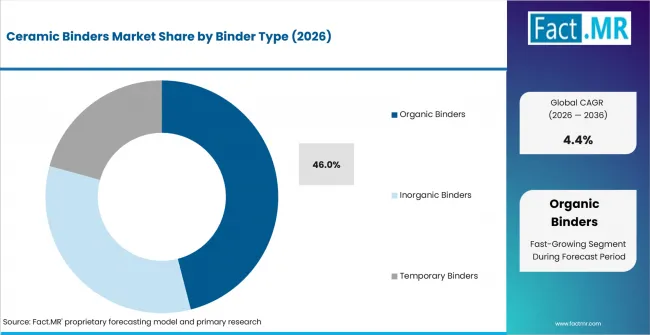
Organic binders lead because pressed and extruded ceramic bodies need temporary strength before firing. PVA, CMC and starch systems are used where burnout behavior and green strength affect scrap rates. Buyers compare these products by ash profile and viscosity rather than price alone. Adjacent ceramic additives also influence how binder grades perform in body recipes.
Which chemistry dominates?
PVA holds 32.0% chemistry share in 2026.
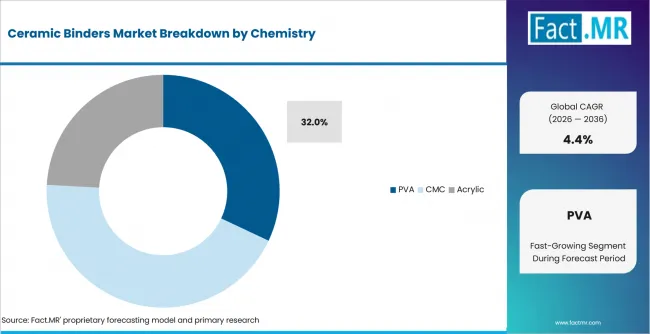
PVA leads because it gives green strength while breaking down during firing. Kuraray Europe states that KURARAY POVAL use in ceramic mixes ranges from 0.1% to 5.0% of the dry mix. [2] This makes polyvinyl alcohol important for ceramic processors that need stable forming and low residue.
Which application dominates?
Tiles hold 38.0% application share in 2026.
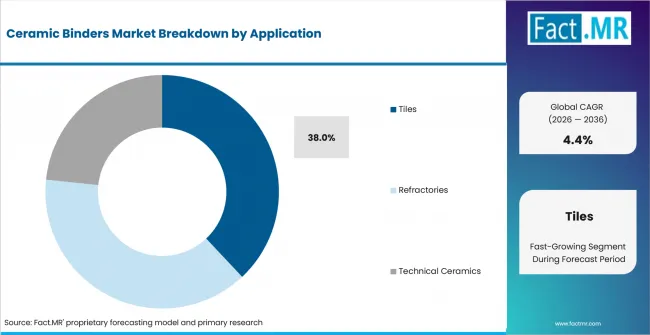
Tiles lead because high-volume pressing and drying create repeat use for body binders. India Brand Equity Foundation reported that India’s ceramic tile industry reached Rs. 62,000 crore in FY24. [5] That scale supports binder demand where ceramic tile producers try to reduce breakage during handling.
Which form dominates?
Liquid binders hold 44.0% share in 2026.
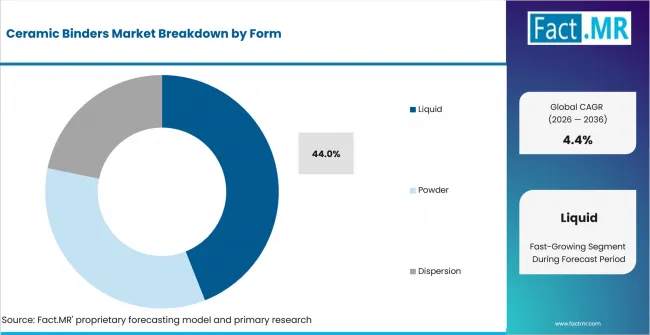
Liquid binders lead because they are easier to dose into slips, dispersions and wet refractory mixes. Powder binders remain important where plants prefer dry blending and longer inventory life. Form selection depends on process layout, water balance and the supplier support available during trial runs.
Which buyer type dominates?
Ceramic Manufacturers hold 41.0% share in 2026.
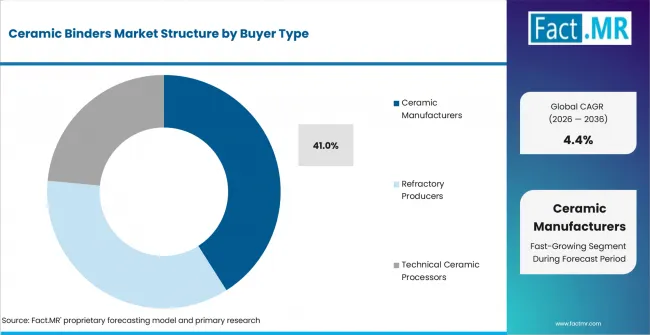
Ceramic manufacturers lead because they buy binders repeatedly for body preparation and defect reduction. Refractory producers form a second customer base where refractory linings need early strength and controlled set behavior. Technical ceramic processors buy smaller volumes but often pay more for clean burnout and tight specifications.
What is accelerating ceramic binders demand, and what is holding it back?
Tile output, refractory repair needs and technical ceramic precision drive it. Qualification time and recipe lock-in restrain faster switching.
The main driver is process risk inside ceramic plants. A binder failure can break unfired bodies before firing or change burnout behavior inside the kiln. This makes coating binders and ceramic binder know-how relevant to suppliers that sell formulation support rather than only materials.
The main restraint is qualification time. Each ceramic body has its own clay mix, particle size and firing cycle, so a binder that works in one plant may need fresh trials in another. This slows supplier switching, even when buyers test lower-cost alternatives.
Where do the biggest ceramic binders opportunities sit?
Technical ceramics, refractory castables and tile production clusters.
- Technical Ceramics: Suppliers can sell low-residue grades where part geometry and firing loss affect final value.
- Refractory Castables: Inorganic binders can support faster repair cycles and earlier job-site strength.
- Tile Clusters: Distributors can gain repeat orders when stock and dosing advice sit close to production hubs.
Which countries are scaling ceramic binders fastest?
China 5.1%, India 4.9%, United States 4.2%, Germany 4.0%, Italy 3.9%, Japan 3.7%, Brazil 3.6%.
Based on regional analysis, the ceramic binders market is segmented into North America, Latin America, Europe, Asia Pacific, and Middle East and Africa.
.webp)
| Country | CAGR |
|---|---|
| China | 5.1% |
| India | 4.9% |
| United States | 4.2% |
| Germany | 4.0% |
| Italy | 3.9% |
| Japan | 3.7% |
| Brazil | 3.6% |

What is powering China’s lead?
5.1% CAGR, driven by ceramic output scale and local supplier depth.
China remains the largest ceramic body additive outlet because tile, sanitaryware and technical ceramic production are concentrated at scale. The country is projected to record 5.1% CAGR through 2036 as producers move toward more controlled formulations. Local suppliers compete on delivery speed, while multinational suppliers hold access through specialty grades.
Why is India gaining share?
4.9% CAGR, supported by tile clusters and export-linked production.
India has a large ceramic tile base centered on Gujarat and other production clusters. India is expected to expand at 4.9% CAGR through 2036 as producers buy binders for pressing, drying and export-grade quality control.
What supports the United States outlook?
4.2% CAGR, led by technical ceramics and refractory users.
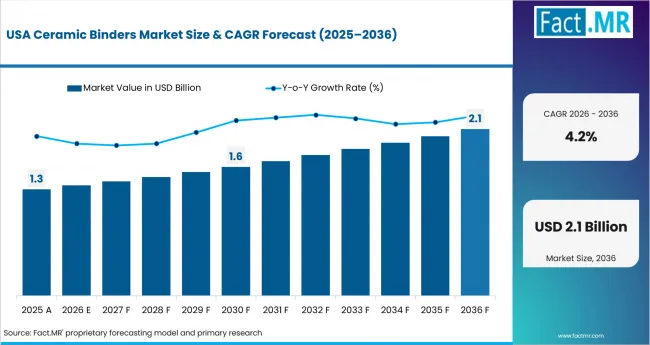
The United States has a smaller tile base than Asia but a deeper technical ceramic and refractory customer base. U.S. Geological Survey estimated U.S. clay production at 26 million tons in 2025. [1] The United States is forecast to advance at 4.2% CAGR through 2036 as buyers link binders to scrap reduction and repeatable kiln output.
What underpins Germany’s steady demand?
4.0% CAGR, backed by process-controlled ceramics and chemical supply depth.
Germany’s ceramic binder demand is shaped by engineered ceramics and industrial buyers that require documented process behavior. Germany is expected to post 4.0% CAGR through 2036 because suppliers must prove viscosity control, burnout and plant consistency. Buyers favor technical support over spot-price savings in precision applications.
Why does Italy remain important?
3.9% CAGR, supported by tile know-how and export-grade production.
Italy remains a key market due to export-oriented tile production and process discipline. Confindustria Ceramica reported that 122 Italian ceramic tile companies produced 369.8 million square meters in 2024. [6] Tile suppliers also track aluminosilicate inputs because mineral chemistry shapes firing behavior. Italy is projected to rise at 3.9% CAGR through 2036 with value tied to high-spec bodies and stable supplier relationships.
How is Japan positioned?
3.7% CAGR, driven by electronics ceramics and quality-led sanitaryware demand.
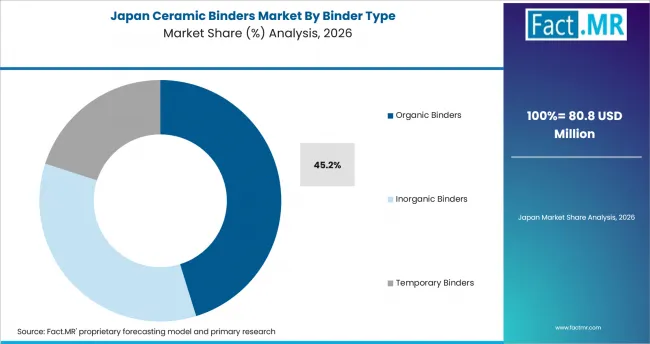
Japan’s demand is shaped less by tile volume and more by precision ceramic and sanitaryware quality needs. Japan is forecast at 3.7% CAGR through 2036 because buyers focus on clean burnout, dimensional stability and qualification history. Suppliers need repeatable test results before they displace approved grades.
What shapes Brazil’s ceramic binder demand?
3.6% CAGR, supported by a large regional tile base.
Brazil remains a significant ceramic tile producer and regional exporter. Brazil is expected to post 3.6% CAGR through 2036 with demand concentrated in tile clusters and distributor-led supply. Price discipline keeps standard polymer grades important, while refractory users create selective demand for inorganic binders.
Who leads the ceramic binders landscape?
Imerys, BASF SE, Dow Inc., Kuraray and Nouryon lead through mineral, polymer and inorganic binder capabilities.
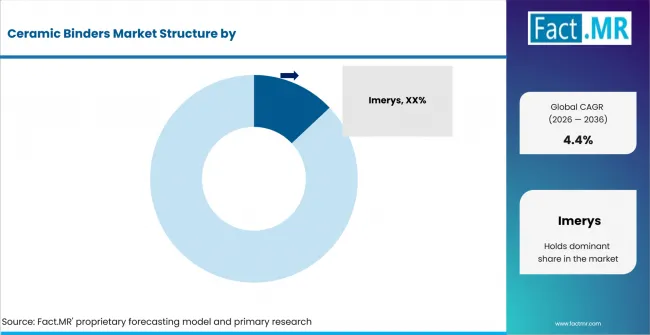
Ceramic binder competition is split between mineral binder suppliers, polymer specialists and refractory formulation providers. Imerys supplies calcium aluminate specialty binders for refractory and construction chemistry use. [7] BASF SE and Dow Inc. compete through acrylic and dispersion binder lines, while Kuraray sells PVA grades used in ceramic mixes.
Nouryon supports inorganic binder demand through Levasil colloidal silica for refractory materials. [3] Roquette is included because IFF Pharma Solutions became part of Roquette in May 2025, which affects current METHOCEL ownership references. [4] Buyers choose suppliers that can link lab data with plant trial support.
Suppliers that understand body recipes, kiln losses and refractory site behavior are better placed through 2036. Specialist providers can win accounts where ceramic membranes or technical ceramics need low-residue binders. Mineral suppliers can defend refractory accounts when colloidal silica and phosphate systems reduce installation risk.
Which companies are the key players?
Imerys, BASF SE, Dow Inc., Ashland Inc., Wacker Chemie AG, Kuraray, Nouryon, Roquette and Zschimmer & Schwarz.
- Imerys
- BASF SE
- Dow Inc.
- Ashland Inc.
- Wacker Chemie AG
- Kuraray
- Nouryon
- Roquette
- Zschimmer & Schwarz
Bibliography
- [1] U.S. Geological Survey. (2026, February). Mineral commodity summaries 2026: Clays. U.S. Department of the Interior.
- [2] Kuraray Europe GmbH. (2026). Ceramics: Kuraray Poval as a temporary binder. Kuraray Europe GmbH.
- [3] Nouryon. (2026). Levasil colloidal silica binder for refractory materials. Nouryon.
- [4] Roquette Frères. (2025, May 1). Roquette completes the acquisition of IFF Pharma Solutions. Roquette.
- [5] India Brand Equity Foundation. (2026, January 30). Tiles of Transformation: Exploring India’s ceramic tile industry. India Brand Equity Foundation.
- [6] Confindustria Ceramica. (2025, July). Ceramic tiles. Confindustria Ceramica.
- [7] Imerys. (2026). Calcium aluminate specialty binders. Imerys.
- [8] Wacker Chemie AG. (2025, January). Factbook 2025. Wacker Chemie AG.
- [9] International Organization for Standardization. (2025, November). ISO/AWI 13006: Ceramic tiles. International Organization for Standardization.
- [10] Cerame-Unie. (2024, December 3). 2024 European Ceramic Days statement on the Clean Industrial Deal. Cerame-Unie.
- [11] World Ceramic Tiles Forum. (2024, November). 31st annual meeting of the World Ceramic Tiles Forum. World Ceramic Tiles Forum.
This Report Addresses
- Strategic intelligence on ceramic binders across binder type, chemistry and application.
- Segment analysis covering Organic Binders, PVA, Tiles, Liquid Binders and Ceramic Manufacturers.
- Regional outlook covering China, India, United States, Germany, Italy, Japan and Brazil.
- Competitive analysis of Imerys, BASF SE, Dow Inc., Ashland Inc., Wacker Chemie AG, Kuraray, Nouryon, Roquette and Zschimmer & Schwarz.
- Service assessment covering formulation support, plant trials, binder qualification and distributor stock strategy.
- Standards and production review covering ceramic tiles, refractory uses and technical ceramic processing.
- Primary interviews, supplier checks, official source review and output validation support the forecast.
What does the ceramic binders market cover?
Organic and inorganic binders used in ceramic bodies, refractories and technical ceramic processing.
The ceramic binders market covers materials that hold ceramic powders together before firing or bind refractory systems during installation. It includes temporary binders used for green strength and permanent binders used in selected refractory systems. The market differs from finished ceramics because the purchase decision is based on processing behavior and defect control.
What is included in the scope?
Temporary binders, permanent binders and formulation support for ceramic production.
The scope includes PVA, CMC, acrylic, starch and cellulose ether binders. It also includes phosphate, silicate, alumina sol and colloidal silica systems for inorganic use. Liquid, powder, dispersion, emulsion and custom formulation forms are included where they are sold for ceramic processing.
What is excluded from the scope?
Finished ceramic products and tile adhesives used after firing are excluded.
The scope excludes finished tiles, sanitaryware, abrasives and technical ceramic parts sold as end products. It excludes construction tile adhesives used only during installation. It also excludes mineral fillers, pigments and processing aids when they do not provide binding or green-strength performance.
How was the analysis built?
100+ sources, 40+ company portfolios, 25+ countries, 20+ interviews.
- Primary Research:
- Primary research includes interviews with ceramic body formulators, refractory installers and procurement teams. It includes input from distributors that supply PVA, CMC and inorganic binder systems.
- Desk Research:
- Desk research reviews ceramic output data, company product portfolios, standards activity and official trade body publications. It also reviews supplier pages for current product ownership and active ceramic use.
- Market-Sizing and Forecasting:
- Forecasting uses the 2026 market estimate as the base and reconciles it against ceramic output, refractory consumption and technical ceramic use. Binder intensity by application is used to split demand by segment.
- Data Validation and Update Cycle:
- Forecasts are validated through source checks, supplier portfolio review and country-level production signals. Company names were checked for current ownership before the final competitive list was locked.
What is the report’s scope and coverage?
| Attribute | Details |
|---|---|
| Quantitative Units | USD Billion in 2026 to USD Billion by 2036 |
| Market Definition | Organic and inorganic binders used to hold ceramic powders before firing or to bind refractory systems during installation |
| Binder Type | Organic Binders, Inorganic Binders, Temporary Binders, Permanent Binders, Aqueous Binders, Solvent-Based Binders |
| Chemistry | PVA, CMC, Acrylic, Starch, Cellulose Ether, Phosphate, Silicate, Alumina Sol, Colloidal Silica |
| Application | Tiles, Refractories, Technical Ceramics, Abrasives, Sanitaryware, Ceramic Filters, Investment Casting |
| Form | Liquid, Powder, Dispersion, Emulsion, Pelletized Additive, Custom Formulation |
| Buyer Type | Ceramic Manufacturers, Refractory Producers, Technical Ceramic Processors, Abrasive Makers, Ceramic Filter Producers |
| Regions Covered | North America, Latin America, Europe, Asia Pacific, Middle East and Africa |
| Countries Covered | China, India, United States, Germany, Italy, Japan and Brazil |
| Key Companies Profiled | Imerys, BASF SE, Dow Inc., Ashland Inc., Wacker Chemie AG, Kuraray, Nouryon, Roquette and Zschimmer & Schwarz |
| Forecast Period | 2026 to 2036 |
| Approach | Hybrid top-down and bottom-up approach using ceramic output, binder intensity, supplier checks and country production signals |
How is the market segmented?
-
By Binder Type:
- Organic Binders
- Inorganic Binders
- Temporary Binders
- Permanent Binders
- Aqueous Binders
- Solvent-Based Binders
-
By Chemistry:
- PVA
- CMC
- Acrylic
- Starch
- Cellulose Ether
- Phosphate
- Silicate
- Alumina Sol
- Colloidal Silica
-
By Application:
- Tiles
- Refractories
- Technical Ceramics
- Abrasives
- Sanitaryware
- Ceramic Filters
- Investment Casting
-
By Form:
- Liquid
- Powder
- Dispersion
- Emulsion
- Pelletized Additive
- Custom Formulation
-
By Buyer Type:
- Ceramic Manufacturers
- Refractory Producers
- Technical Ceramic Processors
- Abrasive Makers
- Ceramic Filter Producers
-
By Region:
- North America
- United States
- Canada
- Mexico
- Latin America
- Brazil
- Argentina
- Rest of Latin America
- Europe
- Germany
- United Kingdom
- France
- Italy
- Spain
- Rest of Europe
- Asia Pacific
- China
- India
- Japan
- South Korea
- ASEAN
- Middle East & Africa
- GCC Countries
- South Africa
- UAE
- Rest of Middle East & Africa
- North America
- Frequently Asked Questions -
Which binder type leads the Ceramic Binders Market?
Organic Binders lead with 46.0% share in 2026 because ceramic bodies need green strength before firing.
Which chemistry leads the Ceramic Binders Market?
PVA leads with 32.0% share in 2026 due to low residue performance and broad ceramic body use.
Which country expands fastest in the Ceramic Binders Market?
China is projected to record 5.1% CAGR through 2036 supported by ceramic output scale and local supplier depth.
How does India perform in the Ceramic Binders Market?
India is expected to expand at 4.9% CAGR through 2036 led by tile clusters and export-linked production.
How does the United States perform in the Ceramic Binders Market?
The United States is forecast to advance at 4.2% CAGR through 2036 with demand tied to technical ceramics and refractory users.
How does Germany perform in the Ceramic Binders Market?
Germany is expected to post 4.0% CAGR through 2036 due to process-controlled ceramic production and supplier depth.
How does Italy perform in the Ceramic Binders Market?
Italy is projected to rise at 3.9% CAGR through 2036 backed by tile know-how and export-grade output.
How does Japan perform in the Ceramic Binders Market?
Japan is forecast at 3.7% CAGR through 2036 with demand tied to precision ceramics and sanitaryware quality.
How does Brazil perform in the Ceramic Binders Market?
Brazil is expected to post 3.6% CAGR through 2036 due to a large regional tile base.
What is the primary driver in the Ceramic Binders Market?
The primary driver is the need to reduce breakage and firing defects during ceramic production.
What is the main restraint in the Ceramic Binders Market?
The main restraint is qualification time because each ceramic body recipe needs plant-level testing.
Why are refractory applications important in this market?
Refractory applications are important because binders affect setting behavior, repair speed and early strength at job sites.
Table of Content
- Key Takeaways
- Market Size and CAGR
- Top Growth Driver
- Fastest Growing Segment
- Leading Region
- Key Companies
- Emerging Opportunities
- Executive Summary
- Global Market Outlook
- Demand-side Trends
- Supply-side Trends
- Technology Roadmap Analysis
- Analysis and Recommendations
- Analyst Perspective (What is happening? Why now? What should investors know?)
- Key Questions Answered
- How large is the market?
- What is the CAGR?
- What are key trends?
- Which region dominates?
- Who are the leaders?
- Market Overview
- Market Coverage / Taxonomy
- Market Definition / Scope / Limitations
- Research Methodology
- Chapter Orientation
- Analytical Lens and Working Hypotheses
- Market Structure, Signals, and Trend Drivers
- Benchmarking and Cross-market Comparability
- Market Sizing, Forecasting, and Opportunity Mapping
- Research Design and Evidence Framework
- Desk Research Programme (Secondary Evidence)
- Expert Input and Fieldwork (Primary Evidence)
- Tooling, Models, and Reference Databases
- Data Engineering and Model Build
- Quality Assurance and Audit Trail
- Market Background
- Market Dynamics (Drivers, Restraints, Opportunity, Trends)
- Scenario Forecast (Optimistic, Likely, Conservative)
- Impact Analysis
- AI Impact
- Sustainability Impact
- Regulatory Impact
- Technology Impact
- Consumer / Buyer Analysis
- Purchase Drivers
- Adoption Barriers
- Buyer Journey
- Opportunity Map Analysis
- Product Life Cycle Analysis
- Supply Chain Analysis
- Investment Feasibility Matrix
- Value Chain Analysis
- PESTLE and Porter's Analysis
- Regulatory Landscape
- Regional Parent Market Outlook
- Production and Consumption Statistics
- Import and Export Statistics
- Global Market Analysis and Forecast, 2021 to 2036
- Historical Market Size Value (USD Billion) Analysis, 2021 to 2025
- Current and Future Market Size Value (USD Billion) Projections, 2026 to 2036
- Y-o-Y Growth Trend Analysis
- Absolute $ Opportunity Analysis
- Global Market Pricing Analysis, 2021 to 2036
- Global Market Analysis and Forecast, By Binder Type, 2021 to 2036
- Introduction / Key Findings
- Historical Market Size Value (USD Billion) Analysis By Binder Type, 2021 to 2025
- Current and Future Market Size Value (USD Billion) Analysis and Forecast By Binder Type, 2026 to 2036
- Organic Binders
- Inorganic Binders
- Temporary Binders
- Y-o-Y Growth Trend Analysis By Binder Type, 2021 to 2025
- Absolute $ Opportunity Analysis By Binder Type, 2026 to 2036
- Global Market Analysis and Forecast, By Chemistry, 2021 to 2036
- Introduction / Key Findings
- Historical Market Size Value (USD Billion) Analysis By Chemistry, 2021 to 2025
- Current and Future Market Size Value (USD Billion) Analysis and Forecast By Chemistry, 2026 to 2036
- PVA
- CMC
- Acrylic
- Y-o-Y Growth Trend Analysis By Chemistry, 2021 to 2025
- Absolute $ Opportunity Analysis By Chemistry, 2026 to 2036
- Global Market Analysis and Forecast, By Application, 2021 to 2036
- Introduction / Key Findings
- Historical Market Size Value (USD Billion) Analysis By Application, 2021 to 2025
- Current and Future Market Size Value (USD Billion) Analysis and Forecast By Application, 2026 to 2036
- Tiles
- Refractories
- Technical Ceramics
- Y-o-Y Growth Trend Analysis By Application, 2021 to 2025
- Absolute $ Opportunity Analysis By Application, 2026 to 2036
- Global Market Analysis and Forecast, By Form, 2021 to 2036
- Introduction / Key Findings
- Historical Market Size Value (USD Billion) Analysis By Form, 2021 to 2025
- Current and Future Market Size Value (USD Billion) Analysis and Forecast By Form, 2026 to 2036
- Liquid
- Powder
- Dispersion
- Y-o-Y Growth Trend Analysis By Form, 2021 to 2025
- Absolute $ Opportunity Analysis By Form, 2026 to 2036
- Global Market Analysis and Forecast, By Buyer Type, 2021 to 2036
- Introduction / Key Findings
- Historical Market Size Value (USD Billion) Analysis By Buyer Type, 2021 to 2025
- Current and Future Market Size Value (USD Billion) Analysis and Forecast By Buyer Type, 2026 to 2036
- Ceramic Manufacturers
- Refractory Producers
- Technical Ceramic Processors
- Y-o-Y Growth Trend Analysis By Buyer Type, 2021 to 2025
- Absolute $ Opportunity Analysis By Buyer Type, 2026 to 2036
- Global Market Analysis and Forecast, By Region, 2021 to 2036
- Introduction
- Historical Market Size Value (USD Billion) Analysis By Region, 2021 to 2025
- Current Market Size Value (USD Billion) Analysis and Forecast By Region, 2026 to 2036
- North America
- Latin America
- Western Europe
- Eastern Europe
- East Asia
- South Asia and Pacific
- Middle East & Africa
- Market Attractiveness Analysis By Region
- North America Market Analysis and Forecast, By Country, 2021 to 2036
- Historical Market Size Value (USD Billion) Trend Analysis By Market Taxonomy, 2021 to 2025
- Market Size Value (USD Billion) Forecast By Market Taxonomy, 2026 to 2036
- By Country
- USA
- Canada
- Mexico
- By Binder Type
- By Chemistry
- By Application
- By Form
- By Buyer Type
- By Country
- Market Attractiveness Analysis
- By Country
- By Binder Type
- By Chemistry
- By Application
- By Form
- By Buyer Type
- Key Takeaways
- Latin America Market Analysis and Forecast, By Country
- Historical Market Size Value (USD Billion) Trend Analysis By Market Taxonomy, 2021 to 2025
- Market Size Value (USD Billion) Forecast By Market Taxonomy, 2026 to 2036
- By Country
- Brazil
- Chile
- Rest of Latin America
- By Binder Type
- By Chemistry
- By Application
- By Form
- By Buyer Type
- By Country
- Market Attractiveness Analysis
- By Country
- By Binder Type
- By Chemistry
- By Application
- By Form
- By Buyer Type
- Key Takeaways
- Western Europe Market Analysis and Forecast, By Country
- Historical Market Size Value (USD Billion) Trend Analysis By Market Taxonomy, 2021 to 2025
- Market Size Value (USD Billion) Forecast By Market Taxonomy, 2026 to 2036
- By Country
- Germany
- UK
- Italy
- Spain
- France
- Nordic
- BENELUX
- Rest of Western Europe
- By Binder Type
- By Chemistry
- By Application
- By Form
- By Buyer Type
- By Country
- Market Attractiveness Analysis
- By Country
- By Binder Type
- By Chemistry
- By Application
- By Form
- By Buyer Type
- Key Takeaways
- Eastern Europe Market Analysis and Forecast, By Country
- Historical Market Size Value (USD Billion) Trend Analysis By Market Taxonomy, 2021 to 2025
- Market Size Value (USD Billion) Forecast By Market Taxonomy, 2026 to 2036
- By Country
- Russia
- Poland
- Hungary
- Balkan & Baltic
- Rest of Eastern Europe
- By Binder Type
- By Chemistry
- By Application
- By Form
- By Buyer Type
- By Country
- Market Attractiveness Analysis
- By Country
- By Binder Type
- By Chemistry
- By Application
- By Form
- By Buyer Type
- Key Takeaways
- East Asia Market Analysis and Forecast, By Country
- Historical Market Size Value (USD Billion) Trend Analysis By Market Taxonomy, 2021 to 2025
- Market Size Value (USD Billion) Forecast By Market Taxonomy, 2026 to 2036
- By Country
- China
- Japan
- South Korea
- By Binder Type
- By Chemistry
- By Application
- By Form
- By Buyer Type
- By Country
- Market Attractiveness Analysis
- By Country
- By Binder Type
- By Chemistry
- By Application
- By Form
- By Buyer Type
- Key Takeaways
- South Asia and Pacific Market Analysis and Forecast, By Country
- Historical Market Size Value (USD Billion) Trend Analysis By Market Taxonomy, 2021 to 2025
- Market Size Value (USD Billion) Forecast By Market Taxonomy, 2026 to 2036
- By Country
- India
- ASEAN
- Australia & New Zealand
- Rest of South Asia and Pacific
- By Binder Type
- By Chemistry
- By Application
- By Form
- By Buyer Type
- By Country
- Market Attractiveness Analysis
- By Country
- By Binder Type
- By Chemistry
- By Application
- By Form
- By Buyer Type
- Key Takeaways
- Middle East & Africa Market Analysis and Forecast, By Country
- Historical Market Size Value (USD Billion) Trend Analysis By Market Taxonomy, 2021 to 2025
- Market Size Value (USD Billion) Forecast By Market Taxonomy, 2026 to 2036
- By Country
- Kingdom of Saudi Arabia
- Other GCC Countries
- Turkiye
- South Africa
- Other African Union
- Rest of Middle East & Africa
- By Binder Type
- By Chemistry
- By Application
- By Form
- By Buyer Type
- By Country
- Market Attractiveness Analysis
- By Country
- By Binder Type
- By Chemistry
- By Application
- By Form
- By Buyer Type
- Key Takeaways
- Key Countries Market Analysis
- USA
- Pricing Analysis
- Market Share Analysis, 2025
- By Binder Type
- By Chemistry
- By Application
- By Form
- By Buyer Type
- Canada
- Pricing Analysis
- Market Share Analysis, 2025
- By Binder Type
- By Chemistry
- By Application
- By Form
- By Buyer Type
- Mexico
- Pricing Analysis
- Market Share Analysis, 2025
- By Binder Type
- By Chemistry
- By Application
- By Form
- By Buyer Type
- Brazil
- Pricing Analysis
- Market Share Analysis, 2025
- By Binder Type
- By Chemistry
- By Application
- By Form
- By Buyer Type
- Chile
- Pricing Analysis
- Market Share Analysis, 2025
- By Binder Type
- By Chemistry
- By Application
- By Form
- By Buyer Type
- Germany
- Pricing Analysis
- Market Share Analysis, 2025
- By Binder Type
- By Chemistry
- By Application
- By Form
- By Buyer Type
- UK
- Pricing Analysis
- Market Share Analysis, 2025
- By Binder Type
- By Chemistry
- By Application
- By Form
- By Buyer Type
- Italy
- Pricing Analysis
- Market Share Analysis, 2025
- By Binder Type
- By Chemistry
- By Application
- By Form
- By Buyer Type
- Spain
- Pricing Analysis
- Market Share Analysis, 2025
- By Binder Type
- By Chemistry
- By Application
- By Form
- By Buyer Type
- France
- Pricing Analysis
- Market Share Analysis, 2025
- By Binder Type
- By Chemistry
- By Application
- By Form
- By Buyer Type
- India
- Pricing Analysis
- Market Share Analysis, 2025
- By Binder Type
- By Chemistry
- By Application
- By Form
- By Buyer Type
- ASEAN
- Pricing Analysis
- Market Share Analysis, 2025
- By Binder Type
- By Chemistry
- By Application
- By Form
- By Buyer Type
- Australia & New Zealand
- Pricing Analysis
- Market Share Analysis, 2025
- By Binder Type
- By Chemistry
- By Application
- By Form
- By Buyer Type
- China
- Pricing Analysis
- Market Share Analysis, 2025
- By Binder Type
- By Chemistry
- By Application
- By Form
- By Buyer Type
- Japan
- Pricing Analysis
- Market Share Analysis, 2025
- By Binder Type
- By Chemistry
- By Application
- By Form
- By Buyer Type
- South Korea
- Pricing Analysis
- Market Share Analysis, 2025
- By Binder Type
- By Chemistry
- By Application
- By Form
- By Buyer Type
- Russia
- Pricing Analysis
- Market Share Analysis, 2025
- By Binder Type
- By Chemistry
- By Application
- By Form
- By Buyer Type
- Poland
- Pricing Analysis
- Market Share Analysis, 2025
- By Binder Type
- By Chemistry
- By Application
- By Form
- By Buyer Type
- Hungary
- Pricing Analysis
- Market Share Analysis, 2025
- By Binder Type
- By Chemistry
- By Application
- By Form
- By Buyer Type
- Kingdom of Saudi Arabia
- Pricing Analysis
- Market Share Analysis, 2025
- By Binder Type
- By Chemistry
- By Application
- By Form
- By Buyer Type
- Turkiye
- Pricing Analysis
- Market Share Analysis, 2025
- By Binder Type
- By Chemistry
- By Application
- By Form
- By Buyer Type
- South Africa
- Pricing Analysis
- Market Share Analysis, 2025
- By Binder Type
- By Chemistry
- By Application
- By Form
- By Buyer Type
- USA
- Market Structure Analysis
- Competition Dashboard
- Competition Benchmarking
- Market Share Analysis of Top Players
- By Regional
- By Binder Type
- By Chemistry
- By Application
- By Form
- By Buyer Type
- Emerging Startups
- Innovation Benchmarking
- Competition Analysis
- Competition Deep Dive
- Imerys
- Overview
- Product Portfolio
- Profitability by Market Segments (Product/Age /Sales Channel/Region)
- Sales Footprint
- Strategy Overview
- Marketing Strategy
- Product Strategy
- Channel Strategy
- BASF SE
- Dow Inc.
- Ashland Inc.
- Wacker Chemie AG
- Kuraray
- Nouryon
- Imerys
- Competition Deep Dive
- Case Studies
- Success Stories
- Recent Developments
- Assumptions & Acronyms Used
List Of Table
- Table 1: Global Market Value (USD Billion) Forecast by Region, 2021-2036
- Table 2: Global Market Value (USD Billion) Forecast by Binder Type, 2021-2036
- Table 3: Global Market Value (USD Billion) Forecast by Chemistry, 2021-2036
- Table 4: Global Market Value (USD Billion) Forecast by Application, 2021-2036
- Table 5: Global Market Value (USD Billion) Forecast by Form, 2021-2036
- Table 6: Global Market Value (USD Billion) Forecast by Buyer Type, 2021-2036
- Table 7: North America Market Value (USD Billion) Forecast by Country, 2021-2036
- Table 8: North America Market Value (USD Billion) Forecast by Binder Type, 2021-2036
- Table 9: North America Market Value (USD Billion) Forecast by Chemistry, 2021-2036
- Table 10: North America Market Value (USD Billion) Forecast by Application, 2021-2036
- Table 11: North America Market Value (USD Billion) Forecast by Form, 2021-2036
- Table 12: North America Market Value (USD Billion) Forecast by Buyer Type, 2021-2036
- Table 13: Latin America Market Value (USD Billion) Forecast by Country, 2021-2036
- Table 14: Latin America Market Value (USD Billion) Forecast by Binder Type, 2021-2036
- Table 15: Latin America Market Value (USD Billion) Forecast by Chemistry, 2021-2036
- Table 16: Latin America Market Value (USD Billion) Forecast by Application, 2021-2036
- Table 17: Latin America Market Value (USD Billion) Forecast by Form, 2021-2036
- Table 18: Latin America Market Value (USD Billion) Forecast by Buyer Type, 2021-2036
- Table 19: Western Europe Market Value (USD Billion) Forecast by Country, 2021-2036
- Table 20: Western Europe Market Value (USD Billion) Forecast by Binder Type, 2021-2036
- Table 21: Western Europe Market Value (USD Billion) Forecast by Chemistry, 2021-2036
- Table 22: Western Europe Market Value (USD Billion) Forecast by Application, 2021-2036
- Table 23: Western Europe Market Value (USD Billion) Forecast by Form, 2021-2036
- Table 24: Western Europe Market Value (USD Billion) Forecast by Buyer Type, 2021-2036
- Table 25: Eastern Europe Market Value (USD Billion) Forecast by Country, 2021-2036
- Table 26: Eastern Europe Market Value (USD Billion) Forecast by Binder Type, 2021-2036
- Table 27: Eastern Europe Market Value (USD Billion) Forecast by Chemistry, 2021-2036
- Table 28: Eastern Europe Market Value (USD Billion) Forecast by Application, 2021-2036
- Table 29: Eastern Europe Market Value (USD Billion) Forecast by Form, 2021-2036
- Table 30: Eastern Europe Market Value (USD Billion) Forecast by Buyer Type, 2021-2036
- Table 31: East Asia Market Value (USD Billion) Forecast by Country, 2021-2036
- Table 32: East Asia Market Value (USD Billion) Forecast by Binder Type, 2021-2036
- Table 33: East Asia Market Value (USD Billion) Forecast by Chemistry, 2021-2036
- Table 34: East Asia Market Value (USD Billion) Forecast by Application, 2021-2036
- Table 35: East Asia Market Value (USD Billion) Forecast by Form, 2021-2036
- Table 36: East Asia Market Value (USD Billion) Forecast by Buyer Type, 2021-2036
- Table 37: South Asia and Pacific Market Value (USD Billion) Forecast by Country, 2021-2036
- Table 38: South Asia and Pacific Market Value (USD Billion) Forecast by Binder Type, 2021-2036
- Table 39: South Asia and Pacific Market Value (USD Billion) Forecast by Chemistry, 2021-2036
- Table 40: South Asia and Pacific Market Value (USD Billion) Forecast by Application, 2021-2036
- Table 41: South Asia and Pacific Market Value (USD Billion) Forecast by Form, 2021-2036
- Table 42: South Asia and Pacific Market Value (USD Billion) Forecast by Buyer Type, 2021-2036
- Table 43: Middle East & Africa Market Value (USD Billion) Forecast by Country, 2021-2036
- Table 44: Middle East & Africa Market Value (USD Billion) Forecast by Binder Type, 2021-2036
- Table 45: Middle East & Africa Market Value (USD Billion) Forecast by Chemistry, 2021-2036
- Table 46: Middle East & Africa Market Value (USD Billion) Forecast by Application, 2021-2036
- Table 47: Middle East & Africa Market Value (USD Billion) Forecast by Form, 2021-2036
- Table 48: Middle East & Africa Market Value (USD Billion) Forecast by Buyer Type, 2021-2036
List Of Figures
- Figure 1: Global Market Pricing Analysis
- Figure 2: Global Market Value (USD Billion) Forecast 2021-2036
- Figure 3: Global Market Value Share and BPS Analysis by Binder Type, 2026 and 2036
- Figure 4: Global Market Y-o-Y Growth Comparison by Binder Type, 2026-2036
- Figure 5: Global Market Attractiveness Analysis by Binder Type
- Figure 6: Global Market Value Share and BPS Analysis by Chemistry, 2026 and 2036
- Figure 7: Global Market Y-o-Y Growth Comparison by Chemistry, 2026-2036
- Figure 8: Global Market Attractiveness Analysis by Chemistry
- Figure 9: Global Market Value Share and BPS Analysis by Application, 2026 and 2036
- Figure 10: Global Market Y-o-Y Growth Comparison by Application, 2026-2036
- Figure 11: Global Market Attractiveness Analysis by Application
- Figure 12: Global Market Value Share and BPS Analysis by Form, 2026 and 2036
- Figure 13: Global Market Y-o-Y Growth Comparison by Form, 2026-2036
- Figure 14: Global Market Attractiveness Analysis by Form
- Figure 15: Global Market Value Share and BPS Analysis by Buyer Type, 2026 and 2036
- Figure 16: Global Market Y-o-Y Growth Comparison by Buyer Type, 2026-2036
- Figure 17: Global Market Attractiveness Analysis by Buyer Type
- Figure 18: Global Market Value (USD Billion) Share and BPS Analysis by Region, 2026 and 2036
- Figure 19: Global Market Y-o-Y Growth Comparison by Region, 2026-2036
- Figure 20: Global Market Attractiveness Analysis by Region
- Figure 21: North America Market Incremental Dollar Opportunity, 2026-2036
- Figure 22: Latin America Market Incremental Dollar Opportunity, 2026-2036
- Figure 23: Western Europe Market Incremental Dollar Opportunity, 2026-2036
- Figure 24: Eastern Europe Market Incremental Dollar Opportunity, 2026-2036
- Figure 25: East Asia Market Incremental Dollar Opportunity, 2026-2036
- Figure 26: South Asia and Pacific Market Incremental Dollar Opportunity, 2026-2036
- Figure 27: Middle East & Africa Market Incremental Dollar Opportunity, 2026-2036
- Figure 28: North America Market Value Share and BPS Analysis by Country, 2026 and 2036
- Figure 29: North America Market Value Share and BPS Analysis by Binder Type, 2026 and 2036
- Figure 30: North America Market Y-o-Y Growth Comparison by Binder Type, 2026-2036
- Figure 31: North America Market Attractiveness Analysis by Binder Type
- Figure 32: North America Market Value Share and BPS Analysis by Chemistry, 2026 and 2036
- Figure 33: North America Market Y-o-Y Growth Comparison by Chemistry, 2026-2036
- Figure 34: North America Market Attractiveness Analysis by Chemistry
- Figure 35: North America Market Value Share and BPS Analysis by Application, 2026 and 2036
- Figure 36: North America Market Y-o-Y Growth Comparison by Application, 2026-2036
- Figure 37: North America Market Attractiveness Analysis by Application
- Figure 38: North America Market Value Share and BPS Analysis by Form, 2026 and 2036
- Figure 39: North America Market Y-o-Y Growth Comparison by Form, 2026-2036
- Figure 40: North America Market Attractiveness Analysis by Form
- Figure 41: North America Market Value Share and BPS Analysis by Buyer Type, 2026 and 2036
- Figure 42: North America Market Y-o-Y Growth Comparison by Buyer Type, 2026-2036
- Figure 43: North America Market Attractiveness Analysis by Buyer Type
- Figure 44: Latin America Market Value Share and BPS Analysis by Country, 2026 and 2036
- Figure 45: Latin America Market Value Share and BPS Analysis by Binder Type, 2026 and 2036
- Figure 46: Latin America Market Y-o-Y Growth Comparison by Binder Type, 2026-2036
- Figure 47: Latin America Market Attractiveness Analysis by Binder Type
- Figure 48: Latin America Market Value Share and BPS Analysis by Chemistry, 2026 and 2036
- Figure 49: Latin America Market Y-o-Y Growth Comparison by Chemistry, 2026-2036
- Figure 50: Latin America Market Attractiveness Analysis by Chemistry
- Figure 51: Latin America Market Value Share and BPS Analysis by Application, 2026 and 2036
- Figure 52: Latin America Market Y-o-Y Growth Comparison by Application, 2026-2036
- Figure 53: Latin America Market Attractiveness Analysis by Application
- Figure 54: Latin America Market Value Share and BPS Analysis by Form, 2026 and 2036
- Figure 55: Latin America Market Y-o-Y Growth Comparison by Form, 2026-2036
- Figure 56: Latin America Market Attractiveness Analysis by Form
- Figure 57: Latin America Market Value Share and BPS Analysis by Buyer Type, 2026 and 2036
- Figure 58: Latin America Market Y-o-Y Growth Comparison by Buyer Type, 2026-2036
- Figure 59: Latin America Market Attractiveness Analysis by Buyer Type
- Figure 60: Western Europe Market Value Share and BPS Analysis by Country, 2026 and 2036
- Figure 61: Western Europe Market Value Share and BPS Analysis by Binder Type, 2026 and 2036
- Figure 62: Western Europe Market Y-o-Y Growth Comparison by Binder Type, 2026-2036
- Figure 63: Western Europe Market Attractiveness Analysis by Binder Type
- Figure 64: Western Europe Market Value Share and BPS Analysis by Chemistry, 2026 and 2036
- Figure 65: Western Europe Market Y-o-Y Growth Comparison by Chemistry, 2026-2036
- Figure 66: Western Europe Market Attractiveness Analysis by Chemistry
- Figure 67: Western Europe Market Value Share and BPS Analysis by Application, 2026 and 2036
- Figure 68: Western Europe Market Y-o-Y Growth Comparison by Application, 2026-2036
- Figure 69: Western Europe Market Attractiveness Analysis by Application
- Figure 70: Western Europe Market Value Share and BPS Analysis by Form, 2026 and 2036
- Figure 71: Western Europe Market Y-o-Y Growth Comparison by Form, 2026-2036
- Figure 72: Western Europe Market Attractiveness Analysis by Form
- Figure 73: Western Europe Market Value Share and BPS Analysis by Buyer Type, 2026 and 2036
- Figure 74: Western Europe Market Y-o-Y Growth Comparison by Buyer Type, 2026-2036
- Figure 75: Western Europe Market Attractiveness Analysis by Buyer Type
- Figure 76: Eastern Europe Market Value Share and BPS Analysis by Country, 2026 and 2036
- Figure 77: Eastern Europe Market Value Share and BPS Analysis by Binder Type, 2026 and 2036
- Figure 78: Eastern Europe Market Y-o-Y Growth Comparison by Binder Type, 2026-2036
- Figure 79: Eastern Europe Market Attractiveness Analysis by Binder Type
- Figure 80: Eastern Europe Market Value Share and BPS Analysis by Chemistry, 2026 and 2036
- Figure 81: Eastern Europe Market Y-o-Y Growth Comparison by Chemistry, 2026-2036
- Figure 82: Eastern Europe Market Attractiveness Analysis by Chemistry
- Figure 83: Eastern Europe Market Value Share and BPS Analysis by Application, 2026 and 2036
- Figure 84: Eastern Europe Market Y-o-Y Growth Comparison by Application, 2026-2036
- Figure 85: Eastern Europe Market Attractiveness Analysis by Application
- Figure 86: Eastern Europe Market Value Share and BPS Analysis by Form, 2026 and 2036
- Figure 87: Eastern Europe Market Y-o-Y Growth Comparison by Form, 2026-2036
- Figure 88: Eastern Europe Market Attractiveness Analysis by Form
- Figure 89: Eastern Europe Market Value Share and BPS Analysis by Buyer Type, 2026 and 2036
- Figure 90: Eastern Europe Market Y-o-Y Growth Comparison by Buyer Type, 2026-2036
- Figure 91: Eastern Europe Market Attractiveness Analysis by Buyer Type
- Figure 92: East Asia Market Value Share and BPS Analysis by Country, 2026 and 2036
- Figure 93: East Asia Market Value Share and BPS Analysis by Binder Type, 2026 and 2036
- Figure 94: East Asia Market Y-o-Y Growth Comparison by Binder Type, 2026-2036
- Figure 95: East Asia Market Attractiveness Analysis by Binder Type
- Figure 96: East Asia Market Value Share and BPS Analysis by Chemistry, 2026 and 2036
- Figure 97: East Asia Market Y-o-Y Growth Comparison by Chemistry, 2026-2036
- Figure 98: East Asia Market Attractiveness Analysis by Chemistry
- Figure 99: East Asia Market Value Share and BPS Analysis by Application, 2026 and 2036
- Figure 100: East Asia Market Y-o-Y Growth Comparison by Application, 2026-2036
- Figure 101: East Asia Market Attractiveness Analysis by Application
- Figure 102: East Asia Market Value Share and BPS Analysis by Form, 2026 and 2036
- Figure 103: East Asia Market Y-o-Y Growth Comparison by Form, 2026-2036
- Figure 104: East Asia Market Attractiveness Analysis by Form
- Figure 105: East Asia Market Value Share and BPS Analysis by Buyer Type, 2026 and 2036
- Figure 106: East Asia Market Y-o-Y Growth Comparison by Buyer Type, 2026-2036
- Figure 107: East Asia Market Attractiveness Analysis by Buyer Type
- Figure 108: South Asia and Pacific Market Value Share and BPS Analysis by Country, 2026 and 2036
- Figure 109: South Asia and Pacific Market Value Share and BPS Analysis by Binder Type, 2026 and 2036
- Figure 110: South Asia and Pacific Market Y-o-Y Growth Comparison by Binder Type, 2026-2036
- Figure 111: South Asia and Pacific Market Attractiveness Analysis by Binder Type
- Figure 112: South Asia and Pacific Market Value Share and BPS Analysis by Chemistry, 2026 and 2036
- Figure 113: South Asia and Pacific Market Y-o-Y Growth Comparison by Chemistry, 2026-2036
- Figure 114: South Asia and Pacific Market Attractiveness Analysis by Chemistry
- Figure 115: South Asia and Pacific Market Value Share and BPS Analysis by Application, 2026 and 2036
- Figure 116: South Asia and Pacific Market Y-o-Y Growth Comparison by Application, 2026-2036
- Figure 117: South Asia and Pacific Market Attractiveness Analysis by Application
- Figure 118: South Asia and Pacific Market Value Share and BPS Analysis by Form, 2026 and 2036
- Figure 119: South Asia and Pacific Market Y-o-Y Growth Comparison by Form, 2026-2036
- Figure 120: South Asia and Pacific Market Attractiveness Analysis by Form
- Figure 121: South Asia and Pacific Market Value Share and BPS Analysis by Buyer Type, 2026 and 2036
- Figure 122: South Asia and Pacific Market Y-o-Y Growth Comparison by Buyer Type, 2026-2036
- Figure 123: South Asia and Pacific Market Attractiveness Analysis by Buyer Type
- Figure 124: Middle East & Africa Market Value Share and BPS Analysis by Country, 2026 and 2036
- Figure 125: Middle East & Africa Market Value Share and BPS Analysis by Binder Type, 2026 and 2036
- Figure 126: Middle East & Africa Market Y-o-Y Growth Comparison by Binder Type, 2026-2036
- Figure 127: Middle East & Africa Market Attractiveness Analysis by Binder Type
- Figure 128: Middle East & Africa Market Value Share and BPS Analysis by Chemistry, 2026 and 2036
- Figure 129: Middle East & Africa Market Y-o-Y Growth Comparison by Chemistry, 2026-2036
- Figure 130: Middle East & Africa Market Attractiveness Analysis by Chemistry
- Figure 131: Middle East & Africa Market Value Share and BPS Analysis by Application, 2026 and 2036
- Figure 132: Middle East & Africa Market Y-o-Y Growth Comparison by Application, 2026-2036
- Figure 133: Middle East & Africa Market Attractiveness Analysis by Application
- Figure 134: Middle East & Africa Market Value Share and BPS Analysis by Form, 2026 and 2036
- Figure 135: Middle East & Africa Market Y-o-Y Growth Comparison by Form, 2026-2036
- Figure 136: Middle East & Africa Market Attractiveness Analysis by Form
- Figure 137: Middle East & Africa Market Value Share and BPS Analysis by Buyer Type, 2026 and 2036
- Figure 138: Middle East & Africa Market Y-o-Y Growth Comparison by Buyer Type, 2026-2036
- Figure 139: Middle East & Africa Market Attractiveness Analysis by Buyer Type
- Figure 140: Global Market - Tier Structure Analysis
- Figure 141: Global Market - Company Share Analysis