- Base Value(2025): 520.0 Mn
- Estimated Value(2026): 548.1 Mn
- Forecast Value (2036): 927.4 Mn
- CAGR (2026 - 2036): 5.4%
Chlorine Injection Systems Market Analysis and Forecast by Fact.MR
- The global chlorine injection systems market is estimated to be around USD 548.1 million in 2026 and has been forecast to expand at a CAGR of 5.4% to reach USD 927.4 million by 2036.
- Tightening drinking water disinfection standards across developed and developing markets represent the most durable demand driver for chlorine injection systems.
- Regulatory agencies are lowering acceptable pathogen thresholds and expanding the scope of contaminants requiring treatment, which increases the precision and reliability requirements for disinfection systems.
- These factors are expected to sustain demand across both established and emerging markets through the forecast period.
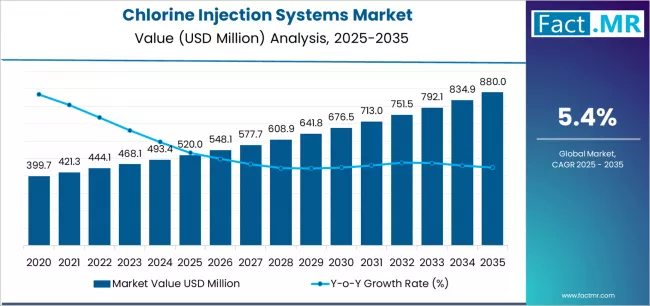
Chlorine Injection Systems Market Market Value Analysis | Source: Fact.MR
Summary of Chlorine Injection Systems Market
- Market Snapshot
- In 2025, the global Chlorine Injection Systems Market was valued at approximately USD 520.0 million.
- The market is estimated to reach USD 548.1 million in 2026 and is projected to attain USD 927.4 million by 2036.
- The chlorine injection systems market is likely to expand at a CAGR of 5.4% during the forecast period.
- The market is anticipated to create an absolute dollar opportunity of USD 379.3 million between 2026 and 2036.
- Electrochlorination Systems accounts for 36.5% of product type share in 2026.
- India (6.8%) and China (6.2%) are the key growth markets during the forecast period.
- Demand and Growth Drivers
- Tightening drinking water disinfection standards across developed and developing markets represent the most durable d...
- On-site electrochlorination systems, which generate sodium hypochlorite from salt and water, are capturing market sha...
- Chlorine injection demand from industrial water treatment is expanding as cooling water management, process water dis...
- Automated chlorine injection systems now account for 57.
- Government-backed water infrastructure programs in India, Brazil, China, and Southeast Asia represent the fastest-gro...
- Product and Segment View
- Electrochlorination Systems accounts for 36.5% of product share in 2026.
- Injection Equipment accounts for 33.8% of component share in 2026.
- Water Treatment accounts for 42.7% of application share in 2026.
- Key segmentation includes:
- Product: Electrochlorination Systems
- Component: Injection Equipment
- Application: Water Treatment
- Enduse: Municipal Water Treatment Facilities
- Technology: Automated Chlorine Injection Systems
- Operation: Continuous Injection Systems
- Geography and Competitive Outlook
- Regulatory compliance drives municipal procurement for upgrades and replacements.
- Strict water quality standards drive ongoing compliance-based procurement.
- Government water infrastructure programs drive large-volume procurement.
- India (6.8%) and China (6.2%) are the key growth markets.
- Some of the major players in this market are Evoqua Water Technologies LLC, Veolia Water Technologies, Xylem Inc., De Nora S.p.A., Thames Water Solutions Ltd., and Kurita Water Industries Ltd..
- Analyst Opinion
- Shambhu Nath Jha, Principal Consultant at Fact.MR, says 'The chlorine injection systems market is transitioning from a hardware procurement model to an integrated disinfection services model. Municipal and industrial buyers are increasingly evaluating vendors on their ability to deliver reliable dosing with minimal operational burden, not just equipment specifications. Vendors that combine automated equipment with chemical supply management, remote monitoring, and predictive maintenance services will capture the highest-value segments. The growth opportunity in emerging markets is substantial, but suppliers must adapt their product and service models to local infrastructure realities rather than simply exporting developed-market specifications.'
Key Growth Drivers, Constraints, and Opportunities
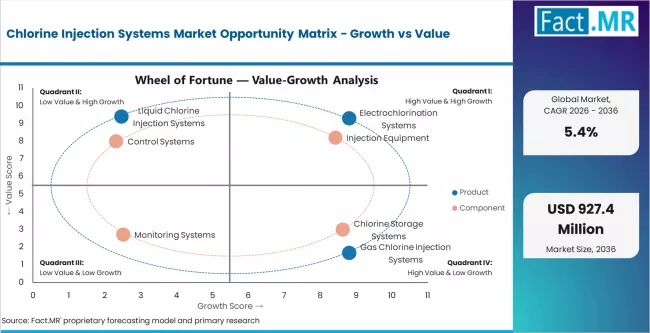
Chlorine Injection Systems Market Opportunity Matrix Growth Vs Value | Source: Fact.MR
Key Factors Driving Growth
- Tightening drinking water disinfection standards across developed and developing markets represent the most durable demand driver for chlorine injection systems.
- On-site electrochlorination systems, which generate sodium hypochlorite from salt and water, are capturing market share from gas chlorination in applications where chlorine gas storage and handling pose safety risks.
- Chlorine injection demand from industrial water treatment is expanding as cooling water management, process water disinfection, and wastewater compliance requirements grow across manufacturing, food processing, and chemical industries.
Key Market Constraints
- Price pressure from competitive alternatives and cost-sensitive buyers affects margins in entry-level segments.
- Supply chain concentration and material availability create procurement uncertainties in certain product categories.
- Regulatory compliance complexity and regional specification differences increase market entry costs.
Key Opportunity Areas
- Automated chlorine injection systems now account for 57.
- Government-backed water infrastructure programs in India, Brazil, China, and Southeast Asia represent the fastest-growing demand source for chlorine injection systems.
- Chlorine injection system manufacturers are increasingly pursuing recurring revenue models that bundle system supply with chemical delivery contracts, maintenance agreements, and monitoring services.
Segment-wise Analysis of the Chlorine Injection Systems Market
- Electrochlorination Systems accounts for 36.5% of the product segment in 2026.
- Injection Equipment accounts for 33.8% of the component segment in 2026.
- Water Treatment accounts for 42.7% of the application segment in 2026.
The chlorine injection systems market is segmented by product, component, application, enduse, technology, operation, and region. Electrochlorination Systems leads by value in the near term, while Continuous Injection Systems in operation is expected to shape medium-term growth as specifications evolve and application requirements expand.
Which Product Segment Dominates the Chlorine Injection Systems Market?
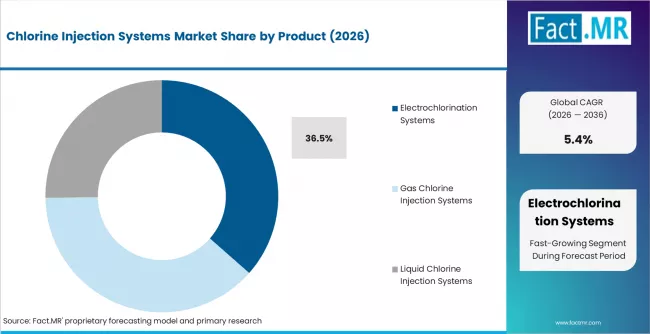
Chlorine Injection Systems Market Analysis By Product | Source: Fact.MR
Electrochlorination Systems accounts for 36.5% of the product segment in 2026. This leadership is supported by strong demand fundamentals, established buyer preference, and application depth across major end-use categories. The segment benefits from a combination of performance characteristics, price accessibility, and compatibility with existing infrastructure that sustains its leading position in both mature and emerging markets.
The segment is expected to maintain its leading position through the forecast period as demand patterns continue to favor established formats with proven operational track records. Buyer procurement criteria in the highest-volume applications prioritize reliability, specification compliance, and total cost of ownership, all of which favor this segment's continued market share leadership.
Which Component Segment Dominates the Chlorine Injection Systems Market?
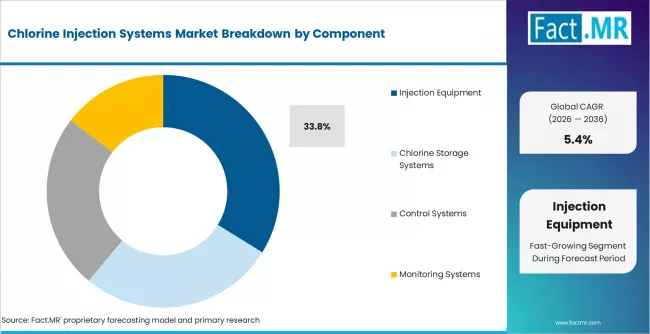
Chlorine Injection Systems Market Analysis By Component | Source: Fact.MR
Injection Equipment accounts for 33.8% of the component segment in 2026. This leadership is supported by strong demand fundamentals, established buyer preference, and application depth across major end-use categories. The segment benefits from a combination of performance characteristics, price accessibility, and compatibility with existing infrastructure that sustains its leading position in both mature and emerging markets.
The segment is expected to maintain its leading position through the forecast period as demand patterns continue to favor established formats with proven operational track records. Buyer procurement criteria in the highest-volume applications prioritize reliability, specification compliance, and total cost of ownership, all of which favor this segment's continued market share leadership.
Which Product Trend is Shaping the Next Phase of Growth in the Chlorine Injection Systems Market?
Chlorine injection system manufacturers are increasingly pursuing recurring revenue models that bundle system supply with chemical delivery contracts, maintenance agreements, and monitoring services. This approach is particularly effective in municipal applications where utilities prefer predictable operating expenditure over capital procurement. Service-linked models also improve customer retention and create barriers to competitive displacement. Vendors that offer chemical supply management alongside equipment are achieving 20% to 30% higher lifetime customer value compared to hardware-only sales.
This shift reflects a broader change in buyer expectations and operational priorities. As specifications evolve and application requirements expand, this trend is expected to create new competitive differentiation points and reshape market dynamics across both established and emerging regional markets.
Regional Outlook Across Key Markets
.webp "Top Country Growth Comparison Chlorine Injection Systems Market Cagr (2026 2036)")
Top Country Growth Comparison Chlorine Injection Systems Market Cagr (2026 2036) | Source: Fact.MR
- North America: Regulatory compliance drives municipal procurement for upgrades and replacements.
- Europe: Strict water quality standards drive ongoing compliance-based procurement.
- Asia Pacific: Government water infrastructure programs drive large-volume procurement.
CAGR Table
| Country | CAGR (%) |
|---|---|
| India | 6.8% |
| China | 6.2% |
| USA | 4.6% |
| Brazil | 4.5% |
| Germany | 4.2% |
Source: Fact.MR analysis. Updated May 18, 2026
Source: Fact MR (FMR) analysis, based on proprietary forecasting model and primary research.
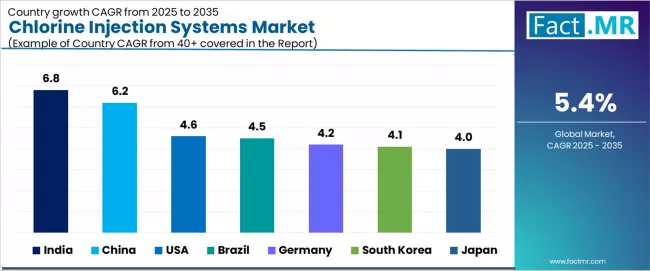
Chlorine Injection Systems Market Cagr Analysis By Country | Source: Fact.MR
Chlorine Injection System Demand Trends in India
The India chlorine injection systems market is projected to grow at a CAGR of 6.8% through 2036, making it the fastest-growing country in the study. Demand is shaped by government water infrastructure programs, expanding municipal treatment capacity, and growing industrial water treatment requirements across food processing and manufacturing.
- Government water infrastructure programs drive large-scale procurement.
- Municipal treatment capacity expansion creates concentrated demand.
- Industrial water treatment growth in food processing supports market widening.
China Chlorine Injection Systems Market Growth Outlook
The China chlorine injection systems market is projected to grow at a CAGR of 6.2% through 2036. Demand is supported by municipal water treatment expansion, industrial water compliance requirements, and growing adoption of automated disinfection systems. Domestic manufacturing capability is increasing competitive pressure on imported systems.
- Municipal water treatment expansion sustains core demand.
- Industrial water compliance drives automated system adoption.
- Domestic manufacturing is intensifying competitive dynamics.
Market Outlook for Chlorine Injection Systems in the United States
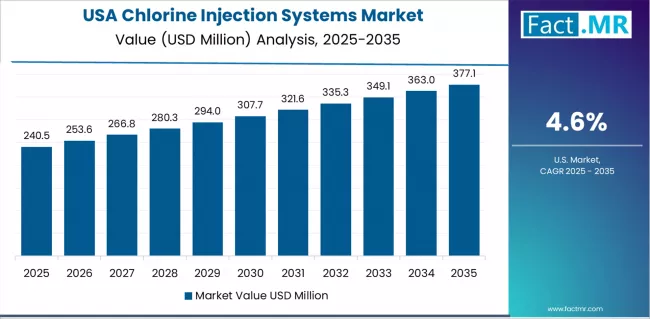
Chlorine Injection Systems Market Country Value Analysis | Source: Fact.MR
The USA chlorine injection systems market is projected to grow at a CAGR of 4.6% through 2036. The market is mature, with replacement and compliance-upgrade cycles driving procurement. The shift from gas chlorination to electrochlorination continues in municipal applications, and industrial water treatment provides incremental demand.
- Replacement and compliance upgrades form the primary demand cycle.
- Electrochlorination is displacing gas chlorination in municipal applications.
- Industrial water treatment sustains incremental procurement demand.
Brazil Chlorine Injection Systems Market Opportunity Analysis
The Brazil chlorine injection systems market is projected to grow at a CAGR of 4.5% through 2036. Demand is driven by water infrastructure investment, expanding municipal treatment coverage, and industrial water compliance requirements. Government sanitation programs support multi-year procurement pipelines.
- Water infrastructure investment drives new treatment system installations.
- Government sanitation programs provide multi-year procurement visibility.
- Industrial water compliance supports demand beyond municipal applications.
Germany Chlorine Injection Systems Market Demand Analysis
The Germany chlorine injection systems market is projected to grow at a CAGR of 4.2% through 2036. Demand is shaped by compliance-driven replacement cycles, water reuse applications, and industrial water treatment requirements. German manufacturers maintain strong positions in automated, precision dosing systems.
- Compliance-driven replacement cycles sustain procurement demand.
- Water reuse regulations create new application requirements.
- German manufacturers lead in automated precision dosing systems.
Competitive Benchmarking and Company Positioning
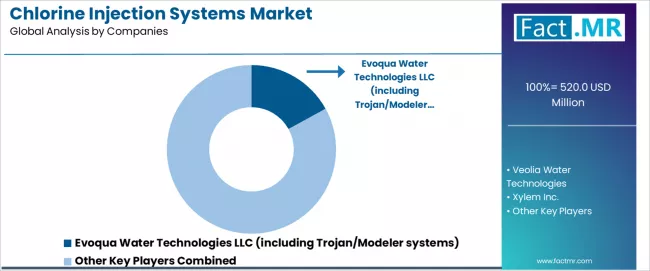
Chlorine Injection Systems Market Analysis By Company | Source: Fact.MR
Chlorine Injection Systems Market Analysis By Company
- Evoqua Water Technologies, Veolia Water Technologies, Xylem, and De Nora hold established positions in the global chlorine injection systems market through broad water treatment portfolios, application engineering depth, and global service networks spanning municipal and industrial end uses.
- Kurita Water Industries, Suez, Grundfos, ProMinent, and Hach maintain positions through regional strength, component specialization, and monitoring technology integration.
- Competition is shaped by application engineering capability, automation integration, and the ability to deliver complete disinfection solutions including equipment, monitoring, and chemical supply management. Vendors with electrochlorination capabilities are gaining share in safety-sensitive applications, while those with strong SCADA integration are winning in industrial and large-municipal tenders. Service-linked business models are creating differentiation among vendors competing for recurring revenue.
Competition is shaped by application engineering capability, automation integration, and the ability to deliver complete disinfection solutions including equipment, monitoring, and chemical supply management. Vendors with electrochlorination capabilities are gaining share in safety-sensitive applications, while those with strong SCADA integration are winning in industrial and large-municipal tenders. Service-linked business models are creating differentiation among vendors competing for recurring revenue.
Key Companies in the Chlorine Injection Systems Market
Evoqua Water Technologies LLC, Veolia Water Technologies, Xylem Inc., De Nora S.p.A..
Thames Water Solutions Ltd., Kurita Water Industries Ltd., Suez S.A., Atlantium Technologies Ltd..
Siemens Water Technologies Corp., Grundfos A/S, ProMinent GmbH, Hach Company.
Recent Industry Developments
- Evoqua Water Technologies – Product Enhancement / Electrochlorination System Upgrade (2025)
- Evoqua introduced an upgraded electrochlorination system with improved energy efficiency and integrated remote monitoring for municipal water treatment applications. The upgrade supports the ongoing transition from gas chlorination to on-site generation in safety-sensitive environments.
- Xylem Inc. – Market Expansion / Industrial Water Treatment Portfolio (2025)
- Xylem expanded its chlorine injection portfolio to address growing industrial water treatment demand, with systems designed for cooling water management and process water disinfection in food processing and manufacturing applications.
- De Nora S.p.A. – Technology Launch / On-Site Chlorine Generation (2026)
- De Nora launched a new on-site sodium hypochlorite generation system for municipal and industrial applications, reducing chemical transport requirements and improving dosing precision. The launch supports growing demand for on-site generation solutions.
Leading Companies Shaping the Chlorine Injection Systems Market
- Evoqua Water Technologies LLC
- Veolia Water Technologies
- Xylem Inc.
- De Nora S.p.A.
- Thames Water Solutions Ltd.
- Kurita Water Industries Ltd.
- Suez S.A.
- Atlantium Technologies Ltd.
- Siemens Water Technologies Corp.
- Grundfos A/S
Sources and Research References
- Evoqua Water Technologies LLC. Product portfolio and market activity updates.
- Veolia Water Technologies. Technology and product development announcements.
- Xylem Inc.. Product and market expansion updates.
- Industry association statistics, regulatory publications, trade data, customs databases, and company product catalogs.
- Primary interviews with manufacturers, distributors, system integrators, and end users.
This bibliography is provided for reader reference and is not exhaustive. The full report contains the complete reference list and detailed citations.
Key Questions This Report Addresses
- What is the current and future size of the Chlorine Injection Systems Market?
- How fast is the Chlorine Injection Systems Market expected to grow between 2026 and 2036?
- Which product type is likely to lead the market by 2026?
- Which application segment is expected to account for the highest demand by 2026?
- What factors are driving demand globally?
- How is technology evolution influencing the market?
- Why are India and China emerging as the fastest-growing markets?
- Which countries are projected to show the fastest growth through 2036?
- Who are the key companies active in the Chlorine Injection Systems Market?
- How does Fact.MR estimate and validate the market forecast?
Chlorine Injection Systems Market Definition
The chlorine injection systems market covers the global and regional market for chlorine injection systems products and systems used across technology and operation categories. It includes analysis across product type, application, end use, and regional demand patterns.
Chlorine Injection Systems Market Inclusions
- The scope covers global and regional market size and forecasts for 2026 to 2036 across product, component, application, enduse, technology, operation, and region.
- It includes regional demand analysis across major geographies, based on factors such as industrial activity, end-use application demand, regulatory conditions, and infrastructure investment.
- The report includes pricing and cost analysis across entry-level, mid-range, and premium products, including component costs and operational expenditure considerations.
- It covers technology trends, market drivers and constraints, and the competitive landscape, including product portfolios, pricing strategy, geographic reach, and distribution expansion of leading players.
Chlorine Injection Systems Market Exclusions
- The scope excludes products and systems not classified within the chlorine injection systems category or those serving fundamentally different end-use applications.
- It excludes software-only solutions, standalone analytics platforms, and services sold independently without associated hardware or system components.
- The report excludes custom-built, non-commercial, and prototype-stage systems without established market presence or commercial sales records.
Chlorine Injection Systems Market Research Methodology
- The methodology combines secondary research, primary interviews, and forecast modelling.
- It draws on 120+ secondary sources and benchmarks 65+ company product portfolios.
- Market sizing covers 30+ countries through a demand-side model, supported by top-down validation.
- Key inputs include end-use application demand, regulatory conditions, infrastructure investment patterns, and product adoption trends.
- The model cross-checks demand with shipments, pricing trends, channel mix, and product launches.
- Primary validation includes 25+ interviews across manufacturers, distributors, and end users.
- Final estimates go through trade-flow checks, sales-pattern review, and sensitivity testing.
Segmentation
Scope of Analysis
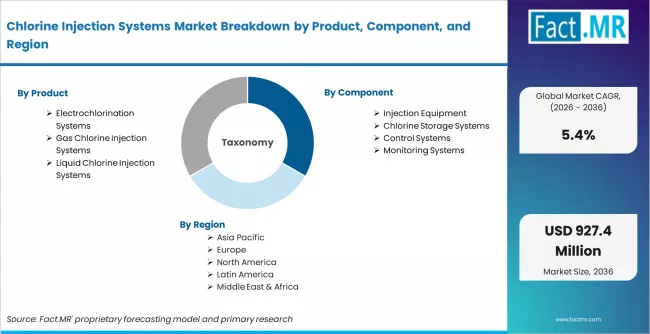
Chlorine Injection Systems Market Breakdown By Product, Component, And Region | Source: Fact.MR
| Parameter | Details |
|---|---|
| Quantitative Units | USD 548.1 million to USD 927.4 million, at a CAGR of 5.4% |
| Market Definition | The Chlorine Injection Systems Market covers products and systems used across product, component, application, enduse, technology, operation, and regional categories. |
| Regions Covered | North America, Latin America, Europe, East Asia, South Asia and Pacific, Middle East and Africa |
| Countries Covered | India, China, USA, Brazil, Germany, South Korea, Japan, 30 plus countries |
| Key Companies | Evoqua Water Technologies LLC, Veolia Water Technologies, Xylem Inc., De Nora S.p.A., Thames Water Solutions Ltd., Kurita Water Industries Ltd., Suez S.A., Atlantium Technologies Ltd., Siemens Water Technologies Corp., Grundfos A/S |
| Forecast Period | 2026 to 2036 |
| Approach | Hybrid demand-side and top-down methodology built on country-level application demand, product benchmarking, pricing analysis, shipment validation, and primary interviews across manufacturers, distributors, and end users |
Source: Fact.MR analysis. Updated May 18, 2026
Chlorine Injection Systems Market Segmentation
-
Chlorine Injection Systems Market Segmented by Product:
- Electrochlorination Systems
- Gas Chlorine Injection Systems
- Vacuum Feed Chlorination Systems
- Pressurized Gas Injection Systems
- Liquid Chlorine Injection Systems
- Sodium Hypochlorite Injection Systems
- Calcium Hypochlorite Injection Systems
-
Chlorine Injection Systems Market Segmented by Component:
- Injection Equipment
- Metering Pumps
- Injectors
- Diffusers
- Chlorine Storage Systems
- Cylinders
- Bulk Storage Tanks
- Control Systems
- PLC Based Controllers
- SCADA Integrated Systems
- Monitoring Systems
- Chlorine Sensors
- Residual Chlorine Analyzers
- pH And ORP Sensors
- Injection Equipment
-
Chlorine Injection Systems Market Segmented by Application:
- Water Treatment
- Drinking Water Disinfection
- Wastewater Treatment
- Industrial Water Treatment
- Cooling Water Treatment
- Process Water Treatment
- Swimming Pool Disinfection
- Food Processing Sanitation
- Packaging Line Sanitation
- Surface Disinfection
- Water Treatment
-
Chlorine Injection Systems Market Segmented by End Use:
- Municipal Water Treatment Facilities
- Residential Water Treatment Systems
- Industrial Water Treatment Plants
- Industrial Sector
- Chemical Industry
- Food And Beverage Industry
- Pulp And Paper Industry
- Commercial Facilities
- Swimming Pools
- Hospitality Facilities
- Municipal Water Treatment Facilities
-
Chlorine Injection Systems Market Segmented by Technology:
- Automated Chlorine Injection Systems
- Manual Chlorine Injection Systems
- Disinfection Technology
- Continuous Chlorination
- Batch Chlorination
-
Chlorine Injection Systems Market Segmented by Operation Mode:
- Continuous Injection Systems
- Batch Injection Systems
-
Chlorine Injection Systems Market by Region:
- North America
- USA
- Canada
- Mexico
- Latin America
- Brazil
- Chile
- Rest of Latin America
- Western Europe
- Germany
- UK
- Italy
- Spain
- France
- Nordic
- BENELUX
- Rest of Western Europe
- Eastern Europe
- Russia
- Poland
- Hungary
- Balkan & Baltic
- Rest of Eastern Europe
- East Asia
- China
- Japan
- South Korea
- South Asia and Pacific
- India
- ASEAN
- Australia & New Zealand
- Rest of South Asia and Pacific
- Middle East & Africa
- Kingdom of Saudi Arabia
- Other GCC Countries
- Turkiye
- South Africa
- Other African Union
- Rest of Middle East & Africa
- North America
Frequently Asked Questions
How big is the chlorine injection systems market in 2025?
What will be the size of the chlorine injection systems market in 2036?
How much will the chlorine injection systems market grow between 2026 and 2036?
What are the key product types in the chlorine injection systems market?
Which segment will contribute significant share in the chlorine injection systems market in 2026?
Which are the fastest-growing countries in the chlorine injection systems market?
Who are the key companies in the chlorine injection systems market?
Who worked on this report


Preview the report firsthand - request a free sample
Free SampleGet the brochure for pricing and purchase details
Download PDF