Solar Lighting Systems Market Size, Share, Growth and Forecast (2026 - 2036)

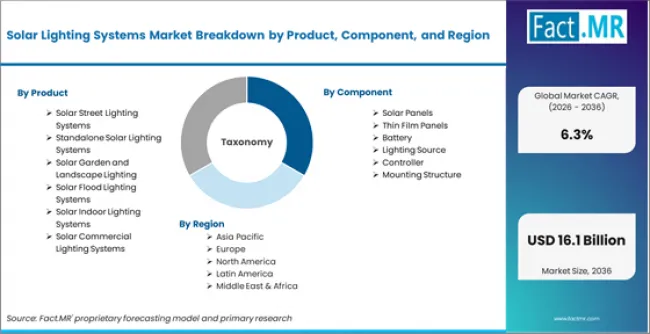
Solar Lighting Systems Market is segmented by Product (Solar Street Lighting Systems, Standalone Solar Lighting Systems, Solar Garden and Landscape Lighting, Solar Flood Lighting Systems, Solar Indoor Lighting Systems, Solar Commercial Lighting Systems), Component (Solar Panels, Thin Film Panels, Battery, Lighting Source, Controller, Mounting Structure), Application (Public Infrastructure, Residential, Commercial, Industrial, Rural and Off Grid Areas), and Region, with forecasts covering the period from 2026 to 2036.

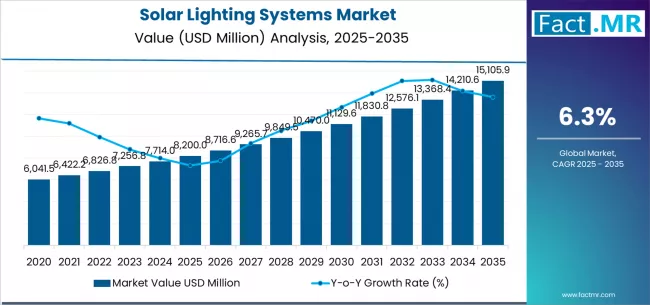
According to Fact.MR estimates, the global solar lighting systems Market was valued at USD 8.2 billion in 2025. The market is projected to reach USD 8.7 billion in 2026 and is expected to grow to USD 16.1 billion by 2036, expanding at a CAGR of 6.3%. Solar Street Lighting Systems is anticipated to account for 38.2% of the product segment in 2026, while Solar Panels is expected to remain the leading application with around 34.6% share.

Solar Lighting Systems Market Analysis and Forecast by Fact.MR

  • The global solar lighting systems market is estimated at USD 8.717 billion in 2026 and is forecast to expand at a CAGR of 6.3% to reach USD 16.058 billion by 2036.
  • Solar lighting systems encompass off-grid and hybrid solar-powered luminaires for street, highway, park, and campus applications.
  • Integrated and semi-integrated designs combine solar panels, LED fixtures, batteries, and charge controllers in compact units that eliminate grid connection requirements.
  • Government smart city programs, municipal energy cost reduction targets, and rural electrification initiatives are accelerating deployment.
  • Advances in lithium battery storage, motion-sensing controls, and connected lighting management platforms are improving system economics and extending autonomous operation.
Solar Lighting Systems Market  Value Analysis

Summary of the Solar Lighting Systems Market

  • Market Snapshot
    • In 2025, the global Solar Lighting Systems Market was valued at approximately USD 8.2 billion.
    • The market is estimated to reach USD 8.717 billion in 2026 and is projected to attain USD 16.058 billion by 2036.
    • The solar lighting systems market is likely to expand at a CAGR of 6.3% during the forecast period.
    • The market is anticipated to create an absolute dollar opportunity of USD 7.341 billion between 2026 and 2036.
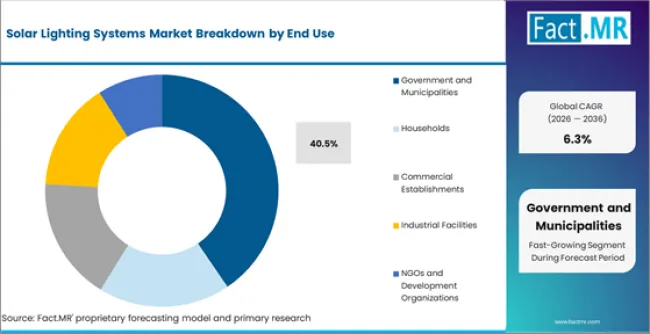
    • Government and Municipalities accounts for 40.5% of the end use segment share in 2026.
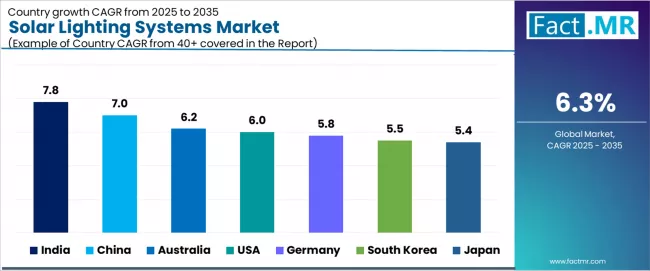
    • India (7.8%) and China (7.0%) are the key growth markets during the forecast period.
  • Demand and Growth Drivers
    • Municipal street lighting modernization programs are shifting procurement budgets from grid-connected fixtures to solar-powered alternatives that eliminate electricity costs and reduce installation complexity by removing trenching and cabling requirements.
    • Smart city infrastructure investments are creating procurement pipelines for connected solar lighting systems with IoT sensors, remote monitoring, and adaptive brightness controls that respond to pedestrian and traffic activity.
    • Rural and peri-urban electrification gaps in developing markets are driving demand for solar street lights that provide public safety illumination without grid extension, particularly across India, Sub-Saharan Africa, and Southeast Asia.
    • Declining LED and lithium battery costs are improving solar lighting system economics, reducing payback periods below 3 years in high-irradiance markets and making solar lighting cost-competitive with grid-connected alternatives.
    • Climate resilience planning is favoring off-grid solar lighting that continues operating during grid outages, particularly in hurricane-prone and disaster-vulnerable regions.
  • Product and Segment View
    • Solar street lighting systems account for 38.2% of the product segment in 2026, with integrated all-in-one units gaining share on installation simplicity and declining component costs.
    • Government and municipalities represent 40.5% of end-use demand in 2026, reflecting structured procurement through smart city budgets and public infrastructure modernization programs.
    • New installations hold 63.8% of the installation segment, driven by greenfield infrastructure and smart city projects.
  • Key segmentation includes:
    • Product: Solar Street Lights, Integrated Solar Lights, Semi-Integrated, All-In-One, Standalone Solar Lights
    • Component: Solar Panels, Battery, LED Fixtures, Charge Controllers
    • Application: Public Infrastructure, Street Lighting, Highways, Parks, Residential
    • End Use: Government, Smart City Projects, Households, Commercial
    • These systems enable:
      • Off-grid public lighting for streets, highways, parks, and campuses without grid connection or trenching requirements
      • Connected lighting management through IoT sensors enabling remote monitoring, adaptive brightness, and motion-triggered illumination
      • Autonomous multi-night operation through integrated lithium battery storage and intelligent charge management
  • Geography and Competitive Outlook
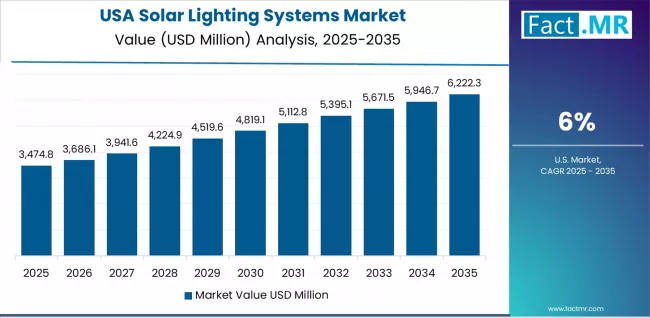
    • North America holds significant value, with the U.S. at USD 3.011 billion in 2026, supported by municipal energy cost reduction programs, smart city initiatives, and climate resilience infrastructure investment.
    • Asia Pacific leads by growth, with India (7.8%) and China (7.0%) supported by Smart Cities Mission deployment, rural electrification programs, and domestic manufacturing cost advantages.
    • Europe shows steady adoption, with Germany (5.8%) supported by EU Green Deal municipal lighting targets and growing deployment of hybrid solar luminaires in urban parks and pedestrian zones.
    • Key companies include Signify, Osram, Acuity Brands, SolarOne, Sunna Design.
  • Analyst Opinion
    • Shambhu Nath Jha, Principal Consultant at Fact.MR, says 'The solar lighting market is transitioning from a rural electrification solution to a mainstream municipal lighting category. Smart city programs are creating structured procurement for connected solar systems that combine lighting with environmental sensing, traffic monitoring, and pedestrian safety features. Manufacturers offering integrated, IoT-enabled platforms with proven multi-night autonomy and remote management capability are capturing the highest-value municipal contracts.'

Key Growth Drivers, Constraints, and Opportunities
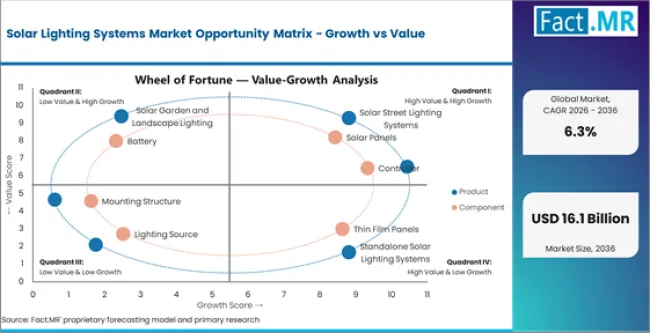
Solar Lighting Systems Market Opportunity Matrix Growth Vs Value

Key Factors Driving Growth

  • Smart city programs with dedicated lighting modernization budgets are creating multi-year procurement pipelines for connected solar lighting systems, with municipalities specifying IoT-enabled platforms that combine illumination with environmental sensing and public safety monitoring.
  • Rural electrification gaps across India, Sub-Saharan Africa, and Southeast Asia are generating high-volume deployment opportunities for solar street lights that provide safety lighting without grid infrastructure investment.
  • Municipal energy cost reduction targets are accelerating the shift from grid-connected to solar lighting, with off-grid systems eliminating recurring electricity costs and delivering lifecycle savings that justify the higher upfront investment.

Key Market Constraints

  • High upfront costs compared to conventional grid-connected LED fixtures create procurement resistance in budget-constrained municipalities, particularly where grid electricity is subsidized and operational cost savings are less apparent.
  • Battery degradation and replacement requirements after 5 to 7 years add lifecycle cost considerations that are not always reflected in initial procurement comparisons, particularly in extreme temperature environments.
  • Inconsistent solar irradiance in high-latitude and overcast climates limits multi-night autonomy, requiring hybrid grid-solar configurations that partially offset the off-grid installation advantage.

Key Opportunity Areas

  • Hybrid solar-grid lighting systems that draw partial grid power during low-irradiance periods are expanding the addressable market into northern European, Japanese, and other high-latitude markets where pure off-grid systems face autonomy limitations.
  • EV charging integration into solar street light poles is creating a dual-function infrastructure product that serves both lighting and electric vehicle charging in public parking and roadside applications.
  • Connected lighting platforms that combine solar lighting with air quality sensors, pedestrian counters, and emergency communication are creating premium smart city product tiers that command higher margins than standard lighting.

Segment-wise Analysis of the Solar Lighting Systems Market

  • Solar street lighting systems hold 38.2% of the product segment in 2026, with integrated all-in-one designs gaining share on installation simplicity.
  • Government procurement accounts for 40.5% of end-use demand, with smart city programs and public infrastructure budgets as the primary channels.
  • Solar panels represent 34.6% of the component segment, with monocrystalline panels dominating on conversion efficiency per unit area.

The solar lighting systems market is segmented by product type, component, application, end use, installation type, and region. Solar street lighting leads by value, with integrated all-in-one designs growing fastest on installation simplicity. Government procurement dominates, while residential adoption is expanding in markets with unreliable grid supply.

Which Product Segment Dominates the Solar Lighting Systems Market?
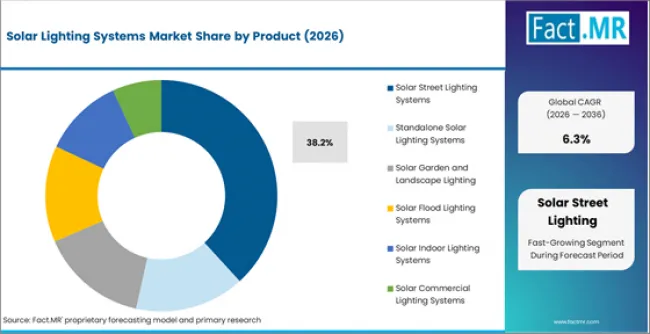
Solar Lighting Systems Market Analysis By Product

Solar street lighting systems account for 38.2% of the product segment in 2026. Integrated all-in-one designs that combine panel, battery, LED, and controller in a single pole-mounted unit are growing fastest because they eliminate separate component installation and reduce deployment time to under 30 minutes per fixture.

Standalone solar lighting systems serve larger-scale highway and infrastructure applications where higher lumen output and larger battery capacity are required. Semi-integrated designs with separate solar panels maintain relevance in installations where panel orientation flexibility is needed for optimal energy capture.

Which End-Use Segment Dominates the Solar Lighting Systems Market?
Solar Lighting Systems Market Analysis By End Use

Government and municipalities lead with a 40.5% share in 2026, driven by smart city infrastructure budgets, public safety lighting mandates, and municipal energy cost reduction programs that favor off-grid solar solutions.

Residential adoption is growing in markets with unreliable grid supply, where solar lighting provides consistent illumination independent of power outages. Commercial applications in parking lots, campuses, and private developments are also expanding.

Which Product Trend is Shaping the Next Phase of Growth in the Solar Lighting Systems Market?

Connected solar lighting platforms with integrated IoT sensors are the technology trend reshaping municipal procurement specifications. These systems combine solar-powered illumination with motion detection, adaptive brightness control, environmental sensing, and remote management through cloud-based platforms. Municipalities are increasingly specifying connected capabilities as standard requirements in lighting tenders, creating a premium product tier that displaces basic solar fixtures.

The connected platform approach also creates recurring software service revenue for manufacturers through lighting management subscriptions, data analytics, and system health monitoring. This shifts the competitive basis from hardware-only pricing to platform value, favoring manufacturers with strong software capabilities and municipal deployment track records over commodity fixture suppliers.

Regional Outlook Across Key Markets

Top Country Growth Comparison Solar Lighting Systems Market Cagr (2026 2036)

  • India leads at 7.8%, supported by Smart Cities Mission procurement, Gram Panchayat rural lighting programs, and domestic manufacturing capacity that supports cost-competitive deployment at scale.
  • China (7.0%) reflects strong domestic demand from urban renewal programs and Belt and Road infrastructure lighting, combined with globally competitive manufacturing that supplies both domestic and export markets.
  • The U.S. (6.0%) shows growth from municipal modernization, climate resilience investment, and smart city programs specifying connected solar lighting with IoT sensor integration.

CAGR Table

Country CAGR (%)
India 7.8%
China 7.0%
Australia 6.2%
USA 6.0%
Germany 5.8%
South Korea 5.5%
Japan 5.4%

Source: Fact MR (FMR) analysis, based on proprietary forecasting model and primary research.
Solar Lighting Systems Market Cagr Analysis By Country

Solar Lighting Demand Trends in India

Smart Cities Mission procurement and Gram Panchayat rural lighting programs are creating multi-year deployment pipelines at 7.8% CAGR. India's domestic solar lighting manufacturing base supports cost-competitive deployment across municipal, highway, and rural electrification applications.

  • Smart Cities Mission tenders specify connected solar lighting with remote management, creating structured procurement for IoT-enabled systems.
  • Gram Panchayat rural lighting schemes generate high-volume orders for basic solar street lights in villages without reliable grid access.

China Solar Lighting Systems Growth Assessment

Domestic manufacturing scale and Belt and Road infrastructure projects position China at 7.0% CAGR. Urban renewal programs in second and third-tier cities are replacing conventional lighting with solar-powered alternatives to reduce municipal electricity costs.

  • Belt and Road infrastructure lighting projects create export demand for Chinese-manufactured solar street lights across Southeast Asia and Africa.
  • Urban renewal programs in provincial cities are converting park, campus, and pedestrian zone lighting to integrated solar systems.

Market Outlook for Solar Lighting in the United States
Solar Lighting Systems Market Country Value Analysis

Municipal energy cost reduction and smart city infrastructure programs drive demand at 6.0% CAGR. Climate resilience planning is accelerating adoption of off-grid solar lighting that maintains operation during grid outages from extreme weather events.

  • Smart city programs specify connected solar platforms with environmental sensors and remote management in municipal lighting tenders.
  • Climate resilience requirements in hurricane and wildfire-prone regions favor off-grid solar systems that operate independently during grid disruptions.

Germany Solar Lighting Systems Demand Analysis

EU Green Deal municipal targets and growing hybrid solar deployment in urban parks drive demand at 5.8% CAGR. Hybrid solar-grid luminaires that draw partial grid power during low-irradiance winter months are enabling deployment in higher-latitude locations.

  • EU sustainable urban mobility plans specify solar-powered lighting for pedestrian zones, cycle paths, and park areas.
  • Hybrid solar-grid technology addresses northern European irradiance limitations, expanding addressable deployment beyond pure off-grid applications.

Australia Solar Lighting Growth Outlook

Strong solar irradiance and municipal cost reduction targets support adoption at 6.2% CAGR. High average daily solar hours across most of the continent provide favorable conditions for multi-night autonomous operation of off-grid solar lighting systems.

  • High solar irradiance enables 3 to 5-night autonomous operation for off-grid systems, maximizing grid-independence advantages.
  • Local government climate action plans include solar lighting conversion targets for parks, pathways, and rural roads.

Competitive Benchmarking and Company Positioning
Solar Lighting Systems Market Analysis By Company

Solar Lighting Systems Market Analysis By Company

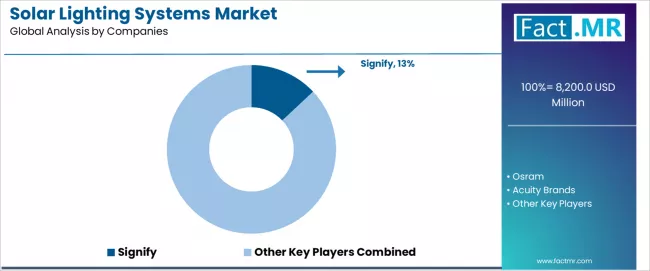
  • Signify holds the strongest competitive position through its SunStay platform, Interact City connected management, and established municipal project relationships across Europe, Asia, and the Americas.
  • Sunna Design, Sol Inc., and SolarOne compete through dedicated solar lighting focus, off-grid system specialization, and deployment track records in African, Asian, and Latin American markets.
  • Connected platform capability and municipal project reference lists are the primary competitive differentiators, with manufacturers offering proven IoT-enabled systems capturing premium tender awards.

The landscape is moderately fragmented, with Signify leading through its SunStay solar platform and Interact City management system that combine lighting with smart city sensor integration. Acuity Brands and Osram maintain positions through broader outdoor lighting portfolios.

Sunna Design, Sol Inc., Greenshine, and Gama Sonic compete as solar lighting specialists, with particular strength in off-grid applications across developing markets. Tata Power Solar and Havells hold strong positions in the Indian market through domestic manufacturing and government tender experience.

Strategic priorities include expanding connected platform capabilities, improving battery autonomy for high-latitude markets, developing hybrid solar-grid systems, and strengthening municipal procurement relationships through pilot deployments and performance guarantees.

Key Companies in the Solar Lighting Systems Market

  • Signify, Osram, Acuity Brands, SolarOne are among the leading players in the solar lighting systems market globally, supported by strong brand visibility, broad service portfolios, and growing positions in managed energy solutions.
  • Sunna Design, Solektra, Jiawei, Philips Lighting hold established positions across specific service segments, end-use categories, and regional markets, supported by specialized capabilities and established commercial relationships.
  • Greenshine, Sol Inc., ENGOPLANET, Exide Energy continue to compete through focused offerings, technology partnerships, and regional service networks.

Recent Industry Developments

  • Signify, Product Launch, SunStay Pro Gen2 Solar Street Lights (September 2025)
    • Signify launched the SunStay Pro gen2 and SunStay Pro gen2 mini connected solar street lights, featuring hybrid charging that operates off-grid on sunny days and draws partial grid power during overcast periods. The compact mini model uses 80% recycled aluminium housing and includes motion-sensing and forward-triggering brightness control.
  • Signify, Project Deployment, Edinburgh Solar Hybrid Lighting (January 2026)
    • Signify deployed SunStay Gen2 Hybrid solar luminaires in Edinburgh parks with outdoor multisensors connected through Interact City. The system operates at 20% brightness when paths are empty and increases automatically when people approach, demonstrating smart solar lighting for public safety in a northern European climate.
  • Signify, Strategic Focus, Solar Product Line Expansion (2026)
    • Signify announced intensified efforts on its solar product line in 2026, focusing on expanding municipal trade and project deployments with improved and more market-appealing solar solutions designed based on user research and field feedback from actual deployment conditions.

Leading Companies Shaping the Solar Lighting Systems Market

  • Signify
  • Osram
  • Acuity Brands
  • SolarOne
  • Sunna Design
  • Solektra
  • Jiawei
  • Philips Lighting
  • Greenshine
  • Sol Inc.

Sources and Research References

  • Signify. SunStay Pro gen2 launch, Edinburgh deployment, and solar product line strategy.
  • Sunna Design. Solar street lighting deployments in Africa and developing markets.
  • International Energy Agency (IEA). Off-grid renewable energy and rural electrification data.
  • World Bank. Smart city and urban infrastructure program data.
  • India Ministry of Housing and Urban Affairs. Smart Cities Mission deployment statistics.
  • Primary interviews across manufacturers, municipal procurement teams, and project developers.
  • This bibliography is provided for reader reference and is not exhaustive.

Key Questions This Report Addresses

  • What is the current and future size of the Solar Lighting Systems Market?
  • How fast is the Solar Lighting Systems Market expected to grow between 2026 and 2036?
  • Which product type leads the market by 2026?
  • Which end-use segment accounts for the highest demand?
  • What drives demand for solar lighting systems?
  • How are connected IoT platforms influencing municipal procurement?
  • Why is India the fastest-growing market?
  • How do hybrid solar-grid systems expand the addressable market?
  • Which countries show the fastest growth through 2036?
  • Who are the key companies in the Solar Lighting Systems Market?
  • How does Fact.MR validate the forecast?

Solar Lighting Systems Market Definition

The solar lighting systems market covers solar-powered outdoor lighting systems for street, highway, park, campus, and residential applications, including integrated, semi-integrated, and standalone configurations.

Solar Lighting Systems Market

  • The scope covers global and regional market size and forecasts for 2026 to 2036 across product type, component, application, end use, installation type, and region.
  • It includes regional demand analysis based on solar irradiance, municipal lighting budgets, smart city programs, and rural electrification targets.
  • The report includes cost analysis across integrated and semi-integrated systems, including system LCOE and payback period benchmarks.
  • It covers technology trends, competitive landscape, product portfolios, and municipal project track records of leading manufacturers.

Solar Lighting Systems Market Exclusions

  • The scope excludes indoor solar lighting, portable solar lanterns below commercial grade, and decorative solar garden lights not designed for public infrastructure use.
  • It excludes grid-connected LED street lights without solar power integration.
  • The report excludes solar panel components sold independently of lighting systems.

Solar Lighting Systems Market Research Methodology

  • The methodology combines secondary research, primary interviews, and forecast modelling.
  • It draws on 110+ secondary sources and benchmarks 45+ company product portfolios.
  • Market sizing covers 30+ countries through a demand-side model supported by top-down validation.
  • Key inputs include municipal lighting inventory, smart city budget allocations, solar irradiance data, and rural electrification targets.
  • The model cross-checks with manufacturer shipments, tender award data, and installation counts.
  • Primary validation includes 25+ interviews across manufacturers, distributors, municipal procurement teams, and project developers.
  • Final estimates go through tender-pipeline reconciliation and sensitivity testing.

Scope of Analysis

Solar Lighting Systems Market Breakdown By Product, Component, And Region

Parameter Details
Quantitative Units USD 8.717 billion to USD 16.058 billion, at a CAGR of 6.3%
Market Definition The solar lighting systems market covers solar-powered outdoor lighting for street, highway, park, and campus applications in integrated, semi-integrated, and standalone configurations.
Regions Covered North America, Latin America, Europe, East Asia, South Asia and Pacific, Middle East and Africa
Countries Covered India, China, Australia, USA, Germany, South Korea, Japan, 30 plus countries
Key Companies Signify, Osram, Acuity Brands, SolarOne, Sunna Design, Solektra, Jiawei, Philips Lighting, Greenshine, Sol Inc.
Forecast Period 2026 to 2036
Approach Hybrid demand-side and top-down methodology built on municipal lighting inventories, smart city budgets, solar irradiance data, tender pipelines, manufacturer shipments, and primary interviews across manufacturers, municipal procurement teams, and project developers

Solar Lighting Systems Market Segmentation

  • Solar Lighting Systems Market Segmented by Product:

    • Solar Street Lighting Systems
      • Integrated Solar Street Lights
      • Semi Integrated Solar Street Lights
      • All In One Solar Street Lights
    • Standalone Solar Lighting Systems
      • Solar Lanterns
      • Portable Solar Lights
      • Solar Home Lighting Systems
    • Solar Garden and Landscape Lighting
      • Pathway Solar Lights
      • Decorative Solar Lights
      • Solar Spotlights
    • Solar Flood Lighting Systems
      • Security Solar Flood Lights
      • High Lumen Outdoor Flood Lights
    • Solar Indoor Lighting Systems
      • DC Solar Lighting Kits
      • Hybrid Solar Indoor Lights
    • Solar Commercial Lighting Systems
      • Solar Parking Lot Lights
      • Solar Billboard Lighting
      • Solar Industrial Lighting
  • Solar Lighting Systems Market Segmented by Component:

    • Solar Panels
      • Monocrystalline Panels
      • Polycrystalline Panels
    • Thin Film Panels
    • Battery
      • Lithium Ion Battery
      • Lead Acid Battery
      • Lithium Iron Phosphate Battery
    • Lighting Source
      • LED Lighting Systems
      • Compact Fluorescent Lamps
    • Controller
      • PWM Charge Controller
      • MPPT Charge Controller
    • Mounting Structure
      • Pole Mounted Systems
      • Wall Mounted Systems
  • Solar Lighting Systems Market Segmented by Application:

    • Public Infrastructure
      • Street Lighting
      • Highways and Roadways
      • Parks and Recreational Areas
    • Residential
      • Home Lighting
      • Garden and Outdoor Lighting
    • Commercial
      • Parking Areas
      • Public Infrastructure
      • Advertising and Signage
    • Industrial
      • Factories and Warehouses
      • Remote Industrial Sites
    • Rural and Off Grid Areas
      • Village Electrification
      • Remote Area Lighting
  • Solar Lighting Systems Market Segmented by End Use:

    • Government and Municipalities
      • Smart City Projects
      • Public Infrastructure Projects
    • Households
      • Urban Residential Users
      • Rural Residential Users
    • Commercial Establishments
      • Retail Spaces
      • Office Buildings
    • Industrial Facilities
      • Manufacturing Units
      • Logistics Facilities
    • NGOs and Development Organizations
      • Rural Development Programs
      • Humanitarian Lighting Projects
  • Solar Lighting Systems Market Segmented by Installation:

    • New Installation
      • Greenfield Projects
      • Infrastructure Development Projects
    • Retrofit Installation
      • Replacement of Conventional Lighting
      • Energy Efficiency Upgrades
  • Solar Lighting Systems Market by Region:

    • North America
      • USA
      • Canada
      • Mexico
    • Latin America
      • Brazil
      • Chile
      • Rest of Latin America
    • Western Europe
      • Germany
      • UK
      • Italy
      • Spain
      • France
      • Nordic
      • BENELUX
      • Rest of Western Europe
    • Eastern Europe
      • Russia
      • Poland
      • Hungary
      • Balkan & Baltic
      • Rest of Eastern Europe
    • East Asia
      • China
      • Japan
      • South Korea
    • South Asia and Pacific
      • India
      • ASEAN
      • Australia & New Zealand
      • Rest of South Asia and Pacific
    • Middle East & Africa
      • Kingdom of Saudi Arabia
      • Other GCC Countries
      • Turkiye
      • South Africa
      • Other African Union
      • Rest of Middle East & Africa

- Frequently Asked Questions -

How big is the solar lighting systems market in 2026?

The global solar lighting systems market is estimated to be valued at USD 8.7 billion in 2026.

What will be the size of solar lighting systems market in 2036?

The market size for the solar lighting systems market is projected to reach USD 16.1 billion by 2036.

How much will be the solar lighting systems market growth between 2026 and 2036?

The solar lighting systems market is expected to grow at a 6.3% CAGR between 2026 and 2036.

What are the key product types in the solar lighting systems market?

The key product types in solar lighting systems market are solar street lighting systems, _integrated solar street lights, _semi integrated solar street lights, _all in one solar street lights, standalone solar lighting systems, _solar lanterns, _portable solar lights, _solar home lighting systems, solar garden and landscape lighting, _pathway solar lights, _decorative solar lights, _solar spotlights, solar flood lighting systems, _security solar flood lights, _high lumen outdoor flood lights, solar indoor lighting systems, _dc solar lighting kits, _hybrid solar indoor lights, solar commercial lighting systems, _solar parking lot lights, _solar billboard lighting and _solar industrial lighting.

Which component segment is expected to contribute significant share in the solar lighting systems market in 2026?

In terms of component, solar panels segment is expected to command 34.6% share in the solar lighting systems market in 2026.

Table of Content

  1. Executive Summary
    • Global Market Outlook
    • Demand to side Trends
    • Supply to side Trends
    • Technology Roadmap Analysis
    • Analysis and Recommendations
  2. Market Overview
    • Market Coverage / Taxonomy
    • Market Definition / Scope / Limitations
  3. Research Methodology
    • Chapter Orientation
    • Analytical Lens and Working Hypotheses
      • Market Structure, Signals, and Trend Drivers
      • Benchmarking and Cross-market Comparability
      • Market Sizing, Forecasting, and Opportunity Mapping
    • Research Design and Evidence Framework
      • Desk Research Programme (Secondary Evidence)
        • Company Annual and Sustainability Reports
        • Peer-reviewed Journals and Academic Literature
        • Corporate Websites, Product Literature, and Technical Notes
        • Earnings Decks and Investor Briefings
        • Statutory Filings and Regulatory Disclosures
        • Technical White Papers and Standards Notes
        • Trade Journals, Industry Magazines, and Analyst Briefs
        • Conference Proceedings, Webinars, and Seminar Materials
        • Government Statistics Portals and Public Data Releases
        • Press Releases and Reputable Media Coverage
        • Specialist Newsletters and Curated Briefings
        • Sector Databases and Reference Repositories
        • Fact.MR Internal Proprietary Databases and Historical Market Datasets
        • Subscription Datasets and Paid Sources
        • Social Channels, Communities, and Digital Listening Inputs
        • Additional Desk Sources
      • Expert Input and Fieldwork (Primary Evidence)
        • Primary Modes
          • Qualitative Interviews and Expert Elicitation
          • Quantitative Surveys and Structured Data Capture
          • Blended Approach
        • Why Primary Evidence is Used
        • Field Techniques
          • Interviews
          • Surveys
          • Focus Groups
          • Observational and In-context Research
          • Social and Community Interactions
        • Stakeholder Universe Engaged
          • C-suite Leaders
          • Board Members
          • Presidents and Vice Presidents
          • R&D and Innovation Heads
          • Technical Specialists
          • Domain Subject-matter Experts
          • Scientists
          • Physicians and Other Healthcare Professionals
        • Governance, Ethics, and Data Stewardship
          • Research Ethics
          • Data Integrity and Handling
      • Tooling, Models, and Reference Databases
    • Data Engineering and Model Build
      • Data Acquisition and Ingestion
      • Cleaning, Normalisation, and Verification
      • Synthesis, Triangulation, and Analysis
    • Quality Assurance and Audit Trail
  4. Market Background
    • Market Dynamics
      • Drivers
      • Restraints
      • Opportunity
      • Trends
    • Scenario Forecast
      • Demand in Optimistic Scenario
      • Demand in Likely Scenario
      • Demand in Conservative Scenario
    • Opportunity Map Analysis
    • Product Life Cycle Analysis
    • Supply Chain Analysis
    • Investment Feasibility Matrix
    • Value Chain Analysis
    • PESTLE and Porter’s Analysis
    • Regulatory Landscape
    • Regional Parent Market Outlook
    • Production and Consumption Statistics
    • Import and Export Statistics
  5. Global Market Analysis 2021 to 2025 and Forecast, 2026 to 2036
    • Historical Market Size Value (USD Million) Analysis, 2021 to 2025
    • Current and Future Market Size Value (USD Million) Projections, 2026 to 2036
      • Y to o to Y Growth Trend Analysis
      • Absolute $ Opportunity Analysis
  6. Global Market Pricing Analysis 2021 to 2025 and Forecast 2026 to 2036
  7. Global Market Analysis 2021 to 2025 and Forecast 2026 to 2036, By Product
    • Introduction / Key Findings
    • Historical Market Size Value (USD Million) Analysis By Product, 2021 to 2025
    • Current and Future Market Size Value (USD Million) Analysis and Forecast By Product, 2026 to 2036
      • Solar Street Lighting Systems
        • Integrated Solar Street Lights
        • Semi Integrated Solar Street Lights
        • All In One Solar Street Lights
      • Standalone Solar Lighting Systems
        • Solar Lanterns
        • Portable Solar Lights
        • Solar Home Lighting Systems
      • Solar Garden and Landscape Lighting
        • Pathway Solar Lights
        • Decorative Solar Lights
        • Solar Spotlights
      • Solar Flood Lighting Systems
        • Security Solar Flood Lights
        • High Lumen Outdoor Flood Lights
      • Solar Indoor Lighting Systems
        • DC Solar Lighting Kits
        • Hybrid Solar Indoor Lights
      • Solar Commercial Lighting Systems
        • Solar Parking Lot Lights
        • Solar Billboard Lighting
        • Solar Industrial Lighting
    • Y to o to Y Growth Trend Analysis By Product, 2021 to 2025
    • Absolute $ Opportunity Analysis By Product, 2026 to 2036
  8. Global Market Analysis 2021 to 2025 and Forecast 2026 to 2036, By Component
    • Introduction / Key Findings
    • Historical Market Size Value (USD Million) Analysis By Component, 2021 to 2025
    • Current and Future Market Size Value (USD Million) Analysis and Forecast By Component, 2026 to 2036
      • Solar Panels
        • Monocrystalline Panels
        • Polycrystalline Panels
      • Thin Film Panels
      • Battery
        • Lithium Ion Battery
        • Lead Acid Battery
        • Lithium Iron Phosphate Battery
      • Lighting Source
        • LED Lighting Systems
        • Compact Fluorescent Lamps
      • Controller
        • PWM Charge Controller
        • MPPT Charge Controller
      • Mounting Structure
        • Pole Mounted Systems
        • Wall Mounted Systems
    • Y to o to Y Growth Trend Analysis By Component, 2021 to 2025
    • Absolute $ Opportunity Analysis By Component, 2026 to 2036
  9. Global Market Analysis 2021 to 2025 and Forecast 2026 to 2036, By Application
    • Introduction / Key Findings
    • Historical Market Size Value (USD Million) Analysis By Application, 2021 to 2025
    • Current and Future Market Size Value (USD Million) Analysis and Forecast By Application, 2026 to 2036
      • Public Infrastructure
        • Street Lighting
        • Highways and Roadways
        • Parks and Recreational Areas
      • Residential
        • Home Lighting
        • Garden and Outdoor Lighting
      • Commercial
        • Parking Areas
        • Public Infrastructure
        • Advertising and Signage
      • Industrial
        • Factories and Warehouses
        • Remote Industrial Sites
      • Rural and Off Grid Areas
        • Village Electrification
        • Remote Area Lighting
    • Y to o to Y Growth Trend Analysis By Application, 2021 to 2025
    • Absolute $ Opportunity Analysis By Application, 2026 to 2036
  10. Global Market Analysis 2021 to 2025 and Forecast 2026 to 2036, By End Use
    • Introduction / Key Findings
    • Historical Market Size Value (USD Million) Analysis By End Use, 2021 to 2025
    • Current and Future Market Size Value (USD Million) Analysis and Forecast By End Use, 2026 to 2036
      • Government and Municipalities
        • Smart City Projects
        • Public Infrastructure Projects
      • Households
        • Urban Residential Users
        • Rural Residential Users
      • Commercial Establishments
        • Retail Spaces
        • Office Buildings
      • Industrial Facilities
        • Manufacturing Value (USD Million)s
        • Logistics Facilities
      • NGOs and Development Organizations
        • Rural Development Programs
        • Humanitarian Lighting Projects
    • Y to o to Y Growth Trend Analysis By End Use, 2021 to 2025
    • Absolute $ Opportunity Analysis By End Use, 2026 to 2036
  11. Global Market Analysis 2021 to 2025 and Forecast 2026 to 2036, By Installation
    • Introduction / Key Findings
    • Historical Market Size Value (USD Million) Analysis By Installation, 2021 to 2025
    • Current and Future Market Size Value (USD Million) Analysis and Forecast By Installation, 2026 to 2036
      • New Installation
        • Greenfield Projects
        • Infrastructure Development Projects
      • Retrofit Installation
        • Replacement of Conventional Lighting
        • Energy Efficiency Upgrades
    • Y to o to Y Growth Trend Analysis By Installation, 2021 to 2025
    • Absolute $ Opportunity Analysis By Installation, 2026 to 2036
  12. Global Market Analysis 2021 to 2025 and Forecast 2026 to 2036, By Region
    • Introduction
    • Historical Market Size Value (USD Million) Analysis By Region, 2021 to 2025
    • Current Market Size Value (USD Million) Analysis and Forecast By Region, 2026 to 2036
      • North America
      • Latin America
      • Western Europe
      • Eastern Europe
      • East Asia
      • South Asia and Pacific
      • Middle East & Africa
    • Market Attractiveness Analysis By Region
  13. North America Market Analysis 2021 to 2025 and Forecast 2026 to 2036, By Country
    • Historical Market Size Value (USD Million) Trend Analysis By Market Taxonomy, 2021 to 2025
    • Market Size Value (USD Million) Forecast By Market Taxonomy, 2026 to 2036
      • By Country
        • USA
        • Canada
        • Mexico
      • By Product
      • By Component
      • By Application
      • By End Use
      • By Installation
    • Market Attractiveness Analysis
      • By Country
      • By Product
      • By Component
      • By Application
      • By End Use
      • By Installation
    • Key Takeaways
  14. Latin America Market Analysis 2021 to 2025 and Forecast 2026 to 2036, By Country
    • Historical Market Size Value (USD Million) Trend Analysis By Market Taxonomy, 2021 to 2025
    • Market Size Value (USD Million) Forecast By Market Taxonomy, 2026 to 2036
      • By Country
        • Brazil
        • Chile
        • Rest of Latin America
      • By Product
      • By Component
      • By Application
      • By End Use
      • By Installation
    • Market Attractiveness Analysis
      • By Country
      • By Product
      • By Component
      • By Application
      • By End Use
      • By Installation
    • Key Takeaways
  15. Western Europe Market Analysis 2021 to 2025 and Forecast 2026 to 2036, By Country
    • Historical Market Size Value (USD Million) Trend Analysis By Market Taxonomy, 2021 to 2025
    • Market Size Value (USD Million) Forecast By Market Taxonomy, 2026 to 2036
      • By Country
        • Germany
        • UK
        • Italy
        • Spain
        • France
        • Nordic
        • BENELUX
        • Rest of Western Europe
      • By Product
      • By Component
      • By Application
      • By End Use
      • By Installation
    • Market Attractiveness Analysis
      • By Country
      • By Product
      • By Component
      • By Application
      • By End Use
      • By Installation
    • Key Takeaways
  16. Eastern Europe Market Analysis 2021 to 2025 and Forecast 2026 to 2036, By Country
    • Historical Market Size Value (USD Million) Trend Analysis By Market Taxonomy, 2021 to 2025
    • Market Size Value (USD Million) Forecast By Market Taxonomy, 2026 to 2036
      • By Country
        • Russia
        • Poland
        • Hungary
        • Balkan & Baltic
        • Rest of Eastern Europe
      • By Product
      • By Component
      • By Application
      • By End Use
      • By Installation
    • Market Attractiveness Analysis
      • By Country
      • By Product
      • By Component
      • By Application
      • By End Use
      • By Installation
    • Key Takeaways
  17. East Asia Market Analysis 2021 to 2025 and Forecast 2026 to 2036, By Country
    • Historical Market Size Value (USD Million) Trend Analysis By Market Taxonomy, 2021 to 2025
    • Market Size Value (USD Million) Forecast By Market Taxonomy, 2026 to 2036
      • By Country
        • China
        • Japan
        • South Korea
      • By Product
      • By Component
      • By Application
      • By End Use
      • By Installation
    • Market Attractiveness Analysis
      • By Country
      • By Product
      • By Component
      • By Application
      • By End Use
      • By Installation
    • Key Takeaways
  18. South Asia and Pacific Market Analysis 2021 to 2025 and Forecast 2026 to 2036, By Country
    • Historical Market Size Value (USD Million) Trend Analysis By Market Taxonomy, 2021 to 2025
    • Market Size Value (USD Million) Forecast By Market Taxonomy, 2026 to 2036
      • By Country
        • India
        • ASEAN
        • Australia & New Zealand
        • Rest of South Asia and Pacific
      • By Product
      • By Component
      • By Application
      • By End Use
      • By Installation
    • Market Attractiveness Analysis
      • By Country
      • By Product
      • By Component
      • By Application
      • By End Use
      • By Installation
    • Key Takeaways
  19. Middle East & Africa Market Analysis 2021 to 2025 and Forecast 2026 to 2036, By Country
    • Historical Market Size Value (USD Million) Trend Analysis By Market Taxonomy, 2021 to 2025
    • Market Size Value (USD Million) Forecast By Market Taxonomy, 2026 to 2036
      • By Country
        • Kingdom of Saudi Arabia
        • Other GCC Countries
        • Turkiye
        • South Africa
        • Other African Union
        • Rest of Middle East & Africa
      • By Product
      • By Component
      • By Application
      • By End Use
      • By Installation
    • Market Attractiveness Analysis
      • By Country
      • By Product
      • By Component
      • By Application
      • By End Use
      • By Installation
    • Key Takeaways
  20. Key Countries Market Analysis
    • USA
      • Pricing Analysis
      • Market Share Analysis, 2025
        • By Product
        • By Component
        • By Application
        • By End Use
        • By Installation
    • Canada
      • Pricing Analysis
      • Market Share Analysis, 2025
        • By Product
        • By Component
        • By Application
        • By End Use
        • By Installation
    • Mexico
      • Pricing Analysis
      • Market Share Analysis, 2025
        • By Product
        • By Component
        • By Application
        • By End Use
        • By Installation
    • Brazil
      • Pricing Analysis
      • Market Share Analysis, 2025
        • By Product
        • By Component
        • By Application
        • By End Use
        • By Installation
    • Chile
      • Pricing Analysis
      • Market Share Analysis, 2025
        • By Product
        • By Component
        • By Application
        • By End Use
        • By Installation
    • Germany
      • Pricing Analysis
      • Market Share Analysis, 2025
        • By Product
        • By Component
        • By Application
        • By End Use
        • By Installation
    • UK
      • Pricing Analysis
      • Market Share Analysis, 2025
        • By Product
        • By Component
        • By Application
        • By End Use
        • By Installation
    • Italy
      • Pricing Analysis
      • Market Share Analysis, 2025
        • By Product
        • By Component
        • By Application
        • By End Use
        • By Installation
    • Spain
      • Pricing Analysis
      • Market Share Analysis, 2025
        • By Product
        • By Component
        • By Application
        • By End Use
        • By Installation
    • France
      • Pricing Analysis
      • Market Share Analysis, 2025
        • By Product
        • By Component
        • By Application
        • By End Use
        • By Installation
    • India
      • Pricing Analysis
      • Market Share Analysis, 2025
        • By Product
        • By Component
        • By Application
        • By End Use
        • By Installation
    • ASEAN
      • Pricing Analysis
      • Market Share Analysis, 2025
        • By Product
        • By Component
        • By Application
        • By End Use
        • By Installation
    • Australia & New Zealand
      • Pricing Analysis
      • Market Share Analysis, 2025
        • By Product
        • By Component
        • By Application
        • By End Use
        • By Installation
    • China
      • Pricing Analysis
      • Market Share Analysis, 2025
        • By Product
        • By Component
        • By Application
        • By End Use
        • By Installation
    • Japan
      • Pricing Analysis
      • Market Share Analysis, 2025
        • By Product
        • By Component
        • By Application
        • By End Use
        • By Installation
    • South Korea
      • Pricing Analysis
      • Market Share Analysis, 2025
        • By Product
        • By Component
        • By Application
        • By End Use
        • By Installation
    • Russia
      • Pricing Analysis
      • Market Share Analysis, 2025
        • By Product
        • By Component
        • By Application
        • By End Use
        • By Installation
    • Poland
      • Pricing Analysis
      • Market Share Analysis, 2025
        • By Product
        • By Component
        • By Application
        • By End Use
        • By Installation
    • Hungary
      • Pricing Analysis
      • Market Share Analysis, 2025
        • By Product
        • By Component
        • By Application
        • By End Use
        • By Installation
    • Kingdom of Saudi Arabia
      • Pricing Analysis
      • Market Share Analysis, 2025
        • By Product
        • By Component
        • By Application
        • By End Use
        • By Installation
    • Turkiye
      • Pricing Analysis
      • Market Share Analysis, 2025
        • By Product
        • By Component
        • By Application
        • By End Use
        • By Installation
    • South Africa
      • Pricing Analysis
      • Market Share Analysis, 2025
        • By Product
        • By Component
        • By Application
        • By End Use
        • By Installation
  21. Market Structure Analysis
    • Competition Dashboard
    • Competition Benchmarking
    • Market Share Analysis of Top Players
      • By Regional
      • By Product
      • By Component
      • By Application
      • By End Use
      • By Installation
  22. Competition Analysis
    • Competition Deep Dive
      • Signify
        • Overview
        • Product Portfolio
        • Profitability by Market Segments (Product/Age /Sales Channel/Region)
        • Sales Footprint
        • Strategy Overview
          • Marketing Strategy
          • Product Strategy
          • Channel Strategy
      • Osram
      • Acuity Brands
      • SolarOne
      • Sunna Design
      • Solektra
      • Jiawei
      • Philips Lighting
      • Greenshine
      • Sol Inc.
      • ENGOPLANET
      • Exide Energy
      • Havells
      • Tata Power Solar
      • Gama Sonic
  23. Assumptions & Acronyms Used

List Of Table

  • Table 1: Global Market Value (USD Million) Forecast by Region, 2021 to 2036
  • Table 2: Global Market Value (USD Million) Forecast by Product, 2021 to 2036
  • Table 3: Global Market Value (USD Million) Forecast by Component, 2021 to 2036
  • Table 4: Global Market Value (USD Million) Forecast by Application, 2021 to 2036
  • Table 5: Global Market Value (USD Million) Forecast by End Use, 2021 to 2036
  • Table 6: Global Market Value (USD Million) Forecast by Installation, 2021 to 2036
  • Table 7: North America Market Value (USD Million) Forecast by Country, 2021 to 2036
  • Table 8: North America Market Value (USD Million) Forecast by Product, 2021 to 2036
  • Table 9: North America Market Value (USD Million) Forecast by Component, 2021 to 2036
  • Table 10: North America Market Value (USD Million) Forecast by Application, 2021 to 2036
  • Table 11: North America Market Value (USD Million) Forecast by End Use, 2021 to 2036
  • Table 12: North America Market Value (USD Million) Forecast by Installation, 2021 to 2036
  • Table 13: Latin America Market Value (USD Million) Forecast by Country, 2021 to 2036
  • Table 14: Latin America Market Value (USD Million) Forecast by Product, 2021 to 2036
  • Table 15: Latin America Market Value (USD Million) Forecast by Component, 2021 to 2036
  • Table 16: Latin America Market Value (USD Million) Forecast by Application, 2021 to 2036
  • Table 17: Latin America Market Value (USD Million) Forecast by End Use, 2021 to 2036
  • Table 18: Latin America Market Value (USD Million) Forecast by Installation, 2021 to 2036
  • Table 19: Western Europe Market Value (USD Million) Forecast by Country, 2021 to 2036
  • Table 20: Western Europe Market Value (USD Million) Forecast by Product, 2021 to 2036
  • Table 21: Western Europe Market Value (USD Million) Forecast by Component, 2021 to 2036
  • Table 22: Western Europe Market Value (USD Million) Forecast by Application, 2021 to 2036
  • Table 23: Western Europe Market Value (USD Million) Forecast by End Use, 2021 to 2036
  • Table 24: Western Europe Market Value (USD Million) Forecast by Installation, 2021 to 2036
  • Table 25: Eastern Europe Market Value (USD Million) Forecast by Country, 2021 to 2036
  • Table 26: Eastern Europe Market Value (USD Million) Forecast by Product, 2021 to 2036
  • Table 27: Eastern Europe Market Value (USD Million) Forecast by Component, 2021 to 2036
  • Table 28: Eastern Europe Market Value (USD Million) Forecast by Application, 2021 to 2036
  • Table 29: Eastern Europe Market Value (USD Million) Forecast by End Use, 2021 to 2036
  • Table 30: Eastern Europe Market Value (USD Million) Forecast by Installation, 2021 to 2036
  • Table 31: East Asia Market Value (USD Million) Forecast by Country, 2021 to 2036
  • Table 32: East Asia Market Value (USD Million) Forecast by Product, 2021 to 2036
  • Table 33: East Asia Market Value (USD Million) Forecast by Component, 2021 to 2036
  • Table 34: East Asia Market Value (USD Million) Forecast by Application, 2021 to 2036
  • Table 35: East Asia Market Value (USD Million) Forecast by End Use, 2021 to 2036
  • Table 36: East Asia Market Value (USD Million) Forecast by Installation, 2021 to 2036
  • Table 37: South Asia and Pacific Market Value (USD Million) Forecast by Country, 2021 to 2036
  • Table 38: South Asia and Pacific Market Value (USD Million) Forecast by Product, 2021 to 2036
  • Table 39: South Asia and Pacific Market Value (USD Million) Forecast by Component, 2021 to 2036
  • Table 40: South Asia and Pacific Market Value (USD Million) Forecast by Application, 2021 to 2036
  • Table 41: South Asia and Pacific Market Value (USD Million) Forecast by End Use, 2021 to 2036
  • Table 42: South Asia and Pacific Market Value (USD Million) Forecast by Installation, 2021 to 2036
  • Table 43: Middle East & Africa Market Value (USD Million) Forecast by Country, 2021 to 2036
  • Table 44: Middle East & Africa Market Value (USD Million) Forecast by Product, 2021 to 2036
  • Table 45: Middle East & Africa Market Value (USD Million) Forecast by Component, 2021 to 2036
  • Table 46: Middle East & Africa Market Value (USD Million) Forecast by Application, 2021 to 2036
  • Table 47: Middle East & Africa Market Value (USD Million) Forecast by End Use, 2021 to 2036
  • Table 48: Middle East & Africa Market Value (USD Million) Forecast by Installation, 2021 to 2036

List Of Figures

  • Figure 1: Global Market Pricing Analysis
  • Figure 2: Global Market Value (USD Million) Forecast 2021 to 2036
  • Figure 3: Global Market Value Share and BPS Analysis by Product, 2026 and 2036
  • Figure 4: Global Market Y-o-Y Growth Comparison by Product, 2026 to 2036
  • Figure 5: Global Market Attractiveness Analysis by Product
  • Figure 6: Global Market Value Share and BPS Analysis by Component, 2026 and 2036
  • Figure 7: Global Market Y-o-Y Growth Comparison by Component, 2026 to 2036
  • Figure 8: Global Market Attractiveness Analysis by Component
  • Figure 9: Global Market Value Share and BPS Analysis by Application, 2026 and 2036
  • Figure 10: Global Market Y-o-Y Growth Comparison by Application, 2026 to 2036
  • Figure 11: Global Market Attractiveness Analysis by Application
  • Figure 12: Global Market Value Share and BPS Analysis by End Use, 2026 and 2036
  • Figure 13: Global Market Y-o-Y Growth Comparison by End Use, 2026 to 2036
  • Figure 14: Global Market Attractiveness Analysis by End Use
  • Figure 15: Global Market Value Share and BPS Analysis by Installation, 2026 and 2036
  • Figure 16: Global Market Y-o-Y Growth Comparison by Installation, 2026 to 2036
  • Figure 17: Global Market Attractiveness Analysis by Installation
  • Figure 18: Global Market Value (USD Million) Share and BPS Analysis by Region, 2026 and 2036
  • Figure 19: Global Market Y-o-Y Growth Comparison by Region, 2026 to 2036
  • Figure 20: Global Market Attractiveness Analysis by Region
  • Figure 21: North America Market Incremental Dollar Opportunity, 2026 to 2036
  • Figure 22: Latin America Market Incremental Dollar Opportunity, 2026 to 2036
  • Figure 23: Western Europe Market Incremental Dollar Opportunity, 2026 to 2036
  • Figure 24: Eastern Europe Market Incremental Dollar Opportunity, 2026 to 2036
  • Figure 25: East Asia Market Incremental Dollar Opportunity, 2026 to 2036
  • Figure 26: South Asia and Pacific Market Incremental Dollar Opportunity, 2026 to 2036
  • Figure 27: Middle East & Africa Market Incremental Dollar Opportunity, 2026 to 2036
  • Figure 28: North America Market Value Share and BPS Analysis by Country, 2026 and 2036
  • Figure 29: North America Market Value Share and BPS Analysis by Product, 2026 and 2036
  • Figure 30: North America Market Y-o-Y Growth Comparison by Product, 2026 to 2036
  • Figure 31: North America Market Attractiveness Analysis by Product
  • Figure 32: North America Market Value Share and BPS Analysis by Component, 2026 and 2036
  • Figure 33: North America Market Y-o-Y Growth Comparison by Component, 2026 to 2036
  • Figure 34: North America Market Attractiveness Analysis by Component
  • Figure 35: North America Market Value Share and BPS Analysis by Application, 2026 and 2036
  • Figure 36: North America Market Y-o-Y Growth Comparison by Application, 2026 to 2036
  • Figure 37: North America Market Attractiveness Analysis by Application
  • Figure 38: North America Market Value Share and BPS Analysis by End Use, 2026 and 2036
  • Figure 39: North America Market Y-o-Y Growth Comparison by End Use, 2026 to 2036
  • Figure 40: North America Market Attractiveness Analysis by End Use
  • Figure 41: North America Market Value Share and BPS Analysis by Installation, 2026 and 2036
  • Figure 42: North America Market Y-o-Y Growth Comparison by Installation, 2026 to 2036
  • Figure 43: North America Market Attractiveness Analysis by Installation
  • Figure 44: Latin America Market Value Share and BPS Analysis by Country, 2026 and 2036
  • Figure 45: Latin America Market Value Share and BPS Analysis by Product, 2026 and 2036
  • Figure 46: Latin America Market Y-o-Y Growth Comparison by Product, 2026 to 2036
  • Figure 47: Latin America Market Attractiveness Analysis by Product
  • Figure 48: Latin America Market Value Share and BPS Analysis by Component, 2026 and 2036
  • Figure 49: Latin America Market Y-o-Y Growth Comparison by Component, 2026 to 2036
  • Figure 50: Latin America Market Attractiveness Analysis by Component
  • Figure 51: Latin America Market Value Share and BPS Analysis by Application, 2026 and 2036
  • Figure 52: Latin America Market Y-o-Y Growth Comparison by Application, 2026 to 2036
  • Figure 53: Latin America Market Attractiveness Analysis by Application
  • Figure 54: Latin America Market Value Share and BPS Analysis by End Use, 2026 and 2036
  • Figure 55: Latin America Market Y-o-Y Growth Comparison by End Use, 2026 to 2036
  • Figure 56: Latin America Market Attractiveness Analysis by End Use
  • Figure 57: Latin America Market Value Share and BPS Analysis by Installation, 2026 and 2036
  • Figure 58: Latin America Market Y-o-Y Growth Comparison by Installation, 2026 to 2036
  • Figure 59: Latin America Market Attractiveness Analysis by Installation
  • Figure 60: Western Europe Market Value Share and BPS Analysis by Country, 2026 and 2036
  • Figure 61: Western Europe Market Value Share and BPS Analysis by Product, 2026 and 2036
  • Figure 62: Western Europe Market Y-o-Y Growth Comparison by Product, 2026 to 2036
  • Figure 63: Western Europe Market Attractiveness Analysis by Product
  • Figure 64: Western Europe Market Value Share and BPS Analysis by Component, 2026 and 2036
  • Figure 65: Western Europe Market Y-o-Y Growth Comparison by Component, 2026 to 2036
  • Figure 66: Western Europe Market Attractiveness Analysis by Component
  • Figure 67: Western Europe Market Value Share and BPS Analysis by Application, 2026 and 2036
  • Figure 68: Western Europe Market Y-o-Y Growth Comparison by Application, 2026 to 2036
  • Figure 69: Western Europe Market Attractiveness Analysis by Application
  • Figure 70: Western Europe Market Value Share and BPS Analysis by End Use, 2026 and 2036
  • Figure 71: Western Europe Market Y-o-Y Growth Comparison by End Use, 2026 to 2036
  • Figure 72: Western Europe Market Attractiveness Analysis by End Use
  • Figure 73: Western Europe Market Value Share and BPS Analysis by Installation, 2026 and 2036
  • Figure 74: Western Europe Market Y-o-Y Growth Comparison by Installation, 2026 to 2036
  • Figure 75: Western Europe Market Attractiveness Analysis by Installation
  • Figure 76: Eastern Europe Market Value Share and BPS Analysis by Country, 2026 and 2036
  • Figure 77: Eastern Europe Market Value Share and BPS Analysis by Product, 2026 and 2036
  • Figure 78: Eastern Europe Market Y-o-Y Growth Comparison by Product, 2026 to 2036
  • Figure 79: Eastern Europe Market Attractiveness Analysis by Product
  • Figure 80: Eastern Europe Market Value Share and BPS Analysis by Component, 2026 and 2036
  • Figure 81: Eastern Europe Market Y-o-Y Growth Comparison by Component, 2026 to 2036
  • Figure 82: Eastern Europe Market Attractiveness Analysis by Component
  • Figure 83: Eastern Europe Market Value Share and BPS Analysis by Application, 2026 and 2036
  • Figure 84: Eastern Europe Market Y-o-Y Growth Comparison by Application, 2026 to 2036
  • Figure 85: Eastern Europe Market Attractiveness Analysis by Application
  • Figure 86: Eastern Europe Market Value Share and BPS Analysis by End Use, 2026 and 2036
  • Figure 87: Eastern Europe Market Y-o-Y Growth Comparison by End Use, 2026 to 2036
  • Figure 88: Eastern Europe Market Attractiveness Analysis by End Use
  • Figure 89: Eastern Europe Market Value Share and BPS Analysis by Installation, 2026 and 2036
  • Figure 90: Eastern Europe Market Y-o-Y Growth Comparison by Installation, 2026 to 2036
  • Figure 91: Eastern Europe Market Attractiveness Analysis by Installation
  • Figure 92: East Asia Market Value Share and BPS Analysis by Country, 2026 and 2036
  • Figure 93: East Asia Market Value Share and BPS Analysis by Product, 2026 and 2036
  • Figure 94: East Asia Market Y-o-Y Growth Comparison by Product, 2026 to 2036
  • Figure 95: East Asia Market Attractiveness Analysis by Product
  • Figure 96: East Asia Market Value Share and BPS Analysis by Component, 2026 and 2036
  • Figure 97: East Asia Market Y-o-Y Growth Comparison by Component, 2026 to 2036
  • Figure 98: East Asia Market Attractiveness Analysis by Component
  • Figure 99: East Asia Market Value Share and BPS Analysis by Application, 2026 and 2036
  • Figure 100: East Asia Market Y-o-Y Growth Comparison by Application, 2026 to 2036
  • Figure 101: East Asia Market Attractiveness Analysis by Application
  • Figure 102: East Asia Market Value Share and BPS Analysis by End Use, 2026 and 2036
  • Figure 103: East Asia Market Y-o-Y Growth Comparison by End Use, 2026 to 2036
  • Figure 104: East Asia Market Attractiveness Analysis by End Use
  • Figure 105: East Asia Market Value Share and BPS Analysis by Installation, 2026 and 2036
  • Figure 106: East Asia Market Y-o-Y Growth Comparison by Installation, 2026 to 2036
  • Figure 107: East Asia Market Attractiveness Analysis by Installation
  • Figure 108: South Asia and Pacific Market Value Share and BPS Analysis by Country, 2026 and 2036
  • Figure 109: South Asia and Pacific Market Value Share and BPS Analysis by Product, 2026 and 2036
  • Figure 110: South Asia and Pacific Market Y-o-Y Growth Comparison by Product, 2026 to 2036
  • Figure 111: South Asia and Pacific Market Attractiveness Analysis by Product
  • Figure 112: South Asia and Pacific Market Value Share and BPS Analysis by Component, 2026 and 2036
  • Figure 113: South Asia and Pacific Market Y-o-Y Growth Comparison by Component, 2026 to 2036
  • Figure 114: South Asia and Pacific Market Attractiveness Analysis by Component
  • Figure 115: South Asia and Pacific Market Value Share and BPS Analysis by Application, 2026 and 2036
  • Figure 116: South Asia and Pacific Market Y-o-Y Growth Comparison by Application, 2026 to 2036
  • Figure 117: South Asia and Pacific Market Attractiveness Analysis by Application
  • Figure 118: South Asia and Pacific Market Value Share and BPS Analysis by End Use, 2026 and 2036
  • Figure 119: South Asia and Pacific Market Y-o-Y Growth Comparison by End Use, 2026 to 2036
  • Figure 120: South Asia and Pacific Market Attractiveness Analysis by End Use
  • Figure 121: South Asia and Pacific Market Value Share and BPS Analysis by Installation, 2026 and 2036
  • Figure 122: South Asia and Pacific Market Y-o-Y Growth Comparison by Installation, 2026 to 2036
  • Figure 123: South Asia and Pacific Market Attractiveness Analysis by Installation
  • Figure 124: Middle East & Africa Market Value Share and BPS Analysis by Country, 2026 and 2036
  • Figure 125: Middle East & Africa Market Value Share and BPS Analysis by Product, 2026 and 2036
  • Figure 126: Middle East & Africa Market Y-o-Y Growth Comparison by Product, 2026 to 2036
  • Figure 127: Middle East & Africa Market Attractiveness Analysis by Product
  • Figure 128: Middle East & Africa Market Value Share and BPS Analysis by Component, 2026 and 2036
  • Figure 129: Middle East & Africa Market Y-o-Y Growth Comparison by Component, 2026 to 2036
  • Figure 130: Middle East & Africa Market Attractiveness Analysis by Component
  • Figure 131: Middle East & Africa Market Value Share and BPS Analysis by Application, 2026 and 2036
  • Figure 132: Middle East & Africa Market Y-o-Y Growth Comparison by Application, 2026 to 2036
  • Figure 133: Middle East & Africa Market Attractiveness Analysis by Application
  • Figure 134: Middle East & Africa Market Value Share and BPS Analysis by End Use, 2026 and 2036
  • Figure 135: Middle East & Africa Market Y-o-Y Growth Comparison by End Use, 2026 to 2036
  • Figure 136: Middle East & Africa Market Attractiveness Analysis by End Use
  • Figure 137: Middle East & Africa Market Value Share and BPS Analysis by Installation, 2026 and 2036
  • Figure 138: Middle East & Africa Market Y-o-Y Growth Comparison by Installation, 2026 to 2036
  • Figure 139: Middle East & Africa Market Attractiveness Analysis by Installation
  • Figure 140: Global Market - Tier Structure Analysis
  • Figure 141: Global Market - Company Share Analysis

Solar Lighting Systems Market