- Market Value (2025):USD 161.9 Mn
- Estimated Value (2026): USD 173 Mn
- Forecast Value (2036): USD 335 Mn
- CAGR (2026-2036): 6.8%
What is the Cleanroom Ovens Market forecast to be worth by 2036?
USD 173 million in 2026 to USD 335 million by 2036, at 6.8% CAGR.
- The market reached approximately USD 161.9 million in 2025 as semiconductor, medical-device, and pharmaceutical users maintained a steady base of classified thermal equipment.
- Revenue is projected to rise from USD 173 million in 2026 to USD 335.0 million by 2036 as clean manufacturing capacity expands and legacy ovens are replaced with more traceable, cleanable systems.
- A 6.8% CAGR from 2026 to 2036 is supported by pass-through workflows, tighter contamination control, and broader adoption of programmable temperature and documentation features.
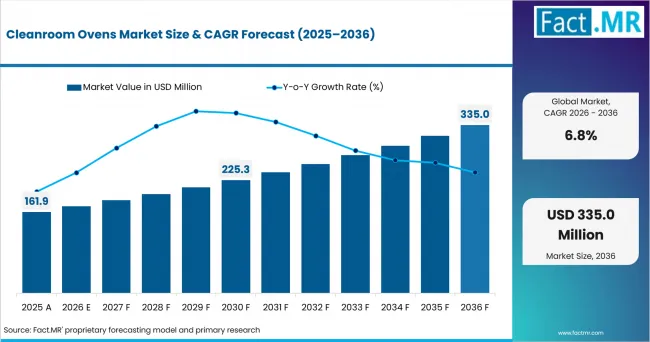
Cleanroom Ovens Market Value Analysis | Source: Fact.MR
What are the defining numbers behind Cleanroom Ovens Market growth?
USD 162 million absolute opportunity by 2036, led by Pass-through cleanroom ovens and ISO 7 within their respective segments.
- Demand Drivers in the Market
- Semiconductor components require drying and curing processes that do not reintroduce particles after upstream cleaning.
- Medical-device and pharmaceutical manufacturers need equipment designs that support qualification, repeatable cycles, and effective chamber cleaning.
- Pass-through ovens can create a controlled material lock between areas of different cleanliness and reduce unnecessary personnel movement.
- Replacement demand grows when older ovens cannot provide the data logging, alarms, or filter monitoring expected in a modern production environment.
- Key Segments Analyzed
- By Oven Type: Pass-through cleanroom ovens lead oven type demand at 28.0%, built with interlocked doors on opposing walls so a load can cure inside the chamber and exit into an adjoining zone of different classification without crossing an open corridor.
- By Cleanroom Class: ISO 7 accounts for 32.0% of demand because it is the classification tied to more demanding production work, including sterile compounding buffer rooms, implantable and drug-eluting device manufacturing, and cell and gene therapy production, while ISO 8 space is reserved for non-sterile packaging and external-contact assembly that generates comparatively little demand for thermal processing equipment.
- By End Use: Semiconductor components hold 28.0% of demand, a share built on the number of bake and cure steps a single device passes through, from photoresist hard bake and polyimide dielectric cure to die-attach epoxy cure and mold compound post-cure, each one a separate oven cycle a medical device or pharmaceutical batch does not require.
- By Temperature Range: The 150-250 degrees C band covers 37.0% of demand because it spans the cure points of two of the most repeated packaging steps in electronics manufacturing: snap-cure die-attach epoxies that cure at 200 to 225 degrees C, and snap-cure underfills that finish in under seven minutes at 165 degrees C or below, both run on nearly every unit that passes through assembly rather than as a one-time process step.
- By Door Configuration: Single-door builds take 39.0% of door configuration demand, the natural default for ovens installed inside one classified zone rather than at a boundary between two, where a single opening skips the interlock logic and airlock footprint a pass-through design requires.
- Analyst Opinion at Fact.MR
- Shambhu Nath Jha, Senior Analyst at Fact.MR, states, "The specification has to begin with the product and the cleanroom boundary, then work outward to airflow, door logic, heat load, and records. Buyers who select from chamber size alone often discover late that service access or contamination recovery matters more than an extra shelf."
- Strategic Implications
- Semiconductor manufacturers should model particle-sensitive load transfer and recovery after door opening before approving oven placement.
- Equipment suppliers can command a stronger position by integrating validation documentation, filter-status visibility, and serviceable clean-side surfaces.
- Medical-device producers need to align oven controls with site data-integrity and change-control practices rather than treating the controller as a stand-alone accessory.
- Cleanroom designers should reserve maintenance access on the less-clean side where possible so routine service does not disrupt classified operations.
Memmert's UF TS pass-through oven is designed as a temperature-controlled material lock between a grey room and a cleanroom, with an easy-to-clean interior and programmable process controls. This type of through-wall architecture shows how contamination control and material flow are being designed as one system.
Germany is positioned for 7.5% annual growth from 2026 to 2036 because precision manufacturing and validation-intensive industries favor engineered, traceable thermal equipment. The United States is projected to expand at a 7.4% CAGR as domestic semiconductor, medical-device, and pharmaceutical projects refresh classified process equipment, and Ireland follows at 7.3% on continuing pharmaceutical and medtech investment. A 7.1% CAGR is forecast for Japan, where high-quality electronics manufacturing sustains precise, low-contamination heat treatment, while South Korea advances at 6.7% on semiconductor drying and curing capacity.
How does the Cleanroom Ovens Market break down by segment?
The leading shares are Pass-through cleanroom ovens at 28.0% by Oven Type and ISO 7 at 32.0% by Cleanroom Class.
Why do pass-through cleanroom ovens lead the product mix?
At 28.0% share in 2026, the leading position goes to Pass-through cleanroom ovens because they combine thermal processing with controlled transfer across a cleanroom boundary.
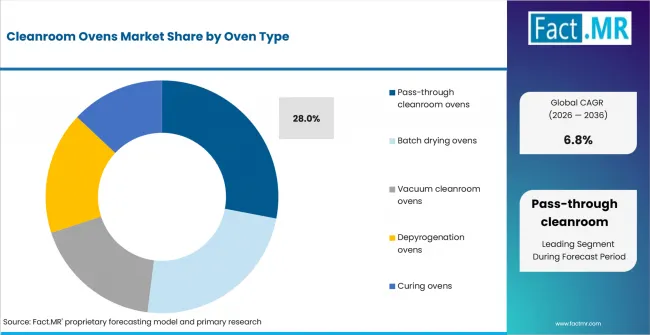
Cleanroom Ovens Market Analysis By Oven Type | Source: Fact.MR
Pass-through cleanroom ovens account for 28.0% of demand because separate loading and unloading sides can support cleaner material flow. Batch drying ovens follow at 24.0%, retaining an advantage where a single-room workflow and flexible loads are more important than a wall interface. Vacuum cleanroom ovens hold 18.0% and serve heat-sensitive or oxidation-sensitive processes that need lower-pressure drying rather than high forced airflow.
Why is ISO 7 the largest cleanroom-class requirement?
The 2026 leader is ISO 7 at 32.0% share because it balances meaningful particle control with practical equipment and operating costs.
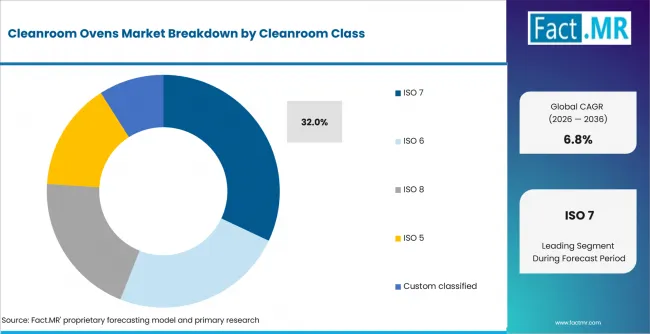
Cleanroom Ovens Market Analysis By Cleanroom Class | Source: Fact.MR
ISO 7 represents 32.0% of demand and covers a broad range of controlled manufacturing without the design burden of the strictest environments. ISO 6 contributes 24.0% where users need tighter control around sensitive components or processes. ISO 8 at 20.0% remains relevant for less critical stages, while ISO 5 equipment requires more deliberate particle-shedding, filtration, and installation choices.
What keeps semiconductor components at the front of cleanroom oven demand?
A 28.0% share puts Semiconductor components first in 2026 because particle-sensitive components pass through several drying, curing, and thermal-conditioning steps.
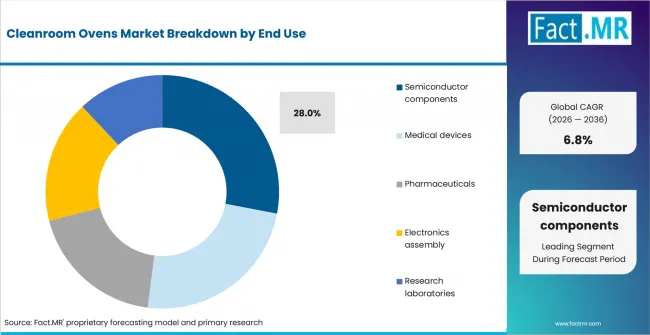
Cleanroom Ovens Market Analysis By End Use | Source: Fact.MR
Semiconductor components lead with 28.0% as contamination risk extends from wafer-related processes to packaging and electronic subassemblies. Medical devices account for 24.0%, supported by qualified drying and curing needs across varied product geometries. Pharmaceuticals hold 19.0%, where depyrogenation, documentation, and clean-side loading can place a premium on validation-ready systems.
Why does the 150-250 C range capture the largest share?
For Temperature Range, the top 2026 position is 150-250 degrees C at 37.0% share because it covers a wide span of drying, curing, and heat-conditioning duties without moving into furnace design.
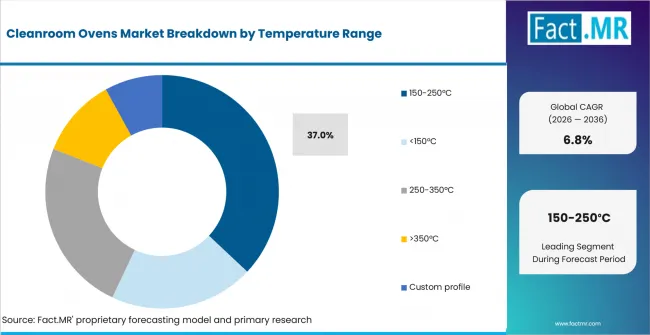
Cleanroom Ovens Market Analysis By Temperature Range | Source: Fact.MR
The 150-250 C band accounts for 37.0% of demand and accommodates many polymer, electronics, and component-processing cycles. The 250-350 C range follows at 24.0% where higher-temperature curing or clean heat treatment is required. Equipment below 150 C holds 20.0% and competes on gentle drying, control stability, and avoidance of material damage rather than maximum heat output.
Why do single-door ovens retain the largest configuration share?
The leading 2026 share is 39.0% for Single door because many qualified processes remain within one classified room and favor simpler sealing and service.
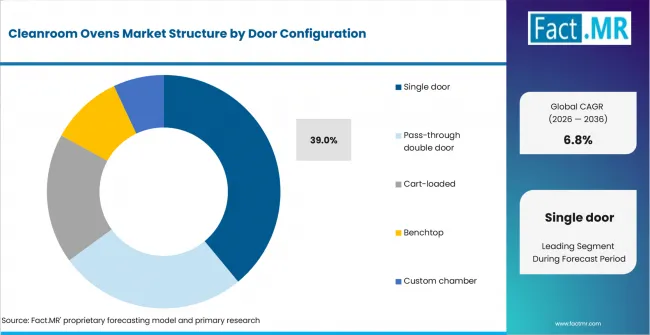
Cleanroom Ovens Market Analysis By Door Configuration | Source: Fact.MR
Single-door designs represent 39.0% of demand because they are straightforward to install, qualify, and maintain in an existing cleanroom. Pass-through double doors account for 26.0% and become valuable when one-way material flow or separation between clean and less-clean areas is central to the process. Cart-loaded ovens at 18.0% support larger batches but require more floor space and careful control of wheels, seals, and chamber loading.
What is accelerating Cleanroom Ovens Market adoption, and what is holding it back?
The principal accelerator is investment in contamination-sensitive manufacturing that requires qualified thermal steps. Adoption is slowed by high customization, cleanroom shutdown risk during installation, and the effort needed to validate airflow, temperature uniformity, and electronic records together.
Drivers Impact Analysis
| DRIVER | (~) % IMPACT ON CAGR | GEOGRAPHIC RELEVANCE | IMPACT TIMELINE |
|---|---|---|---|
| Semiconductor capacity additions | +1.0% | United States, Japan, and South Korea | Medium term (2-4 years) |
| Pass-through material flow | +0.9% | Europe and North America | Short term (<= 2 years) |
| Device manufacturing validation | +0.8% | Global medical-device hubs | Medium term (2-4 years) |
| Data-enabled controls | +0.6% | Germany and United States | Short term (<= 2 years) |
| Installed-base renewal | +0.5% | Japan and Western Europe | Long term (>= 4 years) |
Source: Fact.MR analysis. Updated Jul 16, 2026
- Semiconductor capacity additions: New and upgraded component facilities need thermal tools that fit classified production and traceable recipes. Demand extends beyond leading-edge fabs to packaging, sensors, power electronics, and supporting laboratories.
- Pass-through material flow: Through-wall ovens can reduce traffic and create a controlled handoff between production zones. Their value rises when door interlocks and recovery behavior are designed into the room layout from the start.
- Device manufacturing validation: Medical-device teams increasingly expect qualification support and documented process control from equipment vendors. Replacement projects move faster when protocols and calibration access are available with the oven.
Opportunity Impact Analysis
| OPPORTUNITY | (~) % IMPACT ON CAGR | GEOGRAPHIC RELEVANCE | IMPACT TIMELINE |
|---|---|---|---|
| Grey-side service access | +0.5% | Global | Medium term (2-4 years) |
| Qualification service packages | +0.5% | Pharmaceutical and medical-device markets | Short term (<= 2 years) |
| Modular chamber platforms | +0.4% | Asia-Pacific | Medium term (2-4 years) |
| Predictive filter maintenance | +0.3% | Advanced manufacturing sites | Long term (>= 4 years) |
Source: Fact.MR analysis. Updated Jul 16, 2026
- Grey-side service access: Designs that place motors, filters, and routine service points outside the cleanroom can reduce contamination and downtime. This requires early coordination with wall thickness, utilities, and safe maintenance clearance.
- Qualification service packages: Suppliers can bundle factory testing, installation checks, mapping, calibration, and documentation. The service is most valuable when it follows the customer's quality system rather than a generic certificate set.
- Modular chamber platforms: A common control and airflow platform can support several chamber sizes and door arrangements. Modular engineering shortens delivery while preserving enough application-specific design for classified production.
Restraints Impact Analysis
| RESTRAINT | (~) % IMPACT ON CAGR | GEOGRAPHIC RELEVANCE | IMPACT TIMELINE |
|---|---|---|---|
| Qualification burden | -0.5% | Pharmaceutical and medical-device facilities | Short term (<= 2 years) |
| Custom integration cost | -0.4% | Global | Medium term (2-4 years) |
| Filter temperature limits | -0.3% | High-temperature applications | Short term (<= 2 years) |
| Production disruption | -0.2% | Mature cleanroom facilities | Long term (>= 4 years) |
Source: Fact.MR analysis. Updated Jul 16, 2026
- Qualification burden: A cleanroom oven must be shown to perform within the installed room and actual load pattern. Documentation, mapping, and change control can extend the schedule well beyond physical delivery.
- Custom integration cost: Wall interfaces, doors, exhaust, filters, carts, and controls frequently differ by site. One-off engineering raises price and makes late specification changes expensive.
- Filter temperature limits: Higher process temperatures complicate clean-air filtration, sealing, and material selection. Users may need a specialized design or a different contamination-control strategy above ordinary oven ranges.
How do the leading cleanroom oven markets compare?
Germany 7.5% CAGR. United States 7.4%. Ireland 7.3%. Japan 7.1%. South Korea 6.7%.
Regional analysis addresses North America, Europe, and Asia Pacific through country sections on Germany, the United States, Ireland, Japan, and South Korea, with more than 30 countries treated in the complete report.
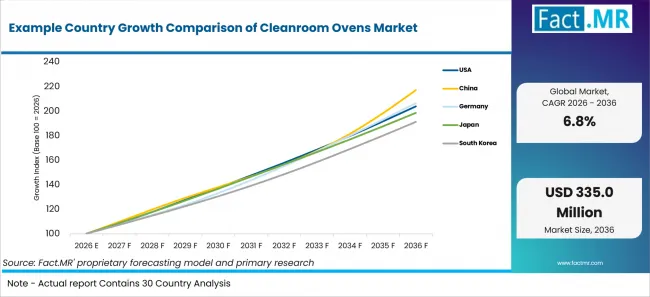
Example Country Growth Comparison Of Cleanroom Ovens Market | Source: Fact.MR
| COUNTRY | CAGR |
|---|---|
| Germany | 7.5% |
| United States | 7.4% |
| South Korea | 6.7% |
Source: Fact.MR analysis. Updated Jul 16, 2026
Why Are Dresden's Chip Fabs and Biberach's Biopharma Plants Pulling Cleanroom Ovens Into Germany?
Germany's cleanroom oven demand tracks two separate buildouts sitting inside the same industrial corridor. Infineon's five billion euro Smart Power Fab in Dresden, the world's largest plant for power semiconductors and analog/mixed-signal chips, opened ahead of schedule and doubled the company's local output. GlobalFoundries followed with a 1.1 billion euro Dresden expansion under its SPRINT program, aiming for more than one million wafer starts a year by 2028, inside the Silicon Saxony cluster.
Biberach adds a second stream. Boehringer Ingelheim, whose 2023 global human-pharma sales topped Bayer's global pharma-division revenue by one industry ranking, operates one of Europe's largest biopharmaceutical manufacturing sites there and is building a new chemical innovation plant at its Ingelheim base. Schwabach-based Memmert supplies drying and heating ovens to both buyer groups from inside the country. The combined base carries a 7.5% CAGR from 2026 to 2036.
Why Is CHIPS Act Fab Construction Setting the Pace for US Cleanroom Oven Demand?
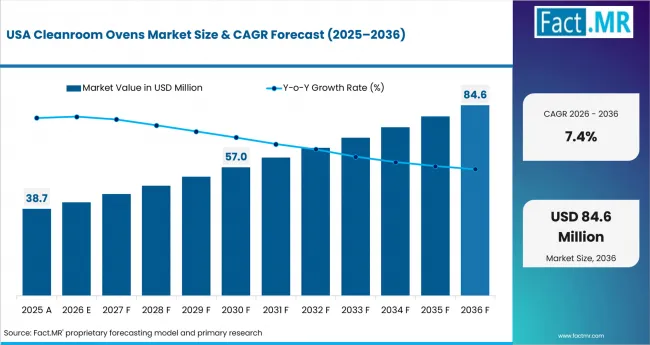
Cleanroom Ovens Market Country Value Analysis | Source: Fact.MR
Arizona is running the country's most advanced fab buildout. TSMC's first Phoenix-area fab is already in production, its second is installing equipment ahead of 2027 3-nanometer output, and the company has laid out plans for as many as 12 fabs and four packaging plants nearby. Intel is spending 32 billion dollars on two new Chandler, Arizona fabs targeting 2-nanometer chips.
Why Do FDA-Approved Plants in Cork and Medtech Lines in Galway Set Ireland Apart?
Ireland's cleanroom oven demand rests on two clusters. Cork hosts an API and biologics base built around Johnson & Johnson's Ringaskiddy and Little Island plants, AbbVie's FDA and Irish Medicines Board accredited site, and Thermo Fisher's FDA-inspected API facility. Nine of the world's top ten pharmaceutical companies now hold Irish operations, spread across dozens of FDA-approved plants nationwide.
Galway carries the medical-device side. Boston Scientific's Galway site, its largest manufacturing plant worldwide, turns out more than four million devices a year and recently added 40,000 square feet of cleanroom space; Medtronic has run its first European manufacturing plant there since 1999. Ireland supplies roughly 80% of the world's stents and about half its acute-hospital ventilators, and the country's demand grows at a 7.3% CAGR from 2026 to 2036.
Why Are Kumamoto and Hokkaido Reshaping Japan's Cleanroom Oven Demand?
Japan's chipmaking base is rebuilding around two new fabs. TSMC's Kumamoto joint venture with Sony and Denso is upgrading its second plant to a 3-nanometer line with 15,000 wafers a month of planned capacity, targeting mass production in 2028. Rapidus, formed with IBM Research to pursue 2-nanometer production, unveiled its first working 2-nanometer chip prototypes from its Hokkaido pilot line in July 2025 and is targeting full mass production in 2027, backed by nearly 2.9 trillion yen, roughly 19 billion dollars, in cumulative government support.
Why Do Yongin's Chip Clusters and Songdo's Biologics Campuses Anchor South Korea's Demand?
Samsung and SK Hynix committed to a combined 800 trillion won, about 518 billion dollars, for new fabs across South Korea's southwest, part of a broader roughly 576 billion dollar national investment plan that also covers AI data centers and packaging clusters, announced in June 2026. The plan moves SK Hynix's Yongin cluster timeline forward by 12 years and pushes Samsung into simultaneous construction of its P5 and P6 fabs in Pyeongtaek, sites that had already reached capacity under the original schedule.
Songdo, Incheon carries the biologics side. Samsung Biologics runs CGMP-compliant Bio Campus I and II plus a dedicated antibody-drug conjugate plant, with cell culture suites operating in grade C space and inoculation suites in grade B. Its fifth plant, a 180,000-liter facility, has been operational since April 2025 and was ramping up production as of early 2026. South Korea's cleanroom oven demand grows at a 6.7% CAGR from 2026 to 2036.
Who leads the Cleanroom Ovens Market?
Memmert, Carbolite Gero, Thermo Fisher Scientific, and Despatch Industries compete through cleanroom fit, temperature capability, controls, and validation support.
Memmert leads the source-company set with a 16.0% share, while Carbolite Gero holds 11.0% and Thermo Fisher Scientific 9.0%. Their reach across laboratory and industrial thermal equipment supports buyer confidence, but cleanroom projects still demand application-specific airflow and installation work.
Which companies are the key providers?
The company set includes Memmert, Carbolite Gero, Thermo Fisher Scientific, and Despatch Industries.
- Memmert
- Carbolite Gero
- Thermo Fisher Scientific
- Despatch Industries
The five named manufacturers anchor the comparison, and the full report reviews more than 30 equipment suppliers and service specialists.
Bibliography
- Memmert GmbH + Co. KG. (n.d.). Pass-Through Oven UF TS.
- Carbolite Gero. (n.d.). Clean Room Ovens for ISO 14644-1 Environments.
- Carbolite Gero. (n.d.). Furnaces and Ovens for the Pharma and Medical Sector.
- Despatch Industries. (n.d.). Clean Room Ovens.
- Despatch Industries. (n.d.). LCC and LCD Pass-Through Cleanroom Oven Manual.
This Report Addresses
- The report quantifies the 2025 baseline and forecasts revenue from 2026 through 2036.
- It compares Germany, the United States, Ireland, Japan, and South Korea, drawing on country coverage of 30+ markets.
- It evaluates Memmert, Carbolite Gero, Thermo Fisher Scientific, and Despatch Industries.
- It examines oven type, cleanroom class, temperature range, and door-configuration choices.
- It separates semiconductor, medical-device, pharmaceutical, electronics, and laboratory demand.
- It tests the forecast against capacity additions, installed-base renewal, qualification needs, and integration constraints.
What does the Cleanroom Ovens Market cover?
The study follows cleanroom-compatible thermal equipment from specification and factory delivery through qualification and installed-base replacement.
Revenue includes the oven chamber, cleanroom-compatible housing, integrated filtration or airflow components, controls, doors, and standard material-handling accessories. Pass-through engineering is recognized within the delivered equipment value.
Demand is segmented by oven type, room class, end use, temperature, and door configuration. Country estimates reflect manufacturing investment, regulated-industry activity, supplier access, and the age of installed equipment.
What is included in the scope?
Included systems are purpose-built or specifically configured to operate in a classified environment or through a cleanroom wall.
Batch, vacuum, curing, drying, depyrogenation, cart-loaded, benchtop, and custom chambers are counted when their cleanroom compatibility is part of the sale. Integrated HEPA filtration, cleanable surfaces, interlocks, controls, and data logging are covered.
Factory acceptance testing, installation qualification support, calibration, and mapping are included only when billed by the equipment vendor as part of the covered project.
What is excluded from the scope?
General thermal equipment and facility infrastructure outside the oven package are not included.
The study excludes standard industrial ovens with no classified-use design, cleanroom air handlers, wall construction, facility exhaust, and external automation platforms. Consumable filters sold as routine aftermarket parts are excluded unless inseparable from a covered service contract.
How was the analysis built?
Equipment portfolios, validation practice, buyer interviews, and forecast cross-checks referencing more than 30 countries.
- Primary Research: Primary research targets cleanroom engineers, semiconductor process teams, medical-device and pharmaceutical validation staff, oven manufacturers, distributors, and calibration providers. Interviews test purchase triggers, class requirements, cycle ranges, door logic, qualification scope, downtime, and service expectations.
- Desk Research: Desk research reviews official manufacturer product literature, cleanroom-oven manuals, application guides, and regulated-industry equipment practices. Named designs are used only when supported by manufacturer sources listed in the bibliography.
- Market-Sizing and Forecasting: Sizing is developed from unit shipments, chamber-size and temperature mixes, cleanroom-class premiums, pass-through customization, and replacement cycles. The result is reconciled to USD 173 million in 2026 and USD 335 million in 2036.
- Data Validation and Update Cycle: Validation compares segment shares, supplier positions, and country growth with channel feedback and visible manufacturing projects. Update signals include fab and plant openings, product launches, controller upgrades, service-network changes, and cleanroom retrofit schedules.
Segmentation
What is the report's scope and coverage?
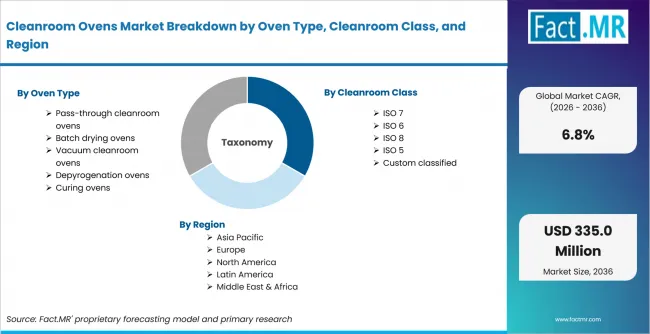
Cleanroom Ovens Market Breakdown By Oven Type, Cleanroom Class, And Region | Source: Fact.MR
| ATTRIBUTE | DETAILS |
|---|---|
| Quantitative Units | USD 173 million in 2026 to USD 335 million by 2036 at 6.8% CAGR |
| Market Definition | The market covers ovens engineered for drying, curing, depyrogenation, heat conditioning, and related thermal processes within or across classified cleanroom environments. |
| Oven Type | Pass-through cleanroom ovens; Batch drying ovens; Vacuum cleanroom ovens; Depyrogenation ovens; Curing ovens |
| Cleanroom Class | ISO 7; ISO 6; ISO 8; ISO 5; Custom classified |
| End Use | Semiconductor components; Medical devices; Pharmaceuticals; Electronics assembly; Research laboratories |
| Temperature Range | 150-250 degrees C; <150 degrees C; 250-350 degrees C; >350 degrees C; Custom profile |
| Door Configuration | Single door; Pass-through double door; Cart-loaded; Benchtop; Custom chamber |
| Regions Covered | North America; Europe; Asia Pacific |
| Countries Covered | Germany; United States; Ireland; Japan; South Korea (full report analyzes 30+ countries) |
| Key Companies Profiled |
Memmert; Carbolite Gero; Thermo Fisher Scientific; Despatch Industries |
| Forecast Period | 2026 to 2036 |
| Approach | Sizing combines annual equipment shipments, realized prices by chamber and cleanroom class, pass-through customization, replacement demand, and separately billed qualification attached to covered systems. |
Source: Fact.MR analysis. Updated Jul 16, 2026
How is the market segmented?
-
By Oven Type
- Pass-through cleanroom ovens
- Batch drying ovens
- Vacuum cleanroom ovens
- Depyrogenation ovens
- Curing ovens
-
By Cleanroom Class
- ISO 7
- ISO 6
- ISO 8
- ISO 5
- Custom classified
-
By End Use
- Semiconductor components
- Medical devices
- Pharmaceuticals
- Electronics assembly
- Research laboratories
-
By Temperature Range
- 150-250 degrees C
- <150 degrees C
- 250-350 degrees C
- >350 degrees C
- Custom profile
-
By Door Configuration
- Single door
- Pass-through double door
- Cart-loaded
- Benchtop
- Custom chamber
-
By Region
- North America
- United States
- Europe
- Germany
- Ireland
- Asia Pacific
- Japan
- South Korea
Frequently Asked Questions
What is the cleanroom ovens market worth in 2026?
What revenue level is projected for cleanroom ovens in 2036?
What CAGR is expected through 2036?
Which oven type leads demand?
Which cleanroom class is the largest segment?
Which end use has the largest share?
What temperature range leads the market?
Which door configuration is most common?
Who worked on this report


Preview the report firsthand - request a free sample
Free SampleGet the brochure for pricing and purchase details
Download PDF