- Base Value(2025): 15.5 Bn
- Forecast Value (2035): 53.6 Bn
- CAGR (2035): 15.1%
Contactless Delivery Services Market Outlook 2025 to 2035
The global contactless delivery services market is expected to reach USD 53.6 Billion by 2035, up from USD 15.5 Billion in 2025. During the forecast period 2025 to 2035, the industry is projected to expand at a CAGR of 13.2%.
The contactless delivery services market is growing fast, as the demand of the consumers for safe, efficient and convenient last-mile delivery solutions is on the rise. The rising penetration of eCommerce, an increase in hygiene consciousness after the pandemic, and trends of urbanization all help in supporting growth.
Quick Stats for Contactless Delivery Services Market
- Industry Value (2025): USD 15.5 billion
- Projected Value (2035): USD 53.6 billion
- Forecast CAGR (2025 to 2035): 13.2%
- Leading Segment (2025): Autonomous Vehicles (50% Market Share)
- Fastest Growing Country (2025-2035): China (14.7% CAGR)
- Top Key Players: Amazon, Starship Technologies, Nuro, JD Logistics, Zipline, UPS Flight Forward, DHL Express, FedEx SameDay Bot, Cainiao, Wing
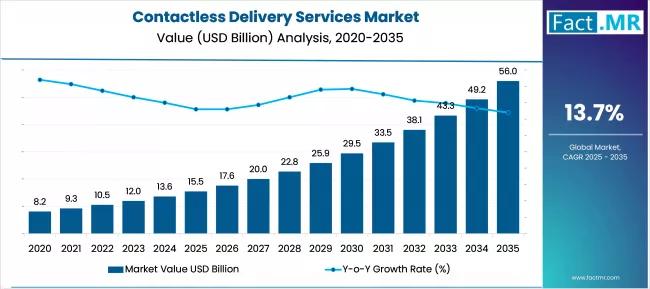
Contactless Delivery Services Market Market Value Analysis | Source: Fact.MR
Automation, drones, and AI-optimized routes are becoming popular with logistics providers and retailers to improve speed and cost-efficiency. Contactless systems are also correlated with the sustainable agenda of minimizing idle time and maximizing delivery resources, and as such, this feature is at the heart of supply chain innovation in the future.
What are the drivers of the Contactless Delivery Services Market?
The market for contactless delivery services is growing quickly since consumers are seeking more convenient, safer and faster last-mile services. Contactless systems are currently taking the lead, and this can be explained by the rise in e-commerce penetration and the rise of hygiene awareness, which was initially provoked by the pandemic.
To simplify the process of interacting with customers, retailers and logistics providers resort to the use of mobile applications, verification using QR codes and online payments. Simultaneously, the speed and cost-effectiveness of delivery is improving, thanks to new technologies in self-driving cars, drones, and AI-based route optimization.
The adoption is additionally supported by regulatory support to the urban mobility and sustainability targets, and technological, logistic, and retail partnerships have the potential to result in the broad-scale implementation of tailored solutions at the global scale.
What are the regional trends of the Contactless Delivery Services Market?
The local environment of the contactless delivery services market has a variety of adoption drivers that can be determined by the maturity of infrastructure, consumer behavior, and regulatory priorities. North America is the top region in integrating drones, autonomous delivery and app-based platforms and has already well-established e-commerce ecosystems.
Strict sustainability policies and urban congestion control in Europe stimulate the use of electric fleets, smart lockers and green logistics.
Asia-Pacific demonstrates the quickest growth, and China, India, and Southeast Asia are utilizing the digital wallets and the e-commerce boom.
Latin America is adopting contactless models based on apps to address the need for urban mobility, whereas Middle East and Africa are progressing in adopting smart cities models and retail digitalization.
What are the challenges and restraining factors of the Contactless Delivery Services Market?
The market for contactless delivery services has significant challenges associated with the complexity of operations, technologies, and regulations. One obstacle has been standardization since the quality of services varies in different regions because of the infrastructure disparity, unreliable internet connectivity and the lack of logistical coherence.
Drones, autonomous vehicles, and smart lockers have high capital requirements to implement, which restrict scalability, especially in the case of small and mid-sized participants. Digital platform-related issues of data privacy and cybersecurity also limit adoption.
Also, the regulatory uncertainty on unmanned aerial systems, human compliance, and city congestion control are complexifying. Disparate digital literacy is impeding smooth commercialization in developing economies because of market fragmentation and insufficient digital literacy rates.
Country-Wise Insights
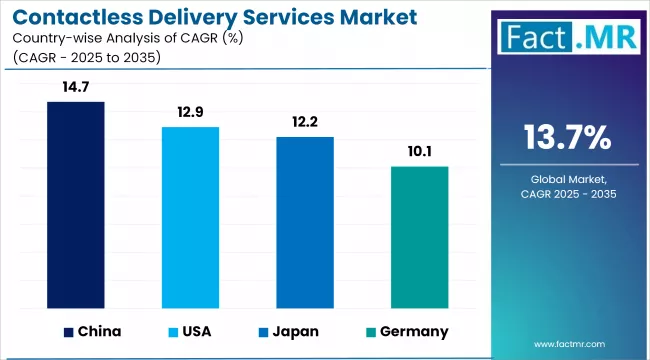
Contactless Delivery Services Market Cagr Analysis By Country | Source: Fact.MR
Automation and Scale Drive U.S. Market Leadership
The market in the U.S is characterized by the fast rate of adapting autonomous vehicles, drones, and AI-based logistics systems due to a robust e-commerce environment and the desire of consumers to be fast and convenient. Amazon, Walmart and FedEx are among retail giants using robotics, contactless lockers, and applications to simplify the last-mile delivery.
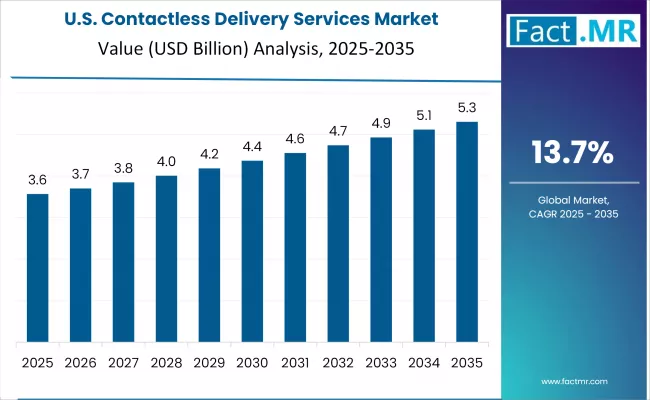
Contactless Delivery Services Market Country Value Analysis | Source: Fact.MR
FAA regulatory transparency with regard to drone activities is speeding up pilot programs across the country, especially in suburban and campus ecologies. The smart routing is being implemented by large logistics integrators in Midwest and Southern hubs in order to achieve a balance between efficiency and sustainability. The U.S. is the innovation center of contactless delivery with stable digital payment adoption and consumer trust reinforcing the stance.
Nutritional Reform and Digital Mandates Shape China’s Evolution
The market development in China is fueled by national needs to modernise logistics following pandemics-induced disruption and e-commerce growth. Smart logistics, traceability, and automation have become the new priorities of regulation reforms, forcing operators to incorporate the deployment of delivery robots, drones, and QR-based verification into the scope of urban large-scale deployment.
The adoption is being led by provinces like Guangdong, Zhejiang and Shandong because of dense urban populations and the availability of technology friendly ecosystems. Tight labor and movement restrictions in megacities put independent and semi-autonomous systems on the rise in food and grocery supply and medical supplies delivery.
Demand prediction and real-time routing based on AI are becoming a standard. Mass-scale integration is further stimulated by strong consumer uptake of super-apps such as Meituan and Alibaba.
Sustainability Mandates and Automation Anchor Germany’s Market Growth
The market of Germany is being influenced by strict sustainability requirements and urban logistics issues that stimulate the use of electric vehicles, automated lockers, and contactless courier systems. The Green Deal of the European Union and the climate neutrality targets of Germany are compelling delivery providers to deal with lowering emissions and maintain speed and convenience.
Parcel stations and e-van fleets are used to control congestion in cities like Berlin, Hamburg, and Munich as the main smart logistics pilots. Logistics providers and retailers are rolling out app-based ecosystems, as well as blockchain-traceability to be transparent.
With regulatory protection, and the trend of consumers being attracted to green business, Germany stands out as a European center in the invention of contactless delivery.
Category-Wise Analysis
Hygiene-driven demand fuels rapid, recurring contactless delivery adoption
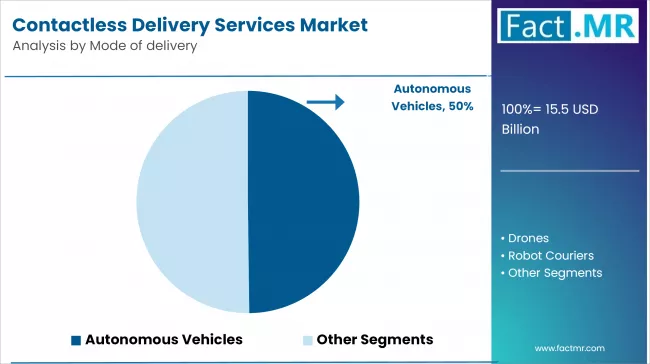
Contactless Delivery Services Market Analysis By Mode Of Delivery | Source: Fact.MR
The food and grocery delivery market is witnessing a faster pace, due to a desire by consumers to have convenience, hygiene, and speed in cities. Contactless models that use an app-based platform, QR-code verification, and digital payment offer safe transactions and also optimize the delivery cycles. Smart lockers and curbside pickups will increase efficiency in operations, especially when ordering in large amounts.
The collaborations between supermarkets, restaurants and third-party logistic companies are strengthening service growth. The increasing use of contactless solutions in essentials after the pandemic has established such a model as a standard consumer behavior, and further growth opportunities are supported by regularities in demand and constant digitalization.
Automation accelerates sustainable, efficient last-mile delivery innovation
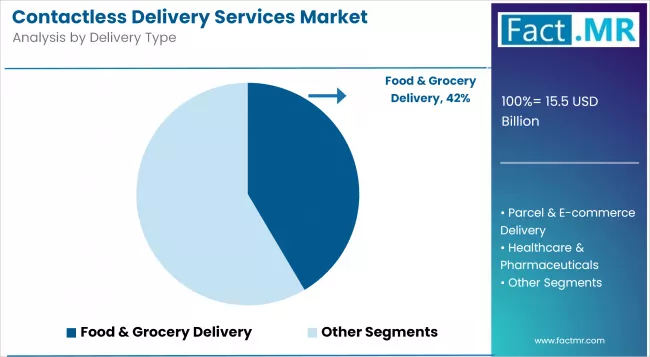
Contactless Delivery Services Market Analysis By Delivery Type | Source: Fact.MR
The drones and autonomous ground vehicles market is on a powerful channel with logistics companies and retailers investing in automation to defeat the obstacle of labor and congestion. Drones are already able to deliver medical, food and parcels to suburban and rural areas and autonomous robots are increasing the urban last mile.
Developments in AI navigation, battery life, and real-time management of obstacles on a granular level are increasing the reliability of the system. Scaled pilots are being supported by regulatory approvals in markets like the U.S., China and Europe. Sustainability requirements support the growth perspective of the segment, as autonomous vehicles will allow reducing the emissions, as well as streamlining the delivery patterns.
AI-powered efficiency and secure handling drive B2B contactless delivery growth
The B2B segment currently is evolving fast in the market of contactless delivery services, which is encouraged by the increasing demands in the reliable, efficient, and secure supply chain solutions. Automated delivery systems, smart lockers, and contactless verification are becoming very popular in industries, healthcare, and corporate sectors, as these means are used to facilitate operations. Real-time tracking and AI-driven route optimization can increase the accuracy of delivery, decrease costs, and increase efficiency in operations.
Contactless delivery has brought about safety of delivery of important medical supplies and pharmaceuticals in healthcare. With businesses prioritizing digital transformation, operational resilience, B2B contactless delivery is becoming a necessity to improve supply-chain responsiveness and minimise human involvement.
Competitive Analysis
Key players in the Contactless Delivery Services Market include Amazon, Starship Technologies, Nuro, JD Logistics, Zipline, UPS Flight Forward, DHL Express, FedEx SameDay Bot, Cainiao, Wing.
The market is growing with the intensification of competition by e-commerce platforms, logistics providers, and food delivery aggregators using technology-based models. Firms are spending a lot on drones, self-piloted cars, smart lockers, and AI-driven route optimization in order to distinguish the speed and efficiency of services. Retailer-tech startup and logistics integrator strategic partnerships are defining innovation and infiltration.
A strong trend is the transition to models of delivery with an increased focus on electric fleets and decreased carbon footprints. Local competitors are exploring solutions based on apps and digital payment initiatives, whereas international leaders are using the benefits of vertical integration and scale to strengthen leadership in contactless delivery systems.
Recent Development
- In Jan 2025, Food delivery platform Square Eats in Botswana was renamed Zesta, formally marking a shift towards a more expanded super-app platform. Zesta is now in the position to provide uninterrupted delivery services of food, groceries and essentials, with its pandemic-era-based trust, including hygiene-based and contactless delivery policies, which places Zesta as a regional frontrunner in the contact-free logistics of food, groceries and essentials.
- In April 2024, Hyundai and Kia also presented the DAL-e, a highly sophisticated autonomous delivery robot with facial recognition, smooth movements on an elevator, and a way to carry a load of up to 10 kilograms. The innovation will support automation of indoor logistics, increase the efficiency of the delivery process, and strengthen the security of the verification which is in line with the increased needs of contactless, technologically oriented delivery systems.
Fact.MR has provided detailed information about the price points of key manufacturers of Contactless Delivery Services Market positioned across regions, sales growth, production capacity, and speculative technological expansion, in the recently published report.
Methodology and Industry Tracking Approach
The Fact.MR (2025), report on the Global Contactless Delivery Services Market surveyed 10,800 stakeholders in 30 countries with a minimum of 300 stakeholders in each market. Two-thirds were end users and service providers (e.g. e-commerce services, logistics, food delivery aggregators) and a third were industry professionals (e.g. technology developers, policymakers, urban planners). The information that has been gathered between May 2024 and April 2025 encompassed the trend in adoption, investing in technology, the effect of the regulation, opportunities, and risks in the value chain. The analysis involved more than 250 secondary materials, such as patents, regulatory filings, corporate reports and academic publications with advanced statistical models like regression and scenario-based prediction.
With Fact.MR monitoring consumer behavior, product efficacy, industry trends, and market opportunities since 2018, this report is becoming an authoritative source of information that stakeholders can rely on.
Segmentation
Segmentation of Contactless Delivery Services Market
-
Mode of Delivery :
- Autonomous Vehicles
- Drones
- Robot Couriers
- Smart Lockers
-
Service Model :
- Business-to-Consumer (B2C)
- Business-to-Business (B2B)
-
Delivery Type :
- Food & Grocery Delivery
- Parcel & E-commerce Delivery
- Healthcare & Pharmaceuticals
-
Technology :
- Laser Triangulation
- GPS Tracking
- AI and Machine Learning
- Internet of Things (IoT)
-
By Region :
- North America
- Latin America
- Western Europe
- Eastern Europe
- East Asia
- South Asia & Pacific
- Middle East & Africa
Frequently Asked Questions
What was the Global Contactless Delivery Services Market Size Reported by Fact.MR for 2025?
Who are the Major Players Operating in the Contactless Delivery Services Market?
What is the Estimated Valuation of the Contactless Delivery Services Market in 2035?
What Value CAGR did the Contactless Delivery Services Market Exhibit Over the Last Five Years?
Who worked on this report


Preview the report firsthand - request a free sample
Free SampleGet the brochure for pricing and purchase details
Download PDF