- Market Value (2025): USD 27.3 Mn
- Estimated Value (2026): USD 35 Mn
- Forecast Value (2036): USD 413.2 Mn
- CAGR (2026-2036): 28.0%
What is the container lashing robots market forecast to be worth by 2036?
USD 35 million in 2026 to USD 413.2 million by 2036, at 28.0% CAGR.
- The container lashing robots market crossed a valuation of USD 27.3 million in 2025.
- Demand is expected to increase from USD 35 million in 2026 to USD 413.2 million by 2036.
- The market is forecast to record a 28.0% CAGR from 2026 to 2036 as ports test robotic twistlock handling and safety inspection automation.
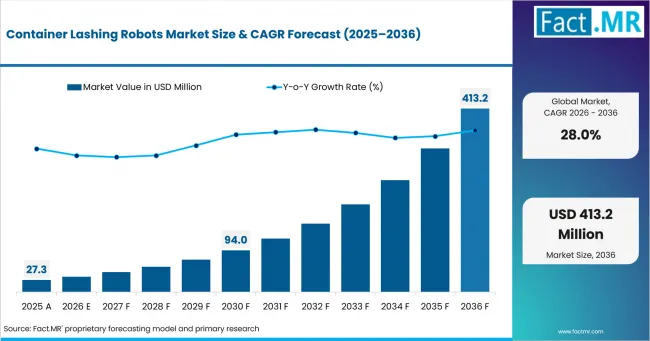
Container Lashing Robots Market Market Value Analysis | Source: Fact.MR
What are the defining numbers behind container lashing robots market growth?
USD 378.2 million absolute opportunity by 2036, led by Singapore and the Netherlands.
- Demand Drivers in the Market
- Terminal operators need safer workflows for twistlock handling near active quay crane zones.
- Shipping lines need faster vessel turnaround without exposing workers to hazardous deck tasks.
- Port automation vendors need robotic systems that close the manual gap in automated terminals.
- Stevedoring contractors need tools that reduce repetitive manual lashing and unlashing strain.
- Key Segments Analyzed
- By Automation Level: Robotic units are expected to hold 38.0% share in 2026 because they represent the clearest commercial path.
- By Operation: Twistlock handling leads because automation is most mature around pin removal and replacement. The segment is projected to capture 42.0% share in 2026.
- By Terminal Type: Automated terminals are likely to account for 34.0% share in 2026 because they already have supporting control systems.
- By Technology: Robot arms are expected to hold 37.0% share in 2026 because picking and placing twistlocks requires precise manipulation.
- By Buyer Type: Terminal operators are projected to record 44.0% share in 2026 because they directly manage quay safety and vessel productivity.
- Analyst Opinion at Fact.MR
- Shambhu Nath Jha, Senior Analyst at Fact.MR, states, “Container lashing robots are still an early-stage port automation category, but the pain point is clear. Twistlock handling and lashing expose workers to repetitive and hazardous tasks near heavy equipment. The market will grow where robots can fit existing quay workflows, handle different twistlock types and prove uptime in real terminal conditions.”
- Strategic Implications
- Robot suppliers should focus first on twistlock handling before full lashing automation.
- Terminal operators should test robotic systems at high-volume quay crane lanes.
- Shipping lines should align automatic twistlock choices with terminal automation readiness.
- Stevedoring contractors should evaluate remote-operated tools for safer manual-work transition.
RAM Spreaders’ 2026 PinSmart brochure describes a quay-crane-mounted twistlock handling machine in which robots pick and handle container twistlocks to and from integrated storage cassettes. This supports the market boundary because the earliest commercial pathway is automated twistlock handling before fully automated onboard lashing becomes widely standardized.
Singapore is projected to record 30.8% CAGR through 2036 as automated terminal operations and safety-led quay workflows expand. The Netherlands is expected to post 29.6% CAGR through 2036 as mega-vessel berths and automated terminals test robotic quay-side tools. China is likely to record 28.7% CAGR as ZPMC-led container handling equipment scale supports port automation pilots. Germany is forecast to advance at 27.4% CAGR as engineering-led terminal automation and equipment retrofit programs expand. The United States is set to record 26.2% CAGR as terminal operators test safer twistlock handling and remote inspection workflows.
How does the container lashing robots market break down by segment?
Robotic units lead at 38.0%; twistlock handling leads at 42.0%.
Which automation level dominates?
Robotic units hold 38.0% share in 2026.
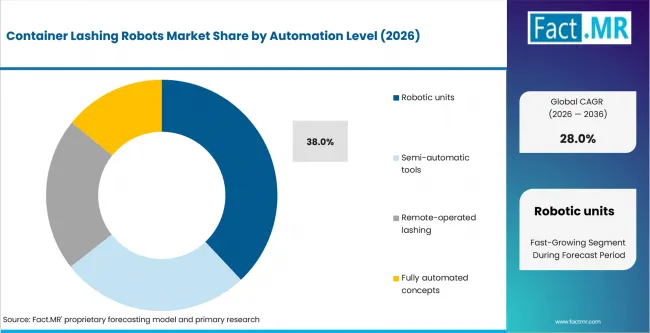
Container Lashing Robots Market Analysis By Automation Level | Source: Fact.MR
Robotic units are expected to hold 38.0% share in 2026 because they provide the strongest bridge between manual twistlock handling and fully automated quay workflows. Semi-automatic tools are used where terminals want lower-cost support. Remote-operated lashing can reduce worker exposure while retaining human supervision. Fully automated concepts are still early because ship design, twistlock types and terminal layouts vary widely. MacGregor secured a 2025 order for its ACV-1 “Hippo” fully automatic twistlocks for Hapag-Lloyd’s 19,900 TEU vessels.
Which operation dominates?
Twistlock handling dominates container lashing robot demand.
Twistlock handling leads because it is the most defined and repeatable automation task around container securing. The segment is projected to capture 42.0% share in 2026 as terminals look for robotic systems that remove and reinstall twistlocks near quay crane operations. Lashing and unlashing are more complex because deck layouts and access paths vary. Safety inspection is growing as vision systems and sensors improve. Deck operations are early but relevant for mega-vessel berths and automated terminals.
Which terminal type dominates?
Automated terminals hold 34.0% share in 2026.
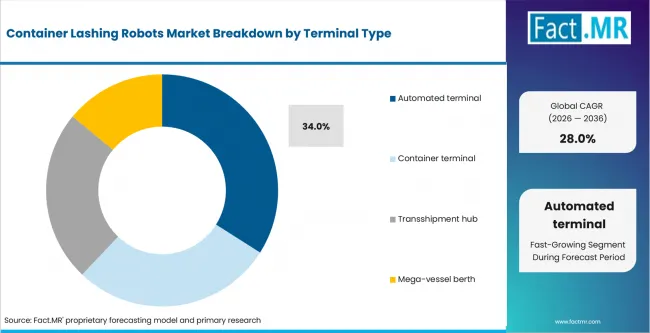
Container Lashing Robots Market Analysis By Terminal Type | Source: Fact.MR
Automated terminals lead because they already use control systems, remote operation and equipment integration across the quay and yard. The terminal type segment is likely to account for 34.0% share in 2026 as automated terminals target the remaining manual steps around vessel operations. Container terminals with mixed equipment follow as retrofit pilots expand. Transshipment hubs support demand because fast vessel turnaround is critical. Mega-vessel berths need safer handling because container volumes and stack complexity are high.
Which technology dominates?
Robot arms hold 37.0% share in 2026.
Robot arms lead because twistlock handling requires precise picking, placing and tool interaction. The technology segment is expected to hold 37.0% share in 2026 as robotic arms become central to automated pinning systems. Mobile platforms follow where robots must move along quay or deck zones. Vision guidance helps locate twistlocks and safe work zones. Remote control supports supervised operation. Safety sensors are essential because robots operate near cranes and moving containers. ABB’s 2025 ports article states that AI technology opens new possibilities for container terminals, with safer and more productive operations.
Which buyer type dominates?
Terminal operators hold 44.0% share in 2026.
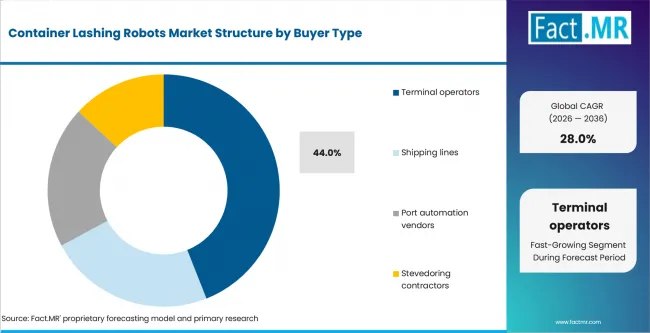
Container Lashing Robots Market Analysis By Buyer Type | Source: Fact.MR
Terminal operators lead because they manage quay productivity, worker safety and vessel turnaround pressure. The buyer-type segment is projected to record 44.0% share in 2026 as operators test robots at crane lanes and automated terminal interfaces. Shipping lines follow where automatic twistlocks and vessel-side lashing systems are part of fleet efficiency. Port automation vendors integrate robotic lashing tools into wider terminal automation. Stevedoring contractors adopt semi-automatic tools where human crews still perform lashing and unlashing.
What is accelerating Container Lashing Robots Market adoption, and what is holding it back?
Port automation and worker safety drive it; Reliability risk and layout variation restrain it.
Drivers Impact Analysis
| DRIVER | (~) % IMPACT ON CAGR | GEOGRAPHIC RELEVANCE | IMPACT TIMELINE |
|---|---|---|---|
| Port automation exposing lashing as a remaining manual quay task | +3.0% | Singapore, Netherlands, China, Germany | Short term (≤ 2 years) |
| Worker safety concerns around twistlock and deck operations | +2.6% | Global, strongest in high-volume terminals | Short term (≤ 2 years) |
| Mega-vessel turnaround pressure increasing robotic handling interest | +2.2% | Transshipment hubs, Europe, East Asia | Medium term (2–4 years) |
| Vision guidance and robot arms improving manipulation reliability | +1.8% | North America, Europe, East Asia | Medium term (2–4 years) |
| Remote operation models supporting supervised automation | +1.5% | Automated terminals globally | Long term (≥ 4 years) |
Source: Fact.MR analysis. Updated Jul 4, 2026
Port automation gap
Port automation is the strongest driver because many terminals have automated yard operations while twistlock and lashing work still require manual effort near the quay. Robots can close this manual gap. This is most important in terminals that already operate automated cranes and digital yard coordination. The driver will strengthen as terminals pursue end-to-end automation.
Worker safety
Worker safety supports demand because lashing and twistlock handling can expose workers to suspended loads, moving containers, deck congestion and repetitive strain. Robotic tools can reduce time spent under or near active container handling zones. This driver is strong across both automated and conventional terminals. Safety-led business cases are easier to justify where labor exposure is high.
Mega-vessel turnaround pressure
Mega-vessel turnaround pressure increases demand because more containers must be handled within tight berth windows. Lashing, unlashing and twistlock delays can slow crane cycles. Robotic systems can reduce variation in repetitive tasks. This driver is strongest in transshipment hubs and mega-vessel berths where berth productivity is heavily scrutinized.
Vision and robot manipulation
Vision guidance and robot arms improve adoption potential because twistlock handling needs accurate recognition and controlled movement. Robots must handle different twistlock types, container positions and weather conditions. Better vision systems reduce failed picks and support safety-zone monitoring. This driver supports both robotic units and safety inspection tools.
Remote operation
Remote operation helps terminals introduce automation without removing human supervision fully. Operators can supervise robotic lashing or twistlock systems from safer locations. This lowers adoption risk and supports exception handling. Remote operation will matter most in early commercial rollouts.
Opportunity Impact Analysis
| OPPORTUNITY | (~) % IMPACT ON CAGR | GEOGRAPHIC RELEVANCE | IMPACT TIMELINE |
|---|---|---|---|
| Quay-crane-mounted twistlock robots for automated terminals | +2.4% | Singapore, Netherlands, China, United States | Short term (≤ 2 years) |
| Safety inspection robots using vision and sensors | +2.0% | Europe, North America, East Asia | Medium term (2–4 years) |
| Remote-operated lashing tools for stevedoring contractors | +1.7% | United States, Germany, Japan, South Korea | Medium term (2–4 years) |
| Shipping-line adoption of automatic twistlocks | +1.4% | Global container shipping lanes | Long term (≥ 4 years) |
Source: Fact.MR analysis. Updated Jul 4, 2026
Quay-crane-mounted robots
Quay-crane-mounted twistlock robots create opportunity because they can fit directly into existing container handling workflows. A robot located near the crane can remove and reinstall twistlocks without moving across the whole deck. This approach is easier to standardize than full vessel-deck robotics. It is strongest in automated terminals and high-throughput crane lanes.
Safety inspection robots
Safety inspection robots create opportunity because vision systems can check twistlock status and unsafe work zones. These robots can reduce manual inspection burden and create evidence for compliance reviews. The opportunity will grow as cameras and safety sensors improve. Terminals with strict safety procedures will adopt first.
Remote-operated tools
Remote-operated lashing tools create opportunity for terminals that cannot move directly to full automation. Stevedoring contractors can reduce worker exposure while retaining human control. This approach fits brownfield terminals and mixed vessel calls. It also supports training and gradual workflow change.
Automatic twistlock adoption
Shipping-line adoption of automatic twistlocks can support longer-term growth. Vessel-side securing technology can reduce manual deck work and support faster port calls. The opportunity will require alignment between ship design, terminal workflows and safety rules. Stronger standardization will help robotic lashing systems scale.
Restraints Impact Analysis
| RESTRAINT | (~) % IMPACT ON CAGR | GEOGRAPHIC RELEVANCE | IMPACT TIMELINE |
|---|---|---|---|
| Low commercial maturity for full lashing robot deployment | -2.4% | Global | Short term (≤ 2 years) |
| Vessel and terminal layout variation complicating standardization | -2.0% | Global, strongest in mixed-call terminals | Medium term (2–4 years) |
| Reliability risk in weather, vibration and dirty quay environments | -1.7% | Global container terminals | Medium term (2–4 years) |
| Labor rules and stevedoring workflow resistance | -1.3% | Europe, United States, Japan | Long term (≥ 4 years) |
Source: Fact.MR analysis. Updated Jul 4, 2026
Commercial maturity
Commercial maturity is the main restraint because fully automated container lashing is still at an early stage. Twistlock handling has clearer product readiness than full deck lashing robots. Terminals may test units slowly before wider deployment. Vendors need evidence from live quay operations, not only demonstrations.
Layout variation
Layout variation slows standardization because vessels and terminal workflows differ. A robot that works at one berth may need adjustment at another. This raises engineering cost and slows repeat deployment. Modular tooling and flexible robot programming will help reduce this restraint.
Reliability in harsh conditions
Reliability risk matters because robots must operate in weather, vibration, dust, salt spray and crowded quay environments. Failed picks, sensor errors or downtime can disrupt crane cycles. Equipment must be rugged and easy to service. Terminals will demand strong uptime evidence before scaling.
Labor and workflow resistance
Labor and workflow resistance can slow adoption because lashing and unlashing are tied to stevedoring roles and safety procedures. Terminals need worker consultation, training and clear operating rules. Some ports may prefer semi-automatic or remote-supervised tools first. This restraint will decline as safety benefits become clearer.
Which countries are scaling container lashing robots fastest?
Singapore 30.8%; Netherlands 29.6%; China 28.7%; Germany 27.4%; United States 26.2%.
Based on regional analysis, the container lashing robots market is segmented into North America, Western Europe, East Asia, South Asia, Latin America, and the Middle East & Africa.
| Country | CAGR |
|---|---|
| Singapore | 30.8% |
| Netherlands | 29.6% |
| China | 28.7% |
| Germany | 27.4% |
| United States | 26.2% |
Source: Fact.MR analysis. Updated Jul 4, 2026
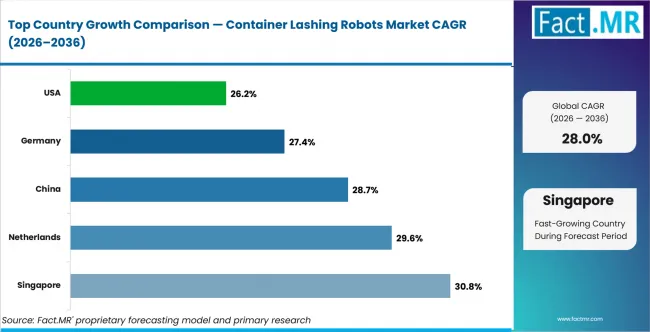
Container Lashing Robots Market Cagr Analysis By Country | Source: Fact.MR
What is powering Singapore’s lead?
30.8% CAGR, driven by automated terminal operations and quay-side safety priorities.
Singapore is projected to record 30.8% CAGR from 2026 to 2036 as terminal operators test automation that reduces manual exposure around quay crane work. Container lashing robots will gain attention where twistlock handling, safety inspection and remote operation can fit high-volume terminal workflows. Growth will favor rugged robotic units and supervised automation.
How is the Netherlands scaling container lashing robot demand?
29.6% CAGR, supported by mega-vessel berths and automated terminal modernization.
The Netherlands is expected to post 29.6% CAGR through 2036 as large container terminals evaluate robotic handling for vessel turnaround and worker safety. Quay-crane-mounted systems and safety inspection robots will receive early attention. Growth will favor systems that integrate with automated terminal controls and quay equipment.
What supports China’s outlook?
28.7% CAGR, backed by ZPMC equipment scale and automated terminal expansion.
China is likely to record 28.7% CAGR by 2036 as major terminals expand automated equipment and robotic handling pilots. ZPMC’s large equipment base creates a pathway for integrated robotic solutions. Growth will favor twistlock handling, mobile platforms and automation systems built for high-throughput terminals.
What underpins Germany’s growth?
Germany is at 27.4% CAGR, scaling through port automation engineering and safety-focused retrofit programs.
Germany is forecast to advance at 27.4% CAGR through 2036 as engineering-led terminals and equipment suppliers test remote-operated and robotic quay-side tools. Safety inspection and semi-automatic lashing tools will gain attention in brownfield terminals. Growth will favor systems with strong sensor safety and service support.
How is the United States scaling container lashing robot adoption?
26.2% CAGR, driven by terminal safety programs and stevedoring workflow modernization.
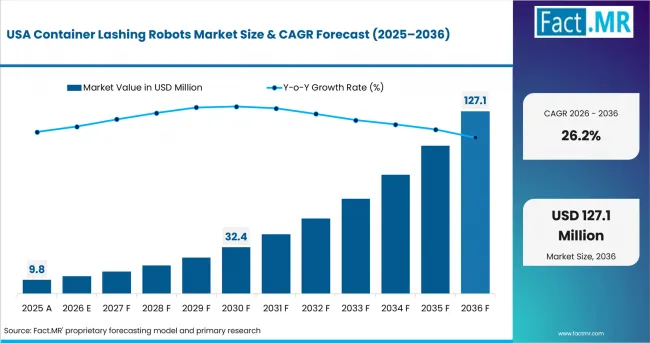
Container Lashing Robots Market Country Value Analysis | Source: Fact.MR
The United States is set to record 26.2% CAGR through 2036 as terminal operators and port automation vendors evaluate safer twistlock handling and remote inspection systems. Adoption will be gradual because labor rules and vessel variability matter. Growth will favor semi-automatic and supervised robotic units before fully automated concepts.
Who leads the container lashing robots market?
RAM Spreaders and MacGregor lead the most direct container securing automation coverage.
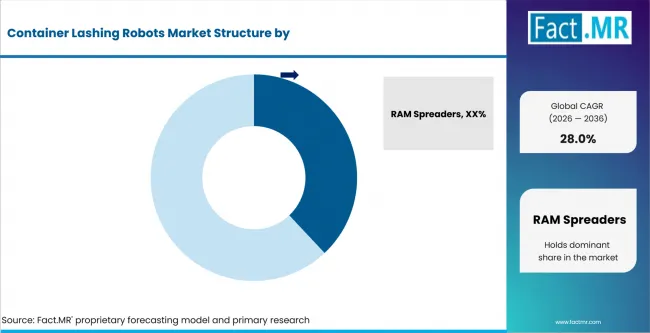
Container Lashing Robots Market Analysis By Company | Source: Fact.MR
Container lashing robots are supplied by twistlock automation specialists, container securing equipment suppliers, port automation vendors and robotics ecosystems. RAM Spreaders is directly relevant through PinSmart automated twistlock handling. MacGregor is directly relevant through automatic twistlocks and container lashing systems. Bromma / Kalmar supports the ecosystem through spreaders, spreader control and container handling upgrades.
ZPMC is relevant through automated terminal equipment scale and smart terminal projects. ABB Ports / ABB Robotics support robotic automation, AI and port automation capabilities, but it should be treated as an enabling ecosystem rather than a direct lashing robot supplier.
Competition through 2036 will be shaped by technology readiness and terminal workflow fit. Direct robotic lashing adoption will take time. Twistlock handling robots and remote safety tools are the most practical early commercial routes.
Which companies are the key providers?
RAM Spreaders and MacGregor are key providers. Bromma / Kalmar is also profiled. ZPMC and ABB Ports / ABB Robotics complete the company set.
- RAM Spreaders
- Bromma / Kalmar
- ZPMC
- MacGregor
- ABB Ports / ABB Robotics
Bibliography
- RAM Spreaders. (2026, February). PinSmart: Fully automated twistlock handling [PDF]. RAM Spreaders.
- MacGregor. (2025, June 30). MacGregor to deliver fully automatic twistlocks for Hapag-Lloyd’s 19,900 TEU vessels. MacGregor.
- ABB. (2025, June 5). AI accelerates productivity and safety in the world of ports. ABB.
- Bromma. (2025, October 27). Spreader options. Bromma.
- Shanghai Zhenhua Heavy Industries Co., Ltd. (2026). Port machinery and automated terminal equipment. ZPMC.
This Report Addresses
- Strategic intelligence on container lashing robots across automation level and operation.
- Segment analysis covering Robotic Units and Twistlock Handling.
- Regional outlook covering Singapore, Netherlands, China, Germany and the United States.
- Competitive analysis of RAM Spreaders, Bromma / Kalmar, ZPMC, MacGregor and ABB Ports / ABB Robotics.
- Technology assessment covering robot arms, mobile platforms, vision guidance, remote control and safety sensors.
- Use case assessment covering lashing, unlashing, twistlock handling, safety inspection and deck operations.
- Technology-readiness screening separates commercial twistlock handling from fully automated lashing concepts.
- Primary interviews, provider checks and official source review support the forecast.
What does the container lashing robots market cover?
Robotic and semi-robotic systems used for container lashing and quay-side safety tasks.
The container lashing robots market covers semi-automatic tools and fully automated concepts. These systems support lashing and deck operations.
The market differs from broad port automation because it is limited to robotic tools and handling systems used around container securing activities. It excludes ordinary spreaders and terminal software unless the revenue is tied to robotic lashing or automated safety inspection.
What is included in the scope?
Robotic lashing support tools and safety inspection systems.
The scope includes semi-automatic tools, robotic units, remote-operated lashing, fully automated concepts, twistlock handling, safety inspection, and deck operations.
Terminal type coverage includes container terminals and mega-vessel berths. Technology coverage includes robot arms and safety sensors. Buyer-type coverage includes terminal operators and stevedoring contractors.
What is excluded from the scope?
General cranes and terminal software without lashing automation are outside the scope.
The scope excludes conventional ship-to-shore cranes and manual lashing gear unless they are fitted with robotic twistlock handling or automated lashing functions. It also excludes full terminal operating systems and yard automation platforms when they do not include container lashing robot equipment.
How was the analysis built?
100+ sources, 40+ company portfolios, 25+ countries, 20+ interviews.
- Primary Research: Primary research includes interviews with terminal automation managers, stevedoring contractors and quay crane operations teams. It includes input from container equipment suppliers and port technology vendors.
- Desk Research: Desk research reviews official product brochures and robotic port equipment roadmaps.
- Market-Sizing and Forecasting: Forecasting uses container terminal automation adoption and technology-readiness screening.
- Data Validation and Update Cycle: Forecasts are validated through provider checks and technical interviews. Pilot readiness, equipment integration requirements and terminal safety priorities help confirm market direction.
Segmentation
What is the report’s scope and coverage?
| Attribute | Details |
|---|---|
| Quantitative Units | USD Million in 2026 to USD Million by 2036 at CAGR |
| Market Definition | Robotic and semi-robotic systems used for container lashing, unlashing, twistlock handling and quay-side safety tasks |
| Automation Level | Semi-automatic tools; robotic units; remote-operated lashing; fully automated concepts |
| Operation | Lashing; unlashing; twistlock handling; safety inspection; deck operations |
| Terminal Type | Container terminal; automated terminal; transshipment hub; mega-vessel berth |
| Technology | Robot arm; mobile platform; vision guidance; remote control; safety sensors |
| Buyer Type | Terminal operators; shipping lines; port automation vendors; stevedoring contractors |
| Regions Covered | North America; Western Europe; East Asia; South Asia; Latin America; Middle East and Africa |
| Countries Covered | Singapore; Netherlands; China; Germany; United States |
| Key Companies Profiled | RAM Spreaders; Bromma / Kalmar; ZPMC; MacGregor; ABB Ports / ABB Robotics |
| Forecast Period | 2026 to 2036 |
| Approach | Hybrid top-down and bottom-up approach using quay crane installed base, automated terminal adoption, twistlock handling workload, robotic unit pricing and technology-readiness screening |
Source: Fact.MR analysis. Updated Jul 4, 2026
How is the market segmented?
-
By Automation Level:
- Semi-automatic tools
- Robotic units
- Remote-operated lashing
- Fully automated concepts
-
By Operation:
- Lashing
- Unlashing
- Twistlock handling
- Safety inspection
- Deck operations
-
By Terminal Type:
- Container terminal
- Automated terminal
- Transshipment hub
- Mega-vessel berth
-
By Technology:
- Robot arm
- Mobile platform
- Vision guidance
- Remote control
- Safety sensors
-
By Buyer Type:
- Terminal operators
- Shipping lines
- Port automation vendors
- Stevedoring contractors
-
Region:
- North America
- United States
- Canada
- Mexico
- Western Europe
- Netherlands
- Germany
- United Kingdom
- Belgium
- Spain
- East Asia
- China
- Japan
- South Korea
- South Asia
- Singapore
- India
- Thailand
- Latin America
- Brazil
- Chile
- Middle East & Africa
- UAE
- Saudi Arabia
- South Africa
- North America
Frequently Asked Questions
Which automation level leads the Container Lashing Robots Market?
Which operation leads the Container Lashing Robots Market?
Which terminal type leads the Container Lashing Robots Market?
Which technology leads the Container Lashing Robots Market?
Which buyer type leads the Container Lashing Robots Market?
Which country expands fastest in the Container Lashing Robots Market?
How does the Netherlands perform in the Container Lashing Robots Market?
How does China perform in the Container Lashing Robots Market?
How does Germany perform in the Container Lashing Robots Market?
How does the United States perform in the Container Lashing Robots Market?
What is the primary driver in the Container Lashing Robots Market?
What is the main restraint in the Container Lashing Robots Market?
Why are robotic units important?
Why do terminal operators dominate demand?
Who worked on this report


Preview the report firsthand - request a free sample
Free SampleGet the brochure for pricing and purchase details
Download PDF