- Market Value (2025): USD 400.0 Mn
- Estimated Value (2026): USD 480.0 Mn
- Forecast Value (2036): USD 2972.0 Mn
- CAGR (2026-2036): 20.0%
What is the Corn Bio BDO Market forecast to be worth by 2036?
USD 480.0 million in 2026 to USD 2972.0 million by 2036 at a 20.0% CAGR.
- The Corn Bio BDO Market reached USD 400.0 million in 2025.
- Demand is projected to increase from USD 480.0 million in 2026 to USD 2972.0 million by 2036.
- The market is forecast to record 20.0% CAGR from 2026 to 2036 as polymer producers and fiber makers qualify corn-derived BDO for recurring production runs.
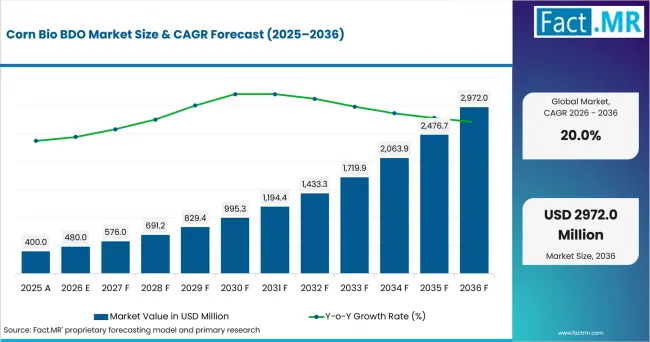
Corn Bio Bdo Market Value Analysis | Source: Fact.MR
What are the defining numbers behind Corn Bio BDO Market growth?
USD 2492.0 million absolute opportunity by 2036, led by bio-based grade, fermentation and polymers.
- Demand Drivers in the Market
- Polymer producers need a drop-in intermediate that keeps BDO functionality while replacing fossil carbon in selected product lines.
- Fiber makers are testing bio-derived BDO for elastane programs after Cargill highlighted in March 2025 Qore’s partnership with The LYCRA Company to use QIRA® in the production of bio-derived LYCRA® fiber.
- Biorefinery operators benefit from starch conversion depth. EIA reported 18,477 million gallons per year of U.S. fuel ethanol production capacity as of January 2025.
- Chemical brands need documented renewable feedstock content because claims travel from the intermediate producer to polymer converters and finished-goods customers.
- Key Segments Analyzed
- By Product: Bio-based grade is expected to hold 39.0% share in 2026 owing to direct fit with polymer and fiber specifications.
- By Process: Fermentation is projected to account for 42.0% share in 2026 since corn sugar conversion supports commercial bio-BDO production.
- By Function: Intermediate is anticipated to capture 35.0% share in 2026 because BDO is mainly purchased for downstream polymer chemistry.
- By Application: Polymers are estimated to represent 37.0% share in 2026 due to use in PBT, TPU, polyurethane and spandex value chains.
- Analyst Opinion at Fact.MR
- Shambhu Nath Jha, Principal Consultant at Fact.MR, states, "Corn bio BDO is moving from a renewable-content claim into a qualification problem. Producers have to prove purity, continuity and carbon documentation at the same time. Demand is expected to follow suppliers that combine fermentation know-how, product specification control and credible downstream partnerships."
- Strategic Implications
- Fermentation producers should document dextrose sourcing, batch consistency and product carbon claims for polymer customers.
- Polymer converters should qualify bio-BDO in existing resin lines before approving wider substitution across performance applications.
- Brand owners should connect bio-based content claims with contracts and certification records before scaling commercial launches.
- Regional distributors should support trial volumes with reliable inventory because application approval usually precedes recurring demand.
The USA is projected to record 22.0% CAGR through 2036 supported by corn feedstock depth and commercial QIRA production. Germany is anticipated to post 21.0% CAGR as its chemical base evaluates bio-based intermediates for polymer use. Japan is estimated to reach 19.6% CAGR through manufacturing R&D and specialty polymer applications. France is forecast to advance at 18.8% CAGR. Brazil is projected to register 18.0% CAGR owing to corn output and ethanol-linked industrial biology capability.
How does the Corn Bio BDO Market break down by segment?
Bio-based grade leads at 39.0%; fermentation leads at 42.0%.
Which Product dominates?
Bio-based grade is expected to hold 39.0% share in 2026.
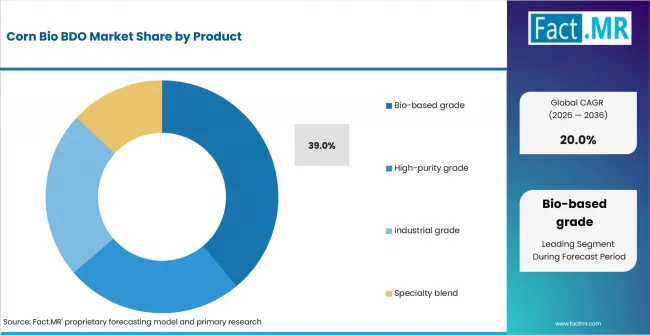
Corn Bio Bdo Market Analysis By Product | Source: Fact.MR
Bio-based grade leads because early customers need a renewable replacement that keeps the same BDO identity. HELM AG states that QIRA is derived from annually renewable crops and acts as an alternative to fossil-derived BDO used in consumer goods. That combination helps polymer makers change feedstock origin while protecting known processing behavior.
What leads the Process segment?
Fermentation is projected to account for 42.0% share in 2026.
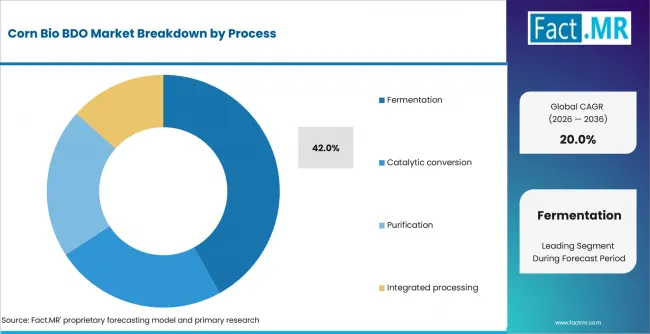
Corn Bio Bdo Market Analysis By Process | Source: Fact.MR
Fermentation leads the process segment because it converts corn sugar into BDO with a clear agricultural supply route. USDA ERS reported that 5.44 billion bushels of U.S. corn were used for fuel ethanol in 2024/25. This demonstrates the scale of corn use in U.S. ethanol production and provides broader context for corn-processing infrastructure relevant to bio-based BDO production.
How does Function shape demand?
Intermediate is anticipated to capture 35.0% share in 2026.
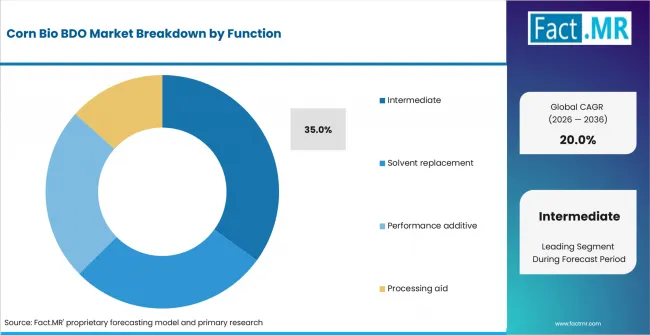
Corn Bio Bdo Market Analysis By Function | Source: Fact.MR
Intermediate use leads because BDO is bought mainly as a building block for materials. It links upstream fermentation to downstream chemistry in THF, PTMG, TPU and polyester routes. Function-level adoption is therefore tied to reliable specification control and evidence that final polymer properties remain within accepted ranges.
What supports demand for Polymers within Application?
Polymers are estimated to represent 37.0% share in 2026.
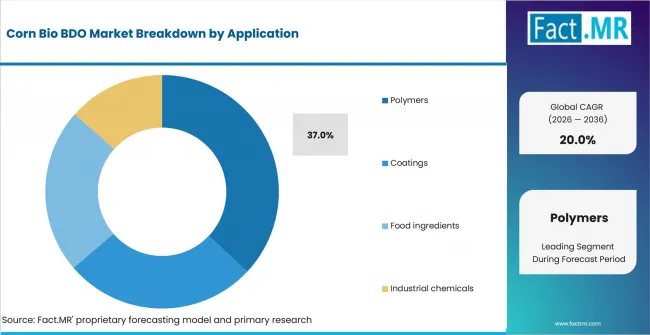
Corn Bio Bdo Market Analysis By Application | Source: Fact.MR
Polymers lead application demand because BDO feeds materials used in textiles, engineering plastics and polyurethane systems. Cargill highlighted in March 2025 Qore’s partnership with The LYCRA Company, linking QIRA® with bio-derived spandex and providing a named commercial use case for QIRA in bio-derived LYCRA® fiber, demonstrating its application potential in renewable-material textile production.
What is accelerating Corn Bio BDO Market adoption, and what is holding it back?
Demand is expected to rise through polymer substitution and fermentation capacity. Growth is constrained by cost, feedstock volatility and qualification cycles.
Drivers Impact Analysis
| DRIVER | (~) % IMPACT ON CAGR | GEOGRAPHIC RELEVANCE | IMPACT TIMELINE |
|---|---|---|---|
| Commercial corn-to-BDO fermentation capacity | +2.4% | USA, Europe, Japan | Short term (<= 2 years) |
| Polymer and fiber qualification for bio-based content | +1.8% | Global | Medium term (2-4 years) |
| Corn availability and biorefinery infrastructure | +1.4% | USA, Brazil | Medium term (2-4 years) |
| EU demand creation for bio-based materials | +1.0% | Germany, France | Long term (>= 4 years) |
- Commercial corn-to-BDO fermentation capacity: Eddyville production provides customers with an established reference plant for corn-based BDO supply, qualification and commercial-scale sourcing.
- Polymer and fiber qualification: BDO is familiar to polymer and fiber manufacturers, supporting qualification through traceability, formulation performance and compatibility with existing production requirements.
- Corn availability and biorefinery infrastructure: Established corn-processing systems in the United States and Brazil support feedstock access for producers connected to starch conversion and fermentation infrastructure.
- EU demand creation for bio-based materials: European bioeconomy initiatives are expected to support lead-market development and strengthen demand for bio-based materials, chemicals and related technologies.
Opportunity Impact Analysis
| OPPORTUNITY | (~) % IMPACT ON CAGR | GEOGRAPHIC RELEVANCE | IMPACT TIMELINE |
|---|---|---|---|
| Bio-based spandex and performance polymers | +1.5% | USA, Japan, Europe | Medium term (2-4 years) |
| Certified low-carbon intermediates for brand programs | +1.1% | Europe, North America | Long term (>= 4 years) |
| Regional partnerships around fermentation feedstocks | +0.8% | Brazil, USA | Long term (>= 4 years) |
- Bio-based spandex and performance polymers: Brands that need renewable content with existing polymer chemistry create a clear adoption path.
- Certified low-carbon intermediates: Procurement teams need documentation that links renewable feedstock claims to actual material flows.
- Regional feedstock partnerships: Corn processors and fermentation developers gain leverage when feedstock access is tied to repeatable material quality.
Restraints Impact Analysis
| RESTRAINT | (~) % IMPACT ON CAGR | GEOGRAPHIC RELEVANCE | IMPACT TIMELINE |
|---|---|---|---|
| Higher cost versus conventional BDO | -0.8% | Global | Short term (<= 2 years) |
| Feedstock and crop-yield volatility | -0.6% | USA, France, Brazil | Medium term (2-4 years) |
| Qualification cycles in polymer plants | -0.5% | Europe, Japan | Medium term (2-4 years) |
- Higher cost versus conventional BDO: Customers compare renewable-content value against price premiums in resin and fiber formulations.
- Feedstock volatility: Corn availability improves scale economics, although weather and ethanol demand influence delivered sugar costs.
- Qualification cycles: Polymer customers need proof that bio-BDO maintains processing behavior, finished-property performance and documented bio-based content.
Which countries are scaling the Corn Bio BDO Market through 2036?
- The country comparison spans 4.0 percentage points and forms three practical growth bands across the forecast period.
- The USA remains 1.0 percentage point above Germany through corn feedstock depth and QIRA’s commercial production base.
- Germany remains 1.4 percentage points above Japan due to its chemical export scale and EU bio-based materials policy.
- Japan remains 0.8 percentage point above France as specialty polymer users prioritize validated materials.
- France remains 0.8 percentage point above Brazil through petrochemical substitution and domestic crop planning.
- Brazil closes the displayed range through corn output and ethanol-linked biomanufacturing capability.
Comparable CAGRs create different entry conditions because corn feedstock access, chemical trade exposure and polymer qualification routes vary by country. Full report coverage includes North America, Latin America, Western Europe, Eastern Europe, East Asia, South Asia & Pacific, Middle East & Africa.
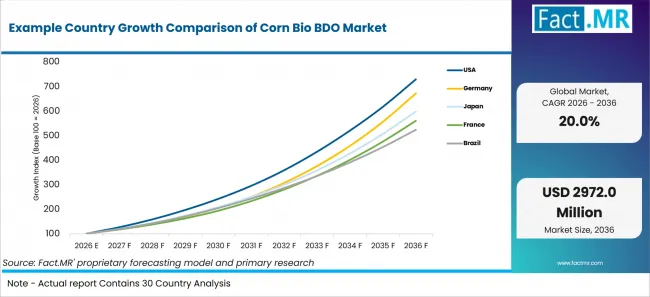
Example Country Growth Comparison Of Corn Bio Bdo Market | Source: Fact.MR
| Country | CAGR (2026-2036) |
|---|---|
| United States | 22.0% |
| Germany | 21.0% |
| Japan | 19.6% |
| France | 18.8% |
| Brazil | 18.0% |
What supports USA adoption?
22.0% CAGR, supported by corn availability and commercial fermentation capacity.
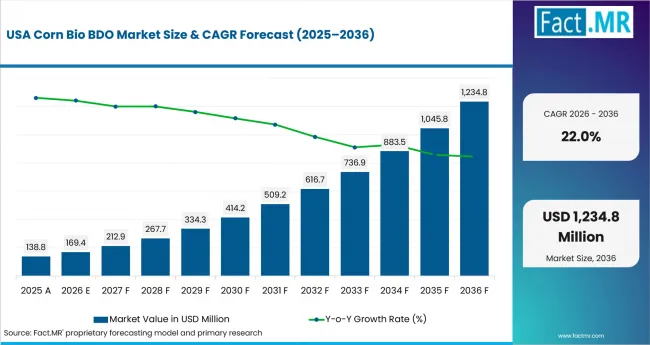
Corn Bio Bdo Market Country Value Analysis | Source: Fact.MR
U.S. adoption is tied to the connection between Midwestern corn supply and chemical-grade fermentation. USDA NASS estimated 95.3 million acres of corn planted in 2026, highlighting the scale of the U.S. corn production base. QIRA’s commercial-scale Iowa facility provides a domestic production reference point for polymer and materials manufacturers evaluating bio-based BDO as a drop-in alternative to fossil-derived BDO.
How is Germany scaling demand?
21.0% CAGR, led by chemical export depth and EU bio-based material programs.
Germany’s chemical users evaluate bio-BDO through an export-heavy manufacturing base. Eurostat reported Germany’s extra-EU exports of chemicals and related products at EUR 134 billion in 2024, demonstrating the scale of the country’s chemical export base. BASF’s biobased and biomass-balanced 1,4-BDO offerings provide renewable alternatives to conventional fossil-based BDO within established chemical value chains.
How does Japan perform?
19.6% CAGR, driven by specialty polymers and manufacturing R&D capacity.
Japan’s demand is linked to specialty polymer qualification and internal process validation. MEXT reported in June 2026 that 56.9% of surveyed companies hired R&D researchers, indicating active corporate demand for research personnel in Japan. Bio-BDO suppliers serving Japanese materials manufacturers are likely to compete on product specifications, technical documentation and qualification support for downstream applications.
What supports France growth?
18.8% CAGR, backed by bio-based substitution and chemical-export demand.
France is using bio-based substitution to reduce exposure to fossil petrochemical routes. France’s statistical service reported in July 2026 that the petrochemical industry consumed 5.3 million tonnes of petroleum-based raw materials in 2025. The figure illustrates the scale of conventional petrochemical feedstock use and provides broader context for potential renewable-intermediate substitution.
How is Brazil developing demand?
18.0% CAGR, supported by corn output and ethanol-linked industrial biology.
Brazil’s demand is tied to agricultural output and fermentation know-how from ethanol value chains. IBGE estimated Brazilian corn production at 141.7 million tonnes for the 2025 harvest, highlighting the scale of the country’s corn-production base. This provides broader feedstock context for fermentation-based industries. Commercial bio-BDO partnerships can connect renewable-feedstock production with process technology and downstream conversion, as demonstrated by Qore’s supply agreement with BASF.
Who leads the Corn Bio BDO Market?
Cargill and HELM are Qore’s joint-venture parents. BASF participates through long-term access to QIRA and also offers biobased and biomass-balanced BDO variants.
HELM AG’s July 2025 announcement confirmed the start of QIRA production and described QIRA as the world’s first large-scale 1,4-butanediol made from locally grown dent corn. Competitive positioning is likely to be shaped by commercial production scale, technology partnerships, downstream integration and the ability to move bio-derived BDO through established chemical and polymer value chains.
Which companies are the key providers?
Key companies include Again (Genomatica/Geno), Cargill, Incorporated, BASF SE, and Qore, LLC.
- Again (Genomatica/Geno)
- Cargill, Incorporated
- BASF SE
- Qore, LLC
Bibliography
- U.S. Department of Agriculture, National Agricultural Statistics Service. (2026, June 30). Corn planted acreage down 3% from 2025, soybean acreage up 5% from last year.
- Ramsey, S. (2026, May 12). U.S. ethanol exports continue to reach new highs. U.S. Department of Agriculture, Economic Research Service.
- U.S. Energy Information Administration. (2025, October 27). U.S. biofuels production capacity growth slowed in 2024.
- U.S. Energy Information Administration. (2025, September 26). U.S. fuel ethanol plant production capacity.
- HELM AG. (2025, July 10). Qore launches in Eddyville, Iowa, ushering in large-scale corn processing for bio-based solutions.
- Cargill, Incorporated. (2025, March 27). Not a stretch: How Qore’s new partnership with LYCRA® means more sustainable (and stretchy) apparel for consumers.
- Directorate-General for Communication. (2025, July 8). Plan for stronger EU chemical industry. European Commission.
- Directorate-General for Communication. (2025, November 27). New plan to unlock the bioeconomy’s potential. European Commission.
- Eurostat. (2025, September 29). EU exports of chemicals reach a new record high.
- Eurostat. (2025, December 16). EU chemical production: -15% over 10 years.
- Caray, J. (2025, December 16). Grandes cultures. Surfaces des cultures d’hiver en hausse en 2026 et relèvement des prévisions sur les récoltes d’automne 2025. Agreste.
- Service des données et études statistiques. (2026, July 23). L’activité de la pétrochimie en France baisse de 11 % en 2025. Ministère de la Transition écologique.
- Brazilian Institute of Geography and Statistics. (2026, January 15). In December, IBGE forecasts harvest of 346.1 million tonnes for 2025, 339.8 million tonnes for 2026. IBGE News Agency.
This Report Answers
- The report explains where corn-derived BDO fits within bio-based intermediate supply and downstream polymer conversion.
- Segment analysis identifies the leading product, process, function and application categories and the reasons behind buyer selection.
- Country analysis examines the listed markets and the feedstock, chemical and policy conditions that support adoption.
- Competitive analysis reviews providers across fermentation technology, corn refining, bio-based BDO and BDO derivative value chains.
- Application analysis assesses how polymer performance, traceability and cost affect purchase decisions.
What does the Corn Bio BDO Market cover?
The Corn Bio BDO Market covers 1,4-butanediol produced from corn-derived sugar streams and sold as a renewable-content intermediate. It includes material used in polymer production, fiber chemistry, solvent replacement and performance additive applications.
Platform chemical screening often begins with a wider renewable-input map. Bio-based platform chemicals analysis helps place corn bio BDO within that broader intermediate group.
What is included in the scope?
The scope includes commercial or qualified corn-derived BDO, fermentation-based BDO routes, bio-based grades and high-purity material used by chemical processors. Low carbon chemicals coverage is relevant where procurement teams compare carbon claims across industrial inputs.
It includes supplier activity from Again (Genomatica/Geno), Cargill, BASF, and Qore where first-hand pages support BDO, bio-BDO, technology or derivative-market relevance.
What is excluded from the scope?
The scope places fossil-only BDO sold with no renewable feedstock claim outside the market boundary. Ethanol, butanol, succinic acid and other platform chemicals stay outside the boundary unless they directly support corn bio BDO production or downstream qualification.
General agricultural corn trading remains outside the market boundary unless the volume or policy point directly affects dextrose supply for fermentation. Finished polymer goods remain outside the boundary when BDO is absent as a traceable intermediate input.
How Was the Analysis Built?
The analysis draws on 120+ sources, 35+ company portfolios, 25+ countries, and more than 20 industry interviews.
- Primary Research: Primary research includes discussions with manufacturers, service providers, technology developers, distributors, end users, and subject-matter experts. These conversations examine purchasing priorities, product adoption, operational challenges, approval requirements, competitive positioning, and the factors that influence wider market acceptance.
- Desk Research: Desk research covers government statistics, regulatory publications, company filings, trade data, technical studies, industry associations, standards, public policy, and other authoritative sources. Every source used in the analysis is documented in the bibliography.
- Market Sizing and Forecasting: Market estimates combine historical performance, demand indicators, pricing and volume trends, segment shares, company participation, country-level growth, adoption patterns, investment activity, and barriers to market expansion.
- Data Validation and Update Cycle: Findings are validated by comparing primary interviews with public data, company activity, regulatory changes, trade patterns, and industry developments. Regular updates review new product launches, capacity changes, partnerships, approvals, and shifts in commercial adoption.
What is the report’s scope and coverage?
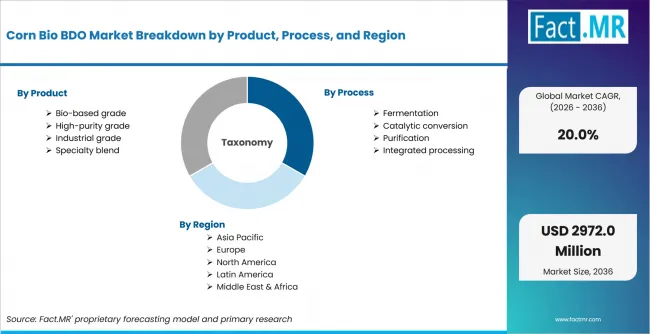
Corn Bio Bdo Market Breakdown By Product, Process, And Region | Source: Fact.MR
| Attribute | Details |
|---|---|
| Quantitative Units | USD million in 2026 to USD million by 2036 at a CAGR |
| Market Definition | Corn bio BDO covers 1,4-butanediol produced from corn-derived sugars or dextrose and sold as a bio-based intermediate for polymer, fiber, coating, solvent-replacement and industrial chemical use. |
| Product | Bio-based grade; High-purity grade; Industrial grade; Specialty blend |
| Process | Fermentation; Catalytic conversion; Purification; Integrated processing |
| Function | Intermediate; Solvent replacement; Performance additive; Processing aid |
| Application | Polymers; Coatings; Food ingredients; Industrial chemicals |
| Regions Covered | North America; Latin America; Western Europe; Eastern Europe; East Asia; South Asia & Pacific; Middle East & Africa |
| Countries Covered | United States; Germany; Japan; France; Brazil |
| Key Companies Profiled | Again (Genomatica/Geno); Cargill, Incorporated; BASF SE; Qore, LLC |
| Forecast Period | 2026 to 2036 |
| Approach | Hybrid top-down and bottom-up approach using corn feedstock availability, fermentation capacity, BDO derivative demand, segment shares, country growth, application qualification and company portfolio review. |
How is the market segmented?
-
By Product
- Bio-based grade
- High-purity grade
- Industrial grade
- Specialty blend
-
By Process
- Fermentation
- Catalytic conversion
- Purification
- Integrated processing
-
By Function
- Intermediate
- Solvent replacement
- Performance additive
- Processing aid
-
By Application
- Polymers
- Coatings
- Food ingredients
- Industrial chemicals
-
By Region
- North America
- Latin America
- Western Europe
- Eastern Europe
- East Asia
- South Asia & Pacific
- Middle East & Africa