- Market Value (2025): USD 351.7 Mn
- Estimated Value (2026): USD 415.0 Mn
- Forecast Value (2036): USD 2172.0 Mn
- CAGR (2026-2036): 18.0%
What is the Bio Aviation Composites Market forecast to be worth by 2036?
USD 415.0 million in 2026 to USD 2,172.0 million by 2036 at an 18.0% CAGR.
- The bio aviation composites market reached USD 351.7 million in 2025.
- Demand is projected to increase from USD 415.0 million in 2026 to USD 2,172.0 million by 2036 as aviation-adjacent qualification expands.
- The market is forecast to record 18.0% CAGR from 2026 to 2036 as aircraft suppliers, coating formulators and cabin-component manufacturers qualify bio-derived material systems for lighter parts and repairable surfaces.
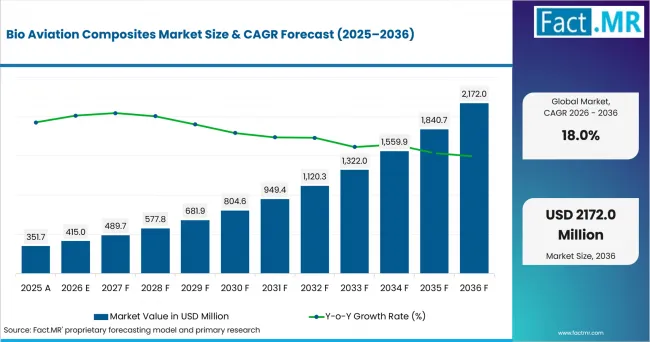
Bio Aviation Composites Market Value Analysis | Source: Fact.MR
What are the defining numbers behind Bio Aviation Composites Market growth?
USD 1,757.0 million absolute opportunity by 2036, led by polyurethane chemistry, liquid coating form and self-repair performance.
- Demand Drivers in the Market
- Airframe engineering teams need lower-weight materials that reduce fuel burn while preserving fatigue behavior and repair quality over long service cycles.
- Cabin-interior manufacturers need resin systems with clearer bio-content claims, especially where airlines ask for lower-carbon materials without changing certified geometry.
- Maintenance teams need self-repair surfaces that slow scratch propagation and moisture ingress, so coatings remain useful between scheduled inspection windows.
- Composite fabricators need biocomposites that process on existing coating, film and prepreg lines, since new aviation materials face long approval cycles.
- Key Segments Analyzed
- By Chemistry: Polyurethane at 36.0% share in 2026 due to flexible film, coating and impact-resistance needs in cabin and secondary parts.
- By Form: Liquid coating at 41.0% share in 2026 owing to retrofit use, repair compatibility and easier application on curved composite surfaces.
- By Performance: Self-repair at 44.0% share in 2026 because operators value surfaces that limit damage spread after abrasion or small impact events.
- By Application: Automotive at 32.0% share in 2026 within the report's broader application taxonomy, with automotive serving as an adjacent scale-up and qualification pathway for high-rate mobility materials.
- Analyst Opinion at Fact.MR
- Shambhu Nath Jha, Principal Consultant at Fact.MR, states, “Bio aviation composites are drawing attention because qualification teams now ask for carbon evidence beside mechanical performance. Demand is expected to move first in coatings, interiors and secondary structures where certification risk is easier to manage. Suppliers that combine bio-content documentation, repair data and repeatable processing records are better placed to win longer aerospace programs.”
- Strategic Implications
- Resin suppliers should document bio-content, smoke behavior and lot consistency before approaching aerospace customers with polyurethane or epoxy systems.
- Composite converters should test liquid coatings on actual curved parts so adhesion and repair behavior are clear before airline or OEM review.
- Aircraft interiors teams should separate near-term cabin opportunities from primary-structure claims, since approval timelines differ sharply by part type.
- Material distributors should maintain traceable batches and application guides, allowing maintenance teams to compare bio-derived products with incumbent systems.
Germany is forecast to record 23.4% CAGR through 2036 due to transport-equipment orders and aerospace composite processing activity. The USA is expected to advance at 20.9% CAGR as aviation activity and defense airframe programs support qualification demand. Japan is projected to post 20.2% CAGR, shaped by high-value parts policy and domestic materials depth. The UK is anticipated to reach 19.8% CAGR, led by public green-aerospace funding. South Korea is estimated to record 15.6% CAGR while export scale and aerospace SME capability support gradual entry.
How does the Bio Aviation Composites Market break down by segment?
Polyurethane leads at 36.0%; Liquid coating leads at 41.0%.
Which Chemistry dominates?
Polyurethane at 36.0% share in 2026.
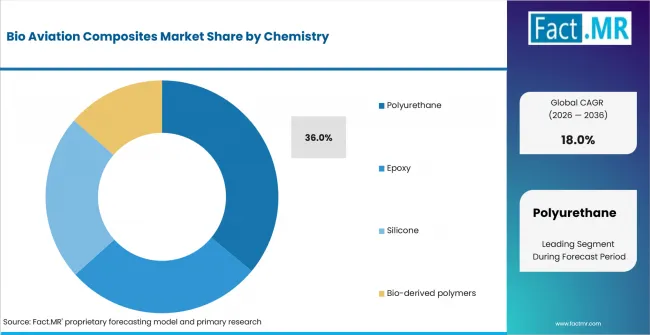
Bio Aviation Composites Market Analysis By Chemistry | Source: Fact.MR
Polyurethane leads the chemistry mix because it offers flexible protective behavior for surfaces that face vibration, abrasion and moisture. Bio-derived polyurethane systems are most practical when they serve coatings, films or interior laminates before moving toward more demanding structural work.
Formulators also favor polyurethane where liquid application can cover curved composite parts without adding heavy fasteners. The chemistry fits the market boundary because it supports protective performance while leaving room for bio-based polyol development and lower-carbon sourcing.
What leads the Form segment?
Liquid coating at 41.0% share in 2026.
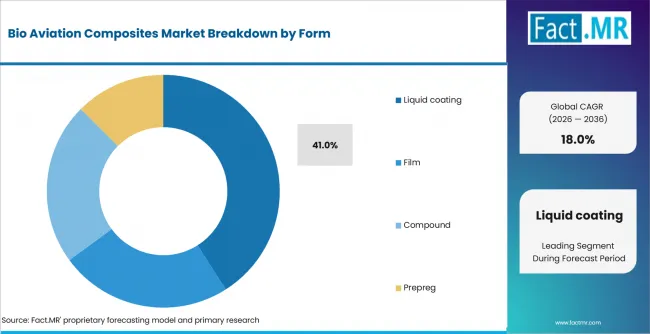
Bio Aviation Composites Market Analysis By Form | Source: Fact.MR
Liquid coating leads because aviation materials often enter service through repair, refinish and surface-protection routes. A coating format lets suppliers work around existing part geometry and maintenance workflows without redesigning the full composite stack.
The form also supports targeted use on cabin panels, fairings and composite surfaces where film bonding is less convenient. Bio-derived liquid systems gain attention when they preserve adhesion, impact tolerance and appearance after repeated cleaning cycles.
How does Performance shape demand?
Self-repair at 44.0% share in 2026.
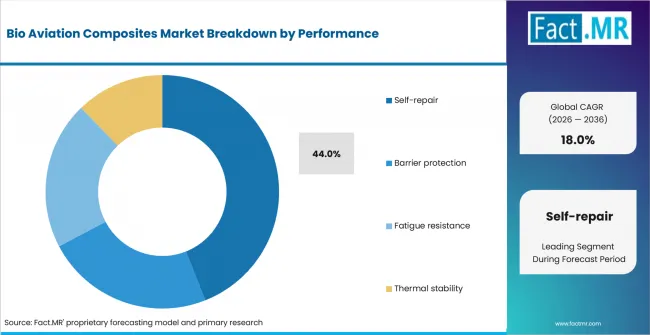
Bio Aviation Composites Market Analysis By Performance | Source: Fact.MR
Self-repair performance leads because damage control carries direct value for aircraft operators. Small scratches, moisture paths and edge wear can raise inspection effort, so material teams favor surfaces that slow visible damage before repair is scheduled.
The segment also fits bio aviation composites because protective coatings can show performance gains before primary structures change. That sequencing lowers adoption risk and allows suppliers to collect repeatable maintenance data over several duty cycles.
What supports Automotive within Application?
Automotive at 32.0% share in 2026.
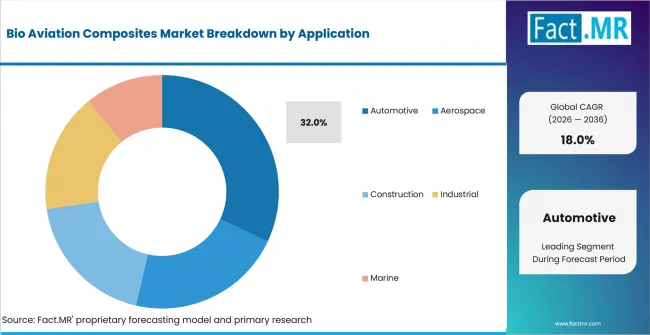
Bio Aviation Composites Market Analysis By Application | Source: Fact.MR
Automotive holds the leading application share because high-spec mobility programs absorb new composite formats faster than certified airframes. Material suppliers use automotive volumes to improve process control, durability evidence and cost learning for adjacent aerospace programs.
The link is especially relevant for aerospace composite materials that need manufacturing proof before certification. Automotive use remains separate from aviation testing. It still provides a practical route for refining bio-derived chemistry at higher production rates.
What is accelerating Bio Aviation Composites Market adoption, and what is holding it back?
Demand is expected to rise through lower-weight materials and bio-derived coating needs. Growth is constrained by aviation qualification, feedstock consistency and supply volatility.
Drivers Impact Analysis
| DRIVER | (~) % IMPACT ON CAGR | GEOGRAPHIC RELEVANCE | IMPACT TIMELINE |
|---|---|---|---|
| Qualification need for lower-carbon aviation materials | +2.0% | North America, Europe, East Asia | Medium term (2-4 years) |
| Weight reduction in cabin and secondary parts | +1.7% | Global | Short term (<= 2 years) |
| High-rate thermoplastic and coating processes | +1.2% | Europe, Japan | Medium term (2-4 years) |
| Public aerospace R&D funding for composite structures | +0.9% | UK, Germany, USA, Japan | Long term (>= 4 years) |
Source: Fact.MR analysis. Updated Aug 27, 2026
- Qualification need for lower-carbon aviation materials: Aircraft OEMs and interiors suppliers are asking for carbon evidence beside mechanical data. Bio-derived resin systems gain entry when they make sustainability claims easier to audit.
- Weight reduction in cabin and secondary parts: Lightweight composite surfaces reduce mass without changing aircraft architecture. Bio-content adds value when it fits the same repair and cleaning practices used on existing parts.
- High-rate thermoplastic and coating processes: The HELUES demonstrator provides an adjacent benchmark for high-rate thermoplastic aerospace processing; the example is used here as a processing reference rather than direct evidence of bio-derived composite adoption.
Opportunity Impact Analysis
| OPPORTUNITY | (~) % IMPACT ON CAGR | GEOGRAPHIC RELEVANCE | IMPACT TIMELINE |
|---|---|---|---|
| Bio-derived polyurethane protective coatings | +1.1% | Global | Short term (<= 2 years) |
| Recyclable PEKK and thermoplastic demonstrators | +0.9% | Europe, North America | Medium term (2-4 years) |
| Liquid-coating retrofit for interiors and panels | +0.7% | North America, Europe | Short term (<= 2 years) |
Source: Fact.MR analysis. Updated Aug 27, 2026
- Bio-derived polyurethane protective coatings: Suppliers can target cabin, fairing and secondary-surface uses where liquid formats align with repair practice and qualification risk is lower.
- Recyclable PEKK and thermoplastic demonstrators: Thermoplastic programs create routes for faster forming and future circularity claims, especially where aerospace customers want cleaner material records.
- Liquid-coating retrofit for interiors and panels: Maintenance channels create a repeat use case when coatings protect existing composite parts without requiring a full component redesign.
Restraints Impact Analysis
| RESTRAINT | (~) % IMPACT ON CAGR | GEOGRAPHIC RELEVANCE | IMPACT TIMELINE |
|---|---|---|---|
| Flight qualification and certification test burden | -0.8% | Global | Medium term (2-4 years) |
| Bio-feedstock consistency and resin lot control | -0.6% | Global | Short term (<= 2 years) |
| Aerospace material supply volatility | -0.4% | USA, Europe, East Asia | Medium term (2-4 years) |
Source: Fact.MR analysis. Updated Aug 27, 2026
- Flight qualification and certification test burden: Aviation materials need evidence on flammability, smoke behavior, fatigue and repair. Testing slows substitution even where bio-derived content is attractive.
- Bio-feedstock consistency and resin lot control: Aerospace customers need repeatable chemistry over several batches. Variability in bio-based inputs can raise retesting work before approval.
- Aerospace material supply volatility: Changes in transport-equipment orders can disrupt qualification schedules. Germany showed this risk when other transport equipment orders fell 41.7% in June 2026 after several large-scale orders had driven an 85.0% increase in May.
Which countries are scaling the Bio Aviation Composites Market through 2036?
- The country comparison spans 7.8 percentage points between Germany and South Korea across the forecast period.
- Germany remains 2.5 percentage points above the USA as transport-equipment orders and thermoplastic composite programs strengthen local qualification routes.
- The USA remains 0.7 percentage point above Japan because aviation activity, defense aircraft programs and composite material testing support higher conversion potential.
- Japan remains 0.4 percentage point above the UK as high-value parts policy and domestic material suppliers support aerospace production needs.
- The UK remains 4.2 percentage points above South Korea through public green-aerospace funding and composite structure projects.
- South Korea closes the displayed range while export scale and aerospace SME clusters create a gradual route into bio-derived aviation materials.
Comparable CAGRs create different entry conditions due to certification culture, aircraft production exposure, public R&D programs and supplier depth. Full report coverage includes North America, Latin America, Western Europe, Eastern Europe, East Asia, South Asia & Pacific, Middle East & Africa.
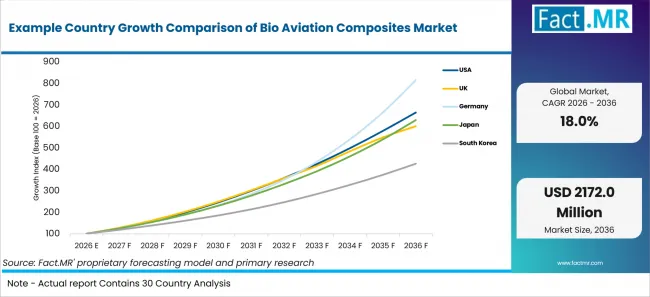
Example Country Growth Comparison Of Bio Aviation Composites Market | Source: Fact.MR
| Country | CAGR (2026-2036) |
|---|---|
| Germany | 23.4% |
| USA | 20.9% |
| Japan | 20.2% |
| UK | 19.8% |
| South Korea | 15.6% |
Source: Fact.MR analysis. Updated Aug 27, 2026
What supports Germany adoption?
23.4% CAGR, supported by transport-equipment orders and thermoplastic composite processing.
German aerospace and transport-equipment programs create an entry point for bio-derived composites when the material record is tied to active production. Destatis reported in July 2026 that new orders in other transport equipment rose 85.0% in May 2026 from the previous month. Destatis also reported in August 2026 that production in other transport equipment rose 8.4% in June 2026. The 23.4% CAGR reflects that qualification base. As an adjacent processing benchmark, Arkema and Hexcel highlighted the HELUES demonstrator in June 2025, showing PEKK and carbon-fiber forming in less than two minutes for aircraft structures.
How is the USA scaling demand?
20.9% CAGR, led by aviation activity and long-cycle manufacturing backlogs.
U.S. aerospace programs favor composite systems that have defense validation and a clear record for repeatable processing. The FAA published preliminary calendar-year 2025 passenger boarding and all-cargo airport data in June 2026, with updated datasets posted in July, providing current aviation-activity context for aerospace material planning. The U.S. Census Bureau reported in August 2026 that unfilled manufactured-goods orders reached USD 1,590.6 billion in June 2026. Toray Advanced Composites stated in June 2025 that its T1100/3960 carbon-fiber prepreg had been selected for the U.S. Army’s FLRAA program for use in primary airframe structures. The 20.9% CAGR reflects a route from defense qualification into cabin and secondary-structure material use.
What supports Japan adoption?
20.2% CAGR, backed by high-value parts policy and domestic material suppliers.
Japan’s aerospace material route is tied to high-value parts policy and domestic carbon-fiber expertise. METI’s FY2025 machine-parts vision aims to raise the customer share in high-value fields such as aerospace from 30% to 50% by 2040. The Cabinet Office reported in August 2026 that machinery orders received by 280 manufacturers increased 0.4% in June 2026. The 20.2% CAGR reflects selective material qualification where bio-derived resin records can be matched with Toray-linked prepreg and thermoplastic knowledge.
How is the UK developing demand?
19.8% CAGR, shaped by green-aerospace funding and composite-structure projects.
UK demand is tied to government-backed green aerospace projects and composite structures that can lower aircraft mass. The UK government announced more than GBP 250 million in joint government-and-industry investment for green aerospace projects in June 2025. The announcement included a GBP 15.8 million High Rate Manufacture Capital Acquisition project to support high-rate manufacturing of large composite structures such as wing covers, with applications including fan cases. The Aerospace Technology Institute Programme has been allocated GBP 975 million in government funding for financial years 2025–26 through 2029–30. The 19.8% CAGR reflects the fit between bio-derived coatings and cabin or secondary parts, where approval is more practical than primary-structure replacement.
What supports South Korea adoption?
15.6% CAGR, supported by export scale and aerospace SME capability.
South Korea’s entry path depends on export-oriented manufacturers and aerospace SME capability. MOTIR reported in May 2026 that South Korea’s first-quarter exports reached USD 219.9 billion under the revised MTI code standards. MOTIR reported in January 2026 that exports reached a record USD 709.7 billion in 2025, up 3.8% from 2024. Under the revised MTI framework, 20 major export items accounted for 86.3% of Korea’s total exports in 2025. The 15.6% CAGR reflects a gradual route for liquid coatings and prepregs when suppliers connect material evidence with precision manufacturing customers.
Who leads the Bio Aviation Composites Market?
Toray Advanced Composites, Hexcel and Syensqo participate in the aerospace composites market through carbon fiber, prepreg, resin and other advanced composite technologies. Toray highlighted its aerospace and defense materials portfolio in June 2025 ahead of the Paris Air Show, while a five-year carbon-fiber supply agreement between Syensqo and Toray took effect in January 2026.
Hexcel and Arkema support thermoplastic composite development through PEKK and carbon-fiber demonstrator work, including the HELUES project. Hexcel also announced a long-term industrial partnership and supply agreement with Deutsche Aircraft in June 2026 to provide advanced composite solutions for primary and secondary structures on the D328eco regional aircraft.
Bcomp and Gurit add bio-based and engineered composite capabilities that can serve cabin, secondary structure and specialty mobility applications. Competition centers on qualification records, bio-content documentation, processing repeatability and the ability to support aircraft material approvals without overstating sustainability claims.
Which companies are the key providers?
Key companies include Bcomp Ltd.; Gurit Holding AG; Syensqo SA; Arkema SA; and Toray Advanced Composites.
- Bcomp Ltd.
- Gurit Holding AG
- Syensqo SA
- Arkema SA
- Toray Advanced Composites
Bibliography
- Arkema. (2025, June 18). HELUES project: Arkema and Hexcel highlight thermoplastics breakthrough at Paris Air Show.
- Department for Business and Trade. (2025, June 17). £250m for green aerospace projects ahead of Industrial Strategy. GOV.UK.
- Federal Statistical Office (Destatis). (2026, July 6). New orders in manufacturing in May 2026: +1.9% on the previous month.
- Federal Statistical Office (Destatis). (2026, August 6). New orders in manufacturing in June 2026: +3.1% on the previous month.
- Federal Statistical Office (Destatis). (2026, August 7). Production in June 2026: +0.2% on the previous month.
- Federal Aviation Administration. (2026, July 15). Passenger boarding (enplanement) and all-cargo data for U.S. airports.
- Ministry of Economy, Trade and Industry. (2025, March 28). FY2025 vision for the machine parts and tooling industries formulated.
- Ministry of Trade, Industry and Resources. (2026, May 6). Korea’s Q1 2026 exports reach record high under revised MTI code standards.
- Syensqo. (2026, April 14). Syensqo and Toray Group strengthen aerospace supply security through strategic partnership.
- Toray Advanced Composites. (2025, June 4). Toray reinforces long-term commitment to aerospace and defense innovation at the 2025 Paris Air Show.
- U.S. Census Bureau. (2026, August 4). Monthly full report on manufacturers’ shipments, inventories, & orders.
This Report Answers
- The report explains where bio aviation composites are used across chemistry, form, performance and application. It also reviews regional demand conditions.
- Segment analysis identifies the leading subsegments and the practical reasons material teams prioritize coatings, self-repair behavior and polyurethane chemistry.
- Country analysis examines Germany, the USA, Japan, the UK and South Korea through country-specific evidence and CAGR comparison.
- Competitive analysis reviews current providers across bio-based natural fibers, aerospace prepregs, thermoplastic systems and specialty resin technology.
- Application analysis assesses how aviation use connects with automotive, marine and industrial qualification pathways while preserving market shares.
What does the Bio Aviation Composites Market cover?
The Bio Aviation Composites Market covers materials used to lower weight, protect surfaces and add bio-derived content to aircraft-adjacent composite systems. It includes liquid coatings, films, compounds and prepregs used where mechanical evidence and processing control support aviation or high-spec mobility requirements.
The assessment covers polyurethane, epoxy, silicone and bio-derived polymer chemistry. It also evaluates self-repair, barrier protection, fatigue resistance and thermal stability across automotive, aerospace, construction, industrial and marine applications linked to aerospace parts manufacturing.
What is included in the scope?
The scope includes bio-derived or bio-based composite materials, protective coatings, films, compounds and prepregs that support aviation or aviation-adjacent qualification needs. It includes materials that require composites testing before use in demanding transport environments.
It also includes engineered systems that use advanced polymer composites where bio-derived content, repair behavior and documented process control influence supplier selection.
What is excluded from the scope?
The scope excludes general packaging bioplastics outside aviation-grade composite systems. It also excludes standalone feedstocks such as bio-based 1,4-butanediol sold outside qualified composite, coating or resin applications.
Raw carbon fiber, general aerospace hardware and unrelated aircraft maintenance chemicals fall outside the scope unless they form part of a bio-derived composite system. Conventional composites are included only when the product has a clear bio-derived material component.
How Was the Analysis Built?
The analysis draws on 120+ sources, 35+ company portfolios, 25+ countries, and more than 20 industry interviews.
- Primary Research: Primary research includes discussions with manufacturers, service providers, technology developers, distributors, end users, procurement teams, and subject-matter experts. These conversations examine purchasing priorities, product adoption, operational challenges, approval requirements, competitive positioning, and the factors that influence wider market acceptance.
- Desk Research: Desk research covers government statistics, regulatory publications, company filings, trade data, technical studies, industry associations, standards, public policy, and other authoritative sources. Every source used in the analysis is documented in the bibliography.
- Market Sizing and Forecasting: Market estimates combine historical performance, demand indicators, pricing and volume trends, segment shares, company participation, country-level growth, adoption patterns, investment activity, and barriers to market expansion.
- Data Validation and Update Cycle: Findings are validated by comparing primary interviews with public data, company activity, regulatory changes, trade patterns, and industry developments. Regular updates review new product launches, capacity changes, partnerships, approvals, procurement trends, and shifts in commercial adoption.
Segmentation
What is the report’s scope and coverage?
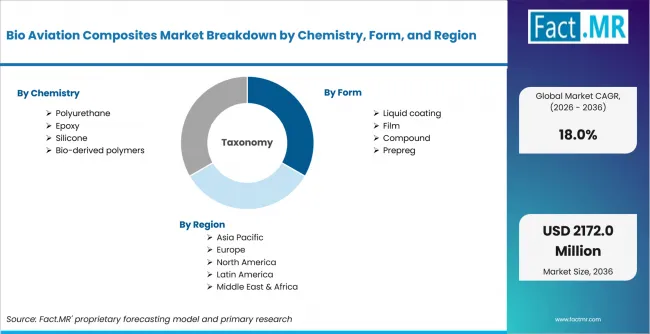
Bio Aviation Composites Market Breakdown By Chemistry, Form, And Region | Source: Fact.MR
| Attribute | Details |
|---|---|
| Quantitative Units | USD million |
| Market Definition | Bio aviation composites are composite materials, coatings, films, compounds and prepregs that use bio-derived or bio-based chemistry for aviation, cabin, mobility and adjacent high-performance applications. |
| Chemistry | Polyurethane; Epoxy; Silicone; Bio-derived polymers |
| Form | Liquid coating; Film; Compound; Prepreg |
| Performance | Self-repair; Barrier protection; Fatigue resistance; Thermal stability |
| Application | Automotive; Aerospace; Construction; Industrial; Marine |
| Regions Covered | North America; Latin America; Western Europe; Eastern Europe; East Asia; South Asia & Pacific; Middle East & Africa |
| Countries Covered | United States; United Kingdom; Germany; Japan; South Korea |
| Key Companies Profiled | Bcomp Ltd.; Gurit Holding AG; Syensqo SA; Arkema SA; Toray Advanced Composites |
| Forecast Period | 2026 to 2036 |
| Approach | Hybrid top-down and bottom-up approach using material qualification routes, aerospace activity, supplier portfolios, country indicators and segment-level application behavior. |
Source: Fact.MR analysis. Updated Aug 27, 2026
How is the market segmented?
-
By Chemistry:
- Polyurethane
- Epoxy
- Silicone
- Bio-derived polymers
-
By Form:
- Liquid coating
- Film
- Compound
- Prepreg
-
By Performance:
- Self-repair
- Barrier protection
- Fatigue resistance
- Thermal stability
-
By Application:
- Automotive
- Aerospace
- Construction
- Industrial
- Marine
-
By Region:
- North America
- Latin America
- Western Europe
- Eastern Europe
- East Asia
- South Asia & Pacific
- Middle East & Africa
Frequently Asked Questions
How big is the Bio Aviation Composites Market in 2026?
What is the CAGR of the Bio Aviation Composites Market from 2026 to 2036?
Which chemistry leads the Bio Aviation Composites Market?
Which form leads the Bio Aviation Composites Market?
Who are the leading companies in the Bio Aviation Composites Market?
Who worked on this report


Preview the report firsthand - request a free sample
Free SampleGet the brochure for pricing and purchase details
Download PDF