- Market Value (2025): USD 501.3 Mn
- Estimated Value (2026): USD 532.9 Mn
- Forecast Value (2036): USD 981.7 Mn
- CAGR (2026-2036): 6.3%
What is the Defibrillator Pads Market forecast to be worth by 2036?
USD 532.9 million in 2026 to USD 981.7 million by 2036, at a 6.3% CAGR.
- As per Fact.MR analysis, the defibrillator pads market reached USD 501.3 million in 2025.
- Sales are projected to increase from USD 532.9 million in 2026 to USD 981.7 million by 2036.
- The market is forecast to record a 6.3% CAGR during 2026 to 2036 as hospitals and community AED operators replace single-use pads and maintain ready-to-use devices.
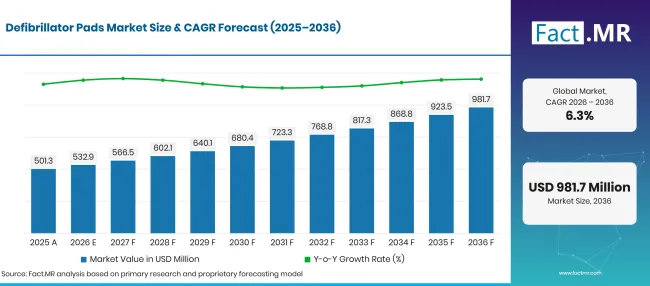
Factmr Defibrillator Pads Market Forecast Global | Source: Fact.MR
| Year | Basis | Market Value (USD million) |
|---|---|---|
| 2025 | Historical | 501.3 |
| 2026 | Estimate | 532.9 |
| 2036 | Forecast | 981.7 |
| CAGR 2026 to 2036 | Forecast period | 6.3% |
Source: Fact.MR analysis. Updated Oct 19, 2026
What are the defining numbers behind Defibrillator Pads Market growth?
USD 448.8 million in absolute opportunity between 2026 and 2036, with adult pads and hospital purchasing forming the main sales base.
- Demand Drivers in the Market
- Hospital emergency teams use defibrillator pads during urgent cardiac treatment and must keep compatible replacement sets ready.
- Emergency medical services need pad packs that travel safely and work with the defibrillator fitted to each ambulance. In September 2025, the U.S. Food and Drug Administration published a LIFEPAK 1000 AED recall involving incomplete servicing inspection procedures [2].
- Public access AED owners inspect electrode expiry dates and replace used pad sets while keeping the main device in service.
- Medical supply distributors help institutions select pad packs that match the installed AED. In October 2025, the FDA published a HeartSine Pad-Pak recall after reports of damaged connector pins affecting the fit and electrical contact of certain pad packs [4].
- Key Segments Analyzed
- By Product Type: Adult Defibrillator Pads account for 68.5% share in 2026, reflecting routine adult resuscitation readiness across clinical and public locations.
- By End-User: Hospitals represent 42.3% share in 2026 due to regular emergency-care use and organized stocks of compatible electrodes.
- By Distribution Channel: Medical Supply Stores capture 54.6% share in 2026 as institutional purchasers seek precise device compatibility and repeat fulfillment.
- Analyst Opinion at Fact.MR
- Shambhu Nath Jha, Principal Consultant at Fact.MR, states, “Pad replacement remains part of owning a defibrillator long after the original device has been installed. Clinical teams monitor pack expiry dates and connector compatibility, and suppliers with clear product guides and reliable deliveries can support these recurring purchases.”
- Strategic Implications
- Defibrillator manufacturers should make compatible replacement pad codes easy to find in product guides and packaging. Clear labeling helps hospital equipment teams avoid ordering errors and supports dependable maintenance schedules.
- Hospital equipment teams should record pad references against the defibrillator models used across different wards. Keeping expiry dates in the same records helps staff plan replacements and avoid waste from expired stock.
- Medical supply stores benefit from carrying defined pad ranges with reliable reorder information. Their service role is particularly valuable when a customer uses several defibrillator brands and needs different connectors.
- Public AED managers should inspect pad packaging and expiry dates during routine checks. Standardized inspection records help ensure that a device placed in a school or community center has usable electrodes when needed.
Germany is projected to record 7.8% CAGR and Brazil 7.1% through 2036. The United States is forecast at 6.5%, while the United Kingdom reaches 5.8%. Japan follows at 5.1%, where continued attention to AED maintenance shapes replacement buying.
How does the Defibrillator Pads Market break down by segment?
Adult Defibrillator Pads 68.5%; Hospitals 42.3%; Medical Supply Stores 54.6% in 2026.
Which Product Type dominates?
Adult Defibrillator Pads account for 68.5% share in 2026.
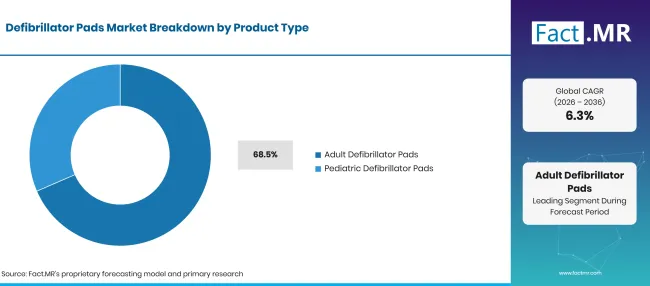
Factmr Defibrillator Pads Market Breakdown Product Type | Source: Fact.MR
| Product Type | Share (2026) |
|---|---|
| Adult Defibrillator Pads (Leading segment) | 68.5% |
| Other segments combined | 31.5% |
| Total | 100.0% |
Source: Fact.MR analysis. Updated Oct 19, 2026
Adult pads are kept with compatible hospital defibrillators and public AEDs for emergency use. Pediatric pads serve younger patients according to each device’s instructions. Hospitals therefore check connector fit and patient-use labeling before ordering, particularly when several defibrillator models are in service.
What leads the End-User segment?
Hospitals represent 42.3% share in 2026.
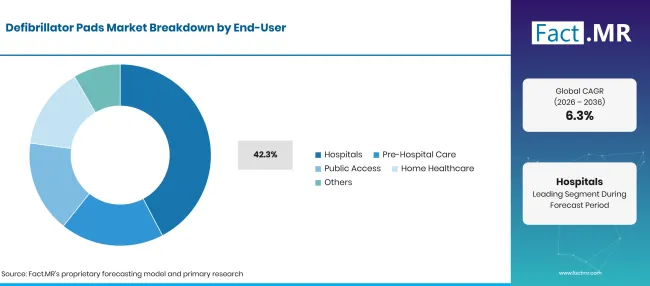
Factmr Defibrillator Pads Market Breakdown End User | Source: Fact.MR
| End-User | Share (2026) |
|---|---|
| Hospitals (Leading segment) | 42.3% |
| Other segments combined | 57.7% |
| Total | 100.0% |
Source: Fact.MR analysis. Updated Oct 19, 2026
Hospitals keep electrode pads ready for emergency treatment and replace each set after use or at the stated expiry date. Ambulance teams need portable packs that fit their defibrillators, while schools and other public sites rely on routine checks to maintain AED readiness. These settings create different but recurring replacement schedules.
Which Distribution Channel serves the largest share?
Medical Supply Stores account for 54.6% share in 2026.
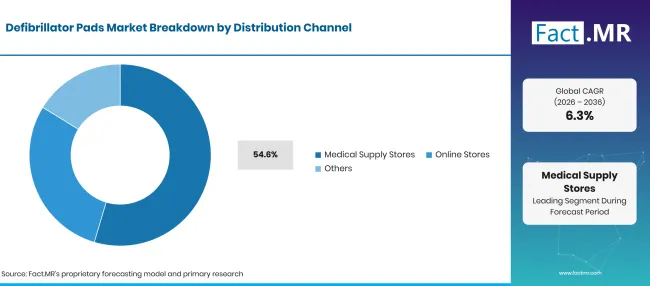
Factmr Defibrillator Pads Market Breakdown Distribution Channel | Source: Fact.MR
| Distribution Channel | Share (2026) |
|---|---|
| Medical Supply Stores (Leading segment) | 54.6% |
| Other segments combined | 45.4% |
| Total | 100.0% |
Source: Fact.MR analysis. Updated Oct 19, 2026
Medical supply stores help clinical customers find defibrillator pads with the correct connector and patient-size labeling. Repeat orders depend on clear product references and dependable availability. Online stores can serve organizations that already know their AED model and pad code. According to Fact.MR analysis, hospitals operating several device brands are likely to value advice that prevents wrong-product orders. For repeat purchases, the age rating and electrode connector are more useful than a broad description such as defibrillator accessories. Stock teams can then match the order to the device already on site.
How does the market serve different clinical and community settings?
Hospitals and public AED owners use different replacement purchasing schedules.
| Clinical Setting | Share (2026) |
|---|---|
| Hospital Use | 42.3% |
| Other end users | 57.7% |
| Total | 100.0% |
Source: Fact.MR analysis. Updated Oct 19, 2026
Different care settings call for different pad replacement routines. Ambulance crews carry sealed electrodes suited to their portable devices, while school and workplace staff generally plan orders around the pack expiry date. Both groups benefit from clear model information and straightforward repeat ordering.
What is accelerating Defibrillator Pads Market adoption, and what is holding it back?
Installed defibrillators create recurring pad requirements after use and at labeled expiry dates. Connector differences and stock management determine how institutions organize those purchases.
Drivers Impact Analysis
| DRIVER | (~) % IMPACT ON CAGR | GEOGRAPHIC RELEVANCE | IMPACT TIMELINE |
|---|---|---|---|
| Replacement after use | +1.0% | Global | Short term (<= 2 years) |
| Expiry-led changes | +0.8% | Global | Short term (<= 2 years) |
| Hospital stock management | +0.7% | Global | Medium term (2–4 years) |
| Public-access AED coverage | +0.5% | Europe, North America | Long term (>= 4 years) |
| Distributor availability | +0.4% | Global | Medium term (2–4 years) |
Source: Fact.MR analysis. Updated Oct 19, 2026
Opportunity Impact Analysis
| OPPORTUNITY | (~) % IMPACT ON CAGR | GEOGRAPHIC RELEVANCE | IMPACT TIMELINE |
|---|---|---|---|
| Compatibility guides | +0.8% | Global | Short term (<= 2 years) |
| Stock rotation services | +0.6% | Global | Medium term (2–4 years) |
| Community AED servicing | +0.5% | Europe | Medium term (2–4 years) |
| Clear product coding | +0.4% | Global | Medium term (2–4 years) |
Source: Fact.MR analysis. Updated Oct 19, 2026
Restraints Impact Analysis
| RESTRAINT | (~) % IMPACT ON CAGR | GEOGRAPHIC RELEVANCE | IMPACT TIMELINE |
|---|---|---|---|
| Model-specific connectors | -0.8% | Global | Medium term (2–4 years) |
| Expired stock waste | -0.6% | Global | Short term (<= 2 years) |
| Product quality actions | -0.5% | Global | Medium term (2–4 years) |
| Channel traceability | -0.4% | Global | Medium term (2–4 years) |
Source: Fact.MR analysis. Updated Oct 19, 2026
Which countries are scaling the Defibrillator Pads Market through 2036?
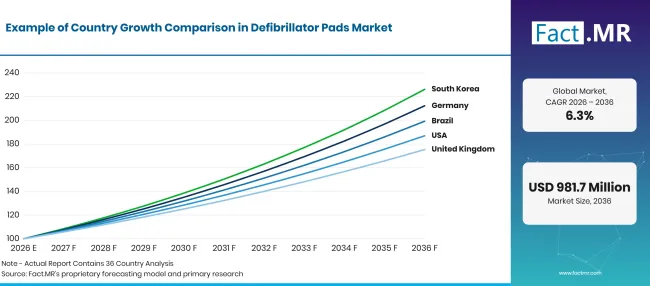
Factmr Defibrillator Pads Market Growth Index | Source: Fact.MR
| Country | CAGR (2026–2036) |
|---|---|
| Germany | 7.8% |
| Brazil | 7.1% |
| United States | 6.5% |
| United Kingdom | 5.8% |
| Japan | 5.1% |
Source: Fact.MR analysis. Updated Oct 19, 2026
Why is Germany expanding defibrillator pad purchases?
7.8% CAGR, linked to clinical equipment maintenance and hospital replacement schedules.
German hospital equipment manage pads across clinical defibrillators that have different connectors and replacement dates. In November 2025, Destatis reported 1,841 hospitals operating in Germany during 2024 [1]. This broad care network creates regular work for equipment managers who track consumables.
How does Brazil support defibrillator pad sales?
7.1% CAGR, influenced by emergency service readiness and device-level stock control.
Brazilian emergency-care facilities depend on replacement electrode packs matched to the defibrillators registered at each location. The national CNES health establishment registry records equipment categories and supports a practical view of the installed clinical fleet. Regional distribution affects how quickly medical units can obtain compatible products.
What supports the United States outlook?
6.5% CAGR, supported by installed AED equipment and attention to consumable safety.
American hospital and community AED programs manage replacement pads through equipment checks and supplier records. In November 2025, the FDA authorized an update to a manufacturing step for HeartSync disposable defibrillator pads [5]. Product teams still need to follow the approved device instructions when choosing compatible electrodes.
How is the United Kingdom developing pad replacement activity?
5.8% CAGR, associated with public-access AED coverage and planned consumable checks.
School AED installations support public-access replacement pad sales alongside hospital use in the United Kingdom. In February 2026, Northern Ireland’s Department of Education confirmed that every school premises in the region had access to a defibrillator [3]. Staff responsible for each unit need to check the pad pack and its expiry date during routine inspections.
Why is Japan maintaining defibrillator pad sales?
5.1% CAGR, shaped by inspection routines and careful medical equipment management.
Japanese AED owners follow routine checks of electrode packs so devices remain ready for emergency use. Product compatibility and the date printed on each replacement pack help clinical teams maintain the right supplies. Specialist sellers support sites using different AED models by providing the matching product code.
Who leads the Defibrillator Pads Market?
ZOLL Medical provides electrodes for its AED ranges. Stryker also supports LIFEPAK and HeartSine equipment, whose replacement pads have specific compatibility requirements. Buyers operating several device models need accurate connector information and dependable supply.
Nihon Kohden and SCHILLER supply defibrillator systems and related electrodes for clinical users. Progetti offers defibrillator products for emergency treatment. According to Fact.MR analysis, the competitive comparison should focus on currently supported equipment families and replacement parts, keeping separate brand heritage clear.
Which companies are the key providers?
Key companies include ZOLL Medical Corporation; Stryker Corporation; Nihon Kohden Corporation; Schiller AG; Progetti Srl.
- ZOLL Medical Corporation
- Stryker Corporation
- Nihon Kohden Corporation
- Schiller AG
- Progetti Srl
Bibliography
- [1] Statistisches Bundesamt (Destatis). (2025, November 6). 2,0 % mehr stationäre Krankenhausbehandlungen im Jahr 2024. https://www.destatis.de/DE/Presse/Pressemitteilungen/2025/11/PD25_398_231.html
- [2] U.S. Food and Drug Administration. (2025, September 2). Class 2 device recall LIFEPAK 1000. https://www.accessdata.fda.gov/scripts/cdrh/cfdocs/cfRes/res.cfm?id=214086
- [3] Department of Education, Northern Ireland. (2026, February 25). All schools now equipped with life-saving defibrillators. https://www.education-ni.gov.uk/news/all-schools-now-equipped-life-saving-defibrillators
- [4] U.S. Food and Drug Administration. (2025, October 23). Class 2 device recall HeartSine PadPak. https://www.accessdata.fda.gov/scripts/cdrh/cfdocs/cfres/res.cfm?id=216250
- [5] U.S. Food and Drug Administration. (2025, November 12). Premarket approval (PMA): HeartSync multifunction disposable single-use AED defibrillator pads, P200007S001.
This Report Answers
- The report examines disposable adult and pediatric defibrillation pads used with compatible clinical and automated external defibrillators.
- End-user assessment explains the role of hospitals and identifies different purchasing needs in pre-hospital and public settings.
- Country comparison addresses Germany, Brazil, the United States, the United Kingdom and Japan using the forecast CAGR outlook.
- Competitive review distinguishes current companies from older brands and acquired product portfolios.
- Distribution analysis explores the importance of medical supply stores, device fit and repeat consumable ordering.
What does the Defibrillator Pads Market cover?
The market covers disposable patient-contact electrode pads used to deliver a shock from a compatible external defibrillator. Adult and pediatric pad sets are considered for clinical and public-access use. Related Fact.MR research on automated external defibrillators describes the installed devices that need these accessories, while emergency medical service products provide context for ambulance-based equipment.
What is included in the scope?
The scope includes patient-contact defibrillation pads and associated compatible electrode sets sold for clinical and public-access use.
It covers routine replacement after use and purchases linked to labeled expiry dates. Sales channels include medical supply stores and online sellers that offer legitimate model-specific products.
What is excluded from the scope?
The scope excludes complete defibrillator and AED devices, separately sold batteries, training electrodes, and implantable cardiac leads.
These products serve different functions from disposable therapeutic defibrillator pads and therefore fall outside the core market definition used in this report.
How Was the Analysis Built?
The analysis draws on 120+ sources, 35+ company portfolios, 25+ countries, and more than 20 industry interviews.
- Primary Research: Primary research includes discussions with manufacturers, service providers, technology developers, distributors, end users, and subject-matter experts. These conversations examine purchasing priorities, product adoption, operational challenges, approval requirements, competitive positioning, and the factors that influence wider market acceptance.
- Desk Research: Desk research covers government statistics, regulatory publications, company filings, trade data, technical studies, industry associations, standards, public policy, and other authoritative sources. Every source used in the analysis is documented in the bibliography.
- Market Sizing and Forecasting: Market estimates combine historical performance, demand indicators, pricing and volume trends, segment shares, company participation, country-level growth, adoption patterns, investment activity, and barriers to market expansion.
- Data Validation and Update Cycle: Findings are validated by comparing primary interviews with public data, company activity, regulatory changes, trade patterns, and industry developments. Regular updates review new product launches, capacity changes, partnerships, approvals, and shifts in commercial adoption.
Segmentation
What is the report’s scope and coverage?
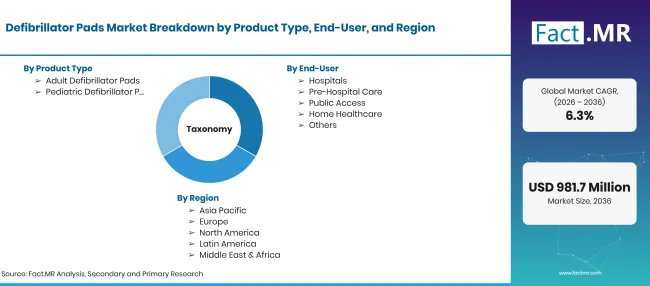
Factmr Defibrillator Pads Market Taxonomy | Source: Fact.MR
| Attribute | Details |
|---|---|
| Quantitative Units | USD million in 2026 to USD million by 2036 at CAGR |
| Market Definition | Disposable therapeutic defibrillation electrodes used with compatible external defibrillators. |
| Product Type | Adult Defibrillator Pads; Pediatric Defibrillator Pads |
| End-User | Hospitals; Pre-Hospital Care; Public Access; Home Healthcare; Others |
| Distribution Channel | Medical Supply Stores; Online Stores; Others |
| Regions Covered | North America; Latin America; Western Europe; Eastern Europe; East Asia; South Asia & Pacific; Middle East & Africa |
| Countries Covered | Germany; Brazil; United States; United Kingdom; Japan |
| Companies Profiled | ZOLL Medical Corporation; Stryker Corporation; Nihon Kohden Corporation; Schiller AG; Progetti Srl. |
| Forecast Period | 2026 to 2036 |
| Approach | Assessment of defibrillator pad compatibility, replacement schedules, hospital and public-access applications, buying channels, and manufacturer product information |
Source: Fact.MR analysis. Updated Oct 19, 2026
How is the market segmented?
-
By Product Type
- Adult Defibrillator Pads
- Pediatric Defibrillator Pads
-
By End-User
- Hospitals
- Pre-Hospital Care
- Public Access
-
Home Healthcare
- Others
- By Distribution Channel
- Medical Supply Stores
- Online Stores
- Others
-
By Region
- North America
- Latin America
- Western Europe
- Eastern Europe
- East Asia
- South Asia & Pacific
- Middle East & Africa
Frequently Asked Questions
How big is the defibrillator pads market in 2026?
What is the CAGR from 2026 to 2036?
Which product type leads?
Which end-user leads?
Who are the main companies in the defibrillator pads market?
Who worked on this report


Preview the report firsthand - request a free sample
Free SampleGet the brochure for pricing and purchase details
Download PDF