- Market Value (2025): USD 316.6 Mn
- Estimated Value (2026): USD 335.0 Mn
- Forecast Value (2036): USD 590.0 Mn
- CAGR (2026-2036): 5.8%
What is the Detergent CMC Market forecast to be worth by 2036?
USD 335 million in 2026 to USD 590 million by 2036, at 5.8% CAGR.
- The USD 316.6 million market value in 2025 reflects an established functional additive sold into both global laundry brands and regional detergent production.
- Revenue is forecast to rise from USD 335 million in 2026 to USD 590.0 million in 2036 as detergent volumes expand and formulators seek tighter control of soil suspension, viscosity, and fabric appearance.
- A 5.8% CAGR is supported by the continued scale of powder laundry detergents, formulation upgrades in emerging markets, and demand for cellulose-derived additives with more traceable inputs.
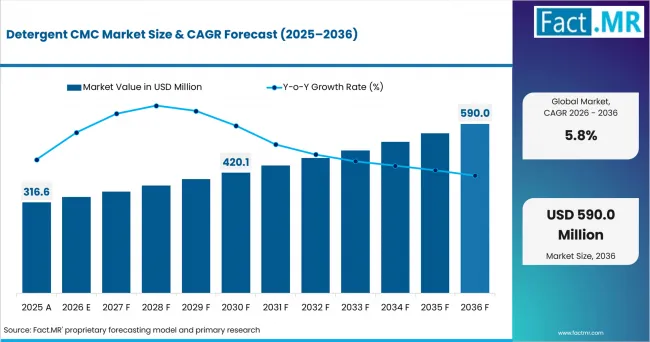
Detergent Cmc Market Value Analysis | Source: Fact.MR
What are the defining numbers behind Detergent CMC Market growth?
USD 255 million absolute opportunity by 2036, led by Powder laundry detergents and Anti-redeposition within their respective segments.
- Demand Drivers in the Market
- Powder laundry detergents require CMC that hydrates and distributes consistently during dry blending, storage, and wash release.
- Anti-redeposition performance becomes more valuable when consumers wash mixed loads, use shorter cycles, or expect acceptable results at lower dosage.
- Liquid formulators need grades whose substitution and viscosity profile can stabilize the product without creating stringiness or poor dispensing.
- Renewable cellulose origin gives suppliers a practical route to improve ingredient narratives, provided chain-of-custody and processing claims remain specific.
- Key Segments Analyzed
- By Detergent Format: Powder laundry detergents leads at 55.0% of demand, since CMC's anti-redeposition action depends on forming an electrostatic bond with cellulose fiber, a bond that cotton and cotton-blend fabrics carry but synthetics largely do not, and powder remains the default heavy-duty wash format for cotton-heavy loads across the largest laundry markets.
- By Function: Anti-redeposition leads at 48.0% of demand. The anionic CMC molecule adsorbs onto both the suspended soil particle and the fabric surface, so both carry the same negative charge and repel each other through the wash and rinse cycle instead of letting dirt resettle. Formulators dose CMC at roughly 0.5% to 2% in powder detergent for this effect, and because the mechanism depends on cotton fiber, it has little or no anti-redeposition benefit on polyester or synthetic-cotton blend loads.
- By CMC Grade: Standard viscosity leads at 37.0% of demand, because the mid-range band (roughly 300-800 cps) runs on both powder and liquid processing lines without reformulation, letting formulators and contract manufacturers specify one grade for multiple product types instead of stocking separate low- and high-viscosity variants.
- By Cellulose Source: Wood pulp leads at 46.0% of demand. Cotton linters cellulose can reach a degree of polymerization of 2,400 or higher against roughly 1,500 for most wood pulp, a gap that has historically reserved linters for the highest-viscosity cellulose ether output, and wood pulp's documented cost advantage as a feedstock is why producers default to it for the standard-viscosity grades that make up most detergent CMC volume.
- By Customer Group: FMCG detergent brands leads at 42.0% of demand, as branded packaged-detergent manufacturers running large-volume powder and liquid production lines buy CMC under bulk, multi-year supply agreements, a purchasing scale that institutional cleaning formulators and smaller regional producers do not match.
- Analyst Opinion at Fact.MR
- Shambhu Nath Jha, Senior Analyst at Fact.MR, states, "Detergent CMC is bought on the strength of formulation evidence: a familiar label is less useful than data on hydration, viscosity, compatibility, and soil redeposition under the customer's wash conditions. Suppliers that connect those results to reliable particle form and traceable cellulose inputs can defend value even in a cost-sensitive additive category."
- Strategic Implications
- CMC producers should separate powder, liquid, tablet, and industrial-laundry recommendations instead of presenting viscosity as a universal quality ranking.
- Detergent brands can reduce reformulation risk by qualifying second sources against wash performance as well as substitution degree, moisture, and apparent viscosity.
- Private-label manufacturers need grades that tolerate frequent formula changes and variable mixing equipment without leaving undissolved particles.
- Distributors can add value through lot traceability, dry storage, technical sample control, and realistic guidance on hydration sequence.
Nouryon introduced FinnFix PB MAX as a fully bio-based, biodegradable CMC for laundry detergents, combining wood-derived cellulose with an attributed bio-based route for monochloroacetic acid. The launch illustrates how anti-redeposition performance and raw-material documentation are being packaged together rather than treated as separate purchasing questions.
The United States is positioned for a 6.4% CAGR from 2026 to 2036 through liquid, tablet, private-label, and institutional formulations that reward controlled rheology and qualification support. Germany follows at 6.1% because sophisticated formulators scrutinize performance, process consistency, and renewable-material claims together, while France at 6.0% and Poland at 5.8% add format diversity and private-label production scale across Europe. Brazil is anticipated to advance at a 5.7% CAGR by pairing powder-formulation economics with practical regional support.
How does the Detergent CMC Market break down by segment?
The leading shares are Powder laundry detergents at 55.0% by Detergent Format and Anti-redeposition at 48.0% by Function.
Why do powder laundry detergents account for the largest CMC demand?
At 55.0% share in 2026, the leading position goes to Powder laundry detergents because dry formulations use CMC at scale to limit soil return while preserving familiar blending and dosing economics.
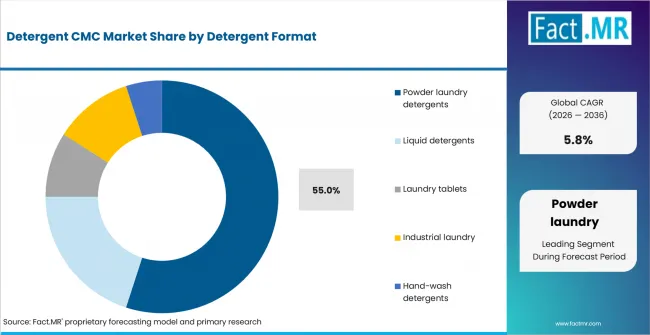
Detergent Cmc Market Analysis By Detergent Format | Source: Fact.MR
Powder laundry detergents hold 55.0% of the market, compared with 20.0% for liquid detergents and 11.0% for industrial laundry. CMC can be dry-blended into a powder and then hydrate in the wash liquor, where its dispersing action helps keep removed particulate soil from settling back onto fabric. Liquids require closer attention to hydration order and rheology, while tablets place an additional premium on granulation, flow, and rapid dissolution.
What keeps anti-redeposition ahead of other CMC functions?
The 2026 leader is Anti-redeposition at 48.0% share as the polymer's central detergent value is maintaining suspended soil after surfactants release it from the textile.
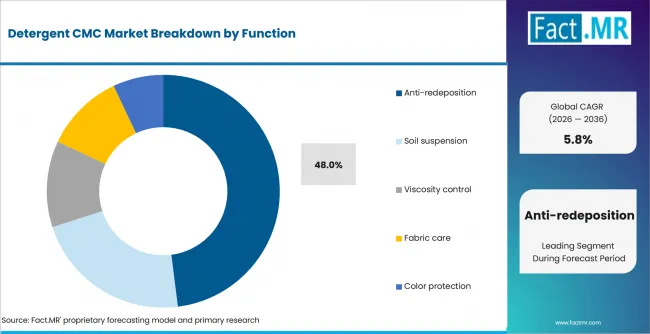
Detergent Cmc Market Analysis By Function | Source: Fact.MR
Anti-redeposition represents 48.0% of demand, with soil suspension at 22.0% and viscosity control at 12.0%. The leading function addresses a visible failure mode: fabric can look dull even when soil was initially removed if particles return during the wash. Fabric care and color protection are smaller positions because their benefit depends more heavily on the full surfactant, builder, enzyme, and wash-condition system.
Why is standard-viscosity CMC the market's reference grade?
A 37.0% share puts Standard viscosity first in 2026 since mainstream detergents prioritize repeatable dispersion and adequate soil control over maximum solution thickening.
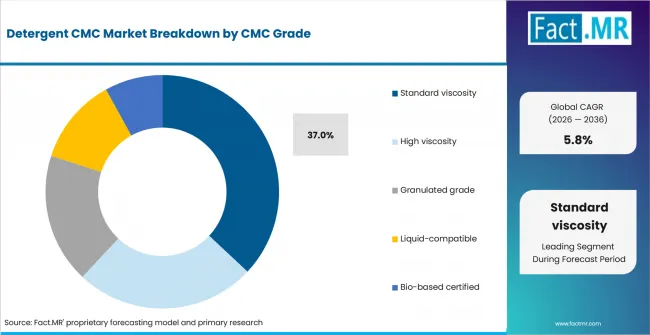
Detergent Cmc Market Analysis By Cmc Grade | Source: Fact.MR
Standard viscosity takes 37.0% of sales, followed by high viscosity at 25.0% and granulated grade at 18.0%. It serves broad powder applications without imposing the processing sensitivity or formulation impact associated with a more strongly thickening polymer. Granulated material addresses dust and handling needs, whereas liquid-compatible and bio-based-certified grades earn their place through format or sourcing requirements rather than viscosity alone.
Why does wood pulp remain the principal cellulose source?
For Cellulose Source, the top 2026 position is Wood pulp at 46.0% share because it combines industrial availability, controlled purity, and an established route into detergent-grade cellulose ether production.
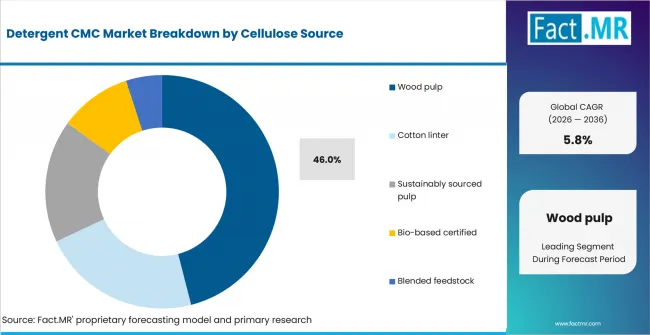
Detergent Cmc Market Analysis By Cellulose Source | Source: Fact.MR
Wood pulp supplies 46.0% of the market and cotton linter another 22.0%, while sustainably sourced pulp accounts for 17.0%. Pulp producers can deliver cellulose at the consistency and scale needed for etherification, so wood remains the practical base for high-volume detergent CMC. Certified and blended feedstocks broaden sourcing options, but customers must distinguish cellulose origin from the origin and accounting of other reagents used in manufacture.
Why are FMCG detergent brands the leading customer group?
The leading 2026 share is 42.0% for FMCG detergent brands as branded portfolios aggregate substantial volume and maintain formal qualification standards across several laundry formats.
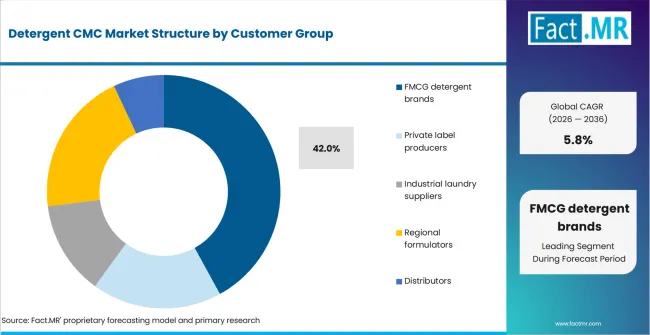
Detergent Cmc Market Analysis By Customer Group | Source: Fact.MR
FMCG detergent brands account for 42.0% of demand, ahead of regional formulators at 20.0% and private-label producers at 18.0%. Their scale supports structured trials, supplier audits, and multi-site specifications that can convert a successful grade into recurring purchases. Regional and private-label customers remain commercially important, although their shorter runs and frequent formula changes favor flexible supply and hands-on technical service.
What is accelerating Detergent CMC Market adoption, and what is holding it back?
Growth is accelerated by CMC's ability to improve an established detergent formula with modest changes to manufacturing and consumer use. Price pressure, inconsistent hydration practice, and the need to prove benefits inside each complete formulation restrain premium-grade adoption.
Drivers Impact Analysis
| DRIVER | (~) % IMPACT ON CAGR | GEOGRAPHIC RELEVANCE | IMPACT TIMELINE |
|---|---|---|---|
| Powder detergent scale | +0.9% | Brazil and other powder-led laundry markets | Long term (>= 4 years) |
| Better fabric appearance | +0.8% | Global | Short term (<= 2 years) |
| Liquid formula refinement | +0.6% | United States and Germany | Medium term (2-4 years) |
| Traceable cellulose inputs | +0.5% | Europe and multinational brand supply chains | Medium term (2-4 years) |
| Regional detergent upgrading | +0.4% | Brazil and Latin America | Long term (>= 4 years) |
Source: Fact.MR analysis. Updated Jul 16, 2026
- Powder detergent scale: Powder detergents create the largest addressable base for CMC and remain suited to cost-conscious household washing. Suppliers that control particle size and dry-blend uniformity can serve both national brands and high-volume regional plants.
- Better fabric appearance: Anti-redeposition performance helps formulators protect whiteness and avoid the dull appearance caused by resettled particulate soil. The benefit is strongest when demonstrated in the customer's water hardness, dosage, textile mix, and wash cycle.
- Liquid formula refinement: Liquid detergents open demand for grades engineered around solubility, viscosity, and compatibility rather than dry-blend behavior. Careful polymer selection can support stability without compromising pouring or dispensing.
Opportunity Impact Analysis
| OPPORTUNITY | (~) % IMPACT ON CAGR | GEOGRAPHIC RELEVANCE | IMPACT TIMELINE |
|---|---|---|---|
| Low-dust granules | +0.5% | Brazil, Poland, and contract-manufacturing hubs | Short term (<= 2 years) |
| Compact liquid systems | +0.4% | United States, Germany, and premium urban markets | Medium term (2-4 years) |
| Certified bio-based portfolios | +0.3% | Europe and global FMCG accounts | Medium term (2-4 years) |
| Application labs for regional brands | +0.3% | Brazil and price-sensitive markets | Long term (>= 4 years) |
Source: Fact.MR analysis. Updated Jul 16, 2026
- Low-dust granules: Granulated CMC can reduce dust, improve metering, and distribute more evenly in powder plants. Producers can tailor granule strength and dissolution so the handling gain does not create slower hydration in use.
- Compact liquid systems: Concentrated liquids leave less room for incompatible or weakly dispersing additives. Liquid-compatible CMC supported by formulation maps can secure value in products where viscosity drift or settling is costly.
- Certified bio-based portfolios: Suppliers can combine renewable cellulose with documented sourcing for additional production inputs. Clear certificates and claim language allow detergent brands to use the attribute without overstating the polymer's physical composition.
Restraints Impact Analysis
| RESTRAINT | (~) % IMPACT ON CAGR | GEOGRAPHIC RELEVANCE | IMPACT TIMELINE |
|---|---|---|---|
| Formula-dependent performance | -0.4% | Global | Short term (<= 2 years) |
| Cost-led substitution | -0.3% | Brazil, Poland, and private-label channels | Medium term (2-4 years) |
| Moisture and storage sensitivity | -0.3% | Humid manufacturing regions | Short term (<= 2 years) |
| Claim boundary confusion | -0.2% | Global | Medium term (2-4 years) |
Source: Fact.MR analysis. Updated Jul 16, 2026
- Formula-dependent performance: CMC does not work independently of surfactants, builders, enzymes, electrolytes, and wash conditions. A grade that performs well in one formula may need a different dose or hydration sequence in another.
- Cost-led substitution: Detergent producers frequently compare additives at a narrow cost-in-use threshold. Premium sourcing or particle-form attributes can be removed when their benefit is not translated into a measurable wash or processing result.
- Moisture and storage sensitivity: Poor storage can promote caking and make a cellulose ether harder to meter or disperse. Distributors and plants therefore need sealed packaging, dry warehouses, and disciplined stock rotation.
How does detergent CMC demand build across leading countries?
United States 6.4% CAGR. Germany 6.1%. France 6.0%. Poland 5.8%. Brazil 5.7%.
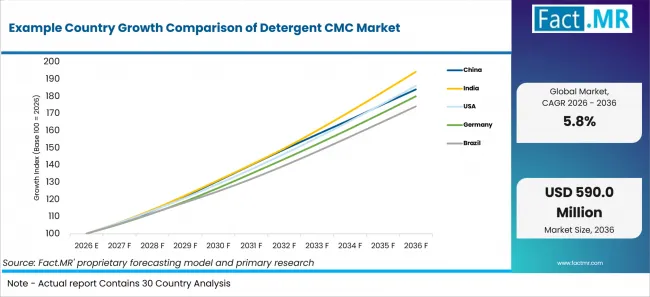
Example Country Growth Comparison Of Detergent Cmc Market | Source: Fact.MR
Regional analysis covers North America, Europe, and Latin America, with country chapters for the United States, Germany, France, Poland, and Brazil. The full report carries this same analysis into more than 30 countries.
| COUNTRY | CAGR |
|---|---|
| United States | 6.4% |
| Germany | 6.1% |
| France | 6.0% |
| Poland | 5.8% |
| Brazil | 5.7% |
Source: Fact.MR analysis. Updated Jul 16, 2026
How does US detergent reformulation history shape CMC demand?
CMC demand in the United States grows at a 6.4% CAGR from 2026 to 2036, tied to a detergent industry reformulated around federal and state phosphate rules rather than one dominant format.
In 2010, seventeen states banned phosphate dishwasher detergents and members of the American Cleaning Institute matched it with a voluntary nationwide ban, pushing formulators toward alternative soil-suspension polymers such as CMC. The EPA's Safer Choice program still screens builder ingredients for toxicity and biodegradation before a product can carry its label. Ashland, headquartered in Wilmington, Delaware, and CP Kelco, headquartered in Atlanta, Georgia, supply a market where liquid detergent holds about 42% of retail value and pods keep taking volume from powder, steering CMC grades toward liquid-compatible viscosity.
Does Germany's detergent legacy still set its CMC formulation rules?
Germany's CMC demand expands at a 6.1% CAGR from 2026 to 2036, in a market that invented the modern self-acting detergent and still enforces strict surfactant biodegradability rules.
Henkel launched Persil in 1907 from Duesseldorf, the city its detergent production had moved to by 1899, as the first detergent able to release bleaching oxygen without hand scrubbing, and still runs the market today from that same headquarters city. EU Regulation 648/2004 requires detergent surfactants to reach 60% biodegradation within 28 days under the CO2 headspace test, a threshold carried into the 2026 replacement rule with compliance allowed through September 2029. Germany produces over 23 million tonnes of paper and board a year yet still imports roughly two-thirds of its pulp and paper by market value, leaving CMC producers dependent on cellulose sourced outside the country.
How did a 1927 trademark split shape France's detergent brands?
France's CMC demand grows at a 6.0% CAGR between 2026 and 2036, in a detergent market whose two largest brand owners split rights to the Persil name a century ago and still compete under different labels because of it.
A 1927 settlement between Henkel and Lever Brothers gave Unilever the Persil trademark in France and the UK, while Henkel kept it across most of continental Europe, so Henkel sells its French formulation under the Le Chat brand instead. Henkel still holds the country's largest detergent brand portfolio at six labels, including Le Chat, X-Tra, Super Croix, Mir, Maison Verte, and YOU, while Unilever runs multiple French plants such as Le Meux in Oise and Chevigny in Cote-d'Or. France also hosts SNF, headquartered in Andrezieux-Boutheon, one of the world's largest water-soluble polymer producers, evidence of a domestic base for cellulose-derivative processing.
What does Henkel's Raciborz plant closure mean for Polish CMC buyers?
Poland's CMC demand rises at a 5.8% CAGR from 2026 to 2036, inside a detergent manufacturing base that is consolidating even as retail demand shifts toward private label.
Henkel permanently closed its Raciborz plant, which made Persil powder and Silan fabric softener, on November 30, 2025, cutting around 159 jobs as part of a wider European production overhaul, while keeping its Staporkow and Dzierzoniow plants running. Discounter Biedronka controls 63.6% of Poland's discount grocery channel through more than 3,800 stores, and Polish private label spending reached PLN 67 billion in 2025, up 6.6% year on year, with private label now holding a 23.5% value share. That combination pushes formulators toward cost-efficient powder recipes where CMC's soil-suspension role competes directly on price.
Does Brazil's eucalyptus pulp base give local CMC producers an edge?
Brazil's CMC demand grows at a 5.7% CAGR from 2026 to 2036, supported by a domestic wood pulp base few competing markets can match and a detergent category still led by powder.
Suzano runs eight mills in Brazil with 13.5 million tonnes of annual eucalyptus pulp capacity, including the single largest pulp production line in the world at its Cerrado site, while Klabin, the country's second-largest pulp producer, is investing BRL 14.5 billion in further capacity. Brazilian pulp exports brought in USD 4.95 billion in the first half of 2024, up 19% year on year. Powder still holds 50 to 55% of Brazil's detergent volume against liquid's 40 to 45%, with Unilever, P&G, and Reckitt controlling roughly two thirds of value and local formulators Quimica Amparo (Ype) and Bombril holding 15 to 20% in value powders and private label.
Who leads the Detergent CMC Market?
Nouryon, Ashland, CP Kelco, Lamberti, and Nippon Paper Industries compete on detergent performance, viscosity range, particle form, cellulose sourcing, and regional service.
Nouryon holds an 18.0% share, followed by Ashland at 12.0% and CP Kelco at 9.0%. Lamberti represents 6.0% and Nippon Paper Industries 4.0%, leaving room for regional producers where detergent economics and nearby inventory outweigh a global product platform.
The competitive issue is not simply who offers the highest viscosity. Nouryon and Lamberti explicitly position CMC for anti-redeposition in laundry, Nippon Paper Industries lists detergent technical grades within its SUNROSE range, and broader grade portfolios from suppliers such as Ashland support adjustment by processing and rheology need.
Which companies are the key providers?
The company set includes Nouryon, Ashland, CP Kelco, Lamberti, and Nippon Paper Industries.
- Nouryon
- Ashland
- CP Kelco
- Lamberti
- Nippon Paper Industries
These named producers frame the competition chapter, while the complete study reviews more than 30 companies supplying cellulose ethers and detergent ingredients.
What is the report's scope and coverage?
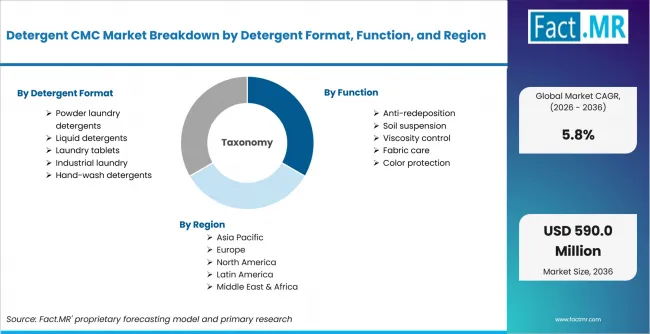
Detergent Cmc Market Breakdown By Detergent Format, Function, And Region | Source: Fact.MR
| ATTRIBUTE | DETAILS |
|---|---|
| Quantitative Units | USD 335 million in 2026 to USD 590 million by 2036 at 5.8% CAGR |
| Market Definition | The market covers detergent-grade sodium carboxymethyl cellulose sold as a functional polymer for anti-redeposition, soil suspension, viscosity control, fabric care, or color protection in household and industrial laundry formulations. |
| Detergent Format | Powder laundry detergents; Liquid detergents; Laundry tablets; Industrial laundry; Hand-wash detergents |
| Function | Anti-redeposition; Soil suspension; Viscosity control; Fabric care; Color protection |
| CMC Grade | Standard viscosity; High viscosity; Granulated grade; Liquid-compatible; Bio-based certified |
| Cellulose Source | Wood pulp; Cotton linter; Sustainably sourced pulp; Bio-based certified; Blended feedstock |
| Customer Group | FMCG detergent brands; Private label producers; Industrial laundry suppliers; Regional formulators; Distributors |
| Regions Covered | North America; Europe; Latin America |
| Countries Covered | United States; Germany; France; Poland; Brazil (30+ countries covered in the full report) |
| Key Companies Profiled | Nouryon; Ashland; CP Kelco; Lamberti; Nippon Paper Industries |
| Forecast Period | 2026 to 2036 |
| Approach | Sizing converts detergent output and format-specific CMC dosage into grade volumes, then applies supplier, viscosity, particle-form, certification, and regional price mixes. |
Source: Fact.MR analysis. Updated Jul 16, 2026
How is the market segmented?
-
By Detergent Format
- Powder laundry detergents
- Liquid detergents
- Laundry tablets
- Industrial laundry
- Hand-wash detergents
-
By Function
- Anti-redeposition
- Soil suspension
- Viscosity control
- Fabric care
- Color protection
-
By CMC Grade
- Standard viscosity
- High viscosity
- Granulated grade
- Liquid-compatible
- Bio-based certified
-
By Cellulose Source
- Wood pulp
- Cotton linter
- Sustainably sourced pulp
- Bio-based certified
- Blended feedstock
-
By Customer Group
- FMCG detergent brands
- Private label producers
- Industrial laundry suppliers
- Regional formulators
- Distributors
-
By Region
- North America
- United States
- Europe
- Germany
- France
- Poland
- Latin America
- Brazil
Bibliography
- Nouryon. (2026). Nouryon launches industry's first 100% bio-based, biodegradable carboxymethyl cellulose for laundry detergents.
- Nouryon. (n.d.). Carboxymethyl cellulose.
- Lamberti. (n.d.). Personal care and detergency.
- Lamberti. (n.d.). Cellulosic ethers.
- Nippon Paper Industries. (n.d.). SUNROSE carboxymethyl cellulose.
- Ashland. (n.d.). Home care overview.
What does the Detergent CMC Market cover?
Detergent-grade CMC sold for functional use in household and industrial laundry formulations.
The study measures CMC revenue across detergent format, function, grade, cellulose source, and customer group exactly as set out in the source taxonomy. It follows the polymer when sold into a qualifying detergent application rather than the value of the finished laundry product.
More than 30 countries inform the geographic comparison, led by the United States and Europe; the competitive review takes in 30+ suppliers; monetary forecasts run in USD millions for 2026-2036.
What is included in the scope?
Included supply ranges from mainstream powder grades to liquid-compatible, granulated, and certified bio-based CMC.
The product boundary captures wood-pulp, cotton-linter, sustainably sourced pulp, bio-based-certified, and blended-feedstock routes. Functional allocation covers anti-redeposition, soil suspension, viscosity control, fabric care, and color protection.
Customer coverage includes direct brand and private-label purchasing, industrial-laundry supply, regional formulation, and distributor transactions.
What is excluded from the scope?
Non-detergent cellulose ethers and the downstream value of formulated laundry products are excluded.
The study does not count CMC consumed outside laundry and detergent production, nor does it include hydroxyethyl cellulose, methyl cellulose, or unrelated rheology modifiers. Finished detergent revenue is omitted to prevent the polymer's contribution from being overstated.
How was the analysis built?
Producer portfolios, formulator interviews, trade flows, and forecast cross-checks assembled from more than 30 countries.
- Primary Research: Primary interviews included CMC manufacturers, detergent formulators, FMCG procurement teams, private-label plants, industrial laundries, distributors, and cellulose-pulp suppliers. Discussions tested dosage, substitution degree, viscosity method, particle form, hydration sequence, wash result, packaging, qualification time, and acceptable sourcing evidence.
- Desk Research: Desk research prioritized official product pages, technical brochures, detergent application guidance, safety and quality documents, certification records, and supplier launches. Each grade claim was tagged to its recommended detergent format, function, cellulose route, and evidence level.
- Market-Sizing and Forecasting: Market size was built from detergent production by format and realistic CMC inclusion ranges, with separate treatment of industrial-laundry demand. Volume estimates were then reconciled with supplier sales, imports, regional pricing, grade mix, and distributor margins without counting finished detergent value.
- Data Validation and Update Cycle: Results were checked against formulation trials, purchase frequency, plant throughput, customs movement, supplier capacity, and sample-to-contract conversion. Updates monitored powder-to-liquid mix, pulp and reagent costs, bio-based certification, granulation capacity, and changes in major brand specifications.
Frequently Asked Questions
What is the Detergent CMC Market forecast for 2036?
Which detergent format uses the most CMC?
Which CMC function has the largest share?
Which detergent CMC grade leads?
What is the principal cellulose source?
Which countries anchor the demand outlook?
Why cannot viscosity alone determine the best CMC grade?
What most often restrains a premium detergent CMC sale?
Who worked on this report


Preview the report firsthand - request a free sample
Free SampleGet the brochure for pricing and purchase details
Download PDF