On-Farm Blending Concentrate for Biological-Chemical Stacks Market

On-Farm Blending Concentrate for Biological-Chemical Stacks Market Size and Share Forecast Outlook 2026 to 2036

On-farm blending concentrate for biological-chemical stacks market is projected to grow from USD 0.5 billion in 2026 to USD 2.3 billion by 2036, at a CAGR of 16.6%. Biological & Reduced-Dose Chemical Concentrates will dominate with a 38.0% market share, while microbial actives (bacteria & fungi) will lead the biological component type segment with a 41.0% share.

On-Farm Blending Concentrate for Biological-Chemical Stacks Market Forecast and Outlook 2026 to 2036

The global on-farm blending concentrate for biological-chemical stacks market is projected to reach USD 2.26 billion by 2036. The market is valued at USD 0.49 billion in 2026 and is set to rise at a CAGR of 16.6% during the assessment period. By stack configuration type, biological & reduced-dose chemical concentrates hold a leading 38% share. The microbial actives biological component segment represents a dominant 41% share, while custom tank-mix programs are the primary use case at 44%.

Key Takeaways from the On-Farm Blending Concentrate for Biological-Chemical Stacks Market

  • Market Value for 2026: USD 0.49 Billion
  • Market Value for 2036: USD 2.26 Billion
  • Forecast CAGR (2026-2036): 16.6%
  • Leading Stack Configuration Type Share (2026): Biological & Reduced-Dose Chemical Concentrates (38%)
  • Leading Biological Component Type Share (2026): Microbial Actives (41%)
  • Leading On-Farm Use Case Share (2026): Custom Tank-Mix Programs (44%)
  • Key Players in the Market: BioConsortia Inc., Biotalys NV, Seipasa S.A., Futureco Bioscience, Daymsa
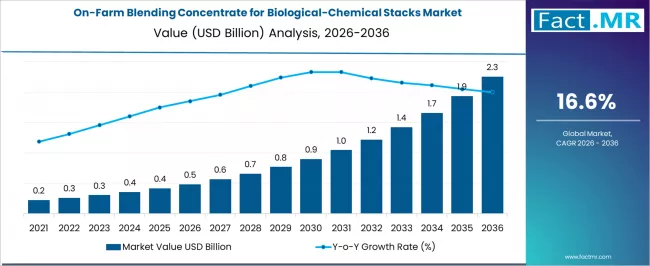
On Farm Blending Concentrate For Biological Chemical Stacks Market Market Value Analysis

A transformative trend is the shift from pre-formulated, fixed-ratio products to modular concentrate systems that empower farmers to create tailored stacks. Innovation focuses on stabilizing biological actives in concentrated forms compatible with a range of chemical adjuvants and water qualities. Integration of these concentrates with digital decision-support tools is advancing, providing real-time blending recommendations based on field-specific pest pressure, soil conditions, and resistance profiles.

Regulatory frameworks encouraging integrated pest management and reduced chemical loads per hectare are significant market enablers. Policies that incentivize or mandate lower residue levels in food create direct demand for programs incorporating biologicals. Streamlined registration pathways for biological components, as opposed to new synthetic chemicals, accelerate the introduction of new compatible concentrate modules into the market.

On-Farm Blending Concentrate for Biological-Chemical Stacks Market

Metric Value
Market Value (2026) USD 0.49 Billion
Market Forecast Value (2036) USD 2.26 Billion
Forecast CAGR (2026-2036) 16.6%

Category

Category Segments
Stack Configuration Type Biological & Reduced-Dose Chemical Concentrates, Microbial–Fungicide Compatibility Blends, Bio-Insecticide & Selective Chemical Stacks, Multi-Bio & Chemical Modular Concentrates, Others
Biological Component Type Microbial Actives (Bacteria & Fungi), Fermentation-Derived Metabolites, Botanical & Plant-Extract Biologics, Enzyme & Protein-Based Biologics, Others
On-Farm Use Case Custom Tank-Mix Programs (Field-Level), Resistance-Management Stack Programs, Residue-Reduction & Compliance Programs, Precision & Variable-Rate Blending, Others
Region North America, Latin America, Western Europe, Eastern Europe, East Asia, South Asia & Pacific, MEA

Segmental Analysis

By Stack Configuration, Which Model Best Balances Efficacy with Sustainability Goals?
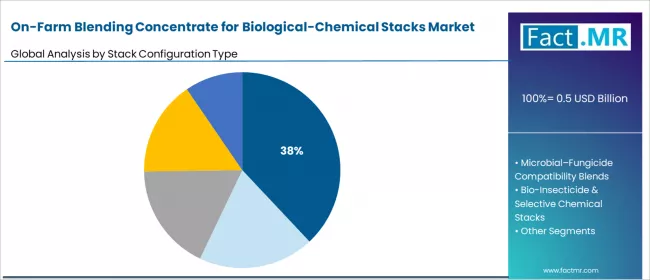
On Farm Blending Concentrate For Biological Chemical Stacks Market Analysis By Stack Configuration Type

Biological & reduced-dose chemical concentrates lead the segment with a 38% share. This configuration directly addresses the core goal of chemical load reduction without sacrificing reliable control. The concentrate system allows farmers to mix a proven biological agent with a lower-than-label rate of compatible chemical, achieving synergistic effects that maintain efficacy while minimizing environmental impact and residue profiles, fulfilling both agronomic and regulatory objectives.

By Biological Component, Which Offers the Most Reliable and Consistent Performance?
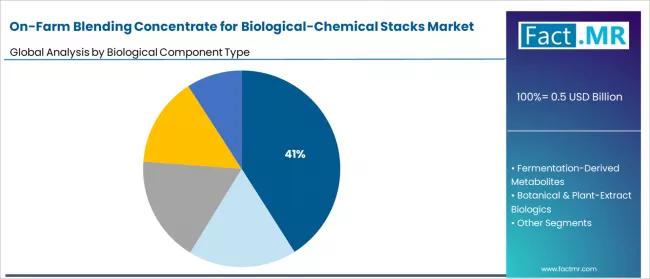
On Farm Blending Concentrate For Biological Chemical Stacks Market Analysis By Biological Component Type

Microbial actives command the largest component share at 41%. This dominance is due to the well-established production, formulation, and mode of action of bacterial and fungal strains. Their living nature allows them to colonize and provide ongoing protection, making them ideal partners in a stack. Advances in fermentation and stabilization have improved their consistency and shelf-life in concentrated forms, increasing farmer confidence in their performance.

By On-Farm Use Case, What is the Primary Driver for Adopting Blending Systems?
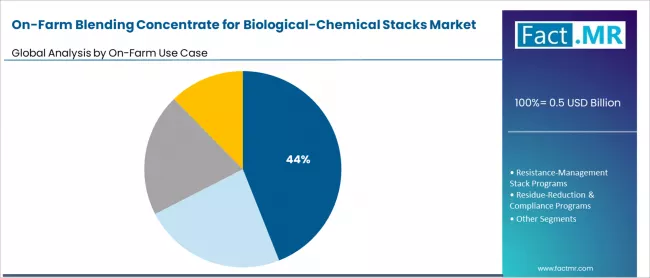
On Farm Blending Concentrate For Biological Chemical Stacks Market Analysis By On Farm Use Case

Custom tank-mix programs represent the leading use case at 44%. This reflects the fundamental desire of progressive farmers to move away from generic solutions. The ability to create a unique stack tailored to the specific weed, disease, and insect spectrum observed in a particular field during a specific season provides superior control and cost efficiency. This customization is the key value proposition driving the entire market.

What are the Drivers, Restraints, and Key Trends of the On-Farm Blending Concentrate for Biological-Chemical Stacks Market?

Market growth is driven by the critical need for resistance management, where stacking modes of action is a fundamental strategy. The economic and regulatory pressure to reduce synthetic chemical use creates demand for partial biological substitution. The increasing availability of high-efficacy biologicals provides viable building blocks for stacks. The professionalization of farming and greater farmer confidence in handling inputs further supports adoption.

A significant restraint is the complexity of compatibility knowledge required to avoid deactivating biologicals or causing tank-mix phytotoxicity. The need for additional on-farm storage and handling for multiple concentrates adds logistical complexity. The higher upfront cost per liter of biological concentrates, despite a lower overall program cost, can be a perceptual barrier. Performance consistency of biologicals can also be more environmentally sensitive than chemicals.

Key trends include the development of "plug-and-play" concentrate ecosystems from single manufacturers, ensuring compatibility. Digital platforms are emerging with databases of validated stack recipes. There is a growing focus on concentrates that include both biologicals and specific adjuvants to buffer pH and protect viability. The market is also seeing integration with variable-rate technology to apply different stack ratios across a single field.

Analysis of the On-Farm Blending Concentrate for Biological-Chemical Stacks Market by Key Countries
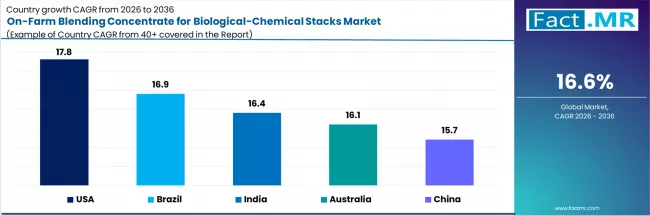
On Farm Blending Concentrate For Biological Chemical Stacks Market Cagr Analysis By Country

Country CAGR (2026-2036)
USA 17.80%
Brazil 16.90%
India 16.40%
Australia 16.10%
China 15.70%

How does the USA's Technologically Advanced and Regulatory-Pressured Farming Drive Adoption?
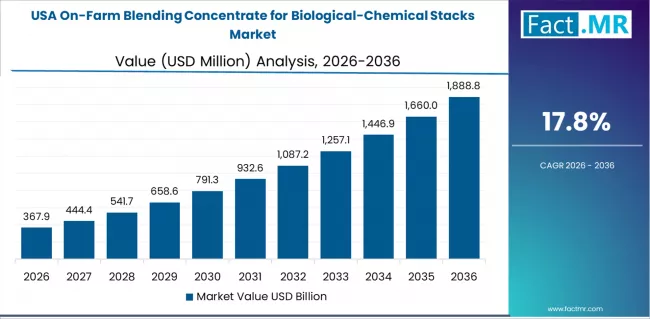
On Farm Blending Concentrate For Biological Chemical Stacks Market Country Value Analysis

The USA leads with a 17.80% CAGR, driven by a potent combination of advanced farming practices and mounting regulatory and consumer pressure on chemical use. American farmers, equipped with sophisticated sprayers and data tools, are adept at implementing complex tank-mix programs. They adopt blending concentrates to build resistance-management strategies and create "softer" chemical programs that meet the sustainability requirements of their downstream buyers.

Why is Brazil's Large-Scale Battle against Resistance a Key Market Force?

Brazil's 16.90% growth is fueled by an intense and continuous battle against resistant pests and weeds in its vast soybean, corn, and cotton fields. Brazilian farmers are forced to innovate constantly. On-farm blending allows them to rapidly deploy customized stacks that combine new biological tools with strategic chemical doses, a practice seen as essential for preserving the efficacy of remaining chemical assets in their intensive production system.

What Role does India's Need for Cost-Effective and Residue-Compliant Solutions Play?

India's 16.40% growth stems from the dual challenge of managing input costs for smallholders and meeting stricter export residue standards. Blending concentrates enable the cost-effective use of high-value biologicals by combining them with smaller amounts of generics. This approach helps farmers maintain yields while reducing residue loads, which is critical for accessing premium vegetable and pulse export markets.

How does Australia's Focus on Environmental Stewardship and Export Shape the Market?

Australia's 16.10% CAGR is linked to its strong national focus on environmental stewardship and its reliance on high-quality, residue-sensitive export markets. Australian farmers use on-farm blending to design programs that minimize chemical footprints in fragile ecosystems. The practice is integral to both meeting "clean and green" marketing claims and complying with the stringent import requirements of Asian trading partners.

What Factors Underpin China's Push for Agricultural Ecological Intensification?

China's 15.70% growth aligns with national policies promoting the reduction of chemical fertilizer and pesticide use. Government support for "green prevention and control" drives adoption of biologicals. On-farm blending concentrates allow large cooperatives and state farms to integrate these biologicals into existing chemical programs efficiently, supporting the national goal of maintaining yields while reducing environmental impact.

Competitive Landscape of the On-Farm Blending Concentrate for Biological-Chemical Stacks Market
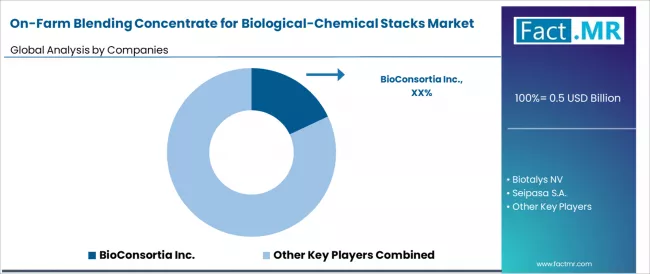
On Farm Blending Concentrate For Biological Chemical Stacks Market Analysis By Company

The market is highly specialized, featuring companies with deep expertise in biologicals and formulation science. Pure-play biological firms like BioConsortia Inc., Biotalys NV, and Futureco Bioscience compete by developing proprietary microbial or biochemical strains explicitly designed for compatibility in tank mixes. Their focus is on proving synergy data with specific chemical groups and providing robust compatibility guides.

Integrated biocontrol companies like Seipasa S.A. and Daymsa often offer broader portfolios that include both botanical extracts and microbials, providing a range of building blocks for different stack needs. Competition centers on technological leadership in strain development or extraction, generating compelling field trial data for stack efficacy, and providing exceptional technical support to educate farmers and agronomists on successful blending protocols.

Key Players in the On-Farm Blending Concentrate for Biological-Chemical Stacks Market

  • BioConsortia Inc.
  • Biotalys NV
  • Seipasa S.A.
  • Futureco Bioscience
  • Daymsa

Scope of Report

Items Values
Quantitative Units USD Billion
Stack Configuration Type Biological & Reduced-Dose Chemical Concentrates, Microbial–Fungicide Compatibility Blends, Bio-Insecticide & Selective Chemical Stacks, Multi-Bio & Chemical Modular Concentrates, Others
Biological Component Type Microbial Actives (Bacteria & Fungi), Fermentation-Derived Metabolites, Botanical & Plant-Extract Biologics, Enzyme & Protein-Based Biologics, Others
On-Farm Use Case Custom Tank-Mix Programs (Field-Level), Resistance-Management Stack Programs, Residue-Reduction & Compliance Programs, Precision & Variable-Rate Blending, Others
Key Countries USA, Brazil, India, Australia, China
Key Companies BioConsortia Inc., Biotalys NV, Seipasa S.A., Futureco Bioscience, Daymsa
Additional Analysis Compatibility matrix development for biological-chemical pairs, on-farm mixing protocol efficacy, economic analysis of stack programs versus standalone applications, and regulatory pathways for combined-use claims.

On-Farm Blending Concentrate for Biological-Chemical Stacks Market by Segments

  • Stack Configuration Type :

    • Biological & Reduced-Dose Chemical Concentrates
    • Microbial–Fungicide Compatibility Blends
    • Bio-Insecticide & Selective Chemical Stacks
    • Multi-Bio & Chemical Modular Concentrates
    • Others
  • Biological Component Type :

    • Microbial Actives (Bacteria & Fungi)
    • Fermentation-Derived Metabolites
    • Botanical & Plant-Extract Biologics
    • Enzyme & Protein-Based Biologics
    • Others
  • On-Farm Use Case :

    • Custom Tank-Mix Programs (Field-Level)
    • Resistance-Management Stack Programs
    • Residue-Reduction & Compliance Programs
    • Precision & Variable-Rate Blending
    • Others
  • Region :

    • North America

      • USA
      • Canada
    • Latin America

      • Brazil
      • Mexico
      • Argentina
      • Rest of Latin America
    • Western Europe

      • Germany
      • UK
      • France
      • Spain
      • Italy
      • BENELUX
      • Rest of Western Europe
    • Eastern Europe

      • Czech Republic
      • Poland
      • Russia
      • Rest of Eastern Europe
    • East Asia

      • China
      • Japan
      • South Korea
      • Rest of East Asia
    • South Asia & Pacific

      • India
      • Indonesia
      • Australia
      • Rest of South Asia & Pacific
    • MEA

      • GCC Countries
      • Turkiye
      • Saudi Arabia
      • Rest of MEA

Table of Content

  1. Executive Summary
    • Global Market Outlook
    • Demand to side Trends
    • Supply to side Trends
    • Technology Roadmap Analysis
    • Analysis and Recommendations
  2. Market Overview
    • Market Coverage / Taxonomy
    • Market Definition / Scope / Limitations
  3. Market Background
    • Market Dynamics
      • Drivers
      • Restraints
      • Opportunity
      • Trends
    • Scenario Forecast
      • Demand in Optimistic Scenario
      • Demand in Likely Scenario
      • Demand in Conservative Scenario
    • Opportunity Map Analysis
    • Product Life Cycle Analysis
    • Supply Chain Analysis
    • Investment Feasibility Matrix
    • Value Chain Analysis
    • PESTLE and Porter’s Analysis
    • Regulatory Landscape
    • Regional Parent Market Outlook
    • Production and Consumption Statistics
    • Import and Export Statistics
  4. Global Market Analysis 2021 to 2025 and Forecast, 2026 to 2036
    • Historical Market Size Value (USD Million) Analysis, 2021 to 2025
    • Current and Future Market Size Value (USD Million) Projections, 2026 to 2036
      • Y to o to Y Growth Trend Analysis
      • Absolute $ Opportunity Analysis
  5. Global Market Pricing Analysis 2021 to 2025 and Forecast 2026 to 2036
  6. Global Market Analysis 2021 to 2025 and Forecast 2026 to 2036, By Stack Configuration Type
    • Introduction / Key Findings
    • Historical Market Size Value (USD Million) Analysis By Stack Configuration Type, 2021 to 2025
    • Current and Future Market Size Value (USD Million) Analysis and Forecast By Stack Configuration Type, 2026 to 2036
      • Biological & Reduced-Dose Chemical Concentrates
      • Microbial–Fungicide Compatibility Blends
      • Bio-Insecticide & Selective Chemical Stacks
      • Multi-Bio & Chemical Modular Concentrates
      • Others
    • Y to o to Y Growth Trend Analysis By Stack Configuration Type, 2021 to 2025
    • Absolute $ Opportunity Analysis By Stack Configuration Type, 2026 to 2036
  7. Global Market Analysis 2021 to 2025 and Forecast 2026 to 2036, By Biological Component Type
    • Introduction / Key Findings
    • Historical Market Size Value (USD Million) Analysis By Biological Component Type, 2021 to 2025
    • Current and Future Market Size Value (USD Million) Analysis and Forecast By Biological Component Type, 2026 to 2036
      • Microbial Actives (Bacteria & Fungi)
      • Fermentation-Derived Metabolites
      • Botanical & Plant-Extract Biologics
      • Enzyme & Protein-Based Biologics
      • Others
    • Y to o to Y Growth Trend Analysis By Biological Component Type, 2021 to 2025
    • Absolute $ Opportunity Analysis By Biological Component Type, 2026 to 2036
  8. Global Market Analysis 2021 to 2025 and Forecast 2026 to 2036, By On-Farm Use Case
    • Introduction / Key Findings
    • Historical Market Size Value (USD Million) Analysis By On-Farm Use Case, 2021 to 2025
    • Current and Future Market Size Value (USD Million) Analysis and Forecast By On-Farm Use Case, 2026 to 2036
      • Custom Tank-Mix Programs (Field-Level)
      • Resistance-Management Stack Programs
      • Residue-Reduction & Compliance Programs
      • Precision & Variable-Rate Blending
    • Y to o to Y Growth Trend Analysis By On-Farm Use Case, 2021 to 2025
    • Absolute $ Opportunity Analysis By On-Farm Use Case, 2026 to 2036
  9. Global Market Analysis 2021 to 2025 and Forecast 2026 to 2036, By Region
    • Introduction
    • Historical Market Size Value (USD Million) Analysis By Region, 2021 to 2025
    • Current Market Size Value (USD Million) Analysis and Forecast By Region, 2026 to 2036
      • North America
      • Latin America
      • Western Europe
      • Eastern Europe
      • East Asia
      • South Asia and Pacific
      • Middle East & Africa
    • Market Attractiveness Analysis By Region
  10. North America Market Analysis 2021 to 2025 and Forecast 2026 to 2036, By Country
    • Historical Market Size Value (USD Million) Trend Analysis By Market Taxonomy, 2021 to 2025
    • Market Size Value (USD Million) Forecast By Market Taxonomy, 2026 to 2036
      • By Country
        • USA
        • Canada
        • Mexico
      • By Stack Configuration Type
      • By Biological Component Type
      • By On-Farm Use Case
    • Market Attractiveness Analysis
      • By Country
      • By Stack Configuration Type
      • By Biological Component Type
      • By On-Farm Use Case
    • Key Takeaways
  11. Latin America Market Analysis 2021 to 2025 and Forecast 2026 to 2036, By Country
    • Historical Market Size Value (USD Million) Trend Analysis By Market Taxonomy, 2021 to 2025
    • Market Size Value (USD Million) Forecast By Market Taxonomy, 2026 to 2036
      • By Country
        • Brazil
        • Chile
        • Rest of Latin America
      • By Stack Configuration Type
      • By Biological Component Type
      • By On-Farm Use Case
    • Market Attractiveness Analysis
      • By Country
      • By Stack Configuration Type
      • By Biological Component Type
      • By On-Farm Use Case
    • Key Takeaways
  12. Western Europe Market Analysis 2021 to 2025 and Forecast 2026 to 2036, By Country
    • Historical Market Size Value (USD Million) Trend Analysis By Market Taxonomy, 2021 to 2025
    • Market Size Value (USD Million) Forecast By Market Taxonomy, 2026 to 2036
      • By Country
        • Germany
        • UK
        • Italy
        • Spain
        • France
        • Nordic
        • BENELUX
        • Rest of Western Europe
      • By Stack Configuration Type
      • By Biological Component Type
      • By On-Farm Use Case
    • Market Attractiveness Analysis
      • By Country
      • By Stack Configuration Type
      • By Biological Component Type
      • By On-Farm Use Case
    • Key Takeaways
  13. Eastern Europe Market Analysis 2021 to 2025 and Forecast 2026 to 2036, By Country
    • Historical Market Size Value (USD Million) Trend Analysis By Market Taxonomy, 2021 to 2025
    • Market Size Value (USD Million) Forecast By Market Taxonomy, 2026 to 2036
      • By Country
        • Russia
        • Poland
        • Hungary
        • Balkan & Baltic
        • Rest of Eastern Europe
      • By Stack Configuration Type
      • By Biological Component Type
      • By On-Farm Use Case
    • Market Attractiveness Analysis
      • By Country
      • By Stack Configuration Type
      • By Biological Component Type
      • By On-Farm Use Case
    • Key Takeaways
  14. East Asia Market Analysis 2021 to 2025 and Forecast 2026 to 2036, By Country
    • Historical Market Size Value (USD Million) Trend Analysis By Market Taxonomy, 2021 to 2025
    • Market Size Value (USD Million) Forecast By Market Taxonomy, 2026 to 2036
      • By Country
        • China
        • Japan
        • South Korea
      • By Stack Configuration Type
      • By Biological Component Type
      • By On-Farm Use Case
    • Market Attractiveness Analysis
      • By Country
      • By Stack Configuration Type
      • By Biological Component Type
      • By On-Farm Use Case
    • Key Takeaways
  15. South Asia and Pacific Market Analysis 2021 to 2025 and Forecast 2026 to 2036, By Country
    • Historical Market Size Value (USD Million) Trend Analysis By Market Taxonomy, 2021 to 2025
    • Market Size Value (USD Million) Forecast By Market Taxonomy, 2026 to 2036
      • By Country
        • India
        • ASEAN
        • Australia & New Zealand
        • Rest of South Asia and Pacific
      • By Stack Configuration Type
      • By Biological Component Type
      • By On-Farm Use Case
    • Market Attractiveness Analysis
      • By Country
      • By Stack Configuration Type
      • By Biological Component Type
      • By On-Farm Use Case
    • Key Takeaways
  16. Middle East & Africa Market Analysis 2021 to 2025 and Forecast 2026 to 2036, By Country
    • Historical Market Size Value (USD Million) Trend Analysis By Market Taxonomy, 2021 to 2025
    • Market Size Value (USD Million) Forecast By Market Taxonomy, 2026 to 2036
      • By Country
        • Kingdom of Saudi Arabia
        • Other GCC Countries
        • Turkiye
        • South Africa
        • Other African Union
        • Rest of Middle East & Africa
      • By Stack Configuration Type
      • By Biological Component Type
      • By On-Farm Use Case
    • Market Attractiveness Analysis
      • By Country
      • By Stack Configuration Type
      • By Biological Component Type
      • By On-Farm Use Case
    • Key Takeaways
  17. Key Countries Market Analysis
    • USA
      • Pricing Analysis
      • Market Share Analysis, 2025
        • By Stack Configuration Type
        • By Biological Component Type
        • By On-Farm Use Case
    • Canada
      • Pricing Analysis
      • Market Share Analysis, 2025
        • By Stack Configuration Type
        • By Biological Component Type
        • By On-Farm Use Case
    • Mexico
      • Pricing Analysis
      • Market Share Analysis, 2025
        • By Stack Configuration Type
        • By Biological Component Type
        • By On-Farm Use Case
    • Brazil
      • Pricing Analysis
      • Market Share Analysis, 2025
        • By Stack Configuration Type
        • By Biological Component Type
        • By On-Farm Use Case
    • Chile
      • Pricing Analysis
      • Market Share Analysis, 2025
        • By Stack Configuration Type
        • By Biological Component Type
        • By On-Farm Use Case
    • Germany
      • Pricing Analysis
      • Market Share Analysis, 2025
        • By Stack Configuration Type
        • By Biological Component Type
        • By On-Farm Use Case
    • UK
      • Pricing Analysis
      • Market Share Analysis, 2025
        • By Stack Configuration Type
        • By Biological Component Type
        • By On-Farm Use Case
    • Italy
      • Pricing Analysis
      • Market Share Analysis, 2025
        • By Stack Configuration Type
        • By Biological Component Type
        • By On-Farm Use Case
    • Spain
      • Pricing Analysis
      • Market Share Analysis, 2025
        • By Stack Configuration Type
        • By Biological Component Type
        • By On-Farm Use Case
    • France
      • Pricing Analysis
      • Market Share Analysis, 2025
        • By Stack Configuration Type
        • By Biological Component Type
        • By On-Farm Use Case
    • India
      • Pricing Analysis
      • Market Share Analysis, 2025
        • By Stack Configuration Type
        • By Biological Component Type
        • By On-Farm Use Case
    • ASEAN
      • Pricing Analysis
      • Market Share Analysis, 2025
        • By Stack Configuration Type
        • By Biological Component Type
        • By On-Farm Use Case
    • Australia & New Zealand
      • Pricing Analysis
      • Market Share Analysis, 2025
        • By Stack Configuration Type
        • By Biological Component Type
        • By On-Farm Use Case
    • China
      • Pricing Analysis
      • Market Share Analysis, 2025
        • By Stack Configuration Type
        • By Biological Component Type
        • By On-Farm Use Case
    • Japan
      • Pricing Analysis
      • Market Share Analysis, 2025
        • By Stack Configuration Type
        • By Biological Component Type
        • By On-Farm Use Case
    • South Korea
      • Pricing Analysis
      • Market Share Analysis, 2025
        • By Stack Configuration Type
        • By Biological Component Type
        • By On-Farm Use Case
    • Russia
      • Pricing Analysis
      • Market Share Analysis, 2025
        • By Stack Configuration Type
        • By Biological Component Type
        • By On-Farm Use Case
    • Poland
      • Pricing Analysis
      • Market Share Analysis, 2025
        • By Stack Configuration Type
        • By Biological Component Type
        • By On-Farm Use Case
    • Hungary
      • Pricing Analysis
      • Market Share Analysis, 2025
        • By Stack Configuration Type
        • By Biological Component Type
        • By On-Farm Use Case
    • Kingdom of Saudi Arabia
      • Pricing Analysis
      • Market Share Analysis, 2025
        • By Stack Configuration Type
        • By Biological Component Type
        • By On-Farm Use Case
    • Turkiye
      • Pricing Analysis
      • Market Share Analysis, 2025
        • By Stack Configuration Type
        • By Biological Component Type
        • By On-Farm Use Case
    • South Africa
      • Pricing Analysis
      • Market Share Analysis, 2025
        • By Stack Configuration Type
        • By Biological Component Type
        • By On-Farm Use Case
  18. Market Structure Analysis
    • Competition Dashboard
    • Competition Benchmarking
    • Market Share Analysis of Top Players
      • By Regional
      • By Stack Configuration Type
      • By Biological Component Type
      • By On-Farm Use Case
  19. Competition Analysis
    • Competition Deep Dive
      • BioConsortia Inc.
        • Overview
        • Product Portfolio
        • Profitability by Market Segments (Product/Age /Sales Channel/Region)
        • Sales Footprint
        • Strategy Overview
          • Marketing Strategy
          • Product Strategy
          • Channel Strategy
      • Biotalys NV
      • Seipasa S.A.
      • Futureco Bioscience
      • Daymsa
      • Others
  20. Assumptions & Acronyms Used
  21. Research Methodology

List Of Table

  • Table 1: Global Market Value (USD Million) Forecast by Region, 2021 to 2036
  • Table 2: Global Market Value (USD Million) Forecast by Stack Configuration Type, 2021 to 2036
  • Table 3: Global Market Value (USD Million) Forecast by Biological Component Type, 2021 to 2036
  • Table 4: Global Market Value (USD Million) Forecast by On-Farm Use Case, 2021 to 2036
  • Table 5: North America Market Value (USD Million) Forecast by Country, 2021 to 2036
  • Table 6: North America Market Value (USD Million) Forecast by Stack Configuration Type, 2021 to 2036
  • Table 7: North America Market Value (USD Million) Forecast by Biological Component Type, 2021 to 2036
  • Table 8: North America Market Value (USD Million) Forecast by On-Farm Use Case, 2021 to 2036
  • Table 9: Latin America Market Value (USD Million) Forecast by Country, 2021 to 2036
  • Table 10: Latin America Market Value (USD Million) Forecast by Stack Configuration Type, 2021 to 2036
  • Table 11: Latin America Market Value (USD Million) Forecast by Biological Component Type, 2021 to 2036
  • Table 12: Latin America Market Value (USD Million) Forecast by On-Farm Use Case, 2021 to 2036
  • Table 13: Western Europe Market Value (USD Million) Forecast by Country, 2021 to 2036
  • Table 14: Western Europe Market Value (USD Million) Forecast by Stack Configuration Type, 2021 to 2036
  • Table 15: Western Europe Market Value (USD Million) Forecast by Biological Component Type, 2021 to 2036
  • Table 16: Western Europe Market Value (USD Million) Forecast by On-Farm Use Case, 2021 to 2036
  • Table 17: Eastern Europe Market Value (USD Million) Forecast by Country, 2021 to 2036
  • Table 18: Eastern Europe Market Value (USD Million) Forecast by Stack Configuration Type, 2021 to 2036
  • Table 19: Eastern Europe Market Value (USD Million) Forecast by Biological Component Type, 2021 to 2036
  • Table 20: Eastern Europe Market Value (USD Million) Forecast by On-Farm Use Case, 2021 to 2036
  • Table 21: East Asia Market Value (USD Million) Forecast by Country, 2021 to 2036
  • Table 22: East Asia Market Value (USD Million) Forecast by Stack Configuration Type, 2021 to 2036
  • Table 23: East Asia Market Value (USD Million) Forecast by Biological Component Type, 2021 to 2036
  • Table 24: East Asia Market Value (USD Million) Forecast by On-Farm Use Case, 2021 to 2036
  • Table 25: South Asia and Pacific Market Value (USD Million) Forecast by Country, 2021 to 2036
  • Table 26: South Asia and Pacific Market Value (USD Million) Forecast by Stack Configuration Type, 2021 to 2036
  • Table 27: South Asia and Pacific Market Value (USD Million) Forecast by Biological Component Type, 2021 to 2036
  • Table 28: South Asia and Pacific Market Value (USD Million) Forecast by On-Farm Use Case, 2021 to 2036
  • Table 29: Middle East & Africa Market Value (USD Million) Forecast by Country, 2021 to 2036
  • Table 30: Middle East & Africa Market Value (USD Million) Forecast by Stack Configuration Type, 2021 to 2036
  • Table 31: Middle East & Africa Market Value (USD Million) Forecast by Biological Component Type, 2021 to 2036
  • Table 32: Middle East & Africa Market Value (USD Million) Forecast by On-Farm Use Case, 2021 to 2036

List Of Figures

  • Figure 1: Global Market Pricing Analysis
  • Figure 2: Global Market Value (USD Million) Forecast 2021 to 2036
  • Figure 3: Global Market Value Share and BPS Analysis by Stack Configuration Type, 2026 and 2036
  • Figure 4: Global Market Y to o to Y Growth Comparison by Stack Configuration Type, 2026 to 2036
  • Figure 5: Global Market Attractiveness Analysis by Stack Configuration Type
  • Figure 6: Global Market Value Share and BPS Analysis by Biological Component Type, 2026 and 2036
  • Figure 7: Global Market Y to o to Y Growth Comparison by Biological Component Type, 2026 to 2036
  • Figure 8: Global Market Attractiveness Analysis by Biological Component Type
  • Figure 9: Global Market Value Share and BPS Analysis by On-Farm Use Case, 2026 and 2036
  • Figure 10: Global Market Y to o to Y Growth Comparison by On-Farm Use Case, 2026 to 2036
  • Figure 11: Global Market Attractiveness Analysis by On-Farm Use Case
  • Figure 12: Global Market Value (USD Million) Share and BPS Analysis by Region, 2026 and 2036
  • Figure 13: Global Market Y to o to Y Growth Comparison by Region, 2026 to 2036
  • Figure 14: Global Market Attractiveness Analysis by Region
  • Figure 15: North America Market Incremental Dollar Opportunity, 2026 to 2036
  • Figure 16: Latin America Market Incremental Dollar Opportunity, 2026 to 2036
  • Figure 17: Western Europe Market Incremental Dollar Opportunity, 2026 to 2036
  • Figure 18: Eastern Europe Market Incremental Dollar Opportunity, 2026 to 2036
  • Figure 19: East Asia Market Incremental Dollar Opportunity, 2026 to 2036
  • Figure 20: South Asia and Pacific Market Incremental Dollar Opportunity, 2026 to 2036
  • Figure 21: Middle East & Africa Market Incremental Dollar Opportunity, 2026 to 2036
  • Figure 22: North America Market Value Share and BPS Analysis by Country, 2026 and 2036
  • Figure 23: North America Market Value Share and BPS Analysis by Stack Configuration Type, 2026 and 2036
  • Figure 24: North America Market Y to o to Y Growth Comparison by Stack Configuration Type, 2026 to 2036
  • Figure 25: North America Market Attractiveness Analysis by Stack Configuration Type
  • Figure 26: North America Market Value Share and BPS Analysis by Biological Component Type, 2026 and 2036
  • Figure 27: North America Market Y to o to Y Growth Comparison by Biological Component Type, 2026 to 2036
  • Figure 28: North America Market Attractiveness Analysis by Biological Component Type
  • Figure 29: North America Market Value Share and BPS Analysis by On-Farm Use Case, 2026 and 2036
  • Figure 30: North America Market Y to o to Y Growth Comparison by On-Farm Use Case, 2026 to 2036
  • Figure 31: North America Market Attractiveness Analysis by On-Farm Use Case
  • Figure 32: Latin America Market Value Share and BPS Analysis by Country, 2026 and 2036
  • Figure 33: Latin America Market Value Share and BPS Analysis by Stack Configuration Type, 2026 and 2036
  • Figure 34: Latin America Market Y to o to Y Growth Comparison by Stack Configuration Type, 2026 to 2036
  • Figure 35: Latin America Market Attractiveness Analysis by Stack Configuration Type
  • Figure 36: Latin America Market Value Share and BPS Analysis by Biological Component Type, 2026 and 2036
  • Figure 37: Latin America Market Y to o to Y Growth Comparison by Biological Component Type, 2026 to 2036
  • Figure 38: Latin America Market Attractiveness Analysis by Biological Component Type
  • Figure 39: Latin America Market Value Share and BPS Analysis by On-Farm Use Case, 2026 and 2036
  • Figure 40: Latin America Market Y to o to Y Growth Comparison by On-Farm Use Case, 2026 to 2036
  • Figure 41: Latin America Market Attractiveness Analysis by On-Farm Use Case
  • Figure 42: Western Europe Market Value Share and BPS Analysis by Country, 2026 and 2036
  • Figure 43: Western Europe Market Value Share and BPS Analysis by Stack Configuration Type, 2026 and 2036
  • Figure 44: Western Europe Market Y to o to Y Growth Comparison by Stack Configuration Type, 2026 to 2036
  • Figure 45: Western Europe Market Attractiveness Analysis by Stack Configuration Type
  • Figure 46: Western Europe Market Value Share and BPS Analysis by Biological Component Type, 2026 and 2036
  • Figure 47: Western Europe Market Y to o to Y Growth Comparison by Biological Component Type, 2026 to 2036
  • Figure 48: Western Europe Market Attractiveness Analysis by Biological Component Type
  • Figure 49: Western Europe Market Value Share and BPS Analysis by On-Farm Use Case, 2026 and 2036
  • Figure 50: Western Europe Market Y to o to Y Growth Comparison by On-Farm Use Case, 2026 to 2036
  • Figure 51: Western Europe Market Attractiveness Analysis by On-Farm Use Case
  • Figure 52: Eastern Europe Market Value Share and BPS Analysis by Country, 2026 and 2036
  • Figure 53: Eastern Europe Market Value Share and BPS Analysis by Stack Configuration Type, 2026 and 2036
  • Figure 54: Eastern Europe Market Y to o to Y Growth Comparison by Stack Configuration Type, 2026 to 2036
  • Figure 55: Eastern Europe Market Attractiveness Analysis by Stack Configuration Type
  • Figure 56: Eastern Europe Market Value Share and BPS Analysis by Biological Component Type, 2026 and 2036
  • Figure 57: Eastern Europe Market Y to o to Y Growth Comparison by Biological Component Type, 2026 to 2036
  • Figure 58: Eastern Europe Market Attractiveness Analysis by Biological Component Type
  • Figure 59: Eastern Europe Market Value Share and BPS Analysis by On-Farm Use Case, 2026 and 2036
  • Figure 60: Eastern Europe Market Y to o to Y Growth Comparison by On-Farm Use Case, 2026 to 2036
  • Figure 61: Eastern Europe Market Attractiveness Analysis by On-Farm Use Case
  • Figure 62: East Asia Market Value Share and BPS Analysis by Country, 2026 and 2036
  • Figure 63: East Asia Market Value Share and BPS Analysis by Stack Configuration Type, 2026 and 2036
  • Figure 64: East Asia Market Y to o to Y Growth Comparison by Stack Configuration Type, 2026 to 2036
  • Figure 65: East Asia Market Attractiveness Analysis by Stack Configuration Type
  • Figure 66: East Asia Market Value Share and BPS Analysis by Biological Component Type, 2026 and 2036
  • Figure 67: East Asia Market Y to o to Y Growth Comparison by Biological Component Type, 2026 to 2036
  • Figure 68: East Asia Market Attractiveness Analysis by Biological Component Type
  • Figure 69: East Asia Market Value Share and BPS Analysis by On-Farm Use Case, 2026 and 2036
  • Figure 70: East Asia Market Y to o to Y Growth Comparison by On-Farm Use Case, 2026 to 2036
  • Figure 71: East Asia Market Attractiveness Analysis by On-Farm Use Case
  • Figure 72: South Asia and Pacific Market Value Share and BPS Analysis by Country, 2026 and 2036
  • Figure 73: South Asia and Pacific Market Value Share and BPS Analysis by Stack Configuration Type, 2026 and 2036
  • Figure 74: South Asia and Pacific Market Y to o to Y Growth Comparison by Stack Configuration Type, 2026 to 2036
  • Figure 75: South Asia and Pacific Market Attractiveness Analysis by Stack Configuration Type
  • Figure 76: South Asia and Pacific Market Value Share and BPS Analysis by Biological Component Type, 2026 and 2036
  • Figure 77: South Asia and Pacific Market Y to o to Y Growth Comparison by Biological Component Type, 2026 to 2036
  • Figure 78: South Asia and Pacific Market Attractiveness Analysis by Biological Component Type
  • Figure 79: South Asia and Pacific Market Value Share and BPS Analysis by On-Farm Use Case, 2026 and 2036
  • Figure 80: South Asia and Pacific Market Y to o to Y Growth Comparison by On-Farm Use Case, 2026 to 2036
  • Figure 81: South Asia and Pacific Market Attractiveness Analysis by On-Farm Use Case
  • Figure 82: Middle East & Africa Market Value Share and BPS Analysis by Country, 2026 and 2036
  • Figure 83: Middle East & Africa Market Value Share and BPS Analysis by Stack Configuration Type, 2026 and 2036
  • Figure 84: Middle East & Africa Market Y to o to Y Growth Comparison by Stack Configuration Type, 2026 to 2036
  • Figure 85: Middle East & Africa Market Attractiveness Analysis by Stack Configuration Type
  • Figure 86: Middle East & Africa Market Value Share and BPS Analysis by Biological Component Type, 2026 and 2036
  • Figure 87: Middle East & Africa Market Y to o to Y Growth Comparison by Biological Component Type, 2026 to 2036
  • Figure 88: Middle East & Africa Market Attractiveness Analysis by Biological Component Type
  • Figure 89: Middle East & Africa Market Value Share and BPS Analysis by On-Farm Use Case, 2026 and 2036
  • Figure 90: Middle East & Africa Market Y to o to Y Growth Comparison by On-Farm Use Case, 2026 to 2036
  • Figure 91: Middle East & Africa Market Attractiveness Analysis by On-Farm Use Case
  • Figure 92: Global Market - Tier Structure Analysis
  • Figure 93: Global Market - Company Share Analysis

- FAQs -

How big is the on-farm blending concentrate for biological-chemical stacks market in 2026?

The global on-farm blending concentrate for biological-chemical stacks market is estimated to be valued at USD 0.5 billion in 2026.

What will be the size of on-farm blending concentrate for biological-chemical stacks market in 2036?

The market size for the on-farm blending concentrate for biological-chemical stacks market is projected to reach USD 2.3 billion by 2036.

How much will be the on-farm blending concentrate for biological-chemical stacks market growth between 2026 and 2036?

The on-farm blending concentrate for biological-chemical stacks market is expected to grow at a 16.6% CAGR between 2026 and 2036.

What are the key product types in the on-farm blending concentrate for biological-chemical stacks market?

The key product types in on-farm blending concentrate for biological-chemical stacks market are biological & reduced-dose chemical concentrates, microbial–fungicide compatibility blends, bio-insecticide & selective chemical stacks, multi-bio & chemical modular concentrates and others.

Which biological component type segment to contribute significant share in the on-farm blending concentrate for biological-chemical stacks market in 2026?

In terms of biological component type, microbial actives (bacteria & fungi) segment to command 41.0% share in the on-farm blending concentrate for biological-chemical stacks market in 2026.

On-Farm Blending Concentrate for Biological-Chemical Stacks Market