- Market Value (2025): USD 663.3 Mn
- Estimated Value (2026): USD 780.0 Mn
- Forecast Value (2036): USD 3946.1 Mn
- CAGR (2026-2036): 17.6%
What is the Dry Fungi Mycoproteins Market forecast to be worth by 2036?
USD 780.0 million in 2026 to USD 3,946.1 million by 2036 at a 17.6% CAGR.
- The Dry Fungi Mycoproteins Market crossed a valuation of USD 663.3 million in 2025.
- Demand is projected to increase from USD 780.0 million in 2026 to USD 3,946.1 million by 2036.
- The market is forecast to record 17.6% CAGR from 2026 to 2036, supported by meat alternative brands and nutrition food formulators.
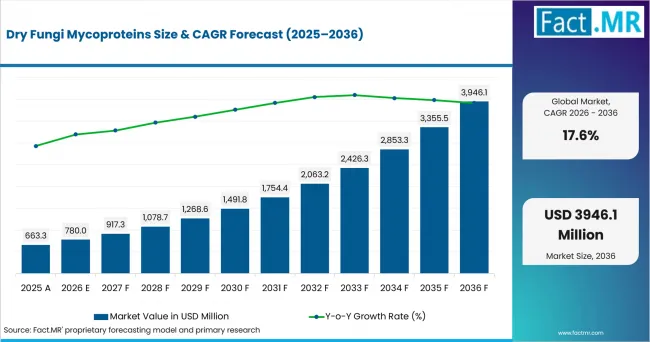
Dry Fungi Mycoproteins Value Analysis | Source: Fact.MR
What are the defining numbers behind Dry Fungi Mycoproteins Market growth?
An absolute opportunity of USD 3,166.1 million is expected between 2026 and 2036.
- Demand Drivers in the Market
- Meat alternative brands need dry mycoprotein that hydrates into a fibrous bite. Many plant proteins require added texturizers to build chew.
- Ready meal manufacturers need protein inputs that tolerate freezing and reheating. Dry powder and flakes help formulators test recipes without changing the whole production line.
- Label review teams need clear product naming and composition files. In January 2025, FDA issued draft, non-binding guidance on naming and labeling certain plant-based alternatives to animal-derived foods. The guidance recommends truthful, non-misleading product names that accurately describe the nature or plant source of the food. It provides adjacent labeling context rather than guidance specific to mycoprotein products.
- Key Segments Analyzed
- By Fungi Source: Fusarium is expected to hold 33.0% share in 2026 due to its history in commercial mycoprotein and its useful filament structure.
- By Product Form: Dry powder is projected to account for 34.0% share in 2026, supported by easier storage and recipe testing across nutrition foods.
- By Application: Meat alternatives are anticipated to capture 37.0% share in 2026, shaped by the need for bite and juiciness in burgers and minced products.
- By Processing: Biomass fermentation is estimated to represent 29.0% share in 2026, owing to controlled growth of fungal biomass before drying and milling.
- Analyst Opinion at Fact.MR
- Shambhu Nath Jha, Principal Consultant at Fact.MR, states, “Dry fungi mycoproteins are drawing attention as their texture is formed by the organism before formulation starts. The market is expected to favor suppliers that prove batch consistency and easy hydration across food formats. Formulators should look for strain control, drying discipline and clear safety documentation in one technical file.”
- Strategic Implications
- Ingredient suppliers should document hydration rate, particle size and protein quality so food manufacturers compare dry powders with soy and pea systems.
- Food manufacturers should test dry powder against frozen or wet biomass where storage cost and transport flexibility influence production planning.
- Brand owners should connect mycoprotein selection to product naming, texture claims and allergen review before moving from pilot batches into launch planning.
- Application teams should map dry powder use against meat alternatives and nutrition foods while comparing hydration, texture and protein claims in the same trial plan.
China is expected to record 19.1% CAGR through 2036, supported by food manufacturing activity and wider recipe trials. USA is projected to post 18.6% CAGR as meat alternative brands test dry protein formats. Germany is anticipated to advance at 18.4% CAGR, supported by ready-meal output and EU ingredient review pathways. Japan is estimated to reach 17.5% CAGR due to health foods and shelf-stable ingredient demand. France is forecast to post 17.1% CAGR, reinforced by agri-food investment and EU novel food experience.
How does the Dry Fungi Mycoproteins Market break down by segment?
Meat alternatives lead Application at 37.0% share in 2026; Dry powder leads Product Form at 34.0% share.
Which Fungi Source dominates?
Fusarium is expected to hold 33.0% share in 2026.
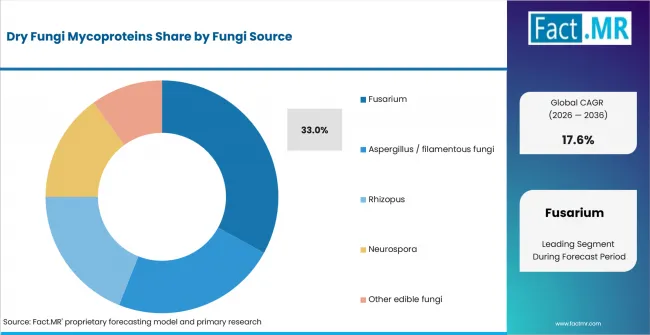
Dry Fungi Mycoproteins Analysis By Fungi Source | Source: Fact.MR
Fusarium is expected to lead the fungi source segment due to its commercial use in mycoprotein and its filamentous structure. Other fungal-protein platforms are also being commercialized for food applications.
What leads the Product Form segment?
Dry powder is projected to account for 34.0% share in 2026.
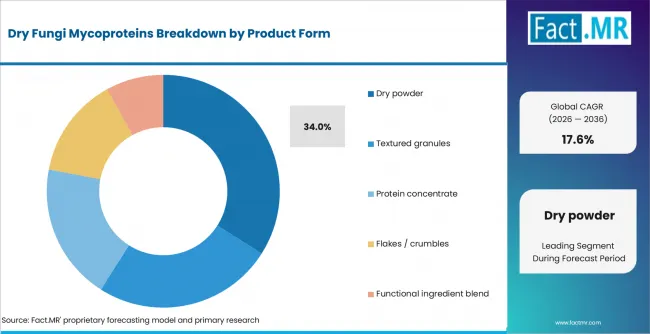
Dry Fungi Mycoproteins Analysis By Product Form | Source: Fact.MR
Dry powder is projected to account for the main product form share due to easier storage and controlled recipe dosing. Textured granules serve products that need visible bite. Protein concentrates fit nutrition foods that use measured protein claims. Flakes and crumbles support snacks and ready meals where the ingredient must rehydrate quickly.
How does Application shape demand?
Meat alternatives are anticipated to capture 37.0% share in 2026.
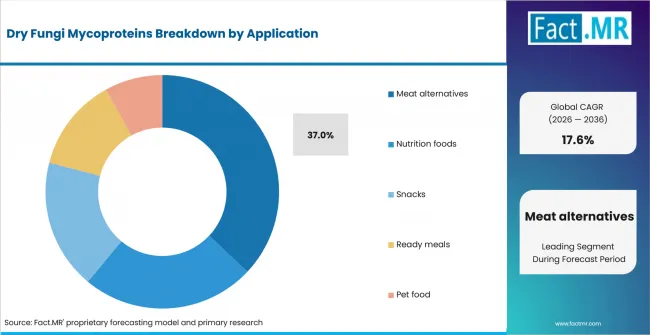
Dry Fungi Mycoproteins Analysis By Application | Source: Fact.MR
Meat alternatives are anticipated to capture 37.0% share since mycoprotein naturally brings fibrous structure into burgers, mince and hybrid meat formats. Nutrition foods use dry powder where brands need protein, fiber and mild flavor in bars or shakes. Snacks and ready meals use flakes or crumbles where shelf life and reheating performance guide ingredient choice.
What supports Biomass fermentation within Processing?
Biomass fermentation is estimated to represent 29.0% share in 2026.
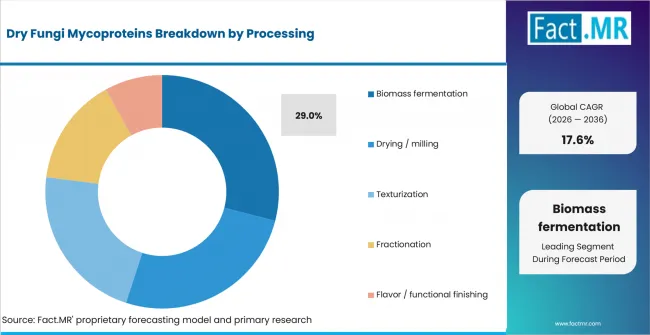
Dry Fungi Mycoproteins Analysis By Processing | Source: Fact.MR
Biomass fermentation is estimated to represent 29.0% share due to its role in producing edible fungal material before downstream drying and finishing. Drying and milling convert biomass into powders or flakes for ingredient handling. Texturization supports meat analogues that need fiber alignment, while fractionation is used when brands want protein concentrates or functional blends. Clear strain identity and defined use conditions improve the reference pathway for fungal biomass ingredients in Europe.
What is accelerating Dry Fungi Mycoproteins Market adoption, and what is holding it back?
Texture-led reformulation drives it; scale-up cost and regulatory review restrain it.
Drivers Impact Analysis
| DRIVER | (~) % IMPACT ON CAGR | GEOGRAPHIC RELEVANCE | IMPACT TIMELINE |
|---|---|---|---|
| Meat alternative texture reformulation | +2.1% | North America, Europe, East Asia | Short term (<= 2 years) |
| Powder handling and shelf-stable ingredient use | +1.5% | Global | Medium term (2-4 years) |
| Nutrition foods using protein and fiber claims | +1.2% | USA, Japan, Western Europe | Medium term (2-4 years) |
| Fermentation capacity and strain know-how | +0.9% | Europe, North America | Long term (>= 4 years) |
Opportunity Impact Analysis
| OPPORTUNITY | (~) % IMPACT ON CAGR | GEOGRAPHIC RELEVANCE | IMPACT TIMELINE |
|---|---|---|---|
| Hybrid meat and blended protein formats | +1.4% | Europe, USA, China | Short term (<= 2 years) |
| Functional ingredient blends for snacks | +1.0% | North America, Japan, Western Europe | Medium term (2-4 years) |
| Regional ingredient approval and dossier support | +0.7% | Europe, Japan, USA | Long term (>= 4 years) |
Restraints Impact Analysis
| RESTRAINT | (~) % IMPACT ON CAGR | GEOGRAPHIC RELEVANCE | IMPACT TIMELINE |
|---|---|---|---|
| Scale-up cost and drying economics | -0.8% | Global | Short term (<= 2 years) |
| Label clarity and regulatory files | -0.6% | USA, Europe, Japan | Medium term (2-4 years) |
| Taste and hydration variability | -0.5% | Global | Long term (>= 4 years) |
Which countries are scaling the Dry Fungi Mycoproteins Market through 2036?
- The country comparison spans 2.0 percentage points and forms three practical growth bands across the forecast period.
- China remains 0.5 percentage point above the USA through food manufacturing activity and ingredient reformulation.
- The USA remains 0.2 percentage point above Germany as food manufacturing scale supports meat alternative trials.
- Germany remains 0.9 percentage point above Japan through ready-meal output and EU fungal ingredient review pathways.
- Japan remains 0.4 percentage point above France as health foods and shelf-stable ingredient formats support dry protein testing.
- France closes the displayed range through agri-food investment and EU approval experience for fungal biomass ingredients.
Comparable CAGRs create different entry conditions due to local food formats, ingredient rules and manufacturing capacity. Full report coverage includes North America, Latin America, Western Europe, Eastern Europe, East Asia, South Asia & Pacific, Middle East & Africa.
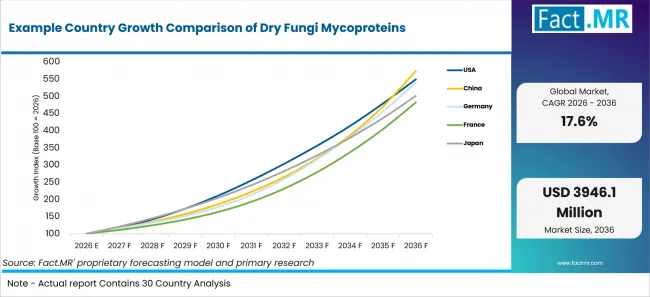
Example Country Growth Comparison Of Dry Fungi Mycoproteins | Source: Fact.MR
| Country | CAGR |
|---|---|
| China | 19.1% |
| USA | 18.6% |
| Germany | 18.4% |
| Japan | 17.5% |
| France | 17.1% |
How is China scaling demand?
19.1% CAGR, driven by food manufacturing activity and ingredient reformulation.
China food brands evaluate dry mycoprotein where snacks and meat alternatives need stable protein inputs. The country is forecast to post 19.1% CAGR through 2036. China’s National Bureau of Statistics reported in January 2026 that value added in the manufacture of foods increased 5.3% in 2025, providing a direct official indicator of food-manufacturing activity.
What supports USA adoption?
18.6% CAGR, supported by food manufacturing scale and meat alternative testing.
USA product teams are expected to use dry mycoprotein in meat alternatives and nutrition foods where texture and protein content must be proven together. The market is projected to record 18.6% CAGR through 2036. The U.S. Census Bureau reported in September 2026 that Food Manufacturing (NAICS 311) generated an estimated value of shipments of USD 1,054.3 billion in 2024.
What supports Germany’s outlook?
18.4% CAGR, reinforced by ready-meal output and meat substitute experience.
German manufacturers are anticipated to test dry fungal protein in ready meals and meat analogues where reheating behavior shapes product acceptance. Demand is estimated to advance at 18.4% CAGR through 2036. Destatis reported in January 2026 that Germany produced 1.7 million tonnes of ready meals in 2024, 25.6% more by volume than in 2019.
How does Japan perform?
17.5% CAGR, shaped by health foods and shelf-stable ingredient demand.
Japanese health food and ready-meal brands need dry protein inputs that store well and support clear nutrition positioning. The country is forecast to reach 17.5% CAGR through 2036. USDA FAS reported in April 2026 that Japan’s food processing sector decreased 3% in 2025 to USD 174 billion, while health foods, frozen foods and canned and bottled foods were among the categories that recorded growth.
What underpins France’s growth?
17.1% CAGR, backed by agri-food investment and EU ingredient approval routes.
France is expected to scale dry fungi mycoproteins through agri-food processors that evaluate new proteins for prepared foods. The market is projected to post 17.1% CAGR through 2036. France’s agriculture ministry reported on February 26, 2025, that France 2030 had financed more than 90 projects associated with EUR 1.1 billion in total productive investment.
Who leads the Dry Fungi Mycoproteins Market?
Public product information documents powder-format fungal-protein or mycoprotein offerings from The Protein Brewery, Promyc and Nosh.bio.
Quorn launched Marlow Ingredients in 2023 to make its mycoprotein available to other food producers. Cargill’s ABUNDA specification lists typical dry matter content of 25 g/100 g and moisture content of 75 g/100 g, making it a broader high-moisture mycoprotein comparator rather than a direct dry-format product.
The Protein Brewery markets Fermotein® as a nutritious mycoprotein powder. Promyc lists S112P as a powdered mycoprotein containing more than 50% protein and 30% fibre, while Nosh.bio offers Koji Protein in formats ranging from frozen to powder. The Protein Brewery raised EUR 30 million in September 2025 to advance Fermotein and expand production capacity for food manufacturers. Across these suppliers, documented areas of differentiation include fungal strain and fermentation platforms, downstream processing and powder functionality, and application-development support.
Which companies are the key providers?
Key companies include The Protein Brewery; Promyc (produced by Naplasol, a VEOS Group company); Nosh.bio; and Enifer.
- The Protein Brewery
- Promyc (produced by Naplasol, a VEOS Group company)
- Nosh.bio
- Enifer
Bibliography
- European Commission. (2026, July 3). Commission Implementing Regulation (EU) 2026/1507 of 3 July 2026 authorising the placing on the market of Rhizomucor pusillus mycelium as a novel food and amending Implementing Regulation (EU) 2017/2470. Official Journal of the European Union.
- Monde Nissin Corporation. (2025, April 15). 2024 annual report.
- National Bureau of Statistics of China. (2026, January 20). Industrial production operation in December 2025.
- Promyc. (2024, August 23). NAPLASOL, a member of the VEOS group, acquires the Swedish mycoprotein company, Mycorena.
- Quorn. (2026, February 17). How is Quorn made?
- Statistisches Bundesamt. (2026a, January 14). Produktion von Fertiggerichten binnen fünf Jahren mengenmäßig um 25,6 % gestiegen.
- Statistisches Bundesamt. (2026b, May 18). Nach jahrelangem Anstieg: Fleischersatz-Produktion sinkt 2025 um 1,2 % gegenüber dem Vorjahr.
- Ministère de l’Agriculture, de l’Agro-alimentaire et de la Souveraineté alimentaire. (2025, February 26). #SIA2025 : annonces du Gouvernement pour le renforcement des capacités industrielles pour les entreprises agroalimentaires et les filières.
- Aoki, S. (2026, April 1). Food processing ingredients annual (GAIN Report No. JA2026-0012). U.S. Department of Agriculture, Foreign Agricultural Service.
- U.S. Census Bureau. (2026, September 3). Census Bureau releases new Annual Integrated Economic Survey data.
- U.S. Food and Drug Administration. (2025, January). Labeling of plant-based alternatives to animal-derived foods: Draft guidance for industry [Draft guidance].
- The Protein Brewery. (2025, September 22). The Protein Brewery raises €30M in Series B equity to bring sustainable fungi-based proteins to market.
This Report Answers
- The report explains where dry fungi mycoproteins are used across fungi source and product form. It covers application and processing.
- Segment analysis identifies the leading subsegments and the reasons product development teams prioritize them.
- Country analysis examines China, USA, Germany, Japan and France through local food manufacturing and ingredient review conditions.
- Competitive analysis reviews The Protein Brewery, Promyc, Nosh.bio, Enifer.
- Application analysis assesses how texture, hydration and dry handling influence purchase decisions across meat alternatives and nutrition foods.
What does the Dry Fungi Mycoproteins Market cover?
The Dry Fungi Mycoproteins Market covers dry powders, granules, concentrates, flakes and functional blends made from edible fungal biomass. The assessment focuses on formats used by food manufacturers for protein content, fiber, texture, hydration and flavor finishing.
The market differs from broad alternative protein. It centers on fungi-derived mycoprotein in dry or dry-adjacent ingredient form. Whole mushrooms, fresh mushroom pieces, animal proteins and general plant isolates fall outside the core boundary unless they are part of a fungal protein blend.
What is included in the scope?
The scope includes dry fungal biomass ingredients used in meat alternatives, nutrition foods, snacks, ready meals and pet food. Adjacent coverage on mycoprotein products helps frame whole-food fungal protein formats. The scope includes mycoprotein fibrous ingredients where texture is a direct buying criterion.
Application coverage includes meat-free burgers, mince, protein bars, dry mixes and prepared meals where fungal protein is added as a functional ingredient. The boundary links naturally to meat substitutes and broader protein ingredients where formulation teams compare source, form and performance.
What is excluded from the scope?
Fresh mushrooms, mushroom extracts used only for flavor, animal proteins, single-cell proteins without fungal biomass positioning and plant protein isolates are outside the scope. Finished retail foods are assessed only where they demonstrate mycoprotein ingredient use or application fit.
Precision-fermented sweeteners and flavor modulators are treated as adjacent fungal ingredient technologies. They are included only when the application discussion relates to dry functional blends or food formulation support.
How Was the Analysis Built?
The analysis draws on 120+ sources, 35+ company portfolios, 25+ countries, and more than 20 industry interviews.
- Primary Research: Primary research includes discussions with manufacturers, service providers, technology developers, distributors, end users, and subject-matter experts. These conversations examine purchasing priorities, product adoption, operational challenges, approval requirements, competitive positioning, and the factors that influence wider market acceptance.
- Desk Research: Desk research covers government statistics, regulatory publications, company filings, trade data, technical studies, industry associations, standards, public policy, and other authoritative sources. Every source used in the analysis is documented in the bibliography.
- Market Sizing and Forecasting: Market estimates combine historical performance, demand indicators, pricing and volume trends, segment shares, company participation, country-level growth, adoption patterns, investment activity, and barriers to market expansion.
- Data Validation and Update Cycle: Findings are validated by comparing primary interviews with public data, company activity, regulatory changes, trade patterns, and industry developments. Regular updates review new product launches, capacity changes, partnerships, approvals, and shifts in commercial adoption.
What is the report’s scope and coverage?
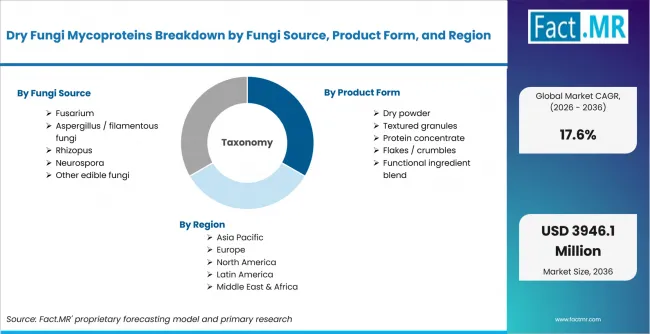
Dry Fungi Mycoproteins Breakdown By Fungi Source, Product Form, And Region | Source: Fact.MR
| Attribute | Details |
|---|---|
| Quantitative Units | USD million |
| Market Definition | Dry ingredient formats made from edible fungal biomass or mycoprotein used for protein, fiber, texture and functional finishing in food applications. |
| Fungi Source | Fusarium; Aspergillus / filamentous fungi; Rhizopus; Neurospora; Other edible fungi |
| Product Form | Dry powder; Textured granules; Protein concentrate; Flakes / crumbles; Functional ingredient blend |
| Application | Meat alternatives; Nutrition foods; Snacks; Ready meals; Pet food |
| Processing | Biomass fermentation; Drying / milling; Texturization; Fractionation; Flavor / functional finishing |
| Regions Covered | North America; Latin America; Western Europe; Eastern Europe; East Asia; South Asia & Pacific; Middle East & Africa |
| Countries Covered | China; USA; Germany; Japan; France |
| Key Companies Profiled | The Protein Brewery; Promyc; Nosh.bio; Enifer |
| Forecast Period | 2026 to 2036 |
| Approach | Hybrid top-down and bottom-up approach using food manufacturing activity; ingredient format mapping; application trials; country demand signals; and provider portfolio review. |
How is the market segmented?
-
By Fungi Source
- Fusarium
- Aspergillus / filamentous fungi
- Rhizopus
- Neurospora
- Other edible fungi
-
By Product Form
- Dry powder
- Textured granules
- Protein concentrate
- Flakes / crumbles
- Functional ingredient blend
-
By Application
- Meat alternatives
- Nutrition foods
- Snacks
- Ready meals
- Pet food
-
By Processing
- Biomass fermentation
- Drying / milling
- Texturization
- Fractionation
- Flavor / functional finishing
-
By Region
- North America
- Latin America
- Western Europe
- Eastern Europe
- East Asia
- South Asia & Pacific
- Middle East & Africa