- Base Value(2025): 5.2 Bn
- Estimated Value(2026): 5.7 Bn
- Forecast Value (2036): 12.4 Bn
- CAGR (2026 - 2036): 9.1%
Eczema Relief Creams Market Forecast 2026 to 2036
In 2025, the eczema relief creams market was valued at USD 5.2 billion. Based on Fact MR's analysis, demand for eczema relief creams is estimated to grow to USD 5.7 billion in 2026 and USD 12.4 billion by 2036. FMR projects a CAGR of 9.1% during the forecast period.
The absolute dollar growth from 2026 to 2036 is USD 6.7 billion. This growth is driven by increasing awareness of skin conditions like eczema and the growing availability of over-the-counter and prescription treatments. As the global population becomes more health-conscious and skincare-focused, the demand for eczema relief creams continues to rise, particularly in regions with high rates of skin sensitivity and allergies. However, challenges such as regulatory requirements, the high cost of premium formulations, and competition from other skincare solutions may impact market growth.
As Barbara Paldus, Ph.D., Founder and Chief Executive Officer of Codex Labs, noted regarding innovation in microbiome-friendly eczema relief products, “We are thrilled that our products have been recognized as non-irritating for over 30 million Americans who suffer from eczema, as well as microbiome safe. We remain dedicated to creating solutions that protect and restore the skin barrier while supporting the microbiome.”
India leads with a CAGR of 22.7%, supported by a large population with rising awareness of eczema treatment and increasing demand for effective skincare solutions. China follows with a 20.2% CAGR, driven by the growing consumer interest in health and wellness products. Japan shows growth at 16.4%, reflecting strong demand for dermatology treatments and increasing consumer spending on skincare. The UK grows at 12.7%, benefiting from rising skin sensitivity awareness and effective marketing strategies. Germany grows at 10.3%, supported by the popularity of advanced skincare products for eczema. The USA shows growth at 8.6%, driven by demand for both OTC and prescription eczema relief treatments.
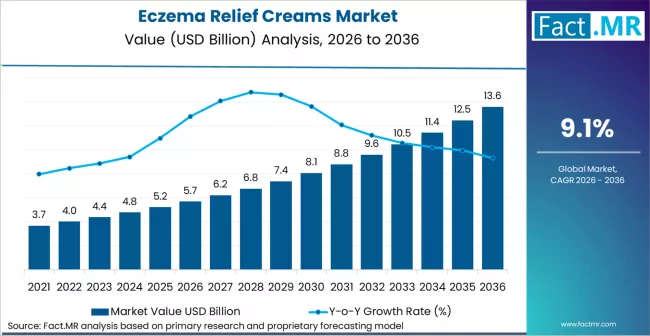
Eczema Relief Creams Market Market Value Analysis | Source: Fact.MR
| Metric | Value |
|---|---|
| Estimated Value in (2026E) | USD 5.7 billion |
| Forecast Value in (2036F) | USD 12.4 billion |
| Forecast CAGR (2026 to 2036) | 9.1% |
Eczema Relief Creams Market Definition
The Eczema Relief Creams Market involves the development, manufacture, and sale of topical cream formulations designed to soothe symptoms of eczema, such as itch, dryness, inflammation, and irritation in affected skin.
Market Inclusions
This report covers global and regional market sizes for eczema relief creams over a defined forecast period, including product types (moisturizing creams, corticosteroid creams, non‑steroidal formulations), application areas (body, face, infant use), and distribution channels (retail pharmacies, online, clinics).
Market Exclusions
The scope excludes systemic eczema therapies (oral or injectable medications), general skincare products without eczema‑specific formulation or claims, and unrelated dermatology treatments not indicated for eczema.
Research Methodology
- Primary Research: Interviews were conducted with dermatologists, formulators, and retail buyers.
- Desk Research:Data was sourced from clinical reports, industry publications, and trade association statistics.
- Market‑Sizing and Forecasting: A hybrid model combining top‑down dermatology treatment demand with bottom‑up product sales data was used.
- Data Validation and Update Cycle: Findings were validated through expert review and aligned with recent production and usage statistics.
Summary of the Eczema Relief Creams Market
- Market Definition
- The eczema relief creams market encompasses the development, production, and sale of topical creams designed to alleviate the symptoms of eczema, including itchiness, dryness, inflammation, and irritation. These creams are formulated to provide relief from flare-ups, restore the skin's protective barrier, and support skin healing.
- Demand Drivers
- Growing Awareness of Skin Conditions: As awareness of eczema and other skin conditions rises, the demand for effective relief creams continues to increase.
- Preference for Over-the-Counter Solutions: With rising healthcare access, more consumers are opting for OTC eczema relief creams to manage symptoms independently.
- Shifting Focus to Sensitive Skin Care: A growing preference for skincare products that cater to sensitive skin, particularly those that are fragrance-free or hypoallergenic, drives the demand for eczema relief creams.
- Efficacy of Advanced Formulations: The development of creams with anti-inflammatory properties, barrier-repairing ingredients, and clinically supported active components (e.g., ceramides, colloidal oatmeal) increases consumer confidence in their effectiveness.
- Key Segments Analyzed
- Claim: Fragrance-free products are expected to dominate, capturing 61.5% of the market in 2026 due to their appeal to consumers with sensitive skin.
- Function: Barrier repair creams are projected to account for 58.4% of the market, as they provide critical support for restoring and maintaining the skin's natural protective barrier.
- Geography: India leads with a CAGR of 22.7%, followed by China (20.2%) and Japan (16.4%).
- Analyst Opinion at FMR
- Shambhu Nath Jha, Principal Consultant at Fact MR, comments, “The eczema relief creams market is expanding due to increased consumer awareness of skincare and the growing incidence of eczema. As consumers prioritize safe, effective, and convenient treatment options, the demand for advanced, dermatologist-tested, and fragrance-free creams continues to surge.”
- Strategic Implications/Executive Takeaways
- Focus on Formulations for Sensitive Skin: Manufacturers should focus on developing fragrance-free, hypoallergenic, and non-irritating eczema relief creams to meet the growing demand for safe, effective skincare products for sensitive skin.
- Targeting Emerging Markets: With increasing awareness and healthcare access, regions like India and China present significant growth opportunities for eczema relief creams.
- Collaboration with Healthcare Providers: Partnering with dermatologists and healthcare professionals can boost brand trust and product recommendations, particularly in managing chronic conditions like eczema.
- Methodology
- Primary research through interviews with dermatologists, formulators, and retail buyers.
- Data sourced from clinical reports, industry publications, and trade association statistics.
- Market sizing and forecasting using a hybrid model combining top-down dermatology treatment demand with bottom-up product sales data.
Segmental Analysis
Eczema Relief Creams Market Analysis by Claim
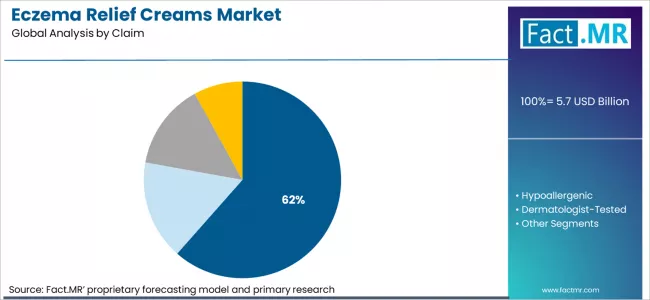
Eczema Relief Creams Market Analysis By Claim | Source: Fact.MR
- Market Overview: Fragrance-free is expected to capture 61.5% of the eczema relief creams market by 2026. Fragrance-free creams are preferred by consumers with sensitive skin, as fragrances can cause irritation or allergic reactions, particularly in individuals with eczema or other skin conditions.
- Demand Drivers:
- Skin Sensitivity and Irritation Prevention: Consumers with eczema are often sensitive to fragrances and other irritants, making fragrance-free creams a preferred option. These creams provide relief without the risk of exacerbating skin irritation, which is crucial for eczema sufferers.
- Growing Awareness of Skin Sensitivity: As awareness of skin sensitivities and the potential harmful effects of fragrances grows, more consumers are opting for fragrance-free eczema relief creams. This trend is particularly strong among individuals with conditions like eczema, where the skin is more prone to irritation.
- Regulatory and Dermatological Recommendations: Dermatologists frequently recommend fragrance-free products for individuals with sensitive skin, which is driving the demand for creams with this claim. The dermatological endorsement also increases consumer confidence in the safety and efficacy of these products.
Eczema Relief Creams Market Analysis by Function
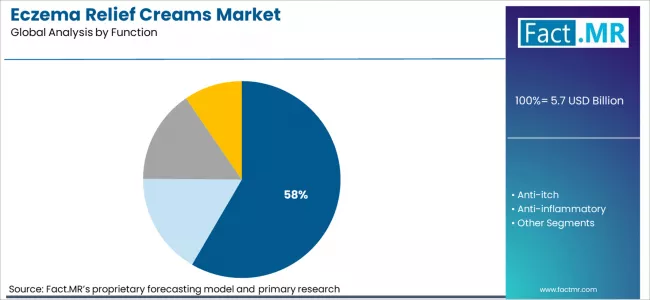
Eczema Relief Creams Market Analysis By Function | Source: Fact.MR
- Market Overview: Barrier repair is projected to hold 58.4% of the market share by 2026. Barrier repair creams are essential for eczema sufferers, as they help restore the skin's natural protective barrier, preventing moisture loss and shielding the skin from environmental irritants.
- Demand Drivers:
- Skin Protection and Moisture Retention: Barrier repair is critical for individuals with eczema, as the skin's protective barrier is often compromised in those with the condition. Eczema relief creams focused on barrier repair help maintain skin hydration and reduce vulnerability to external irritants.
- Effectiveness in Chronic Skin Conditions: Barrier repair creams are particularly effective for managing chronic skin conditions like eczema, where skin dryness and irritation are ongoing issues. These creams provide long-lasting protection, making them essential for daily care and treatment.
- Increasing Focus on Long-Term Skin Health: With growing consumer interest in maintaining healthy skin, products that offer long-term benefits, such as barrier repair, are in high demand. This trend aligns with the increasing use of eczema relief creams designed to support skin health over time.
Eczema Relief Creams Market Drivers, Restraints, and Opportunities
FMR analysts observe that the eczema relief creams market is a growth‑aligned dermatology segment driven by rising prevalence of atopic dermatitis, heightened patient awareness of skin barrier care, and expansion of topical therapeutic options beyond basic emollients. Historically, simple moisturizers and barrier creams addressed only mild symptoms; as clinicians and consumers aim for improved flare‑control and sustained relief, structural demand emerged for formulations with targeted actives, barrier repair lipids, and anti‑inflammatory properties. The 2026 valuation reflects this shift, with adoption tied to both diagnostic rates and broader acceptance of proactive, long‑term management rather than reactive care alone.
While demand for basic emollient products remains large in cost‑sensitive markets, advanced relief creams with clinically supported ingredients (ceramides, colloidal oatmeal, botanical anti‑inflammatories) are gaining share. These higher‑value products command premium pricing, contributing to net market value growth even as unit volumes expand moderately with increased disease recognition and healthcare guidance. The market exists because symptom relief and barrier restoration are central to quality‑of‑life improvement in eczema care, and regulatory and label standards continue to favor products that meet defined efficacy and safety criteria.
- Clinical & Diagnostic Growth: Rising rates of atopic dermatitis diagnosis and emphasis on proactive management expand demand for targeted relief formulations beyond basic moisturizers.
- Regulatory & Safety Standards: Dermatology product standards and claims requirements push formulators toward certified actives and barrier‑focused ingredients that meet defined performance criteria.
- Regional Consumer Trends: In North America and Europe, strong consumer awareness and healthcare guidance support premium eczema relief cream uptake, while Asia‑Pacific sees rapid growth as access and awareness expand.
Regional Analysis
The market analysis covers key global regions, including South Asia, East Asia, Western Europe, and North America. It is segmented geographically, with specific market dynamics for each region. The full report provides a detailed market attractiveness analysis.
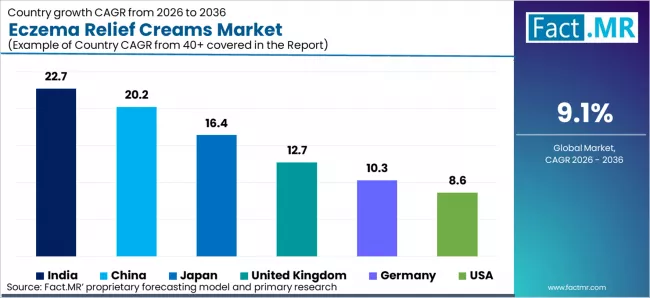
Eczema Relief Creams Market Cagr Analysis By Country | Source: Fact.MR
| Country | CAGR (2026-2036) |
|---|---|
| India | 22.7% |
| China | 20.2% |
| Japan | 16.4% |
| United Kingdom | 12.7% |
| Germany | 10.3% |
| USA | 8.6% |
Source: Fact MR (FMR) analysis, based on proprietary forecasting model and primary research.
South Asia
In South Asia, India is leading the demand for eczema relief creams, driven by increasing awareness of skincare, rising incidences of eczema, and growing consumer interest in natural and effective relief products.
- India: Demand for eczema relief creams in India is projected to rise at 22.7% CAGR through 2036. India’s increasing skincare awareness, growing incidence of eczema, and demand for natural relief solutions continue to drive significant market growth.
East Asia
In East Asia, China and Japan are major markets for eczema relief creams, supported by growing awareness of skin conditions, a rising middle class, and increased demand for skincare products.
- China: Demand for eczema relief creams in China is projected to rise at 20.2% CAGR through 2036. China’s growing consumer healthcare awareness and rising demand for effective skincare solutions continue to fuel market expansion.
- Japan: Demand for eczema relief creams in Japan is projected to rise at 16.4% CAGR through 2036. Japan’s aging population and growing focus on skin health contribute to steady growth in the demand for eczema relief products.
Western Europe
In Western Europe, the United Kingdom and Germany are key markets for eczema relief creams, supported by strong consumer demand for skincare solutions and an increasing focus on managing skin conditions.
- United Kingdom: Demand for eczema relief creams in the UK is projected to rise at 12.7% CAGR through 2036. The UK’s growing awareness of skincare needs and increased focus on managing skin conditions continue to contribute to steady market growth.
- Germany: Demand for eczema relief creams in Germany is projected to rise at 10.3% CAGR through 2036. Germany’s advanced healthcare infrastructure and growing demand for effective eczema treatment solutions continue to support the market for eczema relief creams.
North America
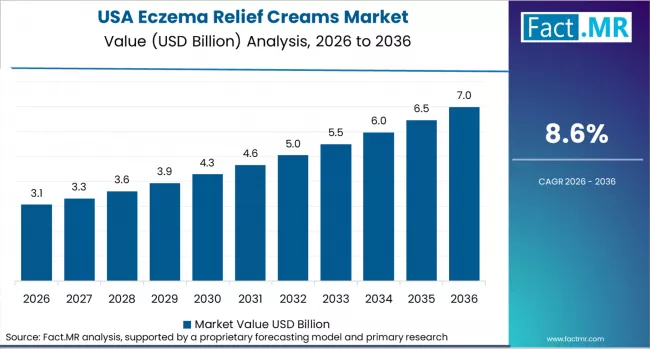
Eczema Relief Creams Market Country Value Analysis | Source: Fact.MR
In North America, the USA remains a significant market for eczema relief creams, driven by rising eczema cases, increasing consumer preference for natural products, and the expansion of over-the-counter skincare treatments.
- USA: Demand for eczema relief creams in the U.S. is projected to rise at 8.6% CAGR through 2036. The USA’s large consumer healthcare market and rising awareness of eczema treatments continue to contribute to steady demand for eczema relief creams.
Fact MR's analysis of the eczema relief creams market in South Asia, East Asia, Western Europe, North America consists of country-wise assessments that include India, China, Japan, the United Kingdom, Germany, and the USA. Readers can find detailed trends, regulatory updates, and company-specific investments shaping the market’s growth in these countries.
How Are Key Players Competing in the Eczema Relief Creams Market?
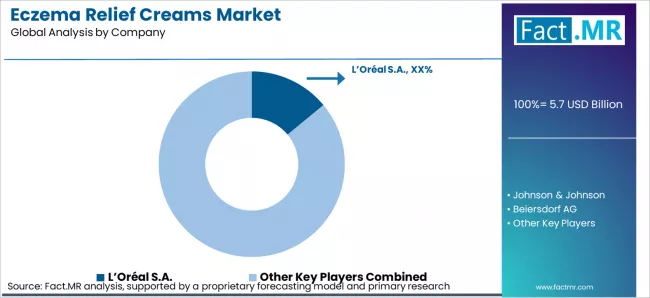
Eczema Relief Creams Market Analysis By Company | Source: Fact.MR
The eczema relief creams market is fiercely competitive, with leading players such as L’Oréal S.A., Johnson & Johnson, and Beiersdorf AG driving innovation with dermatologically tested, soothing creams that cater to sensitive skin. Galderma S.A. and NAOS Group focus on providing scientifically formulated products for effective skin hydration and barrier protection. Companies like Laboratoires Expanscience and Pharmaceutical Specialties, Inc. offer natural, gentle formulations to appeal to consumers seeking organic and gentle skin care solutions. Pierre Fabre Group, Kao Corporation, and Sanofi have introduced treatments combining proven efficacy with skin-friendly ingredients. Weleda AG and WALA Heilmittel GmbH stand out with their eco-friendly, organic offerings, while Earth Mama Organics, Inc., Little Twig, LLC, and The Clorox Company target the organic segment with all-natural products. Additionally, brands like Babyganics, Inc., California Baby, Inc., and Reckitt Benckiser Group plc focus on the sensitive baby and child skincare segment, offering gentle, non-toxic eczema relief solutions. The market is driven by consumer demand for safe, effective, and natural treatments for eczema, with a strong emphasis on skin health and comfort.
Recent Industry Developments
- Incyte Opzelura® (Ruxolitinib) Pediatric Expansion
- On September 18, 2025, the FDA approved Opzelura® cream 1.5% for children aged 2 to 11 with mild-to-moderate atopic dermatitis. This established it as the first topical JAK inhibitor available for this younger demographic.
- LEO Pharma Anzupgo® (Delgocitinib) Launch
- In July 2025, the FDA approved Anzupgo® (delgocitinib) cream, making it the first and only treatment specifically indicated for moderate-to-severe chronic hand eczema (CHE) in adults.
- Arcutis ZORYVE® (Roflumilast) Pediatric Growth
- The FDA approved ZORYVE® cream 0.05% on October 6, 2025, for the treatment of mild-to-moderate eczema in children aged 2 to 5. Furthermore, in February 2026, Arcutis announced positive Phase 2 results for an infant-specific formulation (ages 3 months to 2 years), with an sNDA filing planned for Q2 2026.
Key Players of the Eczema Relief Creams Market
- L’Oréal S.A.
- Johnson & Johnson
- Beiersdorf AG
- Galderma S.A.
- NAOS Group
- Laboratoires Expanscience
- Pharmaceutical Specialties, Inc.
- Pierre Fabre Group
- Kao Corporation
- Sanofi
- Weleda AG
- WALA Heilmittel GmbH
- Earth Mama Organics, Inc.
- Little Twig, LLC
- The Clorox Company
- Babyganics, Inc.
- California Baby, Inc.
- Reckitt Benckiser Group plc
Report Scope
| Metric | Value |
|---|---|
| Quantitative Units | USD 5.7 billion (2026) to USD 12.4 billion (2036), at a CAGR of 9.1% |
| Market Definition | The eczema relief creams market includes products designed to relieve the symptoms of eczema, offering treatment solutions in the form of creams, lotions, ointments, and other topical products. |
| By Treatment Type | OTC Emollients & Barrier Creams, OTC Corticosteroid Creams, Prescription Topicals (Calcineurin Inhibitors, PDE4 Inhibitors), Adjunctive Therapies (Colloidal Oatmeal, Probiotics) |
| By Function | Barrier Repair, Anti-itch, Anti-inflammatory, Soothing & Redness Control |
| By Form | Cream, Ointment/Balm, Lotion, Wash/Cleanser |
| By Channel | Pharmacies/Drugstores, E-commerce, Dermatology Clinics, Mass Retail (Supermarkets, Hypermarkets) |
| By End-User | Infants & Children, Adults, Sensitive Skin Users |
| By Claim | Fragrance-free, Hypoallergenic, Dermatologist-tested, Steroid-free |
| Regions Covered | North America, Latin America, Europe, East Asia, South Asia, Oceania, Middle East and Africa |
| Countries Covered | United States, Canada, Mexico, Brazil, Argentina, Germany, France, United Kingdom, Italy, Spain, China, India, Japan, South Korea, Indonesia, Australia, and 40+ countries |
| Key Companies Profiled | L’Oréal S.A., Johnson & Johnson, Beiersdorf AG, Galderma S.A., NAOS Group, Laboratoires Expanscience, Pharmaceutical Specialties, Inc., Pierre Fabre Group, Kao Corporation, Sanofi, Weleda AG, WALA Heilmittel GmbH, Earth Mama Organics, Inc., Little Twig, LLC, The Clorox Company, Babyganics, Inc., California Baby, Inc., Reckitt Benckiser Group plc |
| Forecast Period | 2026 to 2036 |
| Approach | Hybrid top-down and bottom-up market modeling validated through primary interviews with manufacturers and supported by trade data benchmarking and market research. |
Bibliographies
- Arcutis Biotherapeutics. (2025, October 6). FDA approves ZORYVE® (roflumilast) cream 0.05% for mild-to-moderate eczema in children [Press release]. Arcutis Biotherapeutics.
- Incyte Newsroom. (2025, September 18). FDA approval of Opzelura® (ruxolitinib) cream for pediatric atopic dermatitis patients aged 2-11 years [Press release]. Incyte Corporation.
- MedCity News. (2025, July). LEO Pharma receives FDA approval for Anzupgo® (delgocitinib) topical cream for chronic hand eczema [Industry report]. MedCity News.
- Babyganics, Inc. (2025). Non-toxic eczema relief products for sensitive baby skin. Babyganics, Inc.
- Beiersdorf AG. (2025). Eczema relief formulations and advanced moisturizing creams for irritated skin. Beiersdorf AG.
- California Baby, Inc. (2025). Gentle eczema care formulations for babies and children. California Baby, Inc.
- Earth Mama Organics, Inc. (2025). Organic eczema relief products for babies and sensitive skin. Earth Mama Organics, Inc.
This report addresses
- Market Intelligence enabling a comprehensive assessment of leading countries and service segments across the Eczema Relief Creams Market globally.
- Market Volume (Sales Units) estimates and 10-year revenue forecasts from 2026 to 2036, validated through manufacturer shipment data, channel partner surveys, and country-level demand modeling.
- Growth Opportunity Mapping across treatment types (OTC Emollients & Barrier Creams, OTC Corticosteroid Creams, Prescription Topicals, Adjunctive Therapies), claims (Fragrance-free, Hypoallergenic), functions (Barrier Repair, Anti-itch, Anti-inflammatory), and regions.
- Segment and Regional Revenue Forecasts by treatment, function, form, and region across 40+ countries.
- Competition Strategy Analysis covering dealer network structure, recent developments, product portfolio, USPs, and market share analysis.
- Product and Regulatory Compliance Tracking aligned with dermatological standards, active ingredients, and regulatory frameworks.
- Regulatory Impact Analysis addressing global market compliance, safety standards, and evolving eczema relief technologies.
- Report Delivery in PDF, Excel, PowerPoint, and interactive dashboard formats for executive, procurement, and operational planning use.
Eczema Relief Creams Market Key Segments
-
Treatment Type
- OTC Emollients & Barrier Creams
- OTC Corticosteroid Creams
- Prescription Topicals (Calcineurin Inhibitors, PDE4 Inhibitors)
- Adjunctive Therapies (Colloidal Oatmeal, Probiotics)
-
Function
- Barrier Repair
- Anti-itch
- Anti-inflammatory
- Soothing & Redness Control
-
Form
- Cream
- Ointment/Balm
- Lotion
- Wash/Cleanser
-
Channel
- Pharmacies/Drugstores
- E-commerce
- Dermatology Clinics
- Mass Retail (Supermarkets, Hypermarkets)
-
End-User
- Infants & Children
- Adults
- Sensitive Skin Users
-
Claim
- Fragrance-free
- Hypoallergenic
- Dermatologist-tested
- Steroid-free
-
Region
- North America
- USA
- Canada
- Mexico
- Europe
- Germany
- UK
- France
- Italy
- Spain
- Nordic Countries
- BENELUX
- Rest of Europe
- Asia Pacific
- China
- Japan
- South Korea
- India
- Australia
- Rest of Asia Pacific
- Latin America
- Brazil
- Argentina
- Rest of Latin America
- Middle East and Africa
- Kingdom of Saudi Arabia
- United Arab Emirates
- South Africa
- Rest of Middle East and Africa
- Other Regions
- Oceania
- Central Asia
- Other Markets
- North America