- Market Value (2025): USD 21.5 Bn
- Estimated Value (2026): USD 21.5 Bn
- Forecast Value (2036): USD 39.8 Bn
- CAGR (2026-2036): 6.3%
What is the General Surgical Devices Market forecast to be worth by 2036?
USD 21.5 billion in 2026 to USD 39.8 billion by 2036 at a 6.3% CAGR.
- The General Surgical Devices Market is estimated at USD 20.2 billion in 2026.
- Demand is projected to increase from USD 21.5 billion in 2026 to USD 39.8 billion by 2036.
- The market is forecast to record 6.3% CAGR from 2026 to 2036.
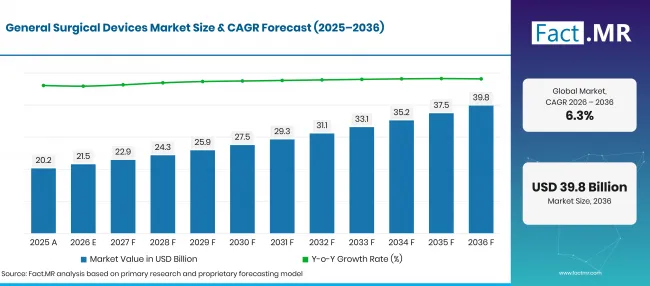
Factmr General Surgical Devices Market Forecast Global | Source: Fact.MR
What are the defining numbers behind General Surgical Devices Market growth?
An entirely opportunity of USD 18.3 billion is expected between 2026 and 2036.
- Demand Drivers in the Market
- Rising surgical volumes are the base of demand. Ageing populations and a growing chronic disease burden increase the number of orthopedic, cardiovascular, neurological and gynecological procedures, and each procedure consumes handheld, energy-based and wound closure devices.
- The shift to minimally invasive surgery is raising the value of specialized instruments. Laparoscopic and electrosurgical techniques support shorter hospital stays and fewer complications, which aligns with provider cost and capacity targets.
- Procedure migration to ambulatory surgical centers and clinics is changing purchasing patterns. These sites favor compact, cost-efficient and often single-use instrument sets that support fast room turnover.
- Key Segments Analyzed
- By Product Type: Handheld devices are estimated to command a 32.5% share in 2026. Scalpels, forceps, retractors, scissors and clamps are required in nearly every open procedure and are replaced frequently, which sustains high unit volumes.
- ·By Application: Orthopedic surgery is anticipated to represent a 28.4% share in 2026. Joint replacement, trauma, spine and sports medicine procedures each call for extensive instrument sets, along with repeated use of closure and energy devices.
- ·By End User: Hospitals are poised to hold a 58.4% share in 2026. Inpatient and complex procedures, large operating-room capacity and centralized contracting arrangements keep device purchasing concentrated in the hospital setting.
- Analyst Opinion at Fact.MR
- Shambhu Nath Jha, Principal Consultant at Fact.MR, states, "Over the coming years, surgical device purchasing will continue to shift from unit price toward procedure-level value. Hospitals will increasingly weigh instrument performance, sterility assurance and supply reliability alongside cost, as device choice directly influences operating-room time and complication risk. Handheld instruments will remain the foundation of volume, while laparoscopic and energy platforms will raise the value of each procedure."
- Strategic Implications
- Manufacturers are advised to document clinical and operating-room outcomes for each device family. Hospital value-analysis committees are increasingly comparing products on procedure time, complication rates and total cost per case, and verifiable evidence strengthens a supplier's position in those reviews.
- Handheld and wound closure suppliers are encouraged to offer both reusable and single-use formats. Hospitals and ambulatory sites weigh reprocessing cost, sterility assurance and sustainability targets differently, and a flexible portfolio allows suppliers to meet each buyer's priorities.
- Laparoscopic and electrosurgical suppliers would benefit from pairing their devices with training and service support. Surgeon familiarity and consistent energy performance are key drivers of repeat purchasing, so ongoing support helps build lasting customer relationships.
- Companies serving ambulatory surgical centers and clinics are well advised to develop compact, procedure-specific kits and offer flexible contract terms. These settings operate with lower volumes and faster turnover, and tailored solutions align more closely with how they work.
How does the Flexible Packaging Soft-Touch Finishes Market break down by segment?
Handheld devices are estimated to command a 32.5% share of the Product Type segment in 2026. Orthopedic surgery holds the top position within Application at a 28.4% share, while hospitals dominate the End User segment with a 58.4% share
Which Product Type dominates?
Handheld Devices are expected to hold 32.5% share in 2026.
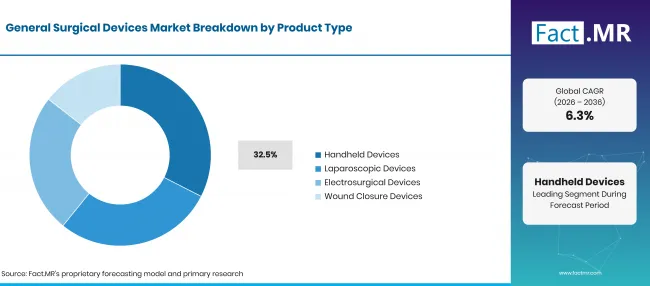
Factmr General Surgical Devices Market Breakdown Product Type | Source: Fact.MR
Handheld devices hold the leading position because they are the core working tools of surgery. Scalpels, forceps, scissors, retractors, needle holders and clamps are essential in open and minimally invasive procedures alike, so demand is tied to overall surgical volume rather than to any single technique.
Unit prices are modest, but replacement and replenishment cycles are frequent. Reusable sets require regular reprocessing and renewal, while single-use formats are reordered with every case. This gives handheld devices a steady and broad revenue base across all end users.
What leads the Application segment?
Orthopedic Surgery is projected to account for 28.4% share in 2026.
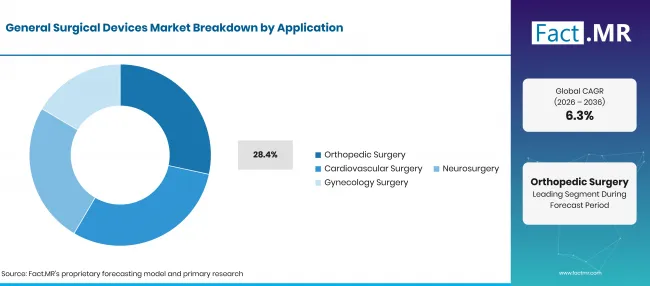
Factmr General Surgical Devices Market Breakdown Application | Source: Fact.MR
Orthopedic procedures command the top position because joint replacement, fracture repair, spine surgery and sports medicine are carried out in large volumes and call for numerous instruments in every case. A growing ageing population and a more active older demographic continue to lift procedure counts across most developed markets.
These operations also draw on cutting, fixation-support, energy and closure devices within a single procedure. Suppliers with strong orthopedic relationships, including Stryker, Zimmer Biomet and Smith and Nephew, gain from the repeat use of their instruments across surgical teams.
How does End User shape demand?
Hospitals are anticipated to lead with 58.4% share in 2026.
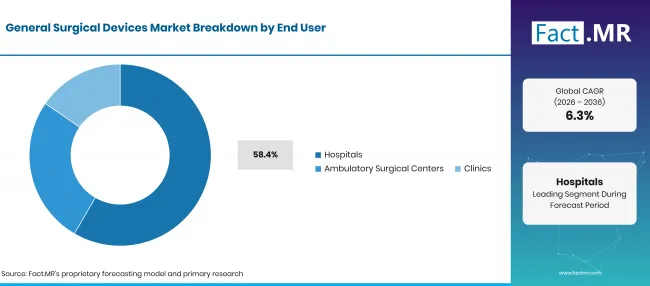
Factmr General Surgical Devices Market Breakdown End User | Source: Fact.MR
Hospitals hold the dominant position because they perform the majority of inpatient, emergency and complex procedures and operate the largest number of operating rooms. Purchasing is centralized through supply-chain teams and group contracts, which concentrates volume with suppliers able to cover several device categories.
Ambulatory surgical centers and clinics are expanding as lower-acuity procedures shift out of hospitals. Their smaller scale and emphasis on cost per case favor compact kits and single-use products, yet hospitals remain the largest single buying channel through 2036.
What is accelerating General Surgical Devices Market adoption, and what is holding it back?
Demand is set to strengthen on the back of rising surgical volumes and the ongoing shift toward minimally invasive procedures. At the same time, growth may be tempered by hospital pricing pressure, regulatory compliance costs and supply-chain disruption.
| DRIVER | (~) % IMPACT ON CAGR | GEOGRAPHIC RELEVANCE | IMPACT TIMELINE |
|---|---|---|---|
| Higher surgical volumes driven by ageing populations and the burden of chronic disease | +1.9% | Global | Medium term (2-4 years) |
| Growing preference for minimally invasive and energy-based techniques | +1.4% | North America, Europe, East Asia | Medium term (2-4 years) |
| Transfer of procedures to ambulatory surgical centers | +1.1% | North America, Europe | Short term (<= 2 years) |
| Stronger emphasis on infection control and uptake of single-use devices | +0.8% | Global | Long term (>= 4 years |
| OPPORTUNITY | (~) % IMPACT ON CAGR | GEOGRAPHIC RELEVANCE | IMPACT TIMELINE |
|---|---|---|---|
| Build-out of surgical capacity across emerging healthcare markets | +1.2% | East Asia, South Asia & Pacific, Middle East & Africa | Long term (>= 4 years) |
| Compatibility of devices with robotic and digital surgery platforms | +1.0% | North America, Europe, East Asia | Long term (>= 4 years) |
| Reusable and reprocessed device programs aimed at reducing hospital waste | +0.6% | Europe, North America | Medium term (2-4 years) |
Restraints Impact Analysis
| RESTRAINT | (~) % IMPACT ON CAGR | GEOGRAPHIC RELEVANCE | IMPACT TIMELINE |
|---|---|---|---|
| Pricing pressure from group purchasing and value-analysis committees | -0.8% | Global | Short term (<= 2 years) |
| Regulatory and quality compliance costs for device makers | -0.6% | Europe, North America | Medium term (2-4 years) |
| Supply-chain disruption and product recall risk | -0.4% | Global | Medium term (2-4 years) |
Which countries are scaling the General Surgical Devices Market through 2036?
- The country comparison spans 3.1 percentage points and falls into three practical growth bands across the forecast period.
- Germany sits at the lower end of the range as a mature hospital market, shaped by cost-containment measures and structural reform of the hospital sector.
- Switzerland stands 0.8 percentage point ahead of Germany, as specialized hospitals and precision device manufacturing sustain steady demand.
- Spain is 0.4 percentage point ahead of Switzerland, supported by public-system demand and elective surgery capacity.
- The USA is 0.9 percentage point ahead of Spain, driven by high procedure volumes and the shift toward ambulatory surgery.
- South Korea is 0.6 percentage point ahead of the USA, as hospital capacity and domestic device production continue to expand.
- Ireland takes the top position, 0.4 percentage point ahead of South Korea, backed by its medical-technology manufacturing base and export-led supply.
Similar CAGRs can translate into very different market-entry conditions, depending on procedure volumes, reimbursement models, hospital purchasing structures and regulatory requirements. The full report covers North America, Latin America, Western Europe, Eastern Europe, East Asia, South Asia & Pacific, and Middle East & Africa.
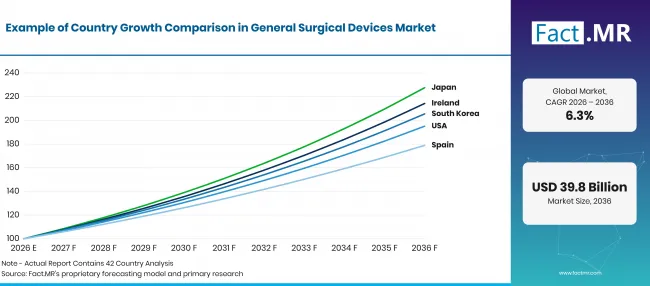
Factmr General Surgical Devices Market Growth Index | Source: Fact.MR
| Country | CAGR (2026-2036) |
|---|---|
| United States | 6.9% |
| Spain | 6.0% |
| Switzerland | 5.6% |
| Ireland | 7.9% |
| Germany | 4.8% |
| South Korea | 7.5% |
What supports USA adoption?
The USA is growing at a 6.9% CAGR, supported by high procedure volumes and the expansion of ambulatory surgery.
A large annual volume of orthopedic, cardiovascular and general surgical procedures keeps demand for handheld, laparoscopic and closure devices strong. As lower-acuity cases continue to move to ambulatory surgical centers, demand is rising for compact, cost-efficient instrument sets. At the same time, hospital contracting favors suppliers with broad portfolios.
How is Spain scaling demand?
Spain is advancing at a 6.0% CAGR, driven by public-system demand and elective surgery capacity.
Most surgical care is delivered through the national health system, and an ageing population sustains demand for orthopedic and cardiovascular procedures. Efforts to reduce elective surgery waiting lists support steady purchasing of instruments and wound closure products, although public tendering keeps pricing discipline firm.
What supports Switzerland's growth?
Switzerland is growing at a 5.6% CAGR, backed by specialized hospitals and precision manufacturing.
High healthcare spending, specialized clinical centers and a strong precision-engineering base work together to support the market. Demand is concentrated in advanced laparoscopic and orthopedic instruments, where surgeons place a premium on quality and consistency. However, the small domestic population limits growth in absolute volumes.
How is Ireland developing demand?
Ireland is expanding at a 7.9% CAGR, led by medical-technology manufacturing and export supply.
A dense cluster of medical-technology manufacturing sites serves global markets from Ireland. Investment in production capacity, combined with rising domestic surgical demand, supports the fastest growth among the countries analyzed. Manufacturers based there supply wound closure, handheld and minimally invasive devices to hospitals worldwide.
What is supporting Germany's adoption?
Germany is growing at a 4.8% CAGR, supported by large procedure volumes in a mature, cost-controlled market.
An extensive hospital base and high surgical activity sustain demand across all four device categories. Growth is the lowest among the countries analyzed, as the market is mature, hospital pricing is tightly managed and structural reform is reducing the number of sites performing certain procedures.
How does South Korea perform?
South Korea is growing at a 7.5% CAGR, led by hospital capacity expansion and domestic device production.
Advanced hospital infrastructure, an ageing population and a growing domestic medical-device industry define the market. Strong uptake of minimally invasive techniques supports demand for laparoscopic and electrosurgical devices, while national health insurance coverage keeps procedure volumes high.
Who leads the General Surgical Devices Market?
Medtronic PLC holds the leading position with an estimated 10% share. Its standing rests on a broad surgical portfolio spanning laparoscopic instruments, advanced energy devices and stapling, supported by long-standing hospital contracts across major markets.
Johnson and Johnson Services Inc. competes through its surgical business, which covers sutures, staplers and energy devices. Stryker Corporation, Zimmer Biomet Holdings Inc. and Smith and Nephew plc maintain strong positions in orthopedic surgery, where instrument sets, powered tools and procedure support are closely linked to implant relationships.
B. Braun Melsungen AG supplies surgical instruments and sutures to hospitals worldwide. Boston Scientific Corporation focuses on minimally invasive and endoscopic procedures, Conmed Corporation on electrosurgery and endoscopy, and Becton, Dickinson and Company on surgical products such as hernia repair and infection-prevention items.
Competition therefore centers on portfolio breadth and contract coverage. Clinical evidence, surgeon training and supply reliability also carry weight, as does the ability to serve hospitals and ambulatory surgical centers on different terms.
Which companies are the key providers?
Key companies include Medtronic PLC; Johnson and Johnson Services Inc.; Stryker Corporation; B. Braun Melsungen AG; Boston Scientific Corporation; Smith and Nephew plc; Zimmer Biomet Holdings Inc.; Becton, Dickinson and Company; and Conmed Corporation.
- Medtronic PLC
- Johnson and Johnson Services Inc.
- Stryker Corporation
- B. Braun Melsungen AG
- Boston Scientific Corporation
- Smith and Nephew plc
- Zimmer Biomet Holdings Inc.
- Becton, Dickinson and Company
- Conmed Corporation
Biblography
- B. Braun SE. (2026). Annual report 2025.
- Becton, Dickinson and Company. (2025, November 6). BD reports fourth quarter and full year fiscal 2025 financial results [Press release].
- Boston Scientific Corporation. (2026, February 4). Boston Scientific announces results for fourth quarter and full year 2025 [Press release]
- Bundesministerium für Gesundheit. (2024, May 15). Bundeskabinett beschließt Krankenhausreform [Federal cabinet approves hospital reform] [Press release].
- Centers for Medicare & Medicaid Services. (2025, November 21). Calendar year 2026 Hospital Outpatient Prospective Payment System (OPPS) and Ambulatory Surgical Center final rule (CMS-1834-FC) [Fact sheet].
- CONMED Corporation. (2026, January 28). CONMED Corporation announces fourth quarter and full-year 2025 financial results [Press release].
- Enterprise Ireland. (2025, December 2). Ireland's lifesciences & health tech landscape [Report powered by PitchBook data].
- Johnson & Johnson. (2026, January 21). Johnson & Johnson reports Q4 and full-year 2025 results [Press release].
- Medtronic plc. (2026, June 3). Medtronic reports fourth quarter and full year fiscal 2026 results; delivers highest annual revenue growth in 10 years [Press release].
- Ministerio de Sanidad. (2026). Sistema de Información sobre Listas de Espera del Sistema Nacional de Salud (SISLE-SNS): Informe de situación a 31 de diciembre de 2025 [Waiting list information system of the National Health System: Situation report as of December 31, 2025].
- Ministry of Food and Drug Safety. (2025). 2024년 의료기기 생산 및 수·출입 실적 통계 자료 [2024 medical device production, import and export performance statistics].
- Smith+Nephew. (2026, March 2). Smith+Nephew fourth quarter and full year 2025 results [Press release].
- Stryker Corporation. (2026, January 29). Stryker reports 2025 operating results and 2026 outlook [Press release].
- Swiss Medtech. (2026). Medtech industry study 2026.
- Zimmer Biomet Holdings, Inc. (2026, February 10). Zimmer Biomet announces fourth quarter and full-year 2025 financial results [Press release].
This Report Answers
- The report explains where general surgical devices are used across product type and application. It also covers end user and country demand.
- Segment analysis identifies the leading subsegments and the clinical and purchasing reasons providers prioritize them.
- Country analysis examines the listed markets and the procedure, reimbursement or manufacturing factors supporting device demand.
- Competitive analysis reviews current providers across handheld, laparoscopic, electrosurgical and wound closure devices. It also covers portfolio breadth and hospital contracting positions.
- Application analysis assesses how procedure volumes and surgical technique influence purchase decisions. It also considers pricing pressure and the shift to ambulatory settings.
What does the General Surgical Devices Market cover?
The General Surgical Devices Market encompasses the devices surgeons rely on to carry out and complete operations. This includes handheld instruments, laparoscopic devices, electrosurgical devices and wound closure devices, supplied in both reusable and single-use formats.
The assessment spans orthopedic, cardiovascular, neurological and gynecological procedures performed in hospitals, ambulatory surgical centers and clinics. Demand is examined across the product type, application and end-user segments.
What is included in the scope?
The scope takes in reusable and single-use handheld surgical instruments, laparoscopic and minimally invasive instruments, electrosurgical generators and handpieces, and wound closure products such as sutures, staplers and clips.
It also covers devices used in orthopedic surgery, cardiovascular surgery, neurosurgery and gynecological surgery that are purchased by hospitals, ambulatory surgical centers and clinics.
What is excluded from the scope?
Orthopedic and cardiovascular implants, surgical robotic systems, operating-room imaging and monitoring equipment, and anesthesia equipment are left out when sold separately from general surgical devices.
Non-surgical wound care dressings and general medical consumables are likewise outside the scope unless they are used to perform or close a surgical procedure.
How Was the Analysis Built?
The analysis is based on more than 120 sources, 35+ company portfolios, 25+ countries and over 20 industry interviews.
- Primary Research: Insights were gathered through discussions with manufacturers, service providers, technology developers, distributors, end users and subject-matter experts. These conversations explored purchasing priorities, product adoption, operational challenges, approval requirements, competitive positioning and the factors shaping broader market acceptance.
- Desk Research: This stage draws on government statistics, regulatory publications, company filings, trade data, technical studies, industry associations, standards, public policy and other authoritative sources. All sources used are listed in the bibliography.
- Market Sizing and Forecasting: Market estimates bring together historical performance, demand indicators, pricing and volume trends, segment shares, company participation, country-level growth, adoption patterns, investment activity and barriers to expansion.
- Data Validation and Update Cycle: Findings are cross-checked by comparing primary interview insights with public data, company activity, regulatory changes, trade patterns and industry developments. Periodic updates capture new product launches, capacity changes, partnerships, approvals and shifts in commercial adoption.
What is the report’s scope and coverage?
.webp "General Surgical Devices Market (17)")
General Surgical Devices Market (17) | Source: Fact.MR
| Attribute | Details |
|---|---|
| Quantitative Units | USD billion |
| Market Definition | Devices used by surgeons to cut, dissect, grasp, coagulate, retract and close tissue across open and minimally invasive procedures, including handheld devices, laparoscopic devices, electrosurgical devices and wound closure devices. |
| Product Type | Handheld Devices; Laparoscopic Devices; Electrosurgical Devices; Wound Closure Devices |
| Application | Orthopedic Surgery; Cardiovascular Surgery; Neurosurgery; Gynecology Surgery |
| End User | Hospitals; Ambulatory Surgical Centers; Clinics |
| Regions Covered | North America; Latin America; Western Europe; Eastern Europe; East Asia; South Asia & Pacific; Middle East & Africa |
| Countries Covered | United States; Spain; Switzerland; Ireland; Germany; South Korea |
| Key Companies Profiled | Medtronic PLC; Johnson and Johnson Services Inc.; Stryker Corporation; B. Braun Melsungen AG; Boston Scientific Corporation; Smith and Nephew plc; Zimmer Biomet Holdings Inc.; Becton, Dickinson and Company; Conmed Corporation |
| Forecast Period | 2026 to 2036 |
| Approach | Hybrid top-down and bottom-up approach using surgical procedure volumes; device revenue by product type; end-user purchasing mix; application-level device use; country adoption; and provider portfolio review. |
How is the market segmented?
-
By Product Type:
- Handheld Devices
- Laparoscopic Devices
- Electrosurgical Devices
- Wound Closure Devices
-
By Application:
- Orthopedic Surgery
- Cardiovascular Surgery
- Neurosurgery
- Gynecology Surgery
-
By End User:
- Hospitals
- Ambulatory Surgical Centers
- Clinics
-
By Region:
- North America
- Latin America
- Western Europe
- Eastern Europe
- East Asia
- South Asia & Pacific
- Middle East & Africa