- Forecast Value (2036): 920.0 Mn
- CAGR (2036): 8.3%
What is the surgical smoke filters market forecast to be worth by 2036?
USD 415.0 million in 2026 to USD 920.0 million by 2036, at 8.3% CAGR.
- The surgical smoke filters market crossed a valuation of USD 380.0 million in 2025.
- Demand is expected to increase from USD 415.0 million in 2026 to USD 920.0 million by 2036.
- The market is forecast to record 8.3% CAGR from 2026 to 2036.
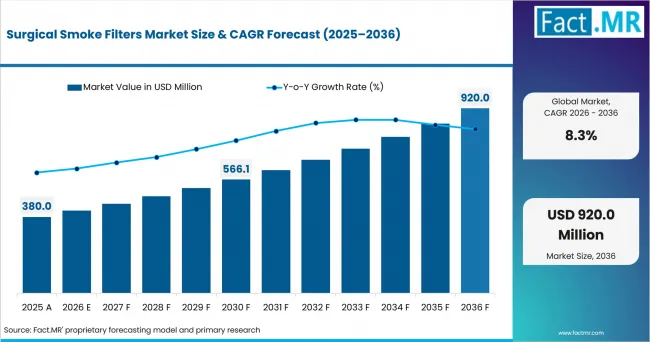
Surgical Smoke Filters Market Market Value Analysis | Source: Fact.MR
What are the defining numbers behind surgical smoke filters growth?
USD 505.0 million absolute opportunity by 2036, led by India and China.
- Demand Drivers in the Market
- Hospitals need source-capture filters before smoke evacuation policies can be operationalized.
- Ambulatory surgery centers need portable cartridges that fit compact evacuator systems.
- Laparoscopy teams need inline filters because plume can impair the camera field.
- Procurement teams prefer approved replacement SKUs that match existing evacuator fleets.
- Key Segments Analyzed
- By Filter Type: ULPA Filters are expected to hold 42.0% share in 2026 because hospitals prefer high-capture cartridges.
- By Procedure: Laparoscopy is projected to account for 34.0% share in 2026 because closed-cavity procedures need smoke clearance.
- By Equipment Fit: Portable Evacuators are expected to hold 36.0% share in 2026 as smaller sites use cart-based systems.
- By End User: Hospitals are likely to account for 55.0% share in 2026 as multi-room systems standardize filters.
- By Sales Model: Replacement Contracts are projected to hold 31.0% share in 2026 due to recurring cartridge replenishment.
- By Geography: India is projected to record 9.8% CAGR through 2036 as surgical access expands.
- Analyst Opinion at Fact.MR
- Shambhu Nath Jha, Senior Analyst at Fact.MR, states, "Surgical smoke filters are becoming a routine operating room control point. Hospital purchasing teams want proof that the cartridge fits the procedure and the installed evacuator. Suppliers that simplify replacement mapping can win repeat purchasing across hospital networks."
- Strategic Implications
- Filter suppliers should map cartridge compatibility to installed smoke evacuation systems before bidding.
- Hospitals need SKU standardization so regulated rooms do not run short of replacement filters.
- Device makers should link filter evidence with smoke evacuation training and audit support.
- Distributors need procedure-specific replenishment plans for ambulatory and specialty surgery sites.
Surgical smoke filters form the recurring consumable layer inside smoke evacuation systems. The United States Food and Drug Administration listed CONMED PlumeSafe X5 under K240127 in August 2024.
India is projected to record 9.8% CAGR through 2036 as covered hospital admissions support wider surgical access. China is expected to post 9.4% CAGR through 2036 because hospital capacity keeps procedure demand expanding. The United States is forecast to advance at 8.7% CAGR through 2036 as state smoke laws shift source capture into facility policy. Germany is projected to rise at 8.1% CAGR through 2036 as hospital procurement links worker safety with documented plume control. Japan is expected to post 7.6% CAGR through 2036 as high hospital capacity supports replacement demand.
How does the surgical smoke filters market break down by segment?
ULPA filters lead at 42.0%. Laparoscopy leads at 34.0%.
Which filter type leads?
ULPA Filters hold 42.0% share in 2026.
ULPA filters lead because hospitals prefer high-capture cartridges that are approved for specific smoke evacuation systems. CONMED’s PlumeSafe® X5™ uses a 5-stage filter and captures 99.9997% of particles from 0.01–0.2 microns.
Which procedure leads?
Laparoscopy leads with 34.0% share in 2026.
Laparoscopy leads because smoke can build up inside insufflated cavities. Surgical teams connect smoke control with camera visibility and procedure flow. Demand from laparoscopic devices supports filter use where tissue-energy work is routine.
Cosmetic and reconstructive rooms add filter demand when plastic surgery instruments are paired with electrosurgical tools.
Which equipment fit leads?
Portable Evacuators hold 36.0% share in 2026.
Portable evacuator fit leads because ambulatory surgery centers and specialty clinics often lack integrated evacuation lines. Stryker describes the SafeAir Compact Evacuator as portable for the operating room and other procedure rooms.
Which end user leads?
Hospitals account for 55.0% share in 2026.
Hospitals lead because multiple rooms can use the same filter platform once purchasing teams standardize smoke evacuation. Operating room equipment planning also affects filter demand because carts and integrated systems compete for the same safety budget.
Which sales model leads?
Replacement Contracts hold 31.0% share in 2026.
Replacement contracts lead because cartridges have finite service life and hospitals prefer planned replenishment. Medtronic states that the RapidVac smoke evacuation system captures and filters smoke from electrosurgery procedures.
What is accelerating surgical smoke filters demand, and what is holding it back?
State smoke laws and recurring cartridge replacement support demand. Capital approval lag and mixed evacuator fleets restrain faster conversion.
The main driver is the movement of smoke evacuation rules into operating room policy. The Association of periOperative Registered Nurses reported in September 2025 that 20 U.S. states had enacted surgical smoke evacuation laws.
The main restraint is installed-base mismatch. Facilities that use mixed smoke evacuation brands need filter mapping before they can standardize replenishment. Electrosurgery devices keep the need visible because plume is created at the tissue-energy interface.
Where do the biggest surgical smoke filters opportunities sit?
Portable evacuator filters, laparoscopic inline filters and contracted replenishment.
- Portable Evacuator Filters: Suppliers can serve ambulatory rooms that need compact source-capture support.
- Inline Laparoscopic Filters: Procedure teams need device-fit filters where insufflation and visibility matter.
- Contracted Replenishment: Hospital systems can reduce missed availability through planned filter replacement.
Which countries are scaling surgical smoke filters fastest?
India leads the country outlook, followed by China, the United States, Germany, and Japan.
Based on regional analysis, the surgical smoke filters market is segmented into North America, Europe, East Asia, South Asia, Latin America, and Middle East and Africa complete the regional scope.
| Country | CAGR |
|---|---|
| India | 9.8% |
| China | 9.4% |
| United States | 8.7% |
| Germany | 8.1% |
| Japan | 7.6% |
Source: Fact.MR analysis. Updated Jun 29, 2026
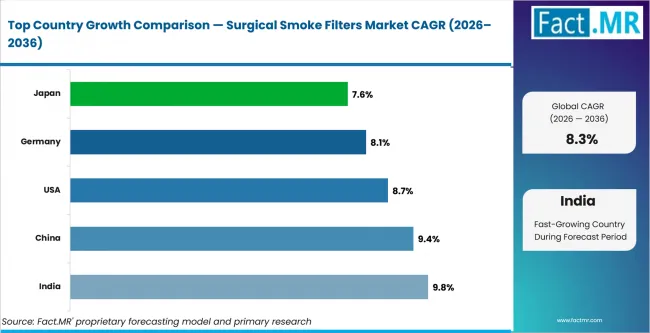
Surgical Smoke Filters Market Cagr Analysis By Country | Source: Fact.MR
What is powering India’s lead?
9.8% CAGR, supported by wider covered hospital access.
India is projected to record 9.8% CAGR through 2036 as hospital access expands across public and private care sites. The Press Information Bureau of the Government of India reported in December 2024 that Ayushman Bharat Pradhan Mantri Jan Arogya Yojana had authorized 8.39 crore hospital admissions.
That procedure base supports filter demand when covered surgeries use energy devices. Suppliers with distributor support can reach smaller hospitals that prefer portable evacuator filters.
How is China scaling filter demand?
9.4% CAGR, driven by hospital capacity and procedure expansion.
China is expected to post 9.4% CAGR from 2026 to 2036 because procedure capacity remains large across public and private hospitals. The National Bureau of Statistics of China reported in February 2026 that the country had 38 thousand hospitals by the end of 2025.
Large hospital networks can convert smoke control into standardized purchasing once safety teams define approved filter lists. Local distributors remain important because device brands and replenishment habits vary by province.
What supports the United States outlook?
8.7% CAGR, supported by state mandates and hospital purchasing scale.
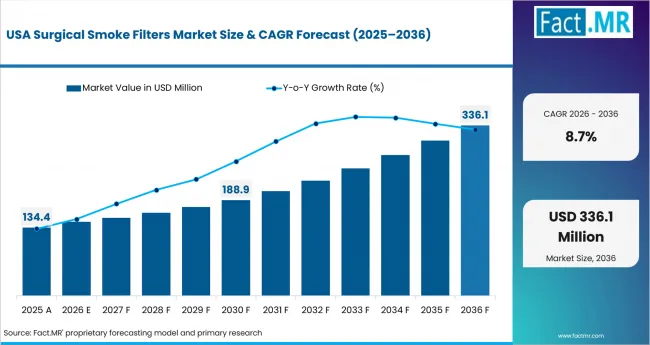
Surgical Smoke Filters Market Country Value Analysis | Source: Fact.MR
The United States is forecast to advance at 8.7% CAGR by 2036 as smoke evacuation laws create a clear compliance trigger. The Centers for Medicare & Medicaid Services reported in January 2026 that national health expenditure reached USD 5.3 trillion in 2024.
Large healthcare spending supports formal value analysis and group purchasing review. Suppliers gain access when filters match installed systems and audit needs.
What underpins Germany’s growth?
8.1% CAGR, backed by hospital capacity and worker-safety purchasing.
Germany is projected to rise at 8.1% CAGR through 2036 as hospitals connect plume control with staff protection. The Organisation for Economic Co-operation and Development reported in November 2025 that Germany had 7.7 hospital beds per thousand population.
This hospital base supports replacement filter contracts where procedures use electrosurgery and laser tools. Medical lighting technologies share planning attention because visibility and room layout affect surgical workflow.
Why is Japan an important filter market?
7.6% CAGR, supported by high hospital capacity and careful procurement review.
Japan is expected to post 7.6% CAGR through 2036 because high hospital density supports recurring filter replacement. The Organisation for Economic Co-operation and Development reported in November 2025 that Japan had 12.5 hospital beds per thousand population.
Japanese buyers are expected to compare documentation and fit before adding new filter SKUs. Endoscopy operative devices create adjacent demand when minimally invasive rooms use energy tools.
Who leads the surgical smoke filters landscape?
CONMED, Medtronic and Stryker lead through smoke evacuation platforms and hospital account access.
Surgical smoke filter competition is shaped by installed equipment access, cartridge compatibility and purchasing-channel control.Medtronic and Stryker compete through surgical energy and operating room relationships. I.C. Medical states that its SAFEGUARD BLUE Hydrophobic ULPA Filter delivers more than 99.9999% efficiency down to 0.03 micron.
Erbe Elektromedizin and CooperSurgical address procedure-specific buying needs. Pall Medical / Cytiva fits adjacent filtration accounts where material performance matters more than smoke evacuator branding. Providers that map filters to installed consoles are better placed. Surgical instrument tracking has similar buyer logic because both categories support procedure readiness and compliance records.
Which companies are the key players?
Key players include CONMED and Medtronic. Stryker and I.C. Medical are also included. Pall appear in the supplier set. Erbe Elektromedizin and CooperSurgical are included.
- CONMED / Buffalo Filter
- Medtronic plc
- Stryker Corporation
- I.C. Medical, Inc.
- Erbe Elektromedizin GmbH
- Pall Medical / Cytiva
- CooperSurgical, Inc.
Bibliography
- U.S. Food and Drug Administration. (2024, August 5). 510(k) premarket notification K240127: PlumeSafe® X5™ Smoke Management System. FDA.
- Stryker Corporation. (2026). SafeAir Compact Smoke Evacuator. Stryker Corporation.
- Medtronic plc. (2026). RapidVac™ smoke evacuation system. Medtronic plc.
- Association of periOperative Registered Nurses. (2025, September 24). Score! Surgical smoke evacuation mandates now the law in 20 U.S. states. Outpatient Surgery Magazine.
- Press Information Bureau. (2024, December 20). Update on Ayushman Bharat Pradhan Mantri Jan Arogya Yojana. Government of India.
- National Bureau of Statistics of China. (2026, February 28). Statistical communiqué of the People’s Republic of China on the 2025 national economic and social development. National Bureau of Statistics of China.
- Centers for Medicare & Medicaid Services. (2026, June 24). NHE fact sheet. Centers for Medicare & Medicaid Services.
- Organisation for Economic Co-operation and Development. (2025, November 13). Health at a Glance 2025: Germany. OECD Publishing.
- Organisation for Economic Co-operation and Development. (2025, November 13). Hospital beds and occupancy: Health at a Glance 2025. OECD Publishing.
- I.C. Medical, Inc. (2026). Surgical smoke evacuation filters and sensors. I.C. Medical, Inc.
- CooperSurgical. (2026). See Clear® Smoke Evacuation System. CooperSurgical.
- Cytiva. (2026). LaparoShield™ laparoscopic smoke filtration system. Cytiva.
This Report Addresses
- Strategic intelligence on surgical smoke filters across filter type, procedure and equipment fit.
- Segment analysis covers ULPA filters and laparoscopy. It also covers portable evacuators and replacement contracts.
- Regional outlook covers India, China, the United States, Germany, and Japan.
- Competitive analysis covers CONMED and Medtronic. It also covers Stryker and I.C. Medical. Erbe Elektromedizin is included.
- Service assessment covers hospital contracts, distributor replenishment, and device-fit filter mapping.
- Policy assessment covering state smoke evacuation mandates and procedure-level smoke control.
- Primary interviews, company source review and official healthcare statistics support the forecast.
What does the surgical smoke filters market cover?
Filter cartridges and inline filtration components used to capture surgical smoke from energy-based procedures.
The surgical smoke filters market covers ultra-low penetration air filters and high-efficiency particulate air filters. It also covers charcoal filters and pre-filters. Inline laparoscopic filters are included where devices connect to tubing. The market differs from smoke evacuator hardware because the focus is replacement filtration and fit-specific consumables.
What is included in the scope?
Replacement filters and inline filtration components used in surgical smoke evacuation systems.
The scope includes filter cartridges for portable evacuators and operating room integrated evacuators. It covers filters connected to laparoscopic tubing, electrosurgical pencils and trocar systems. It also includes replenishment orders through hospital contracts, distributor sales and group purchasing agreements.
What is excluded from the scope?
Smoke evacuator consoles and non-surgical ventilation filters are excluded.
The scope excludes reusable smoke evacuation consoles unless the sale is for replacement filters only. It excludes general heating, ventilation and air-conditioning filters because they are not source-capture plume filters. It also excludes respirator masks and non-medical fume extraction filters.
How was the analysis built?
100+ sources, 40+ company portfolios, 25+ countries, and 20+ interviews informed forecast validation.
- Primary Research: Primary research includes interviews with operating room procurement teams and ambulatory surgery center buyers.
- Desk Research: Desk research reviews state smoke evacuation laws, official healthcare data and public product documentation.
- Market-Sizing and Forecasting: Forecasting uses market shares, replacement behavior and procedure-linked filter use.
- Data Validation and Update Cycle: Forecasts are validated through company portfolio checks and country healthcare capacity signals.
Segmentation
What is the report’s scope and coverage?
| Attribute | Details |
|---|---|
| Quantitative Units | USD Million in 2026 to USD Million by 2036 at CAGR |
| Market Definition | Replacement filters and inline filtration components used for surgical smoke capture |
| Filter Type | ULPA filters, HEPA filters, charcoal filters, pre-filters, inline laparoscopic filters |
| Procedure | Laparoscopy, electrosurgery, laser surgery, plastic surgery, gynecological surgery |
| Equipment Fit | Portable evacuators, OR integrated evacuators, laparoscopic tubing, electrosurgical pencils, trocar systems |
| End User | Hospitals, ambulatory surgery centers, specialty surgical clinics, cosmetic surgery centers, dental surgery centers |
| Sales Model | Direct sales, distributor sales, group purchasing contracts, OEM bundles, replacement contracts |
| Regions Covered | North America, Europe, East Asia, South Asia, Latin America, Middle East and Africa |
| Countries Covered | India, China, United States, Germany, Japan |
| Key Companies Profiled | CONMED, Medtronic, Stryker, I.C. Medical, Pall, Erbe Elektromedizin and CooperSurgical |
| Forecast Period | 2026 to 2036 |
| Approach | Hybrid top-down and bottom-up approach using market value anchors, procedure mix, replacement behavior, and source validation |
Source: Fact.MR analysis. Updated Jun 29, 2026
How is the market segmented?
-
By Filter Type:
- ULPA Filters
- HEPA Filters
- Charcoal Filters
- Pre-Filters
- Inline Filters
-
By Procedure:
- Laparoscopy
- Electrosurgery
- Laser Surgery
- Plastic Surgery
- Gynecological Surgery
-
By Equipment Fit:
- Portable Evacuators
- Integrated Evacuators
- Laparoscopic Tubing
- Electrosurgical Pencils
- Trocar Systems
-
By End User:
- Hospitals
- Ambulatory Centers
- Specialty Clinics
- Cosmetic Centers
- Dental Centers
-
By Sales Model:
- Direct Sales
- Distributor Sales
- Group Contracts
- OEM Bundles
- Replacement Contracts
-
By Region:
- North America
- United States
- Canada
- Mexico
- Latin America
- Brazil
- Argentina
- Rest of Latin America
- Europe
- Germany
- United Kingdom
- France
- Italy
- Spain
- Rest of Europe
- East Asia
- China
- Japan
- South Korea
- South Asia
- India
- ASEAN
- Rest of South Asia
- Middle East and Africa
- GCC Countries
- South Africa
- UAE
- Rest of Middle East and Africa
- North America
Frequently Asked Questions
Which filter type leads the Surgical Smoke Filters Market?
Which country expands fastest in the Surgical Smoke Filters Market?
How does China perform in the Surgical Smoke Filters Market?
How does the United States perform in the Surgical Smoke Filters Market?
What is the primary driver in the Surgical Smoke Filters Market?
What is the main restraint in the Surgical Smoke Filters Market?
Who worked on this report


Preview the report firsthand - request a free sample
Free SampleGet the brochure for pricing and purchase details
Download PDF