- Market Value (2025): USD 419.4 Mn
- Estimated Value (2026): USD 520.0 Mn
- Forecast Value (2036): USD 4469.0 Mn
- CAGR (2026-2036): 24.0%
What is the Graphene Auto Additives Market forecast to be worth by 2036?
USD 520.0 million in 2026 to USD 4,469.0 million by 2036, at 24.0% CAGR.
- The graphene auto additives market reached USD 419.4 million in 2025.
- Demand is projected to increase from USD 520.0 million in 2026 to USD 4,469.0 million by 2036.
- The market is forecast to record a 24.0% CAGR from 2026 to 2036 as OEM material teams, compounders and additive formulators qualify graphene in lightweight plastics and conductive systems.
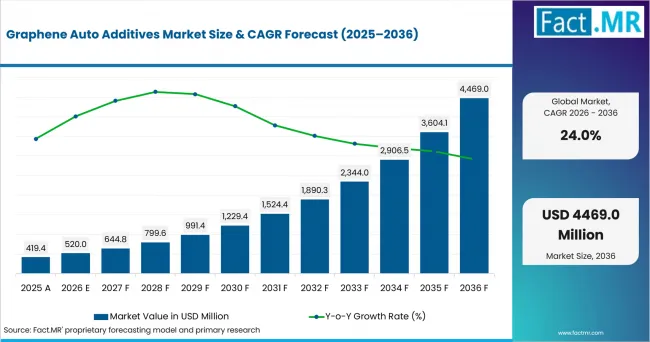
Graphene Auto Additives Market Value Analysis | Source: Fact.MR
What are the defining numbers behind Graphene Auto Additives Market growth?
USD 3,949.0 million absolute opportunity by 2036, led by nanoplatelets, thermoplastics and conductivity-focused formulations.
- Demand Drivers in the Market
- Automotive compounders need low-dosage additives that improve electrical behavior while keeping molding and extrusion routes familiar.
- EV platform teams specify lighter conductive parts as electrified powertrains increase static-control and battery-adjacent shielding needs.
- Tier suppliers use graphene masterbatches when dispersion stability reduces batch variation during molded-part qualification.
- Materials engineers evaluate graphene in plastics and elastomers where one additive can support heat movement or reinforcement targets.
- Key Segments Analyzed
- By Graphene Form: Nanoplatelets are expected to hold 39.0% share in 2026 due to easier handling in compound and masterbatch systems.
- By Carrier Matrix: Thermoplastics are projected to account for 37.0% share in 2026 because molding and extrusion give additives a broad qualification base.
- By Function: Conductivity is anticipated to capture 36.0% share in 2026 as static control and signal protection create measurable performance requirements.
- By Application: Automotive is estimated to represent 35.0% share in 2026 owing to lightweight parts, trim systems and electric-platform material trials.
- Analyst Opinion at Fact.MR
- Shambhu Nath Jha, Principal Consultant at Fact.MR, states, “Graphene auto additives are drawing attention where material teams can link a property gain to a part requirement. Adoption is expected to move first through masterbatches and compounds that fit familiar processing routes. Better-positioned suppliers should combine dispersion control, application testing and documentation that helps OEMs approve the additive faster.”
- Strategic Implications
- Graphene producers should document particle form, loading level and dispersion method for each polymer family.
- Compounders should provide mold-trial data that connects conductivity or thermal performance with processing stability.
- Automotive suppliers should qualify graphene grades in parts where lighter weight or lower additive loading changes part economics.
- Formulators should separate automotive-grade products from broad industrial grades so buyers can review performance claims quickly.
The UK is forecast to post 29.5% CAGR through 2036, supported by zero-emission vehicle uptake and polymer innovation programs. The USA is projected to record 27.8% CAGR as electrified powertrains expand material requirements. Germany is expected to advance at 19.5% CAGR due to automotive production recovery and a large vehicle fleet. South Korea is anticipated to reach 18.9% CAGR with export-oriented eco-friendly vehicle production. Japan is estimated to record 16.9% CAGR as production indicators and precision manufacturing support selective additive qualification.
How does the Graphene Auto Additives Market break down by segment?
Nanoplatelets lead Graphene Form at 39.0%; Thermoplastics lead Carrier Matrix at 37.0%.
Which graphene form leads?
Nanoplatelets hold 39.0% share in 2026.
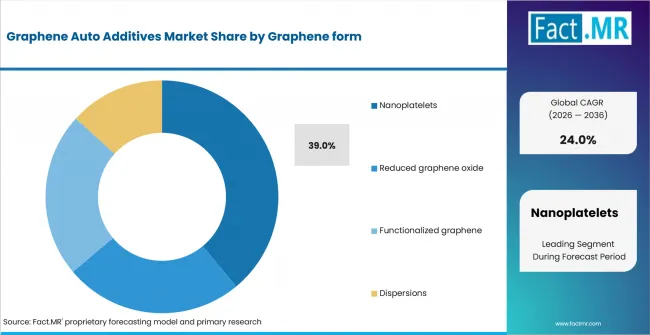
Graphene Auto Additives Market Analysis By Graphene Form | Source: Fact.MR
Nanoplatelets lead because compounders can introduce them through powder, concentrate or masterbatch formats. Their platelet geometry supports conductivity and reinforcement while formulators adjust loading levels during qualification. Avanzare lists graphene and graphite nanoplatelets in its material range, and its 2025 electric-vehicle project work identifies graphene oxide and graphite nanoplatelets as in-house materials for automotive development.
What leads the carrier matrix segment?
Thermoplastics account for 37.0% share in 2026.
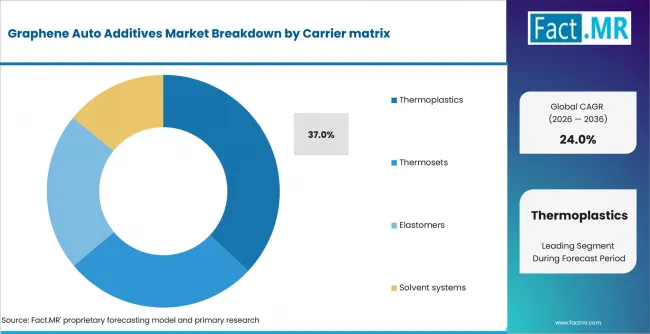
Graphene Auto Additives Market Analysis By Carrier Matrix | Source: Fact.MR
Thermoplastics lead because automotive interiors, housings and under-hood parts already use injection molding and extrusion routes. Graphene additives fit this route when they arrive as concentrates that the compounder can dose with standard equipment. Avanzare announced in October 2025 that the second phase of its EUR 10 million expansion would focus on graphene masterbatches and other highly concentrated conductive materials.
How does function shape demand?
Conductivity captures 36.0% share in 2026.
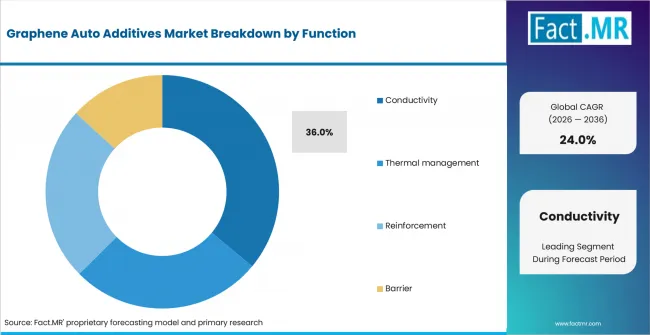
Graphene Auto Additives Market Analysis By Function | Source: Fact.MR
Conductivity leads because electric platforms add more sensors, cables and electronic modules in constrained spaces. Graphene offers one route to conductive plastics where formulators need electrical performance in polymer systems. Avanzare stated in April 2026 that its graphene-based avanGRP additives form a three-dimensional conductive network inside polymers. Separately, its avanSTATIC MLL antistatic additive can remain effective for 6 months to 3 to 4 years depending on the material and use conditions.
What supports automotive within application?
Automotive represents 35.0% share in 2026.
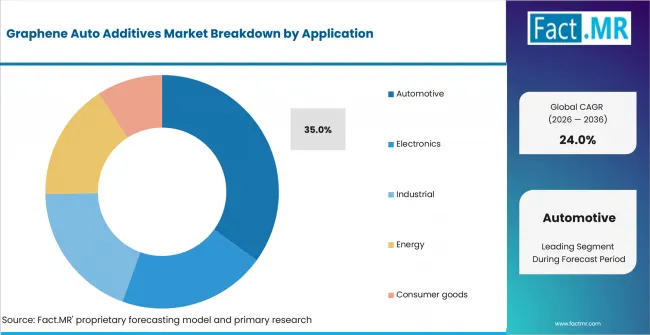
Graphene Auto Additives Market Analysis By Application | Source: Fact.MR
Automotive leads because qualification is slow but volumes become attractive once a material clears validation. The U.S. Energy Information Administration reported in July 2026, using Omdia estimates, that hybrid-electric, battery-electric and plug-in-hybrid vehicles accounted for 24% of new U.S. light-duty vehicle sales in the second quarter of 2026.
What is accelerating Graphene Auto Additives Market adoption, and what is holding it back?
Demand rises with EV materials, conductive plastics and lightweight compound qualification; restraints come from validation time, dispersion control and vehicle-cycle volatility.
Drivers Impact Analysis
| DRIVER | (~) % IMPACT ON CAGR | GEOGRAPHIC RELEVANCE | IMPACT TIMELINE |
|---|---|---|---|
| EV and hybrid material qualification | +2.1% | North America, Europe, East Asia | Short term (<= 2 years) |
| Conductive and thermal additive demand | +1.6% | Global | Medium term (2-4 years) |
| Lightweight thermoplastic replacement programs | +1.3% | USA, UK, Germany | Medium term (2-4 years) |
| Graphene dispersion improvements | +0.9% | Global | Long term (>= 4 years) |
- EV and hybrid material qualification: Electric platforms increase the need for conductive plastics, battery-adjacent housings and parts that manage static discharge without adding weight.
- Conductive and thermal additive demand: Graphene is being evaluated as an additive for electrical and thermal performance in polymers. Weight and performance advantages versus carbon black or metal fillers depend on application-specific comparative testing.
- Lightweight thermoplastic replacement programs: OEMs and tier suppliers review additives that improve part performance while keeping molding routes familiar.
- Graphene dispersion improvements: Graphmatech and Levidian announced in March 2025 a collaboration combining Levidian graphene production with Graphmatech dispersion technology for polymer-graphene composites.
Opportunity Impact Analysis
| OPPORTUNITY | (~) % IMPACT ON CAGR | GEOGRAPHIC RELEVANCE | IMPACT TIMELINE |
|---|---|---|---|
| Graphene-enhanced recycled plastics | +1.2% | North America, Europe | Medium term (2-4 years) |
| Battery and electronics thermal management | +1.1% | USA, South Korea, Japan | Long term (>= 4 years) |
| Barrier and coating additives | +0.7% | Europe, North America | Short term (<= 2 years) |
- Graphene-enhanced recycled plastics: Recycled polypropylene and composite parts may create an entry point for graphene additives where application-specific testing demonstrates recovery or improvement of the required properties.
- Battery and electronics thermal management: Material teams need polymer additives that move heat or protect electronics while keeping part weight low.
- Barrier and coating additives: Coating suppliers can evaluate graphene in thin-layer applications where barrier or surface-performance gains are demonstrated through application-specific testing.
Restraints Impact Analysis
| RESTRAINT | (~) % IMPACT ON CAGR | GEOGRAPHIC RELEVANCE | IMPACT TIMELINE |
|---|---|---|---|
| Long automotive validation cycles | -0.6% | Global | Short term (<= 2 years) |
| Dispersion and batch consistency risk | -0.5% | Global | Medium term (2-4 years) |
| Vehicle demand and tariff uncertainty | -0.4% | USA, Japan, South Korea | Medium term (2-4 years) |
- Long automotive validation cycles: A graphene additive must clear part-level tests before purchasing teams approve it for vehicle platforms.
- Dispersion and batch consistency risk: Poor dispersion can weaken the property gain that justifies the additive, especially in thin-wall molded parts.
- Vehicle demand and tariff uncertainty: Platform delays or model-mix changes can move additive decisions into the next sourcing cycle.
Which countries are scaling the Graphene Auto Additives Market through 2036?
- The country comparison spans 12.6 percentage points and forms three practical growth bands across the forecast period.
- The UK remains 1.7 percentage points above the USA as zero-emission registrations expand the addressable vehicle base.
- The USA remains 8.3 percentage points above Germany through electrified light-duty sales and vehicle-part material trials.
- Germany remains 0.6 percentage point above South Korea through a large vehicle fleet and recovering automotive production.
- South Korea remains 2.0 percentage points above Japan as export-led eco-friendly vehicle production supports additive qualification.
- Japan closes the displayed range through selective adoption in precision automotive and electronic component systems.
Comparable CAGRs create different entry conditions due to vehicle mix, supplier qualification depth and local manufacturing cycles. Full report coverage includes North America, Latin America, Western Europe, Eastern Europe, East Asia, South Asia & Pacific, Middle East & Africa.
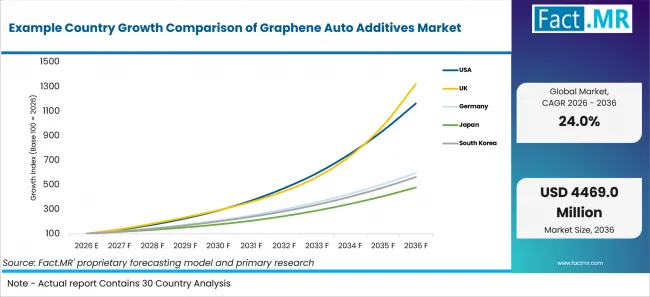
Example Country Growth Comparison Of Graphene Auto Additives Market | Source: Fact.MR
| Country | CAGR |
|---|---|
| United Kingdom | 29.5% |
| United States | 27.8% |
| Germany | 19.5% |
| South Korea | 18.9% |
| Japan | 16.9% |
What supports United Kingdom adoption?
29.5% CAGR, supported by zero-emission vehicle uptake and conductive polymer development.
UK material teams are working from a vehicle base that is shifting toward electric platforms. The Department for Transport reported on April 29, 2026 that 473,226 zero-emission cars were first registered in the UK in 2025, up 24% from 2024.
How is the USA scaling demand?
27.8% CAGR, driven by electrified light-duty sales and vehicle-part material trials.
U.S. adoption is tied to powertrain mix and part-level material testing. The U.S. Energy Information Administration reported in July 2026, using Omdia estimates, that hybrid-electric, battery-electric and plug-in-hybrid vehicles accounted for 24% of new U.S. light-duty vehicle sales in the second quarter of 2026.
What supports Germany adoption?
19.5% CAGR, supported by vehicle stock, engineering depth and automotive production recovery.
Germany combines a large passenger-car base with a deep compounder and tier-supplier network. Destatis reported in July 2026 that around 49.5 million passenger cars were registered in Germany at the beginning of 2026, equivalent to 593 cars per 1,000 inhabitants. Destatis reported in August 2026 that automotive-industry production increased 3.6% month on month in June 2026 after seasonal and calendar adjustment.
How does South Korea develop demand?
18.9% CAGR, led by export-oriented eco-friendly vehicle production and electronics-adjacent materials.
South Korea’s additive demand is linked to export platforms and eco-friendly vehicle sales. MOTIR reported in January 2026 that automobile exports reached USD 72.0 billion in 2025. The same release stated that eco-friendly vehicle sales rose to 813,000 units, up 25% from 2024.
How does Japan perform?
16.9% CAGR, supported by precision manufacturing and selective transport-equipment recovery.
Japan’s route is more selective and favors parts with clear conductivity or heat-control requirements. METI reported that Japan’s industrial production index stood at 103.0 in May 2026, up 0.5% from the previous month. METI separately publishes production data for transport machinery, plastic products and rubber products.
Who leads the Graphene Auto Additives Market?
NanoXplore, Graphmatech, Directa Plus, Avanzare, First Graphene are the profiled providers.
NanoXplore is active in graphene-enhanced plastics, composite parts and masterbatch products. Its May 2026 filing links its Statesville, North Carolina facility to the expansion of graphene-enhanced composite-parts manufacturing. Graphmatech supplies graphene-enhanced polymer solutions through its Aros Graphene® technology, while Avanzare offers functional additives and graphene-based masterbatch systems for plastics and rubber applications.
Directa Plus supplies G+® graphene materials across industrial applications, while First Graphene offers PureGRAPH® powder additives and graphene-enhanced masterbatches for polymers and composites.
Which companies are the key providers?
Key companies include NanoXplore Inc., Graphmatech AB, Directa Plus S.p.A., Avanzare Innovación Tecnológica S.L., First Graphene Limited.
- NanoXplore Inc.
- Graphmatech AB
- Directa Plus S.p.A.
- Avanzare Innovación Tecnológica S.L.
- First Graphene Limited
Bibliography
- Avanzare Materials. (2025, April 25). The government delegate visits Avanzare thanks to our involvement in the framework of the Electric and Connected Vehicle PERTE.
- Avanzare Materials. (2025, October 21). Avanzare Group strengthens its presence with a €10 million investment, creating 30 new jobs.
- Avanzare Materials. (2026, April 23). Why is controlling static electricity important?
- Department for Transport. (2026, April 29). Vehicle licensing statistics, United Kingdom: 2025. GOV.UK.
- Federal Statistical Office. (2026, July 22). Pkw-Dichte 2026 erneut gestiegen [Passenger car density increased again in 2026].
- Federal Statistical Office. (2026, August 7). Production in June 2026: +0.2% on the previous month.
- Graphmatech AB. (2025, March 19). Combining Graphmatech's Aros Graphene® technology with Levidian's LOOP system.
- Ministry of Economy, Trade and Industry. (2026, June 30). Current Survey of Production.
- Ministry of Economy, Trade and Industry. (2026, June 30). Indices of Industrial Production.
- Ministry of Trade, Industry and Resources. (2026, January 15). Automobile exports hit record high of $72 billion in 2025.
- NanoXplore Inc. (2026, May 13). Interim management’s discussion and analysis for the three and nine-month periods ended March 31, 2026 and 2025.
- U.S. Energy Information Administration. (2026, July 27). Hybrid sales rise while battery electric sales remain lower after tax credit expiration.
This Report Answers
- The report explains where graphene auto additives are used across graphene form, carrier matrix, function and application.
- Segment analysis identifies the leading subsegments and the operating reasons material teams prioritize them.
- Country analysis examines the listed markets and the vehicle, manufacturing or policy indicators supporting adoption.
- Competitive analysis reviews current providers across graphene powders, dispersions, masterbatches, composites and additive systems.
What does the Graphene Auto Additives Market cover?
The market covers graphene materials used as additives in automotive plastics, coatings, elastomers and composite systems. It includes forms that overlap with graphene auto thermoplastics where the additive improves conductivity, heat movement or reinforcement in vehicle parts.
The assessment considers adjacent technologies such as graphene composites and graphene-based coating additives where automotive users require thin-film barrier, wear or surface-performance gains.
What is included in the scope?
The scope includes graphene nanoplatelets, reduced graphene oxide, functionalized graphene and graphene dispersions when they are sold for automotive additive use. It also includes masterbatches, concentrates and formulated additive packages used in thermoplastics, thermosets, elastomers and solvent-borne systems.
It covers conductivity, thermal management, reinforcement and barrier functions. Automotive demand includes interior parts, housings, under-hood components, coatings, composite parts and EV-adjacent polymer systems where graphene changes part performance.
What is excluded from the scope?
The scope excludes stand-alone graphene production sold without an automotive additive route, raw graphite, battery active materials, semiconductor graphene devices and general coatings outside graphene-based functional additive use.
It excludes finished vehicles, carbon fiber parts sold without graphene content and polymer compounds where graphene is absent or used only as a lab material outside commercial qualification.
How Was the Analysis Built?
The analysis draws on 120+ sources, 35+ company portfolios, 25+ countries, and more than 20 industry interviews.
- Primary Research: Primary research includes discussions with additive producers, compounders, tier suppliers, OEM material teams, distributors, procurement teams and subject-matter experts.
- Desk Research: Desk research covers government statistics, regulatory publications, company filings, technical studies, standards, public policy and official company developments.
- Market Sizing and Forecasting: Market estimates combine historical values, vehicle-material demand indicators, segment shares, country-level growth, adoption patterns and barriers to scale.
- Data Validation and Update Cycle: Findings are validated by comparing interviews with public data, company activity, qualification trends and shifts in commercial adoption.
What is the report’s scope and coverage?
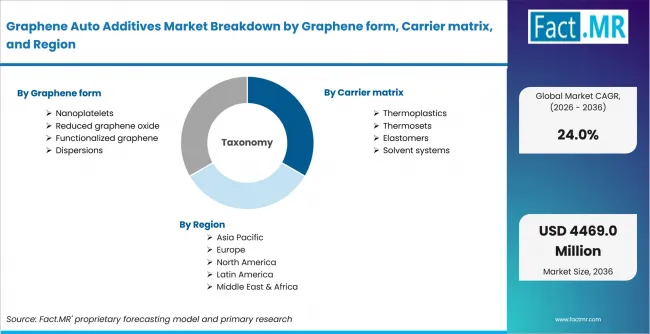
Graphene Auto Additives Market Breakdown By Graphene Form, Carrier Matrix, And Region | Source: Fact.MR
| Attribute | Details |
|---|---|
| Quantitative Units | USD million |
| Market Definition | Graphene-based materials used as additives in automotive plastics, composites, coatings, elastomers and conductive systems to improve electrical, thermal, barrier or mechanical performance. |
| Graphene Form | Nanoplatelets; Reduced graphene oxide; Functionalized graphene; Dispersions |
| Carrier Matrix | Thermoplastics; Thermosets; Elastomers; Solvent systems |
| Function | Conductivity; Thermal management; Reinforcement; Barrier |
| Application | Automotive; Electronics; Industrial; Energy; Consumer goods |
| Regions Covered | North America; Latin America; Western Europe; Eastern Europe; East Asia; South Asia & Pacific; Middle East & Africa |
| Countries Covered | United States; United Kingdom; Germany; South Korea; Japan |
| Key Companies Profiled | NanoXplore Inc.; Graphmatech AB; Directa Plus S.p.A.; Avanzare Innovación Tecnológica S.L.; First Graphene Limited |
| Forecast Period | 2026 to 2036 |
| Approach | Hybrid top-down and bottom-up approach using additive use cases; polymer qualification routes; vehicle material demand; country adoption; and provider portfolio review. |
How is the market segmented?
-
By Graphene Form:
- Nanoplatelets
- Reduced graphene oxide
- Functionalized graphene
- Dispersions
-
By Carrier Matrix:
- Thermoplastics
- Thermosets
- Elastomers
- Solvent systems
-
By Function:
- Conductivity
- Thermal management
- Reinforcement
- Barrier
-
By Application:
- Automotive
- Electronics
- Industrial
- Energy
- Consumer goods
-
By Region:
- North America
- Latin America
- Western Europe
- Eastern Europe
- East Asia
- South Asia & Pacific
- Middle East & Africa