- Market Value (2025): USD 176.9 Mn
- Estimated Value (2026): USD 230 Mn
- Forecast Value (2036): USD 3171 Mn
- CAGR (2026-2036): 30.0%
What is the Graphene Auto Thermoplastics Market forecast to be worth by 2036?
USD 230 million in 2026 to USD 3,171 million by 2036 at a 30.0% CAGR.
- The graphene auto thermoplastics market was valued at USD 176.9 million in 2025.
- Demand is projected to increase from USD 230 million in 2026 to USD 3,171 million by 2036.
- The market is forecast to record 30.0% CAGR from 2026 to 2036 as compounders, tier suppliers and electric-vehicle platforms qualify lightweight conductive polymers.
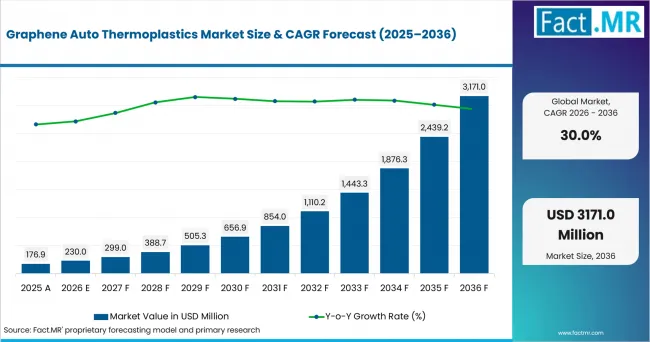
Graphene Auto Thermoplastics Market Value Analysis | Source: Fact.MR
What are the defining numbers behind Graphene Auto Thermoplastics Market growth?
An absolute opportunity of USD 2,941 million is expected between 2026 and 2036.
- Demand Drivers in the Market
- Electric-vehicle programs need lower part weight as model range, payload and battery packaging become linked purchase criteria.
- The IEA reported in May 2026 that global electric car sales exceeded 20 million units in 2025 and are expected to reach about 23 million in 2026.
- Automotive compounders use graphene materials in masterbatch form where graphene can reinforce familiar thermoplastic matrices without changing existing molding assets.
- Tier suppliers need predictable conductivity where connectors, EMI-sensitive modules and sensor housings require polymer parts with repeatable electrical behavior.
- OEM material engineers need documented dispersion, batch stability and processing windows before graphene thermoplastics move into series part approvals.
- Key Segments Analyzed
- By Resin Matrix: Polypropylene is expected to hold 26.0% share in 2026 due to its broad use in interior trim, exterior molded parts and cost-sensitive automotive compounds.
- By Graphene Form: Nanoplatelets are projected to account for 41.0% share in 2026 as their platelet geometry supports reinforcement and conductivity at low loading.
- By Vehicle Application: Interior structures are anticipated to capture 41.0% share in 2026 because molded cabin parts offer scale and fewer thermal extremes than under-hood uses.
- By Performance: Mechanical reinforcement is estimated to represent 52.0% share in 2026 owing to the direct value of stiffness, dimensional stability and part-weight reduction.
- Analyst Opinion at Fact.MR
- Shambhu Nath Jha, Principal Consultant at Fact.MR, states, “Automakers are asking molded parts to carry more functions. The market is expected to move fastest where suppliers prove dispersion quality. Companies that combine graphene processing, masterbatch design and qualification support are better placed.”
- Strategic Implications
- Graphene producers should provide masterbatch grades matched to polypropylene, polyamide and TPU so compounders can test materials on familiar equipment.
- Automotive tier suppliers should validate molded parts through mechanical, thermal and electrical tests instead of treating graphene as a general reinforcing filler.
- Resin formulators should document graphene loading, dispersion method and molding window because OEM approvals depend on repeatable production behavior.
South Korea is projected to record 38.1% CAGR through 2036, supported by eco-friendly vehicle output. The USA is forecast to post 36.8% CAGR as electrified sales raise lightweighting demand. Japan is anticipated to advance at 35.2% CAGR. Germany is estimated to reach 27.3% CAGR. The UK is expected to record 26.6% CAGR.
How does the Graphene Auto Thermoplastics Market break down by segment?
Mechanical reinforcement accounts for 52.0%; nanoplatelets and interior structures each account for 41.0%.
Which Resin Matrix dominates?
Polypropylene is expected to hold 26.0% share in 2026.
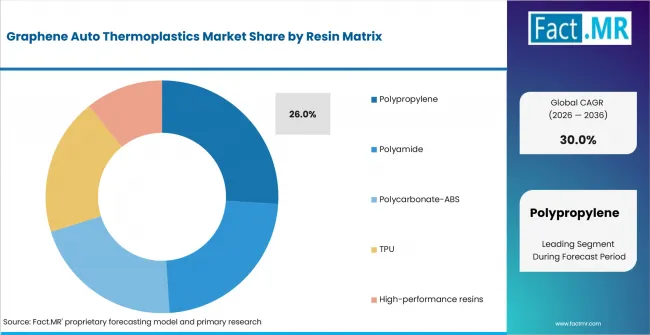
Graphene Auto Thermoplastics Market Analysis By Resin Matrix | Source: Fact.MR
Polypropylene leads the resin matrix split because it already serves high-volume interior and exterior parts. Graphene reinforcement gives compounders a route to adjust stiffness and surface durability while keeping molding speed visible.
The material also aligns with adjacent demand for automotive plastic components. NanoXplore describes graphene-enhanced thermoplastic concentrates and injected plastic parts for transportation use in its September 2025 annual information form.
What leads the Graphene Form segment?
Nanoplatelets are projected to account for 41.0% share in 2026.
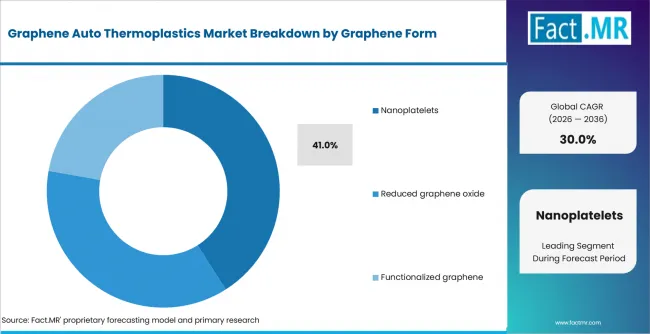
Graphene Auto Thermoplastics Market Analysis By Graphene Form | Source: Fact.MR
Nanoplatelets lead because they bring high surface area into the polymer at low loading. Their geometry helps create reinforcement and conductivity pathways without high filler levels.
Graphene nanoplatelets fit this dosing need because compounders can evaluate performance in small loading bands before committing to part-level validation. Avanzare’s 2025 automotive wiring discussion also connects graphene-enriched insulating surfaces with conductive circuit creation.
How does Vehicle Application shape demand?
Interior structures are anticipated to hold 41.0% share in 2026.
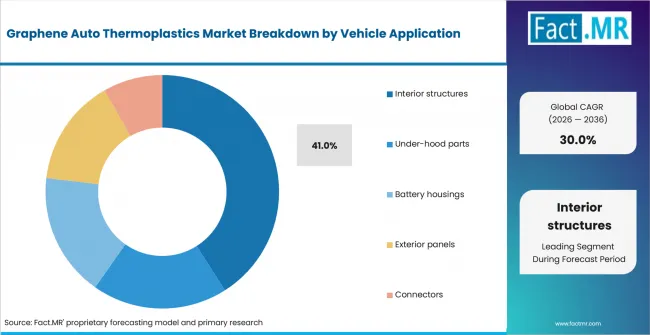
Graphene Auto Thermoplastics Market Analysis By Vehicle Application | Source: Fact.MR
Interior structures lead because they give automakers scale across trims, carriers and cabin panels. These parts reward weight reduction while facing lower heat exposure than under-hood components.
The segment also connects to automotive lightweight material selection because cabin parts let suppliers test stiffness, odor and surface finish before graphene grades move into higher-risk vehicle zones.
What supports Performance-led purchasing?
Mechanical reinforcement is estimated to represent 52.0% share in 2026.
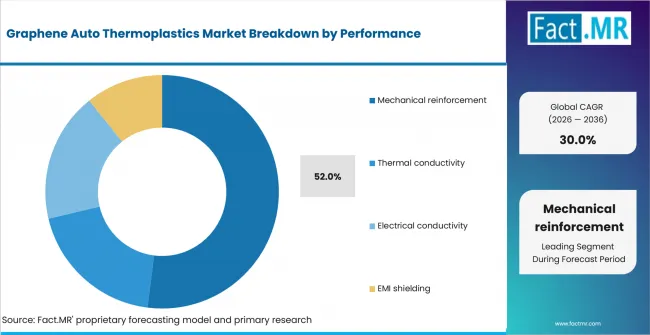
Graphene Auto Thermoplastics Market Analysis By Performance | Source: Fact.MR
Mechanical reinforcement leads the performance split because it is easy to translate into part-level value. Required stiffness at lower weight gives buyers a clear comparison against filled alternatives.
The performance case aligns with graphene composites because many buyers evaluate graphene by part stiffness, fatigue behavior and processing stability rather than by additive novelty. First Graphene listed a thermoplastic masterbatch in its July 2026 product presentation.
What is accelerating Graphene Auto Thermoplastics Market adoption, and what is holding it back?
Demand is expected to rise through lightweighting, EV platform redesign and conductive polymer functions. Adoption remains constrained by qualification cycles, dispersion control and graphite supply concentration.
Drivers Impact Analysis
| DRIVER | (~) % IMPACT ON CAGR | GEOGRAPHIC RELEVANCE | IMPACT TIMELINE |
|---|---|---|---|
| EV lightweighting and battery-housing redesign | +3.1% | North America, East Asia, Europe | Short term (<= 2 years) |
| Conductive and EMI-sensitive molded parts | +2.4% | Global | Medium term (2-4 years) |
| Polypropylene and polyamide masterbatch compatibility | +1.9% | Global | Short term (<= 2 years) |
| OEM push for lower vehicle weight | +1.5% | North America, Europe, Japan | Long term (>= 4 years) |
Source: Fact.MR analysis. Updated Aug 22, 2026
- EV lightweighting and battery-housing redesign: Battery packs increase vehicle mass, so reinforced thermoplastics must protect part weight and dimensional performance.
- Conductive and EMI-sensitive molded parts: Sensor-rich vehicles raise interest in conductive polymers that reduce dependence on metal housings.
- Polypropylene and polyamide masterbatch compatibility: Masterbatch routes reduce handling barriers for existing extrusion and injection-molding lines.
Opportunity Impact Analysis
| OPPORTUNITY | (~) % IMPACT ON CAGR | GEOGRAPHIC RELEVANCE | IMPACT TIMELINE |
|---|---|---|---|
| Graphene-enhanced recycled polypropylene | +1.6% | North America, Europe | Medium term (2-4 years) |
| Interior structural components using low loading levels | +1.3% | Global | Short term (<= 2 years) |
| Thermal and electrical grades for EV systems | +1.1% | East Asia, Europe | Long term (>= 4 years) |
Source: Fact.MR analysis. Updated Aug 22, 2026
- Graphene-enhanced recycled polypropylene: Recycled resin programs need additives that recover strength and stiffness in molded components.
- Interior structural components: Large-volume cabin parts provide a lower-risk qualification path than under-hood exposure zones.
- Thermal and electrical grades: EV platforms need polymer grades that manage heat, conductivity and shielding near electronics.
Restraints Impact Analysis
| RESTRAINT | (~) % IMPACT ON CAGR | GEOGRAPHIC RELEVANCE | IMPACT TIMELINE |
|---|---|---|---|
| Automotive qualification cycles and validation cost | -1.2% | Global | Short term (<= 2 years) |
| Dispersion, dosing and molding-window risk | -0.9% | Global | Medium term (2-4 years) |
| Graphite and graphene feedstock concentration | -0.7% | North America, Europe, Japan | Long term (>= 4 years) |
Source: Fact.MR analysis. Updated Aug 22, 2026
- Automotive qualification cycles and validation cost: OEM approval requires part testing, traceability and repeatable production before series supply.
- Dispersion, dosing and molding-window risk: Poor dispersion can create weak spots or inconsistent conductivity.
- Graphite and graphene feedstock concentration: Concentrated natural graphite supply raises sourcing risk for scaled graphene parts.
Which countries are scaling the Graphene Auto Thermoplastics Market through 2036?
- The country comparison spans 11.5 percentage points and forms two practical growth bands across the forecast period.
- South Korea remains 1.3 percentage points above the USA through eco-friendly vehicle sales and export-led component demand.
- The USA remains 1.6 percentage points above Japan as electrified light-duty sales expand the addressable base for lightweight molded parts.
- Japan remains 7.9 percentage points above Germany through software-defined vehicle policy and export capability.
- Germany remains 0.7 percentage point above the UK through domestic electric-car production and automotive polymer testing depth.
- The UK closes the displayed range as zero-emission registrations and policy pressure guide platform redesign.
Comparable CAGRs create different entry conditions because each country combines vehicle output, electrification policy and qualification risk differently. Full coverage includes North America, Latin America, Western Europe, Eastern Europe, East Asia and other regions.
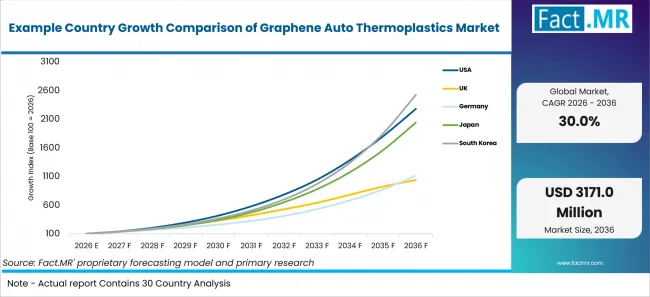
Example Country Growth Comparison Of Graphene Auto Thermoplastics Market | Source: Fact.MR
| Country | CAGR |
|---|---|
| South Korea | 38.1% |
| USA | 36.8% |
| Japan | 35.2% |
| Germany | 27.3% |
| UK | 26.6% |
Source: Fact.MR analysis. Updated Aug 22, 2026
What supports South Korea adoption?
38.1% CAGR, supported by eco-friendly vehicle sales and export-oriented component qualification.
South Korea’s growth is supported by strong automotive exports and rising electric-vehicle adoption. MOTIR reported automobile exports of USD 72.0 billion in 2025, while KAMA recorded 220,177 new electric-vehicle registrations, up 50.1% from 2024. Graphene thermoplastics are expected to find opportunities in lightweight interiors, battery-adjacent parts and electronics housings where conductivity and shielding can be tested alongside mechanical performance.
What supports USA adoption?
36.8% CAGR, led by electrified light-duty sales and vehicle lightweighting needs.
The USA’s growth reflects increasing electrified-vehicle penetration and continued interest in lighter automotive materials. EIA reported that hybrid, battery-electric and plug-in hybrid vehicles represented about 22% of U.S. light-duty sales in 2025. EPA also reported that model-year 2024 fuel economy improved while average vehicle weight, horsepower and footprint each changed by less than 5%. Graphene-enhanced polypropylene and engineering resins can support interiors, housings and sensor applications.
How does Japan scale demand?
35.2% CAGR, driven by software-defined vehicle policy and export-linked supplier capability.
Japan’s growth is supported by vehicle-electronics development and a large export-oriented automotive supply base. METI’s updated Mobility DX Strategy reaffirmed a target for Japanese-affiliated companies to achieve a 30% share of global software-defined vehicle unit sales in both 2030 and 2035, while JAMA reported that Japan exported 4.217 million four-wheel vehicles in 2024. Graphene-enhanced polyamide and PC-ABS can support connectors, electronics-adjacent parts and lightweight structures requiring controlled material behavior.
What is supporting Germany’s adoption?
27.3% CAGR, backed by electric-car production and industrial materials testing.
Germany’s growth reflects its strong automotive manufacturing base and growing electric-vehicle production. VDA reported that electric cars accounted for 40.2% of German domestic passenger-car production in 2025, while Destatis reported automotive production increased 3.6% month over month in May 2026. Germany’s engineering-plastics ecosystem supports graphene-enhanced polyamide and high-performance resin testing for connectors, under-hood components and battery-adjacent parts.
What supports the UK’s growth?
26.6% CAGR, supported by zero-emission vehicle registrations and platform redesign pressure.
The UK’s growth is supported by expanding zero-emission vehicle adoption and policy pressure to redesign vehicle platforms. GOV.UK reported that 528,000 zero-emission vehicles were first registered in 2025, up 24% from 2024, while ONS reported total UK manufacturers’ product sales of GBP 452.0 billion in 2025. Graphene masterbatch routes can help compounders test conductive and reinforced automotive parts without building a full graphene supply chain.
Who leads the Graphene Auto Thermoplastics Market?
NanoXplore connects graphene production with masterbatch and molded composite parts for transportation customers. Its September 2025 annual information form describes graphene-enhanced thermoplastic concentrates and molded plastic or composite parts.
Directa Plus supplies G+ graphene masterbatches for thermoplastic processing routes. The portfolio covers polymer options relevant to automotive compounders, including polyamide and polyethylene families.
First Graphene serves plastics and polymer manufacturers through PureGRAPH® graphene additives and masterbatch options. Its July 2026 investor presentation lists custom masterbatches and a functionalized graphene-oxide thermoplastic masterbatch within its product portfolio.
Avanzare announced a EUR 10 million three-phase expansion plan in October 2025; its second phase, scheduled for late 2026, focuses on graphene masterbatches and conductive materials, with automotive among the strategic sectors. Graphene One offers graphene additives for plastics, fibers and rubber.
Versarien should not be treated as a current independent provider because Versarien plc entered administration in January 2026 after Versarien Graphene entered administration and Cambridge Graphene and 2-DTech entered voluntary liquidation proceedings in 2025.
Which companies are the key providers?
Key companies include NanoXplore Inc.; Directa Plus S.p.A.; First Graphene Ltd.; Avanzare Innovacion Tecnologica S.L.
- NanoXplore Inc.
- Directa Plus S.p.A.
- First Graphene Ltd.
- Avanzare Innovacion Tecnologica S.L.
Bibliography
- Avanzare Innovación Tecnológica, S.L. (2025, April 25). The government delegate visits Avanzare thanks to our involvement in the framework of the Electric and Connected Vehicle PERTE.
- Avanzare Innovación Tecnológica, S.L. (2025, October 21). Avanzare Group strengthens its presence with a €10 million investment, creating 30 new jobs.
- Department for Transport. (2026, April 29). Vehicle licensing statistics: 2025.
- Department for Transport. (2025, October 17). Updates to the Vehicle Emissions Trading Schemes (VETS) Order 2023.
- European Commission, Directorate-General for Environment. (2025, July 4). Circular Economy: New rules to boost recycling efficiency and material recovery from waste batteries.
- Federal Statistical Office (Destatis). (2026, July 7). Production in May 2026: +0.9% on the previous month.
- First Graphene Ltd. (2026, July). July 2026 investor presentation.
- Versarien plc. (2026, January 6). Appointment of administrators and resignation of nominated adviser [Regulatory announcement]. London Stock Exchange.
- International Energy Agency. (2025, May 21). Global Critical Minerals Outlook 2025.
- Japan Automobile Manufacturers Association, Inc. (2025, September). The Motor Industry of Japan 2025.
- Ministry of Economy, Trade and Industry. (2025, June 9). Mobility Digital Transformation (DX) Strategy updated.
- U.S. Energy Information Administration. (2026, February 9). Electric vehicle sales fell as hybrid vehicle sales continued to rise in 2025.
This Report Answers
- The report explains where graphene-enhanced thermoplastics are used across resin matrix, graphene form, vehicle application and performance requirements.
- Segment analysis identifies the leading subsegments and the operational reasons automotive compounders prioritize them.
- Country analysis examines the listed markets and the vehicle production, electrification or policy mechanisms supporting adoption.
- Competitive analysis reviews current providers across graphene production, masterbatch development and automotive molded-part activity.
- Application analysis assesses how mechanical reinforcement, conductivity and thermal behavior influence purchase decisions in vehicle components.
What does the Graphene Auto Thermoplastics Market cover?
The Graphene Auto Thermoplastics Market covers compounds, masterbatches and molded vehicle parts that use graphene to improve stiffness, conductivity or EMI shielding. It sits near coverage of automotive composites but remains narrower because it focuses on graphene used inside automotive thermoplastic systems.
The assessment covers polypropylene, polyamide, polycarbonate-ABS, TPU and high-performance resins. It covers graphene forms used in interior structures, battery housings and connectors.
What is included in the scope?
The scope includes graphene-enhanced thermoplastic compounds sold to compounders, tier suppliers and OEM material teams. It also includes masterbatch and molded component programs supporting reinforcement, conductivity or shielding.
The scope connects to polymer categories such as high-performance polymers for automotive and TPU elastomers. It includes commercial graphene additives when the use case is directly tied to an automotive thermoplastic matrix or molded part.
Adjacent 2D materials graphene are included only when the grade is applied through thermoplastic compounding or molded automotive parts. Comparable engineering thermoplastic demand is treated as an adjacent polymer category, not as graphene auto thermoplastics by default.
What is excluded from the scope?
The scope excludes graphene sold only for batteries, coatings, concrete, textiles or electronics without an automotive thermoplastic application. It also excludes thermoset composites and base resin grades without graphene.
Finished vehicles, raw graphite mining and laboratory samples are excluded unless they have a documented pathway into thermoplastic compounding. General automotive plastics are excluded when graphene is absent.
How Was the Analysis Built?
The analysis draws on 120+ sources, 35+ company portfolios, 25+ countries, and more than 20 industry interviews.
- Primary Research: Primary research includes discussions with resin compounders, graphene producers, tier suppliers and OEM material engineers. These conversations examine material selection, processing limits and qualification cycles.
- Desk Research: Desk research covers government statistics, regulatory publications, company filings, technical data sheets, industry associations and vehicle policy documents. Every source used is documented in the bibliography.
- Market Sizing and Forecasting: Market estimates combine historical performance, electrified-vehicle indicators, resin use, component applications, country growth and supplier participation.
- Data Validation and Update Cycle: Findings are validated by comparing interviews with public data, company activity, regulatory changes and procurement trends. Updates review launches, capacity changes, approvals and adoption shifts.
Segmentation
What is the report’s scope and coverage?
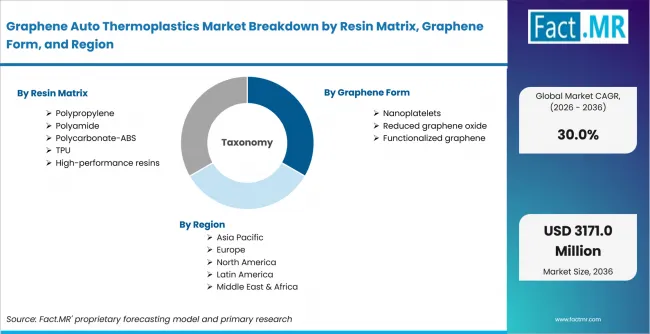
Graphene Auto Thermoplastics Market Breakdown By Resin Matrix, Graphene Form, And Region | Source: Fact.MR
| Attribute | Details |
|---|---|
| Quantitative Units | USD million |
| Market Definition | Graphene-enhanced thermoplastic compounds, masterbatches and molded automotive components that use graphene forms to improve mechanical, thermal, electrical or shielding performance. |
| Resin Matrix | Polypropylene; Polyamide; Polycarbonate-ABS; TPU; High-performance resins |
| Graphene Form | Nanoplatelets; Reduced graphene oxide; Functionalized graphene |
| Vehicle Application | Interior structures; Under-hood parts; Battery housings; Exterior panels; Connectors |
| Performance | Mechanical reinforcement; Thermal conductivity; Electrical conductivity; EMI shielding |
| Regions Covered | North America; Latin America; Western Europe; Eastern Europe; East Asia; South Asia and Pacific; Middle East and Africa |
| Countries Covered | USA; UK; Germany; Japan; South Korea |
| Key Companies Profiled | NanoXplore Inc.; Directa Plus S.p.A.; First Graphene Ltd.; Avanzare Innovacion Tecnologica S.L. |
| Forecast Period | 2026 to 2036 |
| Approach | Hybrid top-down and bottom-up approach using vehicle production, electrification indicators, resin-compounding activity, graphene supplier portfolios and country-level adoption factors. |
Source: Fact.MR analysis. Updated Aug 22, 2026
How is the market segmented?
-
By Resin Matrix
- Polypropylene
- Polyamide
- Polycarbonate-ABS
- TPU
- High-performance resins
-
By Graphene Form
- Nanoplatelets
- Reduced graphene oxide
- Functionalized graphene
-
By Vehicle Application
- Interior structures
- Under-hood parts
- Battery housings
- Exterior panels
- Connectors
-
By Performance
- Mechanical reinforcement
- Thermal conductivity
- Electrical conductivity
- EMI shielding
-
By Region
- North America
- Latin America
- Western Europe
- Eastern Europe
- East Asia
- South Asia and Pacific
- Middle East and Africa
Frequently Asked Questions
How big is the graphene auto thermoplastics market in 2026?
What is the CAGR of the graphene auto thermoplastics market from 2026 to 2036?
Which resin matrix leads the graphene auto thermoplastics market?
Which graphene form leads the graphene auto thermoplastics market?
Who are the leading companies in the graphene auto thermoplastics market?
Who worked on this report


Preview the report firsthand - request a free sample
Free SampleGet the brochure for pricing and purchase details
Download PDF