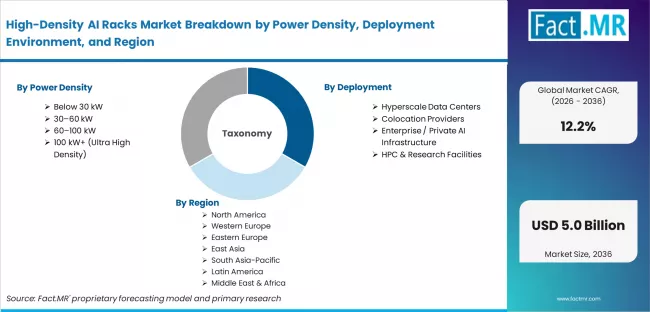
High-Density AI Racks Market Size, Share, Growth and Forecast (2026 - 2036)

The High-Density AI Racks Market is segmented by Power Density, Deployment Environment, Cooling Technology, Cooling Infrastructure Integration, Rack Type, End-User Industry, Application , and Region with forecasts covering the period from 2026 to 2036.

According to Fact.MR estimates, the High-Density AI Racks market stood at USD 1.4 billion in 2025. The market is projected to reach USD 1.6 billion in 2026 and climb to USD 5 billion by 2036, progressing at a CAGR of 12.2%. Hyperscale data centers are anticipated to account for nearly 56% share, while AI training is expected to remain the leading application segment with around 39% share, driven by rapid expansion of large-scale AI infrastructure and increasing demand for high-density, GPU-intensive computing environments.

High-Density AI Racks Market Overview, Growth Outlook, and Forecast

  • The High-Density AI Racks market was valued at USD 1.4 billion in 2025, and it is expected to grow at a High-Density AI Racks to reach USD 5 billion by 2036.
  • Expanding at a CAGR of 12.2% during 2026–2036, the market is projected to grow approximately 3.2x, creating an absolute opportunity of around USD 3.4 billion in 2036 compared to 2026
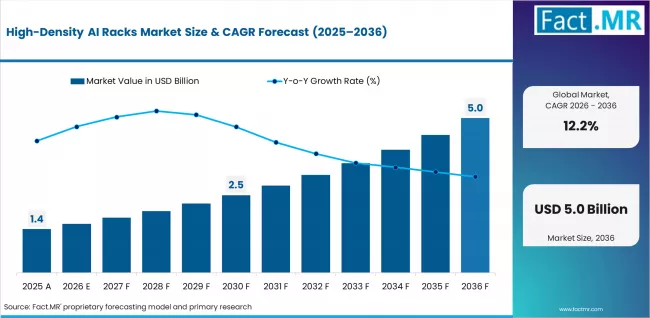
High Density Ai Racks Market Value Analysis

Summary of the High-Density AI Racks Market

  • Market Snapshot
    • In 2025, the size of the global High-Density AI Racks Market was about USD 1.4 billion.
    • The market is expected to grow from USD 1.6 billion in 2026 to an estimated USD 5 billion by 2036.
    • High-Density AI Racks Market is expected to grow at a CAGR of 12.2% in the forecast period.
    • The market is expected to generate an absolute dollar opportunity of around USD 3.4 billion from 2026 to 2036.
    • Hyperscale data centers hold a dominant position in the market in 2026 by the deployment environment segment.
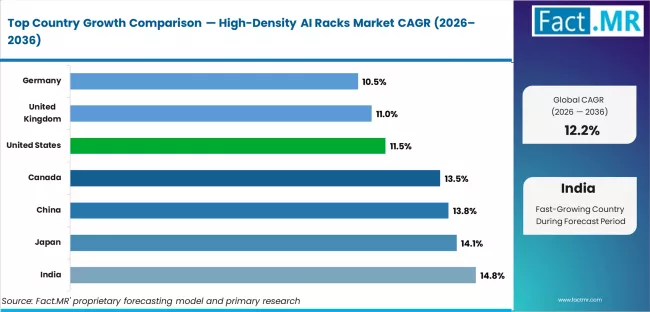
    • Key growth markets during the forecast period are India at 14.8%, Japan at 14.1%, and China at 13.8%, driven by rapid expansion of AI infrastructure, hyperscale data centers, and increasing investments in high-performance computing.
  • Demand and Growth Drivers
    • The growing demand for high-performance computing (HPC) and intensified AI workload is leading to growing necessity for high-density AI racks with support for next-generation GPUs and AI chips.
    • The increasing attention on power consumption, thermal solution and space efficiency in datacenters is driving the demand for liquid cooling-based solutions and ultra-high-density rack architectures.
    • The burgeoning hyperscale data centers, cloud computing, and AI infrastructure in nations like India, China, Japan, and the United States are the most prominent factors boosting the market demand.
    • Increasing adoption of AI-driven applications in various industries such as healthcare, finance, autonomous systems, and manufacturing is leading to a higher demand for a scalable and high-density computing infrastructure.
    • Cooling innovations (direct-to-chip, immersion cooling) and rack design, power delivery and integrated cooling infrastructure innovations are improving efficiency and contributing to market growth.
  • Product and Segment View
    • Below 30 kW leads the power density segment with a 30.8% share in 2026, driven by widespread deployment in existing data centers and enterprise environments transitioning toward AI workloads.
    • 30–60 kW racks follow with a 27.6% share, supported by increasing adoption in mid-to-high density AI and cloud computing applications.
    • 60–100 kW racks hold a 23.4% share, reflecting growing demand for high-performance AI training clusters.
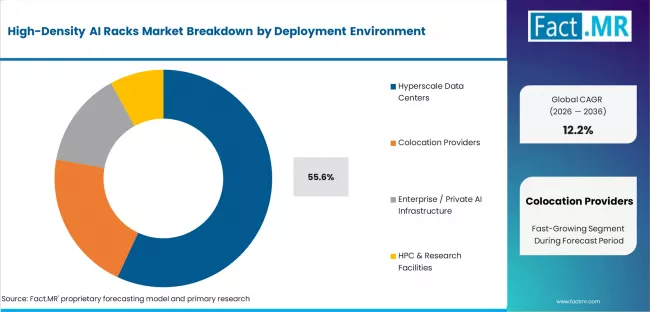
    • Hyperscale data centers dominate the deployment environment segment with a 55.6% share, fueled by large-scale investments from Big Tech in AI infrastructure.
    • Colocation providers account for a 20.4% share, benefiting from rising enterprise outsourcing of AI and high-density workloads.
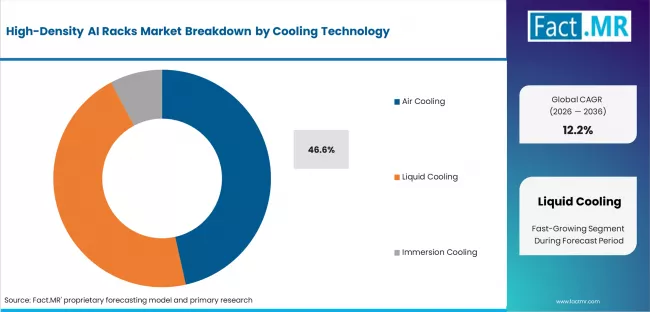
    • Air cooling leads the cooling technology segment with a 46.6% share, supported by its existing infrastructure base and cost-effectiveness.
  • Geography and Competitive Outlook
    • The rapid development of AI infrastructure, hyperscale data center, and HPC cluster is enabling Asia Pacific the fastest growing region for High-Density AI Racks. India, Japan, and China are expected to witness substantial growth owing to increasing investments in sovereign AI, cloud platforms and gpu deployment at scale.
    • North America and Europe are relatively mature markets and were the first to adopt ultra-high-density racks, liquid cooling solutions, and advanced data center designs. New developments in direct-to-chip cooling, immersion today and integrated rack-level power and cooling solutions are improving efficiency of operations and enabling next-generation ai workloads.
    • Key players in the High-Density AI Racks Market include NVIDIA Corporation, Vertiv Holdings Co., Schneider Electric SE, Dell Technologies Inc., Hewlett Packard Enterprise (HPE), Super Micro Computer, Inc., Lenovo Group Limited, Cisco Systems, Inc., Huawei Technologies Co., Ltd., and Rittal GmbH & Co. KG.
  • Analyst Opinion
    • Shambhu Nath Jha, Principal Consultant at Fact.MR, says the High-Density AI Racks Market is anticipated to grow rapidly on account of rising AI workloads, hyperscale data center expansion, and increasing demand for high-performance computing infrastructure. “The shift toward ultra-high-density rack environments and accelerated GPU deployments is driving adoption of advanced cooling and power-efficient rack solutions. Integration of liquid cooling, modular rack designs, and intelligent infrastructure management is improving performance, optimizing energy usage, and enabling scalable, efficient, and sustainable AI data center operations across industries

High-Density AI Racks Market— At a Glance

Attribute Details
Market Value 2025 USD 1.4 Billion
Market Value 2026 USD 1.6 Billion
Market Value 2036 USD 5 Billion
Absolute Dollar Opportunity USD 3.4 Billion
Total Growth 218.80%
CAGR 12.20%
Growth Multiple 3.2x
Key Demand Theme Rising demand for AI training infrastructure, high-performance computing, hyperscale data center expansion, increasing GPU density, and need for advanced cooling solutions
Leading End User Hyperscalers (Big Tech)
End User Share 50.80%
Leading Product Type Below 30 kW racks
Product Share 30.80%
Leading Material Type Liquid Cooling Systems (Infrastructure-driven category proxy)
Material Share 45.80%
Leading Installation Type CDU-Connected Rack Systems
Installation Share 36.80%
Leading Application AI Training
Application Share 38.80%
Key Growth Regions Asia-Pacific, North America, Europe
Key Companies NVIDIA Corporation, Vertiv Holdings Co., Schneider Electric SE, Dell Technologies Inc., Hewlett Packard Enterprise (HPE), Super Micro Computer, Inc., Lenovo Group Limited, Cisco Systems, Inc., Huawei Technologies Co., Ltd., Rittal GmbH & Co. KG
Segmentation by Product Type Below 30 kW, 30–60 kW, 60–100 kW, 100 kW+ (Ultra High Density)
Segmentation by Deployment Environment Hyperscale Data Centers, Colocation Providers, Enterprise / Private AI Infrastructure, HPC & Research Facilities, Edge AI Deployments
Segmentation by Cooling Technology Air Cooling, Liquid Cooling, Immersion Cooling
Segmentation by Cooling Infrastructure Integration CDU-Connected Racks, In-Rack CDU Systems, Rear-Door Heat Exchanger Racks, Manifold-Based Liquid Distribution Racks
Segmentation by Rack Type Enclosed Racks, Open Frame Racks (OCP-style), Custom AI Racks
Segmentation by End-User Industry Hyperscalers (Big Tech), Enterprises, Government & Defense, Telecom / Edge Providers
Segmentation by Application AI Training, AI Inference, Big Data Analytics, Cloud Computing
Segmentation by Region North America, Latin America, East Asia, South Asia & Pacific, Western Europe, Eastern Europe, Middle East & Africa

Key Growth Drivers, Constraints, and Opportunities
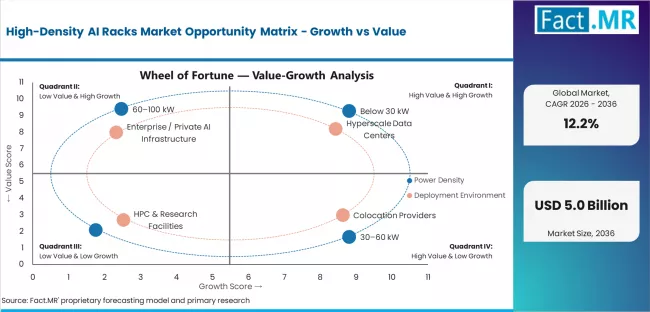
High Density Ai Racks Market Opportunity Matrix Growth Vs Value

Key Factors Driving Growth

  • The growing AI training workloads, the hyperscale data centers, and the GPU-heavy computing, are demanding for high density AI racks that can support 70 kW+ configurations.
  • The increasing utilization of liquid cooling systems to dissipate ever-increasing thermal loads is leading to a growing number of high-performance computing (HPC) optimized racks.
  • Due to the rise of cloud computing, generative AI, as well as large language model (LLM) training, companies are focusing on building scalable, high-density racks for hyperscalers and enterprise AI solutions.
  • Rising investments in sovereign AI infrastructure, government funded data centers, and HPC centers is further bolstering the market expansion especially in regions like Asia and North America.
Growth Driver Demand Impact Time Horizon Key Impact Area Fact.MR Insight
Rapid expansion of AI workloads, hyperscale data centers, and GPU clusters High Short–Mid Term Adoption acceleration Increasing deployment of GPU-intensive AI training environments is driving strong demand for high-density rack infrastructure supporting 60 kW+ configurations.
Rising need for advanced cooling solutions (liquid & immersion) to manage thermal loads High Short–Mid Term Operational efficiency & performance optimization Data centers are adopting liquid cooling technologies to improve thermal efficiency, reduce energy consumption, and sustain high-performance AI workloads.
Shift toward ultra-high-density computing (100 kW+ racks) High Mid Term Infrastructure modernization & scalability Growing demand for large-scale AI model training is accelerating the transition toward ultra-high-density rack deployments in hyperscale facilities.
Advancements in AI hardware, rack design, and integrated cooling systems Medium-High Mid–Long Term Product innovation & system integration Integration of direct-to-chip cooling, CDU systems, and modular rack architectures is improving performance, scalability, and deployment flexibility.

Key Market Constraints

  • High upfront capital costs associated with GPUs, liquid cooling systems, and power infrastructure act as a barrier, especially for enterprises transitioning from traditional data centers.
  • Thermal management complexity at ultra-high densities (60–100 kW+) increases operational risks and requires specialized expertise, limiting adoption in legacy facilities.
  • Power availability and grid constraints in key data center regions restrict the scalability of high-density AI deployments.
  • Supply chain limitations, particularly for advanced GPUs and cooling components, can delay infrastructure rollouts and increase overall costs.

Key Opportunity Areas

  • The expanding AI training workloads, hyperscale data centers and GPU-centric computing are driving demands for high density AI racks capable of supporting 70 kW+ configurations.
  • The trend of increasing application of liquid cooling solutions to remove higher and higher heat loads is resulting in an increasing number of HPC optimized racks.
  • With the emergence of cloud computing, generative AI, and large language model (LLM) training, companies are now concentrating on building scalable, high density racks for hyperscalers and enterprise AI solutions.
  • Growing investments in sovereign AI infrastructure, government sponsored data centers, and HPC centers are further propelling the market growth particularly in geographies such as Asia and North America.

Segment-wise Analysis of the High-Density AI Racks Market

  • Below 30 kW racks hold 30.8% of the power density segment in 2026, supported by continued deployment in enterprise data centers and legacy infrastructure, where moderate-density workloads still dominate.
  • Hyperscale data centers account for 55.6% of the deployment environment segment in 2026, driven by large-scale AI training clusters and centralized cloud infrastructure investments by Big Tech companies.
  • Air cooling holds 46.6% of the cooling technology segment in 2026, owing to its widespread use in existing facilities and compatibility with lower to mid-density rack deployments, although it is closely followed by liquid cooling adoption.

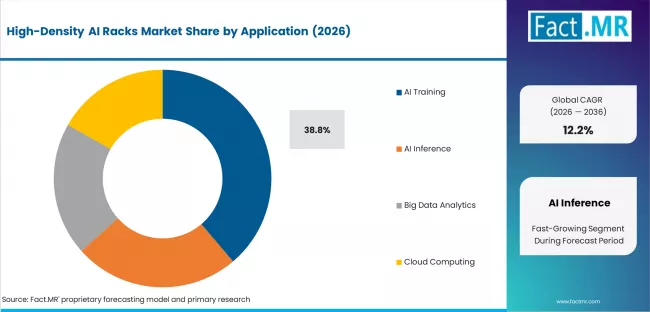
The report provides detailed market size and focuse analysis of power density, deployment environment, cooling technology, cooling infra integration, rack type, end-user industry, application, and region. application, AI training is the largest application at 38.8% due to booming demand for training large-scale models, GPU clusters, and generative AI workload that can leverage high compute density.

Which Power Density Segment Topped the Market in High-Density AI Racks Market?
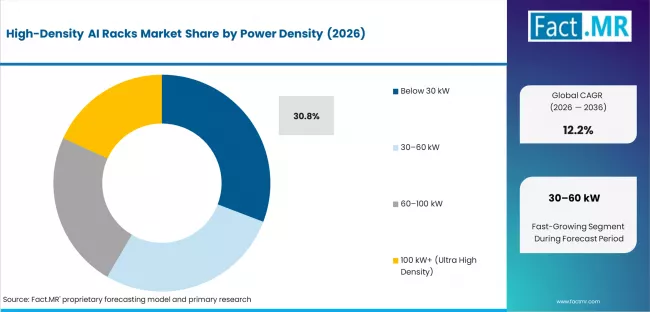
High Density Ai Racks Market Analysis By Power Density

It is anticipated that Below 30 kW segment will hold the largest share in the High-Density AI Racks Market by 2026 and is projected to maintain its dominance contributing 30.8% of market value. Its pre-eminence is due to the ongoing coexistence of enterprise and legacy infrastructure in data centers where medium-density workloads are still widespread and high-density AI workloads are growing.

Which Deployment Environment Accounts for the Highest Share in the High-Density AI Racks Market?
High Density Ai Racks Market Analysis By Deployment Environment

Hyperscale data centers emerge as the leading segment, capturing 55.6% share in 2026. This is driven by massive investments from Big Tech companies in AI training clusters, cloud platforms, and centralized high-performance computing infrastructure.

Which Cooling Technology Holds the Largest Share in the High-Density AI Racks Market?
High Density Ai Racks Market Analysis By Cooling Technology

Air cooling holds the largest share at 46.6% in 2026, primarily due to its widespread deployment in existing data center environments and compatibility with low-to-mid density racks. However, liquid cooling is rapidly gaining ground as density requirements increase.

Which Rack Type Represents the Leading Segment in the High-Density AI Racks Market?
High Density Ai Racks Market Analysis By Rack Type

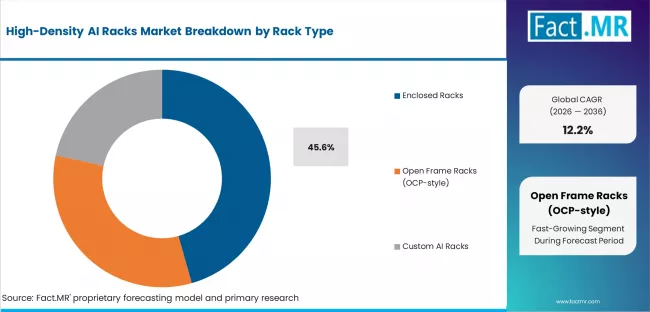
Enclosed racks dominate the rack type segment with a 45.6% share in 2026. Their leadership is driven by their ability to provide controlled environments, improved airflow management, and compatibility with high-density and liquid-cooled configurations.

Which End-User Industry Leads the High-Density AI Racks Market?
High Density Ai Racks Market Analysis By End User Industry

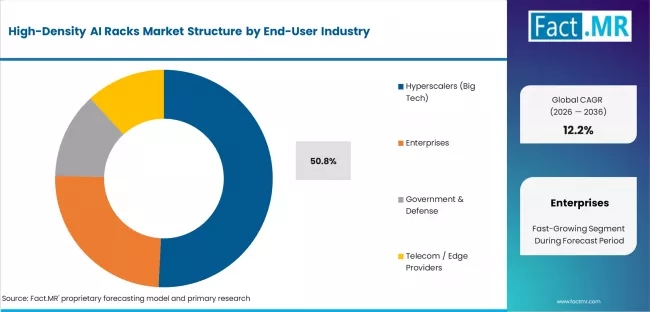
Hyperscalers (Big Tech) lead the end-user segment, accounting for 50.8% share in 2026. This dominance is fueled by large-scale investments in AI infrastructure, hyperscale data centers, and advanced computing environments.

Which Application Segment Commands the Highest Share in the High-Density AI Racks Market?
High Density Ai Racks Market Analysis By Application

AI training holds the highest share among applications, capturing 38.8% in 2026. This is primarily due to the increasing demand for large-scale model training, generative AI, and GPU-intensive workloads requiring high-density infrastructure.

Which Cooling Infrastructure Integration Segment Holds the Largest Share in the Market?
High Density Ai Racks Market Analysis By Cooling Infrastructure Integration

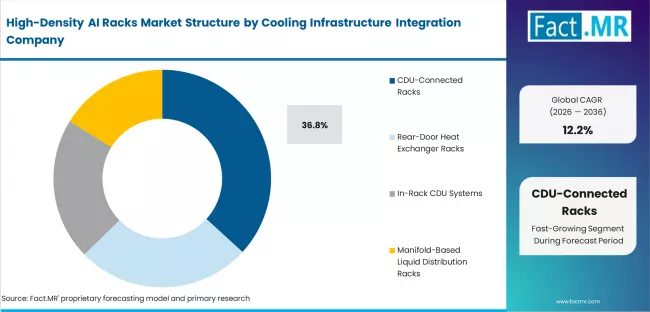
CDU-connected racks account for the largest share at 36.8% in 2026. Their dominance is driven by the growing adoption of liquid cooling systems that enable efficient heat dissipation and scalability in high-density AI environments.

Regional Outlook Across Key Markets

  • India is expected to grow at approximately 14.8%, emerging as the fastest-growing market due to rapid expansion of AI infrastructure, hyperscale data centers, and government-backed digital initiatives. Increasing investments in sovereign AI, cloud computing, and large-scale GPU deployments are significantly driving demand for high-density AI racks.
  • The United States remains a key market, projected to grow at around 11.5%, supported by the strong presence of hyperscalers, advanced AI ecosystems, and continuous investments in next-generation data center infrastructure. The shift toward liquid cooling and ultra-high-density (70–100 kW+) rack deployments is further accelerating market growth.
  • Asia-Pacific is anticipated to witness the highest overall growth, with China growing at 13.8% due to large-scale investments in AI data centers, semiconductor capabilities, and cloud infrastructure. Meanwhile, Japan is expected to grow at 14.1%, driven by advancements in AI, robotics, and high-performance computing (HPC), along with increasing adoption of energy-efficient, high-density rack solutions.
  • Europe is experiencing steady growth, with Germany projected at 10.5%, supported by industrial AI adoption, automation, and data center modernization initiatives. The United Kingdom is expected to grow at 11.0%, driven by rising investments in AI research, cloud infrastructure, and sustainable data center technologies, including liquid cooling adoption.

Top Country Growth Comparison High Density Ai Racks Market Cagr (2026 2036)

CAGR Table

Country CAGR (%)
India 14.8%
Japan 14.1%
China 13.8%
Canada 13.4%
United States 11.5%
United Kingdom 11.0%
Germany 10.5%

Source: Fact.MR (FMR) analysis, based on proprietary forecasting model and primary research.
High Density Ai Racks Market Cagr Analysis By Country

North America – The Hyperscale AI Infrastructure Hub

North America is a highly advanced and mature market where demand for High-Density AI Racks is driven by hyperscale data centers, AI model training, and cloud infrastructure expansion. The region is at the forefront of ultra-high-density (70–100 kW+) deployments and liquid cooling adoption, with strong emphasis on performance optimization and scalability. Leading technology providers and infrastructure vendors are focusing on next-generation rack architectures, integrated cooling, and retrofitting legacy facilities for AI workloads.

  • U.S.: Demand is projected to grow at 11.5% CAGR through 2036, driven by hyperscale AI clusters, generative AI expansion, and large-scale GPU deployments.
  • Canada: Expected to grow at 13.4% CAGR, supported by increasing investments in AI data centers, favorable energy availability, and expansion of cloud infrastructure.

Europe – The Sustainable AI Data Center Market
High Density Ai Racks Market Europe Country Market Share Analysis, 2026 & 2036

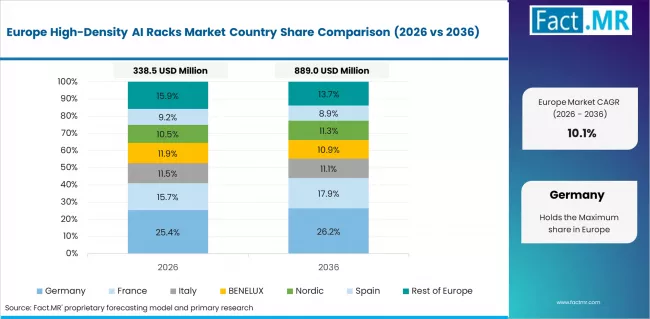
Europe is characterized by strong energy efficiency regulations and sustainability goals, driving adoption of liquid-cooled and energy-efficient high-density AI racks. The market is supported by AI research initiatives, industrial automation, and green data center investments, with a focus on reducing carbon footprint and improving power utilization efficiency (PUE).

  • Germany: Expected to grow at 10.5% CAGR, supported by industrial AI adoption, automation, and modernization of data center infrastructure.
  • United Kingdom: Projected to expand at 11.0% CAGR, driven by AI innovation, cloud adoption, and sustainable infrastructure investments.

Asia-Pacific – The AI Infrastructure Growth Engine
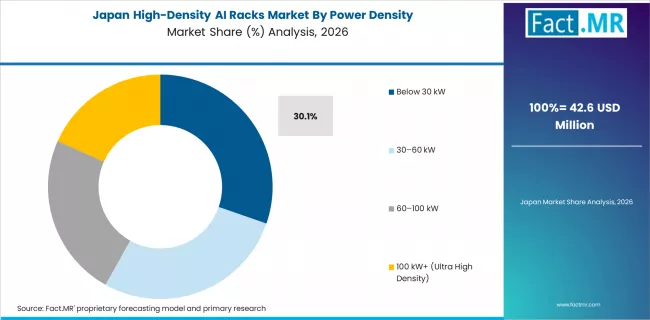
High Density Ai Racks Market Japan Market Share Analysis By Power Density

Asia-Pacific is the fastest-growing region, driven by rapid expansion of AI workloads, hyperscale data centers, and government-backed digital infrastructure initiatives. Countries such as China, India, and Japan are leading adoption due to strong investments in AI, semiconductor ecosystems, and cloud computing. The region is witnessing increasing deployment of high-density and liquid-cooled rack solutions to support next-generation AI applications.

  • China: Expected to grow at 13.8% CAGR, driven by large-scale AI data center investments, cloud expansion, and national AI strategies.
  • Japan: Growth at 14.1% CAGR, supported by advancements in robotics, HPC, and high-performance AI infrastructure.
  • India: Leading growth at 14.8% CAGR, fueled by rapid digital transformation, sovereign AI initiatives, and expansion of hyperscale data centers.

Latin America – The Emerging AI Infrastructure Market

Latin America is an emerging market for High-Density AI Racks, driven by growing adoption of cloud services, AI workloads, and digital transformation initiatives. Infrastructure development is still evolving, with global vendors expanding their footprint through regional partnerships and data center investments.

  • Brazil: Expected to witness steady growth through 2036, supported by increasing cloud adoption, enterprise AI use cases, and investments in data center infrastructure.

Middle East & Africa – The AI & Smart Infrastructure Expansion Zone

The Middle East & Africa is a developing region where demand is driven by smart city initiatives, AI adoption, and large-scale digital infrastructure investments. Governments are focusing on building AI-ready data centers and diversifying economies through technology-driven growth, increasing the need for high-density and energy-efficient rack solutions.

  • Saudi Arabia (KSA): Demand is projected to grow steadily, supported by investments in AI infrastructure, hyperscale data centers, and smart city projects such as NEOM.

Fact.MR’s analysis of the High-Density AI Racks Market provides a comprehensive regional outlook across North America, Europe, Asia-Pacific, Latin America, and the Middle East & Africa, highlighting country-level trends, infrastructure development, and technological advancements shaping both mature and emerging AI infrastructure markets.

Competitive Benchmarking and Company Positioning

Leading Companies Shaping the High-Density AI Racks Market
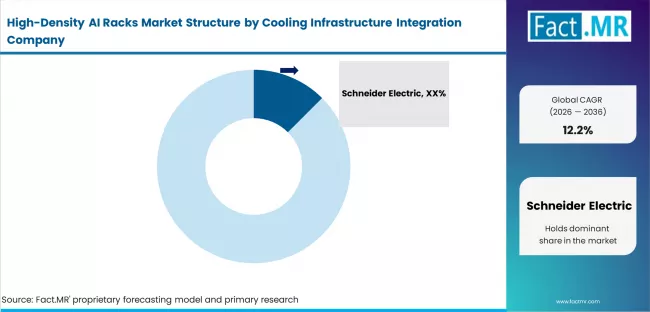
High Density Ai Racks Market Analysis By Company

The major participants in the High-Density AI Racks Market include Vertiv Holdings Co., Schneider Electric SE, Eaton Corporation plc, Rittal GmbH & Co. KG, and Dell Technologies, which hold a combined market share of roughly 45-55%. Competition in the industry is based on high-density capabilities, liquid-cooling suitability, scalability, thermal efficiency, and total cost of ownership.

High-Density AI Rack manufacturers with global operations, including providers of data center infrastructure, have achieved significant market shares due to their solid brand recognition, expansive distribution channels, and close collaboration with hyperscalers, enterprises, and government agencies. Their ability to provide comprehensive AI rack infrastructure products, including racks, power systems, liquid-cooling capabilities, and built-in compute platforms, makes them highly competitive in retaining clients and integrating projects on a large scale.

Recent Industry Developments

  • Vertiv to Showcase Latest High-Capacity Liquid Cooling Innovations at Data Centre World 2025 (2025)
    • Vertiv announced the showcase of its latest high-capacity liquid cooling innovations designed to support AI and high-density computing environments. The solutions focus on improving thermal management, enabling higher rack densities, and enhancing energy efficiency in modern data centers, particularly for AI and HPC workloads.
  • Schneider Electric Launches New Data Center Solutions to Meet Challenges of High-Density AI and Accelerated Compute Applications (2025)
    • Schneider Electric introduced new data center solutions tailored for high-density AI workloads, including advanced rack systems, power distribution, and liquid cooling integration. These solutions aim to address rising power densities, improve scalability, and enhance efficiency in AI-driven data center environments.
  • Vertiv Holdings Co. – Vertiv Announces New AI-Powered Predictive Maintenance Service for Modern Data Centers and AI Factories (2026)
    • Vertiv launched an AI-powered predictive maintenance service designed to optimize the performance and reliability of data center infrastructure supporting high-density AI racks. The solution leverages advanced analytics to reduce downtime, improve operational efficiency, and support next-generation AI factory environments.
  • Dell Technologies Accelerates Enterprise AI with Powerful, Automated Solutions (2025)
    • Dell Technologies announced new enterprise AI solutions featuring integrated rack-scale infrastructure, automation capabilities, and high-performance compute systems. These solutions are designed to support scalable AI deployments, improve workload efficiency, and accelerate adoption of AI across enterprise and hyperscale environments.
  • HPE Accelerates AI Deployments with AMD “Helios” AI Rack-Scale Architecture (2025–2026)
    • Hewlett Packard Enterprise (HPE) introduced the AMD “Helios” AI rack-scale architecture, featuring high-density GPU configurations, advanced networking, and liquid cooling integration. The solution is designed to enable large-scale AI training and HPC workloads, delivering enhanced scalability and performance in next-generation data center environments.

Leading Companies Shaping the High-Density AI Racks Market

  • Schneider Electric
  • Vertiv
  • Eaton
  • Rittal
  • Legrand
  • Dell Technologies
  • Hewlett Packard Enterprise
  • Lenovo
  • IBM
  • Cisco Systems
  • Supermicro

Sources and Research References

  • [1] Vertiv Holdings Co., “Vertiv to Showcase Latest High-Capacity Liquid Cooling Innovations at Data Centre World 2025,” 2025.
  • [2] Schneider Electric SE, “Schneider Electric Launches New Data Center Solutions to Meet Challenges of High-Density AI and Accelerated Compute Applications,” 2025.
  • [3] Vertiv Holdings Co., “Vertiv Announces New AI-Powered Predictive Maintenance Service for Modern Data Centers and AI Factories,” 2026.
  • [4] Dell Technologies Inc., “Dell Technologies Accelerates Enterprise AI with Powerful, Automated Solutions,” 2025.
  • [5] Hewlett Packard Enterprise (HPE), “HPE Accelerates AI Deployments with First AMD ‘Helios’ AI Rack-Scale Architecture with Open, Scale-Up Networking Built with Broadcom,” 2025.

High-Density AI Racks Market Definition

The High-Density AI Racks Market consists of high-end rack systems that are adapted for High Performance Computing (HPC) and Artificial Intelligence (AI) workloads with in modern data center facilities. These racks are designed to support high power densities, frequently over 30kW and up to more than 100 kW, coupled with high-efficiency cooling solutions including air, liquid and immersion cooling. It offers these in such assemblies as enclosed, open-frame or custom manufactured racks, as well as with integrated cooling systems like CDU solutions. These are high-density, thermal and scalability, reliability, and energy solutions. Dense AI racks are being used in hyperscale data centers, enterprises, HPC, and the edge AI.

High-Density AI Racks Market Inclusions

Report analyzes the High-Density AI Racks Market at global and regional scale for the analysis on market share, size, key players, market dynamics and on demand factors and impact of the macroeconomic and microeconomic factors. It is categorized by power density, solution type, rack type, cooling technology, integration of cooling infrastructure, deployment environment, end-user industry, application, and region. The report also covers pricing trends, growth prospects, demand trends, and adoption within hyperscale, enterprise, HPC, and Edge. In addition, the report demonstrates the global liquid cooling, ultra-high density racks, modular approach and developments in energy efficiency, thermal management and scalable AI infrastructure by region.

High-Density AI Racks Market Exclusions

The high density AI racks market does not cover standalone IT hardware component such as GPU, CPU, server, storage, switch, or networking hardware that is otherwise not part of integrated rack solutions. It does not cover general racks with low power density (below the thresholds focused on AI), nor standard data centre enclosures with out-of-the-box cooling solutions. Items related to the power infrastructure, including UPS systems, transformers, and standalone power distribution units (PDU), are excluded unless they are part of a rack system. The scope also excludes standalone sale of cooling accessories (e.g. chillers, cooling plant). Also, the installation, maintenance, and consulting services without rack hardware are not covered.

High-Density AI Racks Market Research Methodology

  • Primary Research
    • In-depth interviews were conducted with rack manufacturers, cooling solution providers, system integrators, hyperscale data center operators, colocation providers, and enterprise AI infrastructure users in IT & telecom, government & defense, and research industries to understand the demand, technology adoption, pricing, and usage in the High-Density AI Racks market.
  • Desk Research
    • To validate the market size, trends, and competitive landscape, secondary sources such as company annual reports, investor presentations, product brochures, industry databases, government publications, trade journals, and white papers on AI infrastructure, data centers, and cooling technologies were reviewed.
  • Market-Sizing and Forecasting
    • The projections were derived from a mix of bottom-up analysis (company revenues, rack deployments, installed base) and top-down analysis (growth in AI workloads, growth in hyperscale data centers, cloud investments, and adoption of high-density computing infrastructure).
  • Data Validation and Update Cycle
    • All data points were triangulated with industry experts and continuously updated based on technological advancements, evolving AI infrastructure standards, data center investments, and macroeconomic factors.

Scope of Analysis

High Density Ai Racks Market Breakdown By Power Density, Deployment Environment, And Region

Parameter Details
Quantitative Units USD 1.4 Billion (2025) to USD 5 Billion (2036), at a CAGR of 12.2%
Market Definition The High-Density AI Racks Market covers advanced rack systems designed to support high-performance computing (HPC) and AI workloads, including GPU-intensive environments. These racks are engineered for high power density (30 kW to 100 kW+), efficient thermal management (air, liquid, and immersion cooling), and scalable infrastructure deployment across hyperscale data centers, enterprises, and research facilities, focusing on performance optimization, energy efficiency, and modularity.
Regions Covered North America, Europe, Asia-Pacific, Latin America, Middle East & Africa
Countries Covered USA, Canada, UK, Germany, France, Italy, China, Japan, India, South Korea, Brazil, Saudi Arabia, UAE, and 20+ countries
Key Companies Vertiv Holdings Co., Schneider Electric SE, Eaton Corporation plc, Rittal GmbH & Co. KG, Dell Technologies, Hewlett Packard Enterprise (HPE)
Forecast Period 2025 to 2036
Approach Hybrid demand-side and top-down methodology based on AI workload growth, hyperscale data center expansion, GPU deployment trends, cooling technology adoption (liquid & immersion), power density evolution, and pricing dynamics, validated through primary interviews with rack manufacturers, cooling solution providers, system integrators, and hyperscale operators across key regions.

Analysis by Power Density, Deployment Environment, Cooling Technology, Cooling Infrastructure Integration, Rack Type, End-User Industry, Application, and Region

  • High-Density AI Racks Market by Power Density

    • Below 30 kW
    • 30–60 kW
    • 60–100 kW
    • 100 kW+ (Ultra High Density)
  • High-Density AI Racks Market by Deployment Environment

    • Hyperscale Data Centers
    • Colocation Providers
    • Enterprise / Private AI Infrastructure
    • HPC & Research Facilities
    • Edge AI Deployments
  • High-Density AI Racks Market by Cooling Technology

    • Air Cooling
      • Traditional airflow (CRAC/CRAH)
      • Hot aisle / cold aisle containment
    • Liquid Cooling
      • Direct-to-chip (cold plate)
      • Rear-door heat exchangers
      • Liquid-assisted air cooling
    • Immersion Cooling
      • Single-phase immersion
      • Two-phase immersion
  • High-Density AI Racks Market by Cooling Infrastructure Integration

    • CDU-Connected Racks
    • In-Rack CDU Systems
    • Rear-Door Heat Exchanger Racks
    • Manifold-Based Liquid Distribution Racks
  • High-Density AI Racks Market by Rack Type

    • Enclosed Racks
    • Open Frame Racks (OCP-style)
    • Custom AI Racks
  • High-Density AI Racks Market by End-User Industry

    • Hyperscalers (Big Tech)
    • Enterprises
    • Government & Defense
    • Telecom / Edge Providers
  • High-Density AI Racks Market by Application

    • AI Training
    • AI Inference
    • Big Data Analytics
    • Cloud Computing
  • High-Density AI Racks Market by Region

    • North America
      • USA
      • Canada
      • Mexico
    • Latin America
      • Brazil
      • Chile
      • Rest of LATAM
    • East Asia
      • China
      • Japan
      • South Korea
      • Taiwan
    • South Asia & Pacific
      • India
      • Singapore
      • Australia
      • ASEAN
    • Western Europe
      • Germany
      • France
      • U.K.
      • Italy
      • Spain
      • BENELUX
      • Nordic
      • Rest of W. Europe
    • Eastern Europe
      • Poland
      • Hungary
      • Czech Republic
      • Balkan & Baltics
      • Rest of E. Europe
    • Middle East and Africa
      • Kingdom of Saudi Arabia
      • United Arab Emirates
      • South Africa
      • Rest of Middle East and Africa

- Frequently Asked Questions -

How large is the demand for High-Density AI Racks in the global market in 2025?

Demand for the High-Density AI Racks Market is estimated to be valued at USD 1.4 billion in 2025, driven by increasing deployment of AI training infrastructure, hyperscale data centers, and GPU-intensive computing environments.

What will be the market size of High-Density AI Racks in the global market by 2036?

The market size is projected to reach USD 5 billion by 2036, supported by rapid growth in generative AI, cloud computing, and high-performance computing (HPC) infrastructure.

What is the expected demand growth for High-Density AI Racks between 2025 and 2036?

Demand is expected to grow at a CAGR of 12.2%, driven by rising need for high-density compute environments, advanced cooling solutions, and scalable AI infrastructure.

Which power density segment is expected to dominate the market?

The below 30 kW segment is expected to dominate, accounting for 30.8% share in 2026, due to continued reliance on enterprise and legacy data center deployments.

Which deployment environment segment is expected to dominate the market?

Hyperscale data centers are expected to dominate, capturing 55.6% share in 2026, driven by large-scale AI training clusters and cloud infrastructure expansion.

Which cooling technology segment is expected to dominate the market?

Air cooling is expected to dominate, holding 46.6% share in 2026, supported by its widespread adoption in existing data center infrastructure, although liquid cooling is rapidly gaining traction.

Which rack type segment is expected to dominate the market?

Enclosed racks are expected to dominate, accounting for 45.6% share in 2026, due to their ability to support controlled, high-density, and thermally optimized environments.

Which end-user segment is expected to lead the market?

Hyperscalers (Big Tech) are expected to lead, accounting for 50.8% share in 2026, fueled by significant investments in AI infrastructure and hyperscale data centers.

Which application segment is expected to dominate the market?

AI training is expected to dominate, with 38.8% share in 2026, driven by increasing demand for large-scale model training, generative AI, and GPU-intensive workloads.

Which cooling infrastructure integration segment is expected to lead the market?

CDU-connected racks are expected to lead, accounting for 36.8% share in 2026, driven by growing adoption of liquid cooling systems for efficient heat management in high-density environments.

Table of Content

  1. High-Density AI Racks Market - Executive Summary
  2. Market Overview
    • Market Definition and Introduction
    • Market Taxonomy/ Research Scope
  3. Global High-Density AI Racks Market Demand Analysis 2021-2025 and Forecast, 2026–2036
    • Historical Market Volume Analysis, 2021-2025
    • Current and Future Market Volume Forecast, 2026–2036
    • Y-o-Y Growth Trend Analysis
  4. Global High-Density AI Racks Market - Pricing Analysis
    • Product Category and Country-Level Pricing Analysis
    • Global Average Pricing Analysis Benchmark
    • Factors Influencing Pricing
    • Cost Structure Analysis: Elementary Deep Dive
    • Competitive Pricing Strategies
    • Price Trends and Forecasts
      • Historical price trends
      • Future price forecasts
  5. Global High-Density AI Racks Market Demand Analysis 2021-2025 and Forecast, 2026–2036
    • Historical Market Value Analysis, 2021-2025
    • Current and Future Market Value Forecast, 2026–2036
      • Y-o-Y Growth Trend Analysis
      • Absolute $ Opportunity Analysis
  6. Market Background and Foundation Data
    • Global High-Density AI Racks Market Outlook, 2025
    • Penetration of High-Density AI Racks in Global AI Infrastructure Market
    • High-Density AI Racks: End-User / Data Center Operator Perception Analysis
    • Recent Developments in High-Density AI Racks, by Market Players
    • High-Density AI Racks Production Analysis
      • Region
      • Key Companies
    • Trade Scenario, 2024
      • Imports and Export Analysis (AI Servers, Racks, Cooling Systems)
      • Region
      • Country
    • High-Density AI Racks Component & Raw Material Sourcing
      • Key Importing Countries
      • Key Exporting Countries
    • Investment in High-Density AI Racks Infrastructure, by Region
    • Start-up Ecosystem Analysis, 2021–2025
      • Total Number of Startups in High-Density AI Infrastructure / Rack Ecosystem
      • Emerging Start-ups in AI Racks, Liquid Cooling, and Data Center Optimization
      • Geographical Boundaries and Regions Covered
      • Investment Trends, Average Funding Rounds, and Total Funding Raised (US$ Bn)
      • Key Regulations & Policies Supporting AI Infrastructure and Data Centers
      • Key Strategies and Initiatives for Energy Efficiency and Sustainable AI Infrastructure
    • High-Density AI Racks Market Opportunity Assessment
      • Total Available Market (US$ Bn)
      • Serviceable Addressable Market (US$ Bn)
      • Serviceable Obtainable Market (US$ Bn)
    • Porter’s Five Forces and PESTEL Analysis
    • Investment Feasibility Analysis
    • Macro-Economic Factors
    • Forecast Factors - Relevance & Impact
    • Industry Value and Supply Chain Analysis
      • List of Key Channel Partners
      • Profit Margin & Operating Margin at Each Node of Supply Chain.
      • Notes on Value Added at Each Node in the Value Chain
      • Factors Influencing Value Chain
    • Market Dynamics
      • Drivers
      • Restraints
      • Opportunity Analysis
    • Key Regulations & Certifications
  7. Global High-Density AI Racks Market Analysis 2021-2025 and Forecast 2026–2036, Power Density
    • Introduction / Key Findings
    • Market Size & Volume Analysis by Market Taxonomy, 2021–2036
      • Below 30 kW
      • 30–60 kW
      • 60–100 kW
      • 100 kW+ (Ultra High Density)
    • Market Attractiveness Analysis by Power Density
  8. Global High-Density AI Racks Market Analysis 2021-2025 and Forecast 2026–2036, Deployment Environment
    • Introduction / Key Findings
    • Market Size & Volume Analysis by Market Taxonomy, 2021–2036
      • Hyperscale Data Centers
      • Colocation Providers
      • Enterprise / Private AI Infrastructure
      • HPC & Research Facilities
      • Edge AI Deployments
    • Market Attractiveness Analysis by Deployment Environment
  9. Global High-Density AI Racks Market Analysis 2021-2025 and Forecast 2026–2036, Cooling Technology
    • Introduction / Key Findings
    • Market Size & Volume Analysis by Market Taxonomy, 2021–2036
      • Air Cooling
        • Traditional airflow (CRAC/CRAH)
        • Hot aisle / cold aisle containment
      • Liquid Cooling
        • Direct-to-chip (cold plate)
        • Rear-door heat exchangers
        • Liquid-assisted air cooling
      • Immersion Cooling
        • Single-phase immersion
        • Two-phase immersion
    • Market Attractiveness Analysis by Cooling Technology
  10. Global High-Density AI Racks Market Analysis 2021-2025 and Forecast 2026–2036, Cooling Infrastructure Integration
    • Introduction / Key Findings
    • Market Size & Volume Analysis by Market Taxonomy, 2021–2036
      • CDU-Connected Racks
      • In-Rack CDU Systems
      • Rear-Door Heat Exchanger Racks
      • Manifold-Based Liquid Distribution Racks
    • Market Attractiveness Analysis by Cooling Infrastructure Integration
  11. Global High-Density AI Racks Market Analysis 2021-2025 and Forecast 2026–2036, Rack Type
    • Introduction / Key Findings
    • Market Size & Volume Analysis by Market Taxonomy, 2021–2036
      • Enclosed Racks
      • Open Frame Racks (OCP-style)
      • Custom AI Racks
    • Market Attractiveness Analysis by Rack Type
  12. Global High-Density AI Racks Market Analysis 2021-2025 and Forecast 2026–2036, End-User Industry
    • Introduction / Key Findings
    • Market Size & Volume Analysis by Market Taxonomy, 2021–2036
      • Hyperscalers (Big Tech)
      • Enterprises
      • Government & Defense
      • Telecom / Edge Providers
    • Market Attractiveness Analysis by End-User Industry
  13. Global High-Density AI Racks Market Analysis 2021-2025 and Forecast 2026–2036, Application
    • Introduction / Key Findings
    • Market Size & Volume Analysis by Market Taxonomy, 2021–2036
      • AI Training
      • AI Inference
      • Big Data Analytics
      • Cloud Computing
    • Market Attractiveness Analysis by Application
  14. Global High-Density AI Racks Market Analysis and Forecast, by Region
    • Introduction / Key Findings
    • Market Size & Volume Analysis by Market Taxonomy, 2021–2036
      • North America
      • Latin America
      • Western Europe
      • Eastern Europe
      • East Asia
      • South Asia & Pacific
      • Middle East & Africa
    • Market Attractiveness Analysis by Region
  15. North America High-Density AI Racks Market Analysis and Forecast
    • Market Size & Volume Analysis by Market Taxonomy, 2021–2036
      • Country
        • United States
        • Canada
        • Mexico
      • Taxonomy
    • Market Attractiveness Analysis Country & Taxonomy
  16. Latin America High-Density AI Racks Market Analysis and Forecast
    • Market Size & Volume Analysis by Market Taxonomy, 2021–2036
      • Country
        • Brazil
        • Chile
        • Rest of LATAM
      • Taxonomy
    • Market Attractiveness Analysis Country & Taxonomy
  17. Western Europe High-Density AI Racks Market Analysis and Forecast
    • Market Size & Volume Analysis by Market Taxonomy, 2021–2036
      • Country
        • Germany
        • Italy
        • France
        • United Kingdom
        • Spain
        • BENELUX
        • Nordics
        • Rest of Western Europe
      • Taxonomy
    • Market Attractiveness Analysis Country & Taxonomy
  18. Eastern Europe High-Density AI Racks Market Analysis and Forecast
    • Market Size & Volume Analysis by Market Taxonomy, 2021–2036
      • Country
        • Russia
        • Hungary
        • Poland
        • Balkan & Baltics
        • Rest of Eastern Europe
      • Taxonomy
    • Market Attractiveness Analysis Country & Taxonomy
  19. East Asia High-Density AI Racks Market Analysis and Forecast
    • Market Size & Volume Analysis by Market Taxonomy, 2021–2036
      • Country
        • China
        • Japan
        • South Korea
      • Taxonomy
    • Market Attractiveness Analysis Country & Taxonomy
  20. South Asia & Pacific High-Density AI Racks Market Analysis and Forecast
    • Market Size & Volume Analysis by Market Taxonomy, 2021–2036
      • Country
        • India
        • ASEAN
        • Australia & New Zealand
        • Rest of South Asia & Pacific
      • Taxonomy
    • Market Attractiveness Analysis Country & Taxonomy
  21. Middle East & Africa High-Density AI Racks Market Analysis and Forecast
    • Market Size & Volume Analysis by Market Taxonomy, 2021–2036
      • Country
        • Kingdom of Saudi Arabia
        • Other GCC Countries
        • Turkiye
        • South Africa
        • Other African Union
      • Taxonomy
    • Market Attractiveness Analysis Country & Taxonomy
  22. Country-level High-Density AI Racks Market Analysis and Forecast
    • Introduction
      • Market Value Proportion Analysis, Key Countries
      • Global Vs. Country Growth Comparison
    • United States High-Density AI Racks Market Analysis
      • Market Size & Volume Analysis by Market Taxonomy, 2021–2036
        • Power Density
        • Deployment Environment
        • Cooling Technology
        • Cooling Infrastructure Integration
        • Rack Type
        • End-User Industry
      • Canada High-Density AI Racks Market Analysis
      • Mexico High-Density AI Racks Market Analysis
      • Brazil High-Density AI Racks Market Analysis
      • Chile High-Density AI Racks Market Analysis
      • Germany High-Density AI Racks Market Analysis
      • France High-Density AI Racks Market Analysis
      • Italy High-Density AI Racks Market Analysis
      • Spain High-Density AI Racks Market Analysis
      • United Kingdom High-Density AI Racks Market Analysis
      • BENELUX High-Density AI Racks Market Analysis
      • Nordics High-Density AI Racks Market Analysis
      • Poland High-Density AI Racks Market Analysis
      • Russia High-Density AI Racks Market Analysis
      • Hungary High-Density AI Racks Market Analysis
      • Balkan & Baltics High-Density AI Racks Market Analysis
      • China High-Density AI Racks Market Analysis
      • Japan High-Density AI Racks Market Analysis
      • South Korea High-Density AI Racks Market Analysis
      • India High-Density AI Racks Market Analysis
      • ASEAN High-Density AI Racks Market Analysis
      • ANZ High-Density AI Racks Market Analysis
      • KSA High-Density AI Racks Market Analysis
      • Other GCC Countries High-Density AI Racks Market Analysis
      • South Africa High-Density AI Racks Market Analysis
      • Turkiye High-Density AI Racks Market Analysis
    • High-Density AI Racks Market Structure Analysis
      • Market Analysis by Tier of Companies
      • Market Share Analysis of Top Players
      • Market Space for New Brands and Dollar Opportunity
      • Market Presence Analysis
        • Regional Footprint of Players
        • Product Footprint by Players
        • Application Footprint by Players
    • High-Density AI Racks Competition Analysis
      • Competition Dashboard
      • Pricing Analysis by Competition
      • Competition Benchmarking
      • Competition Deep Dive
        • Schneider Electric
          • Overview
          • Product Portfolio
          • Sales Footprint
          • Key Developments
          • SWOT Analysis
          • Strategy Overview
          • Key Financials
        • Vertiv
        • Eaton
        • Rittal
        • Legrand
        • Dell Technologies
        • Hewlett Packard Enterprise
        • Lenovo
        • IBM
        • Cisco Systems
        • Supermicro
        • Other Prominent Players
    • Primary Insights
    • Assumption & Acronyms Used
    • Research Methodology & Data Sources

List Of Table

  • Table 1: Global Market Value (USD Bn) Forecast by Region, 2021 to 2036
  • Table 2: Global Market Volume (Units) Forecast by Region, 2021 to 2036
  • Table 3: Global Market Value (USD Bn) Forecast by Power Density, 2021 to 2036
  • Table 4: Global Market Volume (Units) Forecast by Power Density, 2021 to 2036
  • Table 5: Global Market Value (USD Bn) Forecast by Deployment Environment, 2021 to 2036
  • Table 6: Global Market Volume (Units) Forecast by Deployment Environment, 2021 to 2036
  • Table 7: Global Market Value (USD Bn) Forecast by Cooling Technology, 2021 to 2036
  • Table 8: Global Market Volume (Units) Forecast by Cooling Technology, 2021 to 2036
  • Table 9: Global Market Value (USD Bn) Forecast by Cooling Infrastructure Integration, 2021 to 2036
  • Table 10: Global Market Volume (Units) Forecast by Cooling Infrastructure Integration, 2021 to 2036
  • Table 11: Global Market Value (USD Bn) Forecast by Rack Type, 2021 to 2036
  • Table 12: Global Market Volume (Units) Forecast by Rack Type, 2021 to 2036
  • Table 13: Global Market Value (USD Bn) Forecast by End-User Industry, 2021 to 2036
  • Table 14: Global Market Volume (Units) Forecast by End-User Industry, 2021 to 2036
  • Table 15: Global Market Value (USD Bn) Forecast by Application, 2021 to 2036
  • Table 16: Global Market Volume (Units) Forecast by Application, 2021 to 2036
  • Table 17: North America Market Value (USD Bn) Forecast by Country, 2021 to 2036
  • Table 18: North America Market Volume (Units) Forecast by Country, 2021 to 2036
  • Table 19: North America Market Value (USD Bn) Forecast by Power Density, 2021 to 2036
  • Table 20: North America Market Volume (Units) Forecast by Power Density, 2021 to 2036
  • Table 21: North America Market Value (USD Bn) Forecast by Deployment Environment, 2021 to 2036
  • Table 22: North America Market Volume (Units) Forecast by Deployment Environment, 2021 to 2036
  • Table 23: North America Market Value (USD Bn) Forecast by Cooling Technology, 2021 to 2036
  • Table 24: North America Market Volume (Units) Forecast by Cooling Technology, 2021 to 2036
  • Table 25: North America Market Value (USD Bn) Forecast by Cooling Infrastructure Integration, 2021 to 2036
  • Table 26: North America Market Volume (Units) Forecast by Cooling Infrastructure Integration, 2021 to 2036
  • Table 27: North America Market Value (USD Bn) Forecast by Rack Type, 2021 to 2036
  • Table 28: North America Market Volume (Units) Forecast by Rack Type, 2021 to 2036
  • Table 29: North America Market Value (USD Bn) Forecast by End-User Industry, 2021 to 2036
  • Table 30: North America Market Volume (Units) Forecast by End-User Industry, 2021 to 2036
  • Table 31: North America Market Value (USD Bn) Forecast by Application, 2021 to 2036
  • Table 32: North America Market Volume (Units) Forecast by Application, 2021 to 2036
  • Table 33: Latin America Market Value (USD Bn) Forecast by Country, 2021 to 2036
  • Table 34: Latin America Market Volume (Units) Forecast by Country, 2021 to 2036
  • Table 35: Latin America Market Value (USD Bn) Forecast by Power Density, 2021 to 2036
  • Table 36: Latin America Market Volume (Units) Forecast by Power Density, 2021 to 2036
  • Table 37: Latin America Market Value (USD Bn) Forecast by Deployment Environment, 2021 to 2036
  • Table 38: Latin America Market Volume (Units) Forecast by Deployment Environment, 2021 to 2036
  • Table 39: Latin America Market Value (USD Bn) Forecast by Cooling Technology, 2021 to 2036
  • Table 40: Latin America Market Volume (Units) Forecast by Cooling Technology, 2021 to 2036
  • Table 41: Latin America Market Value (USD Bn) Forecast by Cooling Infrastructure Integration, 2021 to 2036
  • Table 42: Latin America Market Volume (Units) Forecast by Cooling Infrastructure Integration, 2021 to 2036
  • Table 43: Latin America Market Value (USD Bn) Forecast by Rack Type, 2021 to 2036
  • Table 44: Latin America Market Volume (Units) Forecast by Rack Type, 2021 to 2036
  • Table 45: Latin America Market Value (USD Bn) Forecast by End-User Industry, 2021 to 2036
  • Table 46: Latin America Market Volume (Units) Forecast by End-User Industry, 2021 to 2036
  • Table 47: Latin America Market Value (USD Bn) Forecast by Application, 2021 to 2036
  • Table 48: Latin America Market Volume (Units) Forecast by Application, 2021 to 2036
  • Table 49: Western Europe Market Value (USD Bn) Forecast by Country, 2021 to 2036
  • Table 50: Western Europe Market Volume (Units) Forecast by Country, 2021 to 2036
  • Table 51: Western Europe Market Value (USD Bn) Forecast by Power Density, 2021 to 2036
  • Table 52: Western Europe Market Volume (Units) Forecast by Power Density, 2021 to 2036
  • Table 53: Western Europe Market Value (USD Bn) Forecast by Deployment Environment, 2021 to 2036
  • Table 54: Western Europe Market Volume (Units) Forecast by Deployment Environment, 2021 to 2036
  • Table 55: Western Europe Market Value (USD Bn) Forecast by Cooling Technology, 2021 to 2036
  • Table 56: Western Europe Market Volume (Units) Forecast by Cooling Technology, 2021 to 2036
  • Table 57: Western Europe Market Value (USD Bn) Forecast by Cooling Infrastructure Integration, 2021 to 2036
  • Table 58: Western Europe Market Volume (Units) Forecast by Cooling Infrastructure Integration, 2021 to 2036
  • Table 59: Western Europe Market Value (USD Bn) Forecast by Rack Type, 2021 to 2036
  • Table 60: Western Europe Market Volume (Units) Forecast by Rack Type, 2021 to 2036
  • Table 61: Western Europe Market Value (USD Bn) Forecast by End-User Industry, 2021 to 2036
  • Table 62: Western Europe Market Volume (Units) Forecast by End-User Industry, 2021 to 2036
  • Table 63: Western Europe Market Value (USD Bn) Forecast by Application, 2021 to 2036
  • Table 64: Western Europe Market Volume (Units) Forecast by Application, 2021 to 2036
  • Table 65: Eastern Europe Market Value (USD Bn) Forecast by Country, 2021 to 2036
  • Table 66: Eastern Europe Market Volume (Units) Forecast by Country, 2021 to 2036
  • Table 67: Eastern Europe Market Value (USD Bn) Forecast by Power Density, 2021 to 2036
  • Table 68: Eastern Europe Market Volume (Units) Forecast by Power Density, 2021 to 2036
  • Table 69: Eastern Europe Market Value (USD Bn) Forecast by Deployment Environment, 2021 to 2036
  • Table 70: Eastern Europe Market Volume (Units) Forecast by Deployment Environment, 2021 to 2036
  • Table 71: Eastern Europe Market Value (USD Bn) Forecast by Cooling Technology, 2021 to 2036
  • Table 72: Eastern Europe Market Volume (Units) Forecast by Cooling Technology, 2021 to 2036
  • Table 73: Eastern Europe Market Value (USD Bn) Forecast by Cooling Infrastructure Integration, 2021 to 2036
  • Table 74: Eastern Europe Market Volume (Units) Forecast by Cooling Infrastructure Integration, 2021 to 2036
  • Table 75: Eastern Europe Market Value (USD Bn) Forecast by Rack Type, 2021 to 2036
  • Table 76: Eastern Europe Market Volume (Units) Forecast by Rack Type, 2021 to 2036
  • Table 77: Eastern Europe Market Value (USD Bn) Forecast by End-User Industry, 2021 to 2036
  • Table 78: Eastern Europe Market Volume (Units) Forecast by End-User Industry, 2021 to 2036
  • Table 79: Eastern Europe Market Value (USD Bn) Forecast by Application, 2021 to 2036
  • Table 80: Eastern Europe Market Volume (Units) Forecast by Application, 2021 to 2036
  • Table 81: East Asia Market Value (USD Bn) Forecast by Country, 2021 to 2036
  • Table 82: East Asia Market Volume (Units) Forecast by Country, 2021 to 2036
  • Table 83: East Asia Market Value (USD Bn) Forecast by Power Density, 2021 to 2036
  • Table 84: East Asia Market Volume (Units) Forecast by Power Density, 2021 to 2036
  • Table 85: East Asia Market Value (USD Bn) Forecast by Deployment Environment, 2021 to 2036
  • Table 86: East Asia Market Volume (Units) Forecast by Deployment Environment, 2021 to 2036
  • Table 87: East Asia Market Value (USD Bn) Forecast by Cooling Technology, 2021 to 2036
  • Table 88: East Asia Market Volume (Units) Forecast by Cooling Technology, 2021 to 2036
  • Table 89: East Asia Market Value (USD Bn) Forecast by Cooling Infrastructure Integration, 2021 to 2036
  • Table 90: East Asia Market Volume (Units) Forecast by Cooling Infrastructure Integration, 2021 to 2036
  • Table 91: East Asia Market Value (USD Bn) Forecast by Rack Type, 2021 to 2036
  • Table 92: East Asia Market Volume (Units) Forecast by Rack Type, 2021 to 2036
  • Table 93: East Asia Market Value (USD Bn) Forecast by End-User Industry, 2021 to 2036
  • Table 94: East Asia Market Volume (Units) Forecast by End-User Industry, 2021 to 2036
  • Table 95: East Asia Market Value (USD Bn) Forecast by Application, 2021 to 2036
  • Table 96: East Asia Market Volume (Units) Forecast by Application, 2021 to 2036
  • Table 97: South Asia and Pacific Market Value (USD Bn) Forecast by Country, 2021 to 2036
  • Table 98: South Asia and Pacific Market Volume (Units) Forecast by Country, 2021 to 2036
  • Table 99: South Asia and Pacific Market Value (USD Bn) Forecast by Power Density, 2021 to 2036
  • Table 100: South Asia and Pacific Market Volume (Units) Forecast by Power Density, 2021 to 2036
  • Table 101: South Asia and Pacific Market Value (USD Bn) Forecast by Deployment Environment, 2021 to 2036
  • Table 102: South Asia and Pacific Market Volume (Units) Forecast by Deployment Environment, 2021 to 2036
  • Table 103: South Asia and Pacific Market Value (USD Bn) Forecast by Cooling Technology, 2021 to 2036
  • Table 104: South Asia and Pacific Market Volume (Units) Forecast by Cooling Technology, 2021 to 2036
  • Table 105: South Asia and Pacific Market Value (USD Bn) Forecast by Cooling Infrastructure Integration, 2021 to 2036
  • Table 106: South Asia and Pacific Market Volume (Units) Forecast by Cooling Infrastructure Integration, 2021 to 2036
  • Table 107: South Asia and Pacific Market Value (USD Bn) Forecast by Rack Type, 2021 to 2036
  • Table 108: South Asia and Pacific Market Volume (Units) Forecast by Rack Type, 2021 to 2036
  • Table 109: South Asia and Pacific Market Value (USD Bn) Forecast by End-User Industry, 2021 to 2036
  • Table 110: South Asia and Pacific Market Volume (Units) Forecast by End-User Industry, 2021 to 2036
  • Table 111: South Asia and Pacific Market Value (USD Bn) Forecast by Application, 2021 to 2036
  • Table 112: South Asia and Pacific Market Volume (Units) Forecast by Application, 2021 to 2036
  • Table 113: Middle East & Africa Market Value (USD Bn) Forecast by Country, 2021 to 2036
  • Table 114: Middle East & Africa Market Volume (Units) Forecast by Country, 2021 to 2036
  • Table 115: Middle East & Africa Market Value (USD Bn) Forecast by Power Density, 2021 to 2036
  • Table 116: Middle East & Africa Market Volume (Units) Forecast by Power Density, 2021 to 2036
  • Table 117: Middle East & Africa Market Value (USD Bn) Forecast by Deployment Environment, 2021 to 2036
  • Table 118: Middle East & Africa Market Volume (Units) Forecast by Deployment Environment, 2021 to 2036
  • Table 119: Middle East & Africa Market Value (USD Bn) Forecast by Cooling Technology, 2021 to 2036
  • Table 120: Middle East & Africa Market Volume (Units) Forecast by Cooling Technology, 2021 to 2036
  • Table 121: Middle East & Africa Market Value (USD Bn) Forecast by Cooling Infrastructure Integration, 2021 to 2036
  • Table 122: Middle East & Africa Market Volume (Units) Forecast by Cooling Infrastructure Integration, 2021 to 2036
  • Table 123: Middle East & Africa Market Value (USD Bn) Forecast by Rack Type, 2021 to 2036
  • Table 124: Middle East & Africa Market Volume (Units) Forecast by Rack Type, 2021 to 2036
  • Table 125: Middle East & Africa Market Value (USD Bn) Forecast by End-User Industry, 2021 to 2036
  • Table 126: Middle East & Africa Market Volume (Units) Forecast by End-User Industry, 2021 to 2036
  • Table 127: Middle East & Africa Market Value (USD Bn) Forecast by Application, 2021 to 2036
  • Table 128: Middle East & Africa Market Volume (Units) Forecast by Application, 2021 to 2036

List Of Figures

  • Figure 1: Global Market Volume (Units) Forecast 2021–2036
  • Figure 2: Global Market Pricing Analysis
  • Figure 3: Global Market Value (USD Bn) Forecast 2021–2036
  • Figure 4: Global Market Value Share and BPS Analysis by Power Density, 2026 and 2036
  • Figure 5: Global Market Y-o-Y Growth Comparison by Power Density, 2026 to 2036
  • Figure 6: Global Market Attractiveness Analysis by Power Density
  • Figure 7: Global Market Value Share and BPS Analysis by Deployment Environment, 2026 and 2036
  • Figure 8: Global Market Y-o-Y Growth Comparison by Deployment Environment, 2026 to 2036
  • Figure 9: Global Market Attractiveness Analysis by Deployment Environment
  • Figure 10: Global Market Value Share and BPS Analysis by Cooling Technology, 2026 and 2036
  • Figure 11: Global Market Y-o-Y Growth Comparison by Cooling Technology, 2026 to 2036
  • Figure 12: Global Market Attractiveness Analysis by Cooling Technology
  • Figure 13: Global Market Value Share and BPS Analysis by Cooling Infrastructure Integration, 2026 and 2036
  • Figure 14: Global Market Y-o-Y Growth Comparison by Cooling Infrastructure Integration, 2026 to 2036
  • Figure 15: Global Market Attractiveness Analysis by Cooling Infrastructure Integration
  • Figure 16: Global Market Value Share and BPS Analysis by Rack Type, 2026 and 2036
  • Figure 17: Global Market Y-o-Y Growth Comparison by Rack Type, 2026 to 2036
  • Figure 18: Global Market Attractiveness Analysis by Rack Type
  • Figure 19: Global Market Value Share and BPS Analysis by End-User Industry, 2026 and 2036
  • Figure 20: Global Market Y-o-Y Growth Comparison by End-User Industry, 2026 to 2036
  • Figure 21: Global Market Attractiveness Analysis by End-User Industry
  • Figure 22: Global Market Value Share and BPS Analysis by Application, 2026 and 2036
  • Figure 23: Global Market Y-o-Y Growth Comparison by Application, 2026 to 2036
  • Figure 24: Global Market Attractiveness Analysis by Application
  • Figure 25: Global Market Value (USD Bn) Share and BPS Analysis by Region, 2026 and 2036
  • Figure 26: Global Market Y-o-Y Growth Comparison by Region, 2026 to 2036
  • Figure 27: Global Market Attractiveness Analysis by Region
  • Figure 28: North America Market Incremental $ Opportunity, 2026 to 2036
  • Figure 29: Latin America Market Incremental $ Opportunity, 2026 to 2036
  • Figure 30: Western Europe Market Incremental $ Opportunity, 2026 to 2036
  • Figure 31: Eastern Europe Market Incremental $ Opportunity, 2026 to 2036
  • Figure 32: East Asia Market Incremental $ Opportunity, 2026 to 2036
  • Figure 33: South Asia and Pacific Market Incremental $ Opportunity, 2026 to 2036
  • Figure 34: Middle East & Africa Market Incremental $ Opportunity, 2026 to 2036
  • Figure 35: North America Market Value Share and BPS Analysis by Country, 2026 and 2036
  • Figure 36: North America Market Value Share and BPS Analysis by Power Density, 2026 and 2036
  • Figure 37: North America Market Y-o-Y Growth Comparison by Power Density, 2026 to 2036
  • Figure 38: North America Market Attractiveness Analysis by Power Density
  • Figure 39: North America Market Value Share and BPS Analysis by Deployment Environment, 2026 and 2036
  • Figure 40: North America Market Y-o-Y Growth Comparison by Deployment Environment, 2026 to 2036
  • Figure 41: North America Market Attractiveness Analysis by Deployment Environment
  • Figure 42: North America Market Value Share and BPS Analysis by Cooling Technology, 2026 and 2036
  • Figure 43: North America Market Y-o-Y Growth Comparison by Cooling Technology, 2026 to 2036
  • Figure 44: North America Market Attractiveness Analysis by Cooling Technology
  • Figure 45: North America Market Value Share and BPS Analysis by Cooling Infrastructure Integration, 2026 and 2036
  • Figure 46: North America Market Y-o-Y Growth Comparison by Cooling Infrastructure Integration, 2026 to 2036
  • Figure 47: North America Market Attractiveness Analysis by Cooling Infrastructure Integration
  • Figure 48: North America Market Value Share and BPS Analysis by Rack Type, 2026 and 2036
  • Figure 49: North America Market Y-o-Y Growth Comparison by Rack Type, 2026 to 2036
  • Figure 50: North America Market Attractiveness Analysis by Rack Type
  • Figure 51: North America Market Value Share and BPS Analysis by End-User Industry, 2026 and 2036
  • Figure 52: North America Market Y-o-Y Growth Comparison by End-User Industry, 2026 to 2036
  • Figure 53: North America Market Attractiveness Analysis by End-User Industry
  • Figure 54: North America Market Value Share and BPS Analysis by Application, 2026 and 2036
  • Figure 55: North America Market Y-o-Y Growth Comparison by Application, 2026 to 2036
  • Figure 56: North America Market Attractiveness Analysis by Application
  • Figure 57: Latin America Market Value Share and BPS Analysis by Country, 2026 and 2036
  • Figure 58: Latin America Market Value Share and BPS Analysis by Power Density, 2026 and 2036
  • Figure 59: Latin America Market Y-o-Y Growth Comparison by Power Density, 2026 to 2036
  • Figure 60: Latin America Market Attractiveness Analysis by Power Density
  • Figure 61: Latin America Market Value Share and BPS Analysis by Deployment Environment, 2026 and 2036
  • Figure 62: Latin America Market Y-o-Y Growth Comparison by Deployment Environment, 2026 to 2036
  • Figure 63: Latin America Market Attractiveness Analysis by Deployment Environment
  • Figure 64: Latin America Market Value Share and BPS Analysis by Cooling Technology, 2026 and 2036
  • Figure 65: Latin America Market Y-o-Y Growth Comparison by Cooling Technology, 2026 to 2036
  • Figure 66: Latin America Market Attractiveness Analysis by Cooling Technology
  • Figure 67: Latin America Market Value Share and BPS Analysis by Cooling Infrastructure Integration, 2026 and 2036
  • Figure 68: Latin America Market Y-o-Y Growth Comparison by Cooling Infrastructure Integration, 2026 to 2036
  • Figure 69: Latin America Market Attractiveness Analysis by Cooling Infrastructure Integration
  • Figure 70: Latin America Market Value Share and BPS Analysis by Rack Type, 2026 and 2036
  • Figure 71: Latin America Market Y-o-Y Growth Comparison by Rack Type, 2026 to 2036
  • Figure 72: Latin America Market Attractiveness Analysis by Rack Type
  • Figure 73: Latin America Market Value Share and BPS Analysis by End-User Industry, 2026 and 2036
  • Figure 74: Latin America Market Y-o-Y Growth Comparison by End-User Industry, 2026 to 2036
  • Figure 75: Latin America Market Attractiveness Analysis by End-User Industry
  • Figure 76: Latin America Market Value Share and BPS Analysis by Application, 2026 and 2036
  • Figure 77: Latin America Market Y-o-Y Growth Comparison by Application, 2026 to 2036
  • Figure 78: Latin America Market Attractiveness Analysis by Application
  • Figure 79: Western Europe Market Value Share and BPS Analysis by Country, 2026 and 2036
  • Figure 80: Western Europe Market Value Share and BPS Analysis by Power Density, 2026 and 2036
  • Figure 81: Western Europe Market Y-o-Y Growth Comparison by Power Density, 2026 to 2036
  • Figure 82: Western Europe Market Attractiveness Analysis by Power Density
  • Figure 83: Western Europe Market Value Share and BPS Analysis by Deployment Environment, 2026 and 2036
  • Figure 84: Western Europe Market Y-o-Y Growth Comparison by Deployment Environment, 2026 to 2036
  • Figure 85: Western Europe Market Attractiveness Analysis by Deployment Environment
  • Figure 86: Western Europe Market Value Share and BPS Analysis by Cooling Technology, 2026 and 2036
  • Figure 87: Western Europe Market Y-o-Y Growth Comparison by Cooling Technology, 2026 to 2036
  • Figure 88: Western Europe Market Attractiveness Analysis by Cooling Technology
  • Figure 89: Western Europe Market Value Share and BPS Analysis by Cooling Infrastructure Integration, 2026 and 2036
  • Figure 90: Western Europe Market Y-o-Y Growth Comparison by Cooling Infrastructure Integration, 2026 to 2036
  • Figure 91: Western Europe Market Attractiveness Analysis by Cooling Infrastructure Integration
  • Figure 92: Western Europe Market Value Share and BPS Analysis by Rack Type, 2026 and 2036
  • Figure 93: Western Europe Market Y-o-Y Growth Comparison by Rack Type, 2026 to 2036
  • Figure 94: Western Europe Market Attractiveness Analysis by Rack Type
  • Figure 95: Western Europe Market Value Share and BPS Analysis by End-User Industry, 2026 and 2036
  • Figure 96: Western Europe Market Y-o-Y Growth Comparison by End-User Industry, 2026 to 2036
  • Figure 97: Western Europe Market Attractiveness Analysis by End-User Industry
  • Figure 98: Western Europe Market Value Share and BPS Analysis by Application, 2026 and 2036
  • Figure 99: Western Europe Market Y-o-Y Growth Comparison by Application, 2026 to 2036
  • Figure 100: Western Europe Market Attractiveness Analysis by Application
  • Figure 101: Eastern Europe Market Value Share and BPS Analysis by Country, 2026 and 2036
  • Figure 102: Eastern Europe Market Value Share and BPS Analysis by Power Density, 2026 and 2036
  • Figure 103: Eastern Europe Market Y-o-Y Growth Comparison by Power Density, 2026 to 2036
  • Figure 104: Eastern Europe Market Attractiveness Analysis by Power Density
  • Figure 105: Eastern Europe Market Value Share and BPS Analysis by Deployment Environment, 2026 and 2036
  • Figure 106: Eastern Europe Market Y-o-Y Growth Comparison by Deployment Environment, 2026 to 2036
  • Figure 107: Eastern Europe Market Attractiveness Analysis by Deployment Environment
  • Figure 108: Eastern Europe Market Value Share and BPS Analysis by Cooling Technology, 2026 and 2036
  • Figure 109: Eastern Europe Market Y-o-Y Growth Comparison by Cooling Technology, 2026 to 2036
  • Figure 110: Eastern Europe Market Attractiveness Analysis by Cooling Technology
  • Figure 111: Eastern Europe Market Value Share and BPS Analysis by Cooling Infrastructure Integration, 2026 and 2036
  • Figure 112: Eastern Europe Market Y-o-Y Growth Comparison by Cooling Infrastructure Integration, 2026 to 2036
  • Figure 113: Eastern Europe Market Attractiveness Analysis by Cooling Infrastructure Integration
  • Figure 114: Eastern Europe Market Value Share and BPS Analysis by Rack Type, 2026 and 2036
  • Figure 115: Eastern Europe Market Y-o-Y Growth Comparison by Rack Type, 2026 to 2036
  • Figure 116: Eastern Europe Market Attractiveness Analysis by Rack Type
  • Figure 117: Eastern Europe Market Value Share and BPS Analysis by End-User Industry, 2026 and 2036
  • Figure 118: Eastern Europe Market Y-o-Y Growth Comparison by End-User Industry, 2026 to 2036
  • Figure 119: Eastern Europe Market Attractiveness Analysis by End-User Industry
  • Figure 120: Eastern Europe Market Value Share and BPS Analysis by Application, 2026 and 2036
  • Figure 121: Eastern Europe Market Y-o-Y Growth Comparison by Application, 2026 to 2036
  • Figure 122: Eastern Europe Market Attractiveness Analysis by Application
  • Figure 123: East Asia Market Value Share and BPS Analysis by Country, 2026 and 2036
  • Figure 124: East Asia Market Value Share and BPS Analysis by Power Density, 2026 and 2036
  • Figure 125: East Asia Market Y-o-Y Growth Comparison by Power Density, 2026 to 2036
  • Figure 126: East Asia Market Attractiveness Analysis by Power Density
  • Figure 127: East Asia Market Value Share and BPS Analysis by Deployment Environment, 2026 and 2036
  • Figure 128: East Asia Market Y-o-Y Growth Comparison by Deployment Environment, 2026 to 2036
  • Figure 129: East Asia Market Attractiveness Analysis by Deployment Environment
  • Figure 130: East Asia Market Value Share and BPS Analysis by Cooling Technology, 2026 and 2036
  • Figure 131: East Asia Market Y-o-Y Growth Comparison by Cooling Technology, 2026 to 2036
  • Figure 132: East Asia Market Attractiveness Analysis by Cooling Technology
  • Figure 133: East Asia Market Value Share and BPS Analysis by Cooling Infrastructure Integration, 2026 and 2036
  • Figure 134: East Asia Market Y-o-Y Growth Comparison by Cooling Infrastructure Integration, 2026 to 2036
  • Figure 135: East Asia Market Attractiveness Analysis by Cooling Infrastructure Integration
  • Figure 136: East Asia Market Value Share and BPS Analysis by Rack Type, 2026 and 2036
  • Figure 137: East Asia Market Y-o-Y Growth Comparison by Rack Type, 2026 to 2036
  • Figure 138: East Asia Market Attractiveness Analysis by Rack Type
  • Figure 139: East Asia Market Value Share and BPS Analysis by End-User Industry, 2026 and 2036
  • Figure 140: East Asia Market Y-o-Y Growth Comparison by End-User Industry, 2026 to 2036
  • Figure 141: East Asia Market Attractiveness Analysis by End-User Industry
  • Figure 142: East Asia Market Value Share and BPS Analysis by Application, 2026 and 2036
  • Figure 143: East Asia Market Y-o-Y Growth Comparison by Application, 2026 to 2036
  • Figure 144: East Asia Market Attractiveness Analysis by Application
  • Figure 145: South Asia and Pacific Market Value Share and BPS Analysis by Country, 2026 and 2036
  • Figure 146: South Asia and Pacific Market Value Share and BPS Analysis by Power Density, 2026 and 2036
  • Figure 147: South Asia and Pacific Market Y-o-Y Growth Comparison by Power Density, 2026 to 2036
  • Figure 148: South Asia and Pacific Market Attractiveness Analysis by Power Density
  • Figure 149: South Asia and Pacific Market Value Share and BPS Analysis by Deployment Environment, 2026 and 2036
  • Figure 150: South Asia and Pacific Market Y-o-Y Growth Comparison by Deployment Environment, 2026 to 2036
  • Figure 151: South Asia and Pacific Market Attractiveness Analysis by Deployment Environment
  • Figure 152: South Asia and Pacific Market Value Share and BPS Analysis by Cooling Technology, 2026 and 2036
  • Figure 153: South Asia and Pacific Market Y-o-Y Growth Comparison by Cooling Technology, 2026 to 2036
  • Figure 154: South Asia and Pacific Market Attractiveness Analysis by Cooling Technology
  • Figure 155: South Asia and Pacific Market Value Share and BPS Analysis by Cooling Infrastructure Integration, 2026 and 2036
  • Figure 156: South Asia and Pacific Market Y-o-Y Growth Comparison by Cooling Infrastructure Integration, 2026 to 2036
  • Figure 157: South Asia and Pacific Market Attractiveness Analysis by Cooling Infrastructure Integration
  • Figure 158: South Asia and Pacific Market Value Share and BPS Analysis by Rack Type, 2026 and 2036
  • Figure 159: South Asia and Pacific Market Y-o-Y Growth Comparison by Rack Type, 2026 to 2036
  • Figure 160: South Asia and Pacific Market Attractiveness Analysis by Rack Type
  • Figure 161: South Asia and Pacific Market Value Share and BPS Analysis by End-User Industry, 2026 and 2036
  • Figure 162: South Asia and Pacific Market Y-o-Y Growth Comparison by End-User Industry, 2026 to 2036
  • Figure 163: South Asia and Pacific Market Attractiveness Analysis by End-User Industry
  • Figure 164: South Asia and Pacific Market Value Share and BPS Analysis by Application, 2026 and 2036
  • Figure 165: South Asia and Pacific Market Y-o-Y Growth Comparison by Application, 2026 to 2036
  • Figure 166: South Asia and Pacific Market Attractiveness Analysis by Application
  • Figure 167: Middle East & Africa Market Value Share and BPS Analysis by Country, 2026 and 2036
  • Figure 168: Middle East & Africa Market Value Share and BPS Analysis by Power Density, 2026 and 2036
  • Figure 169: Middle East & Africa Market Y-o-Y Growth Comparison by Power Density, 2026 to 2036
  • Figure 170: Middle East & Africa Market Attractiveness Analysis by Power Density
  • Figure 171: Middle East & Africa Market Value Share and BPS Analysis by Deployment Environment, 2026 and 2036
  • Figure 172: Middle East & Africa Market Y-o-Y Growth Comparison by Deployment Environment, 2026 to 2036
  • Figure 173: Middle East & Africa Market Attractiveness Analysis by Deployment Environment
  • Figure 174: Middle East & Africa Market Value Share and BPS Analysis by Cooling Technology, 2026 and 2036
  • Figure 175: Middle East & Africa Market Y-o-Y Growth Comparison by Cooling Technology, 2026 to 2036
  • Figure 176: Middle East & Africa Market Attractiveness Analysis by Cooling Technology
  • Figure 177: Middle East & Africa Market Value Share and BPS Analysis by Cooling Infrastructure Integration, 2026 and 2036
  • Figure 178: Middle East & Africa Market Y-o-Y Growth Comparison by Cooling Infrastructure Integration, 2026 to 2036
  • Figure 179: Middle East & Africa Market Attractiveness Analysis by Cooling Infrastructure Integration
  • Figure 180: Middle East & Africa Market Value Share and BPS Analysis by Rack Type, 2026 and 2036
  • Figure 181: Middle East & Africa Market Y-o-Y Growth Comparison by Rack Type, 2026 to 2036
  • Figure 182: Middle East & Africa Market Attractiveness Analysis by Rack Type
  • Figure 183: Middle East & Africa Market Value Share and BPS Analysis by End-User Industry, 2026 and 2036
  • Figure 184: Middle East & Africa Market Y-o-Y Growth Comparison by End-User Industry, 2026 to 2036
  • Figure 185: Middle East & Africa Market Attractiveness Analysis by End-User Industry
  • Figure 186: Middle East & Africa Market Value Share and BPS Analysis by Application, 2026 and 2036
  • Figure 187: Middle East & Africa Market Y-o-Y Growth Comparison by Application, 2026 to 2036
  • Figure 188: Middle East & Africa Market Attractiveness Analysis by Application
  • Figure 189: Global Market – Tier Structure Analysis
  • Figure 190: Global Market – Company Share Analysis

High-Density AI Racks Market